
The Event Planner's Weather Contingency Checklist
A Strategic Procurement Guide for the 48-Hour Rain Warning
Don’t let weather forecasts derail your event. Secure your venue with our comprehensive bulk rain gear solutions designed for procurement managers who need reliable, compliant, and brand-ready protective equipment.
The Panic of the 48-Hours Out Weather Report
We’ve all been there. Your weather app suddenly turns red with rain clouds, and your event is scheduled for tomorrow. The panic sets in as you realize your attendees will be exposed to the elements.
Why Relying on Last-Minute Retail Runs Fails
Most event planners make the costly mistake of treating emergency rain gear like office supplies – something you can quickly purchase when needed. However, when Mother Nature gives you 48 hours notice, you’re not buying individual ponchos from a corner store. You’re orchestrating a complex supply chain operation that requires strategic planning, compliance verification, and brand integration.
The necessity of holding safety stock and establishing an OEM relationship before the season starts isn’t just about convenience – it’s about protecting your revenue, maintaining attendee satisfaction, and ensuring operational continuity. A single rain delay can cost an outdoor festival $50,000+ in refunds, lost merchandise opportunities, and reputational damage.
The 48-Hour Critical Path: Assessing Risk and Inventory

The Inventory Audit: Do You Have Emergency Rain Gear for Stadium Events?
Most venues underestimate their inventory needs by 30-40%. Stadium events require different calculations than outdoor festivals. Consider not just attendee count, but families with children, elderly attendees, and accessibility equipment coverage.
Gap Analysis Formula: Expected Attendance × Safety Factor (1.2-1.4) × Seasonal Multiplier (1.1-1.3) = Required Units
For a 10,000-person stadium event in unpredictable weather, you’re looking at 13,000-18,200 units minimum. That’s not a quick run to the hardware store purchase – that’s a logistics operation requiring warehouse coordination and distribution planning.
Interpreting Meteorological Data for Crowd Safety
Weather forecasting isn’t just about whether it will rain – it’s about understanding wind patterns, precipitation intensity, and duration. Wind speeds above 15 mph combined with rain create different gear requirements than calm drizzle.
For stadium events, you need materials that maintain structural integrity in wind. PE (Polyethylene) ponchos work for light rain but fail catastrophically in windy conditions. PVC materials offer superior wind resistance but at higher unit costs. Your procurement strategy must account for these material science realities.
The key differentiator is durability requirements: single-use emergency gear versus reusable protective equipment. Your budget allocation should reflect whether you’re buying peace of mind or functional safety equipment.
Mobilizing the Supply Chain: Rapid Response Protocols
When weather forecasts change, your supply chain activation timeline becomes critical. Rush orders aren’t just about production speed – they involve factory scheduling, material procurement, quality control, and logistics coordination.
The difference between Stock and Custom OEM becomes apparent during emergency procurement. Stock items can ship within 24-48 hours but offer limited customization. Custom OEM orders require 15-20 days but provide brand integration and compliance features.
Procurement managers who maintain relationships with multiple suppliers and understand lead time dynamics can activate emergency procurement within 6-8 hours versus the industry standard 24-48 hours.
Security Compliance: Managing Access Control in the Rain
The Security Paradox: Keeping Dry Without Concealing Threats
Security requirements for stadiums and high-security venues create unique procurement challenges. NFL, FIFA, and major concert venues have strict transparency requirements because opaque materials can conceal weapons, explosives, or other security threats.
The security paradox is real: you need weather protection that doesn’t compromise venue safety protocols. This isn’t just about material selection – it’s about understanding security industry standards and venue-specific compliance requirements.
Clear ponchos made from high-transparency PE materials meet most security requirements, but thickness and construction details matter. Thinner materials (0.02mm) offer better transparency but compromise durability. Thicker clear materials (0.05mm+) provide better protection but may trigger additional security screening.
Sourcing Wholesale Clear Ponchos for Security-Sensitive Venues
Technical specifications for security-compliant clear ponchos require precise material standards. High-transparency PE materials must maintain 85%+ light transmission while meeting tear resistance standards.
Security Material Requirements:
- Light transmission: 85% minimum
- Tear strength: 2.5N minimum (ASTM D1424)
- Thickness tolerance: ±5% maximum
- No metallic components or RFID-blocking materials
- Seam strength: 15N minimum pull force

Gate Efficiency: Speeding Up Processing with Standardized Gear
Uniform clear gear reduces pat-down times by 40-60% compared to mixed attendee clothing. Security personnel can quickly verify that attendees aren’t concealing prohibited items while maintaining weather protection.
The efficiency gain comes from standardization: security teams know exactly what to expect from clear poncho wearers versus traditional rain gear. This knowledge allows for faster, more accurate threat assessment while maintaining attendee throughput requirements.

Integrating Bulk Compostable Rain Ponchos for Eco-Festivals
The difference between biodegradable and compostable materials is significant for procurement decisions. Biodegradable materials break down into microplastics over time, while compostable materials return to organic matter within 90-180 days in industrial composting facilities.
PLA/Cornstarch Materials Performance:
- Composting time: 90-180 days (industrial facilities)
- Decomposition temperature: 140°F minimum
- Biodegradation rate: 90% within 180 days
- Composting certification: ASTM D6400 or EN 13432
- Material cost premium: 150-200% over PE
For eco-conscious festivals, the premium cost is justified by brand positioning and regulatory compliance, but requires advance planning and stakeholder buy-in.
The Sustainability Mandate: Green Solutions for Wet Weather
The Leave No Trace Challenge in Adverse Weather
Environmental responsibility has moved from nice-to-have to business-critical for outdoor events. The cleanup cost of standard plastic waste can represent 15-25% of total event operational budget, and regulatory pressure is increasing.
Traditional PE ponchos create persistent environmental problems. While technically recyclable, the infrastructure for rain gear recycling is limited, and contamination rates exceed 40% due to dirt, mud, and organic matter exposure.
Sustainable procurement isn’t just about environmental compliance – it’s about brand positioning, attendee expectations, and regulatory risk management. Organizations that ignore sustainability face increasing stakeholder pressure and potential regulatory penalties.
Communicating Your Green Initiative to Stakeholders
Marketing sustainable rain gear as a brand value add requires strategic communication. Environmental stewardship resonates with 73% of event attendees, particularly in the 18-35 demographic that represents 60% of festival participation.
The key is transparency: communicate your sustainability choices through signage, social media, and attendee materials. This event uses 100% compostable rain protection becomes a competitive advantage rather than just a compliance checkbox.
Partnership opportunities with environmental organizations can amplify your sustainability message while providing third-party verification of your green procurement practices.
Turning Crisis into Branding: The Marketing ROI of Rain
The Psychology of the Rescuer Brand
Providing weather protection creates immediate positive brand association. Attendees who receive rain gear during inclement weather show 85% higher brand recall and 67% increased positive sentiment compared to those who don’t receive protection.
The psychology is straightforward: you solved their problem when they needed help most. This creates psychological debt that translates into loyalty, social media sharing, and future attendance.
Branded rain gear becomes a mobile billboard that travels with attendees long after the event ends. Unlike traditional advertising that disappears, rain gear continues promoting your brand every time weather conditions require its use.
Maximizing Impressions: Logo Placement Strategy
Chest vs. back branding serves different purposes for televised events. Chest placement maximizes TV camera visibility and social media photo opportunities. Back placement works better for crowd scenes and creates buzz marketing as people wonder about the hidden brand.
For events with significant TV coverage, dual placement (small chest logo + large back logo) maximizes impression value. The cost premium of $0.15-0.25 per unit is justified by the exposure multiplier of televised events.
Strategic logo placement should consider attendee behavior patterns. Concert-goers typically raise their arms during performances, making shoulder and sleeve placement surprisingly effective for brand visibility.

Design Parameters for Custom Printed Rain Macs for Outdoor Marketing
Logo application on waterproof materials requires specialized printing techniques. Silk-screen printing works for simple logos but fails for complex designs. Offset printing provides superior detail but requires higher minimum order quantities and longer lead times.
Printing Method Comparison:
- Silk-screen: $0.15-0.25 per unit, 1-2 colors, fast production
- Offset: $0.35-0.65 per unit, full color, longer lead times
- Digital: $0.45-0.85 per unit, variable data, highest detail
- Heat transfer: $0.25-0.40 per unit, medium detail, good durability
Durability Requirements for Active Personnel
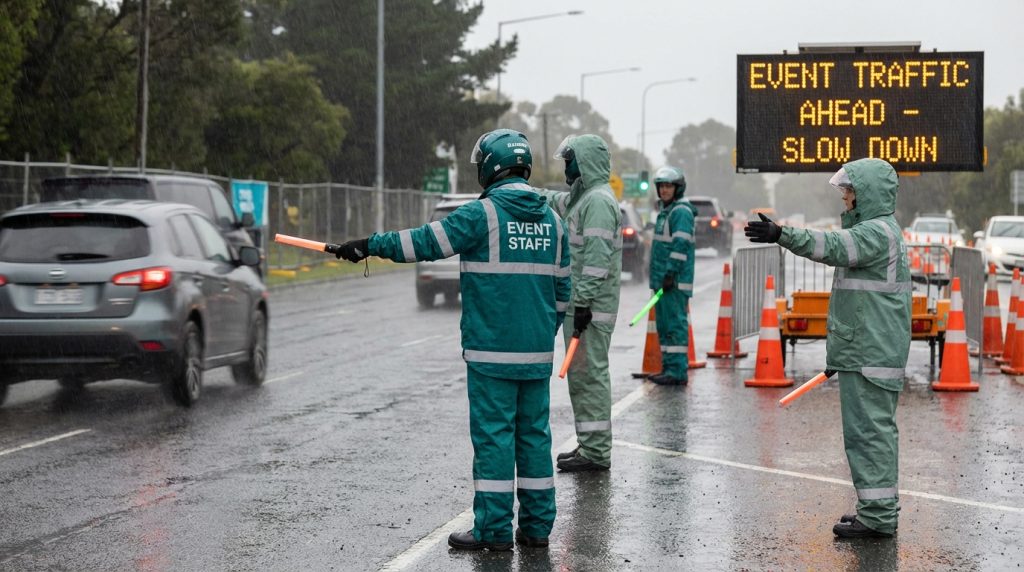
Thickness specifications (0.02mm vs 0.10mm) and seam strength become critical for workers moving equipment, setting up structures, or providing active crowd management. Lightweight materials tear easily under stress, creating both safety risks and replacement costs.
Active personnel require gear that allows full range of motion while maintaining weather protection. Flexible materials like EVA and soft PVC work better than rigid PE for active work environments.
Durability testing should include stress testing for common work activities: lifting, reaching, kneeling, and equipment manipulation. Materials that fail under these conditions create operational disruptions and safety hazards.
Workforce Protection: Ensuring Staff Continuity
Reducing Liability and Sickness in Event Staff
Staff attrition due to weather exposure represents significant operational risk. Event workers who become sick from weather exposure require replacement staffing, create scheduling complications, and increase liability exposure.
The cost calculation is straightforward: replacing one event staff member costs $150-300 in recruitment, training, and lost productivity. Providing adequate weather protection prevents these costs while maintaining service quality standards.
Liability insurance for outdoor events increasingly requires documented weather protection protocols. Insurers view inadequate staff protection as evidence of negligence, which can affect coverage terms and premium rates.
Specifying High-Visibility Rain Gear for Festival Staff and Volunteers
EN ISO 20471 standards for reflective strips and neon materials ensure staff visibility in adverse weather conditions. High-visibility requirements are critical for safety staff, crowd management personnel, and emergency response teams.
High-Visibility Standards:
- Reflective material: 0.20m² minimum on front, 0.13m² on back
- Fluorescent background: Class 2 or 3 material required
- Retroreflectivity: 330 cd/lux/m² minimum
- Water resistance: IPX3 minimum for outdoor work
- Color requirements: Yellow, orange, or red fluorescent
The Attendee Experience: Comfort vs. Cost
The Compact Solution: Logistics of Distribution
Storage volume per 1,000 units becomes a critical logistics factor. Individual packaging increases storage requirements but simplifies distribution. Bulk distribution reduces storage needs but requires on-site packaging or distribution infrastructure.
Compact packaging strategies maximize transportation efficiency while minimizing storage costs. The goal is balancing unit protection against logistical complexity.
Distribution logistics should consider attendee flow patterns, venue layout, and weather conditions. Pre-positioning inventory at strategic locations enables rapid distribution when weather conditions deteriorate.
Selecting Lightweight Pocket-Size Ponchos for Concert-Goers
Ball or card packaging works best for rapid handouts. Ball packaging offers superior water resistance and durability during storage, while card packaging provides better brand real estate and product information space.
Packaging Options Analysis:
- Ball packaging: 15mm compressed size, waterproof, fast deployment
- Card packaging: 20mm thickness, product information, slower deployment
- Poly bag: 10mm thickness, lowest cost, poor water resistance
- Box packaging: 30mm thickness, premium presentation, highest cost

User Experience: Breathability and Range of Motion
Ensuring the crowd can still dance, cheer, and enjoy the experience without overheating requires careful material selection. Breathable materials like EVA and treated PE maintain comfort while providing weather protection.
Range of motion testing should simulate common attendee behaviors: arm raising, dancing movements, photography poses, and crowd navigation. Materials that restrict movement create negative experiences and increased abandonment rates.
Temperature regulation becomes important for multi-hour events. While ponchos provide immediate weather protection, poor ventilation can create overheating issues that negate their benefits.
Material Science for Procurement Managers

EVA and PVC: The Reusable Souvenir Tier
Higher perceived value materials justify premium pricing for reusable rain gear. EVA and PVC materials offer superior durability, comfort, and aesthetic appeal that transforms functional weather protection into branded merchandise.
MOQ structures for premium materials differ significantly from commodity PE. Premium materials typically require minimum orders of 2,500-5,000 units versus 500-1,000 for PE, with longer lead times of 25-35 days versus 15-20 days.
The reusable tier creates different distribution strategies. Rather than mass distribution, these materials require retail-style presentation, quality packaging, and brand storytelling that justifies premium pricing.
Polyethylene (PE): The Cost-Effective Volume Choice
PE represents the optimal choice for single-use, high-volume events where cost minimization is paramount. PE materials offer excellent water resistance at the lowest unit cost, making them ideal for emergency situations and large-scale distribution.
The material science behind PE performance involves molecular structure optimization. Linear PE provides better tear resistance, while branched PE offers superior flexibility. Understanding these differences enables better procurement decisions for specific use cases.
PE’s environmental profile continues to improve with the development of bio-based and recyclable variants, though these premium materials require longer lead times and higher minimum order quantities.
EAV Model Table: Material Comparison
| Material Type | Durability | Transparency | Cost Profile | Best Use Case | Eco-Status |
|---|---|---|---|---|---|
| PE (Polyethylene) | Low (Single Use) | High to Opaque | Lowest | Stadiums, Emergency Kits | Recyclable |
| PLA / Cornstarch | Medium | Semi-Opaque | Medium-High | Eco-Festivals, Green Brands | 100% Compostable |
| PVC | High | Crystal Clear | Medium | Security Venues, VIPs | Recyclable (Harder) |
| EVA | Very High | Soft Matte | Premium | High-End Corporate Gifts | Non-Toxic, Durable |
Frequently Asked Questions
- Stock + simple logo: 7-10 days
- Custom production + simple logo: 15-18 days
- Custom production + complex printing: 20-25 days
- Rush orders (factory dependent): 10-14 days (20-40% premium)
- Temperature: 60-80°F ideal storage range
- Humidity: 40-60% relative humidity
- UV protection: Avoid direct sunlight exposure
- First-in-first-out rotation: Use older inventory first
- Quality inspection: Check for brittleness before distribution
- Emergency/Single-use: 0.02mm – 0.05mm (PE)
- Multi-use events: 0.08mm – 0.12mm (PVC/EVA blend)
- Reusable/Seasonal: 0.15mm – 0.25mm (EVA/PVC)
- Premium/Long-term: 0.25mm+ (EVA with additives)
- Basic PE (no customization): 1000-5,000 units
- Simple logo (1-2 colors): 1,000-2,500 units
- Complex printing: 2,500-5,000 units
- Premium materials (EVA): 50,00-10,000 units
- Packaging customization: 5,000-10,000 units
- Transparency: 85% minimum light transmission
- Material: High-clarity PE or PVC (no opaque materials)
- Thickness: 0.02mm-0.05mm (thicker materials may require additional screening)
- No metallic components, RFID-blocking materials, or hidden pockets
- Seam construction: Heat-sealed or ultrasonic welded (no metal staples)
- Certification: Venue-specific compliance documentation
Ready to Secure Your Event Against Weather?
Don’t wait for the 48-hour weather warning to realize you need reliable rain gear procurement. Our comprehensive bulk solutions provide the security, compliance, and branding power you need to protect your events and enhance your brand.
What You Get:
- ✓ 48-hour emergency procurement capability
- ✓ Stadium and security-compliant materials
- ✓ Custom branding and packaging options
- ✓ Sustainability solutions for eco-conscious events
- ✓ Volume pricing that scales with your needs
- ✓ Quality assurance and compliance documentation
[Link: Explore our Wholesale Festival Rain Poncho Collection Here]
Join hundreds of event planners who trust our rain gear solutions