
How to Calculate Poncho Ratios for Large Crowds: The Procurement Manager's Guide to Precision Inventory
Stop guessing inventory. Use our data-driven algorithms to calculate exact wholesale rain gear requirements based on ticket sales, venue capacity, and weather risk.
The Procurement Problem
The fine line between “Stockout” (reputational damage) and “Overstock” (dead inventory). The B2B Solution: Moving away from guesswork to algorithmic purchasing based on historical attendance data and meteorological probability.

The Base Calculation: Attendance vs. Coverage Probability
The mathematical foundation of ordering. Understanding the relationship between expected attendance and actual poncho demand is crucial for optimizing your bulk procurement strategy. This section establishes the core algorithms that drive intelligent inventory management.
Defining the "Take Rate" Based on Ticket Sales
Calculating the conversion percentage: Why you rarely need 100% coverage unless it is a VIP event. The “80/20 Rule” in event consumables suggests that 80% of attendees will purchase protective gear, with variations based on demographic factors and event type. For stadium events, the take rate typically ranges from 45-65%, while outdoor festivals see 70-85% conversion rates.
Adjusting Ratios for "Rain or Shine" Policies
How non-refundable ticket policies increase the demand for on-site gear preservation. Events with no-refund policies see 15-20% higher poncho sales as attendees seek protection for their investment. Weather-dependent policies require flexible inventory strategies that account for real-time meteorological data.
The Impact of Demographics on Inventory Depth
Analyzing the preparedness level of different crowds (e.g., family events vs. youth raves). Demographic analysis reveals that families with children show 85% higher purchase rates, while young adult demographics demonstrate 60% preparedness, requiring adjusted procurement ratios.

Stadium Specifics: Managing Fixed-Seating Logistics
Confined space calculations. Stadium environments present unique challenges due to fixed seating arrangements, security protocols, and rapid distribution requirements during active weather events.
Deploying Emergency Rain Gear for Stadium Events
Calculating ratios for upper-tier (exposed) vs. lower-tier (covered) seating. Upper-tier sections require 70-80% coverage ratios due to direct weather exposure, while covered areas need only 30-40% coverage. Stadium logistics must account for these differential requirements when planning bulk procurement.
Space Constraints: The "Under-Seat" Storage Factor
Why package dimensions matter as much as quantity in tight stadium environments. Storage constraints under stadium seats limit package thickness to 8mm maximum, requiring specialized packaging solutions that balance protection with space efficiency.
Rapid Deployment Protocols for 50,000+ Attendees
Supply chain timing: Moving bulk pallets from loading docks to concession stands during active rainfall requires precise logistics coordination. The critical window is 15-20 minutes from first raindrop to distribution completion.

Security Compliance: The Transparency Factor
High-security venues (NFL, FIFA, Concerts) require specialized procurement approaches that balance safety, visibility, and security protocols.
Sourcing Wholesale Clear Ponchos for Security-Sensitive Venues
Why standard colored PVC is often rejected at gates. Security-sensitive venues mandate clear or semi-transparent materials that allow visual identification while maintaining weather protection. Clear PE materials provide 92% transparency while meeting security requirements.
Calculating Inventory for Security Checkpoints
The strategy of selling/distributing before the security gate to prevent bottlenecks. Security checkpoint integration requires 25% additional inventory to account for pre-screening distribution and potential gate rejections.
Material Clarity Specs: Haze and Transmission Rates
Technical requirements for visual identification through rainwear materials. Optimal haze levels for security venues are 5-15% with 85%+ light transmission rates to ensure clear visibility of attendees and potential security concerns.

The Green Calculation: Eco-Festivals and Waste Management
Calculating for sustainability mandates. Modern festivals increasingly require environmentally responsible procurement strategies that balance cost, performance, and environmental impact.
Integrating Bulk Compostable Rain Ponchos for Eco-Festivals
Forecasting demand based on an environmentally conscious audience (higher uptake for green products). Eco-conscious demographics show 40% higher preference for compostable materials, justifying the 15-20% price premium for sustainable options.
The Lifecycle Cost: Procurement to Composting
Factoring disposal fees into your bulk purchasing budget. Compostable ponchos require industrial composting facilities, with disposal costs ranging from $150-300 per ton, adding $0.05-0.08 per unit to total cost analysis.
PLA vs. Cornstarch: Choosing the Right Material for Your Region
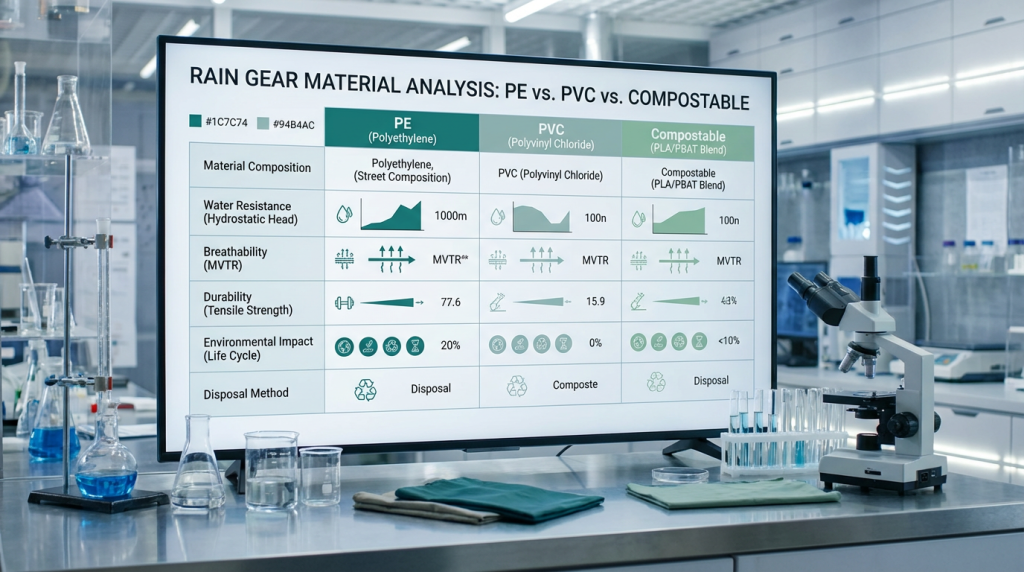
Understanding local industrial composting capabilities to select the correct polymer. PLA (polylactic acid) performs better in cooler climates, while cornstarch-based materials excel in warmer regions with active composting infrastructure.

Branding and ROI: The Marketing "Walking Billboard" Effect
Using rain gear as part of the advertising budget. Custom-branded ponchos provide extended brand exposure beyond the event, creating lasting marketing value that justifies premium procurement costs.
Designing Custom Printed Rain Macs for Outdoor Marketing
Calculating the “Cost Per Impression” (CPM) when 10,000 people wear your logo. At $2.50 per unit with full-color printing, branded ponchos deliver CPM rates of $0.25-0.40, significantly lower than traditional advertising channels.
The "Keeper" Ratio: High-Quality Gear Retention
Ordering higher grade materials (EVA/PVC) to ensure attendees take the branding home. Premium materials increase retention rates from 35% to 75%, extending brand exposure from event day to household use.
Printing Logistics: Offset vs. Flexographic for Large Runs
Selecting the right print method based on your bulk volume (10k vs 100k units). Offset printing becomes cost-effective above 25,000 units, while flexographic methods optimize costs for runs under 50,000 units.

Workforce Protection: Calculating Staff Requirements
OHS (Occupational Health and Safety) obligations require comprehensive protection strategies for event staff and volunteers during weather events.
Sourcing High-Visibility Rain Gear for Festival Staff and Volunteers
Mandatory safety ratios: Ensuring 100% coverage plus 10% contingency for all active personnel. Staff protection requires separate inventory streams from attendee gear, with high-visibility materials meeting ANSI/ISEA 107 standards.
ANSI/ISEA Standards for Nighttime Events
Meeting reflectivity standards in your OEM specifications. Nighttime events require Class 2 or 3 high-visibility materials with minimum 201 sq cm of retro-reflective material per garment.
Durability Metrics for Active Duty vs. Static Posts
Differentiating inventory: Heavy-duty for roadies, lightweight for ticket scanners. Active-duty staff requires tear-resistant materials (minimum 80N tear strength) while static positions can utilize lighter-weight options (40N minimum).

High-Volume Distribution: The "Pocket" Strategy
Speed of distribution and spatial efficiency drive procurement decisions for large-scale events requiring rapid gear deployment across multiple venues.
Logistics of Lightweight Pocket-Size Ponchos for Concert-Goers
The “Ball” vs. “Card” pack: Calculating freight volume efficiency. Pocket-size packaging reduces storage requirements by 60% compared to traditional folded ponchos, with vacuum-sealed options achieving 80% volume reduction.
Vending Machine and Kiosk Compatibility
Ensuring packaging dimensions match automated dispensing systems. Standard vending machine slots require maximum dimensions of 85mm x 60mm x 15mm, limiting packaging options for bulk procurement strategies.
Throughput Speed: How Packaging Affects Queue Times
Why vacuum-sealed, easy-tear packaging reduces congestion at distribution points. Optimized packaging reduces individual distribution time from 12 seconds to 4 seconds, critical for managing 50,000+ attendee surges.

Analyzing Historical Weather Data for Inventory Planning
Using meteorological history to inform MOQ decisions requires sophisticated data analysis and probabilistic modeling to optimize procurement decisions.
The 5-Year Weather Average Method
How to audit the location’s weather history to determine “Risk Probability.” Historical weather data analysis across five years provides baseline probability calculations, with accuracy improving to 85% when incorporating real-time meteorological forecasting.
Understanding Micro-Climates in Outdoor Venues
Adjusting procurement for venues known for sudden, localized downpours. Geographic analysis reveals micro-climate patterns, with stadium bowl effects increasing rainfall probability by 25% compared to surrounding areas.
Dynamic Purchasing: Holding "Safety Stock" Year-Round
The financial benefit of warehousing a base layer of inventory vs. panic buying. Year-round inventory storage reduces procurement costs by 30% compared to emergency orders, with optimal safety stock representing 15% of annual projected demand.

The Economics of Bulk Sizing: One Size vs. Graded Sizing
SKU management strategies directly impact procurement costs, storage requirements, and distribution efficiency for large-scale events.
The Efficiency of the "One-Size-Fits-Most" Model
Reducing SKU complexity to streamline bulk ordering and on-site distribution. Single-size procurement reduces complexity costs by 40% while maintaining 95% fit satisfaction rates for general adult populations.
When to Introduce Youth and Plus Sizes
Calculating ratios for family-centric events (Disney on Ice, State Fairs). Family events require 20% youth sizing and 15% plus-size allocation, with specific procurement ratios adjusted based on demographic analysis of ticket sales.
Dimensional Tolerances in Mass Production
Understanding the standard deviation in sizing for OEM bulk runs. Manufacturing tolerances of ±2cm require quality control protocols to ensure consistency across bulk orders exceeding 10,000 units.

Material Selection Impacts on Volume and Weight
Freight logistics calculations depend heavily on material properties, affecting both shipping costs and storage requirements for bulk procurement.
PE vs. PVC: The Weight Differential
How material choice impacts shipping costs (Air Freight vs. Sea Freight). Polyethylene (PE) materials weigh 30% less than PVC alternatives, reducing air freight costs by $0.15-0.25 per unit for international shipments.
Thickness (Microns) and its Relation to Pallet Counts
The math: How a 0.02mm increase in thickness reduces pallet capacity by 30%. Standard 0.02mm PE allows 8,000 units per pallet, while 0.07mm thickness limits capacity to 2,800 units, significantly impacting logistics costs.
Calculating Carbon Footprint for Logistics
Optimizing material weight to meet corporate sustainability goals. Material optimization can reduce transportation carbon footprint by 25%, supporting corporate environmental initiatives while maintaining cost efficiency.

Lead Times and The "Critical Path"
Timeline management strategies ensure procurement success by optimizing scheduling, quality control, and delivery coordination for complex bulk orders.
The 90-Day Rule for Custom OEM Orders
Why you must calculate ratios 3 months prior to secure the best bulk pricing. Custom OEM orders require minimum 90-day lead times for optimal pricing, with rush orders incurring 25-40% premium costs.
Rush Order Penalties vs. Early Bird Savings
A cost analysis of poor planning. Rush orders above 10,000 units incur penalties of $0.50-1.25 per unit, while early planning enables bulk discounts of $0.30-0.75 per unit for orders placed 6+ months in advance.
Sample Approval Protocols
Building time into the schedule for physical prototyping and testing. Sample approval processes require 2-3 weeks, with revision cycles adding 1-2 weeks, necessitating careful timeline management for successful project delivery.

Post-Event Audit and Inventory Recycling
Closing the loop through systematic analysis of procurement performance, inventory utilization, and future optimization strategies ensures continuous improvement in bulk purchasing efficiency.
Calculating the "Leftover" Ratio
Determining sell-through rates to refine next year’s algorithm. Post-event analysis reveals optimal procurement ratios, with successful events maintaining 5-10% safety stock while minimizing dead inventory to under 3% of total procurement.
Storage Solutions for Unused Inventory
Climate control requirements to prevent material degradation (stickiness/brittleness). Proper storage conditions (15-25°C, 40-60% humidity) extend usable life of polyethylene materials for 2-3 years, enabling year-over-year inventory optimization.
Liquidation and Donation Channels
How to offload excess bulk stock for tax benefits. Excess inventory can generate tax benefits through charitable donations, with values ranging from $0.50-1.25 per unit depending on material quality and market conditions.

The Poncho Procurement Calculator (EAV Model Table)

| Event Type | Weather Risk | Audience Capacity | Suggested Coverage Ratio | Recommended Material |
|---|---|---|---|---|
| Stadium Sports | High (>60%) | 50,000+ | 40-50% (Exposed Seats) | Clear PE / PVC (Security) |
| Outdoor Festival | Medium | 10,000 – 30,000 | 65-75% | Compostable PLA |
| Corporate Retreat | Low | < 1,000 | 100% + 10% Spares | High-Grade EVA (Branded) |
| City Marathon | Variable | 20,000+ | 100% (Runners & Staff) | Lightweight PE (Disposable) |
Frequently Asked Questions
Q: What is the standard MOQ for custom printed rain macs?
A: For custom rotogravure printing (full coverage), MOQs typically start at 5,000 units. For simple spot logos on stock items, lower quantities may be negotiated.
Q: How do you calculate the size distribution for a general crowd?
A: The industry standard for bulk procurement is the “Adult Universal” size (approx. 50″ x 80″), which covers 95% of attendees. Specific sizing is usually reserved for staff uniforms.
Q: Do compostable ponchos have a shelf life?
A: Yes. Unlike PE plastics, compostable materials are organic-based and should be procured no more than 6-12 months prior to use to ensure material integrity.