
Hiking and backpacking - Fit, coverage and purchasing decisions
Rain Ponchos for Hiking and Backpacking: Fit, Coverage and Packability
A hiking poncho has to work around the person, the loaded backpack and the route. This guide helps outdoor brands, tour operators and procurement teams compare coverage, movement, ventilation, construction and packability before approving a sample or a bulk order.
Build the selection around the actual adult user, loaded pack, activity and complete carrying kit.
From a hiking use brief to an approved rainwear kit
- 1. Define the activityIdentify adults, layers, route tasks and operating limits.
- 2. Load and fitReview actual pack geometry, hood, hem and movement.
- 3. Check evidence and kitMatch construction claims; review weight, pouch and care.
- 4. Resolve sample issuesRevise affected features and approve the final instructions.
- 5. Release and receiveAlign the sample, specification, quotation and incoming checks.
If fit, evidence or handling remains unresolved, return to the affected sample decision. A change in construction or intended use triggers review before release.
| Buying question | Useful evidence | Decision |
|---|---|---|
| Will it cover the intended load? | Loaded pack geometry and worn views | Approved wearer and pack combinations |
| Can users move and handle it? | Controlled fit, hood and access review | Suitable cut and instructions |
| What supports the rainwear claims? | Construction description and applicable reports | Accurate product wording |
| Will the kit work operationally? | Mass, pouch, care and distribution review | Complete project-specific supply brief |
01 / 12
Define the hiking use before choosing the poncho
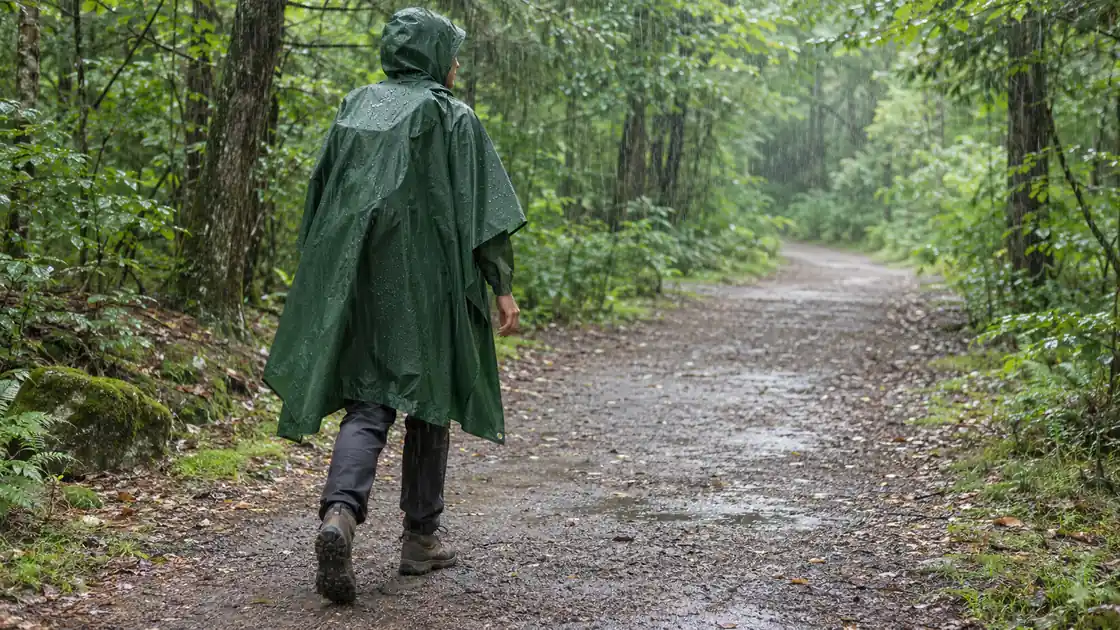
Separate day walks from backpacking requirements
A hiking poncho should be selected around a defined trip, rather than around the word outdoor on a product label. A guided walk on a maintained woodland path creates a different buying brief from an overnight journey with a loaded pack. Both users may encounter rain, but their carried equipment, opportunities to change clothing and access to shelter can differ substantially. For a business buying rainwear, the first useful question is who will wear it, with what equipment, during which part of the planned activity. That description becomes the starting point for the sample request.
For day walking, record the expected clothing layers, approximate pack configuration and how the garment will be issued. A tour operator might hand out individually packed ponchos before departure, while an outdoor retailer might supply a reusable garment that customers select themselves. The operator needs understandable instructions and a workable fitting process. The retailer needs a clear size description and honest product information. Neither should assume that a garment suitable for an unladen adult will provide the same coverage when worn over a daypack. Include the pack in the review even when it appears relatively small.
Backpacking adds another set of practical questions. The pack may extend above the shoulders, project behind the body and carry external items. The wearer may need to remove and replace the poncho several times without a convenient indoor drying space. A compact storage pouch matters, but so does the ability to retrieve the garment without unpacking sleeping equipment. Procurement should describe these handling requirements before comparing sample prices. A poncho that looks tidy when folded on a desk may still be awkward to deploy over the actual load or difficult to repack during an ordinary rest stop.
Keep primary rainwear and supplementary rainwear distinct in the brief. A small reserve poncho carried for an unexpected shower is a different proposition from a garment expected to be worn repeatedly throughout an itinerary. This distinction does not establish a performance rating by itself. It tells the supplier which questions need answering about fit, construction, care and repeated handling. Ask whether the proposed model is intended for the stated use and request the supporting product information. If the answer depends on a different fabric, hood or length, treat that as a separate proposal rather than an interchangeable substitute.
Consider a hypothetical walking company running short valley walks and longer overnight routes. It may initially ask for one poncho across both programs to simplify inventory. During the review, the company could find that the larger packs require another rear profile while the shorter users need less front length. The useful outcome is not an automatic two-product order. It is a documented decision about which combinations one design can serve, which require another size, and which are outside its intended use. Purchasing can then compare the real administrative benefit against the compromise in fit.
Write the final use statement in ordinary language that operations, product development and the supplier can all understand. Include adult user range, route type, likely carried configuration, expected wear pattern, distribution method and care arrangements. Avoid compressing the entire brief into labels such as expedition quality or professional grade. These phrases are difficult to inspect and can conceal different assumptions. A clear description makes later sample comments more useful: reviewers can explain whether a feature supports the agreed trip instead of debating whether a poncho feels generally suitable for hiking.
Turn route conditions into a purchasing brief
Route planning provides context for a rainwear purchase, but a poncho specification should not become a promise that a trip can proceed in any weather. Separate the product decision from the decision to undertake the activity. The National Park Service hiking safety guidance advises checking conditions, choosing an appropriate route and having an alternative when conditions are unsuitable. For a procurement team, the practical implication is to describe the intended operating conditions and the limits of the program. Rainwear remains one part of preparation; it does not replace route judgement, appropriate equipment or the operator's own procedures.
Begin with the physical tasks on the route. A broad path with ordinary walking movements differs from a route requiring frequent high steps, close contact with vegetation or extensive use of hands. These observations help identify what to examine in a controlled fitting trial. They are not an invitation to demonstrate the sample in hazardous terrain. If the activity includes technical climbing, exposed scrambling or specialized equipment, obtain competent activity-specific advice and use equipment designed for that purpose. Do not stretch a general recreational poncho brief until it implies suitability for every outdoor discipline.
Describe the expected weather exposure without inventing a universal numerical threshold. Buyers can record whether their program involves sheltered paths, open ground, repeated rainwear changes or extended periods away from buildings. The proposed garment should then be reviewed against that context and its manufacturer's limitations. A loose poncho can behave differently from a closer fitting jacket when air moves around it, but the exact response depends on its design and use. Ask for relevant limitations in writing rather than treating a dramatic product photograph as proof of performance in severe conditions.
Think about the points at which equipment is handled. Participants may put on rainwear beside a vehicle, at a sheltered trail junction or during a planned stop. The available space, assistance and time affect the value of a large opening, a simple closure and clearly marked orientation. A business can record these requirements without making a speed claim. For example, ask reviewers whether an adult can identify the front, place the garment over a representative pack and close it without pulling hard on the fabric. Record the steps that caused confusion so instructions or construction can be revised.
Bring the return journey into the brief as well. A wet garment may travel in a vehicle, enter accommodation or be returned to a rental store. Decide where it will be separated from dry stock and how the actual care instructions will be followed. This is an operating requirement rather than an environmental claim. A reusable product only becomes practical for a particular program when the organization has a workable process for checking, cleaning, drying and storing it. If there is no such process, identify that gap before purchasing a larger quantity and assigning responsibility later.
The completed route brief should be short enough to accompany a quotation request. State the intended recreational setting, representative user and pack combinations, necessary handling tasks, expected care arrangements and any excluded activities. Let the supplier identify which proposed construction meets that brief and which details remain to be confirmed. When a route or operating model changes, revisit the affected decisions. A larger load, a different user group or a more demanding activity may require another fitting review even if the garment's material and commercial description remain exactly the same.
Define what best means for your intended users
The phrase best hiking poncho is useful only when the comparison criteria are visible. A garment that packs into a convenient pocket may not provide the preferred coverage for a tall wearer with a large load. A generous cut may suit one backpack configuration while creating unnecessary fabric for another. Instead of looking for a universal winner, define a small set of requirements and compare actual samples against them. This gives procurement teams a defensible selection process and helps customer-facing teams explain the product without promising a result that depends on circumstances they have not reviewed.
Start by separating essential requirements from preferences. Essential requirements are conditions that a sample must meet before it can be considered for the project. They might include an agreed adult size range, acceptable walking clearance, usable hood adjustment and documented construction. Preferences might concern color, pouch shape or the position of an optional logo. The exact list belongs to the buyer's program. Do not assign a high total score to a sample that misses an essential condition simply because it performs well on several cosmetic preferences. A scoring sheet should make unresolved limitations visible rather than hide them inside an average.
Use observable questions instead of vague adjectives. Replace comfortable with questions about where the garment pulls, whether the hood moves as the wearer turns and whether the user can reach the intended closure. Replace packable with the complete kit dimensions after the agreed packing method. Replace good coverage with the observed positions of the front and rear edges over a specified load. These observations do not turn a fitting exercise into a laboratory test. They make the sample discussion repeatable enough for a buyer to distinguish a construction problem from a difference in reviewer expectations.
Keep the weighting appropriate to the actual audience. A promotional outdoor event may place value on clear branding and simple distribution, while a specialist retailer may place more emphasis on documented construction, fit choices and care information. Both still need accurate claims and a suitable product. Avoid borrowing another organization's priorities without examining its use case. An online comparison can suggest questions to ask, but it cannot confirm that the reviewed model, production revision or intended conditions match the item being quoted for your order. Treat recommendations as starting points for enquiry, not substitutes for evidence.
When customers search for the best poncho for hiking, a useful answer explains the decision rather than repeating the phrase as a slogan. Show how backpack coverage, walking movement, ventilation, material evidence and packed size interact. A buyer may reasonably accept a little more packed volume to obtain easier handling, or choose another rainwear system when a loose cut does not suit the activity. Document the tradeoff in plain language. This approach supports honest product positioning and reduces the risk that a short marketing claim is interpreted as an all-weather or all-user guarantee.
Finish the comparison with a reasoned selection note. Identify the approved sample, the user and load combinations reviewed, the evidence considered and the remaining operating limitations. If two proposals serve different purposes, preserve that distinction in the product names and stock records. Do not merge them into one generic description merely because both are called trekking ponchos. A good selection record allows a future colleague to understand why the item was chosen and what would trigger a new review. That is more valuable to a purchasing program than an unsupported claim that one design is best for everyone.
Compare the wider options in the rain poncho types, materials and uses guide.
02 / 12
Measure coverage with the backpack actually loaded
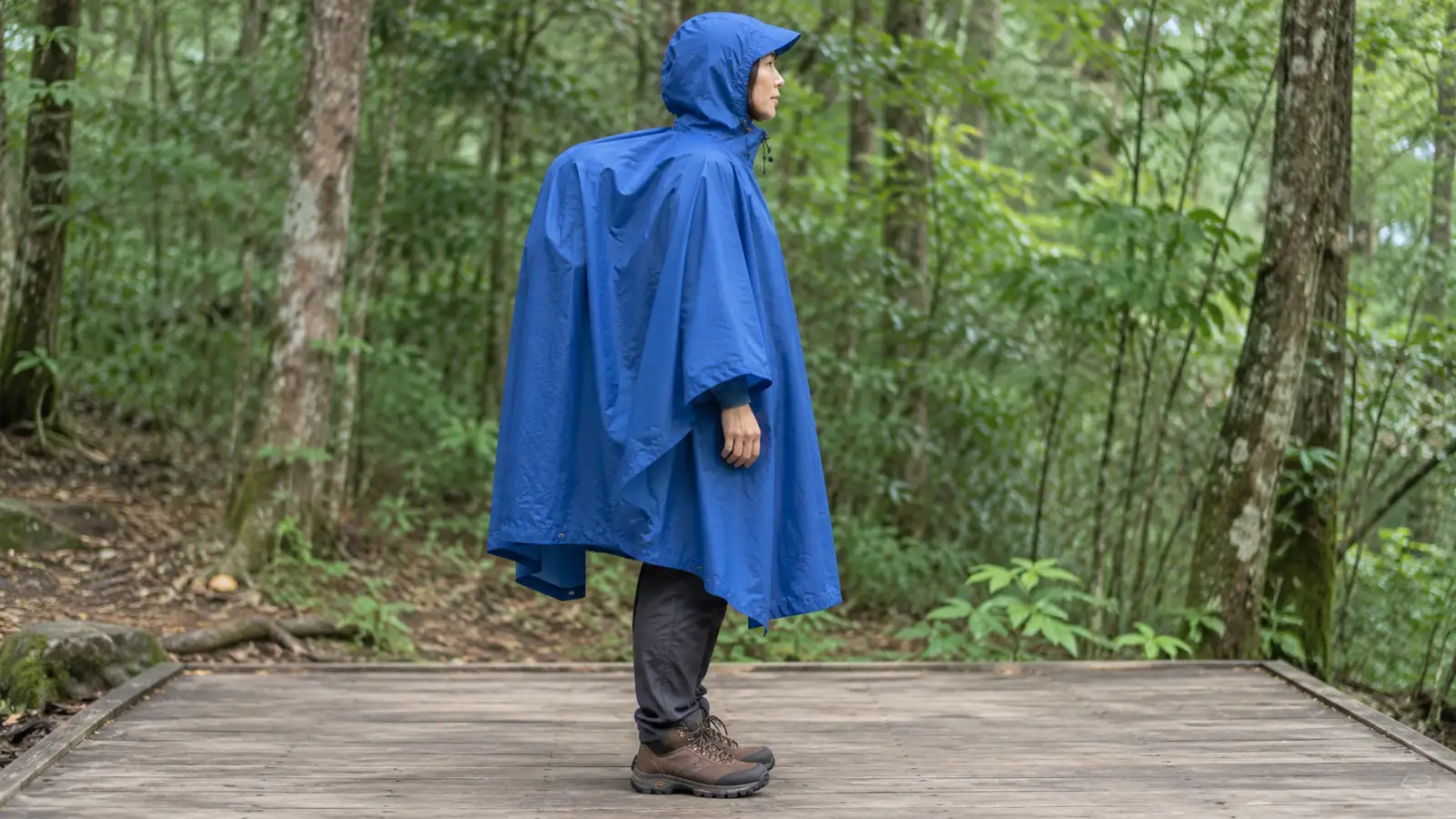
Compare pack shape instead of relying on volume labels
Backpack capacity is an incomplete guide to poncho fit. A volume label describes storage capacity, while the poncho must drape over an external shape. Two packs carrying similar amounts can differ in height, width, depth and the position of their contents. A rigid frame, a raised lid or an item attached outside can change that shape further. Ask for the proposed poncho dimensions and examine the garment with representative loaded packs. Do not approve a coverage statement solely because a supplier associates the product with a particular capacity range in litres.
Prepare the pack as it will normally be carried. Close the main compartment, adjust the straps and place usual external items in their intended positions. An empty pack can collapse and make a marginal fit appear generous. Record the packed height, widest point and rear projection using an agreed method, with photographs or a simple drawing showing the measurement points. The purpose is to describe the test configuration, not to produce a universal conversion between pack dimensions and poncho size. A later change in how the load is carried can alter the result even when the nominal capacity remains unchanged.
Fit the pack to the adult wearer before adding the poncho. Shoulder and hip adjustments affect where the load sits and how the garment crosses it. Then place the poncho in its intended orientation, using any pack extension or adjustment only as instructed for that model. Check whether the fabric rests naturally across the top and rear or is pulled taut between contact points. Look at side coverage as well as the rear view. A garment can cover the center of a pack in a photograph while leaving the sides or lower corners exposed when the wearer moves normally.
A longer rear panel is one possible design approach, but it is not a feature shared by every poncho. Sea to Summit's guidance describes an asymmetric cut on its named tarp ponchos to accommodate a backpack. That manufacturer example illustrates why front and rear measurements should be distinguished. It does not establish the dimensions or capability of another supplier's model. For a wholesale proposal, ask which panel provides the extra coverage, how it is measured and whether any adjustment changes the front length. Confirm those details on the actual sample rather than inferring them from a similar silhouette.
Use more than one representative load when the program serves different trips. A compact daypack, a taller overnight pack and a pack with an external sleeping mat may require different observations. Select configurations that reflect real intended users instead of constructing an extreme combination merely to create an impressive claim. Record which combinations were reviewed and which were not. If the garment cannot serve part of the intended range, discuss another size or another rainwear arrangement. Avoid solving every mismatch by adding more length, because that can create a different problem for shorter users and unloaded use.
The useful purchasing output is a coverage matrix tied to specific sample references. Each row can identify the wearer range, pack configuration, garment size and observed limitations. Attach photographs that show the same front, side and rear views for each combination. Keep these as review evidence, with permission from any identifiable participants, rather than advertising proof of universal fit. The supplier can then discuss a defined geometry problem, and the receiving team has a reference for later checks. A statement such as reviewed with the agreed loaded pack is much more precise than fits all backpacks.
Check front and rear hem positions together
The lower edge of a hiking poncho has two competing jobs: provide useful coverage and remain clear of movement. Buyers should review its position at the front, sides and rear as a connected system. Adding a pack under the back can raise or redistribute the garment, while a change in the shoulder position can affect the front. A flat overall length does not reveal every part of that relationship. Inspect the worn sample and record where each edge falls relative to the wearer and the loaded equipment, using a consistent stance before beginning a movement review.
Begin with the adult standing upright on a level surface in the clothing and footwear intended for the fitting. Note the front edge, the longest side points and the rear edge below the pack. Check whether any part contacts the ground or sits where a normal step could catch it. Do not use a single preferred hem height as a universal rule for all users and routes. Instead, agree practical clearance requirements for the project and have a competent reviewer assess the relevant movements. The garment should not need continuous hand support just to keep fabric away from the wearer's feet.
Then compare the loaded and unloaded configurations if both are intended uses. A model that drapes neatly over a large pack may hang much lower when the pack is removed. Some designs offer a way to manage extra rear length; others do not. Use only the adjustment intended for that garment, and assess it as part of the sample. Improvised knots or attachments can change the behavior of the fabric and should not become an unexamined solution in customer instructions. If the model requires the pack to achieve its intended fit, make that limitation clear in the purchasing decision.
Observe ordinary movement in a controlled area. A comfortable standing photograph can conceal a front edge that catches the knee during a step, a side corner that swings toward a boot or a rear section that moves against external equipment. Ask the wearer to stop if anything interferes. Record the location and the circumstances instead of reducing the finding to too long. The supplier may need to change the cut, the size choice or a closure position. A specific description helps distinguish a general size mismatch from an isolated construction detail that can be revised and reviewed again.
For a hypothetical adult walking program, the tallest participant and the shortest participant may expose different weaknesses in the same sample. The taller wearer could have less lower-body coverage, while the shorter wearer could have too much loose length. The purchasing team should not treat these findings as contradictory. They describe the boundaries of one cut. Compare another size or another product before assuming that a single broad size claim is necessary for inventory simplicity. Fewer stock codes have an administrative benefit only when the resulting fit remains acceptable for the intended population and equipment combinations.
Carry the agreed measurement points into the specification. State whether length is measured from a shoulder reference, the neck opening or another clearly illustrated point, and whether the hood is excluded. Distinguish front and rear values where appropriate and agree tolerances with the supplier. Include the garment condition during measurement, such as laid flat without stretching. This helps prevent a later shipment from being accepted against an ambiguous overall dimension. The written drawing, approved sample and worn-fit observations should tell the same story about coverage and clearance; none should be treated as a substitute for the others.
Protect critical contents with a separate packing plan
Covering a backpack with a poncho does not automatically make every item inside that backpack protected from water. Openings, movement, handling and the pack's own construction all influence what happens to its contents. A buyer should therefore separate outer coverage from the internal packing plan. Describe which items need additional protection and select storage products suitable for those items and the intended conditions. Do not turn a poncho's broad coverage claim into an assurance about electronics, spare clothing or sleeping equipment that has not been assessed as part of the complete carrying system.
Map the contents according to access and consequence. Frequently used items may need to remain reachable, while spare clothing or other sensitive contents may be packed deeper inside an appropriate protective container. The exact arrangement belongs to the user or operator, but procurement can ensure the rainwear does not make the agreed arrangement impractical. For example, if a guide needs regular access to a side pocket, the poncho review should include that action while stationary. Lifting a large section of fabric repeatedly can change coverage and may require a different storage arrangement rather than a change to the poncho alone.
Review how the pack is handled when the garment is removed. A user may set down a covered pack, remove the poncho and then open the main compartment. Water on the outer fabric or the ground can become a separate handling issue. The goal is not to claim that a particular sequence eliminates all moisture. It is to identify practical points where dry and wet equipment should be kept apart. Include a simple instruction to follow the care and use guidance for both the rainwear and the pack protection products, rather than improvising a universal method for every construction.
Keep pack-cover claims distinct from immersion claims. A garment draped over a pack is not evidence that the assembled system is suitable for submersion, river crossings or water sports. Similarly, a pouch supplied with a poncho may be a storage accessory rather than a waterproof container. Ask the supplier to identify the pouch's intended function and any supported performance description. If the buyer needs a separate protective liner or bag, specify it separately and review its documentation. This prevents the convenience of a bundled kit from blurring the limits of each component in customer-facing instructions.
Consider a hypothetical tour business that issues ponchos together with a packing checklist. Its staff might confirm that participants have a suitable place for dry spare layers and know where the rainwear is stored. The company can rehearse retrieval and repacking in an ordinary indoor session, noting whether the poncho obstructs access to the chosen compartment. These are operational observations, not claims of waterproof certification. They can still reveal a poor kit arrangement before the group departs. The resulting improvement may be as simple as moving the poncho to an accessible pocket or clarifying which pouch is for temporary wet storage.
Document the final responsibility boundaries. The poncho specification should describe the garment and the reviewed pack coverage. The packing instructions should describe how users protect and access their contents using suitable equipment. The trip plan should address the wider activity and conditions. Keeping these documents connected but distinct helps a business answer questions honestly. It also gives customer support a clearer starting point if something becomes wet: the team can investigate the garment, the pack, the internal storage and the handling sequence instead of assuming that every moisture report proves the same type of product failure.
Review construction choices alongside the nylon and ripstop poncho guide.
03 / 12
Check the hood and garment fit as one system

Adjust the hood without losing a useful field of view
A hood needs to be reviewed on a moving person, not only on a hanger. The opening, crown volume, brim and adjustment positions affect how the garment sits around the face. Begin with the wearer standing still and the poncho correctly positioned over the intended layers and pack. Ask whether the front edge stays above the eyes without the wearer holding it. An adjustment that makes the hood feel secure but pulls the garment awkwardly across the shoulders may indicate a fit problem elsewhere. Treat the hood and the main body as connected parts of the same design.
Use the manufacturer's intended adjustment method and check that it is understandable. Some designs use cords, tabs or simple fixed shapes; their suitability should be assessed on the actual sample. A reviewer should be able to identify the adjustment without guessing which piece of fabric to pull. Examine loose ends and the way hardware rests near the face. Avoid inventing modifications such as extra cord loops or improvised attachments. If the supplied method cannot provide the needed fit, ask for a revised construction or another size and review that version before approving any customer instructions.
After the standing adjustment, ask the wearer to turn the head normally while remaining in a safe controlled space. Observe whether the hood follows the movement or stays in place while the face turns inside it. Check ordinary downward and sideways viewing, including seeing the area immediately ahead of the feet. Do not require exaggerated neck movements or claim a formal field-of-view result from this informal exercise. Record specific observations, such as the brim dropping during a turn or the side panel brushing across glasses. These descriptions give the supplier something concrete to address.
Include accessories only when they form part of the intended use. A cap, glasses or a warm hat can change how a hood sits. Review the combinations that the product description is expected to cover, and keep their identity in the fitting notes. Do not infer compatibility with protective helmets or specialist equipment from a roomy hood. Such uses require their own competent assessment and product-specific evidence. For an ordinary adult hiking program, a modest review of common clothing combinations is more useful than a broad compatibility claim that has not been demonstrated on the proposed garment.
Examine how the hood interacts with the upper pack. A tall load may press into the rear of the hood or pull the neck area as the wearer looks down. The solution may involve pack arrangement, garment geometry or a different size, rather than simply tightening the face opening. Ask the reviewer to describe where the pressure occurs and whether it changes after normal shoulder movements. Photograph the relevant contact points with permission, keeping private fitting records separate from marketing images. An image of a hood from the front cannot establish how it behaves against the loaded pack behind it.
For the final specification, identify the hood construction and the adjustment features that were actually approved. Include reference photographs, relevant dimensions and an instruction drawing where needed. If the supplier later proposes a different toggle, brim stiffness or panel shape, ask whether the change affects the review findings. A hood is a small portion of the garment's material but a significant part of daily handling. Protecting its approved details helps keep the delivered product consistent with the sample, while clear limitations prevent a comfortable fitting result from becoming an unsupported claim about every wearer and activity.
Allow room for layers without accepting excess loose fabric
A poncho's generous shape can make fit appear simple, but room for clothing and room for a pack are different requirements. The buyer should identify both before selecting dimensions. A thin shirt under a sample may leave ample space that disappears when the intended mid-layer and backpack are added. Conversely, a garment chosen around the bulkiest configuration may hang unnecessarily low or wide during lighter use. The fitting process should examine the combinations that matter to the program and decide whether one cut can serve them without creating avoidable handling problems.
Prepare a clothing schedule for the sample review. It does not need to prescribe every brand or garment. Describe the layer types and approximate bulk that represent actual use, then record what each participant wore during the fitting. Keep the pack adjustment consistent when comparing samples. If one model is reviewed over a light top and another over a thick jacket, the observations are difficult to interpret. A simple record of clothing and load configuration allows the team to explain why a difference occurred and prevents a comfort comment from being detached from the conditions that produced it.
Check the shoulder area, chest opening and arm access separately. Loose fabric at the sides does not prove that the neck opening or upper back has adequate room. A poncho can look broad while pulling across the shoulders when the wearer reaches forward. Ask reviewers to make normal low-risk movements and identify localized tension. Look for changes in hood position and front hem height during those movements. The aim is to discover whether the cut permits the intended activity, not to force the garment into extreme positions or to create a numerical stretch claim without a defined method.
Excess material deserves an equally specific review. Note where unused fabric gathers, whether it interferes with a closure and whether it must be held out of the way. Do not assume that more coverage always improves the product. A larger panel can change movement, access and packing even if it provides additional drape at rest. Discuss the reason for each proposed dimension with the supplier. If the design is intended to cover a pack, ask how that extra allowance is managed when the pack is smaller or removed. A practical explanation should accompany the size drawing.
A hypothetical outdoor brand might compare a broad single-size poncho with two more defined size options. The single-size version could simplify purchasing and allocation, while the alternatives could better serve the lower and upper ends of the adult fitting range. Evaluate the real number of combinations the business expects to supply, the clarity of size selection and the handling burden of additional stock. Do not present either approach as automatically superior. The decision should follow observed fit and the operating model, with unsupported one-size-fits-all wording removed from the final product copy if it cannot be justified.
Record the approved layer allowance as part of the intended-use description rather than as a vague comfort promise. Where dimensions are specified, show the measurement points and the garment condition. Where observations are used, identify the wearer, clothing category and pack configuration without collecting unnecessary personal data. This combination gives the supplier a usable target and helps staff explain the product accurately. It also creates a clear trigger for review: introducing substantially bulkier clothing, a different pack profile or a new audience should lead to another fitting assessment before the original size description is reused unchanged.
Build an inclusive adult fitting review
A sample fitted to one member of the buying team cannot represent the entire adult audience. Height, shoulder breadth, body shape, reach and the equipment carried all affect how a poncho behaves. An inclusive review starts by describing the intended user range and then selecting willing adult participants who represent relevant differences. The purpose is product assessment, not an evaluation of the people involved. Explain the activities, collect only information needed for the fitting and make it easy for participants to stop or decline a movement that is uncomfortable or unsuitable for them.
Plan the review around practical needs rather than assumptions about demographic labels. Two adults of similar height can have different reach or torso proportions, and people may use different ways of putting on a garment. Ask about the tasks the poncho needs to support, such as closing side fasteners, adjusting the hood or reaching an accessible pocket while stationary. Where a program serves people with particular mobility or dexterity needs, involve appropriate users and competent advisers. Do not claim universal accessibility from an informal sample session or assume that a larger opening resolves every handling difficulty.
Give each participant the same basic instructions and the opportunity to describe what happened. A reviewer who already knows the product may overlook a confusing orientation that a new user notices immediately. Begin with an unaided inspection when appropriate, then provide the proposed instructions and observe whether they resolve the confusion. This distinguishes an instruction problem from a construction problem. Record the action that was difficult and the point at which assistance became necessary. Avoid reducing feedback to a general satisfaction score when a specific closure, label or size choice can be improved.
Keep privacy proportionate to the task. Anonymous participant codes, broad fitting categories and equipment descriptions are often enough for a procurement record. If photographs are useful, obtain permission and define how they will be used and stored. Do not reuse internal fitting photographs as customer endorsements without separate authorization. The buying decision can be well documented without exposing names, health information or detailed personal measurements to everyone in the supply chain. Share only the product-related observations and measurement ranges necessary for the supplier to understand the requested revision.
Review allocation as well as garment fit. A product can have suitable size options but still be difficult to distribute if the pouch labels do not distinguish them clearly. For a guided adult group, staff need a straightforward way to identify the correct model and explain adjustments. For a retailer, the size description should help customers choose without relying on a dramatic photograph. Test whether the approved size names, drawings and instructions agree. If a participant receives an unsuitable size because the label is ambiguous, treat that as a kit problem rather than dismissing it as user error.
Conclude with the boundaries of the evidence. List the adult configurations reviewed, unresolved needs and any uses that require a different product or specialist assessment. This guide does not extend an adult sample decision to children's rainwear, for which design and safety questions can differ. Keep the approved range visible in the commercial brief and customer information. An inclusive process is useful when it changes decisions: it can support another size, clearer instructions or a different closure. It should not become a decorative claim that the product suits everyone simply because several people tried it on.
Connect fit with repeat-use needs in the reusable rain poncho selection guide.
04 / 12
Test walking movement and access to equipment
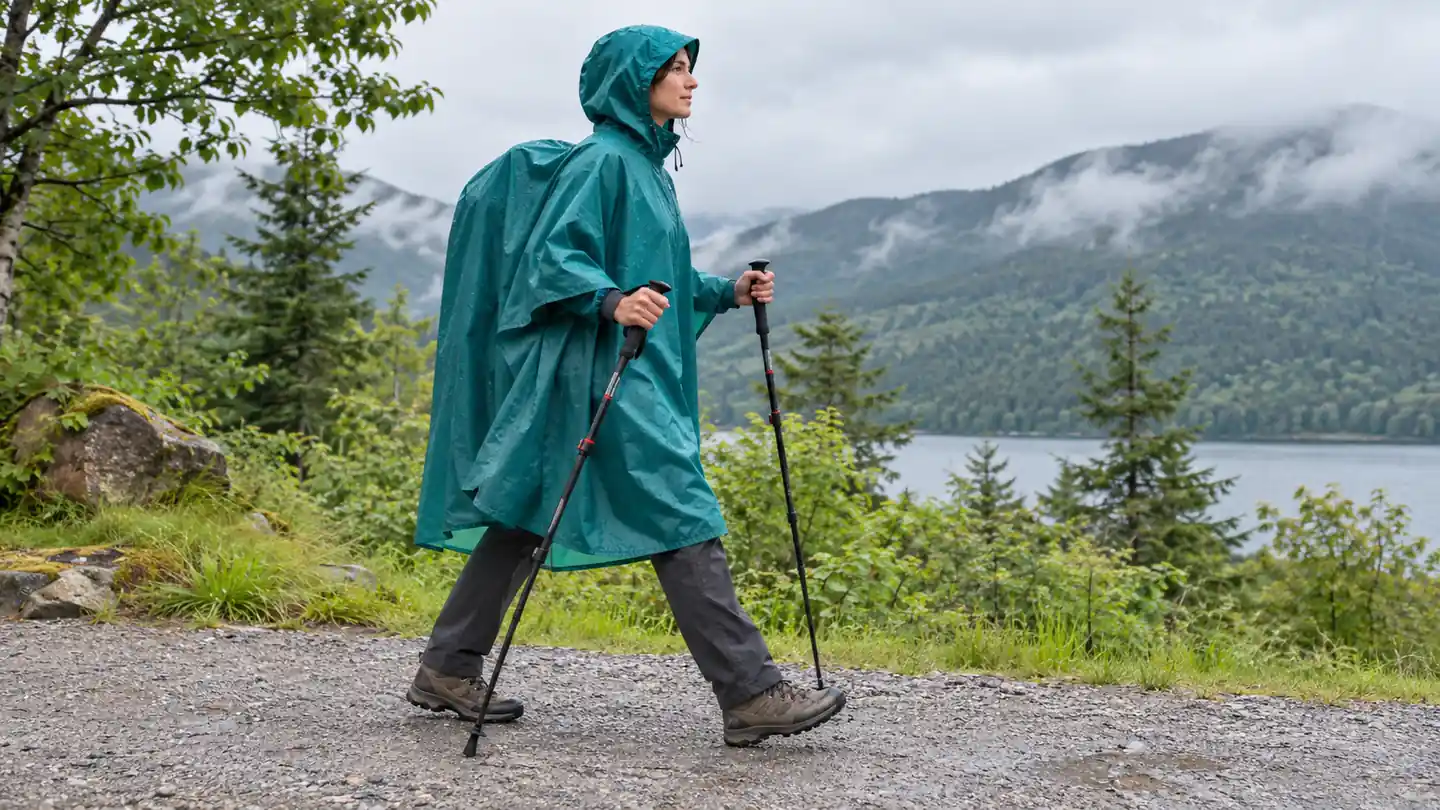
Observe stride and step clearance in a controlled trial
Walking clearance is easiest to assess when the review has a defined purpose and a safe setting. Start on a dry, level, unobstructed surface with the intended footwear, clothing and loaded pack. Confirm the standing fit first, then ask the adult wearer to take ordinary steps at a comfortable pace. A procurement review should never require someone to tolerate an obvious snag or continue after fabric interferes with movement. Stop, note the problem and adjust the review plan. The objective is to identify design limitations before purchase, not to prove toughness through an unnecessarily demanding demonstration.
Observe the front edge as the knee moves forward and the side corners as the legs pass beneath them. Look for fabric that enters the step path, catches on footwear or needs to be lifted by hand. Also note whether the rear panel pulls the garment backward and changes the hood position. These findings are more useful when described by location and action. For example, a note that the left side corner contacted the boot during a normal turn points toward a specific fit issue. A general statement that the poncho felt awkward gives the supplier much less information.
If the intended use includes ordinary steps or modest changes in level, have a competent reviewer decide how to represent them safely. Use a controlled environment with appropriate support rather than taking an unapproved sample onto a challenging trail. The wearer should be free to decline any action. Do not introduce climbing, jumping or technical movements merely because the garment is intended for hiking. Those activities create different equipment questions and can make a simple fitting review misleading. Keep the task close to the intended use while respecting the limits of what an informal review can establish.
Compare loaded and lighter configurations where both are in scope. The same poncho may drape differently when the pack is full, partly loaded or absent. Ask whether the wearer can turn and stop normally in each approved configuration without catching loose material. Keep a simple sequence so reviewers can compare samples consistently, but avoid treating repetition counts as a formal durability standard. A short handling session provides observations about fit and usability. It does not predict a service life or prove performance under every possible combination of weather, terrain and user behavior.
Record the changes that improve a finding. If selecting a different size resolves the front clearance issue, note whether pack coverage remains acceptable. If closing a side fastener changes the drape, check that arm access and ventilation choices still suit the use. Solving one problem can expose another, so evaluate the revised configuration as a whole. Do not approve an improvised workaround that the supplier has not designed or supported. A product intended for public distribution should have a clear, repeatable setup that staff can explain and users can follow without special knowledge of the sample session.
Carry the result into the release decision with appropriate language. State that the approved sample was reviewed for the specified adult walking tasks and describe any limits. Avoid calling the exercise a certified mobility test or using it to claim that the garment prevents falls. A buyer can still make a useful decision from carefully recorded observations. The key is to preserve the relationship between the exact sample, the equipment configuration and the tasks performed, so later dimensional or construction changes can be checked against the reasons the original version was accepted.
Check pole use and hand access without adding hazards
Trekking poles change the positions of the hands and forearms relative to a poncho's openings. A garment that feels roomy with the arms at rest may pull or lift when the user reaches for a pole grip. Review this interaction in a controlled space using the intended equipment and normal technique. Keep the poles under control, provide adequate room and stop if fabric catches or movement becomes awkward. The review concerns garment access and interference; it is not instruction in pole technique and should not be presented as proof that a particular setup is safe on every route.
Inspect where the hands emerge from the poncho and how much material moves with them. Side snaps, sleeves or open panels can create different arrangements. Ask whether the wearer can use the intended grip without pulling the hood forward or raising the front excessively. Notice where rainwear ends around the forearm, because a broad torso cover does not necessarily cover every part of the arm during movement. Describe the coverage observed rather than assuming that a photograph of a stationary model establishes protection while using equipment. The product information should reflect the actual design and reviewed activity.
Check common stationary tasks separately from walking. These might include opening a reachable pocket, reading a map, adjusting a pack strap or handling a water bottle. Have the wearer stop in a safe place before reviewing access. It is unnecessary to combine movement and fine handling to create a more impressive demonstration. Record whether the garment must be lifted or opened and which areas become exposed during that action. The resulting information can help the buyer decide where frequently used items belong or whether another garment arrangement would be more practical for the intended program.
Avoid modifying the garment to force compatibility with equipment. Attaching fabric to poles, tying extra loops around wrists or routing cords through unrelated hardware can introduce new interactions that were not part of the design. If the supplied openings do not serve the intended task, ask the manufacturer about a supported alternative. A closer fitting shell, another poncho cut or a different storage arrangement may be more suitable. Procurement should not turn a one-off improvisation during a fitting into an instruction issued to a large group without a proper assessment of that arrangement.
Consider the information needs of guides and distribution staff. They should know which garment features are adjustable and which are not, and how to recognize an unsuitable fit before departure. A short orientation can show the intended arm opening and closure positions without making technical promises. If participants use different equipment, provide a way to identify combinations that have not been reviewed. A hypothetical tour company might keep an alternative rainwear option available for users whose equipment does not work comfortably with the selected poncho. That is an operational choice to evaluate, not an assumed supplier service.
Summarize access findings by task rather than by a single comfort rating. Record pole handling, stationary pocket access, hood adjustment and pack-strap access as separate observations. Note the garment size, closure setting and representative pack for each. This helps the supplier understand whether a proposed change affects only one interaction or the whole fit. It also supports more accurate customer copy: the business can describe the actual openings and adjustment features without claiming unrestricted movement or complete coverage during every action a hiker might perform outdoors.
Review donning and removal before the trip
Putting on a poncho over a loaded pack is a handling task worth reviewing before the product reaches users. The garment may be stored tightly, the front and back may look similar and the pack may obstruct the rear panel. A sample that is easy to arrange on a mannequin can still confuse a first-time wearer. Start with the complete packed kit and the proposed instructions, not with a garment already unfolded by the product team. Observe how an adult identifies the opening, finds the intended orientation and places the fabric without forcing it across equipment.
Carry out the review while stationary in a clear, stable area. The wearer should have enough space and appropriate assistance if needed. There is no benefit in trying to simulate a hurried roadside or exposed-trail change during a procurement session. Instead, note the steps that would become inconvenient under ordinary use: a tiny label, a pouch opening that grips the fabric, a hood that is hard to locate or a rear panel that catches on an external pack item. These are actionable findings that can lead to better instructions, a different packing method or a revised garment detail.
Check whether the intended sequence requires the pack to be removed. Some users may prefer to place the poncho over an already worn pack, while a particular design or load may be easier to arrange another way. Follow the product's instructions and record the method reviewed. Do not promise one-handed deployment or independent use unless the actual construction and intended audience support that statement. If assistance is expected in a guided program, make that part of the operating plan. If the garment is sold for individual use, consider whether the instructions accurately communicate the required handling.
Removal deserves equal attention because the outside may be wet while the clothing beneath is intended to remain dry. Review how the wearer releases closures and lifts or folds the garment without pulling on vulnerable seams or hardware. A dry rehearsal can reveal confusing steps before a later controlled wet-handling review is considered. The buyer should not invent a universal folding technique for every fabric and coating. Ask for construction-specific use and care guidance and check that the proposed method does not conflict with it. Keep the resulting instructions clear enough to follow without an expert demonstration.
Evaluate the pouch and garment as one package. A narrow storage opening can make removal difficult, while a detached accessory can be misplaced during handling. Decide which components should remain together and how users identify the correct pouch after a group activity. Any attachment feature should be part of the approved design rather than an improvised cord. For a hypothetical rental program, a simple matching identifier on the garment record and pouch inventory may support returns. Such a system should avoid unnecessary personal information and should be tested for administrative clarity before it is applied across the stock.
The final instruction review should include someone who did not help develop the product. Give that person the kit and the approved written or visual instructions, then record remaining questions. Revise unclear wording and repeat only the affected steps. This is a useful check on communication, not a guarantee that every user will act identically. Preserve the instruction revision alongside the sample reference and packaging artwork. When the garment opening, pouch or closure arrangement changes, review the instructions again so the delivered kit does not contain guidance for an earlier version of the product.
Compare the garment shape with the existing nylon rain poncho category and request current model-specific details.
05 / 12
Distinguish ventilation from fabric breathability
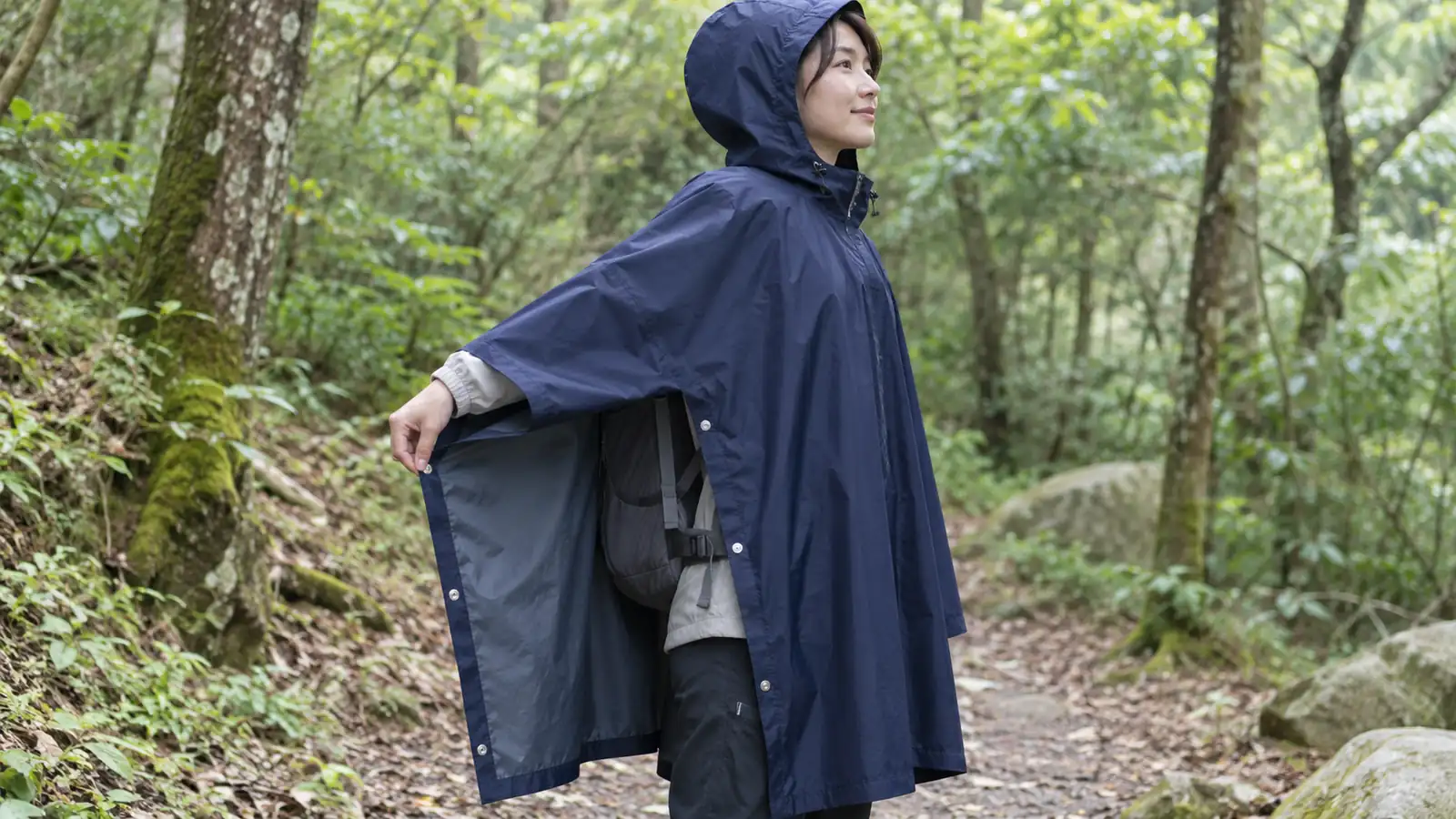
Describe airflow through openings accurately
Ventilation and fabric breathability describe different aspects of a rainwear system. A poncho can allow air to move through its open sides or lower edge even when the material itself has no supported breathability claim. Buyers should keep those statements separate in the specification and marketing copy. Ask what the garment's openings do, what the fabric supplier claims about the material and which evidence supports each description. A loose shape is an observable design feature. It is not, by itself, a measured water-vapor performance result or a guarantee that every wearer will remain comfortable during activity.
The distinction is visible in manufacturer information for specific products. Sea to Summit describes the fabric of its Nylon Tarp Poncho as nonbreathable while discussing ventilation through the poncho design. That is a useful example of precise terminology, not a performance claim that can be transferred to another model. For the proposed wholesale item, request its own material description and identify any intended ventilation openings. If a supplier uses the word breathable, ask whether it refers to a tested fabric property, a construction feature or an informal comfort description. Resolve that ambiguity before approving the wording.
Map the garment's openings in the intended wearing configuration. Side panels, neck openings and arm access can change as closures are adjusted or a pack is added. A sample laid flat may appear open in places that are covered or tensioned when worn. Observe the actual drape on representative adults and loads. Note whether the user can reach the intended adjustments while stationary and whether closing one opening changes movement elsewhere. These observations help define how the design can be used, but they do not quantify airflow or establish a cooling effect without an appropriate measurement method.
For a practical comparison, describe the activity and clothing rather than asking whether the garment is simply hot or cool. A gentle walk over a light layer is not comparable with a faster pace over bulky insulation. Reviewers can report their experience under stated conditions, and the buyer can use that information to identify questions for further evaluation. Avoid turning a small set of subjective comments into a general claim about temperature control. The observations are valuable when they show a particular opening is difficult to use or a closure setting consistently creates an inconvenient arrangement.
Explain ventilation choices in customer language that matches the design. If the product has side snaps, describe their intended positions and use as confirmed by the manufacturer. Do not instruct users to leave closures open in conditions where that would conflict with the product guidance or the activity plan. A useful instruction tells the user how to operate the feature and when to reconsider the garment arrangement. It should not suggest that an open poncho solves every problem associated with exertion, moisture or changing weather. Product instructions need to remain narrower than a broad promise of comfort.
The procurement record should therefore contain separate entries for material performance and garment ventilation. Material entries can identify the construction and any relevant report. Ventilation entries can identify openings, adjustment hardware and the practical handling review. Keep the distinction in the quotation comparison so a technically documented material is not compared with an unsupported adjective. This also helps later revisions: changing the fabric may affect one set of claims, while moving a snap or reducing an opening may affect another. Clear terminology makes those consequences easier to review before a bulk order is released.
Balance side closure settings with the use conditions
Side closures influence more than whether a poncho looks tidy. They help define the openings through which arms move, the way panels overlap and the amount of loose fabric around the wearer. Their usefulness depends on position, accessibility and the intended activity. Begin by identifying the settings the manufacturer has designed, then review those settings on the actual sample. Do not assume that every combination of snaps or ties is an intended wearing mode. A buyer should be able to explain which arrangement was approved and what changes when a user selects another supported setting.
Examine the closure hardware before judging the whole garment. Check whether the parts align naturally, whether the surrounding material is visibly distorted when fastened and whether an adult can operate them using ordinary hand movements. Use the proposed instructions and avoid excessive pulling. If a closure is difficult, record whether the issue is its position, resistance, visibility or the amount of fabric gathered around it. These distinctions matter because the remedy may be a placement change, a hardware choice or clearer orientation. A generic request for stronger snaps can solve the wrong problem and create another handling difficulty.
Review closure settings together with pack coverage. Closing a side can draw material inward and affect how it lies around the load. Leaving it open can create a different coverage pattern. Observe the front, side and rear views in the settings intended for the project, then compare ordinary movement within the controlled review. A buyer should not select the most attractive standing configuration and ignore how users will actually operate the garment. The accepted arrangement needs to work with the agreed clothing and pack rather than depending on an ideal display position that is difficult to maintain.
Wind-related limitations should come from the actual product guidance and competent activity planning. Loose garments may require different choices from closer fitting shells, but there is no single closure adjustment that makes every poncho suitable for severe weather. Sea to Summit expressly limits very windy use for its named tarp-poncho model. That example reinforces the need to ask about limits, not to invent a universal fix. Do not recommend an improvised belt or tie for a different product merely because an accessory is discussed for another manufacturer's design. Confirm supported features and their intended use on the proposed garment.
Consider how users will understand the choices. A simple instruction diagram may be more useful than several unexplained closure points. If the poncho can be arranged in more than one supported way, show the relevant differences without suggesting that one setting is appropriate for all situations. For a group program, staff should be able to recognize when a participant has fastened the garment incorrectly or selected an unsuitable size. Keep adjustments and limitations visible in the issue briefing. The goal is practical consistency, not a complicated operating system that requires users to remember numerous undocumented configurations.
Approve the closure arrangement as part of the finished sample. Record hardware type, positions, reinforced areas where present and the intended instruction revision. Ask the supplier to flag substitutions that could change handling or drape, even when the replacement looks similar in a photograph. During incoming checks, compare representative units with the approved reference and investigate misalignment or unexpected resistance. This gives the business a way to preserve the decision it made during sampling. It also keeps the product description honest: adjustable sides should refer to an actual usable feature, not imply unlimited control over weather exposure.
Separate perspiration observations from leakage evidence
A report that clothing became damp does not identify the source of the moisture. Rain entering through an opening, water passing through a material or seam, moisture transferred during handling and perspiration can require different investigations. Buyers should avoid diagnosing every report from a photograph of the inside of a garment. Record the circumstances first and compare them with the product's intended use and evidence. The purpose is to find a useful explanation and corrective action, not to assign blame to the wearer or declare the product defective before the relevant information is available.
A practical observation record can identify the garment model, sample reference, clothing, pack configuration, activity, weather description and location of dampness. Include whether the garment was newly issued, previously used, cleaned or repaired. Ask when the moisture was first noticed and which closures or openings were in use. Keep personal information to the minimum needed for follow-up. These details do not constitute a laboratory test, but they can reveal patterns that a single adjective cannot. Moisture near an opening after repeated access to a pocket presents a different question from a repeated localized finding along the same seam.
For sample development, separate dry fit checks from any planned rain-resistance evaluation. Dry fitting helps identify tension, gaps and handling issues without introducing multiple moisture sources. If further performance evaluation is needed, agree an appropriate method and competent reviewer with the supplier. Do not invent a home spray procedure and label it equivalent to a recognized standard. A casual demonstration may be useful for showing a specific handling problem, but it should remain clearly described as that demonstration. Formal performance wording requires evidence suitable for the property, specimen and conditions being claimed.
When discussing perspiration, keep claims proportionate. User comfort depends on the complete clothing and activity arrangement, and a poncho's openings do not establish a guarantee against internal dampness. Ask reviewers to describe sensations and visible findings without assuming a cause. If the business needs a technical breathability comparison, request the relevant material information and a suitable test basis. Do not compare values from different methods as if they were interchangeable. For many ordinary purchasing decisions, a clear distinction between unsupported comfort language and actual construction features is already a meaningful improvement in the quotation review.
Use findings to choose the next question. A repeated seam-location concern may justify examining the seam construction and applicable evidence. An access-related concern may lead to a change in pocket arrangement or instructions. A report after unsuitable cleaning may require checking the care guidance and product history. More than one factor can be involved, so do not force every case into a single category. Retain the affected sample when practical and document any changes made before further review. Once a garment is altered, the team needs to know which version produced each observation.
Close the investigation with supported wording and a traceable action. The outcome might be a revised seam detail, clearer limitations, another material proposal or no confirmed conclusion pending more evidence. It should not become a broad claim that all dampness is perspiration or that all moisture proves leakage. This disciplined approach benefits both the buyer and supplier by keeping the discussion focused on observable facts. It also improves customer support: staff can ask useful questions and explain the product's scope without promising complete dryness in circumstances that were never part of the approved specification.
For another material starting point, review the polyester rain poncho category and confirm the proposed construction.
06 / 12
Compare material and construction evidence
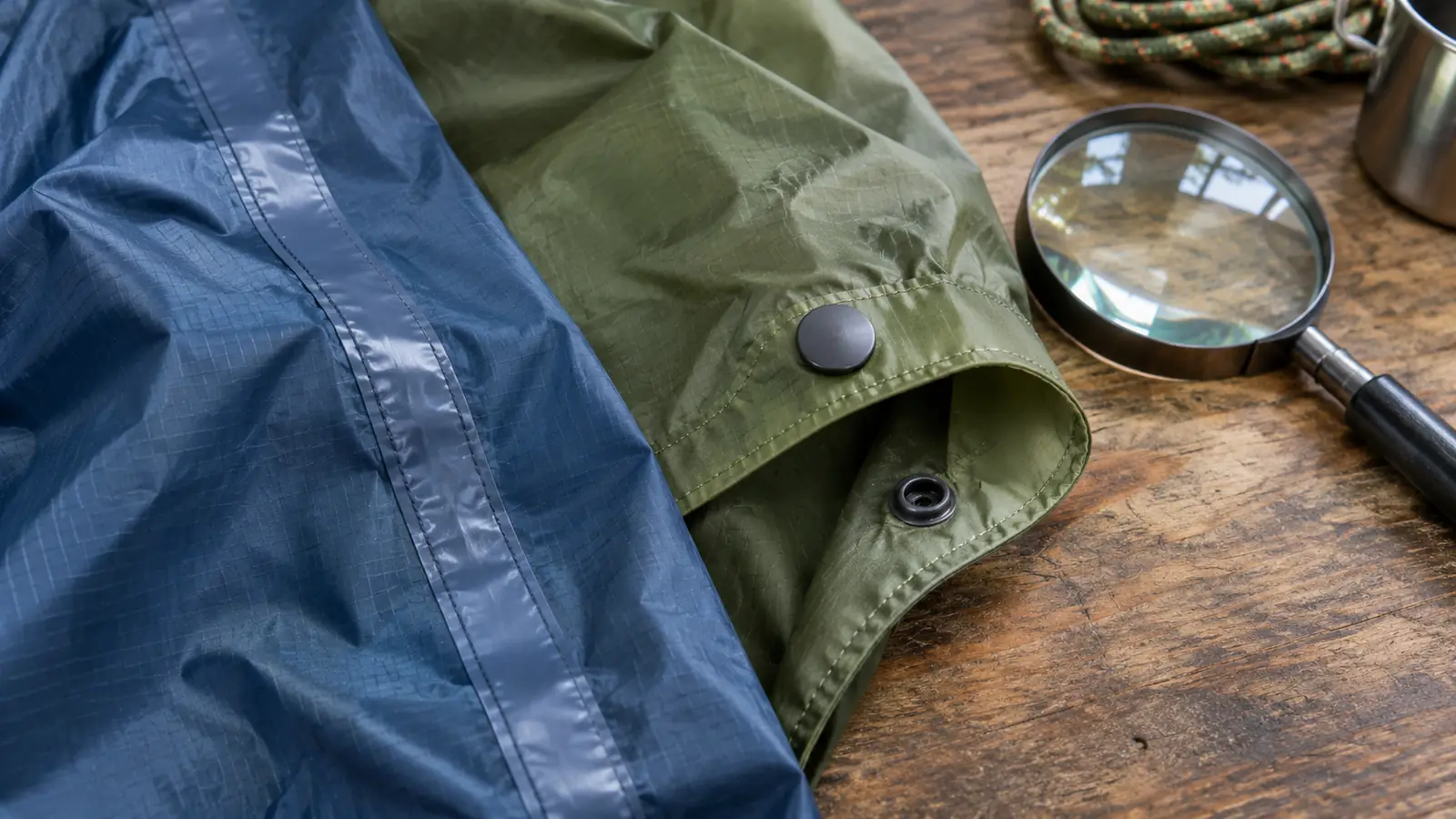
Read fiber weave and rain barrier as separate specifications
The material name on a hiking poncho is only the beginning of its construction description. Nylon and polyester identify fiber families; ripstop describes a type of fabric construction; a coating or laminate may provide a separate barrier function. Buyers should ask for these elements individually instead of treating one familiar word as a complete performance specification. A woven shell with a visible reinforcement pattern is not automatically waterproof, and a soft hand feel does not establish durability. The proposed garment needs a description that connects the material, the finished construction and any evidence used in its claims.
Begin with the supplier's material reference and confirmed composition. Ask whether the description applies to the base fabric, the finished coated fabric or the entire garment. If yarn size or fabric mass is relevant, state the units and the condition to which the value applies. A fabric mass per unit area is not the same as the weight of a complete poncho. Similarly, a yarn description does not directly specify garment thickness, packed size or service life. Keep these fields separate in the buying sheet so a change in one cannot be mistaken for confirmation of the others.
Next identify the intended rain barrier. Ask whether the proposed construction uses a coating, a laminate, a film or another described system, and which side or component carries it. Request information the supplier can substantiate without demanding unnecessary proprietary detail. The buyer needs enough clarity to interpret reports, approve care guidance and recognize a material substitution. If the supplier only provides a generic waterproof label, ask what that label means for the quoted item and which evidence supports it. Do not fill the gap by borrowing a specification from a visually similar product sold elsewhere.
Examine the physical sample alongside the written description. Note the face and reverse surfaces, the seam treatment and any differences between garment panels. A swatch can help explain the construction, but the finished poncho may include other materials in the hood, reinforcement areas or pouch. Decide which components are included in the performance claim and which are simply accessories. This prevents a test result for one piece of fabric from being interpreted as approval of the entire kit. It also makes branding discussions more precise because the decoration process must be compatible with the actual surface being printed.
The existing nylon and polyester product categories provide starting points for a construction-specific enquiry. Their presence does not establish that every listed option has the rear geometry, adult fit or evidence needed for your backpacking program. Ask for a current proposal tied to the intended use and review the sample before assigning a hiking claim. A supplier may suggest a standard model, a different size or an OEM Program variation. Treat each proposed construction as its own reference, with its own drawings and evidence, rather than assuming that a shared material family makes the options interchangeable.
A complete material line in the specification should therefore identify the component, confirmed composition, construction reference, finish or barrier description and relevant verification. Add agreed values only when they have been confirmed for the project. Where information is outstanding, mark it as a question to resolve before release rather than using an attractive placeholder number. This approach gives procurement a meaningful basis for comparison and helps future staff understand what was purchased. It also reduces accidental overstatement in product copy, where a short material phrase can otherwise grow into unsupported claims about strength, rain resistance or suitability for demanding routes.
Review seam and opening details on the finished garment
A hiking poncho is an assembled garment with joins, openings and hardware, not simply a sheet of material. Buyers should inspect those details on the finished sample because they influence fit, handling and the scope of rain-resistance claims. Begin with a simple construction map showing the hood joins, panel seams, neck opening, side closures and any attachment points. Identify which seams receive a specified treatment and which do not. The map helps the reviewer compare the written proposal with the sample and prevents a broad phrase such as sealed construction from concealing important differences between locations.
Look at the seam treatment without assuming that appearance alone proves performance. A neat line of tape or a consistent join can be a useful construction observation, but it does not replace appropriate evidence for the claimed property. Record visible interruptions, lifting edges, uneven application or unexpected changes in the sample and ask the supplier to explain them. Use neutral descriptions rather than diagnosing the cause from a photograph. If a detail is revised, compare the new sample with the earlier observation and confirm whether supporting evidence or care guidance also needs to change for the revised construction.
Openings should be reviewed in the worn configuration. The neck area, side overlap and arm access can behave differently when the poncho is draped over a pack. Check whether tension pulls an opening wider or changes how a flap lies. Observe the settings intended for the project and keep those settings in the review record. Do not describe the garment as completely enclosed if its design deliberately includes open areas. Accurate descriptions can still communicate useful coverage without suggesting that every potential path for rain has been eliminated by the presence of a waterproof fabric.
Hardware attachment deserves attention because users handle these areas repeatedly. Examine the material around snaps, tabs and pouch openings for the construction specified in the sample. Ask how the intended operation is explained and whether any reinforcement is part of the approved design. Avoid informal destructive pulling to estimate strength. If a strength requirement is important, agree a suitable test approach with a competent party and define the component being evaluated. A buyer's visual inspection and ordinary handling check serve a different purpose from a measured force result and should be recorded in separate fields.
Consider the effect of branding and optional features. Adding a pocket, label or printed area can change the construction or introduce another process. The decorated production reference should reflect the final proposal rather than relying only on an undecorated sample. Ask whether any added stitching passes through a barrier layer and how the supplier addresses the resulting design requirement. Do not assume that a small logo or accessory has no effect because it occupies little surface area. The relevant question is how it is made and whether the finished item still matches the agreed construction and evidence.
Keep a photographic reference for the approved details, with clear labels for the locations rather than promotional captions. Receiving staff can use it to identify obvious differences, while technical reviewers can use it to decide when further investigation is warranted. A later substitution in tape, joining method or hardware should trigger review of the affected detail. This does not mean every minor variation automatically rejects an order. It means the buyer and supplier have a defined way to decide whether the delivered construction remains consistent with the approved garment and the claims that depend on it.
Match technical reports to the actual sample
A technical report becomes useful when the buyer can connect it to the material or garment being purchased. Start with the report's identity, issuing organization, date, sample description, method and reported conditions. Compare those details with the supplier's construction reference and the physical sample. A report for an unidentified blue fabric does not necessarily support a claim about every blue poncho in a catalogue. Ask the supplier to explain the relationship in writing and retain that explanation with the document. The objective is traceability, not collecting a large folder of unrelated certificates that appear reassuring.
ISO 811:2018 describes a hydrostatic pressure method for determining fabrics' resistance to water penetration. The official ISO listing identifies the publication as confirmed in 2025. Its scope illustrates an important distinction: a fabric test is evidence about the tested material under the stated method, not automatic certification of the complete poncho. The buyer should still examine the finished garment's joins, openings and intended use. Do not translate a report into a guarantee about how long a person can remain dry on a particular hike unless the evidence genuinely supports that separate claim.
Read the units, specimen condition and any preparation before comparing results. A value measured on a new material may not describe a specimen after cleaning or other conditioning. Different methods can address different properties, and numbers are not interchangeable simply because both appear beside the word waterproof. If the organization lacks the expertise to interpret a report, obtain qualified assistance before using it in a specification or public claim. Procurement can still organize the necessary questions: which component was assessed, which construction revision it represents and whether the proposed wording stays within the report's actual scope.
Separate performance evidence from management-system or factory information. A document concerning an organization's processes does not, by itself, establish the rain resistance, adult fit or safety classification of a particular poncho. Likewise, a test report is not automatically a product certification. Use the correct document description in internal records and marketing approvals. If a buyer requires a specific certification, destination-market assessment or specialist classification, define that requirement explicitly and verify the exact evidence. Do not imply that ordinary recreational rainwear is certified protective equipment merely because the supply file contains technical paperwork.
Build a claim-to-evidence table for the statements the business intends to publish. Each row can identify the wording, the component it refers to, the supporting source and the reviewer responsible for approval. Some statements are simple construction descriptions that can be checked against the sample. Others require technical evidence. Unsupported claims should be removed, narrowed or left pending rather than treated as inevitable marketing language. This process also helps with photographs: water droplets on fabric may illustrate a wet surface, but they cannot serve as proof of a measured rating or of real customer performance.
Before release, reconcile the final sample reference with the report set and any approved changes. If the supplier replaces the material, alters a seam system or changes a relevant process, ask whether the earlier evidence still applies. Keep the answer and any revised documents with the order. A clear evidence file allows later teams to distinguish confirmed facts from open questions and expired assumptions. It supports a practical purchasing decision without exaggerating what documentation can prove. The finished specification should describe the product that will actually be supplied, not a better-documented model that merely resembles it.
Separate fiber, weave and rain-barrier questions with the nylon and ripstop construction guide.
07 / 12
Evaluate packed size and the complete carrying kit
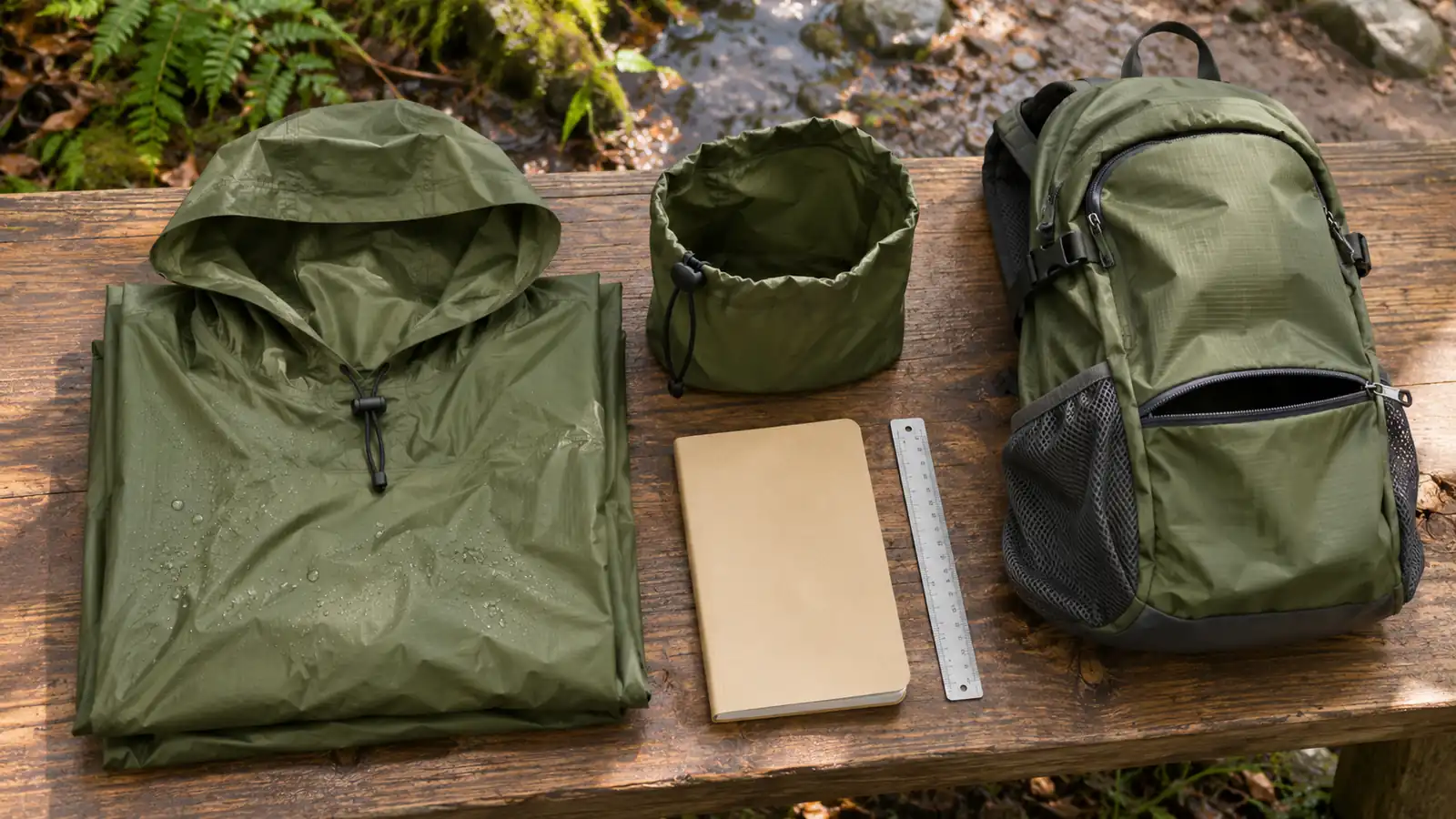
Compare garment weight with complete kit weight
Weight comparisons are meaningful only when the items being weighed are defined. A poncho without its pouch is not directly comparable with a complete kit containing storage accessories, instructions and optional attachments. Ask suppliers to identify exactly what is included in each quoted figure. For a hiking program, the carried configuration usually matters more than the lightest isolated component. The buyer may still want both values: garment-only mass to understand the product and complete-kit mass to understand what the user actually carries. Keep them in separate fields with units and the relevant sample reference.
Agree the condition and measurement approach before comparing samples. Use dry garments in the same defined configuration, a suitable scale and a consistent method. Record the scale resolution and any limitations that affect interpretation. Do not imply laboratory precision from an ordinary office weighing exercise. The exercise can still reveal whether a quoted value includes a pouch or whether two options differ substantially in the form supplied. If a precise mass requirement is commercially important, agree the verification method and allowable variation with the supplier rather than treating a single sample reading as the production limit.
A lower mass is one design characteristic, not a complete selection result. Dimensions, material construction, hood details, fasteners and included accessories all contribute to the finished item. A smaller garment can weigh less while providing less useful coverage for the intended adult and pack. A different pouch can change the kit figure without changing the poncho. Compare these factors openly so the team understands what has been gained or removed. Avoid describing a lighter sample as more advanced or more durable unless separate evidence supports those claims. The selection should follow the use brief rather than one attractive number.
Use clearly labelled hypothetical calculations when explaining the commercial implications. Suppose a buyer compares two complete kits and finds a difference of thirty grams on its agreed sample method. The buyer can consider how that difference fits the overall carrying plan, but should not infer a universal comfort improvement or a freight saving without the other relevant data. Shipment cost depends on packing and commercial arrangements as well as product mass. Keep a sample comparison separate from a logistics quotation. This prevents a useful internal observation from becoming an unsupported public claim about performance or financial benefit.
Review optional components individually. If a model includes attachment cords, a separate pouch or another accessory, decide whether each is actually required for the intended use and whether its function has been assessed. Do not remove a necessary component merely to publish a lower kit weight. Conversely, do not carry an accessory because it appears in a product photograph if it is irrelevant to the approved application. The final kit list should identify included and excluded parts clearly, allowing both the supplier and the end user to understand what the commercial description covers.
Record the approved weight description in the same form everywhere it appears. The quotation, specification, product page and packaging should not alternate between garment-only and complete-kit values without explanation. Where the supplied item varies by size, construction or accessory set, state which variant the figure represents. Agree whether a nominal value, range or other qualified description is appropriate for the evidence available. A careful mass statement supports comparison without pretending that a single number captures hiking suitability. It also makes later changes easier to evaluate because the team knows which configuration produced the original reference.
Specify a repeatable packing and pouch check
Packed size depends on both the garment and the packing method. A tightly compressed factory sample may look smaller than the same poncho folded by a user after a walk. Buyers should therefore agree what the packed dimensions describe and how the result is obtained. Identify the pouch, included components, garment condition and intended packing approach. The goal is a usable kit rather than a demonstration of how much force can be applied to fabric. A practical pouch should suit the approved instructions and the people expected to repack the garment during normal use.
Begin with the supplied storage arrangement and follow its instructions. If the manufacturer recommends folding, rolling or loose stuffing, use that method for the review. Do not assume one technique is correct for every coated or laminated construction. Observe whether the opening admits the garment without excessive pulling and whether the closure can be operated once packed. Record any need to remove components or rearrange them. A pouch that closes only after a product specialist spends several minutes perfecting the folds may be unsuitable for a program that expects ordinary users to repack it without assistance.
Measure the final packed form consistently. For a rectangular pouch, define length, width and depth; for another shape, agree suitable measurement points and record them in a drawing. State whether external straps or loose cords are included in the envelope. Avoid calculating a precise usable storage volume from an irregular soft bundle unless the method supports that interpretation. A set of approximate external dimensions can still help a buyer assess pocket compatibility. The important point is that suppliers and reviewers use the same description, rather than comparing a compressed cylinder with an uncompressed rectangular package as if they were equivalent.
Test access in the intended backpack location. A pouch may fit inside a compartment but be difficult to retrieve when that compartment is loaded. Place the complete kit in the proposed pocket with the representative equipment around it, then review removal while stationary. Check whether sharp or abrasive items share the space and whether the pouch is squeezed by the load. These are packing observations, not evidence that a particular pouch provides impact or water protection. If protective storage is required, specify that separate function and request appropriate information instead of assuming it from the presence of a fabric bag.
Include repacking in the sample feedback. Ask a reviewer who did not prepare the factory sample to use the instructions and record where difficulty occurs. Compare the result with the agreed packed dimensions without insisting on an unrealistically perfect bundle. The buyer and supplier can decide whether a more forgiving pouch, clearer folding diagram or another closure is appropriate. A slightly larger storage format may be a reasonable choice when it improves usability, but that decision should remain tied to the actual program. Do not turn it into a general claim that larger or smaller pouches are always better.
Approve the pouch and instructions with the garment, including any branding that affects identification. Preserve the reference sample so incoming checks can confirm the opening, closure and fit of the supplied kit. If the supplier changes the pouch material or dimensions, review the effect before accepting the substitution. Packed size is a system characteristic: altering the garment, accessories or packing method can change it. Keeping these details together helps the business publish an honest packability description and avoids the common mismatch between an impressive sample photograph and a storage arrangement that users find frustrating in practice.
Keep rainwear accessible when weather changes
A compact poncho is useful only if the user can reach it when needed. The storage location should be part of the carrying plan rather than an afterthought once the pack is full. Identify a place that suits the backpack design, the intended activity and the garment's care requirements. The user should know where the kit is and how to retrieve it while stopped in a safe location. Do not encourage hurried unpacking while walking or imply that convenient storage removes the need to monitor weather and make appropriate route decisions.
Review access with the pack in its normal loaded state. An empty demonstration pack can make every pocket look convenient. Place the usual equipment inside and check whether the poncho can be removed without exposing items that need to remain protected or unloading unrelated contents. If another person normally helps with retrieval in a guided program, include that arrangement in the review. If independent use is expected, assess the actual sequence required by the pack and garment. Avoid promising instant deployment when the evidence only shows that a neatly arranged demonstration kit was easy to open indoors.
Make the poncho easy to identify without relying on memory of a product photograph. A clear pouch label, a distinguishable location or an agreed packing routine may help a group program. The exact method should be simple enough to maintain after the first use, when equipment is no longer arranged as it was at distribution. Do not introduce unnecessary personal data on visible labels. A product or size identifier can often serve the operational need. If several rainwear options are issued, staff should be able to distinguish them so the intended adult and pack configuration receives the correct model.
Plan what happens after a short shower. The wearer may need to remove a wet poncho before the rest of the pack is ready to be opened. Identify suitable temporary separation from dry equipment, following the garment and storage product instructions. The supplied pouch should not automatically be described as a waterproof wet bag. If the program needs that function, request and assess it explicitly. A temporary carrying arrangement also does not replace later drying and inspection. The operating plan should make clear when the garment returns to its normal storage condition rather than remaining compressed and forgotten after the activity.
For an outdoor business, accessibility includes stock handling before issue. Staff need to find the correct sizes and quantities, recognize incomplete kits and provide the approved instructions. A hypothetical tour operator could prepare a departure tray by garment model and check each kit against a simple component list. After return, used garments would follow the agreed care and inspection process before rejoining ready stock. This is a proposed operating model, not evidence that a supplier performs those services. It shows why a procurement brief should describe how rainwear moves through the organization as well as how it fits on a person.
Connect the storage decision with the wider trip checklist. The National Park Service Ten Essentials includes rain layers among the clothing needed for changing conditions, alongside other preparation categories. A poncho should therefore occupy a clear place in a complete kit rather than being marketed as a substitute for everything else. Keep the article's product comparison focused on the garment, while directing activity decisions to appropriate local guidance and competent planning. A well-organized carrying arrangement makes the approved equipment easier to use; it does not create a guarantee that the selected route or weather conditions are suitable.
Connect the carrying kit to the bulk rain poncho material and packing guide.
08 / 12
Choose between ponchos jackets and combined systems
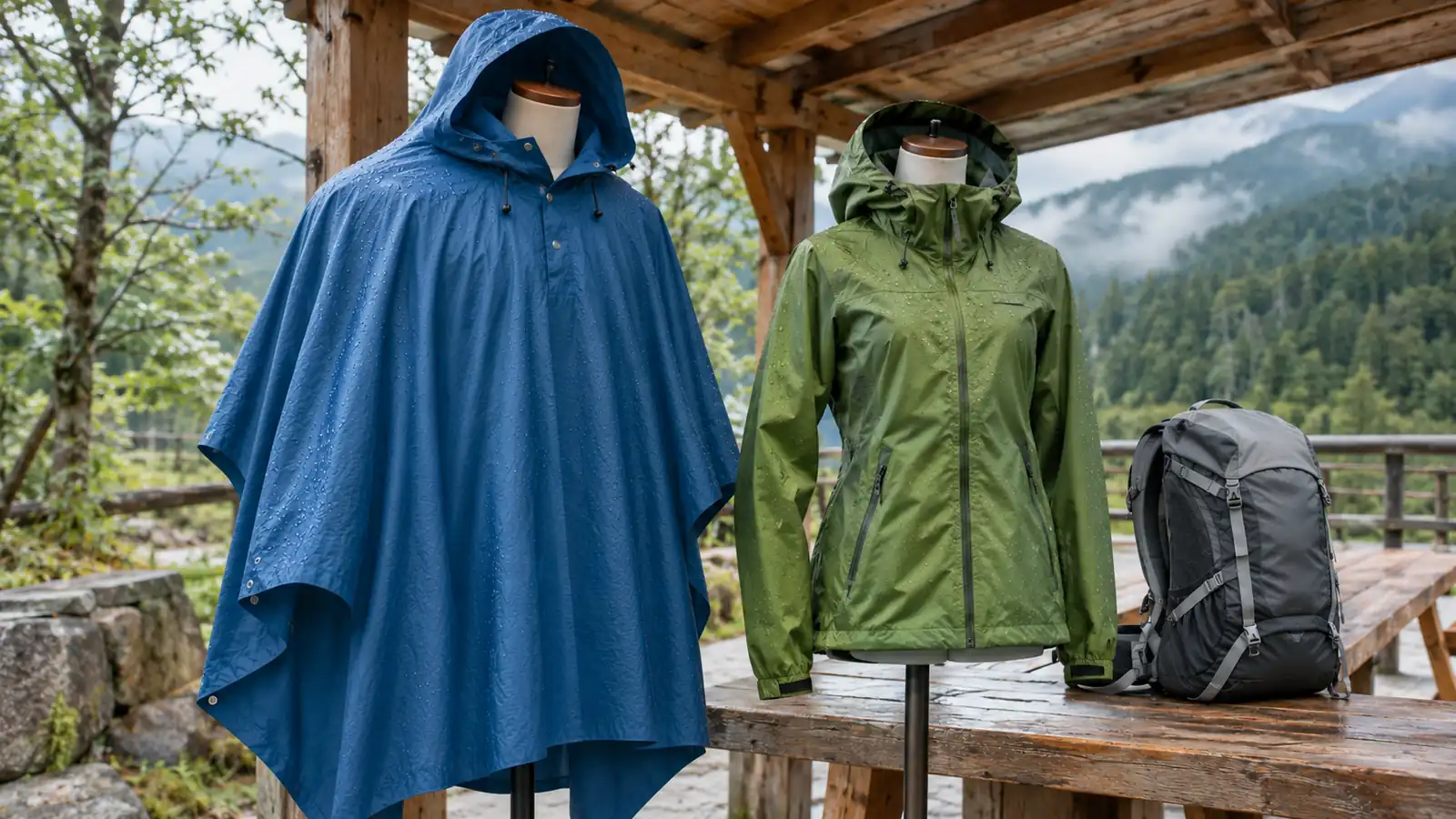
| Decision area | Poncho system | Jacket system |
|---|---|---|
| Person and pack coverage | Review drape over the actual loaded pack | Review wearer fit and separate pack protection |
| Movement | Check loose panels, hem and arm openings | Check sleeves, body fit and equipment access |
| Ventilation | Describe supported openings and settings | Describe the actual jacket ventilation features |
| Evidence | Match fabric and garment claims to the sample | Use the same claim-to-evidence discipline |
| Carried kit | Count poncho, pouch and included accessories | Count jacket and other selected protection components |
| Care and operation | Confirm garment and pouch care and issue process | Confirm the process for every component in the system |
Compare coverage and movement under the same conditions
Ponchos and rain jackets solve coverage differently, so a useful comparison begins with a complete wearing system. A poncho may be designed to drape over the person and a pack, while a jacket generally fits more closely around the wearer and may require a separate plan for pack protection. The exact result depends on the models being compared. Do not judge a loose poncho against a jacket photograph without identifying the pack, lower-body clothing and accessories included in each arrangement. Purchasing decisions become clearer when every component and limitation is visible.
Use the same adult, clothing layers and representative load when reviewing alternatives, where appropriate and with the participant's agreement. Observe the same ordinary tasks in the same controlled setting: standing fit, head turns, normal walking, hand access and putting on or removing the equipment. Keep technical performance evidence separate from these handling observations. A person preferring one fit does not establish that its fabric has a higher measured resistance to water. Conversely, a strong material result does not prove that the garment is easier to operate for the intended group. Both kinds of information may matter, but they answer different questions.
Compare the areas actually covered during use. A poncho's hem, arm openings and rear drape may leave different areas exposed from a jacket's sleeves and closer body shape. A jacket may offer more defined arm coverage while the pack requires another product. Neither arrangement should be described as complete protection without an appropriate scope. Draw a simple system map showing the garment, pack protection and any other components the program requires. The map can reveal missing assumptions, such as comparing a complete poncho kit with a jacket alone and forgetting the separate equipment included in the jacket-based option.
Examine the handling burden of the whole system. More components can mean more items to distribute, retrieve and check, but a combined system may offer choices that a single garment does not. A large poncho can simplify some coverage arrangements while creating a different challenge when the pack is removed. The buyer should decide which tradeoffs matter for the actual activity and audience. Avoid reducing the decision to a slogan that ponchos are always lighter or jackets are always more protective. Such comparisons depend on specific constructions, sizes, included accessories and the conditions being discussed.
For a hypothetical adult walking program, the team could compare two defined options: a pack-covering poncho with its storage pouch, and a jacket with the separately selected pack arrangement. The comparison sheet would list complete-kit mass, packed dimensions, fit findings, evidence, care and issue instructions. Commercial offers would use the same quantities and delivery basis. This method can show where a lower garment price is offset by additional components or where an alternative better serves the operating model. It does not predict the winner in advance or imply that one supplier offers every component needed.
Close the comparison by identifying the suitable use scope of each approved option. Some organizations may select one system for a particular program and another for different conditions or users. Preserve those distinctions in stock names and staff instructions. If the business publishes a comparison, state which models and configurations were reviewed and avoid extrapolating to entire product categories. A fair purchasing decision explains the relationship between coverage, movement, evidence and handling. That explanation remains useful even when the final choice changes because the route, audience or carried load changes later.
Recognize when a closer fitting shell is more appropriate
A poncho should not be forced into a use case simply because it is convenient to buy in bulk. Some activities place greater importance on keeping loose fabric controlled or providing a more defined arrangement around the arms and torso. A closer fitting shell may deserve consideration in those situations, subject to its own design and evidence. The decision should follow the intended activity and competent guidance rather than a general ranking of garments. Recognizing a limitation is part of responsible product selection and can prevent an unsuitable sample from becoming the default for an entire program.
Start with the specific interaction causing concern. It may be fabric moving near equipment, difficulty accessing a required control or a cut that does not suit the planned movement. Describe the interaction and assess whether another size or supported adjustment resolves it. If the issue remains, compare a different garment system instead of adding improvised ties or clips. A procurement team should not turn a simple poncho into an untested assembly in order to preserve an early buying decision. The practical requirement matters more than retaining the original category label or the first sample's commercial appeal.
Exposure and activity limits also need explicit attention. Consult the garment manufacturer's instructions and the operator's route assessment. Ordinary recreational rainwear should not be presented as equipment for technical climbing, specialized work or severe conditions without appropriate evidence and assessment. A closer fit alone does not prove suitability for those uses either. The useful distinction is that another design may address a particular handling requirement, while the wider activity still needs its own equipment decisions. Keep this boundary clear so a discussion of garment shape does not become an implied safety endorsement.
Consider the user's preference alongside observable requirements. Some adults may find a jacket's sleeves and familiar closure easier to manage, while others may prefer the space of a poncho for a defined ordinary walking use. Preference can affect whether the product is used as intended, but it should not override an unresolved fit or equipment conflict. Offer a structured way to record both. A reviewer can state that a closure feels familiar and separately note whether the garment permits the required task. The purchasing record then retains the reason for the choice without treating a personal preference as universal evidence.
Assess the commercial implications fairly. Changing to a closer fitting shell may introduce more size choices, a separate pack cover or another care process. Those factors belong in the comparison rather than being treated as reasons to ignore the alternative. Ask for current quotations and available configurations, and do not invent minimum quantities or lead times. A hypothetical outdoor retailer might carry two clearly differentiated products because its customers have distinct needs. Another organization might select one narrowly defined option for a particular activity. Both decisions can be reasonable when the scope and evidence are clear.
The final recommendation should use conditional language tied to the findings. Explain that the selected arrangement suits the reviewed adult users, equipment and tasks, with specified limitations. If the poncho does not meet an essential requirement, record that conclusion and seek an appropriate alternative. Do not relabel the concern as user error or rely on an instruction that is unlikely to be practical. A buyer adds value by identifying where the product fits the program and where it does not. That makes the resulting assortment more credible than presenting every available poncho as suitable for every outdoor activity.
Treat multipurpose shelter claims as product specific
Some products are deliberately designed to serve as both a poncho and a tarp, but that does not make shelter use a standard property of every rain poncho. A garment intended for that additional function may have specific dimensions, attachment points, construction and instructions. Before including such a claim in a buying brief, identify the exact model and confirm what the manufacturer supports. Do not assume that a large rectangular shape or a few fasteners establish shelter capability. A product photograph showing fabric suspended between objects is not sufficient evidence for a functional or safety claim.
Sea to Summit publishes shelter setup guidance for its named tarp-poncho products, including product-specific features and configurations. That source is useful as an example of why the function needs its own instructions. It does not authorize applying those instructions to another brand's ordinary poncho. For a proposed wholesale item, ask whether shelter use is intended, what components are required and what limitations apply. If the supplier cannot provide a supported specification and guidance, keep the product description focused on its confirmed garment use. Do not add a multipurpose claim simply because the phrase appears attractive in search results.
Think about simultaneous needs. If the same item is being worn as rainwear, it cannot also be deployed elsewhere as a shelter at that moment. This is a basic planning question that can be overlooked when a compact kit is promoted as several products in one. The buyer should ask how the intended user or group manages the transition and what other equipment the activity requires. Do not assume that removing an item from the packing list is appropriate just because another component has a secondary function. Activity-specific planning remains necessary, especially when shelter is part of an emergency preparation strategy.
Review accessories and commercial scope carefully. A tarp configuration may require components that are not included in the garment package. The quotation should state what is supplied, while the instructions should identify any additional equipment and its intended use. Do not quietly count those accessories out of the advertised kit weight or packed size. Similarly, avoid implying that hiking poles supplied by the user have been assessed for every proposed setup. The business should describe the product's supported function and refer users to the correct manufacturer guidance rather than improvising a universal shelter tutorial in a sales article.
For ordinary poncho procurement, it is often clearer to leave unsupported secondary functions out of the specification. A hypothetical tour operator might decide that its selected garment will be described only as rainwear, while shelter needs are addressed through separately selected equipment and procedures. Another buyer may specifically require a documented tarp-poncho design and review that proposal as a distinct product. The choice depends on the program. Neither decision should be disguised as proof that all multipurpose equipment is better or that all ordinary ponchos are incapable of any additional practical use.
Record the approved wording and its evidence before artwork or packaging is released. If a product is described as a tarp poncho, identify the relevant model, instructions, included components and limits. If the evidence only supports garment use, keep the copy within that scope. The National Park Service lists emergency shelter as a separate preparation category from extra clothing, which reinforces the need to think about the complete kit. A useful buying guide helps teams ask these questions; it should not convert a convenient marketing phrase into a promise that one unverified garment replaces the equipment required for a particular journey.
Use the general rain poncho selection guide to compare the broader garment categories.
09 / 12
Plan care drying and repeated use
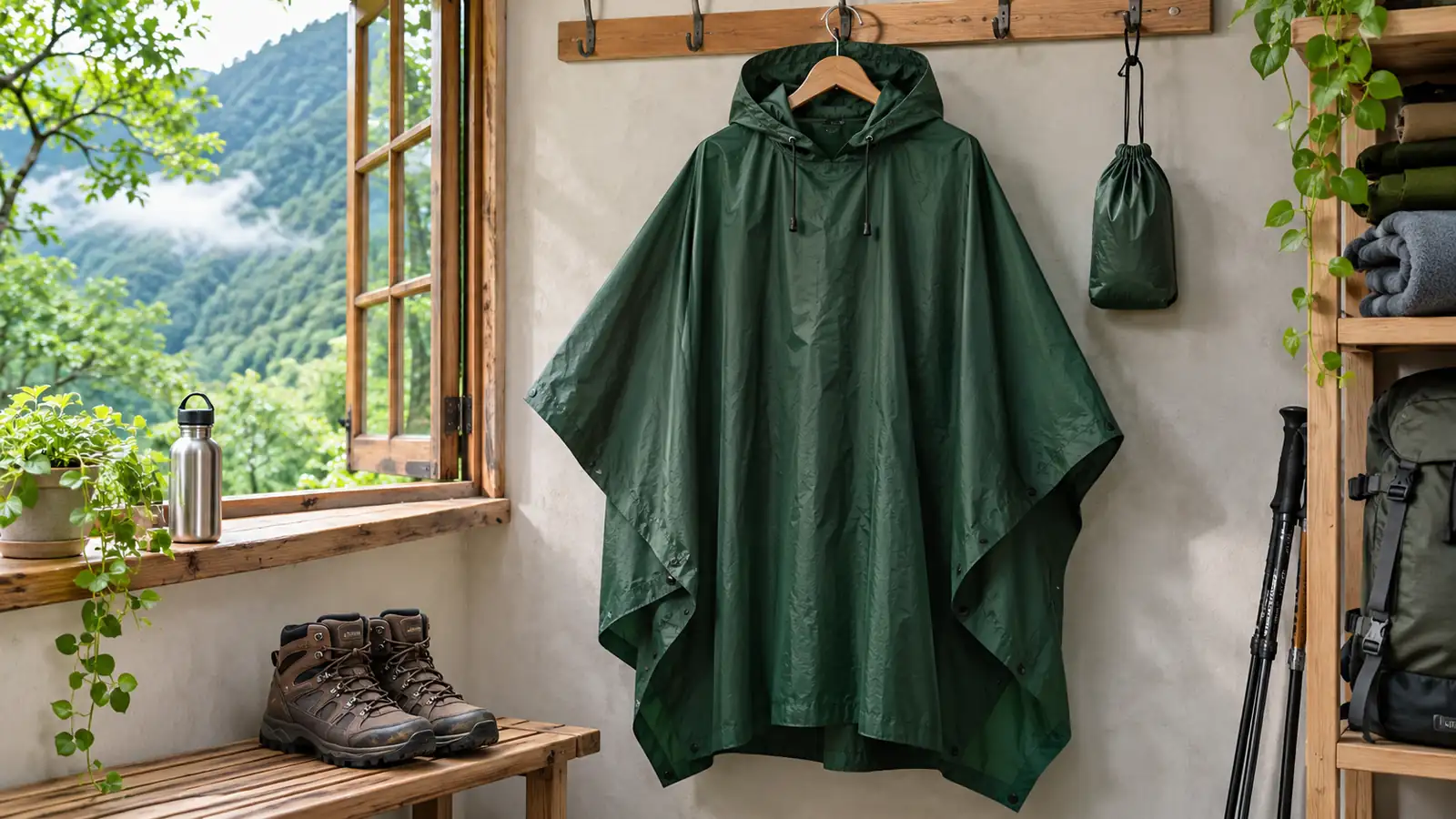
Confirm the care method for the actual construction
Care instructions belong to the complete garment construction, including its fabric, barrier, seam treatment, decoration and accessories. They should not be inferred from the fiber name alone. Two nylon ponchos can require different handling if their coatings or added features differ. Before approving a reusable hiking product, request the supplier's care guidance for the exact proposed model and check that it agrees with the sample and intended operating process. A purchasing team should know how the item is meant to be cleaned, dried, stored and inspected before it decides that repeated use is practical for the program.
Avoid transferring a familiar care routine from another rain jacket. GORE-TEX's official outerwear guidance, for example, tells users to follow the garment manufacturer's instructions and distinguishes special care for particular constructions. That illustrates the need for product-specific guidance; it is not a washing recipe for an unrelated poncho. Do not recommend heat, chemicals, machine cycles or reproofing products without confirming compatibility with the actual item. A generic statement that all rainwear can be treated the same way can create a mismatch between the published instructions and the construction the supplier has agreed to provide.
Ask for clear instructions that the intended user can follow. The guidance should identify permitted cleaning methods, relevant restrictions and how to handle the garment after use. If symbols are used, check that their meaning is communicated appropriately for the destination and audience. Keep the care label, packaging insert and digital product information consistent. A short pouch insert can point to fuller instructions, but it should not contradict them or omit a critical limitation. The buyer should also confirm that any proposed translation preserves the actual instruction rather than replacing it with a more familiar but unsupported local phrase.
For a business managing shared stock, compare the care requirements with available facilities and staff practices. A product that requires a particular process may be unsuitable if the organization cannot reliably provide it. This is an operational fit question, not a reason to rewrite the manufacturer's instructions. Discuss another construction or a different service arrangement if needed. A hypothetical rental operator might find that its return schedule leaves insufficient time for the approved cleaning and drying process. The purchasing decision should account for that constraint before stock quantities and turnaround promises are set.
Review decoration and accessories within the same care decision. Printed areas, labels, closure hardware and pouches may have their own constraints, and the finished branded sample should be assessed accordingly. Do not assume that care guidance for an undecorated fabric automatically covers a newly added logo process. Ask the supplier to confirm the instructions for the final production reference. If the branding method or material changes, revisit the affected guidance. This keeps an otherwise useful reusable product from arriving with a care label that describes only part of the item the customer actually receives.
Preserve the approved care revision with the order documents and sample. Staff responsible for receiving, customer support and stock maintenance should be able to locate it without relying on a verbal explanation from the original buyer. If instructions are unclear, resolve the question with the supplier before issuing a new public statement. Good care information supports correct handling, but it does not justify an invented service-life or environmental-benefit claim. Describe the intended repeat-use process and the actual requirements, allowing the organization to assess practicality without promising a result that has not been measured for its circumstances.
Manage wet packing and drying between uses
Temporary wet packing and normal long-term storage are different stages of a rainwear program. A poncho may need to be carried after use before there is a suitable opportunity to dry it. That practical need should be anticipated, but it should not turn into an instruction to leave the garment compressed indefinitely. Follow the manufacturer's care guidance and identify where the item will be unpacked, checked and dried. For a business issuing multiple garments, this requires a simple operating process that keeps used stock separate from items ready for the next distribution.
Start with the return point. Decide how staff distinguish a used garment from an unused kit and where each goes. A folded poncho inside a pouch can look ready even when it has not completed the agreed care process. Use a clear status system suited to the operation, such as separate storage locations or a stock record, rather than relying on appearance alone. Avoid attaching improvised items to the garment that could interfere with its use. The status information should help staff manage the stock without becoming another unsupported product feature or a source of confusion for the wearer.
Choose a drying arrangement consistent with the actual instructions and available space. Do not assume that direct heat, a tumble dryer or exposure to strong sunlight is suitable for every material and decoration. The buyer should confirm the permitted method with the supplier and assess whether the facility can follow it. A generic photograph of a hanging poncho illustrates organization, not a validated drying time. If turnaround timing matters commercially, observe the real process under the organization's conditions and plan accordingly. Do not publish a universal drying-duration claim from one sample or an unrelated manufacturer's guidance.
Inspect both the garment and the pouch before returning the kit to ready stock. A dry-looking exterior does not necessarily show the condition of folded areas or accessories. Follow the agreed process and make any uncertainty visible to the person responsible for release. If an item has an unexpected odor, visible surface change, damaged closure or unclear use history, keep it out of ready stock until it has been assessed appropriately. These signs alone do not establish the cause of a material change. Record the findings and base the decision on the construction, condition and supplier guidance.
Plan storage so the approved kit remains identifiable and complete. Keep the garment, correct pouch and current instructions together once the care process is finished. Avoid mixing variants that look similar but have different sizes or care requirements. For a hypothetical walking club, a simple return checklist might confirm the model, condition, care completion and any missing component. The club could then replenish or investigate before the next outing. This is an example of administrative control, not a claim that repeated use has a fixed cost or guaranteed environmental advantage compared with every alternative.
Use operating experience to improve the next purchase. If staff repeatedly find that pouches are too difficult to reopen, instructions are lost or drying space is inadequate, record those observations as requirements for the next sample review. Do not quietly change the care method to make a poorly matched system fit the schedule. The best improvement may involve another pouch, clearer issue instructions, different quantities or a different garment construction. Connecting these findings to procurement makes care a real part of product selection rather than a paragraph added to the packaging after the commercial decision is already final.
Inspect repairs and decide when a garment leaves service
A reusable poncho needs a clear process for handling damage and uncertainty. That process should identify who can inspect the item, when supplier guidance is required and how a garment is kept out of ready stock while a decision is pending. Do not assume that a small visible tear is the only reason to review an item. Closure problems, seam changes, unclear repairs or missing identification can also affect whether the garment still matches the approved reference. The purpose is to make a reasoned decision about the actual item rather than promise an indefinite service life.
Begin with a comparison against the approved construction and the recorded issue. Note the location, appearance and circumstances of the concern without guessing the cause. If a user reports a snag, keep that description separate from the inspector's observations. Photograph the relevant area where appropriate and retain the garment reference. Avoid destructive pulling or improvised water tests that can change the evidence before a competent reviewer sees it. A simple, factual record helps the supplier understand whether the concern involves material damage, a construction detail, an accessory or a handling question that needs further investigation.
Repairs must be compatible with the actual surface and construction. A patch, adhesive or seam product suitable for one material may not be suitable for another. Ask the garment or repair-product manufacturer for relevant guidance and follow the supported process. This article does not prescribe a universal adhesive or repair method. The buyer should also decide whether a field repair is temporary, whether further assessment is required and what wording can be used about the repaired item. A visible patch does not automatically restore every original performance claim, and a neat appearance is not proof of equivalent behavior.
Record the repair history where it matters to the operating program. The record can identify the garment, the affected area, the approved method, the person or service carrying out the work and any follow-up decision. Keep it proportionate; a small organization may use a straightforward stock note rather than a complex system. The key is that a repaired garment should not become indistinguishable from an unassessed item merely because both are folded into matching pouches. Staff issuing the kit need a reliable way to know that the relevant review has been completed and what limitations remain.
Define retirement or escalation criteria with appropriate expertise and supplier input. These should reflect the product and use, not an arbitrary number of outings invented for a marketing page. An item may need further assessment when its identity is unclear, a closure no longer functions as intended or damage affects a feature required by the specification. The organization should decide who has authority to return it to service. Do not keep a questionable garment available simply to meet an inventory target, and do not describe a retirement decision as proof that the entire material category is unsuitable.
Finally, use the findings to distinguish product issues from operating requirements. Repeated damage at the same location may justify discussing another construction or a change in how equipment is carried, but that conclusion needs evidence. Missing pouches may point toward distribution control rather than fabric quality. Share the relevant pattern with the supplier and request a defined proposal instead of asking vaguely for a tougher poncho. A useful repeat-use program learns from its records while keeping claims modest. It can improve the fit between garment and activity without promising that any product is unbreakable, permanently waterproof or universally repairable.
Develop the operating process with the reusable rain poncho buying guide.
10 / 12
Build a sample review that records useful evidence
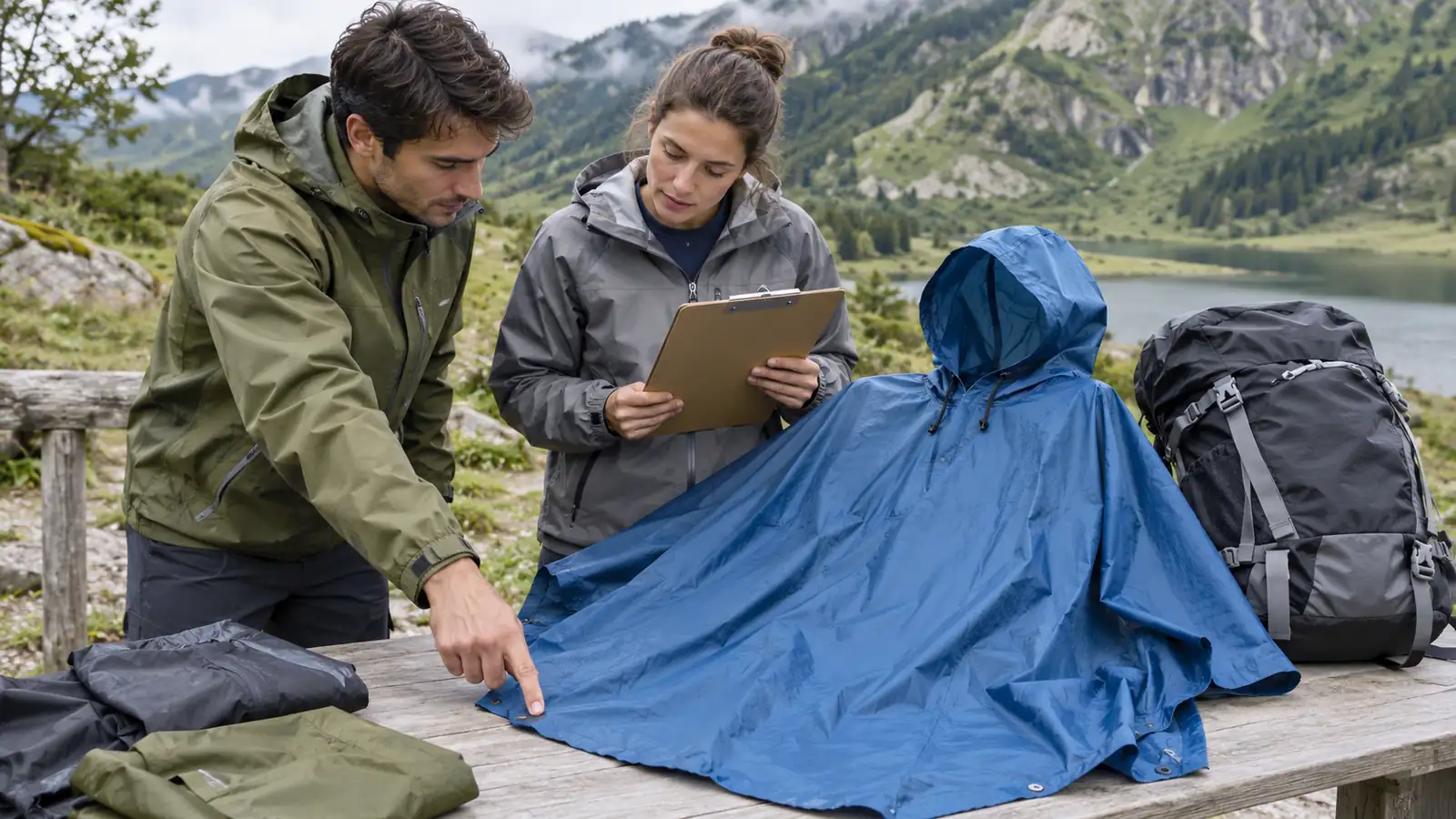
Create a controlled fit and handling review
A sample review works best when the team agrees on the questions before opening the package. List the intended adult user and pack combinations, essential fit requirements, ordinary handling tasks and documents to be checked. Keep the review manageable enough that participants can complete it carefully. A long checklist with unclear pass criteria can produce more paperwork than insight. Assign responsibility for recording observations and for deciding which issues need technical advice. The purpose is to build a usable purchasing decision, not to imitate a certification process that the organization is not qualified to perform.
Identify every sample clearly. Record the supplier reference, construction revision, size, color, included accessories and whether branding is present. Photograph the package and garment if useful, then compare them with the quotation and drawing. A sample sent before the final material or closure choice may still support discussion, but it should not silently become the production reference. Label its provisional status in the record. If several suppliers submit similar-looking ponchos, keep their references distinct so measurements, feedback and technical reports do not become attached to the wrong item during a busy review session.
Organize the review in a sensible sequence. Check documents and visible construction first, then standing fit, hood adjustment, ordinary movement, stationary access, donning and removal, and packing. Stop or revise the process when a finding makes a later step inappropriate. There is no need to continue a movement review if the garment obviously catches under the wearer's feet. Keep any technical performance evaluation separate and use a suitable method with competent input. This sequence helps the team resolve simple fit problems before investing time in detailed comparison of a sample that cannot meet an essential requirement.
Give participants enough context to provide useful feedback without steering them toward a preferred result. Explain the intended use and the tasks, but avoid announcing that one sample is the premium or favored option. Ask for specific observations: where the garment pulled, which closure was difficult, whether the rear coverage changed and how the pouch handled. Separate these descriptions from preference. A reviewer can prefer a color while reporting a fit concern. The record should retain both pieces of information without allowing the cosmetic preference to hide the issue that needs resolution before purchase.
Use repeatability where it adds value. Keep the pack load, clothing category and basic task sequence consistent when comparing alternatives, and note any unavoidable differences. There is no need to manufacture precise scores for observations that are better expressed in words. A simple outcome such as acceptable for the reviewed configuration, revision needed or not assessed can be more honest than a numerical rating with no defined scale. If a score is used, explain what it measures and how it affects the decision. Essential requirements should remain visible regardless of the total preference score.
End the session with an issue list that assigns the next action. Each entry should identify the sample, location or task, observation, proposed response and person responsible for confirming closure. Some issues require another sample; others may require a clearer document or a corrected instruction. Do not mark everything approved because the meeting has ended. Preserve the reviewed samples and notes until the final production reference is agreed. A controlled process is valuable because it makes uncertainty actionable, allowing the buyer and supplier to resolve specific questions instead of exchanging broad assurances that the product is suitable for hiking.
Record findings without inventing test certifications
The language used in a sample report affects how its conclusions are understood later. A fitting session, visual inspection, document review and laboratory test are different activities. Name each accurately and describe what was actually done. An internal team can produce useful evidence about handling and fit without calling the work certified testing. Avoid adding official-looking badges, invented standards or unsupported pass statements to make the report appear stronger. A clear record of a limited but relevant observation is more credible than a grand claim whose method, authority and scope cannot be explained.
For fit and handling, record the configuration and task. Identify the garment reference, adult fitting category, clothing, pack shape and closure setting, then describe the result. Use neutral phrases such as front edge contacted the boot during the reviewed turn or hood adjustment was difficult to locate from the supplied instructions. These observations can guide a revision without claiming a measured safety outcome. Do not infer that the garment prevents falls, suits every adult or performs in severe weather because it was comfortable during a short session. Keep the conclusion within the evidence that the activity actually produced.
For measurements, record units, points and method. A length taken from the neck opening should not be mixed with a supplier's shoulder-based dimension. A mass reading should identify the included components and dry condition. A packed-size record should explain the pouch and packing method. Where measurement uncertainty or equipment limitations matter, state them rather than displaying unnecessary decimal places. The goal is a meaningful comparison that another reviewer can understand. Precision in formatting is not the same as accuracy, and a spreadsheet with many digits does not compensate for an unclear measurement definition.
For external reports, preserve the original document and summarize it carefully. Identify the issuing body, specimen, method, date and relevant result without changing its scope. If the report requires specialist interpretation, record who reviewed it and which questions remain open. Do not crop a favorable number out of context and attach it to a different sample. The buyer's summary should make the relationship between evidence and product easier to follow, not conceal conditions or limitations. Where a supplier provides a translated summary, retain access to the original and resolve any material ambiguity before relying on the claim.
Photographs should support a specific observation. Include enough context to show the location and configuration, and label the image with the sample reference rather than an exaggerated result. Internal fitting images require appropriate permission and should not automatically become promotional assets. For a seam concern, include a wider view showing its location and a closer view showing the observed detail. Keep the sample identifier with both photographs so another reviewer can find the same area on the retained garment. If the item is repaired or altered, preserve the earlier photographs and add a dated record of the change. That sequence supports investigation without implying a technical conclusion from appearance alone.
Write the conclusion as a decision with limits. State which requirements were met on the reviewed sample, which were not assessed and which need revision or external confirmation. Name the person or role authorized to approve the next step. If the record later supports public product copy, check each statement against the actual evidence before publication. This approach does not weaken the commercial message; it makes the message defensible. Buyers can explain the construction and intended use clearly while avoiding claims that an internal sample review has conferred a certification or guaranteed an outcome it was never designed to establish.
Close issues before approving a production reference
Sample approval should mean that the buyer and supplier share a clear reference for what will be supplied. It should not mean that unresolved questions have disappeared because the order date is approaching. Keep an issue list from the review and distinguish essential corrections from optional preferences. For each essential item, identify the evidence needed to close it: a revised sample, a corrected drawing, a construction explanation or an appropriate report. Assign a reviewer and retain the response. This turns approval into a documented decision rather than a general statement that the sample looked satisfactory.
When a revised sample arrives, compare the changed feature with the original issue and check for effects elsewhere. Shortening a panel may improve walking clearance but change pack coverage. Moving a closure may help access while altering the drape. A different pouch may improve repacking but change kit dimensions and artwork space. Review the affected system, not only the isolated detail. The buyer does not need to repeat every completed check without reason, but should identify which earlier conclusions depend on the revised feature. That makes the follow-up efficient while preserving the logic of the original assessment.
Control version names carefully. Mark superseded drawings and sample notes so they cannot be mistaken for the final reference. The approved garment, material description, dimensions, decoration, pouch and instructions should carry compatible revision identifiers. If one component remains provisional, state that plainly and define what it prevents from being released. Avoid using a sample photograph as the sole production instruction when important dimensions or construction details are not visible. The physical reference and written specification should support each other, giving the supplier and receiving team a consistent basis for identifying differences.
Resolve commercial assumptions at the same time. Confirm which sample costs, artwork processes, packaging components and inspection arrangements are included in the current offer. Ask the supplier to state project-specific minimum order quantities, available variants and timing rather than borrowing values from an earlier order. If a revised construction changes the quotation, update the comparison before approval. A buyer should not approve one technical version while placing the order against a price and delivery description for another. Clear reconciliation prevents later disagreement over whether an attractive proposal included the feature that made the sample acceptable.
Set a practical change process for production. Ask the supplier to notify the buyer before substituting material, hardware, dimensions or relevant processes, and identify who can approve the change. The response should consider the affected evidence and claims, not only whether the replacement looks similar. If the buyer authorizes a change, update the reference documents and any receiving instructions. This is especially important when a product page or packaging statement depends on a specific construction. A production shortcut should not leave customer information describing a version that is no longer being supplied.
Finally, issue a release note that identifies the approved reference, order scope, resolved issues and any explicit limitations. Keep a retained sample or equivalent agreed reference available for receiving checks. The note can be concise, but it should allow a colleague to understand what was approved without reconstructing an entire email history. A hypothetical outdoor brand might use this step to confirm a particular adult hiking application while excluding unsupported shelter or technical-use claims. The value lies in alignment: the garment, documents, commercial offer and public description all refer to the same reviewed product before the bulk order proceeds.
Organize your supplier enquiry with the wholesale rainwear sourcing and logistics guide.
11 / 12
Write the wholesale specification and release plan
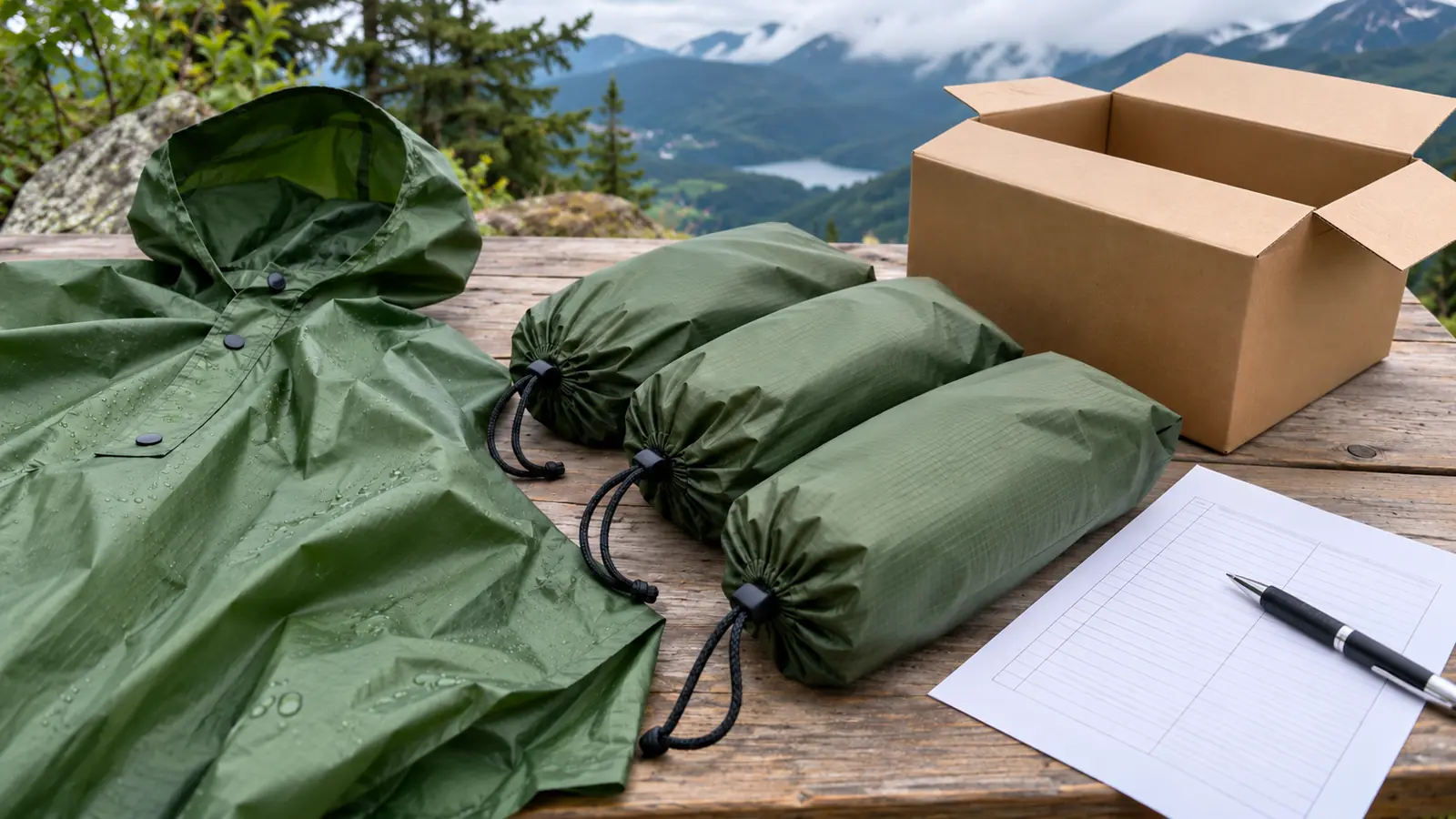
| Entity | Attribute | Value to agree | Verification |
|---|---|---|---|
| Use | Adult audience and activity | [Reviewed adult range; route and tasks] | Use brief and fitting plan |
| Pack | Loaded external geometry | [Height / width / rear projection in cm; attachments] | Defined loaded-pack measurement and photos |
| Shell | Material and rain barrier | [Confirmed composition; fabric and finish references] | Supplier description linked to sample |
| Garment | Front and rear length | [cm; measurement points; agreed tolerances] | Drawing and flat measurement |
| Garment | Width and openings | [cm; points; supported closure settings] | Drawing and sample review |
| Hood | Shape and adjustment | [Panel / brim / adjustment reference] | Adult fitting and instruction review |
| Coverage | Wearer and pack combinations | [Approved configurations and limits] | Front / side / rear observations |
| Movement | Ordinary walking tasks | [Agreed tasks and essential clearance criteria] | Controlled fit and handling review |
| Joins | Seam construction and treatment | [Locations; materials; approved details] | Finished sample and applicable evidence |
| Performance | Exact proposed claims | [Property; method; specimen; condition; result] | Relevant report and qualified interpretation |
| Garment mass | Dry garment only | [g; configuration; agreed variation] | Defined weighing method |
| Kit mass | All carried components | [g; included components; variation] | Complete kit weighing |
| Packed kit | External dimensions | [cm; pouch and packing method] | Repeatable pouch and retrieval review |
| Decoration | Artwork and placement | [File revision; process; position; colors] | Final decorated sample |
| Care | Cleaning drying storage | [Construction-specific instructions] | Supplier guidance and operating review |
| Order | Variants quantities and release | [SKU split; current MOQ; reference; delivery basis] | Current quotation and named approval owner |
Complete an entity attribute value specification
An entity attribute value specification organizes a purchasing brief into small, checkable statements. The entity identifies the part of the product, the attribute identifies what matters about that part, and the value records what the buyer and supplier have agreed. For a hiking poncho, entities can include the shell, hood, closures, rear panel, pouch and complete kit. This structure is useful because it separates a confirmed requirement from a question still awaiting an answer. The table in this guide uses project fields rather than invented product values, allowing buyers to complete it with evidence from their own proposal.
Begin with identity and intended use. Record the model or project reference, adult audience, clothing assumptions and representative pack configurations. These fields explain why later dimensions and handling requirements exist. Then define the construction: component materials, fabric reference, rain barrier, joins and relevant hardware. Avoid filling a field with an adjective when a description is needed. Durable, premium and professional do not identify a construction. If a supplier proposes an alternative, record it as a separate option until the buyer has decided whether it meets the same use brief and evidence requirements.
For dimensional attributes, include units and measurement points. Front length, rear length, width, opening dimensions and pouch size should be tied to an agreed drawing or method. Distinguish flat garment measurements from worn coverage observations. A flat width can be checked on incoming stock, while a coverage observation depends on the adult and load used during review. Both can belong in the specification, but they should not be presented as interchangeable. Agree tolerances with the supplier where necessary, and ensure that the chosen values reflect the approved sample rather than a generic catalogue drawing for a different version.
For performance-related attributes, identify the evidence and the wording it supports. A fabric water-penetration result, a construction description and a practical fit observation require different verification. The table should make that difference visible. Include report references and competent review where appropriate, while leaving unsupported claims unresolved. Do not add a numerical requirement simply because it appears in a competitor's product page. The buyer needs a reason for the requirement, a suitable method and a supplier proposal that can be assessed against it. Otherwise, the number can create an appearance of technical rigor without a useful decision basis.
Add the complete kit and communication requirements. Identify pouch, instructions, labels, branding, included accessories and packaging allocation. These elements affect what users receive and how staff handle the product. The specification should state which artwork revision is approved and which claims appear on the product page or insert. If different sizes share a pouch design, confirm how they remain distinguishable. A missing instruction sheet or an ambiguous size label can undermine an otherwise well-reviewed garment, so the release reference should cover the supplied package rather than ending at the edge of the poncho fabric.
Assign an owner and verification method to the important fields. Some can be checked against a document, others against the retained sample, and some require specialist evidence. Mark open items clearly and decide which prevent release. Keep the completed table readable enough to accompany the purchase order rather than turning it into an archive of every conversation. Its value is clarity: the supplier knows what is being requested, the buyer knows what has been confirmed, and the receiving team knows how to recognize a difference. That shared reference is the foundation of a useful wholesale hiking poncho specification.
Align branding packing quantities and commercial scope
A wholesale quotation should describe the same complete product that passed the sample review. Branding, packing and quantity decisions can change both the item and the commercial offer, so resolve them together. Begin with the approved construction and size references, then identify the required variants and quantities. Ask the supplier to confirm the current MOQ for that proposal, including any differences created by color, decoration or packaging. Do not assume that a minimum from another product or an earlier order applies. Project-specific confirmation is more useful than a generic claim about unlimited customization or immediate availability.
Provide artwork in a form the supplier can assess and identify the intended placement on the actual garment. A position that looks good on a flat drawing may be covered by a fold or altered when the poncho drapes over a backpack. Review a decorated sample or an appropriate production reference before approving the final appearance. Ask which process is proposed for the confirmed surface and how it affects the construction and care instructions. Do not assume that every coating accepts the same printing method or that adding a logo leaves all earlier sample conclusions unchanged.
Treat packing as part of the user experience and the shipment scope. Identify whether each garment is supplied in a pouch, whether instructions are included, how sizes are marked and how variants are grouped in cartons. For a group program, clear allocation may matter more than elaborate presentation. For a retail channel, the package may need additional information and a different handling format. Confirm destination-specific requirements with appropriate expertise where needed. This guide does not provide a universal legal label. It provides the fields a buyer should resolve so the supplier is not left to guess the intended distribution model.
Request Bulk Pricing against comparable scopes. If one offer includes a branded pouch and another excludes it, the headline figure does not describe the same kit. Align quantities, variant splits, decoration, packing, inspection arrangements and delivery basis before judging the proposals. Ask how changes affect the offer and retain the current revision. Do not publish speculative unit prices or calculate a guaranteed saving from incomplete quotations. A useful comparison explains the commercial differences and the product decisions behind them, allowing the buyer to choose with an accurate understanding of what will actually be supplied.
Build timing around real approvals and confirmed supplier information. Identify the dates needed for sample review, artwork sign-off, production release, inspection and delivery, then ask the supplier to confirm a feasible plan for the agreed scope. Avoid turning a desired arrival date into an assumed production capability. If an unresolved construction or evidence question remains, show its effect on the schedule rather than approving an incomplete product to preserve a target date. An OEM Program can involve additional development decisions; those decisions should be visible in the plan instead of hidden behind a general customization promise.
Before placing the order, reconcile the commercial documents with the final technical reference. The purchase description should identify the garment, size range, material revision, branding, pouch, instructions and quantities in terms that match the approved file. Clarify any exclusions and responsibilities, including who approves changes and how discrepancies are handled. This step can be concise, but it prevents different teams from acting on different assumptions. A well-defined wholesale offer does more than state a price: it connects the buyer's intended hiking application to a specific supplied kit, supported claims and an agreed route from sample approval to delivery.
Control production changes and incoming checks
A product can drift from its approved sample when materials, dimensions or accessories change during production. Buyers should therefore agree how changes are proposed and reviewed before the order begins. Identify which construction and communication details require notification, who can approve them and what evidence is needed. The process should be proportionate to the project, but it must prevent silent substitutions that affect fit, claims or instructions. A replacement that looks similar in a photograph may still change the way the poncho fits over a pack, operates at a closure or responds to the approved care method.
Use the retained reference and specification as the basis for incoming checks. Confirm the model, variants, quantities and package contents, then examine representative units according to an agreed inspection plan. Check the dimensions and construction details that matter to the project using the defined methods. Do not invent a sampling rule and present it as a recognized quality standard. If formal statistical sampling or laboratory evaluation is required, agree the appropriate approach with competent support. Ordinary receiving checks are still useful, but their scope and limits should be clear to everyone relying on the result.
Look for differences that affect the complete kit. A garment may match the main color and length while the pouch opening, closure hardware or instruction revision differs from the approved reference. Compare these details before treating the shipment as ready for issue. Keep any discrepancy tied to the relevant lot or delivery information so the supplier can investigate. Photographs and factual descriptions are more helpful than a broad complaint that the order is wrong. Where the difference is uncertain, hold the affected decision pending review rather than quietly accepting it or rejecting unrelated stock without evidence.
Define how the business handles an unresolved delivery. Staff should know where to place items awaiting assessment and who can authorize their release. Keep questionable units distinguishable from ready stock and avoid distributing them simply because a trip or campaign is approaching. The next action may involve clarification, replacement, rework or another agreed response, depending on the facts and commercial terms. This guide does not prescribe a contractual remedy. It recommends maintaining a clear decision trail so operational pressure does not erase the connection between the approved specification and the product issued to users.
Feed later observations back into the specification. Customer questions, return reasons and staff handling notes can identify requirements that were unclear or insufficiently reviewed. Distinguish isolated incidents from supported patterns and avoid drawing broad material conclusions from a single report. If a change is proposed, assess the affected fit, construction, care, packing and claim fields before approving the next version. Keep old and new references distinguishable. This makes improvement traceable and helps customer-facing teams avoid describing a revised product using information that applied only to an earlier construction.
A controlled release process ends with a usable record, not with an assertion that every future unit is guaranteed to perform identically. Preserve the approved sample identity, relevant evidence, inspection outcome and any accepted changes. Make the current version accessible to purchasing, operations and support. The benefit is practical accountability: when a question arises, the team can identify what was ordered, what was checked and what remains uncertain. For hiking ponchos, that discipline is especially useful because fit and handling depend on several interacting details that can be lost when a product is reduced to a material name and a photograph.
Prepare the artwork and pack proposal with the custom rain poncho logos and packaging guide.
12 / 12
Answer the final hiking poncho buying questions

What makes a hiking poncho suitable for a loaded backpack
A suitable backpacking poncho is one whose actual design, dimensions and intended use match the wearer and the loaded equipment. The pack's external shape matters more than a capacity label alone. Review height, width, rear projection and external attachments, then fit the garment over that configuration on representative adults. Check front, side and rear coverage together with ordinary movement. A long rear panel can be useful on a design intended for that purpose, but it should not be assumed from a generic poncho description. Confirm the feature on the proposed sample and its drawing before approving a coverage claim.
Does a larger size automatically solve insufficient coverage? It may change the result, but it can also change hood position, arm access and walking clearance. Review the whole garment after any size change. A solution that covers the pack while placing fabric in the step path is not a completed fit decision. If the intended user range is broad, another size option or another rainwear arrangement may be needed. Keep the decision tied to the actual adults and equipment reviewed rather than using one unusually generous sample to justify a statement that the product fits all people and all backpacks.
Can one poncho serve both day hiking and overnight backpacking? It may be suitable for particular combinations, but the answer requires a defined use brief and sample review. The overnight load may have a different profile, and the user may have different opportunities for drying or repacking. Compare those tasks directly. A business seeking one stock item should evaluate the operational benefit against any fit compromise. Inventory simplicity is a legitimate consideration, but it should not erase essential requirements. Where a single item is selected, describe its reviewed scope clearly so staff and customers understand the intended combinations.
Does covering the outside of a pack protect everything inside it? Outer coverage and internal storage are separate decisions. The poncho does not establish the performance of the backpack, its openings or any containers used for sensitive contents. Choose appropriate internal protection and follow the relevant product instructions. Review access while stationary and plan how wet rainwear is separated from dry equipment after use. Do not extend a pack-covering claim to immersion, river crossings or protection of every electronic device. A clear kit plan identifies the role and limits of each component instead of assigning all responsibility to the poncho.
What should a buyer ask the supplier first? Send the adult use brief, representative pack description, intended clothing layers and required handling tasks. Request the current model drawing, construction details, care guidance and relevant evidence, then ask which proposed option fits that brief. Include whether loaded and unloaded use are both expected. Do not begin with a universal dimension copied from an unrelated item. The supplier needs enough context to offer a specific construction, and the buyer needs enough information to assess it. A focused enquiry usually produces more useful answers than asking for the best outdoor poncho without explaining the application.
The final answer should be recorded as an approved configuration, not a broad slogan. Identify the sample, size, pack combinations, movement findings and limitations. Link that reference to the commercial offer and instructions. If the pack arrangement or audience changes, review the affected fit again. This keeps the product recommendation useful over time and gives support staff a clear basis for answering questions. The goal is a rainwear choice that has been thoughtfully matched to the intended hiking program, with transparent boundaries around what was reviewed and what still needs another assessment.
How should buyers compare waterproof lightweight and best claims
Start by asking what each claim describes and how it is supported. Waterproof may refer to a fabric property, a finished garment statement or an informal marketing description. Lightweight may refer to the garment alone or the complete carrying kit. Best may reflect a reviewer's preferences rather than a defined comparison. These words should not be treated as interchangeable evidence of hiking suitability. Break them into specific questions about construction, reported performance, mass configuration, fit and intended use. The resulting information can be compared honestly without assuming that the strongest adjective identifies the most appropriate product.
For rain-resistance wording, request the relevant evidence and connect it to the actual material and sample. Check the method, specimen, conditions and limits of the report with qualified support where needed. A recognized fabric test does not automatically establish the behavior of every seam, opening or worn configuration. The supplier should explain which statement the evidence supports. If the intended wording is broader than that evidence, narrow it or obtain appropriate additional assessment. Do not create a universal time-in-rain promise from a hydrostatic value or use an attractive water-beading photograph as a substitute for documented performance.
For lightweight wording, compare dry items in the same defined configuration. State whether the pouch, instructions and accessories are included, and distinguish any size variants. A lower kit mass may be useful for a particular carrying plan, but it does not establish better durability, comfort or coverage. Examine what changed to produce the difference. A smaller cut, another fabric or fewer accessories may each affect the result. Keep hypothetical calculations clearly labelled and avoid publishing precise figures before the supplier confirms the proposed production specification and the agreed method for describing variation.
For best claims, identify the audience and criteria. The best hiking poncho for a particular adult day-walking program may differ from the preferred arrangement for a backpacking retailer's customers. Define essential requirements first, then compare preferences such as pouch format or color. Do not average away a failed essential requirement with favorable cosmetic scores. A useful product page can explain who the item is intended for and which features support that use without claiming a universal ranking. A search result can introduce an option, but the buyer still needs to establish whether its construction and fit meet the actual project requirements.
What about breathable, ripstop or reusable? Each term needs its own scope. Ventilation through openings is different from a measured fabric breathability property. A ripstop construction description does not prove that a garment cannot tear. Reusable describes an intended use pattern, not a guaranteed number of outings or an automatic environmental advantage. Ask for the construction, care guidance and relevant evidence behind the proposed wording. Avoid adding broad sustainability statements simply because a garment can be packed and worn again. Such claims need their own substantiation and should remain outside the copy when the necessary evidence is unavailable.
Approve the final language as part of the product release. Keep a short table connecting each material or performance statement to its source and sample reference. Review that table when the construction changes and when marketing proposes a new phrase. This prevents an initially careful description from expanding into unsupported claims over time. A clear answer to buying questions can still be persuasive: it shows how the garment fits the intended person, load and operating process. Credibility comes from useful detail and honest limits, rather than from promising that a single poncho is the lightest, strongest or best option in every situation.
What should be agreed before a bulk order is released
Before releasing a bulk hiking poncho order, align the use brief, approved sample, technical specification, evidence, artwork and commercial offer. Each should describe the same product and included kit. Confirm the adult size range and representative pack configurations, the relevant dimensions, the construction and closure details, and the intended care process. Identify the exact sample revision rather than relying on a photograph or an informal description. If an essential question remains unresolved, keep it visible and assign a next action. A deadline should not turn a provisional sample into an approved production reference by default.
Which documents belong in the release file? Keep the completed specification, current drawing, approved sample identification, applicable reports, claim review, decoration reference, packing instructions and latest quotation or order scope. The exact file structure can be simple. What matters is that a colleague can locate the current information and distinguish it from superseded versions. Avoid collecting unrelated certificates to make the file appear complete. Each document should answer a real question about the supplied item, its claims or the agreed process. Where specialist review is needed, record the responsible reviewer and the conclusion within the appropriate scope.
What must be confirmed commercially? Ask for project-specific quantities, variant splits, MOQ, branding and packing scope, delivery basis and timing. Clarify which accessories and documents are supplied and which are excluded. Compare Bulk Pricing only after the scopes are aligned. Do not assume that a previous order's lead time or a different model's minimum quantity applies to the new proposal. If an OEM Program changes the construction or artwork process, reconcile the technical and commercial revisions before release. This helps prevent the order from referring to a cheaper or earlier configuration that no longer matches the approved sample.
How should the buyer handle later substitutions? Agree a notification and approval process before production starts. Identify who can accept a proposed change and what evidence is needed to assess its effect. Material, seam, hardware, dimension, pouch and instruction changes can affect different parts of the decision. A supplier's explanation should make those effects clear rather than relying on the phrase equivalent quality. If a change is accepted, update the current reference and receiving checks. If it is not accepted, keep the original requirement and discuss the available options through the agreed commercial process.
What happens when the delivery arrives? Follow the inspection and release plan agreed for the project, comparing representative units and documents with the approved reference. Check kit completeness, identification and relevant dimensions or construction details using the defined methods. Keep unresolved differences separate from ready stock until an authorized decision is made. Do not describe an ordinary receiving review as a certification of every unit. Its purpose is to identify discrepancies within its scope and support a controlled release. The record should show what was checked, what was found and who approved the next step.
A useful enquiry can begin before every field is complete, provided the open questions are explicit. Share the intended adult activity, pack profile, preferred material direction, quantities, branding needs and destination, then ask for a current proposal and sample plan. Use the checklist below to organize the conversation. The objective is to move from broad interest in a hiking rain poncho to a clearly defined product that the buyer can review and the supplier can quote accurately. Once the essential checks are closed, the order can proceed against an agreed reference with practical instructions and claims that stay within the evidence.
Hiking poncho purchase release checklist
- Define adult users, clothing, loaded pack profiles and intended activities.
- Review front and rear coverage, hood position and ordinary walking clearance.
- Confirm supported closures, access, donning and removal instructions.
- Separate material evidence from finished garment and fit claims.
- Compare dry garment mass, complete kit mass and repeatable packed dimensions.
- Approve construction-specific care and a workable return-to-stock process.
- Complete artwork, pouch, labels and instructions on the final sample.
- Reconcile the EAV specification, current quotation, release owner and change process.
| RFQ field | Buyer entry |
|---|---|
| Application | [Adult audience; route type; operating limits] |
| Fit and load | [Clothing; pack geometry; size range; required tasks] |
| Construction | [Material direction; hood; seams; closures; evidence questions] |
| Kit | [Pouch; mass configuration; packed dimensions; accessories] |
| Branding and packing | [Artwork; placement; instructions; carton allocation] |
| Commercial scope | [Variant quantities; destination; delivery basis; required dates] |
| Approval | [Sample revision; open questions; reviewers; change control] |
Return to the rain poncho selection guide or build your commercial enquiry with the bulk rain poncho buying guide.