
Sponsorship ROI: Securing Funded Bulk Rain Gear for Events
The Strategic Shift: Transitioning from Rain Contingency to Sponsored Branding Opportunity. Discover how event managers leverage attendee rescue moments to secure 100% funding for high-volume gear.
The Strategic Shift: From Weather Risk to Sponsored Branding Opportunity
Every event planner knows the frustration of budgeting for rain. Those contingency line items eat into margins and rarely deliver value. But what if you could transform that weather risk into a revenue-generating asset that actually enhances your event experience?
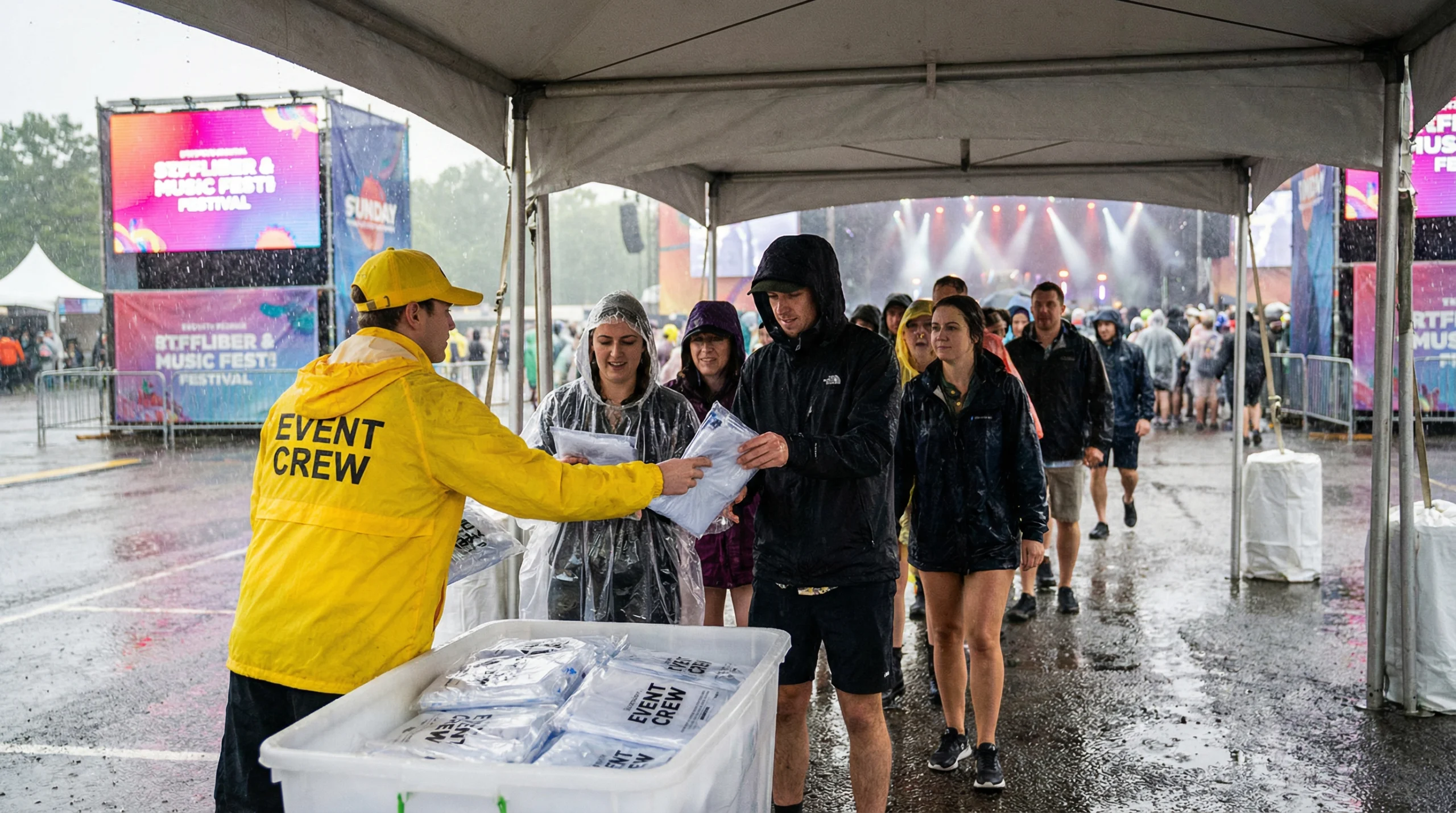
Welcome to the new paradigm of event procurement. Forward-thinking event managers are discovering that branded rain gear represents one of the most powerful sponsorship opportunities available today. When the skies open and your attendees are suddenly rescued by sponsor-provided ponchos, you’re not just providing comfort—you’re creating a mobile billboard that travels with thousands of potential customers, generating impressions that traditional advertising can never match at this price point.
The Financial Logic: Offsetting Procurement Costs
Understanding the economics behind sponsored rain gear and how to convert weather risk into sponsorship revenue.
Eliminating the Weather Risk Line Item
Traditional event budgeting treats rain as an expense to be managed rather than an opportunity to be leveraged. The conventional approach allocates anywhere from $10,000 to $50,000 or more as a contingency fund for emergency rain gear—money that sits idle if the sun shines and delivers minimal value even when its needed.
Smart event managers are rewriting this equation entirely. Instead of viewing rain protection as a cost center, they are positioning it as a premium sponsorship asset that companies pay to associate with. The math is compelling: convert that $20,000 contingency spend into a $30,000 sponsorship revenue stream through strategic OEM partnerships. Your sponsor gets premium brand exposure during a captive rescue moment, and your event transforms a potential budget headache into profit.
The key lies in understanding sponsor psychology. When rain threatens an outdoor event, attendees become visibly uncomfortable—that is the moment when brand intervention creates genuine gratitude. Your sponsor is not just placing a logo; they are solving a real problem at the exact moment attendees are most receptive. This emotional connection translates to lasting positive brand association that outdoor advertising simply cannot replicate.
Bulk Pricing vs. Sponsorship Tiers
Understanding the relationship between minimum order quantities (MOQ) and sponsor brand-reach goals is fundamental to structuring successful partnerships. Most OEM programs begin at 5,000 to 10,000 units for custom printing and colors to ensure price efficiency, but this creates natural tiering opportunities for sponsorship packages.
When structuring sponsorship tiers, align quantity with sponsor objectives. A primary sponsor wanting maximum visibility might underwrite 50,000 units for a major festival, securing exclusive brand rights and premium placement. Secondary sponsors can participate at lower commitment levels, perhaps 10,000 units with co-branding arrangements. This tiered approach maximizes revenue while ensuring every attendee receives useful gear regardless of sponsorship depth.
The pricing model extends beyond simple unit costs. Consider value-in-kind arrangements where sponsors provide services in exchange for gear placement. A security company might provide venue security in exchange for branded rain gear for their staff. A beverage sponsor might supply all hydration products for the event in exchange for logo placement on rain gear distributed at hydration stations. These creative arrangements multiply the value of your sponsorship inventory.
Supply Chain Transparency as a Selling Point
Modern sponsors, particularly those with corporate social responsibility (CSR) commitments, increasingly demand supply chain transparency. They are not just buying products; they are buying into a story they can tell their stakeholders. Direct factory-to-venue logistics that reduce overhead while increasing sponsor ROI represent a compelling value proposition that differentiates your pitch from traditional sponsorship opportunities.
When you can demonstrate ethical manufacturing practices, sustainable material sourcing, and efficient logistics, sponsors in industries like green energy, ethical finance, and sustainable consumer goods become natural partners. They appreciate that their sponsorship investment aligns with their stated values—not just their marketing objectives. This alignment creates longer-term partnerships built on shared principles rather than transactional exchanges.
The transparency angle also protects sponsors from reputational risks that have plagued other sponsorship categories. By providing full supply chain documentation, certified ethical manufacturing, and verifiable sustainability claims, you position rain gear sponsorship as a responsible choice that enhances rather than threatens sponsor brand equity.

High-Impact Visibility: The Stadium Pitch
How to pitch the massive brand exposure of attendees wearing sponsor colors during broadcast events.
Dominating the Sea of People Visuals
Television broadcasts of outdoor events capture something unique: thousands of people as a unified visual canvas. When those thousands are wearing coordinated, branded rain gear, your sponsor achieves visual dominance that is impossible to buy through traditional advertising at equivalent cost. A stadium filled with 50,000 attendees wearing teal and sage ponchos bearing a single brand creates a visual impact thatadvertisers pay millions for in other contexts.
The key is coordinating gear color with sponsor branding. Rather than offering random colors, work with sponsors to select palettes that match their brand identity. This creates a cohesive visual statement that reads clearly even on television. The investment in coordinated branding pays dividends in every wide shot, every crowd pan, every social media post captured during the event.
This visual dominance translates to measurable value. Sponsors can calculate equivalent advertising impressions based on broadcast time, crowd size, and visibility duration. The math often reveals that rain gear sponsorship delivers cost-per-impression figures far below industry benchmarks for out-of-home advertising—making your pitch compelling from a pure media buying perspective.
Deploying Emergency Rain Gear for Stadium Events
Emergency rain gear for stadium events represents a unique opportunity to position your sponsor as the hero. When unexpected weather arrives, the distribution of branded ponchos becomes a planned response rather than chaotic scramble—and the narrative framing shifts from necessary evil to sponsor provides comfort.
Rapid-deployment logistics transform weather contingencies into brand moments. Rather than attendees scrambling for plastic sheeting or leaving early, they receive thoughtfully designed, properly sized, professionally branded rain gear that solves their problem elegantly. Your sponsor becomes associated with problem-solving and attendee care—not just logo placement.
The operational logistics matter here. Staff positioning, distribution speed, and gear accessibility all affect perception. When rain gear appears quickly and efficiently, sponsors receive credit for operational excellence. When distribution lags and attendees suffer, the negative associations also reflect on the sponsor. Detailed logistics planning protects sponsor brand while maximizing positive exposure.
Calculating Impressions per Square Meter
Data-driven sponsors appreciate concrete metrics. Using attendee count, crowd density, and rainfall duration, you can calculate precise brand exposure figures that demonstrate concrete value. This approach transforms subjective visibility claims into verifiable impressions that sponsors can report to their leadership.
Impressions per square meter account for viewing distance, angle, and duration. A sponsor logo on gear viewed from 50 meters for 30 seconds represents different value than the same logo viewed from 5 meters for five minutes. By providing granular impression calculations, you help sponsors understand true value and build more confident commitment levels.
Beyond live event impressions, factor in post-event reach. Quality rain gear becomes ongoing wearable advertising. Each time an attendee wears their poncho to commute, shop, or enjoy another outdoor activity, sponsor logos continue generating impressions. This extended lifespan multiplies the effective value of every unit produced.

The Eco-Sponsor Match: Sustainability PR
How to match environmentally-conscious brands with sustainable event gear solutions.
Targeting CSR Budgets
Companies with dedicated CSR budgets represent prime sponsorship targets for sustainable rain gear programs. These organizations actively seek opportunities to demonstrate their environmental commitment through tangible actions—not just symbolic gestures. made from recycled or Branded rain gear compostable materials provides exactly this kind of visible, verifiable sustainability action.
The pitch to CSR-focused sponsors centers on authentic impact. Unlike carbon offset programs that feel abstract, rain gear sponsorship creates immediate, visible environmental benefit. When you can demonstrate that your event diverted thousands of single-use plastics from landfills through compostable alternatives, or that recycled materials prevented virgin plastic production, sponsors have concrete stories for their stakeholders.
These partnerships often extend beyond single events. Companies committed to sustainability value ongoing relationships with aligned partners. Position your event series as a platform for demonstrating year-over-year environmental improvement, and sponsors will commit to multi-year arrangements that provide revenue stability while reducing your sales effort.
Utilizing Bulk Compostable Rain Ponchos for Eco-Festivals
Bulk compostable rain ponchos for eco-festivals represent a growing market segment with compelling narrative potential. These events specifically target environmentally-conscious attendees who appreciate—and expect—sustainable practices from their organizers. Providing compostable rain gear aligns with attendee values while demonstrating genuine commitment beyond greenwashing.
The landfill-avoidance story resonates particularly well. A single outdoor event might distribute 50,000 ponchos during wet conditions. Traditional polyethylene ponchos create 5+ tons of plastic waste. Compostable alternatives eliminate this waste entirely, with the added benefit that soiled ponchos can actually contribute to composting streams rather than burdening landfills.
Sponsors receive dual benefit: positive association with attendee care and environmental responsibility. The messaging writes itself—This compostable poncho is provided by [Sponsor] connects brand identity directly to environmental action. This authentic alignment drives stronger sponsor engagement than traditional advertising partnerships.
Material Traceability and Green Certifications
EN13432 and similar standards provide third-party validation of environmental claims that sponsors increasingly demand. Using certified compostable materials with full traceability demonstrates commitment to genuine sustainability rather than superficial green claims that risk backlash.
Material traceability means knowing exactly where your raw materials come from, how they are processed, and what certifications apply at each stage. This transparency protects sponsors from reputational damage if environmental claims are later questioned. It also enables precise carbon footprint calculations that sophisticated CSR departments require for reporting.
When presenting to potential sponsors, bring documentation. Certificates, test results, and supply chain audits demonstrate professionalism and build confidence. Sponsors appreciate that you are not asking them to take your word for sustainability claims—you have done the verification work and can provide proof.

Security-First Sponsorships: The Transparency Angle
Why clear gear is the perfect match for companies in cybersecurity, fintech, and law enforcement sectors.
Pitching Tech and Security Firms
Technology and security companies represent an underserved sponsorship category that responds strongly to clear gear solutions. These organizations value visibility but often avoid sponsorships that might conflict with their security-focused brand positioning. Clear ponchos solve this problem elegantly—logo visibility without the perception issues that can accompany certain imagery.
The security industry specifically appreciates products that do not obstruct visibility. Clear polyethylene ponchos enable full situational awareness while providing weather protection. This functional benefit aligns perfectly with security company values—they protect while remaining transparent. The messaging practically writes itself: Providing protection without barriers.
Fintech sponsors similarly appreciate clarity associations. These companies work hard to position themselves as transparent, trustworthy partners. Clear gear reinforces these brand attributes without requiring compromise on visibility. Logo placement on clear material reads as confident and open—exactly the positioning these companies seek.
Sourcing Wholesale Clear Ponchos for Security-Sensitive Venues
Wholesale clear ponchos for security-sensitive venues require specific product specifications that your pitch must address. These venues—government buildings, airports, stadiums, high-profile events—maintain strict security protocols that gear must accommodate. Understanding these requirements enables confident pitching to sponsors concerned about venue compliance.
Security venues typically require unobstructed visibility at all times, metal-free components that do not trigger detection systems, and materials that do not obscure identity verification. High-transmission polyethylene materials meet these requirements while still providing effective weather protection and excellent branding surfaces.
The venue compliance story becomes a selling point rather than limitation. When you can demonstrate that sponsored gear meets security requirements, sponsors gain confidence that their activation will not be restricted or removed due to safety concerns. This reliability matters for events where security is paramount.
The Optical Clarity Standard in OEM Manufacturing
Optical clarity standards in OEM manufacturing ensure sponsor logos remain crisp on high-transmission PE materials. Not all clear materials are created equal—some cloud or yellow over time, degrading brand appearance. Quality specifications protect sponsor investment and maintain professional appearance throughout the event.
When commissioning clear ponchos, specify UV-stabilized materials that resist yellowing. Request samples that demonstrate clarity over realistic use conditions. Sponsors paying for visibility need assurance that their logo will appear professional throughout the event—not hazy or discolored by the time rain subsides.
Print quality matters equally on clear materials. Ink adhesion, color matching, and registration precision all affect final appearance. Work with manufacturers experienced in clear material printing to ensure results that meet sponsor standards. The combination of clear materials and quality printing creates premium positioning that justifies higher sponsorship rates.

Experiential Marketing: The Long-Term Souvenir
Shifting from disposable gear to durable rainwear that extends sponsorship value beyond the event.
Shifting from Disposable to Durable Gear
The evolution from disposable to durable rainwear represents a fundamental shift in sponsorship value proposition. Traditional single-use ponchos deliver brief visibility during the event then disappear into trash bins. Premium rainwear that attendees keep and wear for years extends the sponsorship lifespan dramatically—converting single-event expense into multi-year brand exposure.
This shift requires different product specifications and pricing models. EVA and TPU materials create stylish, durable rain macs that attendees treat as wardrobe additions rather than throwaway items. These materials enable fashion-forward designs that people actually want to wear, not merely accept and discard.
The value calculation changes accordingly. A $3 poncho generates impressions only during the event. A $25 rain mac generates impressions every time it is worn in the months and years following—potentially hundreds of additional impressions at no additional production cost. Sophisticated sponsors understand this lifetime value difference and adjust their commitment levels accordingly.
Designing Custom Printed Rain Macs for Outdoor Marketing
Custom printed rain macs for outdoor marketing require sophisticated design collaboration that separates amateur efforts from professional results. These products serve as brand ambassadors that represent sponsors every time they are worn—so design quality directly impacts brand perception.
Design considerations extend beyond logo placement. Color blocking, pocket design, hood construction, and closure systems all affect both function and appearance. Premium rain macs should look intentional and considered, not merely like ponchos with arms. This sophistication justifies premium pricing while delivering superior sponsorship experience.
Material selection between EVA and TPU affects both aesthetics and environmental profile. EVA creates glossy, vibrant colors that photograph well—ideal for sponsors prioritizing visual impact. TPU offers matte finishes with excellent durability and easier recycling—preferred by sustainability-focused sponsors. Understanding these tradeoffs enables informed recommendations to sponsors.
The Post-Event Social Media Echo
User-generated content represents an often-unmeasured value component of premium rain gear sponsorship. When sponsors provide stylish, photo-ready rainwear, attendees share images on social media—creating earned media impressions that amplify sponsor reach beyond the event itself.
The social media echo begins during the event. Attendees posting photos of themselves in attractive rain gear generate impressions among friends and followers who were not at the event. This organic amplification extends sponsor reach to networks that traditional advertising struggles to penetrate.
Post-event value continues when attendees wear their rain gear afterward. Each social occasion where someone wears their sponsored rain mac potentially generates additional shares and comments. Sponsors increasingly understand this extended value and factor it into sponsorship decisions. When presenting to potential sponsors, quantify this potential—estimate impressions per attendee based on expected social sharing rates and ongoing wear frequency.

Workforce Sponsorship: The Behind-the-Scenes Hero
Pitching logistics and safety companies to sponsor staff-only gear as a targeted visibility opportunity.
Sponsoring the Unsung Heroes of the Event
Every successful event relies on dozens or hundreds of staff members working tirelessly behind the scenes. These individuals—volunteers, security personnel, logistics coordinators, medical staff—represent an often-overlooked sponsorship opportunity. Sponsoring staff-only gear positions companies as event partners while targeting specific functional audiences.
The logic differs from attendee gear sponsorship. Staff members interact directly with attendees, creating high-visibility moments throughout the event. When a security officer wearing a sponsor-branded rain jacket assists an attendee, that interaction carries implicit sponsor endorsement. The sponsor becomes associated with the helpful, professional staff serving the event.
Staff gear also commands different pricing. Rather than reaching thousands of general attendees, sponsor messaging reaches a smaller but highly targeted audience of event workers. This concentrated reach appeals to companies seeking to reach specific demographic or professional segments—security firms targeting venue managers, logistics companies seeking event industry relationships, equipment suppliers cultivating event organizer connections.
Specifying High-Visibility Rain Gear for Festival Staff and Volunteers
High-visibility rain gear for festival staff and volunteers requires balancing sponsor branding with functional requirements. Occupational health and safety standards often mandate specific visibility features—reflective strips, high-visibility colors, certified protective properties. These requirements constrain design options but also create opportunities for creative integration.
Reflective materials provide natural branding surfaces while meeting safety requirements. Sponsors can incorporate reflective logos that become highly visible under stage lighting or vehicle headlights—creating dramatic nighttime visibility that regular apparel cannot achieve. This distinctive positioning creates memorable impressions that daytime-only branding misses.
Color selection similarly balances branding and safety. High-visibility yellow and orange meet safety standards while providing excellent backgrounds for sponsor logos. Alternatively, corporate colors can be incorporated into reflective piping or accent elements that satisfy both brand and safety requirements. This integration requires early coordination with safety consultants to ensure compliance.
Meeting ISO Safety Standards in Bulk Orders
ISO safety standards in bulk orders require manufacturer certification and quality verification processes that protect both sponsors and event organizers. Sponsors providing staff gear want assurance that products meet legal requirements—particularly when employees will be working in challenging conditions.
Specific standards apply depending on intended use. High-visibility apparel must comply with EN 471 or equivalent standards depending on target market. Waterproof ratings must meet specifications for expected conditions. Fire retardancy may be required for certain venue types or proximity to heat sources.
Documentation matters. Sponsors need certificates demonstrating compliance for their records. Third-party testing from recognized laboratories provides independent verification that specs are met. Building these verification steps into your procurement process protects everyone while demonstrating professionalism that differentiates your event operations.

The Pocket-Sized Pitch: FMCG Integration
Why snacks, beverages, and telecommunications companies love the pocket-size handout model.
Targeting Fast-Moving Consumer Goods Sponsors
FMCG companies—snack food manufacturers, beverage producers, consumer goods companies—represent ideal rain gear sponsors because their products share characteristics with ponchos: compact, portable, impulse-distributed, and universally needed. This conceptual alignment creates natural partnership opportunities.
Beverage companies particularly appreciate the hydration angle. When it rains, people want beverages to warm up or hydrate—sponsoring rain gear creates positive brand association at a moment of genuine need. This emotional connection drives preference beyond what television advertising achieves. Telecom companies similarly value the staying connected narrative—when weather threatens fun, your brand keeps people connected.
The distribution model aligns perfectly. Both ponchos and beverage samples distribute efficiently at entry points, concession stands, or hydration stations. This operational synergy reduces logistics complexity while creating multiple touchpoints between sponsor brands and attendees.
Deploying Lightweight Pocket-Size Ponchos for Concert-Goers
Lightweight pocket-size ponchos for concert-goers create the ultimate brand-in-hand physical connection. Unlike bulky apparel that gets checked at the coat counter, compact ponchos stay with attendees throughout the event—becoming constant brand reminders that compete for attention throughout the experience.
Product specifications matter here. Ultra-lightweight materials minimize pack size while providing adequate weather protection. Compression packaging creates tiny footprint that fits easily in pockets or bags. Clear packaging enables brand visibility before purchase while protecting product integrity. These details seem minor but significantly affect distribution efficiency and attendee acceptance.
The brand-in-hand positioning creates unique opportunities. Sponsors can include sample-sized product offers inside poncho packaging. Coupons, QR codes linking to special offers, or samples of related products extend sponsor touchpoints beyond the initial distribution moment. This multi-stage engagement increases return on sponsorship investment.
Logistics of Mass Distribution
Optimizing carton counts and pallet dimensions for quick distribution at transport hubs or gates requires careful planning. Distribution efficiency directly affects both cost and attendee experience—slow distribution creates bottlenecks while fast distribution creates positive first impressions.
Packaging geometry matters significantly. Standard carton sizes that maximize pallet efficiency reduce shipping costs while facilitating warehouse handling. Inner packaging designed for grab-and-go distribution enables rapid handoff without staff fumbling. Pre-packaged bundles in standardized quantities simplify count reconciliation and inventory management.
Distribution point placement affects overall logistics. Multiple smaller distribution points scattered throughout the venue reduce attendee travel distance but increase staff requirements. Central distribution points minimize staff needs but create congestion. Hybrid approaches using both work well for large events—main distribution for initial arrival plus supplemental points for re-supply during the event.

Material Science as a Value-Add
Educating sponsors on fabric durability and how material choices affect branding effectiveness.
Educating Sponsors on Fabric Durability
The difference between PE, PVC, and EVA materials affects both branding effectiveness and product perception. Understanding these differences enables informed recommendations that match sponsor objectives with appropriate product solutions.
Polyethylene (PE) represents the most economical choice—lightweight, waterproof, and recyclable in many markets. However, PE feels flimsy and does not hold prints as crisply as other materials. It is ideal for budget-conscious sponsors or events where attendees expect throwaway items. PVC offers superior durability and print quality but contains plasticizers that complicate recycling. EVA provides the best balance—excellent print reproduction, good durability, and cleaner environmental profile through absence of plasticizers.
Tactile experience matters more than sponsors initially realize. Premium products that feel substantial create premium brand associations. The sponsor who provides flimsy ponchos appears cheap regardless of logo size. The sponsor who provides substantial, comfortable rain gear appears generous and quality-focused. This perception difference often justifies the price premium for better materials.
Printing Technologies: Rotogravure vs. Silk Screen
Advising sponsors on the best print method for complex, multi-color corporate logos requires understanding technical capabilities and cost implications. Each printing technology offers distinct advantages for different scenarios.
Rotogravure printing uses engraved cylinders to transfer ink, enabling photographic-quality prints with seamless color gradients. This process works excellently for complex designs, photographic images, or full-coverage printing. Setup costs are high, making rotogravure most economical for large production runs where the setup investment amortizes across many units. Quality is exceptional—crisp details and vibrant colors that silk screen cannot match.
Screen printing applies ink through mesh screens, building designs layer by layer. This process handles bold graphics and solid colors efficiently while accommodating specialty inks (metallic, fluorescent, puff) that create distinctive effects. Setup is faster and less expensive than rotogravure, making screen printing economical for smaller quantities or designs requiring special effects. Color matching requires careful ink mixing but can achieve excellent results with experienced operators.
Hydrophobic Coatings and Brand Legibility
Ensuring the logo remains clear and dry, even in heavy downpours, through technical OEM specs protects sponsor investment in adverse conditions. Water beading on logo surfaces can obscure designs if coating specifications are inadequate.
Hydrophobic coatings cause water to bead and roll off rather than forming continuous films that obscure printing. Quality hydrophobic treatments maintain brand legibility throughout rain events, ensuring sponsors receive full visibility value regardless of weather intensity. These coatings also extend product lifespan by preventing water saturation that degrades materials.
Application quality matters as much as chemical formulation. Even the best hydrophobic coatings fail if improperly applied. Specify manufacturers with proven application processes and quality control measures. Request samples tested under realistic rain conditions to verify performance before committing to production orders.

The Pitch Deck Slide-by-Slide Strategy
How to build data-driven presentations that close sponsorship deals with measurable ROI projections.
Data Visualization: Crowd Reach vs. Cost
Using EAV (Earned Advertising Value) models to show the rainwear branding ROI converts subjective visibility claims into concrete numbers that sponsors can evaluate. This data-driven approach differentiates professional sponsorships from amateur arrangements.
The EAV model calculates equivalent advertising value by comparing sponsorship impressions to what sponsors would pay for equivalent exposure through traditional advertising channels. If 50,000 attendees each view a sponsor logo an average of 15 times during a 4-hour event, that is 750,000 impressions. At typical outdoor advertising CPM rates, this represents substantial value delivered at a fraction of commercial advertising cost.
Beyond live impressions, factor in social media amplification, post-event wear, and media coverage value. Sophisticated sponsors appreciate comprehensive value models that demonstrate full impact. This transparency builds trust while justifying premium sponsorship rates.
Case Studies of Successful Sponsored Weather Activations
Analyzing previous festival saves where sponsors gained massive PR demonstrates real-world value more persuasively than theoretical projections. Case studies provide social proof that transforms skeptical prospects into confident believers.
Document specific examples: which sponsors participated, what they paid, what results they achieved. Include quantifiable metrics—social media mentions, media coverage, post-event surveys measuring sponsor awareness. When possible, include sponsor testimonials quoting their satisfaction with the partnership.
Varied case studies appeal to different sponsor categories. A beverage company responds to evidence that beverage brands can successfully activate through rain gear. A tech company appreciates examples from previous tech industry sponsors. Building a diverse case study library enables targeted pitches that resonate with specific prospect categories.
Visualizing the Prototype: OEM Digital Mockups
Presenting realistic 3D renders to close the deal helps sponsors visualize the final product and builds confidence in their investment. Digital mockups transform abstract sponsorship concepts into tangible products that prospects can evaluate.
Modern rendering software creates photorealistic mockups showing exactly how sponsor branding will appear on rain gear. These visualizations incorporate accurate color representation, realistic fabric texture, and proper logo scaling. Sponsors can review mockups and request adjustments before production commitments—reducing risk while improving final results.
The presentation matters as much as the visualization. Display mockups on appropriate contexts—rendered on models, shown in event environments, positioned alongside competitor sponsor materials. Help prospects imagine their brand in actual use scenarios. This visualization investment significantly improves close rates by helping sponsors commit to concepts they can clearly see.

Strategic Timing: Procurement Lead Times
Understanding the 90-day sponsorship cycle and how timing affects pricing and availability.
The 90-150 Day Sponsorship Cycle
Why sponsorship contracts must be signed in time for factory production windows creates natural urgency in your sales process. Understanding these timelines enables effective deadline pressure that motivates decisions.
Standard production timelines for custom rain gear require 60-90 days from artwork approval to delivery. This includes material sourcing (10-15 days), production setup (10-15 days), manufacturing (30-85 days), and shipping (7-15 days for air freight/20-80 days for sea freight). Compressed timelines for urgent orders incur premium rush fees that affect sponsor economics.
Position this timeline as a benefit rather than limitation. Sponsors who commit early secure better pricing, broader design options, and production quality that rushed orders cannot match. Late sponsors face limited options and premium costs—making early commitment the rational choice regardless of internal decision timelines.
Avoiding Rush Fees through Early Commitment
Educating sponsors on the price benefits of early-season OEM contracts creates win-win scenarios. Sponsors save money while you secure production slots and can plan logistics effectively.
Early commitment pricing typically offers 15-25% savings compared to rush orders. For a $100,000 sponsorship, this represents $15,000-$25,000 in savings that can be redirected to other marketing initiatives or simply improve event margins. This tangible benefit justifies internal advocacy for timely sponsorship decisions.
Create early-bird incentives that make commitment attractive. Advance pricing guarantees, exclusive design options, premium placement priority—these benefits provide concrete value to sponsors who decide quickly. Communicate these incentives clearly and consistently to build urgency that accelerates sales cycles.
Storage and Logistics: Managing the Bulk Stock
Allocating warehouse space for sponsored inventory across a multi-event tour requires logistics planning that protects product quality while minimizing storage costs. This operational detail significantly affects overall sponsorship economics.
Climate-controlled storage prevents quality degradation from heat, humidity, or UV exposure. This investment costs more but protects sponsor brand by ensuring products arrive in pristine condition. Storage location affects shipping efficiency—warehouses near primary distribution points minimize last-mile costs.
Inventory management systems track product location, quantity, and status throughout the logistics chain. Real-time visibility enables accurate forecasting, prevents stockouts, and facilitates post-event reconciliation. These systems require investment but pay dividends through operational efficiency and sponsor confidence.

Multi-Sponsor Aggregation Models
How to structure co-branded arrangements that reduce costs while maximizing sponsor value.
The Co-Branded Poncho Strategy
Reducing costs further by placing 2-3 sponsors on a single garment creates tiered value propositions that expand your addressable market. Not every sponsor needs exclusive presence—many prefer reduced cost entry points that co-branding enables.
Co-branding works best when sponsor categories do not conflict. A beverage company and a snack company can share a poncho without competitive tension. A local business and a national brand create interesting visibility dynamics. Technology and entertainment sponsors rarely conflict and can share product effectively.
Design integration matters significantly. Multiple logos require careful layout that maintains each sponsor visibility while creating cohesive overall appearance. Amateur attempts cramp logos together, degrading all brands. Professional design allocates appropriate space to each sponsor while maintaining visual harmony.
Dividing Territory: Back vs. Chest vs. Sleeve
Establishing a tiered pricing map for logo placement on the rainwear recognizes that different positions deliver different visibility value. Premium positions command premium prices while secondary positions provide cost-effective options.
Back placement offers largest surface area and maximum visibility from behind—ideal for primary sponsors seeking dominant presence. Chest placement provides front-facing visibility with good proximity for personal interactions. Sleeve placement offers smaller but constant visibility during arm movement. Pocket or collar placement serves secondary sponsors well without competing for primary attention.
Create clear tiered pricing that reflects placement value. Primary placement might be 2-3x the cost of secondary placement. This pricing structure enables sponsors to self-select based on budget while maximizing revenue for your event.
Handling Brand Guidelines across Multiple OEM Prints
Maintaining Pantone accuracy for every sponsor on the same production run requires careful process management that protects brand integrity across all partners. Inconsistency damages credibility and creates sponsor dissatisfaction.
Color management begins with clear specifications. Each sponsor should provide exact Pantone references for their brand colors. Production facilities must use calibrated color matching systems to reproduce these colors accurately. Pre-production proofs enable sponsor approval before full production runs.
Multiple sponsors on single production runs require additional coordination. Each sponsor design must be correctly applied to designated products while maintaining quality standards across the entire order. This complexity justifies premium pricing for co-branded arrangements.

Post-Event Reporting: Proving the ROI
How to document sponsorship results and build renewal business through comprehensive reporting.
Scraping Social Media for Brand Mentions
Gathering viral photos of the sponsored gear as proof of reach demonstrates concrete results that justify continued sponsorship investment. This earned media analysis provides evidence beyond your owned impressions.
Social listening tools capture posts mentioning sponsor brands in event context. Hashtag tracking identifies posts using event hashtags that include sponsored gear. Location tagging reveals posts from event venues showing branded apparel. This organic coverage supplements your measured impressions with authentic endorsements.
Quantify this reach. Total posts, estimated impressions based on follower counts, sentiment analysis showing positive association—these metrics demonstrate sponsorship value beyond your direct distribution. Sponsors appreciate comprehensive analysis that captures full impact.
Estimating Total Live Impressions during the Event
Using attendee count and duration of rainfall to calculate brand exposure hours provides concrete metrics for sponsor reporting. This live impression analysis demonstrates exact value delivered during the event itself.
Calculate impressions based on attendees multiplied by average view duration. If 30,000 attendees view sponsor logos for average 3 hours during rain conditions, that is 90,000 impression-hours. Break down by sponsor tier showing differential delivery against committed quantities.
Compare against commitments. Did you deliver contracted quantities? Did weather conditions create expected or better-than-expected visibility? This honest assessment builds trust and demonstrates professionalism. Over-delivery creates positive surprises; under-delivery requires explanation and potential remediation.
Building the Renewal Deck for Next Year
Turning this year success into an automatic sponsorship renewal requires structured follow-up that maintains momentum. The post-event period represents peak sponsor receptivity to continuing partnerships.
Prepare renewal proposals during post-event analysis. What worked well, what could improve, what new opportunities exist for next year? Propose incremental improvements that demonstrate learning while building sponsorship value. Early renewal incentives create commitment before competition for sponsor attention.
Build relationships beyond transactions. Introduce sponsors to other partnership opportunities within your organization. Connect them with complementary sponsors for co-branding discussions. Position yourself as a strategic partner rather than vendor—this relationship depth drives long-term retention.

EAV Model: Sponsorship Value Metrics
Comprehensive metrics framework for calculating sponsorship return on investment.
| Metric Category | Measurement Method | Typical Values | Sponsor Value |
|---|---|---|---|
| Primary Impressions | Attendee Count × Distribution Rate × View Duration | 750,000 – 2,500,000 per event | $15,000 – $50,000 equivalent |
| Social Amplification | Social Posts × Avg Followers × Engagement Rate | 50,000 – 500,000 reach | $5,000 – $25,000 equivalent |
| Post-Event Wear | Units Distributed × Reuse Frequency × Visibility | 3-10 uses over 6 months | $10,000 – $30,000 equivalent |
| Media Coverage | Press Mentions × Outlet Reach × Coverage Value | Varies significantly | $2,000 – $20,000 equivalent |
| Crisis Value | Weather Contingency Value – Sponsorship Cost | $10,000 – $50,000 savings | Direct cost reduction |
| CSR Alignment | Sustainability Metrics × Brand Value | Quantified ESG impact | Variable |
Frequently Asked Questions
Common questions about sponsorship procurement for bulk rain gear.