
Wholesale buying guide · Product & material expertise
Rainwear Product & Material Guide for Wholesale Buyers
A bulk rainwear order starts with a practical question: what must the garment do after someone takes it out of the pack? A festival giveaway, a school-trip poncho and a jacket worn through a working shift can look similar in a quotation, yet ask very different things of their materials, construction and fit. This guide helps procurement teams turn those differences into a clear specification—one that suppliers can quote, technical colleagues can check and the people wearing the rainwear can actually use.
Compare materials. Define the specification. Approve the right bulk rainwear program.
01 / 12
Start with the job your bulk rainwear must do

Translate the wearing environment into buying requirements
A useful rainwear brief begins outdoors, not in a price spreadsheet. Picture the person who will open the pack, put on the garment and move through the weather. Are they standing in a festival queue, guiding a school group, walking between buildings or working through a full shift? Those situations create different priorities for coverage, freedom of movement, pack size and repeat use. Describe the activity in ordinary language first. Technical requirements become much easier to choose when everyone can see the same job.
Record the likely exposure pattern without pretending that a weather forecast is a product specification. A short walk between sheltered areas differs from prolonged outdoor work with few opportunities to dry clothing. Note whether the wearer will sit, bend, carry equipment or hold a bag. Check whether the rainwear must fit over a backpack or several clothing layers. A garment that looks generous on a hanger may pull across the shoulders when someone reaches forward. Those movements belong in the sample review, before dimensions are approved.
Think about the distribution point as well. A compact promotional poncho handed out at a gate should be easy for staff to identify and quick for the wearer to unfold. An employee garment issued from a central store may need a size label and a repeat-order reference. A tour operator might need a clear way to separate unused stock from returned garments. These details change the value of the product even when two samples use the same material. Include them in the brief so suppliers can suggest an appropriate combination of garment and packaging.
Next, identify constraints that purchasing cannot solve alone. A site safety officer may need to define occupational protection. A brand team may have strict color and artwork rules. A school coordinator will understand supervision, group sizes and how garments are distributed. Bring those people into the specification early, but ask each to identify the decisions they actually own. A short list of named approvers prevents an attractive sample from reaching production before a critical fit, labeling or safety concern has been reviewed.
Use a simple scenario to test the brief. Imagine a regional event with an uncertain forecast and a fixed opening date. The operations team wants small packs that can be moved quickly between entry points; marketing wants visible branding; procurement needs comparable bulk quotations. The buying question is not merely which poncho is cheapest. It is which approved specification meets the intended wearing conditions, distribution plan and brand requirements within the available procurement window. That framing gives suppliers something concrete to work with and keeps avoidable surprises out of the final approval meeting.
Your finished use-case statement should be short enough to share in an email, with a fuller specification attached. For example: “We need individually packed adult rain ponchos for supervised distribution at outdoor visitor events, worn over normal clothing, with approved front branding and clear carton identification.” Add quantity bands, destination, required delivery window and the planned sample review. If a requirement remains undecided, label it as a question rather than inventing a number. A visible open question is easier to resolve than an assumption buried inside a quotation.
Separate emergency cover, repeat use and occupational protection
Rainwear categories often overlap in appearance, which makes loose product descriptions risky for buyers. A lightweight emergency poncho, a reusable promotional raincoat and a garment selected for occupational protection can all have a hood and front closure. Their purpose is different. Start by deciding whether the purchase is intended to provide occasional weather cover, support a planned reuse program or meet requirements identified through a workplace assessment. That decision guides the questions you ask; it does not automatically select a polymer, thickness or construction.
Emergency distribution usually puts particular pressure on readiness and ease of use. Packs may sit in storage until a sudden shower changes visitor behavior. Staff need to locate the correct carton, open it and hand out garments without complicated sorting. Buyers should examine how the product unfolds, how the opening is identified and whether instructions are understandable in the destination market. Review the complete packed item, not only an unpacked sample. A garment that is acceptable on a table may still be awkward to distribute when staff have wet hands and a queue is forming.
Repeat use introduces a different set of operational questions. Who keeps the rainwear after the first outing? Will it be dried at home, collected by the organizer or stored on site? How will damage be identified before another issue? A heavier material can be one part of a reusable design, but weight alone does not establish useful life. Construction, care instructions, fit, handling and storage all matter. Ask the supplier to describe the intended use and care of the proposed product, then decide how your organization would support that use in practice.
Occupational rainwear requires the responsible employer or specialist to identify applicable protection and performance requirements. A promotional garment should never be treated as suitable workplace protective equipment simply because it looks substantial or has bright colors. If workers face moving vehicles, heat, chemicals, machinery or other hazards, those risks need their own assessment. Procurement can coordinate documents and samples, but it should not substitute a catalog description for that assessment. Request evidence appropriate to the exact product and destination before making any protection claim in internal instructions or public copy.
It helps to label intended use directly in the buying file. Consider three otherwise similar requests: visitor rain cover for a short outdoor event, reusable garments for a tour team's regular outings, and rainwear for a maintenance workforce. The first may prioritize distribution and packed volume. The second may prioritize drying and repeat handling. The third may include formal protective requirements, compatibility checks and wearer training. The distinction makes comparison fairer because suppliers can explain which of their proposals addresses the actual brief instead of competing with unlike products.
Do not force one specification to serve every audience just to simplify the order. A shared color or artwork system can connect several garments while their construction and intended use remain distinct. Equally, avoid multiplying variants without a clear reason: every additional size, color and pack combination complicates ordering and stock control. The useful balance is a small, purposeful range with clearly documented applications. Once that range is agreed, ask for Bulk Pricing against each specification and quantity band so commercial discussions reflect comparable products and a realistic distribution plan.
Build a decision brief that purchasing and technical teams can share
A decision brief should help colleagues approve the same product for the same reason. Keep the front page focused on the use case, destination, quantity range, timing and unresolved decisions. Put detailed measurements, artwork and evidence requirements in controlled attachments. This structure gives a purchasing manager a quick commercial overview while letting technical colleagues inspect the details that affect their approval. It also reduces the chance that a supplier quotes an old drawing because the newest information was hidden in an email thread.
Begin with a clear distinction between requirements and preferences. “Must fit over the approved winter uniform” is a requirement if the garment will be worn that way. “Prefer sage green” may be a preference until the brand team confirms it. Treating every idea as mandatory can make a request unnecessarily restrictive; treating everything as optional invites substitutions that disappoint the wearer. Ask each stakeholder to explain the practical consequence of a proposed requirement. If nobody can explain why it matters, the team may need a sample comparison before making it a condition of purchase.
Give each attachment a revision and a short title. A dimension sheet, artwork proof, packaging layout and inspection checklist should be identifiable without opening several files. The revision system does not need to be elaborate. What matters is that the quotation and approval record point to the same versions. When a hood dimension or logo position changes, record what changed and which earlier approval it replaces. This is particularly helpful when several people review samples at different times or when an OEM Program continues across more than one order.
Include a decision table with an owner, evidence and due point for each open issue. Material selection might require a sample comparison by the technical team. Artwork may require marketing approval of a physical print. Packaging could require an operations check against the actual distribution setup. Delivery planning may depend on confirmed carton dimensions and the chosen transport arrangement. A supplier can work more effectively when these dependencies are visible. The same table helps the buyer see which unanswered question is actually holding up the order, instead of treating every delay as a production problem.
For a practical example, consider a buyer who receives three quotations with different garment lengths and pack formats. Asking for a blanket discount will not make those offers comparable. The brief should require each supplier to identify departures from the requested specification and price any proposed alternative separately. Procurement can then compare a common baseline and evaluate alternatives on their merits. A thinner garment, different closure or simpler pack might be acceptable, but the tradeoff should be a deliberate decision supported by samples, not an unnoticed change made to reach a target price.
Finish the brief with the next action you want from the supplier. Request a proposed specification, stated assumptions, sample options, MOQ by variant and a timing outline that separates sample preparation, approval and production. Ask which information is still needed for a firm quotation. Keep a short record of the answers and circulate the same final brief to everyone involved. The result is a shared buying document that can survive handoffs between sourcing, branding, operations and quality teams, while giving the eventual wearer a better chance of receiving rainwear that suits the job.
Buying for an outdoor event? Explore our Wholesale Festival Rain Poncho Collection Here to connect this material brief with festival distribution and branding needs.
02 / 12
Compare PE, EVA, PVC and coated polyester
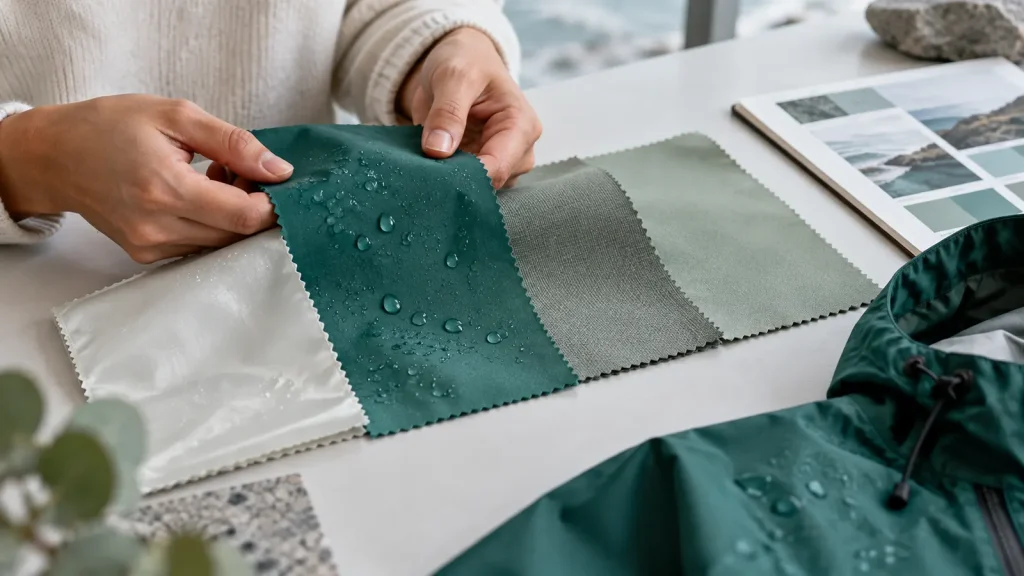
Understand what a polymer name tells you—and what it does not
PE, EVA and PVC are useful starting points for discussing rain ponchos, but none is a complete buying specification. The name identifies a material family. It does not tell you the garment's dimensions, thickness distribution, seam construction, closures or suitability for a particular task. Polyester creates another common source of confusion because it names a textile fiber, while a rainwear proposal may also depend on a coating or laminate. Ask what the actual construction is before comparing two products under the same broad label.
PE means polyethylene. When a supplier proposes a PE rain poncho, ask for the film specification, nominal thickness, measurement approach and finished garment weight, together with dimensions and construction. Do not assume that every lightweight film product has the same handling characteristics. Open the pack and feel how the sample unfolds, where the material gathers and how the seams behave during ordinary movement. The purpose of this review is to identify whether the particular product suits the intended use, rather than to declare an entire polymer family good or bad.
EVA is an ethylene-vinyl acetate copolymer. Formulation matters: Celanese's EVA extrusion guide explains that vinyl acetate content influences characteristics including flexibility and softening behavior. For the buyer, the practical lesson is that “EVA” alone cannot establish how two finished garments will compare. Ask for product-specific information and a sample in the proposed color and construction. If softness, clarity or low-temperature handling matters to your program, describe that need and agree how it will be evaluated. Do not transfer a resin manufacturer's grade data to an unidentified finished raincoat.
PVC is likewise a material description rather than a universal promise of durability or compliance. A quotation should identify whether PVC is being proposed as a film or as part of a coated textile construction. Ask about the complete material formulation and relevant destination requirements through the appropriate technical review. Avoid shorthand claims such as “chemical-free,” which say little about what has actually been assessed. When documentation is offered, connect it to the supplied article and its components. A general statement about a polymer does not replace evidence for a particular finished product.
For polyester rainwear, ask the supplier to describe the base fabric and the system that provides the intended water protection. A fabric name or yarn description should not be treated as a waterproof rating. Construction details, coating or laminate information, seams and closures all belong in the comparison. Request the care instructions for the finished garment and review them against the expected handling. If the program requires repeated folding, cleaning or long periods in storage, include those conditions in the sample discussion so the proposed construction can be assessed meaningfully.
Build a shortlist by application, then compare actual candidates side by side. One buyer may need compact emergency distribution; another may want a reusable branded garment with a particular feel. Both can consider several materials without assuming a fixed hierarchy. Keep the quotation tied to an identified sample and documented specification. The right question is “Which proposed construction meets our agreed requirements?” That question produces a more useful answer than “Which polymer is best?” and gives your purchasing team a defensible basis for choosing between wholesale rainwear options.
Compare film garments with coated textile constructions
Film rainwear and coated textile rainwear can achieve a similar visual outline while behaving differently in the hand and in use. A film garment uses sheet material as a main part of its construction. A coated textile combines a fabric substrate with another layer or treatment, depending on the product. This distinction affects the questions buyers should ask about seams, reinforcement, packing and care. It does not, by itself, establish a quality ranking. Compare complete garments designed for the same use case, and keep each proposal's intended limitations visible.
Start with how the garment is assembled. Ask the supplier to identify the seam method and any reinforcement at closures or other stress points. Examine the relationship between the material and the joining process rather than judging a seam only by its appearance. A neat line on a sample is helpful, but you also need an agreed way to assess integrity and consistency. For textile constructions, discuss how sewn areas are managed where water protection is required. For film constructions, examine the joins and the surrounding material during normal handling and unfolding.
Weight and packed volume deserve separate lines in the comparison. A heavier sample does not necessarily occupy proportionally more space, and a compact pack does not tell you how easy the garment is to use. Ask for packed dimensions of the actual proposed configuration, including any pouch, insert or outer wrapping. Then handle several packs as your staff would. Can they be counted, stacked and distributed efficiently? Will a returned reusable garment fit into its pouch after ordinary drying and folding? A packaging review should answer those practical questions before carton planning begins.
The wearing experience also needs a complete-garment review. Look at how material gathers around the neck, whether the hood moves with the head and whether the garment pulls when the wearer sits. Discuss ventilation and comfort requirements without making unsupported breathability claims. A loose silhouette or an opening may affect comfort, but neither substitutes for defined performance evidence when a specific claim is required. For longer wear, a trial with the actual clothing layers can reveal issues that are difficult to predict from a flat swatch or an attractive catalog photograph.
Branding can change the comparison. Large graphic areas, fine lines and strong color coverage may behave differently on different substrates. Ask which decoration method is proposed for each candidate, then inspect physical print samples. Include folding and handling in the review if the garment will be packed tightly. A procurement team may discover that one construction best supports the desired artwork while another better suits the distribution format. Keep those differences explicit so marketing and operations can agree on the tradeoff before a purchase order commits the business to a particular design.
Use a common evaluation sheet across the shortlist: construction, dimensions, mass or thickness, seam approach, closure, print sample, packed size and care instructions. Add application-specific tests only where they answer a real buying question. Record observations in neutral language, such as “hood restricts turning when worn over the approved cap,” rather than vague labels like “premium” or “poor.” This gives the supplier a clear issue to address and creates a useful comparison record. You can then choose the garment system that fits the program instead of allowing a material category to make the decision for you.
Ask for measurable specifications instead of material superlatives
Words such as “premium,” “heavy duty” and “ultra-light” can be convenient catalog descriptions, but they are weak acceptance criteria. Different suppliers may use the same phrase for very different products. Turn each important claim into an attribute you can identify, measure or verify. If the buying team wants a lightweight rain poncho, agree whether the relevant measure is finished garment mass, packed mass or carrying volume. If it wants durability, identify the use and failure modes that matter before asking for an appropriate test or sample review.
Film thickness is a good example of why units and methods matter. A specification should state the intended unit and the agreed approach to measurement. It should also explain where measurements are taken and what tolerance applies. Without that detail, two reported numbers may appear comparable while describing different sampling practices. Ask the supplier to distinguish nominal material thickness from finished garment weight. The latter can also reflect garment dimensions, closures and other components. Neither measurement should be interpreted in isolation when you are evaluating coverage, handling and commercial value.
For textiles, mass per area, fiber content and construction information can help define the substrate, but they do not replace performance requirements. A quoted fabric weight should have a unit and a clear scope: does it describe the base fabric or the finished coated construction? If a coating or laminate is important to the rainwear specification, identify it in the product record rather than leaving it as an unnamed feature. The supplier may need to provide additional technical information before two offers can be evaluated on an equivalent basis.
Dimensions are equally important. Ask for a measurement diagram showing reference points, not just a list of numbers. Define how the garment is laid out, which closures are fastened and whether a hood or other component is included in a stated length. A broad poncho and a fitted raincoat need different dimension sheets. Request the proposed tolerances and review their effect on the smallest and largest intended wearers. When fit is critical, retain the approved size sample as well as the drawing so later checks have a practical reference.
Commercial language should connect to the specification. Ask for MOQ by design, color and size where relevant, and request Bulk Pricing against the same revision and packing arrangement. If a supplier proposes a lower-cost alternative, have it identified as a separate option with its differences listed. That makes it possible to evaluate a change in material, dimensions or pack format without accidentally approving it as equivalent. A clear comparison protects both sides: the buyer knows what is being quoted, and the supplier knows which attributes must remain consistent in production.
Finally, decide which measurements will actually be checked at each stage. Some belong in the initial sample review; others require production records, laboratory evidence or an agreed inspection plan. Assign an owner and retain the results with the order. Avoid collecting numbers merely because they look technical. Every required attribute should answer a buying question or support a stated claim. A concise specification with clear units, tolerances and evidence is more useful than a long list of impressive terms that nobody can connect to the garment being ordered.
Explore product starting points: EVA rain ponchos, PVC rain ponchos and polyester rainwear. Request the specification and evidence for the exact option you are considering.
03 / 12
Specify water protection as a complete garment system

Distinguish fabric resistance, seam integrity and garment coverage
Water protection depends on the assembled garment, not on a single swatch. Material, seams, openings, hood shape and coverage interact when someone wears rainwear. This is why a fabric test result and a practical fit review answer different questions. A material can perform as expected in its test while a poorly chosen garment allows rain to enter around an opening. Buyers should define the level and type of protection their application needs, then identify which parts of the proposed design and evidence address that requirement.
Begin with the material evidence. ISO 811:2018 describes a hydrostatic pressure method for determining fabric resistance to water penetration. That is useful information about the tested fabric under the stated method; it is not a blanket certification of a finished raincoat. If a quotation includes a water-resistance number, ask for the method, units, sample identity and test conditions. Compare like with like. A result without its context may be impressive on a sales sheet but difficult to use in a technical buying decision.
Next, review seams as a separate part of the system. Ask which seams are present, how they are joined and what evidence supports their intended performance. Pay attention to locations exposed during the planned activity, such as shoulders under backpack straps or areas that bend repeatedly. Do not invent a universal test threshold from a catalog claim. Agree suitable acceptance criteria with the responsible technical reviewer and supplier. Include a clear description of any sealing, joining or reinforcement detail so the production garment can be compared with the approved sample.
Openings need their own review because the wearer changes them constantly. Examine how the front closure is operated, how cuffs sit during movement and whether the hood remains useful when the head turns. Consider the intended clothing layers and any bags or equipment. A large opening may make a garment easy to put on while creating a different coverage tradeoff. The buying team should understand that tradeoff instead of discovering it during distribution. Ask the supplier to demonstrate the proposed garment as it is intended to be worn.
Coverage is also affected by activity. A hem that seems sufficient while standing may rise when the wearer sits or reaches. A backpack can change how a poncho hangs. Wind can expose areas that remain covered in still conditions. Use a controlled sample review that reflects realistic movements without exposing anyone to unnecessary hazards. Record what the garment covers, where it pulls and which adjustments are available. Those observations help you refine dimensions and design details without claiming that an informal demonstration replaces laboratory testing or a required conformity assessment.
The purchase specification should bring these layers together. Identify material requirements, seam construction, closures, dimensions and the evidence needed for the intended claim. State whether an assessment applies to the substrate, a component or the complete garment. Where performance after care or repeated use matters, discuss appropriate conditioning and evaluation with a qualified technical provider. This approach makes a rainwear quotation more transparent. It also helps marketing describe the product accurately, because the wording can be tied to documented features and evidence instead of relying on a broad “waterproof” label alone.
Read a test report in the context of the ordered product
A test report becomes useful when you can connect it to the product you intend to buy. Start with the sample identification: material description, style reference, color, construction and any other details that distinguish the tested item. Check who commissioned the work, which laboratory performed it and when it was completed. A professional-looking document may still describe a different sample. Procurement should ask the supplier to explain the connection clearly and provide supporting identification where the report's wording is too general to establish that connection.
Look at the method and the result together. A standard number tells you which procedure was used; it does not automatically mean that the product has passed every requirement relevant to your market. Some documents report measurements, while others assess a specified limit. Read the conclusion in that context. If the report includes a condition such as testing before or after a particular treatment, preserve that distinction in your comparison. Do not simplify several different results into a single marketing number that loses the conditions under which it was obtained.
Scope is especially important when the garment has several materials or components. A fabric result may not cover fasteners, printed areas, trims or packaging. A chemical assessment may address a defined substance list rather than every possible restriction. Ask your compliance or technical reviewer which evidence is necessary for the destination and intended user. The purchasing file should state what each document supports and what remains outside its scope. This avoids the common mistake of attaching one report to an entire product family without checking whether the variants are actually covered.
Check for changes since the sample was tested. A new material source, different colorant, altered coating, replacement trim or revised print process can create questions about continued applicability. That does not mean every change automatically requires the same response. It means someone competent should evaluate it before the old evidence is reused. Include a change-notification requirement in the order process so the buyer has an opportunity to review substitutions. The supplier should know which characteristics are controlled and who must approve a proposed departure from the accepted specification.
Keep the report review proportionate and organized. Create a register with the document name, date, product reference, assessed attribute and reviewer decision. Note any clarification requested from the supplier or laboratory. If authenticity or scope is uncertain, use the issuer's appropriate verification route rather than relying on a screenshot forwarded through several parties. Store the complete document where relevant colleagues can access it. A single conclusion copied into a spreadsheet is convenient, but the underlying report should remain available when a technical question arises later in the procurement process.
Finally, connect evidence to the language used in the RFQ, purchase order and product description. If your public statement is broader than the evidence, revise the statement or obtain the additional assessment that is needed. Avoid inventing certification marks or treating a supplier's general capability as proof that a particular order is certified. The aim is a traceable chain from requirement to proposed product, from product to evidence, and from evidence to the claim made. That chain is far more valuable to a B2B buyer than a folder full of impressive but unrelated documents.
Plan practical sample checks for rain, movement and wear
A practical sample review gives the buying team a chance to notice problems before they become a bulk-order issue. Plan it around specific questions rather than asking colleagues whether they “like” the garment. Can the intended wearer put it on easily? Does it cover the required clothing and equipment? Do closures operate comfortably? Can staff identify the correct size from the pack? A short, repeatable review provides more useful feedback than an unstructured demonstration in which each person looks at a different feature.
Prepare a sample sheet with the style reference, revision, size, color and date received. Photograph the sample and packaging for identification, then record visible observations in a consistent way. Measure agreed dimensions using the same reference points as the specification. If several candidates are being compared, keep the order of checks the same. This makes differences easier to understand and helps the supplier respond to a particular concern. Preserve the physical sample until the buying decision is complete, especially if later versions are expected to correct identified issues.
Movement checks should reflect ordinary use. For an event poncho, that may include putting it on over everyday clothing, walking, sitting and carrying the expected bag. For a reusable staff garment, the review may include the actual uniform layers and routine reaching movements. Any workplace trial should be planned by the responsible team and kept within safe conditions. Record where fabric pulls, where coverage changes and whether the hood interferes with the task. Ask the wearer to describe the issue in practical terms so the design team can address it.
If water exposure is part of the sample review, agree a controlled method and a clear purpose. An informal observation can help locate a design issue, but it should not be presented as an accredited performance result. Note the setup, duration, garment arrangement and observed entry points so another person can understand what happened. Keep laboratory testing separate when a formal claim or acceptance requirement depends on it. The two approaches complement each other: one can investigate a real wearing concern, while the other provides evidence under a defined technical method.
Handling after use is often overlooked. Follow the supplier's care instructions and assess whether they fit the proposed operating model. Review how the garment is dried, inspected, folded and returned to its pack. Do not improvise harsh cleaning or heat treatments and then treat the outcome as representative of approved use. If the organization needs a particular cleaning process, raise that requirement before approval and ask whether the proposed construction supports it. This is particularly relevant when rainwear will be shared, collected centrally or issued repeatedly by staff.
Close the review with a decision, not a pile of comments. Classify observations as acceptable, requiring clarification or requiring a revised sample. Assign each unresolved issue to an owner and record what evidence will close it. When a replacement sample arrives, verify the requested changes and check that they have not introduced new problems elsewhere. Retain the final approved sample and its record as the reference for the order. A disciplined sample review turns wearer feedback into practical specification improvements and makes the transition to production much easier to manage.
04 / 12
Make sustainable rainwear claims specific and verifiable

Separate recycled content, recyclability and compostability
Sustainable rainwear conversations become more productive when each claim is made specific. Recycled content describes an input to a product. Recyclability concerns what can happen to it after use under relevant collection and processing conditions. Compostability concerns a different end-of-life pathway, with its own requirements and conditions. These ideas are related to environmental purchasing, but they are not interchangeable. A buyer should ask which claim is being made, which component it covers and what evidence supports it before deciding whether the proposal meets the organization's CSR objectives.
For recycled-content rainwear, request the claimed percentage and its basis, together with identification of the relevant material or component. Clarify whether a statement applies to the garment, a particular layer or the packaging. Ask how that information is supported for the proposed product and order. A recycled-paper insert does not establish recycled content in the raincoat itself. Likewise, a claim about one component should not quietly become a claim about the whole packed article. Keep the wording used in supplier documents, internal approvals and customer-facing descriptions consistent in scope.
Recyclability requires a practical destination question: where would the used item go? The FTC's consumer guidance distinguishes recycled-content claims from recycling claims and highlights the importance of understanding what a claim covers. For a procurement team, the useful next step is to speak with the actual waste or recovery provider for the event, school or workplace. Ask whether the complete article is accepted, how it must be separated and what contamination restrictions apply. A theoretical material pathway has limited operational value if there is no available collection route for the actual program.
Compostable and biodegradable language needs equal care. Do not assume that a product described with one term is suitable for a home compost bin, an industrial facility or disposal outdoors. Ask for the exact claim, applicable standard or assessment, tested article and disposal conditions. The FTC's Green Guides explain the need for appropriate substantiation and qualification of environmental claims. Your technical and compliance reviewers should determine whether the proposed wording is suitable for the market. Keep any necessary conditions beside the claim so the audience can understand what is being promised.
Avoid broad comparisons that the evidence cannot support. A product containing recycled material is not automatically the lowest-impact option for every use pattern, and a reusable garment does not deliver repeated use merely because it could be worn again. Procurement can compare specific, documented attributes without asserting a universal environmental winner. If a broader impact comparison is central to the purchasing decision, define its boundaries and obtain an appropriate assessment. Otherwise, describe the features you can verify and the operating practices that the buyer will actually put in place.
Turn the discussion into a claim register. For every proposed statement, record the wording, component, evidence, conditions and approval owner. Include the packaging copy and any website or event messaging that will repeat it. If evidence is missing, keep the statement out of the approved artwork until it has been resolved. This approach gives eco-conscious brands a practical way to evaluate sustainable promotional gifts while avoiding vague promises. It also makes supplier discussions more efficient because both sides can see exactly which fact needs to be established for the order.
Match end-of-life claims to collection and processing conditions
An end-of-life plan begins with the place where the rainwear will actually be used. A festival site, a school trip and an employee program have different opportunities to collect garments and packaging. Ask who controls the waste arrangements, where collection points can be placed and what the contracted provider accepts. Then compare those arrangements with the proposed product. This is an operational design exercise as much as a material selection exercise. A purchasing decision should account for what people are likely to do after the rain stops.
For an event, walk through the exit route and the distribution area. Are there staffed collection points? Can garment returns be separated from food waste and other discarded items? Is there space to store collected material until pickup? Discuss these details with the event operations team before printing a disposal instruction. The wording on a pack must match the system people will encounter. If the garment is intended to be kept and reused, make that instruction clear and provide appropriate care information instead of assuming guests will understand the intended next step.
For a school or organized tour, the decision may depend on whether garments stay with individuals or return to a central stock. A collection system should identify who receives them, how wet items are handled and where unsuitable garments are separated. Reuse requires a care and inspection process appropriate to the product and setting. If the organization cannot provide that process, the purchasing team should reconsider its operating assumptions before presenting reuse as an achieved outcome. The garment's design and the organization's capacity need to support the same plan.
Speak directly with the intended processing provider when a recycling or composting route is proposed. Share the actual material and component information, including printing, closures and packaging where relevant. Ask for a clear acceptance decision and any preparation requirements. Do not rely on a generic symbol or an unrelated product example. Record the provider's response with the buying file so event staff and communications teams can use consistent instructions. If acceptance changes before the program begins, update the instructions rather than allowing outdated environmental messaging to remain on public materials.
Consider how the program will measure what happened. Useful operational records might include quantities distributed, unused packs returned, garments collected for reuse and material accepted by the chosen provider. Keep the categories clear so an item is not counted twice. These records do not automatically constitute a life-cycle assessment or a verified environmental saving, but they can show whether the intended collection system operated. They also help the next purchasing team understand where the plan succeeded and where the product, packaging or collection arrangement needs adjustment.
When no suitable recovery pathway exists, describe that limitation honestly in the internal decision. The team can still compare material use, packaging choices and reuse opportunities without claiming an unavailable disposal benefit. A clear operating plan is more valuable than an attractive but unsupported label. By matching product claims to collection and processing conditions, procurement can give marketing specific, defensible information and give operations a workable process. That makes the sustainability discussion part of the actual rainwear program rather than a separate statement added to the artwork at the last minute.
Turn CSR goals into supplier evidence requirements
CSR goals often arrive in procurement as broad ambitions: reduce waste, increase recycled content or improve product transparency. Translate each ambition into a question that a supplier can answer for a defined rainwear proposal. If the goal concerns recycled material, identify the component and evidence needed. If it concerns reuse, define the intended handling program and durability questions. If it concerns packaging, specify which packaging layers are under review. A focused request produces a more useful supplier response than asking whether a product is simply “eco-friendly.”
Agree who will review the evidence before collecting it. Procurement can coordinate the documents, but sustainability, technical and compliance colleagues may need to assess different aspects. Ask those reviewers to state their acceptance criteria early. This prevents a supplier from preparing one form of evidence only to learn later that the buyer needed something different. Where a certificate or third-party verification is proposed, ask the reviewer to check the scope, relevant product or material, issuer and any applicable conditions. Record the decision without expanding the document's meaning beyond what it supports.
Build environmental requirements into the RFQ alongside performance and commercial requirements. Suppliers should know whether a particular attribute is mandatory, preferred or being explored as an alternative. Request separate proposals when a change affects the material, construction, pack format or MOQ. Keep the baseline specification visible so the team can compare practical tradeoffs. A sustainable option that requires a different operating model may still be useful, but the buyer should understand that dependency before presenting it internally as a direct replacement for an existing product.
Ask how the approved claim will be maintained through production. Which material or component is controlled? How will the supplied lot be identified? What changes require notification? The level of documentation should match the claim and the order, but the principle is simple: evidence reviewed during sourcing must remain relevant to the product delivered. A sample from one construction should not become the basis for claims about a substituted construction without review. Include the environmental attributes in the same change-control process used for dimensions, artwork and other agreed specifications.
Review the language on every customer-facing surface. The product name, pack, insert, carton, website and sales presentation should describe the same approved attributes. If a claim needs a qualification, make sure it remains readable in the final layout. Avoid separating a bold promise from the conditions that make it accurate. Ask the responsible reviewer to approve the actual artwork rather than an isolated sentence in an email. This is particularly useful for promotional rainwear, where a small pack can encourage teams to compress wording until important meaning is lost.
End the CSR review with a documented decision that explains the chosen option and its limits. State which goals the product addresses, which depend on the buyer's operating practices and which remain unresolved. This helps future teams evaluate repeat orders without recreating the entire discussion. It also creates a more credible conversation with the supplier: the objective is a specific rainwear program with traceable attributes, not an undefined promise of sustainability. Bring the same discipline to each reorder so changes in materials, evidence or disposal arrangements are noticed before old claims are reused.
Investigating an environmental brief? Review the biodegradable rain poncho range, then ask for product-specific evidence and the conditions supporting any proposed claim.
For a detailed sustainable purchasing brief, read our Eco-Friendly & Biodegradable Rain Ponchos guide. Compare compostable, recycled-content and reusable options, check product-specific evidence, and plan packaging and collection before approving a bulk order.
05 / 12
Choose disposable or reusable rain ponchos for the operating model
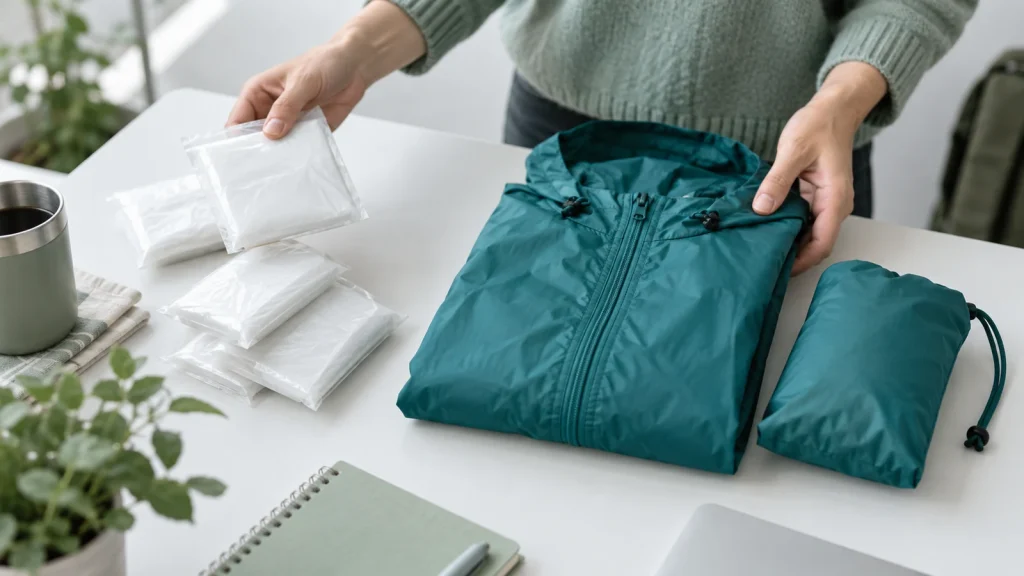
Match useful life to real distribution and recovery behavior
The disposable-versus-reusable decision starts with behavior, not a label. Ask what will happen to the garment after the first use. Will a visitor keep it, will an employee wear it again, or will an organizer collect it? A product intended for repeat use needs a realistic route to that second outing. If that route is absent, purchasing a more substantial garment does not by itself create a reuse program. Map the intended journey from stockroom to wearer and from wearer to its next destination before comparing options.
For bulk disposable ponchos, evaluate the immediate job carefully. The buyer may need emergency cover that can be stored compactly and distributed quickly when rain begins. Review how the pack opens, how the garment is identified and whether the chosen size suits the audience. Consider what staff will do with unused stock after the event. Keeping unopened packs organized and traceable can support future distribution, provided storage and product condition remain appropriate. Do not confuse unused inventory retained for another event with a garment that has already been worn and returned.
Reusable rainwear requires a different conversation about ownership. A branded garment given to an individual may depend on that person following the care instructions and choosing to carry it again. A shared program needs an operator responsible for collection, inspection, drying and storage. These are distinct models with different costs and practical demands. Decide which one you are planning before requesting quotations. The supplier can then discuss suitable construction, packaging and care information without assuming that a generic reusable claim answers every operational question.
Consider the audience's willingness to retain the product. A well-fitting garment with useful coverage and appropriate branding may be more attractive to keep than one chosen mainly for a large print area. That is a design hypothesis to explore through samples and user feedback, not a guaranteed retention rate. Ask a small representative group how they would carry, store and reuse the proposed item. Their answers may reveal that a pouch, clearer care instructions or a different fit matters more than another decorative feature on the garment.
Recovery also affects stock availability. If a program relies on returned garments, procurement needs to understand how many are ready for the next issue and how long preparation takes. Wet items awaiting care are not the same as usable stock. Separate these categories in the inventory plan and allow for damaged or missing items based on actual experience where available. When launching a new program, state the assumptions openly and review them after the first use. Avoid treating an optimistic return estimate as an established operating fact.
Choose the model that your team can run consistently. A mixed approach may be reasonable when different groups have different needs, but document the purpose of each specification. Staff issued regular rainwear and visitors receiving emergency cover do not necessarily need identical garments. Keep the branding coherent while allowing the product choice to reflect the use. Once the operating model is clear, compare the proposed disposable and reusable options against defined requirements, sample evidence and the complete distribution process rather than making a universal claim that one category always wins.
Compare total program cost without relying on unit price alone
A useful cost comparison includes the activities required to make the rainwear program work. The purchase quotation is one part of that picture. Sampling, artwork preparation, packaging, transport, storage, distribution and any planned return process may also affect the budget. Keep these categories visible even when some values are still estimates. This helps the team distinguish supplier pricing from internal operating costs and prevents an apparently attractive offer from being approved before the practical requirements of the program are understood.
Start with a common specification for each option. If one quotation includes individual pouches, printed inserts and sorted cartons while another includes only garments, the totals do not describe equivalent deliverables. Ask suppliers to state inclusions and assumptions. Request Bulk Pricing at relevant quantity bands without publishing unit prices in the buying guide or promotional page. For internal analysis, connect each commercial figure to the exact product revision, quantity mix and delivery basis so colleagues can see what changes when the order scope changes.
Then map handling activities. An event team may need to move cartons to several gates, replenish stock during rain and count leftovers afterward. A reusable program may add collection, care, inspection and reissue. Estimate those activities using information from the people who will perform them. If no reliable data exists, use clearly labeled scenarios rather than a single precise-looking answer. A low, central and high workload estimate can show whether the decision is sensitive to staffing or return behavior without pretending that the future operating cost is already known.
Use a consistent denominator when comparing programs. Depending on the purpose, the team might compare cost per event served, per employee equipped or per confirmed use. Be careful with projected repeat uses: a garment's potential life is not the same as the number of uses your program will achieve. Keep planned and observed figures separate. After the program runs, update the model with actual distribution, returns and replacement information. That makes the next procurement decision better grounded and avoids repeating assumptions that the first event has already disproved.
Include consequences that are difficult to reduce to a single number. Late availability, confusing pack identification or unsuitable fit can create operational disruption even when the invoice is within budget. Describe these risks and the controls proposed to manage them. Do not invent financial savings for avoiding hypothetical failures. Instead, ask whether the selected option supports the deadline, staff workflow and wearer requirements. A cost model should inform the decision alongside practical suitability, rather than hiding important concerns behind a total that appears mathematically complete.
Present the comparison as a decision document. State which costs are quoted, which are estimated, which assumptions drive the result and what information could change the recommendation. If the team chooses a reusable option, identify the conditions needed to achieve the planned use pattern. If it chooses emergency disposable rainwear, explain the distribution and stock-control plan. This gives management a clear basis for approval without turning the discussion into a contest over the lowest visible price. The goal is a rainwear program whose commercial and operational requirements fit together.
Design a reuse program around drying, storage and return rates
A reuse program needs a process owner as well as a product owner. Someone must decide when a returned garment is ready to be issued again, where it is stored and how unsuitable items are removed from usable stock. Define that responsibility before placing the bulk order. The supplier's care instructions should inform the process, and the organization should confirm that it has the facilities and staffing to follow them. A reusable raincoat is only one component of a workable system for repeated distribution.
Create separate handling stages for returned, inspected and ready-to-issue garments. Use clear physical locations or containers so staff do not accidentally treat a wet return as available inventory. The exact layout will depend on the setting, but the categories should be unambiguous. Discuss drying arrangements with the operations team and follow the product's instructions. Avoid assuming that tightly repacking a damp garment is an acceptable shortcut. If a rapid turnaround is essential, include that requirement in the product review and assess whether the proposed care process can support it.
Inspection should focus on the product's intended use and the issues your team can identify reliably. Check the areas specified in the care and acceptance guidance, such as closures, visible damage and relevant construction details. Define what happens when staff are uncertain. A quarantine or review category is often more useful than forcing an immediate pass-or-fail decision by someone without the appropriate information. Keep the process simple enough to be followed during busy periods, while ensuring that garments with unresolved concerns are not quietly returned to circulation.
Storage planning should account for both physical space and identification. Keep variants easy to distinguish, especially when several sizes or branding versions are in use. Follow supplier guidance on storage conditions and avoid unsupported promises about unlimited shelf life. Record receipt dates and batches so stock can be reviewed systematically. If the program uses pouches, test the packing process after the garment has been worn and cared for, not only when it arrives neatly folded from production. The pack should support the real workflow your staff will carry out.
Measure return behavior without making it burdensome. Record how many garments are issued, how many return, how many are ready for another use and why others are unavailable. These categories reveal different problems. Low returns may suggest that the ownership model or collection communication needs changing; a high number awaiting care may indicate a turnaround constraint. Do not use one combined “recovery rate” to hide those distinctions. A small amount of clear operational data can help procurement determine whether to adjust quantities, packaging, staffing or the garment specification.
Review the program after a defined initial period and before a repeat order. Ask staff which steps took longer than expected and ask wearers which features helped or hindered use. Compare those observations with the assumptions used in the original cost and stock plan. Make changes deliberately, keeping the approved specification and care information aligned. A successful reuse program is one your organization can maintain in ordinary conditions, not just during a carefully managed trial. That is the standard against which the product and the operating model should be judged together.
For contingency stock, compare the bulk disposable rain poncho options with the distribution and storage requirements in your brief.
06 / 12
Define industrial rainwear requirements before discussing branding
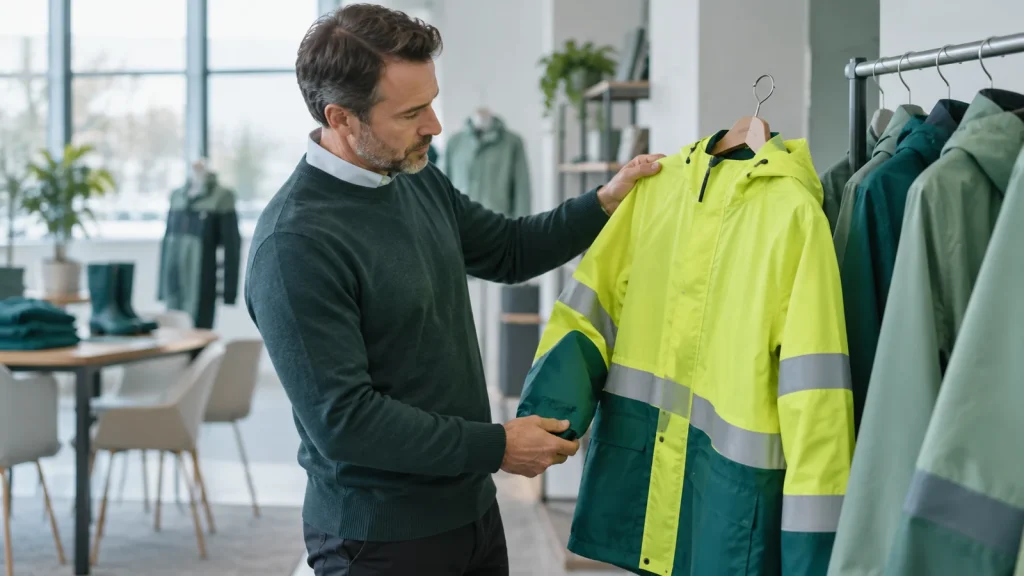
Build the specification from the employer's risk assessment
Industrial rainwear procurement begins with the work, the environment and the employer's assessment of risk. A construction team, a maintenance crew and a logistics workforce may all work outdoors, yet their garment requirements can differ substantially. Purchasing should obtain a clear brief from the responsible safety and operations teams before requesting a workwear quotation. The purpose is to identify what the garment must do, what it must be compatible with and what evidence is required. A generic request for a tough waterproof jacket leaves too many important decisions undefined.
The UK's Health and Safety Executive places PPE selection within a wider process of managing workplace risks. Its guidance describes the need to assess suitability, provide appropriate instructions and maintain equipment. Buyers serving other markets should use the applicable local framework and competent advice. The practical procurement point is that a rainwear supplier should receive requirements derived from the actual task. A product description cannot decide which hazards exist at the workplace or whether rainwear is an adequate control for them. Those decisions belong with the responsible organization and its qualified reviewers.
Turn the assessment into a product brief that is specific enough to quote. Identify the wearer group, tasks, exposure pattern, climate range, required clothing layers and other equipment. State any required performance standards or classifications as defined by the reviewer, with the applicable version and evidence expectations. Avoid adding standards merely because they appear in a competitor's catalog. Unnecessary requirements can complicate sourcing, while missing requirements can make a proposal unsuitable. Each requested feature should have a clear connection to the intended work or a defined procurement obligation.
Ask the operations team where garments are likely to experience repeated contact or strain. Sitting in vehicles, reaching overhead, carrying equipment and entering confined spaces can create different fit and construction questions. Discuss these observations with the supplier during the sample stage. Do not assume that a thicker material automatically solves them. A change in cut, closure arrangement or reinforcement may need evaluation alongside material choice. The approved design should reflect actual use, and any claim about its performance should be supported by appropriate evidence for the identified construction.
Branding should follow the protective specification. A logo or color request may affect garment areas that have a defined function, so involve the technical reviewer before artwork is approved. If a supplier advises that a proposed decoration could affect compliance or performance, ask for a suitable alternative and document the resolution. The commercial team should not treat that advice as a minor cosmetic objection. For industrial orders, the final sample should represent the complete intended article, including decoration and labels, so reviewers can assess what will actually be issued to workers.
Keep approval responsibilities clear throughout the order. Procurement coordinates quotations, samples and documents; the responsible safety and technical personnel determine suitability for the workplace. Record the accepted specification and any restrictions on use, care or modification. Make those instructions available to the team that will issue and maintain the garments. An industrial rainwear order is more reliable when sourcing, approval and use are connected by the same documented requirements. That connection matters more than a broad “industrial strength” label that does not explain the conditions in which the garment is intended to serve.
Keep visibility, weather protection and other PPE claims distinct
Several protective features can appear on one garment, but each claim needs its own basis. Bright color, reflective-looking trim and a hood do not establish that a rain jacket meets every requirement for a particular workplace. Weather protection, visibility and any other protective properties should be identified separately in the specification. Ask the responsible reviewer which claims are necessary for the task and destination. Then ask the supplier to show how the exact proposed article supports each one, including any limitations or conditions that affect its use.
Create a claim matrix before comparing industrial rainwear suppliers. Put the required property in one column, the applicable requirement in another and the evidence requested in a third. Add the product reference and reviewer decision. This prevents one certificate or report from being used as a catch-all answer to several unrelated questions. It also makes gaps visible early. A proposal may be suitable in one respect and unresolved in another; the buying team needs to see that distinction before selecting a sample for final approval or presenting the product to a client.
High-visibility design deserves review at the complete-garment level when such protection is required. Ask how size, layout, closures and any decoration relate to the specified requirements. Do not assume that adding reflective tape to a promotional raincoat makes it appropriate occupational visibility clothing. Equally, a vivid brand color should not be described as a certified visibility feature without supporting evidence. Procurement can help by keeping marketing terminology separate from the technical claim and by requiring the artwork team to work within the approved garment design and any restrictions identified by the reviewer.
Other hazards require separate consideration. A garment selected for rain protection should not be described as protection against chemicals, flame, electrical hazards or other risks unless the relevant suitability and evidence have been established. Avoid using broad phrases such as “all-weather safety” to imply capabilities that were never part of the assessment. When a workforce faces several hazards, the employer's responsible specialists should define the required system. The rainwear supplier can respond to that brief, but purchasing should not fill evidence gaps by borrowing claims from visually similar products.
Labeling and instructions should match the approved claims. Review the actual label layout, product reference, care information and any accompanying documentation with the appropriate person. If different garments in a range have different properties, make sure the identification system prevents them from being confused during issue. A warehouse team should not need to interpret subtle visual differences to determine which item belongs to which application. Clear SKU references and packing information can support the process, provided the organization also gives staff the necessary instructions for selecting and issuing the correct garment.
Before a repeat order, check whether the product, artwork or intended work has changed. A previously accepted jacket may need another review if its construction is revised or if the employer plans to use it in a different role. Keep the claim matrix with the purchasing record and update it deliberately. This makes the next order faster without allowing old assumptions to become permanent. Industrial buyers benefit from precise, limited claims that are easy to trace, because those claims can be communicated consistently from the supplier's proposal through to the person wearing the garment.
Check movement, layering and compatibility during wearer trials
A wearer trial should explore how the proposed rainwear works with the clothing and equipment used for the task. Plan the review with the responsible workplace team, using safe conditions and representative movements. The goal is to discover fit and compatibility issues before bulk approval. It is not an invitation to expose participants to hazards or to replace a required technical assessment. Define the questions in advance and record the sample identity so observations can be connected to the exact size, cut and construction being considered.
Include the intended layers. A jacket tried over a light shirt may behave differently over a winter uniform or other approved clothing. Ask participants to reach, bend, sit and turn in ways relevant to their ordinary work, within the safe trial setup. Observe whether the garment pulls across the shoulders, rides up or restricts access to necessary equipment. Record the movement that creates the issue rather than writing only “too tight.” That detail helps the supplier understand whether the solution concerns dimensions, cut, layering allowance or another part of the design.
Review the hood with whatever head equipment the workplace assessment requires. Check the intended wearing arrangement and ask the responsible reviewer to consider visibility, movement and compatibility. Do not improvise modifications to make a sample fit around equipment. Any proposed change should be evaluated through the same controlled process as the rest of the garment. If the hood's position changes when the wearer turns, note the conditions and ask the supplier for an appropriate design response. A static photograph of the sample cannot answer all of these practical questions.
Closures and pockets should be assessed in the context of the task. Can the wearer operate the required fastenings with the expected hand protection, if applicable? Does accessing a pocket affect garment coverage or interfere with another item? Are adjustments understandable without repeated explanation? The answers will vary with the workplace and product. Use them to refine the brief, not to create a universal checklist of mandatory features. More pockets, straps or fasteners are not automatically better if they add complexity without serving a defined need in the intended application.
Gather feedback from more than one body shape and size where the workforce range requires it. Keep personal information out of the supplier feedback unless it is necessary and appropriately handled; garment observations and anonymized size references are often enough for design discussion. Separate comfort preferences from issues that affect suitability or required protection, and have the responsible reviewer decide how each observation should be resolved. The trial record should show what was accepted, what needs clarification and what requires another sample before the procurement team can proceed.
Use the outcome to improve the specification and issue instructions. If a particular size range or layering arrangement is approved, record it clearly. If some combinations remain unsuitable, do not let them enter the purchasing file as implied alternatives. Review revised samples against the same practical questions and retain the approved reference. A well-run wearer trial gives procurement useful evidence about the working experience while keeping technical responsibility with the appropriate people. It also gives the supplier precise feedback that is much easier to act on than a general request for a more comfortable industrial raincoat.
07 / 12
Plan children's rainwear around fit, supervision and use

Use age and size ranges instead of a one-size promise
Children's rainwear should be selected for the actual group that will wear it. A school, tour organizer or educational supplier may serve a wide range of heights, clothing layers and abilities to manage fastenings. A single age label cannot describe every child's fit, and a broad “one size” claim is rarely a useful procurement specification. Ask for garment measurements, an intended wearer range and samples that can be reviewed through the organization's appropriate process. Keep the emphasis on suitability for the group rather than on simplifying the quotation at any cost.
Begin with the information the school or organization can reasonably provide. Procurement usually needs an estimated size distribution and the intended age range, not identifiable records about individual children. Work with the coordinator to establish quantity bands by size and any expected clothing or bag requirements. The sample review should be arranged by responsible adults under the organization's policies. Do not infer fit from a photograph of an unrelated wearer. A supplier's size chart is a starting point that must be interpreted against the actual garment and the intended use.
Review coverage and movement together. A poncho that is very generous in width may still need a careful length check for smaller wearers. A fitted raincoat may require more size variants to accommodate the group. Ask how the hood sits and how the garment behaves during ordinary walking and sitting. Discuss whether the wearer is expected to carry a backpack underneath or separately. These details affect the size brief and should be resolved before artwork or pack quantities are finalized, because late dimension changes can affect several parts of the order.
Make size identification easy for adults distributing the garments. A clear size reference on the individual pack and master carton can reduce confusion when several classes or tour groups are preparing to leave. If color is used as an additional aid, do not rely on color alone; a written or coded size reference should still be clear to staff. Review the actual label proof with the coordinator. An internal supplier size code that nobody at the school understands can create avoidable delays even when the garments themselves are appropriate.
Allow for the way group numbers change. A school-trip order may need a modest reserve in selected sizes, but the amount should come from the organizer's experience and distribution plan rather than an invented universal percentage. Clarify who holds spare stock and how replacements are issued. If unused packs will remain for later trips, store them with the relevant product and size information. Keep repeat orders tied to the same approved dimension sheet, or review any revised sizing before treating a new supply as equivalent to the earlier garment.
The final approval should record the size range, garment dimensions, intended clothing allowance and the process used to review suitability. Avoid turning this into a promise that a product fits every child of a stated age. Clear limitations are useful to the buying team because they support better distribution decisions. For bulk youth rainwear, the objective is a manageable range that serves the intended group well. A careful size plan can make ordering, packing and trip-day distribution more straightforward while giving responsible adults a clear basis for selecting each garment.
Review closures, trim and packaging with the destination market in mind
Children's rainwear needs a component review that goes beyond choosing cheerful colors. Closures, cords, small parts, labels and packaging should be assessed for the intended users and destination market. Ask the appropriate compliance reviewer to identify the requirements before the sample is approved. The supplier should receive that brief alongside dimensions and artwork. A product described as suitable for adults should not be assumed suitable for children simply because it is made smaller. The intended user changes the questions that the buying team needs to resolve.
Drawstrings are a concrete example. The US Consumer Product Safety Commission identifies specified hood and neck drawstrings in children's upper outerwear as a substantial product hazard and provides detailed guidance on the relevant size ranges and other drawstring requirements. Buyers should consult that current guidance and obtain a product-specific review for US orders. Other destinations may apply different requirements. Do not copy a closure arrangement from a catalog image without checking its suitability. Ask the supplier to propose an appropriate design and have the responsible reviewer assess the complete sample.
Look at fastenings in ordinary use as well as in the compliance review. Can the intended wearer understand how to close the garment, with adult assistance where appropriate? Are staff likely to pull on a component in a way the design does not support? What instructions should accompany distribution? These operational observations help identify questions for the supplier, but they do not replace required product testing. Keep the distinction clear so a successful demonstration at a school office is not mistaken for evidence that every relevant safety requirement has been addressed.
Packaging deserves separate attention because it is handled before the garment is worn. Review the material, opening method, labeling and any required warnings for the destination. Decide whether adults will remove and manage packaging centrally or whether individual packs will be distributed to the group. That decision should inform the pack design and staff instructions. Avoid adding novelty components solely for promotional effect without assessing their suitability for the intended audience. A simple pack that fits the distribution process may serve the program better than a more elaborate format that creates additional handling questions.
Request documentation for the actual proposed product and components. If a report refers to a different style, color or trim, ask the supplier and reviewer to explain whether it applies. Keep the evidence register connected to the approved sample and the order revision. Changes to closures, decoration or packaging should be reviewed before they are accepted as substitutions. The purchasing team can support this by making the change process explicit in supplier communications and by ensuring that the person approving artwork does not inadvertently approve unrelated construction changes at the same time.
For educational suppliers, accurate product descriptions are part of the handoff to schools and organizations. State the intended size range and care or use information supported by the product record. Avoid sweeping terms such as “completely safe” or “non-toxic” without a defined, supportable basis. Give purchasing contacts the information they need to select and manage the product responsibly. A well-documented children's rainwear order combines a clear design brief, relevant evidence and practical distribution instructions, with each part reviewed by the appropriate person before the bulk order is released.
Organize school-trip distribution and replacement stock
Trip-day distribution is easier when it has been planned during procurement. Ask the coordinator how groups assemble, who issues equipment and where spare supplies will be held. Rainwear may be needed quickly, sometimes while staff are managing transport, attendance and other preparations. The pack and carton system should help those adults identify the right items without opening every box. A clear distribution plan also makes the quantity request more accurate because it separates planned issues, spare stock and any garments reserved for staff or accompanying adults.
Pack planning can follow classes, departure groups or another structure the organization already uses. Avoid creating a new coding system that staff must learn under time pressure. Confirm the number of garments per inner group and per master carton, together with size identification and any artwork distinctions. If mixed-size packs are proposed, have the coordinator review whether they simplify or complicate issue. A mixed pack may suit a known group but create confusion when last-minute changes occur. The correct choice depends on the organization's actual process, not on a universal packing rule.
Check the individual pack with the person who will distribute it. Can the size be read easily? Is the opening method clear? Will adults remove the wrapping before giving out the garment? Are care and use instructions available in the required language and format? These questions help the supplier prepare a practical packaging proposal. They also reveal whether printed instructions need to be supplemented by a staff briefing. Packaging can support the process, but it cannot take the place of supervision or the organization's own procedures for the outing.
Create a simple replacement process. Staff should know where spare sizes are held, how an unsuitable or damaged item is separated and who records the replacement. Avoid sending a questionable garment back into usable stock merely to keep the count tidy. The buying team should agree with the coordinator which observations trigger a review and what product information staff need to report. Clear references, such as style and batch identifiers, can make later supplier discussions more useful than a vague message that several ponchos were difficult to use.
After the trip, count unused packs separately from worn returns. If garments are intended for reuse, follow the approved care, inspection and storage process before marking them available for another outing. If the program does not include reuse, manage the remaining items according to the organization's arrangements and the product's supported disposal information. Do not make environmental claims from distribution counts alone. The post-trip record should describe what happened, including sizes that were overstocked or in short supply, so the next order can reflect actual experience.
Use that feedback to refine the range without losing control of the specification. A school may discover that one size is rarely needed or that a different packing split would save staff time. Discuss the change with the supplier and update the relevant dimension, quantity or packaging document. Retain the earlier record for reference, but make the current version unmistakable. Bulk school rainwear works best when product selection and trip operations are treated as one program. The result is a clearer order, more useful stock information and fewer avoidable decisions left to staff on the day of departure.
08 / 12
Connect OEM branding choices with material performance

Choose decoration methods after confirming the substrate
Rainwear branding works best when the print process is selected for the actual material and garment. Do not choose screen printing, heat transfer or another method solely because it produced a good result on a different product. Ask the supplier to identify the proposed substrate, decoration process and any design limitations. Share the intended artwork early enough for a technical discussion. The goal is a branded rainwear sample that looks appropriate and performs as intended, with a production method that can be repeated consistently for the bulk order.
Start with the artwork's practical demands. A simple solid logo, a fine-line illustration and a large pattern place different demands on a printing process. Explain which details are essential and which can be adjusted. Provide the appropriate source artwork and color references, and ask the supplier which file format and preparation it needs. Avoid treating a low-resolution image copied from a presentation as an approved production file. If the design must be redrawn or simplified, have the brand owner review the revision before it becomes the basis for a sample.
Discuss substrate compatibility directly. The supplier should explain why the proposed method is suitable for the identified film or textile construction and which sample checks it recommends. Where heat, pressure, ink or adhesive is involved, ask how the process will be controlled for that product. Do not assume that a familiar decoration name guarantees adhesion or preserves garment performance. Product-specific trials are the useful evidence. Keep a record of the method and sample revision so later artwork or material changes can be evaluated against the same agreed production approach.
Consider print placement as a technical choice as well as a visual one. A large design may cross folds, seams or areas that move frequently. A chest mark may become partly covered by a closure or the way the poncho hangs. Ask the supplier to show the proposed printable area on the garment dimensions, then inspect it on a physical sample. For occupational rainwear, any decoration must also be reviewed against the garment's required protective features. A layout that works for promotional use may not be appropriate for a regulated workwear application.
Look at the relationship between artwork and order complexity. Multiple designs, colorways or size-dependent placements can create additional approvals and production coordination. Ask how MOQ applies to each variant and whether a shared layout could serve the range effectively. This is a commercial discussion about a defined OEM Program, not a reason to accept an unsuitable design. If alternatives are proposed, compare their appearance, sample evidence and operational implications. A simpler graphic can be a strong choice when it remains recognizable and supports the product's intended use.
Treat the first printed sample as a decision point. Review appearance, placement and relevant handling or performance checks before authorizing the final artwork for production. Record any accepted limitation explicitly, such as a required minimum detail size or a placement boundary. The brand team then knows which design rules must remain intact on future orders. By choosing the decoration method after the substrate is confirmed, procurement reduces the chance of approving attractive artwork that cannot be reproduced appropriately on the rainwear construction the organization actually needs.
Approve color, placement and artwork on a physical sample
A digital proof is useful for checking wording and layout, but it cannot show every aspect of print on a finished rain garment. Screen settings, lighting, material transparency and surface texture can affect perception. Use the digital stage to resolve content and positioning questions, then inspect a physical sample for the attributes that matter to the brand. The approval record should identify which decisions were made at each stage. This prevents a signed PDF from being treated as blanket approval of a material or finish the buyer has never seen.
Define the color reference and the acceptable comparison process with the supplier. A brand color code can help communicate intent, but the result still needs evaluation on the proposed substrate. Ask how the base material affects the appearance and whether a different treatment is required to achieve the intended look. Review the sample under agreed viewing conditions rather than comparing photographs taken in unrelated environments. Where exact color control is essential, have the appropriate specialist establish a suitable method and tolerance instead of relying on a subjective promise of a perfect match.
Placement should be measured from clearly defined points. State the print dimensions, orientation and position on the garment drawing. A phrase such as “centered on the front” may be interpreted differently when a poncho has snaps, folds or an asymmetric opening. Confirm whether the placement remains the same across sizes or needs adjustment. The physical sample should show how the design reads when the garment is worn normally. A logo that looks centered on a flat table can appear displaced when the material hangs around the body.
Check small but consequential artwork details. Confirm spelling, contact information, authorized brand marks and the correct design revision. Review negative space, fine lines and any areas that may fill in or become difficult to read at the intended size. If a QR code is part of the approved design, test the printed code on the actual material under realistic viewing conditions and confirm its destination. Do not add a code solely because it looks modern; it should serve a defined purpose and remain usable within the garment's normal folds and movement.
Document approval with photographs and the physical reference. Photographs help identify the sample and communicate comments, but they should not replace the agreed physical standard for color or texture. State exactly what has been approved and list any remaining changes. A sample marked “approved with comments” can be ambiguous if nobody records whether another proof is required. Give each issue an owner and a closing action. This is especially valuable when marketing, procurement and a client agency are all involved and may otherwise assume that another party completed the final check.
Keep production communication concise after approval. Send the final artwork files, placement drawing and reference details together, and make superseded versions clearly obsolete. Ask the supplier to confirm the revision that will be used. If a later change is unavoidable, assess its effect on samples, timing and any evidence before authorizing it. A careful artwork approval process protects the brand's appearance without turning every discussion into a long design exercise. It gives the factory an identifiable target and gives the buyer a clear basis for reviewing the finished branded rainwear.
Protect rainwear function during printing and finishing
Decoration should be assessed as part of the finished product. The buying team may focus on the logo while the technical team focuses on water protection, but both are reviewing the same garment. Ask how the proposed printing or finishing process interacts with the material, seams and other construction details. Identify the checks needed for the actual use. Do not assume that a process approved on an undecorated swatch establishes the performance of a fully printed raincoat after packing, handling or care.
Include normal folding and opening in the sample review. Promotional rainwear may spend much of its life packed tightly before being unfolded quickly. A print area can pass a visual check while flat and still raise questions once the garment is folded along the intended lines. Review the actual packing arrangement, especially where decoration sits against another surface. Ask the supplier which conditions and checks are appropriate for the proposed construction. Keep observations tied to the sample and method rather than making broad claims about every product printed with the same technique.
Consider the care process for reusable garments. The approved print should be reviewed alongside the supplier's care instructions and the buyer's intended operating model. If the organization requires a particular cleaning or drying arrangement, disclose it before the decoration process is finalized. Do not improvise a treatment after approval and assume it is covered. The supplier and technical reviewer need to determine whether the complete garment and decoration system are suitable. Any limitation that affects use should appear in the appropriate instructions, not remain in a private email that operations staff will never see.
For protective workwear, decoration can have implications beyond appearance. Ask the responsible reviewer to consider whether artwork, labels or finishing could affect the required garment properties or identification. Keep the approved placement and process under change control. A last-minute sponsor mark or a larger logo should not be treated as automatically equivalent to the reviewed version. The commercial team can avoid delays by involving the reviewer early and explaining which branding features are essential. That allows the supplier to propose options within the agreed technical boundaries.
Production checks should include the attributes that were important during approval. If the buyer accepted a particular placement tolerance, print appearance or handling result, connect that requirement to the inspection plan. Define how a concern will be recorded and who can authorize a correction. Avoid relying only on a general instruction to “match the sample” when a measurable attribute can be stated clearly. At the same time, retain the physical reference for aspects that are difficult to describe numerically. Written criteria and an identified sample work best together.
Review branding as an investment in a useful product experience. A memorable pattern or distinctive color can support a promotional program, but it should not interfere with the rainwear's intended job. Ask the wearer-focused question at the end of approval: does the complete garment remain easy to put on, move in, care for and pack as planned? When the answer is supported by a well-documented sample review, procurement can proceed with greater clarity. The result is branded rainwear whose visual design and practical function have been developed together rather than approved in separate conversations.
09 / 12
Build a technical EAV specification that suppliers can quote
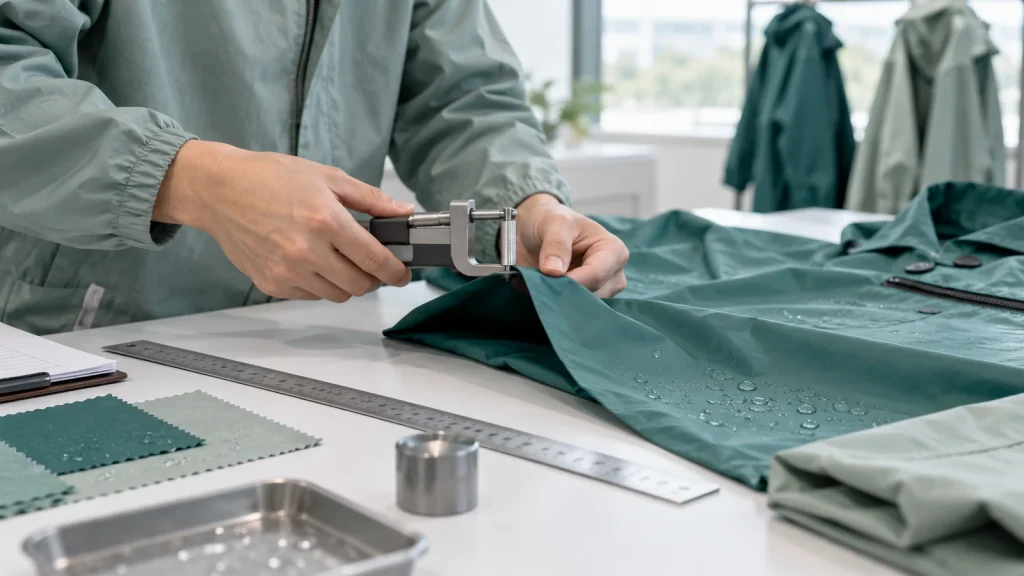
| Entity | Attribute | Specification to confirm | Evidence / approval point |
|---|---|---|---|
| Garment | Material and grade | Named polymer or coated textile construction; agreed blend and substrate details | Supplier specification and approved sample |
| Film or fabric | Thickness / mass | Micrometers for film or g/m² for textile; measurement method and tolerance | Measured sample and agreed inspection plan |
| Garment | Dimensions and fit | Flat measurements, wearer range and layering allowance | Dimension sheet and wearer trial |
| Seam system | Construction and integrity | Seam type, reinforcement and relevant performance criteria | Seam inspection and agreed test evidence |
| Decoration | Artwork and color | Approved artwork revision, placement, size and color tolerance | Physical print sample and signed approval |
| Environmental claim | Scope and conditions | Exact claim, applicable component, percentage or disposal conditions | Relevant valid product-specific evidence |
| Individual pack | Format and information | Pouch or other format, instructions, destination-specific markings | Packaging proof and sample |
| Master carton | Packing and identification | Count, dimensions, gross weight, SKU and lot marking | Packing specification and pre-shipment verification |
Record measurable attributes and agreed tolerances
An EAV specification organizes information as entity, attribute and value. For rainwear procurement, the entity might be the garment, film, seam, printed design or carton. The attribute is the characteristic being controlled, and the value states the agreed requirement. Add an evidence or approval column so the team knows how the requirement will be checked. This format is useful because it replaces scattered descriptions with a structured record. It also makes it easier to see when a quotation answers only part of the buyer's specification.
Write values at the right level of precision. If a dimension matters to fit, identify the reference points, unit and tolerance. If a material characteristic needs measurement, agree the method and sampling approach. Avoid inserting numbers simply to make the document look technical. An unsupported value can create confusion or an unnecessary restriction. Where the requirement is still being developed, mark it as pending sample review and state who will decide it. The specification should distinguish confirmed requirements from proposals, observations and open questions throughout the sourcing process.
Tolerances should reflect the product and the reason for the requirement. Ask the supplier to propose achievable tolerances, then have the responsible reviewer assess whether they are suitable. Do not assume that a tolerance used on an unrelated garment is appropriate here. A variation that is unimportant for one dimension may affect fit or packaging in another. Record the agreed limit with its measurement conditions so both parties can interpret it consistently. This is more useful than adding “approximately” to every number and leaving acceptance to a later disagreement.
Separate measurable attributes from visual reference attributes. Garment length, print dimensions and carton count can often be stated directly. Color, hand feel or a particular surface appearance may require an approved physical standard and an agreed evaluation process. The table should say which reference applies. Avoid allowing a sample to silently override written requirements or vice versa. If there is a difference between the two, resolve it before production and update the documents. The buyer and supplier should be able to identify one coherent approval package.
Use the EAV table during quotation review. Ask each supplier to confirm the requested value, identify deviations and explain any proposed alternative. A blank cell should trigger clarification rather than being treated as agreement. If an alternative changes several linked attributes, show those changes together. For example, a different pack format may affect packed dimensions, carton count and labeling. Keeping the relationships visible helps procurement understand the full proposal and prevents a seemingly small commercial adjustment from creating a hidden operational change elsewhere in the program.
Once the order is approved, control the table as an order document. Give it a revision, date and owner, and reference it in the purchase communication. Record who approved each substantive change and whether another sample or evidence review is needed. The table below is a framework for that discussion, not a declaration of standard product values or guaranteed capabilities. Use it to request an identified rainwear specification from the supplier. A clear EAV record gives purchasing, quality, marketing and operations a common view of what has been agreed and how it will be verified.
Identify which attributes belong to garment, packaging or order
Many sourcing misunderstandings arise because a requirement is attached to the wrong object. A garment's mass is different from its packed mass. A material's claimed recycled content is different from that of the entire product and packaging. A delivery date is an order requirement, not a physical characteristic of the raincoat. An EAV structure helps keep these distinctions visible. Before entering a value, ask what exactly it describes. That question often reveals why two quotations appear to disagree even when the suppliers are describing different parts of the same program.
Garment-level attributes include style, dimensions, closures, construction and the intended size range. Material-level attributes may include composition, thickness or mass per area, with appropriate scope and measurement information. Decoration needs its own reference for artwork, size, placement and approved appearance. These categories interact, but they should remain identifiable. A supplier can then explain how a material change affects the garment or print process without rewriting the entire brief in general language. The buyer can also assign the right reviewer to each proposed change.
Individual packaging has a separate job. It protects or contains the product during the planned handling and communicates information needed at the distribution point. Its attributes might include format, dimensions, opening method, label layout and instructions. Master cartons add count, gross weight, external dimensions, SKU identification and any agreed handling information. Ask for data on the actual proposed packed configuration. A carton estimate based on an earlier garment or a different pouch can be useful during planning, but it should remain clearly labeled as an estimate until confirmed.
Order-level attributes include quantity by variant, destination, timing, delivery basis and the approval sequence. These are essential to a quotation even though they are not visible on the garment. State whether quantity is a firm requirement or an inquiry band. Distinguish the requested arrival date from a proposed production completion date. Identify which approvals must occur before the supplier can confirm a schedule. Keeping these details in the same structured buying file allows commercial and technical teams to see how their decisions affect one another without confusing their responsibilities.
Consider a practical example: marketing requests a larger pouch so it can carry an insert. The garment specification may remain unchanged, but the individual pack dimensions, packed weight and carton arrangement may need revision. That can affect storage and transport planning. If the change is recorded only in an artwork email, procurement may continue using obsolete logistics estimates. An entity-based table makes the affected objects explicit and prompts the team to request updated values. It is a simple way to expose dependencies before they become surprises late in the order.
Use references to connect related entities. The carton record should identify the packed SKU; the packed SKU should identify the garment and artwork revision; the order should identify the approved specification set. The system does not need expensive software to be useful. A controlled spreadsheet or well-maintained document can work if the references are clear and consistently used. The objective is traceability that helps people make decisions. When everyone can tell which value belongs to which part of the rainwear program, quotations become easier to compare and approvals become much less ambiguous.
Use an approval sample to connect the specification to production
The approval sample is the physical reference that helps turn a written specification into a shared understanding. Identify it with the style, size, color, artwork revision and date, and record what has been approved. A sample should not be called final if it still contains unrecorded exceptions. If it uses a temporary trim or a different material color, state that clearly and decide whether another sample is required. The purpose is to create a reliable reference for production and review, not merely to complete an administrative step.
Check the sample against the EAV table systematically. Confirm dimensions using the agreed method, inspect construction and compare decoration with the approved artwork and visual reference. Review the individual pack and carton proposal as applicable. Record results rather than relying on memory. If a value is not yet verifiable, note why and identify the later evidence or inspection that will address it. This keeps the sample review realistic: a single physical item can demonstrate many features, but it cannot by itself prove every claim or establish the consistency of a future production lot.
Resolve conflicts between the sample and documents before approval. A sample with a different closure spacing may look acceptable, but the written drawing should be updated if that arrangement is the one being approved. Conversely, if the sample is incorrect, record the required correction and determine whether a revised sample is necessary. Avoid phrases such as “same as discussed” when the discussion includes several possible versions. The supplier and buyer should be able to identify exactly which construction and documents govern the order without reconstructing a long conversation.
Agree how reference samples will be retained. The buyer and supplier may each need an identified reference, and an inspection provider may need access to the same approval information. Decide which photographs, measurements and documents accompany it. Protect the reference from unnecessary alteration or use so it remains useful during the order. If it is used for a destructive assessment, keep the resulting record and arrange an appropriate replacement reference where needed. A sample's role should be deliberate, especially when it is expected to support later acceptance decisions.
Connect the approval to production change control. The supplier should know which substitutions require review and how to report a proposed departure. The buyer should know who can approve it and whether the change affects evidence, artwork, packaging or timing. A controlled change can be manageable; an undocumented change is much harder to assess after delivery. Keep the decision record with the specification, including the reason, affected references and any conditions. This approach supports practical collaboration without pretending that an initial approval makes all later questions disappear.
At the end of the order, retain the approval package with inspection and delivery records. It can provide a useful baseline for repeat purchases, complaint investigation or future design improvements. Before reusing it, confirm that the intended application and relevant requirements remain the same. A reference sample is valuable because it connects the buyer's expectations to a particular product, but it should not become a substitute for reviewing changed circumstances. Used alongside a clear EAV specification, it gives the OEM Program a practical foundation for consistent communication from the first sample to the next bulk order.
10 / 12
Prepare bulk packaging, storage and delivery requirements

Match pack format to distribution speed and available storage
Packaging should be designed around the moment the rainwear is needed. An event gate, a visitor kiosk, a staff issue desk and a school departure point have different handling requirements. Ask operations to describe how cartons arrive, where they are stored and how individual garments reach the wearer. That sequence should inform the pack format. A compact pouch or novelty container may look appealing, but it needs to support the actual workflow. The best option is the one that makes the approved product easy to identify, handle and distribute in its intended setting.
Start with individual packs. Review the opening method, size information, artwork and any instructions together with the folded garment. Can staff distinguish variants without opening them? Can the wearer find the garment's opening without unnecessary handling? Does the package need to be retained for reuse? Test these questions with a physical sample rather than relying on a flat design proof. If a keychain ball, travel pouch or compact kit is being considered, ask the supplier to confirm the proposed configuration and inspect the complete packed item before approving its dimensions or branding.
Then examine how packs are grouped. Inner quantities can help staff replenish a distribution point without repeatedly counting loose items. Mixed-color or mixed-size cartons may suit some programs but slow others. Ask the operations team whether it needs cartons organized by location, group, SKU or another known system. Keep the packing instructions clear and avoid unnecessary combinations. Every additional packing variant introduces another distinction that production and receiving staff must manage. The objective is a system that can be checked accurately and used without lengthy explanation during a busy period.
Storage constraints should be included early. Ask for estimated and then confirmed packed dimensions so the organization can assess available shelf, cupboard or warehouse space. Do not plan solely from the unfolded garment's apparent size. A pouch, insert or protective outer layer can change the packed configuration. If the stock will move through several locations, review whether the carton and labeling remain practical at each stage. Clear identification is particularly valuable when rainwear is held as contingency stock and the person retrieving it may not be the person who placed the order.
Consider the disposal and reuse plan for packaging separately from that of the garment. A reusable pouch has a different role from wrapping removed by staff before distribution. Environmental statements should identify the relevant component and be supported by appropriate evidence. If packaging is collected centrally, align the instructions with the actual local arrangements. Avoid adding layers that do not serve a defined protective, informational or operational purpose. Equally, do not remove a useful layer solely to simplify a marketing claim without assessing the effect on storage, handling and product condition.
Approve packaging as part of the complete rainwear order. Keep a reference of the packed item, label proof, grouping arrangement and carton markings. If the garment or artwork changes, confirm whether the pack needs revision too. A well-designed pack can help purchasing, logistics and distribution teams work from the same information. It also supports a more professional wearer experience because the product arrives in a format that is understandable and appropriate to the situation. That practical value should be considered alongside the visual appeal of the packaging concept.
Confirm carton information before planning transport
Transport planning needs information about the actual packed order. Request carton dimensions, gross weight, net weight where relevant, count per carton and the total number of cartons for each configuration. Clarify which figures are estimates and when they will be confirmed. A quotation based on preliminary packing information can be useful during sourcing, but it should not silently become the final logistics plan. Keep the packing revision connected to the garment and individual pack specifications so changes can be reflected before collection or shipment is arranged.
Check units and measurement conventions. Dimensions should identify length, width and height in an agreed unit, and weights should be clearly labeled. A receiving team needs to know which SKU and quantity belongs in each carton, especially when the order includes several sizes or artwork versions. Ask the supplier to provide a packing list that matches the agreed structure. If cartons contain mixed items, specify how the mix will be identified. The aim is to make receiving and allocation possible without opening every carton simply to discover what it contains.
Distinguish production completion, dispatch and arrival. These dates are related but they are not interchangeable. Ask the supplier to explain the proposed production timeline and discuss transport arrangements with the responsible logistics provider. State the destination and delivery requirements accurately. If the rainwear supports a fixed event date, work backward from the point at which stock must be available for checking and distribution. Do not treat the event opening time as the latest sensible arrival point. Internal receiving, sorting and contingency planning need their own place in the schedule.
Clarify the commercial delivery basis with the appropriate purchasing and logistics professionals. The order should identify responsibilities for the agreed transport arrangement, required documents and handover points. Avoid assuming that a familiar shipping term answers every practical question about unloading, appointments or delivery access. The receiving location may have its own requirements that need to be shared early. Keep this information in the order file and confirm it with the parties responsible. A supplier cannot plan around a warehouse restriction or special labeling requirement that was never included in the brief.
Review whether a packaging change affects the transport plan. A different pouch, insert or folding arrangement can alter carton count and volume. If marketing adds an item late in the process, request updated packing information before accepting the revised plan as commercially equivalent. This is an example of why cross-functional approval matters: a small design change can have implications outside the artwork file. Record the revised values and tell the logistics team which earlier estimate they replace. That keeps booking and receiving decisions aligned with the product that will actually be shipped.
Before dispatch, reconcile the order, packing list and agreed identification. Confirm quantities by variant and document any approved differences. Use the appropriate inspection and acceptance process rather than relying only on a total carton count. Keep contact and delivery details current, and make sure the receiving team has the information it needs. Accurate carton data does not guarantee an uninterrupted journey, but it gives the people planning transport a sound basis for their work. For wholesale rainwear, that preparation can be especially valuable when the order is tied to a seasonal program or a fixed public event.
Protect material and print quality during storage and handling
Storage requirements belong in the product handover, particularly when rainwear will be held for future events or issued repeatedly. Ask the supplier for guidance specific to the proposed garment, decoration and packaging. Record the conditions and handling instructions that matter to the product. Avoid assuming that every polymer or coated fabric behaves identically in storage, or that an unopened pack can be kept indefinitely without review. The organization should know how to preserve the stock appropriately and how to identify concerns before garments are distributed.
Consider the actual storage location. A central warehouse, a school cupboard, a vehicle and an outdoor event container can expose stock to very different conditions. Share the intended arrangement with the supplier and ask whether it is suitable. If the proposed location cannot meet the product's requirements, resolve that mismatch before ordering a large quantity. It may require a different storage plan, a smaller replenishment cycle or another product configuration. The useful question is whether the stock can be managed appropriately in the real operating environment, not whether the packaging looks robust in a photograph.
Keep identification visible while protecting the packed items from unnecessary handling. Organize stock by style, size, artwork version and receipt or batch reference as appropriate. This helps staff retrieve the correct product and supports investigation if a concern arises. Do not mix unidentified leftover packs with a new delivery simply because they look similar. If older stock is retained, keep its records and review its condition under the organization's agreed process. Clear stock categories make future purchasing more accurate and reduce the chance that obsolete branding or an earlier specification is issued accidentally.
Handle printed garments according to the approved process. Review folding, packing and any relevant care instructions with the people managing returns or repacking. If staff notice transfer, sticking, cracking or another unexpected appearance, separate affected items for assessment and record the circumstances. Do not assume the cause without evidence. The supplier will be better able to investigate when it receives the product reference, storage conditions, photographs and an identified sample where appropriate. A clear record is more useful than a broad complaint that the print quality has changed.
Establish a pre-distribution check proportionate to the program. Confirm that the correct stock has been selected, packs are in appropriate condition and required instructions are available. For reusable stock, verify that the approved care and inspection process has been completed. Do not let the urgency of a rain forecast erase the distinction between ready-to-issue inventory and items awaiting review. The procedure should be simple enough for staff to follow consistently, with a clear route for questions. A small amount of preparation can prevent avoidable confusion at the point of use.
Feed storage and handling observations into the next order. If cartons are difficult to move, labels become hard to identify or a pouch complicates repacking, discuss those issues during the supplier review. Separate product concerns from process issues so the response addresses the right cause. Update the specification and operating instructions together when a change is approved. Rainwear procurement does not end when the cartons arrive; the product's value depends on reaching the wearer in suitable condition. A practical storage and handling plan helps connect the approved sample to that final experience.
11 / 12
Move from supplier comparison to an approved OEM order

Issue a comparable RFQ to avoid hidden specification changes
A good RFQ makes it possible to compare suppliers on the same basis. Send a clear use-case brief, an identified specification revision, quantity bands, artwork requirements, packaging expectations and destination information. State which details are fixed and which alternatives you want explored. Ask suppliers to list assumptions and deviations explicitly. Without that structure, a lower quotation may simply describe a different garment, pack or service scope. The buyer then spends time negotiating figures that were never comparable in the first place.
Give the request enough detail to be useful without pretending every decision is final. If material selection remains open, describe the application and ask for identified alternatives with sample options. If the artwork is provisional, say which aspects may change and ask how that affects quotation validity or timing. Suppliers can respond more accurately when uncertainty is visible. A vague inquiry often produces a vague answer, while an overly rigid request can exclude practical suggestions. The useful middle ground is a defined baseline with clearly labeled questions and optional proposals.
Ask for MOQ in the context of variants. A total order quantity may hide separate requirements by color, print design, size or packaging configuration. Clarify how those requirements apply to the proposed OEM Program. Request Bulk Pricing at quantity bands that reflect realistic purchasing decisions, and specify the commercial inclusions to be compared. Keep public-facing content focused on the buying process rather than displaying unit prices. Internally, each quotation should be traceable to its product specification, quantity mix and delivery basis so the team understands what the offered figures represent.
Require alternatives to be presented separately. If a supplier suggests a different material, garment length or pack to meet a commercial target, ask for a short deviation table. Evaluate the proposal on its practical merits and obtain any necessary sample review. Do not allow the alternative to replace the baseline silently. This protects the supplier as well as the buyer because it creates an explicit decision about what has changed. It also helps management understand whether a cost difference comes from supplier efficiency, order scope or a different product proposition.
Use a comparison sheet that combines commercial and technical status. A quotation can be commercially complete while evidence or fit remains unresolved. Label those gaps rather than forcing every proposal into a single score prematurely. Record response dates, validity periods where stated, sample availability and unanswered questions. Keep communications factual and specific. Asking a supplier to clarify a measurement method or identify the tested product is more productive than sending a general demand for better quality. The clearer the question, the easier it is to judge whether the answer addresses the requirement.
Before selecting a supplier, reconcile the final offer with the approval package. Confirm the current specification, artwork, packing arrangement, quantity split and planned decision points. Make sure any accepted deviation is documented and understood by the relevant stakeholders. The RFQ process should end with an identifiable proposal that can become an order, not a collection of partly overlapping emails. For wholesale rainwear buyers, this discipline creates a cleaner handoff from sourcing to production and gives both parties a common reference when practical questions arise during the OEM Program.
Set sample, approval and production decision points
A rainwear timeline is easier to manage when it is built around decisions rather than a single delivery promise. Identify the stages that must happen before production can proceed: brief confirmation, material or style selection, artwork proof, physical sample review and final approval. Not every order needs the same sequence, but the required steps should be clear. Ask the supplier to explain dependencies and the information it needs at each point. That allows the buyer to plan internal reviews instead of treating approval time as invisible space in the schedule.
Assign one coordinator to collect feedback. Marketing, operations, procurement and technical reviewers may all have legitimate comments, but conflicting instructions can make a sample cycle inefficient. The coordinator should consolidate decisions and identify unresolved issues before sending the response. Keep comments tied to the sample revision and relevant specification. If one team requests a larger print and another requests a different fold, discuss the interaction before asking the supplier to implement both. A coordinated response reduces ambiguity and makes the next sample more likely to answer the team's actual questions.
Define what each approval authorizes. A digital artwork approval may authorize sample printing without authorizing bulk production. A material swatch approval may confirm appearance while leaving garment fit open. State those boundaries explicitly in the record. Avoid using an unqualified “approved” when several aspects remain unresolved. If production authorization depends on technical evidence, packaging or another review, make that dependency visible. The supplier should not need to guess whether a favorable comment from one colleague represents the final decision of the entire buying organization.
Plan for the possibility of revision without presenting it as inevitable. Samples exist to answer questions, and some questions may lead to changes. Ask the supplier how revisions would affect the proposed schedule and which elements are most time-sensitive. The buyer can then prioritize decisions that influence other work. For a fixed event date, review whether the available procurement window supports the desired level of customization and evidence review. If it does not, consider appropriate scope adjustments early rather than assuming every approval can be compressed at the end.
Keep dates attached to named deliverables. “Artwork ready” should mean the correct file and revision are available to the supplier; “sample approved” should mean the required reviewers have completed the agreed checks. Record when each deliverable is actually complete and communicate changes promptly. This makes it easier to distinguish an unanswered buyer decision from a supplier preparation stage. The purpose is practical coordination, not assigning blame. Both parties need a current view of what is ready, what is pending and which next action will move the order forward.
Before releasing the bulk order, conduct a final alignment check. Confirm that the specification, sample, artwork, quantity split, packaging and evidence refer to the same intended product. Verify the commercial and timing assumptions with the appropriate people. Record the authorization in a form that the supplier can identify clearly. A well-managed approval sequence does not eliminate every production risk, but it removes many avoidable ambiguities. It gives the OEM Program a documented starting point and helps the buyer communicate a realistic status to colleagues who depend on the rainwear being available.
Agree evidence, inspection and change-control expectations
Quality expectations should be discussed before production begins. Identify which attributes require documentary evidence, which can be checked on samples and which will be reviewed during or after production. Ask the responsible technical or quality team to define an appropriate inspection approach for the order. Avoid treating a general promise of “strict QC” as a complete plan. The buyer and supplier should understand what will be assessed, against which reference, by whom and how concerns will be resolved before the goods are accepted or released under the agreed process.
Build the inspection criteria from the approved specification. Include the relevant dimensions, construction details, artwork, packaging and identification requirements. Define how observations will be recorded and how acceptance decisions will be made. Where a sampling plan or formal test is needed, have qualified personnel select the appropriate method and criteria. Do not invent a universal inspection threshold that applies to every rainwear order. The suitable approach depends on the product, use, volume and requirements. Keep the plan proportionate while ensuring it addresses the attributes that matter to the buyer's application.
Evidence should remain connected to the ordered construction. Maintain a register of relevant reports, approvals and supplier declarations, with scope and product references. If a document covers only one component or a defined test, preserve that limitation. Ask how the supplied lot will be identified and what records will accompany the delivery. The objective is to make a later question answerable. A file containing unrelated certificates may look complete but provide little help when the buyer needs to establish which material, artwork or construction was used in a particular shipment.
Agree a straightforward change process. The supplier should notify the buyer before substituting controlled materials, components, artwork or packaging. The buyer should identify who can approve a change and what supporting information is needed. Assess the effect on performance, evidence, appearance, logistics and timing as relevant. Record the final decision and the documents it replaces. Changes are sometimes necessary, but they should be deliberate and visible. An informal instruction from someone without the relevant approval role can create uncertainty for the supplier and the receiving team alike.
Define how problems will be communicated. A useful report identifies the order, SKU, batch or carton reference, observed issue and supporting photographs or measurements. Avoid jumping immediately from an observation to an assumed cause. Give the supplier enough information to investigate and agree what happens to affected stock while the question is reviewed. Keep the resolution documented, including any rework, replacement or other action agreed through the normal commercial process. The buying guide cannot prescribe a remedy for every situation, but it can encourage an orderly process that both parties understand.
Use the completed order as a source of improvement. Compare inspection results, receiving observations and wearer feedback with the original requirements. Identify whether a concern arose from the specification, production execution or the operating process. Update the next RFQ accordingly, while retaining the records that explain the change. This closes the loop between product expertise and purchasing practice. A strong supplier relationship is supported by clear evidence and decisions, because those allow both sides to address real issues precisely and build a more consistent rainwear program over successive bulk orders.
12 / 12
Answer the buyer questions that determine the final specification

Which material, thickness and construction should we request?
Request a material and construction that can be evaluated against your use case, rather than starting with a universal thickness target. Tell the supplier who will wear the rainwear, for how long, over which clothing and in what activities. Explain whether the program concerns emergency distribution, planned repeat use or occupational protection. Ask for identified proposals and samples. A useful answer should connect the recommended product to those requirements and disclose any assumptions. It should not rely only on a claim that one polymer is always better than the others.
If you are comparing PE and EVA rain ponchos, ask for the actual film specification, garment dimensions, seam approach, closures and packed configuration. Review the samples in the way they will be handled and worn. The material family alone does not settle the buying decision. If PVC or coated polyester is proposed, request the same level of construction detail, including the relevant substrate and coating information where applicable. Keep the comparison focused on complete products serving the same purpose so that a difference in size or pack format does not masquerade as a material advantage.
Thickness should be defined with a unit, method and tolerance when it is a controlled attribute. Ask where it is measured and how the reported value relates to the finished item. For textile constructions, clarify the scope of any mass-per-area value and request the performance evidence required for the intended claim. Do not use thickness or weight as a shortcut for every aspect of quality. A garment's useful performance also depends on its design, construction, fit, care and the conditions in which the buyer intends it to be used.
For weather protection, distinguish the material result from the complete garment. Ask what evidence addresses the substrate and what review addresses seams, openings and coverage. A hydrostatic-pressure fabric test can support a defined material assessment; it does not automatically describe all aspects of wearing a finished raincoat. The responsible technical reviewer should determine which tests and acceptance criteria are appropriate. Complement that work with a structured sample review of ordinary movement and fit. Keep informal observations and formal evidence clearly identified so neither is asked to prove more than it can.
For sustainable options, specify the exact attribute you want to investigate. Recycled content, a supported compostability claim and a practical reuse program answer different questions. Ask for evidence and conditions relevant to the proposed product, then compare them with your organization's actual handling and recovery arrangements. Avoid requesting a vague “green material” and assuming the supplier will interpret your CSR goal correctly. A precise request gives the supplier a fair chance to propose a suitable option and gives your internal reviewers a clear basis for deciding whether it meets the brief.
The most useful first request is often a short application brief followed by a structured comparison of two or three identified candidates. Ask each proposal to include the specification, sample options, relevant evidence, MOQ by variant and packing details. Use the sample review to resolve fit, feel and practical handling questions before finalizing the order. This approach leaves room for supplier expertise while keeping the decision under the buyer's control. The result should be a chosen construction with documented reasons, not a material name selected because it appears most often in a search result.
What MOQ, customization and timing information belongs in an RFQ?
An effective rainwear RFQ includes the quantity range, variants, destination, intended use, branding requirements and the date by which stock must be available. Ask for MOQ in relation to the actual configuration: design, color, size and packaging can each affect how an order is organized. Do not assume that one headline minimum applies to every customized option. Request clarification where the supplier's response is general. The commercial discussion becomes more useful when both parties are referring to the same product, artwork revision and quantity split.
Customization information should describe the result you need while allowing the supplier to propose a suitable method. Provide approved or clearly labeled provisional artwork, color references, print dimensions and placement expectations. Explain any essential brand rules and ask about technical limitations on the proposed material. If a special pouch, insert or compact container is required, include it in the request from the beginning. Packaging is part of the order scope, not a detail that can always be added later without affecting dimensions, approvals, quantity requirements or the production plan.
Ask for Bulk Pricing against realistic quantity bands and a clearly stated commercial scope. The quotation should identify inclusions, assumptions and proposed alternatives. Keep any internal cost comparison tied to the same specification so the team can understand why figures differ. A lower offer is not directly comparable if it uses a smaller garment, different material or simpler pack. Request a deviation table when necessary. This gives procurement a cleaner basis for negotiation and helps management evaluate an alternative as a conscious product decision rather than an unexplained change in price.
Timing should separate supplier preparation from buyer approval and transport. Ask for an outline covering samples, artwork review, production and the relevant dispatch or handover stage. State the required destination and when the receiving team needs stock for checking and allocation. If the program supports a fixed event, explain that context early. Do not ask the supplier to confirm a complete schedule while important material, artwork or packaging decisions remain hidden. Identify the assumptions behind the proposed dates and update the plan when those assumptions change.
Include evidence and inspection expectations that are relevant to the product and market. The supplier should know whether the buyer requires particular reports, documentation, labeling or an independent review before order release. Ask qualified colleagues to define those requirements rather than assembling an arbitrary list of standards. If the intended use involves children's products or occupational protection, make the responsible review process clear. A complete RFQ helps avoid late discoveries that an attractive sample still lacks information needed for the buyer's actual approval and distribution process.
End the request with a clear response format and next step. Ask the supplier to confirm the proposed specification, identify open questions and explain what is needed to prepare a sample or firm quotation. Name the buying contact who will consolidate feedback, and keep a revision record for attachments. A well-structured RFQ does not need to be complicated. It needs to make the intended product and decision process understandable. That is how MOQ, OEM Program options, Bulk Pricing and timing can be discussed as connected parts of a viable wholesale rainwear order.
How do we verify claims and move from samples to a bulk order?
Move forward when the proposed product, evidence and approval record describe the same article. Start by checking sample identity, specification revision, artwork and packaging. Review relevant reports for scope, method, date and the connection to the ordered construction. Ask the appropriate technical or compliance reviewer to resolve questions that procurement cannot assess alone. A supplier's general experience or an unrelated certificate should not be treated as proof of a particular product claim. The objective is a clear basis for approval, with any limitations understood before the bulk order is authorized.
Use a claim register to keep the review manageable. List each statement that matters to the purchase, such as an identified performance result or a specific environmental attribute. Record the supporting evidence, applicable component, conditions and reviewer decision. Compare this register with the actual wording on labels, packaging and product descriptions. If a public claim is broader than the evidence, revise the wording or obtain the additional assessment needed. This method helps marketing and procurement work from the same facts instead of maintaining separate versions of the product story.
Review the physical sample against the intended use. Check agreed dimensions, construction, closure operation, artwork and packed format. Gather practical feedback from the people responsible for distribution and, where appropriate, representative wearers through an approved process. Record observations and resolve required changes. Do not let a favorable overall impression obscure a specific unresolved issue. If the sample differs from the written specification, decide which version is intended and update the approval package. The supplier should receive a coherent final instruction rather than several documents that contradict one another.
Before production authorization, confirm the commercial and operational details. The order should identify quantity by variant, accepted specification, final artwork, packaging, delivery basis and planned timing. Agree the relevant inspection approach and how proposed substitutions will be handled. State who can approve changes and what evidence is required. Keep the approved sample and records available to the people reviewing production and receiving stock. This gives both parties a practical reference when a question arises and reduces the chance that an informal conversation becomes an undocumented change to the order.
After delivery, compare the received goods with the agreed process and records. Separate any items requiring review, document the concern precisely and follow the agreed communication route. Collect feedback from distribution and use so the next order can address real experience. Keep environmental or performance claims tied to their evidence rather than expanding them because the first delivery went smoothly. A successful order can support confidence in the working relationship, but each new specification or application still deserves an appropriate review of what has changed and what remains applicable.
When you are ready to discuss a program, share the use case, destination, quantity range, material shortlist, branding files and required availability date. Include any unresolved technical or CSR questions so they can be addressed at the sample stage. Ask for an identified proposal and the information needed to evaluate it. This is the practical bridge from research to procurement: a clear brief, relevant samples, evidence matched to claims and a documented approval. Use the contact button below to start that conversation about your wholesale rainwear requirements and the next step for your OEM Program.