
Rainwear packaging · A practical guide for bulk buyers
Innovative Packaging for Rain Ponchos: Balls, Pouches, and Compact Kits
The right poncho can still be difficult to issue, carry or sell when its packaging gets in the way. A ball case, travel pouch or compact kit should solve a specific handling problem. Use this guide to compare formats, define the packed sample and connect branding with the practical work of shipping, receiving and distribution.
Choose the format. Approve the filled pack. Connect presentation with practical distribution.
01 / 12
Choose rain poncho packaging around the distribution job

Define what happens before, during and after the handout
A packaging decision starts with a person doing a job. Picture the colleague opening a master carton, the staff member handing out a poncho and the wearer trying to use it when rain arrives. Each person needs something different from the same pack. A purchasing brief that describes those moments gives a supplier more useful direction than a request for an attractive container. Write the sequence down before choosing a ball case, travel pouch or compact rain gear kit.
Begin with storage and preparation. Will unopened stock sit in a warehouse, travel between events or arrive at a temporary venue shortly before distribution? Identify who counts it and how they distinguish sizes, colours and artwork versions. A pack that hides every identifying detail may look tidy but require staff to open items simply to sort them. Decide which information must be visible at individual, inner-pack and carton level. The aim is to make the correct item recognisable without disturbing its presentation.
Next describe the issue point. A staffed corporate registration desk has different constraints from a busy outdoor gate. Staff may have room to explain a pouch, or they may need to pass a sealed pack across a narrow counter quickly. Ask the event team about available space, wet surfaces and replenishment access. Do not invent a universal distribution speed. Use a small rehearsal with representative packs to discover whether the proposed format suits the actual arrangement and the people who will operate it.
Consider what the wearer carries already. A visitor holding a bag and phone may appreciate a pack that is easy to grip and identify. A commuting employee might prefer a pouch that fits a familiar compartment. A clip can be useful only if its attachment and intended use have been considered; it is not automatically a suitable connection for every bag or activity. Describe the carrying situation in the brief and check it with a filled sample rather than judging an empty accessory.
The opening sequence deserves its own review. Can the recipient recognise where to open the pack, remove the garment without snagging it and understand which way the poncho unfolds? If instructions are needed, decide where they belong and who approves their wording. A small novelty case should not become a puzzle at the moment it is needed. Ask someone unfamiliar with the sample to try the sequence, observe the difficulties and record changes without turning an informal trial into a performance claim.
Finally, define what happens after use. A reusable garment may need a practical drying and storage routine before it returns to its pouch. An event handout may require a clearly organised collection route or ordinary disposal information appropriate to the destination. Do not assume that the packaging creates a reuse system by itself. Name the people responsible for any managed return process and check whether the chosen container supports their work. That decision affects the packing format, instructions and quantity of spare containers.
Bring these observations into one short use statement: who receives the pack, how it is issued, where it is carried, how it opens and what happens afterwards. Include the destination market and intended audience so technical questions reach the right reviewer. This statement becomes the starting point for the OEM Program. It lets suppliers propose packaging against a defined need and gives your team a fair basis for deciding whether an appealing design also works in practice.
Compare a ball, pouch and compact kit against the same brief
A fair packaging comparison holds the rainwear requirement steady. If one sample contains a thin emergency poncho and another contains a larger reusable coat, the difference in packed size does not tell you which container is more efficient. First identify the garment, accessories and information that every option must accommodate. Then compare the ball case, pouch and kit against that common contents list. Where the contents genuinely differ, show the difference clearly instead of presenting the options as interchangeable packages.
Give each format a clear reason to be considered. A spherical case might support a distinctive promotional presentation or an attachment feature. A flexible pouch might fit a particular bag compartment or make later repacking easier. A compact kit might organise several agreed components for a staff or visitor programme. These are possible uses, not guaranteed advantages. Ask the supplier to demonstrate the proposed benefit with the actual filled sample, including the final closure, insert and decoration rather than an idealised empty shell.
Build a comparison sheet around decisions your organisation can assess. Useful columns include filled dimensions, mass, opening sequence, identification, carrying method, repacking expectations, artwork area, carton arrangement and approval work. Add a field for unresolved questions. Avoid awarding a format a high score simply because its shape looks different. A novelty feature matters only when it supports the campaign or use requirement. Equally, a familiar flat pack should not be dismissed if it solves the distribution problem with fewer handling steps.
Ask for commercial scope on the same basis. The quotation should identify the garment, container, decoration, inserts, assembly and outer packing included in each option. Clarify whether an attachment, custom colour or printed card is part of the proposal. An apparently simpler offer may omit work that another supplier has included. Keep the actual amounts in the private Bulk Pricing comparison and use the public product brief to describe requirements. This prevents a headline figure from replacing a clear description of the packed order.
Review the sample-development burden as well as the eventual presentation. A custom moulded shape, a new pouch construction and a stock container with revised artwork can require different preparation. Ask what must be approved before production can proceed, which changes affect the minimum order and how revisions are handled. Do not assume that a standard-looking case is available in every colour or that a simple print can be applied anywhere on its surface. The supplier's proposal needs to explain its actual route.
Use an illustrative comparison meeting to expose competing priorities. Marketing may prefer the spherical case because it is recognisable on a desk, while operations may prefer a pouch that stacks neatly in a shallow drawer. Both observations can be valid. Put the campaign objective and distribution constraints beside the samples, then decide which requirement takes priority. If two formats are retained for different channels, keep their specifications and quantities separate so the purchasing order does not blur them into one undefined product.
Finish the comparison with a reasoned selection, not a list of favourite features. Record the chosen format, the requirements it meets, the compromises accepted and the evidence still needed. Keep rejected options for reference without leaving them in the current production brief. A supplier should be able to read the final decision and understand exactly which packed configuration is being developed. That clarity makes later discussion of dimensions, printing, MOQ and delivery much more productive.
Use a sample journey to expose packaging friction
The most revealing packaging review follows the sample through the work it is meant to support. Start with a closed carton and finish with the garment in use or returned to storage, as appropriate. Invite the colleagues who handle those stages rather than asking only the person who approved the artwork. A sample journey is a practical rehearsal, not a formal certification test. Its purpose is to reveal avoidable handling problems while the pack can still be revised without disrupting bulk production.
Prepare the rehearsal with a short script. Specify the assumed delivery condition, the number and type of variants being represented, the issue location and the expected user. Use clearly identified samples so observations can be traced to the correct version. If a printed label or final insert is not ready, mark that limitation in the record. An unfinished pack can still answer useful questions, but the team should know which parts of the eventual experience remain untested.
At receiving, ask someone to identify the contents from the outer information. Can they find the required colour or sponsor version without opening several cartons? Is the pack count obvious, and does the arrangement make a discrepancy noticeable? Record what the person actually does rather than what the designer expected them to do. If they need an explanation, decide whether that explanation belongs in warehouse instructions, on an inner label or in a simpler packing arrangement. Different problems require different fixes.
At the issue point, observe how staff open the transport packaging and replenish the working stock. A large master carton may be suitable for shipping yet awkward to place behind a narrow desk. A smaller inner pack might solve that problem, but it adds another component and must be specified. Check whether empty wrappers accumulate where staff need to work. Discuss these observations with the operations team before asking the supplier to add more packaging simply to make the presentation appear complete.
For the wearer stage, provide only the information that will actually accompany the product. Ask a representative adult reviewer to locate the opening, remove the rainwear and unfold it. Avoid coaching every movement, because that hides the very confusion the exercise is meant to reveal. Where the intended audience includes children or people with particular access needs, arrange an appropriate review through the responsible team. Do not treat a convenient office trial as evidence that every audience can use the pack successfully.
If reuse is part of the brief, include the return step using the garment's agreed care and storage instructions. Check whether the pouch can accommodate the garment after an ordinary fold, rather than only after a skilled factory pack. Record any difference between initial presentation and later storage. A container might be suitable for the first handout but unsuitable for routine repacking. That finding does not automatically reject it; it tells the buyer which promise the packaging can honestly support.
Close the rehearsal with a small action register. For each issue, identify the sample, observation, proposed change, decision owner and evidence needed to close it. Repeat only the affected parts after a revision unless the change alters the wider sequence. Keep the approved journey with the packing specification so future orders can use the same reference. This turns subjective comments about convenience into practical instructions that a supplier, warehouse colleague and event team can all understand.
Connect packaging decisions with the complete purchase through our Wholesale Rainwear Buyer’s Guide to Sourcing, Branding and Logistics. Bring the approved filled pack into the same plan as the garment, decoration and delivery requirements.
02 / 12
Evaluate rain poncho ball wholesale options with a packed sample

Check the complete case, closure and attachment
A rain poncho ball is more than a round outer shape. The proposed product includes the case material, the way its parts connect, the closure, any carrying attachment and the folded garment inside. Ask for a complete sample of that combination. A photograph of an empty shell cannot show whether the packed poncho interferes with the closure or whether the attachment is comfortable in the intended carrying position. Review the finished unit before approving a bulk order or a promotional artwork layout.
Identify the case construction in the specification. Is it made from two separate halves, a hinged arrangement or another design? Ask the supplier to describe the material and the surfaces that engage when it closes. Record the relevant dimensions and the agreed appearance criteria. Do not infer strength or environmental characteristics from a glossy finish. The purchasing team needs a factual description that can be connected to the sample and any evidence requested for the destination market and intended audience.
Open and close the filled case using the intended sequence. Check whether the garment is easy to remove, whether folds become trapped at the join and whether the case gives a clear indication that it is closed. Describe any difficulty precisely. A comment that the lid feels wrong is less useful than a note that the packed film must be pushed away from one edge before the halves engage. The latter observation gives the supplier a specific fit or packing question to resolve.
Examine the connection between the case and its attachment. A ring, loop, cord or clip should be reviewed as part of the complete arrangement rather than as a decorative extra. Explain how the recipient is expected to carry it and ask the technical reviewer what assessment is appropriate. Do not describe an attachment as load-bearing or suitable for safety use without product-specific evidence. Its ordinary promotional carrying role should be clear in the brief, sample review and any accompanying instructions.
Consider the surfaces people touch. Review edges, joins and accessible components through the appropriate product assessment, and record visible inconsistencies against the agreed reference. The informal purchasing review can identify concerns, but it does not replace specialist safety evaluation where that is needed. Keep those roles separate. A neat sample and a smooth opening movement are useful observations; they are not a basis for declaring the whole product safe for every age group, destination or foreseeable use.
Ask how the supplier will keep the approved configuration consistent. A change to the closure, attachment or internal packing can affect the way the ball functions even if the outside colour remains unchanged. Include these details in the sample register and require proposed substitutions to be identified before acceptance. If several case colours are ordered, confirm whether they share the same construction and which variants need separate review. Familiar appearance should not conceal an unreviewed difference in the finished pack.
Your release reference should therefore contain a filled case, its attachment, the current packing method and the written specification. Add photographs that show the open and closed arrangement, but retain the physical reference where practical. The buyer can then compare production samples with something more useful than a sales image. This makes rain poncho ball wholesale discussions concrete: the supplier knows which combination is being quoted, approved and inspected, and the buyer knows which details remain conditional.
Separate compact presentation from realistic reuse
A small spherical case can make a poncho easy to present as a single promotional item. That does not automatically mean the wearer can return the garment to the same case after use. Initial factory folding and later user repacking are different operations. Decide which one matters to your programme and describe it honestly. If the pack is intended mainly for the first issue, the design review differs from a programme that expects the case to remain useful through repeated carrying and storage.
Start with the actual garment. Its dimensions, construction, closures and decoration influence the folded shape. A case that fits one reference poncho may not fit a revised version with a larger hood or additional features. Ask the supplier to identify the exact garment used for the packing trial. Keep its revision connected to the case specification. Otherwise, a purchasing team can approve the container and garment separately, only to discover that the final combination requires a different fold or no longer closes reliably.
Review the initial folding method with enough detail to reproduce it. A simple sequence of photographs can show orientation, fold order and the position of the opening within the case. Record any insert or protective layer used. Do not require unnecessary compression merely to achieve an impressive diameter. Ask the technical team whether the proposed packing method affects the garment, print or closures, and assess the resulting unpacked sample. The smallest possible volume is not necessarily the most useful commercial configuration.
For a reuse claim, ask an unfamiliar reviewer to repack the garment after an ordinary handling cycle under the agreed conditions. Give them only the instructions the recipient would receive. Record whether the task is understandable and whether the case closes without excessive manipulation. Keep this as a usability observation, with its limits stated internally. A successful office demonstration does not establish a universal service life, but it can reveal whether the proposed promise depends on a folding technique most recipients will never learn.
Keep drying and storage separate from the shape of the container. Follow the garment supplier's appropriate care instructions and define when the item may return to storage. A closed case should not be advertised as solving wet-garment management merely because it prevents visible drips on a desk. If the programme needs temporary transport of a used garment, review that specific arrangement and its instructions. Avoid creating an implied long-term storage recommendation from an attractive photograph of a tightly packed poncho.
Discuss the role of the empty case after the first use. Some campaigns may value it as a retained branded object, but retention should not be assumed or translated into an unsupported environmental benefit. Ask whether the recipient has a practical reason to keep it and whether the programme provides any return or reuse arrangement. A larger number of components can add handling decisions. The buyer should choose those components because they serve the intended experience, not because every extra part seems like a promotional opportunity.
Record the agreed claim in plain language. The pack might be described as a compact carrying case for the supplied folded poncho, with any reuse expectations explained through appropriate instructions. If routine repacking is essential and the ball does not support it, compare a roomier pouch before freezing the design. This preserves the appeal of a distinctive format while keeping the commercial proposal connected to what the sample actually demonstrates. Buyers can then approve the presentation without accidentally promising more than the product supports.
Plan storage and issue without relying on the novelty shape
The distinctive shape of a poncho ball can be useful in a promotional concept, but operations still need a stable way to store, count and issue the units. Begin with the place where the stock will wait before distribution. A shallow drawer, open counter bin and transport carton create different handling conditions. Ask the team to try representative filled cases in that location. The question is whether the format works within the planned system, not whether it looks appealing when one sample sits on a desk.
Define how individual units are grouped. Loose cases, partitioned cartons and inner packs each create a different counting and replenishment process. Ask the supplier to show the proposed arrangement with the actual attachment in place. Clips or cords can change how neighbouring units sit together. If separators are proposed, review their purpose and the extra handling they introduce. Do not assume that adding a divider improves every order; it should address a specific protection, presentation or counting requirement that the buyer can explain.
Consider the working surface at the issue point. Staff may need a tray or contained bin rather than a pile of loose spherical cases. Test how easily they can reach one unit without disturbing the others, particularly when the table is busy with tickets or other promotional items. Keep any fixture dimensions in the distribution plan. A container that works well in a display may become inconvenient when a different venue uses a narrow temporary desk, so avoid treating one successful setup as universal.
Make the variant identification visible. If the case hides the garment, staff need a reliable way to distinguish the intended size, colour or sponsor version. A case colour may help, but it should not be the only reference where confusion would affect the order. Agree a suitable identifier and connect it to the packing list. Check the final artwork and label position on the filled case, because a small mark that is clear in a design file may be hard to locate in a full carton.
Plan replenishment before the event. Decide which team opens master cartons, where reserve stock stays and how empty packaging leaves the working area. A handout process can stall because replenishment stock is inaccessible even when the individual case is easy to use. Use realistic inner quantities that the staff can handle and count within their setup. The required quantities are project decisions, not universal recommendations. Ask operations to approve them alongside the purchasing and branding teams.
Include unused stock in the plan. After a campaign, remaining cases may return to storage, transfer to another venue or require revised identification for a later event. Keep batches and artwork versions distinguishable. Avoid mixing similar cases into an unlabelled container simply because the event has ended. The next team needs to know what garment and message each unit contains. A clear returns record can prevent unnecessary opening and repacking when the stock is considered for another authorised use.
The final packing approval should show the individual case, its inner grouping and the master carton as one system. Add the distribution instructions that explain how the venue will use that system. This gives your rain poncho ball wholesale enquiry a practical foundation and helps the supplier quote the work actually required. Novelty can support the campaign, but a coherent packing arrangement is what lets the campaign team receive the goods, find the correct units and put them into people's hands.
03 / 12
Specify travel pouch raincoats for practical carrying and repacking
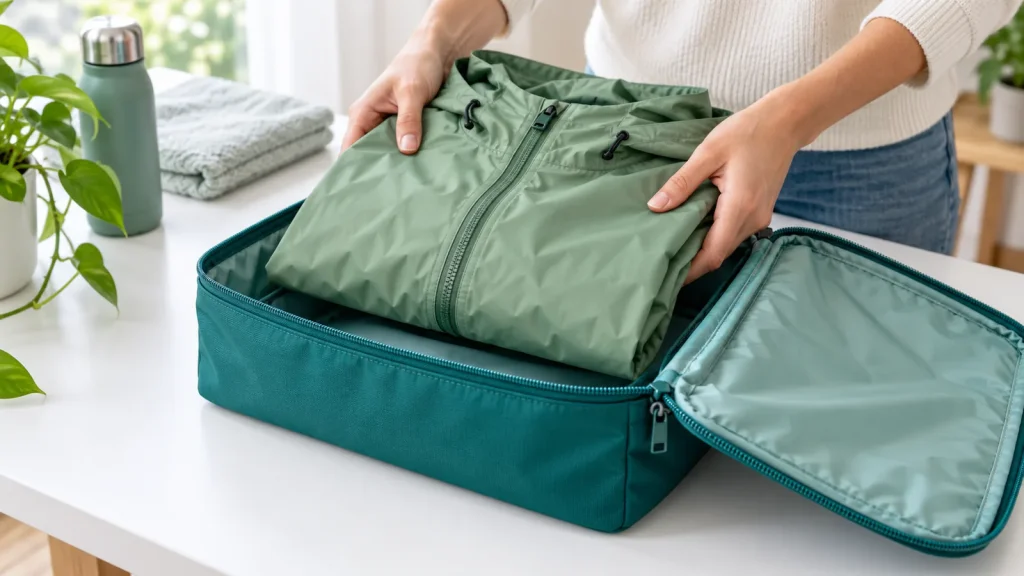
Match the pouch volume to the finished garment
A travel pouch should be sized around the rainwear it will carry, including the way that rainwear is folded. Start with the finished garment revision, not a convenient empty bag. Ask for a packing trial using the proposed construction, size and accessories. The pouch may look generous when empty yet become difficult to close once a hood, fasteners and printed panels are folded together. A filled sample connects those details and helps the buyer judge whether the proposed dimensions are practical.
Distinguish external dimensions from usable internal space. Seams, corners, lining and the closure opening can reduce the room available for the garment. Ask the supplier to show how each measurement is taken and record the units. For a soft pouch, also define the filled condition used for measurement so two reviewers are not comparing a flat empty panel with a rounded packed item. The specification should describe the object that warehouse staff and recipients will handle, rather than an ambiguous drawing outline.
Check the opening as carefully as the cavity. A pouch can have enough overall volume while requiring awkward manipulation through a narrow mouth. Try inserting and removing the actual folded garment without forcing it against the zipper or other closure. Observe where the material catches and whether an insert or label interferes. These are useful design questions for the supplier. They may be resolved through the opening shape, fold arrangement or pouch dimensions rather than through a general request to make the bag bigger.
Review every relevant garment variant. A pack developed around the smallest size may not suit a larger version, and a coat with additional components may fold differently from a simple poncho. Ask which variants can share a pouch and which require a separate configuration. Keep that answer in the quantity matrix. One common pouch can simplify stock management, but it should not be selected at the expense of a workable fit. Conversely, too many near-identical pouches can create unnecessary sorting and ordering complexity.
Decide how much freedom the user needs when repacking. A garment folded by a trained packing team may occupy less space than the same garment folded casually after an outing. If routine repacking is part of the product promise, review that second situation with an appropriate sample process. Do not use an exceptionally neat first pack as the only approval reference. The buying decision should reflect the expected user experience, including any instructions that genuinely accompany the rainwear.
Connect pouch size with the carrying requirement. If the pack must fit a particular compartment, display slot or distribution tray, measure that constraint and test the filled sample within it. Avoid broad claims that the pouch fits every handbag or backpack. A clear dimensional requirement is more useful and easier to verify. Where the intended use is flexible, compare a small set of reasonable options and let the purchasing team decide which balance of handling, presentation and packed size serves the programme.
Approve the garment and pouch together once the fit is resolved. Record the fold, contents, closure position and measured filled dimensions, with any tolerances agreed through the supplier's process. Keep an identified reference sample for production and receiving. This makes travel pouch raincoat enquiries more precise: the quotation covers a defined combination, and later changes to either the rainwear or the bag trigger a review of the fit. That simple connection prevents many avoidable disagreements over what compact packaging was meant to deliver.
Choose a closure and carry arrangement for the user
The closure determines how a pouch opens, how it stays organised and how easily it can be used again. Begin with the user's task rather than a preferred trim. A zipper, drawcord or flap can each be suitable in a particular design, but the complete construction matters more than the generic name. Ask the supplier to provide the proposed closure on a filled sample and explain any limitations relevant to carrying, storage or repeated handling. Keep claims tied to that actual configuration.
Describe the opening conditions. Will the wearer use the pouch indoors before leaving, at an outdoor event or while managing other belongings? An adult reviewer can assess whether the pull, cord or flap is easy to locate and operate within the planned sequence. Where access needs are part of the brief, involve the responsible team in an appropriate review. Avoid declaring a closure universally easy to use because one person in the purchasing office found it convenient during a quick demonstration.
Check how the closure interacts with the garment. Folded film or fabric should not be routinely caught in a zipper path or pulled into a drawcord channel. Observe the actual removal and repacking movement and identify where extra guidance is needed. A larger opening, revised fold or different internal seam may solve the issue. Do not assume that a stronger pull component will fix an underlying fit problem. The supplier needs to understand the cause before proposing a change that adds cost or complexity.
For a carry loop or clip, define the intended role. It might help the user hold the pouch or attach it to a specified ordinary bag feature. Ask what assessment is appropriate for the connection and the complete filled mass. Do not imply that an accessory is suitable for climbing, restraint or other protective use. Keep the design and wording consistent with the ordinary rainwear carrying task. If the programme does not need an attachment, consider whether omitting it simplifies the pack without reducing useful function.
Review loose lengths and small components in relation to the intended audience. A packaging feature chosen for an adult promotional programme may need a different assessment when the same item is proposed for schools or family attractions. Give the product reviewer the complete sample and intended distribution context. Do not add a generic warning as a substitute for design review. The purpose is to establish which construction and information are appropriate for the actual product and destination, not to decorate the pack with reassuring language.
Ask the supplier how closure consistency will be checked in production. The approved sample should identify the component, orientation, stitching or attachment arrangement and the agreed operational criteria. If the supplier proposes an equivalent component later, request a review before accepting the substitution. Two closures with similar appearance can behave differently in the finished pouch. Record the selected version so the packing team and inspector know what to compare, including the relationship between the closure and the final folded garment.
Bring the carrying arrangement into the final artwork review. A loop can cover a logo, a zipper can interrupt a print area and a folded flap can hide instructions that looked clear on a flat design. Review the filled pack from the angles people will actually see. This is where functional and visual decisions meet. A well-specified pouch lets the user understand and operate the pack while giving the brand a clear, credible presentation that survives the move from artwork file to physical sample.
Make the return-to-pouch step part of approval
If a raincoat is intended to travel repeatedly in its pouch, approval should include the return journey. Ask what the user does after taking the garment out, wearing it and preparing it for storage under the supplier's appropriate instructions. The pouch is part of that routine. A design that works only for the first factory fold may disappoint a programme that promises convenient repeated carrying. Include repacking in the sample brief so the supplier understands that later handling matters as much as the first presentation.
Define the starting condition for the review. Use the approved garment and explain whether it has been unfolded, handled or subjected to an agreed care process. Follow the relevant care and drying instructions before storage. Do not improvise a wet-storage recommendation because the pouch appears to contain moisture. If temporary transport of a used garment is a requirement, treat it as a separate question for the product team. The conditions and limitations should be resolved before the pack is described to recipients.
Ask a reviewer unfamiliar with the factory fold to use the supplied instructions. Observe the sequence without continually correcting it. Does the garment need a very precise fold to fit, or can the pouch accommodate an ordinary repeatable arrangement? Is it obvious where to place the hood and closures? Record these observations with the sample identifier. The aim is to improve the design or instructions, not to judge the reviewer. Confusion can reveal a mismatch between the packaging concept and the way people will actually use it.
Keep any folding guide short and product-specific. A few clear steps may be more useful than a dense block of text on a small insert. Have the team check the physical guide at its intended size, with the actual garment beside it. If several rainwear versions use different folds, make the distinction clear. Do not show a generic diagram that omits a feature responsible for most of the packed bulk. The instructions should support the supplied product, not merely make the packaging look more considered.
Consider what happens when the pouch is separated from the garment. An event programme may need a way to keep pairs together, while a staff issue programme might require identification or replacement arrangements. Discuss these operational needs with the team that manages the stock. Do not assume that every recipient will retain an unmarked loose bag. If a connected pouch is proposed, assess that complete design and its effect on wearing and folding rather than treating attachment as an automatic solution to loss.
Document the limits of any handling trial. Record who reviewed the sample in general terms, which version was used and what instructions were provided, without collecting unnecessary personal information. A small review can identify practical problems, but it does not justify a quantified durability or universal usability claim. Where repeated closure performance needs formal assessment, ask the appropriate specialist to define the method and acceptance criteria. Keep the informal user sequence and the formal technical evidence distinct in the approval file.
Once the return step works for the agreed use, add it to the retained packing reference. Include the fold guide, pouch dimensions and closure arrangement that supported the decision. Review the sequence again if the garment construction or pouch changes on a repeat order. This gives a travel pouch raincoat programme a more credible promise: the pack has been selected around the intended routine, and the buyer has a clear basis for discussing what it does, how it should be used and what remains outside its scope.
Choose the garment use model before fixing the pouch. Our disposable versus reusable rain poncho buying guide helps connect expected handling and care with the carrying format.
04 / 12
Build compact rain gear kits with a clear purpose
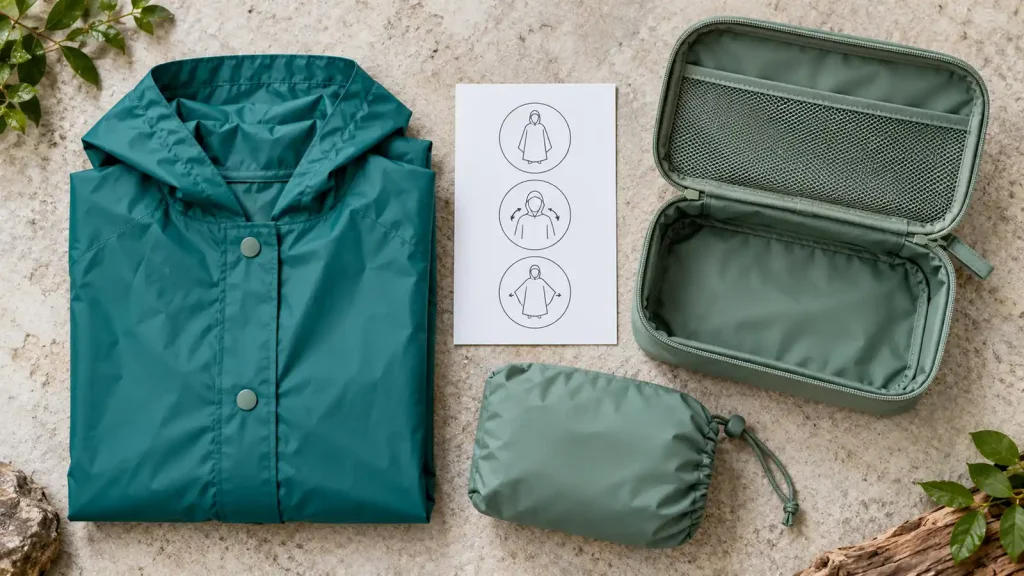
Select kit contents by the task rather than the available space
A compact rain gear kit needs a defined purpose. Start with the activity the recipient is expected to perform and identify the components required for that activity. The rainwear may be the only functional item, with a pouch and instructions supporting it. Another programme may have a justified need for additional accessories. Do not fill unused space simply because a larger kit looks more valuable. Every component adds a specification, an approval decision and another opportunity for the packed order to differ from the buyer's expectations.
Write a contents list that names each item clearly. Include quantity, version, size where relevant and the role it serves. Distinguish the rainwear itself from packaging, instructions and optional accessories. If a supplier proposes an extra item, ask what problem it solves and whether the intended audience needs it. This keeps the discussion focused on the programme rather than on a catalogue of available objects. A useful kit should be easy for staff and recipients to understand without a sales explanation.
Consider the relationship between components. A pouch sized for the poncho alone may become awkward when an insert or accessory is added. A rigid item can influence the way a soft garment folds or sits in the pack. Review the complete arrangement with representative components, including any protective separation proposed by the supplier. Do not approve each item independently and assume that assembly will resolve the fit. The kit is a distinct configuration and needs its own packed reference.
Assign an approval owner to every component. Purchasing may coordinate the package while another team reviews technical performance, artwork or audience suitability. Make those responsibilities visible before sampling. An accessory should not enter the final kit merely because it was included in an early concept photograph. Ask who has approved its intended use and what evidence is needed. If no one can answer those questions, keep it outside the released contents list until the decision has been made.
For a hypothetical visitor programme, the core need might be a poncho that staff can issue with a short wearing guide and a practical carrying pouch. Adding unrelated items could complicate counting without helping the visitor stay prepared for rain. For a managed staff programme, identification or a specific storage arrangement might matter more. These examples illustrate how the same broad label, rain gear kit, can conceal different purchasing requirements. The brief should explain which version your organisation actually needs and why.
Keep replenishment in mind when selecting contents. If one component is used or lost sooner than the rest, decide whether the programme will replace it, issue a new complete kit or retire the remaining items under its own process. Ask the supplier how replacement components would be identified and quoted, without assuming universal availability. A kit intended for continuing use needs a practical maintenance arrangement. A one-time handout may need a simpler structure with fewer promises about future replacement or refilling.
Once the contents are agreed, freeze a bill of materials with the kit revision. Connect each line to its sample or specification and identify optional alternatives separately. Share the same list with the assembly team, inspector and receiving staff. This makes compact rain gear packaging easier to manage: everyone can distinguish a complete kit from an incomplete one, and any later change can be assessed against the task the kit was designed to support rather than against appearance alone.
Arrange contents so staff can verify a complete kit
Kit assembly should make completeness easy to check. Begin with the approved contents list and decide how each item is placed inside the pack. A beautiful arrangement is not enough if a missing component remains invisible until the recipient opens it. Ask the supplier to show the proposed assembly sequence and the checks used before closure. The buyer does not need to prescribe every workshop movement, but the release specification should define the finished arrangement and how the required contents will be confirmed.
Give each component a distinct position where practical. A folded garment, instruction card and accessory should not be mixed in a way that makes the pack difficult to inspect or use. If a pocket, sleeve or divider is proposed, ask what it contributes. It may help identification or prevent unwanted contact, but it also adds material and assembly work. Review that tradeoff against the kit's purpose. Avoid adding compartments simply to make the product look more elaborate in a presentation.
Specify the order in which the recipient encounters information. Instructions needed before unfolding the poncho should be accessible at the appropriate moment. A card hidden beneath every other item may be overlooked. Check the assembled sample rather than relying on a flat artwork proof. The pack can change the reading order through folds, opacity and opening direction. Ask a colleague unfamiliar with the concept to open the kit and describe what they notice first, then use the observation to refine placement.
Make variants visible to the assembly team. If a programme has different garment sizes or sponsor messages, the kit specification should identify which components belong together. Use a clear allocation matrix and consistent references on the working documents. Colour alone may not distinguish similar versions reliably, especially when the outer pouch conceals the contents. The buyer should approve the identification system with the supplier so it supports both production assembly and later receiving, rather than creating separate codes that nobody can reconcile.
Agree how completeness is checked without inventing a universal inspection method. A count, visual confirmation or another suitable process may be proposed according to the configuration. Ask the supplier to explain the method and the exceptions it can or cannot detect. For example, confirming that a card is present does not establish that it carries the correct language or artwork revision. The checklist should address identity as well as quantity, with any additional review assigned to the appropriate person.
Think about what happens when a kit is opened during inspection. Decide how inspected units are identified, returned to their approved condition and reconciled with the shipment count. Do not let inspection create a second, undocumented packing standard. If a seal or presentation feature must be replaced, include that requirement in the process agreed with the supplier and inspection provider. The final shipment should remain understandable to receiving staff, who need to know which configuration they are accepting and how it was checked.
Retain an assembled reference and a contents photograph that shows the relationship between items. The photograph helps people recognise the approved layout, while the written list carries the exact identities and quantities. Keep both connected to the same revision. This combination makes the kit easier to order, assemble and receive. It also gives the buyer a practical basis for discussing a discrepancy: the concern can be traced to a particular missing, incorrect or misplaced component instead of a vague statement that the kit looks different.
Keep the kit promise within the evidence for each component
The name of a kit can create expectations beyond the contents. Calling a package a rain gear kit is a useful description of its purpose; calling it a complete survival solution makes a much broader promise. Decide what the product is intended to do and review the exact public wording against that scope. The outer pack should not imply protective functions that the supplied components have not been assessed to provide. Keep the commercial message specific enough that a procurement manager can understand what is actually being offered.
Separate the evidence for the garment from the evidence for the packaging and any accessories. A report relevant to the poncho does not automatically cover a pouch, clip or additional item. Ask the responsible technical reviewer to identify which requirements apply to the complete configuration and which documents support each decision. This avoids treating one impressive-looking report as approval for an entire kit. The buyer's file should explain the relationship between the product version, the evidence and the claim under consideration.
Review instructions as part of the product. The kit may include guidance on opening, wearing, drying, storing or identifying its components. Have the relevant owners approve that guidance and check it in the final layout. Avoid writing confident operating advice from assumptions about a generic material. Use the instructions appropriate to the supplied construction. If an accessory has separate limitations, make sure those limitations are not lost when its individual packaging is removed during assembly into the larger kit.
Be careful with images as well as words. A photograph showing equipment that is not included can confuse the contents promise, while a staged use scene can imply an activity outside the intended scope. Make the contents list clear and keep visual presentation consistent with it. Do not suggest that a generic sample scene documents a real customer project, company facility or certified test. Useful product communication shows the arrangement and purchasing choices without turning presentation into evidence of an unsupported capability.
Ask marketing to identify the exact statement it wants to use. A phrase such as convenient event rainwear can be discussed in relation to the planned issue process, while a quantified durability or protective claim requires a different evidential basis. Keep numerical comparisons out of the artwork unless the responsible reviewer has approved their scope and support. The pressure to fit a short message on a small pouch is not a reason to remove a qualification that materially changes what the claim means.
Consider downstream use of the kit description. A distributor, event organiser or reseller may copy the supplied wording into its own material. Provide a concise approved description and contents list so they do not need to improvise. Explain any conditions that must accompany a claim. If the buyer intends to add its own components after delivery, distinguish the supplier's approved configuration from that later assembly. The technical and commercial record should remain clear about which party controls each change and what has actually been reviewed.
Close the approval with a communication record as well as a packing record. Include the final kit name, contents wording, instructions, artwork revision and any limitations approved for public use. Revisit that record when a component changes. This gives the OEM Program a consistent description from quotation to handover and prevents a useful compact package from acquiring promises it was never designed to fulfil. Buyers can still present the kit attractively while keeping its value grounded in the specific task and contents.
05 / 12
Turn packaging ideas into an EAV purchasing specification
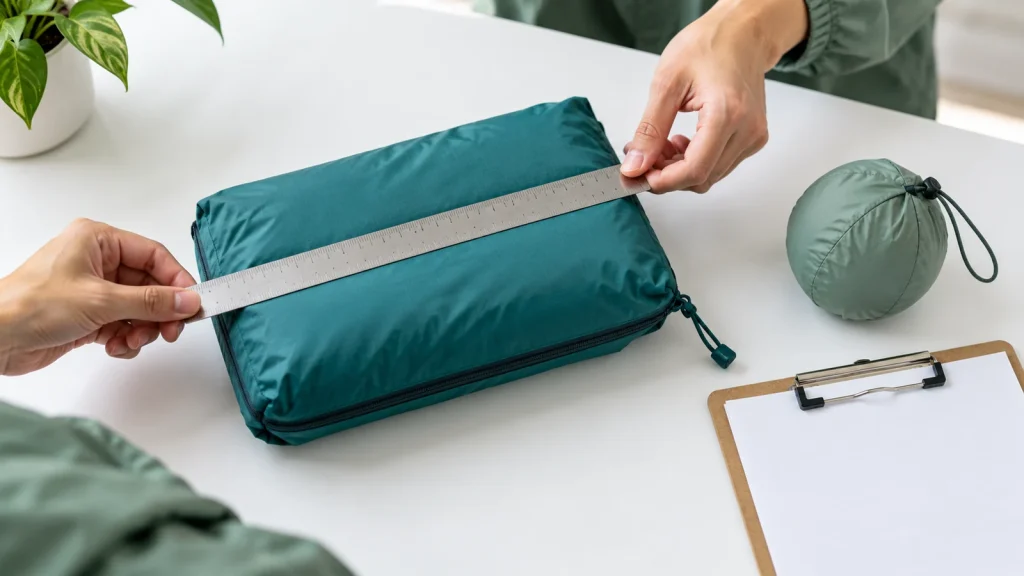
| Entity | Attribute | Value or unit to agree | Approval evidence |
|---|---|---|---|
| Filled individual pack | External size and mass | Length, width, height or diameter in mm; mass in g | Measured sample with final garment and inserts |
| Pack cavity | Usable internal dimensions | Measured space at the closure and narrowest points | Fit and removal trial |
| Case or pouch | Material and construction | Named material, panel or wall construction, components | Supplier specification and matched sample |
| Closure | Type and operation | Agreed mechanism, engagement and opening criteria | Representative handling review |
| Carry attachment | Connection and intended use | Attachment design and agreed assessment criteria | Sample and documented review |
| Decoration | Artwork and placement | Revision, finished size in mm, colour and location | Approved decorated pack |
| Identification | Item and assortment information | Required identifiers, layout and scan requirements | Channel-approved proof and packed scan check |
| Inner pack | Quantity and variant mix | Units per inner and allocation reference | Counted pack sample |
| Master carton | Outer size and gross mass | Length x width x height in cm; mass in kg | Final packing trial and carton record |
| Release file | Current approved configuration | Garment, pack, artwork and carton revisions | Signed sample and specification register |
Measure the filled pack and the usable internal space
Packaging dimensions are useful only when everyone knows what has been measured. An empty pouch laid flat, a filled pouch resting naturally and a tightly compressed pouch can produce different figures. Define the measurement condition before comparing proposals. For a rigid case, distinguish external dimensions from the space available inside. The buying team needs both: external size affects carrying and carton planning, while internal space affects whether the approved garment and inserts fit without creating an awkward opening or closure sequence.
Use consistent units and identifiable measurement points. Individual pack dimensions are often conveniently recorded in millimetres, while master cartons may be recorded in centimetres. State the unit in every relevant field rather than assuming that all documents follow the same convention. Include a simple drawing or photograph that shows the points used. This makes a later sample discrepancy easier to discuss because the supplier and buyer can repeat the same measurement instead of debating figures taken from different parts of the object.
For a pouch, record the opening width and any feature that restricts usable space. The finished seam line, rounded corners or internal pocket can matter more than the dimensions of a flat cut panel. Ask the supplier which dimensions it controls in production and how the filled result will be assessed. Do not invent tight tolerances merely to make the specification appear technical. Agree realistic requirements that serve the intended use and can be checked consistently through the proposed manufacturing and inspection process.
For a ball case, review the closed external size and the internal arrangement around the join. A nominal diameter alone does not show how much room remains once the closure features and folded garment are considered. Ask for the actual packed sample and note any point where the material interferes with engagement. Keep the case's construction description with the measurements. Two round cases with similar outside dimensions may offer different usable space, so their suitability cannot be established by one shared number.
Measure the filled mass where it affects carrying, grouping or logistics. Identify whether the recorded value includes the garment, pouch or case, attachment, insert and any outer sleeve. A sample weighed without its final components can mislead a later comparison. Use the result for the defined purchasing decision and avoid drawing unsupported environmental conclusions from mass alone. A lighter package may still require a different transport arrangement or have other tradeoffs that the figure does not capture.
Keep provisional dimensions visibly provisional. During development, the supplier may estimate the pack size before the final garment or artwork is available. That estimate can support an early discussion, but it should not silently become the approved logistics input. Set a point at which the filled sample and packing trial replace assumptions with measured values. Inform the people using those figures for display, storage or freight planning when they change. The numbers are part of a shared project record, not an isolated design note.
Use the EAV table to connect each dimension with its purpose and evidence. The entity might be the filled pouch, the attribute its external width, and the value the agreed measurement with a defined condition and tolerance. The evidence column points to the sample and measurement record. This structure makes the specification easier to review and keeps a concise table from pretending to be a complete technical assessment. It is a practical index to the decisions and references that the buying team has actually approved.
Record materials, closure, decoration and tolerances
A packaging specification should explain what the supplier is being asked to make, not simply name a format. The term zip pouch leaves the material, construction, dimensions, closure and decoration largely undefined. The term poncho ball leaves similar questions about the case and its attachment. Use the EAV model to break the proposal into attributes that matter to the order. For each one, record the agreed value or reference, the person responsible for approval and the evidence that will support acceptance.
Begin with the material description provided for the proposed pack. Ask the supplier to identify the construction accurately, including relevant layers, lining or components. Do not turn a broad polymer or fabric name into an unsupported claim about durability, recyclability or safety. Where a material property matters to the use or destination, ask the appropriate reviewer which evidence is needed. The specification should distinguish what has been declared, what has been observed in a sample and what has been formally assessed.
Describe the closure and its relationship with the filled contents. Record its type, position, component reference where available and the agreed operational criteria. Include the attachment arrangement if the pack has one. A statement that the pouch must close properly is difficult to inspect consistently without a reference. Show the intended finished condition and identify the unacceptable issues your team has agreed with the supplier. This helps the inspector assess the actual pack rather than apply an improvised personal standard.
For decoration, name the current artwork file and revision, the finished dimensions, the placement reference and the colour approval basis. A logo image attached to an email is not a complete print specification. The case curvature, pouch seams and filled shape can affect the result. Use an approved decorated sample to connect the artwork with the physical surface. If the artwork changes, review whether the printing route, pack arrangement or identification information also needs to change before releasing the revised version.
Agree tolerances around the attributes that genuinely affect acceptance. Dimensions, print position and appearance can require different ways of describing allowable variation. Ask the supplier and relevant reviewer to define a workable basis rather than copying limits from an unrelated product. Where a visual reference is more useful than an arbitrary number, use clear approved and unacceptable examples. Keep the viewing conditions and sample identity with those examples so the next inspector can understand what was intended.
Include the packed configuration, not only the components. Record the garment revision, fold method, insert position and number of units in an inner pack. A change to any of these can affect the way a case closes or a pouch presents its artwork. This is why packaging approval should remain linked to the rainwear specification. Separate documents are acceptable when they share clear references; separate assumptions are not. The people assembling the order should be able to find one current combination without interpreting competing messages.
Review the completed table for contradictions before asking for final confirmation. A larger garment, smaller pouch and unchanged opening may not be compatible. A new label may cover the approved logo or interfere with a scan area. Resolve those conflicts with the relevant owners, then issue the current specification as a whole. A concise, connected record gives suppliers a better basis for MOQ and Bulk Pricing discussions and gives buyers a more dependable reference when reviewing the first packed production samples.
Tie every packaging value to an approval reference
The value of a specification depends on whether people can find the evidence behind it. A dimension in a spreadsheet, a colour sample on a desk and an artwork file in a message thread may all be correct, yet still fail to function as one approved reference. Give the packaging project a clear revision structure. Each important value should point to a drawing, sample, proof or record that can be located by the supplier, buyer and inspector without reconstructing the entire development conversation.
Assign identifiers to physical samples as soon as they enter the review. Record the garment, pack construction, artwork status and any differences from the proposed production version. An early sample might use an available pouch colour or a temporary insert; that can be useful for a fit discussion but unsuitable for final appearance approval. Label the limitation explicitly. Otherwise, a colleague may later treat a convenient reference as evidence that the complete configuration was accepted when only one aspect had been reviewed.
Separate decisions by their scope. Marketing may approve the print layout while operations approves the inner-pack arrangement and a technical colleague reviews the closure. Those approvals can share one register without implying that every reviewer accepted every feature. Record what each decision covers and what remains open. The order owner can then issue a complete release only when the relevant conditions are closed. This is more reliable than relying on a short message such as looks good beside a photograph of the sample.
Keep digital and physical references aligned. Put the artwork revision and drawing identifier in the approval record that accompanies the retained sample. If the supplier holds a matching reference, confirm how the two samples relate. Photographs help people recognise the configuration, but they cannot replace every aspect of a physical review, such as opening or fit. Use each evidence type for the question it can answer and identify where a specialist report or additional sample is still required.
Control later changes through the same register. When the supplier proposes a different closure, material or fold, ask which values and evidence are affected. Route the proposal to the appropriate owners and record the decision before it becomes a production instruction. A change that looks minor in isolation can affect filled dimensions, artwork visibility or carton count. The approval process should follow those connections rather than allow a substituted component to disappear inside a routine progress update.
Give receiving staff a usable version of the reference pack. They may need the final contents list, carton markings, variant allocation, photographs and agreed checks rather than the entire development archive. Keep the fuller evidence available to the people responsible for technical or commercial questions. A concise handover helps the warehouse recognise a discrepancy quickly. It also prevents staff from using an old proof simply because it was the easiest file to find when the goods arrived.
At the end of the order, preserve the approved references and record any lessons separately. Do not quietly rewrite the original requirement to match a later observation. For the next order, start with the previous approved configuration, identify changes and obtain the necessary new decisions. This makes the EAV specification a practical purchasing tool across repeated programmes. It connects what was requested, what was approved and what was delivered while leaving a clear route for improving the pack without losing the history of earlier decisions.
06 / 12
Make custom poncho packaging carry the brand clearly

Allocate artwork across the garment, case and pouch
Branded rainwear can present a message at several moments: when the pack is displayed, when it is handed out and when the garment is worn. Decide which moment matters most before placing the same logo everywhere. A case or pouch may carry the first impression, while the poncho provides visibility during use. The artwork brief should explain the intended relationship between them. This lets the design and purchasing teams make deliberate choices about print areas, variants and approval work instead of adding decoration by default.
Identify the primary message for each surface. The garment might carry a sponsor identity, while the pouch carries the event or programme name and practical information. If several stakeholders need recognition, establish a hierarchy before requesting proofs. Small packaging does not become more informative simply because every available area is filled. Give the designer a clear list of required elements and distinguish those that belong on the pack from those better placed in an insert or approved supporting material.
Consider the geometry of the surface. A spherical case presents a curved viewing area, while a filled pouch may bend or fold across the artwork. Seams, closures and attachments can interrupt the visual field. Ask the supplier to identify the practical decoration area for the proposed construction and method. Do not assume that a logo sized for a flat brochure can be transferred unchanged. Review a physical decorated sample to see how the design reads when the pack is held in its normal orientation.
Map artwork versions to product versions. A campaign with several sponsors may use the same poncho and different pouch prints, or different garment prints inside a shared pack. Either arrangement requires a clear allocation matrix. The outer identification should help staff connect the correct contents and message. Keep the matrix with the quotation and assembly instructions so the commercial scope reflects the actual number of variants. A total quantity alone does not describe the work involved in producing and sorting several branded configurations.
Review what remains visible after the first opening. A recipient may set aside an outer sleeve while retaining a pouch, or may use the garment without keeping the case. Decide which information must stay with the product and which message is intended only for the first presentation. Do not rely on speculative claims about how long people will keep an accessory. Use the intended use sequence to place information where it is needed and keep any campaign expectations separate from verified product characteristics.
Bring operations into the artwork review. A large decorative mark should not obscure the identifier staff need to distinguish sizes or versions. A striking dark background may complicate the placement of readable instructions or required channel information. Ask the people who count, issue and receive the goods to review the packed proof alongside marketing. Their feedback can prevent a design that is visually successful but operationally confusing, especially when several similar packs arrive together at a busy venue.
The final artwork package should show the garment, case or pouch and any insert as a coordinated set. Identify the current files, placement dimensions and approval owner for each item. Keep unselected concepts outside the released production folder. This makes custom rain poncho packaging easier to quote and control: the supplier can see exactly where the brand appears, how variants relate and which references govern the finished result, while the buyer can explain the purpose of each decorated surface.
Approve print size and colour on the actual surface
A flat artwork proof is useful for checking content and proportions, but the physical packaging determines the final appearance. Material colour, texture, curvature and the proposed printing route can change how a design reads. Ask for a decorated sample on the actual case or pouch construction before final approval. Where a temporary sample is used during development, record its differences clearly. A buyer should know whether a proof demonstrates the final result or only an early discussion of layout and scale.
Specify print dimensions in a way the supplier can reproduce. Identify the finished width and height, the placement reference and any relevant orientation. On a spherical case, explain how the mark should face relative to the join or attachment. On a pouch, reference the finished seams or another stable landmark. A photograph with a floating logo does not define those details reliably. Use a placement drawing and measured sample together so the approved design can be understood beyond the original design meeting.
Agree the colour reference and its role. The brand may have a formal target, a physical sample or a coordinated range of existing items. Ask the supplier how the proposed decoration will be assessed on the chosen surface and what limitations need review. Avoid demanding an unexplained perfect match between very different materials. The purchasing team should select the appropriate reference and approve the physical interpretation with the brand owner, especially where translucent film, rigid plastic and woven pouch fabric are being compared.
Check fine details at the size people will actually see. Small lettering, thin lines and closely spaced elements may appear clear on a large screen yet become difficult to distinguish on a small pack. Review the printed sample under the agreed conditions and ask the supplier to identify any artwork changes needed for the proposed process. Do not silently alter a protected brand design to make it easier to print. Route the suggested revision to the brand owner and retain the approved version in the artwork record.
Keep print compatibility connected to the packaging material. A method suitable for one surface is not automatically appropriate for another. Ask the decorator to explain the proposed system and the sample checks needed for the intended handling. Avoid generic promises that every logo will remain perfect through rain, abrasion or repeated storage. The relevant claim needs a defined use and evidence. For a purchasing brief, it is more useful to state which conditions will be reviewed and what acceptance criteria the team has agreed.
Inspect the filled and closed pack, not only the decorated component before assembly. A fold can distort a pouch mark, a label can cover part of the design and an attachment can interrupt the intended orientation. Check the pack from the angles used in display, issue and carrying. If a change is needed, update both the artwork and packing instructions where relevant. This prevents a corrected print file from being paired with an old assembly arrangement that recreates the same visibility problem.
Retain the approved decorated sample and connect it to the exact artwork revision. Identify which variants it covers and which require separate references. Use that record when reviewing production samples and any proposed material substitution. A consistent approval basis protects the brand without pretending that a digital proof settles every physical question. It also gives suppliers a clear target for the finished packaging, making the discussion of custom printing, MOQ and Bulk Pricing more specific and easier to compare across proposals.
Keep instructions and product identity readable
The most useful packaging text helps someone make the next correct decision. It may identify the garment, explain how to open the pack or direct the recipient to the appropriate care information. Start by listing those decisions and deciding where the information must appear. Avoid treating every blank area as advertising space. A small case or pouch has limited room, and the essential information needs to remain understandable when the pack is filled, handled and viewed under the conditions described in the buying brief.
Separate product identity from campaign decoration. Staff may need a size, colour, variant or programme reference even when the sponsor logo is prominent. Use clear labels that match the purchasing and packing records. If colour coding is proposed, provide another suitable identifier where needed rather than relying on colour alone. The receiving team should be able to connect the individual pack with its inner carton and allocation list without opening the garment or guessing from a small decorative difference.
Write opening and folding instructions for the supplied configuration. A generic diagram can become misleading when the case opens differently or the pouch uses a different closure. Check each step with the actual sample and remove instructions that do not apply. Keep the sequence short enough to use, while preserving any necessary qualifications approved by the responsible reviewer. The purpose is to support the user at the right moment, not to fill an insert with reassuring text that has no clear connection to the product.
Review legibility on a physical proof at final size. A document viewed at high magnification does not show how a small printed instruction will appear on a curved case or textured pouch. Check contrast, placement and the effect of folds or joins through the appropriate design review. Where accessibility requirements apply to the programme, involve the responsible team. Do not claim universal readability from a casual inspection; use the review to identify practical improvements and the further assessment the project may need.
Confirm destination and language requirements with the appropriate owner. The article and enquiry can be in English while the actual product may serve a market with different information obligations. Ask the buyer's compliance reviewer which text, labels or instructions are required for the proposed product and distribution. Do not copy a warning from an unrelated package simply because it looks familiar. The final wording should be relevant to the construction, intended audience and destination, with its approval recorded before artwork release.
If a QR code or other digital reference is used, decide what information it supplements and who maintains the destination. Check the final printed pack and the actual link through the agreed process. Do not assume that a digital page can replace information required on the product or packaging. Keep the approved destination and ownership in the project record so a later website change does not leave recipients with an irrelevant page. A useful digital reference should support the product's real use rather than merely add a fashionable symbol.
Finish with a complete packed-copy review. Compare the text, symbols, identifiers and instructions against the current product and artwork register. Ask someone who did not write the copy to follow the sequence and flag ambiguity. Preserve the approved proof with the sample. This gives the buyer confidence that the pack communicates its identity and use clearly, while keeping the brand presentation professional and the production instructions precise enough for repeat orders and later receiving checks.
Coordinate the garment and packaging artwork with our custom printing guide for branded rainwear. Keep each decorated surface and its approved sample clearly identified.
07 / 12
Prepare retail-ready rainwear packs for scanning and display

Agree the receiving channel and item identifiers first
Retail-ready rainwear starts with the channel that will receive it. A visitor-attraction shop, a distributor's warehouse and a promotional agency assembling customer orders may use different identification and presentation systems. Ask the buyer for its current requirements before designing the final pack. The supplier needs to know which information belongs on the individual unit, inner grouping and master carton. A pack can look ready for display while still requiring relabelling or sorting before the receiving team can accept it into stock.
Identify who owns the product data and approves the identifiers. The brand, retailer or distributor may have an established process for assigning item references and barcode requirements. Follow that process rather than inventing numbers for the artwork. Keep the product description, size, colour and pack format connected to the approved identifier. If a variant changes, ask the responsible owner whether its identification must change as well. The supplier should receive a clear instruction, not a collection of unverified labels copied from earlier orders.
Distinguish the individual item from a multipack or transport grouping. A carton containing several individually issued ponchos may need different information from a kit sold or distributed as one unit. Explain which level will be scanned, counted or displayed at each stage. This is especially important when an agency buys bulk stock and later assembles it into another programme. The packing file should make the commercial and operational unit clear so staff do not mistake a group label for an individual product identifier.
Ask for the receiving team's actual layout or data requirements where available. A buyer may need a particular product reference, allocation code or carton information. Do not assume that a familiar label from another customer is acceptable. Review the requirement with the supplier and identify any uncertainty before printing. If the channel has a formal approval process, include its timing in the project plan. A correct garment and attractive pack can still face avoidable work if the identification proof was never submitted to the right owner.
Prepare a data sheet that connects each pack version with its intended channel. Include the approved identifier, human-readable description, artwork revision, quantity and destination allocation. Keep sensitive commercial information in the appropriate private record rather than on a public-facing pack. The sheet should be useful to the assembly and receiving teams, who need to recognise the goods accurately. It also gives purchasing a structured way to reconcile a label change with the order quantity and packing list.
Review the information on a filled sample. A label may sit neatly on an empty pouch but fold over when the garment is inserted. A case attachment may obscure an identifier, or a display arrangement may hide the panel staff expect to see. Ask the receiving team to check the proposed pack in the relevant workflow. This does not require redesigning everything for one person's preference; it requires confirming that the chosen arrangement meets the channel's actual handling and identification needs.
Release identifiers and artwork through one controlled approval. Record who supplied the data, who checked it and which revision is current. If the buyer changes a reference late in the project, identify the affected stock and obtain a clear instruction for any rework. Do not allow two nearly identical labels to circulate without a defined scope. A disciplined identification process makes retail-ready rainwear more useful to the channel and reduces the chance that a packaging project ends with unnecessary sorting at the destination.
Review barcode placement on the final packed shape
A barcode is part of a working identification system, so its placement needs more than an empty rectangle in the artwork. Confirm the symbol, data and channel requirements with the party responsible for them. Then review the proposed position on the final filled pack. A curved case, flexible pouch or folded header card can affect how the symbol is presented. The purchasing team should approve the physical result through the agreed scan and verification process rather than assume that a clean digital image guarantees usable performance.
GS1's retail 2D barcode guidance discusses the clear space around a symbol, distortion and placement on packaging. Use the current requirements relevant to the chosen barcode and channel, with advice from the responsible provider. Do not copy one universal size or margin into every poncho pack specification. The symbol and application matter. This is a narrow technical input to the project: it helps the designer reserve an appropriate area, while the channel owner confirms the actual identification system and acceptance requirements.
Look for features that interfere with the approved area. A seam, closure, curved join or decorative pattern may make the intended position unsuitable. A transparent outer layer can also change the visual presentation of what is printed beneath it. Ask the supplier to produce a representative packed proof and have the relevant team assess it. The right response may be a revised position or label construction, not simply enlarging the artwork without understanding which feature is causing difficulty.
Keep the data proof separate from the appearance proof. One reviewer should confirm that the encoded information and human-readable reference are the approved ones; another process may assess the printed symbol's suitability. A successful scan of the wrong identifier is still a problem. Connect both checks to the same sample and artwork revision. This prevents the project from treating a photograph of a label as evidence that its data, placement and final printed condition have all been accepted.
Test the pack in the way the channel will handle it. If staff scan an individual pouch while it remains in a display, include that arrangement in the review. If cartons are identified at receiving, assess the relevant carton label rather than extrapolating from the individual unit. Use the appropriate verification service or process where required by the channel. An informal phone scan can reveal an obvious issue, but it should not be presented as a substitute for a specified barcode-quality assessment.
Review artwork changes for their effect on the symbol area. A new background, repositioned logo or altered pack shape may disturb an arrangement that previously worked. Keep the approved clear area and placement requirements visible in the design file and change register. Ask the channel owner to review relevant changes before printing revised stock. This is particularly useful for repeat seasonal programmes, where a familiar label is often copied into new artwork without checking whether the surrounding design or construction has changed.
Record the final acceptance evidence with the packaging specification. Include the identifier, artwork revision, sample reference, checking process and responsible approver. Give production and receiving teams the information they need to recognise the approved result. The buyer can then discuss retail-ready rainwear with a concrete basis: the pack has a defined identification arrangement that has been reviewed for its channel. That is more useful than promising effortless scanning across every device or assuming that any printed code makes a product ready for retail distribution.
Make the display format easy to replenish and count
A retail display is a small working system. It must hold the intended packs, present them clearly and allow staff to replenish stock without creating confusion. Start with the available space and the receiving channel's requirements. A countertop tray, hanging arrangement and shelf-ready carton each create different constraints. Ask for a sample of the proposed display with representative filled packs. Reviewing an empty fixture does not show how the rainwear sits, how information remains visible or how the arrangement changes as units are removed.
Define the pack orientation and capacity through a physical trial. Record the number of units in the approved arrangement and the position of any size or variant information. Do not assume that a display remains useful when filled to its maximum possible density. Staff need to remove one item without disturbing the rest, and the presentation should remain understandable as stock decreases. Ask the channel team to assess these practical details rather than relying only on a photograph of a perfectly arranged full display.
Connect replenishment quantities with the inner-pack structure. If staff refill a tray from an inner carton, the quantities and variant mix should make sense together. A mismatch can leave loose partial packs or encourage staff to mix versions in the same location. Agree the arrangement with the buyer and record it in the packing file. The best quantity is project-specific; it depends on the fixture, stock process and assortment rather than on a universal rule about how many ponchos belong in a display.
Make the product identity visible throughout the display cycle. A pack at the back should not become the only place where the size or contents are explained. If a display card carries essential information, confirm how it remains with the fixture and what happens when stock is moved elsewhere. Avoid using the display to compensate for missing individual identification where the channel needs it. The package and fixture should support each other without making the goods unintelligible once they leave their original arrangement.
Review staff handling at replenishment. Can the transport carton be opened without damaging the display or individual packs? Are there loose parts that need assembly, and has the team agreed to that work? A fixture shipped flat may be efficient for one channel but inconvenient for another that expects ready-to-place stock. Describe the required assembly and provide appropriate instructions. Do not assume that the receiving staff will discover the intended structure from a photograph or have spare time to correct an unclear packing arrangement.
Consider partial stock and transfers. An attraction may move a display between locations or return remaining packs to central storage after a season. Decide how the fixture and units are identified during those moves. Keep unused variants distinguishable and avoid treating all similar-looking pouches as the same item. The display review should include ordinary stock handling, not only the initial setup. This gives the purchasing team a better understanding of whether the proposed presentation supports the full programme.
Approve the display, packed unit and replenishment arrangement as a connected set. Keep a photograph of the filled reference, the component list and the agreed quantities with the order file. If the pack dimensions change, revisit the fixture fit before release. This helps turn an attractive rainwear presentation into a workable channel solution. It also makes quotation discussions clearer because the supplier can identify exactly which display components, assembly work and packing arrangement are included in the OEM proposal.
Further guidance: GS1 guidance on 2D barcodes at retail point of sale.
08 / 12
Design bulk packaging for festival gates and promotional distribution
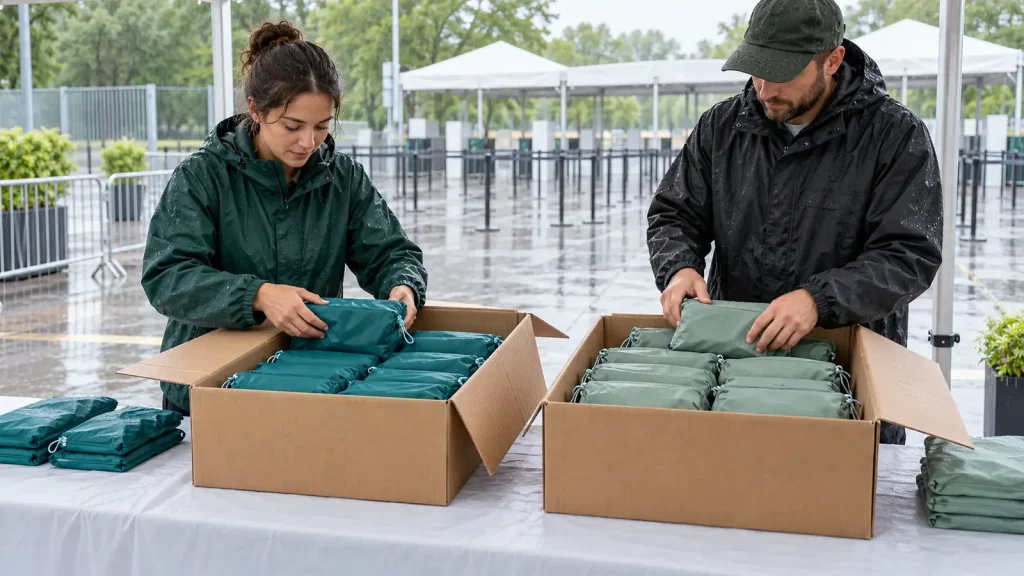
Translate the issue plan into workable inner packs
Festival packaging should start with the issue plan. Ask where rainwear will be handed out, who will manage each point and how reserve stock reaches the working area. The answer may call for a different inner-pack arrangement from the one used for ordinary warehouse storage. A master carton can be suitable for transport while being too awkward for a gate desk. Break the order into handling units that the operations team can receive, count and replenish within its actual setup.
Identify the responsibility at each handover. A central store may allocate stock to several gates, and each gate may issue units through several staff members. Give those teams a clear quantity and variant reference. Do not assume that the original purchasing contact will be present to explain every carton. The inner label should connect the pack with the allocation plan in terms the event team uses. This helps staff find the intended stock without opening several groups or mixing sponsor versions during a busy period.
Choose inner quantities with the people who will handle them. The right number depends on the counter space, staffing arrangement and replenishment process. Ask for a sample grouping and try it in the proposed container or tray. Avoid a universal claim that a particular quantity is always fastest. A short rehearsal can reveal whether the grouping is easy to count and move, but it should remain an observation about the tested setup. Record the agreed quantity and the reason it serves the event's operation.
Specify how the inner pack opens and what remains after opening. Staff may need to access individual units without scattering wrappers or losing the information that identifies the group. Review any tape, sleeve or bag with the actual handling sequence. If an extra layer is proposed for protection or organisation, ask whether it is needed throughout the route or only at one stage. This gives the buyer a basis for balancing useful protection with the work of removing and managing packaging at the issue point.
Plan for staged distribution rather than treating all stock as one undifferentiated reserve. The event may allocate different quantities by day, location or audience group. Keep those allocations visible in the packing instructions and carton map. If some figures remain provisional, identify the decision date before the supplier packs the order. Late changes to destination groupings can create sorting work even when the total quantity stays the same. The commercial and delivery discussion should recognise that packing mix is part of the specification.
Consider unused stock and handover between shifts. Staff should know how to count remaining inner packs and identify opened partial groups. A simple local record may be enough, provided it uses the same references as the packing list. Do not let loose units lose their variant identity when they move back to storage. This matters when similar ponchos carry different sponsor marks or serve different wearer groups. The next shift needs a dependable starting point, not an estimate based on the appearance of a half-full carton.
Include the final inner-pack arrangement in the approved sample package. Record unit quantity, variant mix, label, opening method and relationship to the master carton. Share it with the supplier and event operations team before release. This makes bulk rain poncho packaging a practical part of the event plan. It connects the factory's assembly work with the venue's distribution process and gives the buyer a clear way to assess whether a proposed change will help the programme or simply move work to another team.
Keep size, colour and sponsor variants easy to distinguish
Variant confusion is a packing problem before it becomes a distribution problem. A festival order may contain different garment sizes, colours or sponsor artwork behind similar outer packaging. Make those distinctions visible in the purchase specification and the allocation plan. A single total quantity cannot tell the supplier which combinations belong together. Use a matrix that connects garment version, pack version, artwork, quantity and destination so the same information guides quotation, assembly, inspection and issue.
Choose identifiers that staff can use without opening the rainwear. A clear description or approved code can be placed at the appropriate individual and group levels. Colour can support recognition, but it should not carry the entire identification task where mistakes matter. Two shades may look similar in poor light, and different people may interpret a colour name differently. Agree a practical system with the operations team and check it on the filled pack rather than only in a spreadsheet.
Keep sponsor artwork linked to the correct contents. If a shared pouch contains differently printed ponchos, the outer identifier must still tell staff which version they are issuing. If the pouch itself carries the sponsor mark, verify that the garment and pouch combinations match the approved allocation. Ask the supplier how variants will be separated during packing and how the final mix will be checked. Do not assume that a correct total count proves that every branded combination is correct.
Use photographs to help recognition without replacing the data. A reference sheet showing each approved packed variant can be useful for staff who do not work with the product every day. Label the photographs with the same codes used on cartons and the packing list. Avoid ambiguous filenames or near-identical images without explanations. The aim is to give the receiving and event teams a quick visual aid that points back to a precise specification, not another independent version of the order.
Plan how mixed cartons will be handled if they are necessary. Identify the exact assortment and make the arrangement clear to receiving staff. A mixed carton may be useful for a particular gate allocation, but it can also create sorting work if the venue expects single-variant groups. Ask the team to approve the approach before packing. The supplier should not have to infer the intended distribution from a general instruction to divide the order evenly when the actual audience or sponsor allocations are different.
Define the process for a late artwork or quantity change. Identify which variants are affected, whether any stock has already been produced and how the revised instruction will be distinguished from the previous one. Keep approved exceptions specific. A buyer might permit a change for one destination without permitting it for every event location. The packing record should show that scope clearly so a commercial concession does not become an unexplained substitution across the whole order.
At receiving, reconcile the matrix as well as the grand total. Confirm that the expected combinations are present through the agreed checking process, and record any discrepancy at the level needed to resolve it. Saying that a carton is wrong is less useful than identifying its expected and observed contents. A clear variant system helps every stage of the programme: the supplier can assemble the order accurately, the warehouse can route it and the event staff can issue the intended rainwear with confidence in its identity.
Rehearse opening and replenishment under event conditions
An event rehearsal should resemble the planned workflow closely enough to expose practical problems. Use the actual type of counter, container and packed sample where possible. Ask the operations team to describe the conditions that matter, such as limited space, outdoor exposure or staff handling several tasks at once. The exercise does not need to recreate every possible weather event. It needs to answer specific questions about opening, identifying and replenishing rainwear in the setup the team intends to use.
Choose a small set of tasks before the rehearsal. Staff might identify a required variant, open an inner group, place stock in a working tray and replenish it from reserve. Give them the instructions that will actually be available at the event. Observe the sequence and note where they hesitate or improvise. Avoid turning the session into a competition for the fastest result. The useful outcome is a repeatable process that suits the staff, pack and location, with limitations recorded honestly.
Include the opening tools and facilities that the venue permits. If the transport packaging needs a particular tool or disposal arrangement, confirm that the team will have it. Do not assume that a busy gate desk has the same resources as a warehouse bench. Ask whether the opening method risks disturbing individual packs or losing labels needed for identification. A change to an inner sleeve or closure may remove a practical obstacle more effectively than adding another instruction to an already crowded staff briefing.
Review exposure through the appropriate product and operations process. If packs may sit near wet surfaces, discuss what protection and handling are needed rather than assuming the outer package is waterproof. A waterproof garment claim does not establish the performance of its pouch, paper card or carton. Keep the requirement specific and ask the supplier or technical reviewer how it should be assessed. The rehearsal can identify where exposure occurs, while suitable evidence addresses whether the proposed construction meets the agreed need.
Test replenishment while the working area contains partially used stock. A perfectly empty tray is an easy starting point, but staff often need to add units without mixing variants or losing count. Check where opened partial groups are kept and how the next person recognises them. If the system becomes confusing, simplify the grouping or identification before bulk packing. The best solution may involve fewer variants at one issue point rather than a more complicated label on every individual pack.
Ask staff to describe the problems in concrete terms. A report that a sleeve is hard to open should identify where the opening begins, what the person tried and which sample version was used. A photograph can help locate the issue. Keep the record factual and avoid general conclusions about product quality from one awkward movement. The supplier can respond more usefully to a reproducible observation and proposed acceptance requirement than to a broad request to make distribution easier.
After revisions, repeat the affected tasks and record the agreed operating instructions. Share the final pack reference with the venue team and keep it connected to the supplier's release file. If the event setup changes substantially, review whether the earlier conclusions still apply. This approach turns festival rainwear packaging into a planned operational detail. It gives the buyer a credible basis for selecting a format and helps the event team use that format effectively without relying on unsupported claims about universal speed or convenience.
Planning branded rainwear for an outdoor event? Explore our Wholesale Festival Rain Poncho Collection Here and connect the pack format with attendee allocation, sponsor variants and the handout plan.
09 / 12
Connect compact rainwear packaging with carton and delivery planning

Calculate carton volume from verified outer dimensions
Compact individual packaging does not automatically produce a compact shipment. The master-carton arrangement determines how the filled packs occupy space together, and a spherical case can create a different arrangement from a flat pouch. Ask the supplier for a packing trial using the final configuration. Record the actual units per carton, outer dimensions and gross mass. These figures give logistics colleagues a usable basis for planning, while an isolated photograph of a small individual pack does not.
Keep the calculation straightforward and the units explicit. For a rectangular carton measured in centimetres, length multiplied by width multiplied by height, divided by one million, gives its external volume in cubic metres. As an illustrative arithmetic example, a carton measuring 50 by 40 by 30 centimetres occupies 0.06 cubic metres before any wider shipment arrangement is considered. This is a calculation example, not a promised carton specification, freight saving or transport quotation for a rainwear order.
Use measured outside dimensions rather than the nominal internal dimensions of an empty carton. The filled and closed result is the relevant input for the packing record. Include any protrusion or outer arrangement that the logistics provider needs to assess. Ask the supplier to identify whether the figures come from a completed trial or an estimate. If they remain provisional, make that status visible in the quotation and project plan so a preliminary number does not quietly become the assumed final shipment data.
Multiply by the actual carton count and distinguish different carton types. A shipment with several garment or kit versions may not use one uniform box. List each configuration separately, including partial cartons where applicable. The total should be traceable to the packing list. This helps the buyer compare alternatives without hiding a mixed arrangement behind an average. It also gives receiving staff a clearer expectation of what will arrive and how the contents are divided across the shipment.
Ask the logistics provider how it will use the data for the proposed service. Chargeable weight, handling requirements and transport scope depend on the arrangement being quoted. Do not apply an unexplained universal divisor or assume that cubic volume alone determines the commercial result. Give the provider the actual dimensions, mass, carton count and destination, then request a quotation tied to those assumptions. Keep its response separate from the packaging comparison so the buyer can see where each figure comes from.
Review packing changes before treating an earlier freight estimate as current. A new pouch size, case attachment or insert can alter carton fit and quantities. Ask for revised packing data when those changes are approved. Inform logistics and receiving teams at the same time. A small change to an individual pack may be operationally manageable, but its effect should be assessed through the complete carton arrangement rather than dismissed because the product still carries the same marketing name.
Store the final calculation with the measured packing record and shipment quotation. Identify the version, date and source of the dimensions. This gives procurement a transparent way to compare packaging options and explain the selected arrangement internally. It also prevents the phrase space-saving packaging from becoming an unsupported promise. The useful question is how the approved filled packs work in the actual shipment, with the resulting dimensions and commercial scope confirmed for that particular order.
Review packing protection alongside space efficiency
A carton should do more than hold the largest possible number of units. It must support the handling and protection requirements of the planned distribution route. Begin by describing that route and the condition in which the goods need to arrive. A promotional pouch expected to look presentable at a corporate desk may have different appearance criteria from stock issued from a warehouse. Ask the supplier to propose an arrangement that addresses the actual requirement, with evidence appropriate to the risks being reviewed.
Look at contact between neighbouring packs. Rigid cases, clips and other components can interact differently from soft flat pouches. Ask whether the proposed orientation or separation is needed to protect the approved finish and garment. Do not assume that every unit needs an extra wrapper, but do not remove protective elements merely to improve a packing diagram. The right decision depends on the complete product and route. A trial can reveal practical concerns that the technical reviewer or packaging specialist can then assess.
Review the way individual packs sit near carton edges and closures. A tightly packed arrangement may be difficult to close consistently or may leave staff unsure how to return inspected goods to the approved condition. Ask the supplier to show the final filled carton and its closing method. Record any important orientation or assembly instruction. The inspector should be able to compare production packing with the approved reference rather than improvise a different arrangement after opening a carton for checks.
Consider the protection of printed information and presentation surfaces. A scuffed logo, creased header or obscured identifier can matter to the buyer even when the rainwear itself remains usable. Define the relevant appearance criteria before release and distinguish them from functional or safety requirements. Avoid broad demands for perfect packaging without an agreed reference. Clear examples help the supplier understand which conditions are unacceptable for the programme and help the inspection team apply the criteria consistently.
Ask what evidence supports the proposed transport arrangement. The appropriate assessment depends on the actual distribution environment and the product-package combination. A supplier's familiar carton may be a useful starting point, but prior use for another item does not establish suitability for every new kit. Discuss test selection with a qualified provider where required. Keep the resulting evidence tied to the sample, packing configuration and route assumptions so the buyer understands what was assessed and what remains outside that assessment.
Compare alternatives on the whole arrangement. A divider may reduce contact but change carton quantity; a different inner pack may simplify receiving while adding assembly work. Put those consequences beside the intended benefit. The purchasing team can then decide whether the change is worthwhile for its programme. Do not describe one option as environmentally superior or universally cheaper merely because it uses fewer visible components. The commercial and environmental questions each need their own defined basis, which a packing photograph does not provide.
Approve the selected carton configuration with a documented packing sequence, component list and measured data. Retain photographs of the filled arrangement and the closed carton, linked to the order revision. Review it again when the garment, case, pouch or route changes materially. This connects space efficiency with the practical purpose of transport packaging: delivering the agreed goods in a condition that the receiving team can identify and accept. It also gives suppliers a precise target for the packing work included in their proposal.
Give logistics and receiving teams one current packing file
The packing file connects production with delivery. It should describe what is in each carton, how the cartons are identified and which figures logistics may use. Start with the final approved individual pack and build outward through inner groups, master cartons and any further shipment arrangement. Keep the information in a form that the supplier, provider and receiving team can understand. A series of isolated photographs or old email estimates makes the handover harder, especially when the order contains several variants or destinations.
Include the quantity breakdown at the level needed for receiving. List the garment and packaging version, artwork or sponsor reference, units per inner group, units per carton and destination allocation. Identify partial cartons and mixed assortments clearly. The grand total must reconcile with the order, but the detail is what lets staff find the required stock. A correct total does not resolve a delivery in which the right number of ponchos is divided among the wrong sponsor versions or event locations.
Attach the final measured outer dimensions and gross mass for each carton type. State the units and identify the source of the figures. If a value remains estimated, label it and set a date for confirmation. Logistics should not have to infer whether a number was measured after packing or copied from an early proposal. When the supplier updates the figures, replace the active version and notify the relevant parties so freight planning and receiving expectations remain aligned with the shipment actually being prepared.
Record the approved carton markings and their placement. The label should connect the physical carton with the packing list and destination plan. Ask the receiver which references it requires and confirm the proof before production printing. Avoid adding sensitive commercial details that the handling teams do not need. The aim is clear identification, not a public copy of the purchase file. Check that the marking remains legible in the proposed shipment arrangement and is not hidden by the way cartons are grouped or handled.
Give the destination team practical receiving information. Confirm the delivery address, contact, opening hours and any booking or handling conditions through the responsible people. These details may sit in a separate logistics document, but the packing file should point to the current version. Do not assume that a billing address is the receiving location. If the order is split among sites, make the allocation and responsibility for any later transfer explicit before goods leave the supplier.
Set a change-control point for the file. Once final packing is approved, a change to carton quantity, assortment or marking should be communicated as a revision rather than buried in a progress message. Identify who can authorise it and which parties must receive the update. Preserve superseded records for traceability while making the active version obvious. This is especially useful when several people are arranging production, transport and venue distribution at the same time.
Close the handover with confirmation that the supplier and receiving team are working from the same references. Keep the final packing list, photographs, dimensions and relevant delivery instructions together. After arrival, record discrepancies against that file and preserve the outcome for the next order. A clear packing handover makes compact rainwear packaging more than a design choice. It turns the approved pack into a shipment that can be counted, routed and used by people who were not present during development.
For the wider supplier and delivery process, read our guide to sourcing rainwear from China. Align the final packing list and carton specification with your current purchase documents.
10 / 12
Approve packaging quality before bulk rainwear production

Test opening, closure and handling with representative samples
A packaging approval should state which questions the sample is meant to answer. Opening, closure, appearance, identification and transport performance are related but different subjects. Begin with a checklist that names the proposed construction, contents and intended handling. Ask the supplier and appropriate reviewer to agree how each relevant feature will be assessed. This gives the buyer a clearer basis for acceptance than a general request for a good-quality pouch or a durable ball case, neither of which defines a repeatable decision.
Use samples that represent the proposed order. Record the garment revision, case or pouch construction, attachment, insert and decoration. If a sample uses a substitute component during development, identify it and explain which conclusions remain provisional. A fit check with an undecorated reference may be useful, but it does not automatically establish the final printed appearance. The sample register should make those limits visible so a useful early review is not mistaken for complete production approval.
Define the opening sequence and observe it with the supplied information. A reviewer should be able to identify the intended opening and remove the garment through the agreed handling process. Record snagging, unclear orientation or difficulty locating the closure precisely. Avoid vague comments that the pack is awkward. The supplier needs to know which movement, component or condition caused the concern. Photographs and short written observations can help communicate the issue without presenting an informal review as a formal performance test.
Check closure in the filled condition. The pack should be assessed with the actual contents and fold, because an empty pouch or case may behave differently. Ask the technical reviewer what criteria and method are appropriate where repeated operation or a defined carrying requirement matters. Do not invent a universal cycle count or acceptance force for every design. The assessment should serve the intended use and be agreed before results are interpreted, with the sample and conditions recorded in the evidence file.
Review handling features together. A carry loop may affect the way a pouch hangs, a case attachment may interfere with neighbouring units in a carton, and a label may change the opening sequence. Testing components separately can miss those interactions. Use the complete configuration for the decisions that depend on it. If a concern arises, identify whether the solution belongs in the product design, packing method or user information. Adding instructions should not become the default answer to a physical mismatch that can be corrected.
Keep appearance checks specific. Define the relevant print, seam, surface and assembly criteria using the approved reference and agreed examples. Explain which variation the buyer accepts and which condition requires action. A promotional campaign may have particular presentation priorities, but those should be stated before inspection rather than introduced after the goods are made. The supplier and reviewer need a shared basis for distinguishing a genuine discrepancy from a preference that was never included in the released specification.
Finish with a written sample decision. State what passed the agreed review, which actions remain open and what evidence will close them. Do not use an unconditional approval message when the buyer is still requesting changes. Retain the accepted sample and the checklist with the production file. This makes packaging quality a manageable part of the OEM Program: the supplier understands the target, the inspector has a reference and the buyer can explain the acceptance decision without relying on memory or broad assurances.
Select transport checks for the actual distribution route
Transport assessment begins with the route the packed goods will follow. Describe how cartons are shipped, handled, stored and transferred before they reach the intended receiver. A parcel shipment, a consolidated warehouse delivery and a later transfer to an event venue may expose the package to different handling. Ask a qualified packaging or testing provider which assessment is appropriate for that route and configuration. Do not select a familiar procedure number solely because it appeared in another supplier's presentation.
ISTA's guidance on package design and testing emphasises understanding the distribution environment when selecting procedures and interpreting results. Use that principle to brief the provider about the actual product-package combination. The relevant evidence should identify the tested configuration, conditions and scope. A report does not automatically establish that every future shipment or revised pack will perform identically. Keep the conclusion tied to what was assessed and use actual shipment feedback to inform later decisions where appropriate.
Give the provider a representative packed sample and a clear description of the acceptable outcome. The rainwear, pouch or case, inner grouping, carton and closing arrangement should match the version under review. Identify any provisional components. If presentation matters as well as functional condition, explain the agreed criteria for printed surfaces, header cards or individual cases. The provider can then help the buyer distinguish a transport concern from an appearance preference and identify how each should be assessed.
Ask what the proposed assessment will and will not answer. A particular check may focus on one type of handling or environmental condition rather than every possible hazard. Keep those limits in the approval file. Do not turn a pass statement into a blanket promise that the packaging is indestructible or suitable for every shipping service. The buying decision should consider the route, scope and any remaining questions, with specialist judgment applied where the programme requires a higher level of assurance.
Review the report against the sample identity. Confirm that the carton arrangement, pack quantity and components described are the ones being released for the order. A report on a different garment or an earlier pouch construction may still be informative, but its relevance needs assessment. Ask the responsible reviewer to explain that relationship before relying on it. This prevents the evidence file from becoming a collection of impressive documents that do not actually describe the goods the buyer intends to receive.
Plan time for corrections before dispatch. If a test or trial reveals a weakness, the supplier may need to revise the arrangement and provide further evidence. Build that possibility into the development schedule rather than treating assessment as a ceremonial final step after everything is packed. Ask who decides whether a change is acceptable and how the revised configuration will be identified. A rushed substitution without an updated reference can undermine the usefulness of the assessment that prompted it.
Keep the final transport decision with the packing specification and logistics assumptions. Review it when the product, carton arrangement or route changes materially. The buyer can then discuss protection and space efficiency with a clear evidence trail, rather than relying on a generic claim that the packaging has been tested. This approach supports a more useful commercial conversation: the supplier knows the conditions being planned for, and procurement understands the basis and limits of the arrangement it is approving.
Control approved packing and inspect production consistency
Once the sample is approved, production needs a clear description of the released packing arrangement. Include the garment revision, fold, case or pouch, attachment, insert, decoration and carton configuration. The people assembling the goods should not have to choose between several similar development samples. Identify the current reference and remove ambiguity from the working instructions while retaining earlier records separately. A well-organised release package connects the buyer's decision with the actual work performed during bulk production.
Ask how the first packed output will be reviewed. A supplier may propose an early production check before the full quantity is assembled. Agree what the buyer or inspector needs to see and who can authorise continuation or correction. This is especially useful when the order includes several artwork versions or a new case construction. Do not assume that approval of a handmade sample proves that every aspect of the assembly process is already understood and consistently reproduced at scale.
Use a checklist that separates identity, quantity, appearance and operation. The correct pouch can still contain the wrong garment, and a complete kit can still carry an outdated instruction card. Give each question an appropriate check and reference. Avoid relying on one overall judgment that the package looks fine. A structured review makes it easier to identify the affected units and the necessary corrective action if a discrepancy appears during assembly or before shipment release.
Agree the inspection basis with the responsible provider. The buyer should understand the scope, sampling approach where used and decision criteria before results are available. Do not invent a sample quantity or treat an inspection result as a guarantee that every unexamined pack is identical. Keep the conclusion tied to the actual review. Where a technical or safety requirement needs separate evidence, preserve that distinction instead of expecting an ordinary visual packing inspection to settle every product question.
Control substitutions and rework visibly. If a component becomes unavailable or an assembly issue requires a change, ask the supplier to identify the affected quantity, proposed action and consequences for the approved configuration. Route the proposal to the appropriate owners before acceptance. Reworked packs should return to the agreed condition and remain traceable in the inspection record. A statement that the workshop has been informed is an acknowledgement, not evidence that the packed goods now meet the requirement.
Connect carton checks with the variant matrix. Verify the agreed inner quantities, assortment and markings through the approved process. If an inspection opens cartons or individual packs, specify how they will be restored and reconciled. This prevents the inspection itself from leaving inconsistent presentation or uncertain counts. The final packing list should describe the goods that are actually released, including any authorised exception that receiving staff need to understand before they compare the shipment with the order.
Close production with a release record that points to the relevant evidence and any permitted deviations. Share a practical handover with the receiving team and retain the fuller file for technical or commercial questions. When feedback arrives after delivery, connect it to the same references. This gives the next order a useful starting point and makes packaging improvements traceable. Consistency comes from a clear target, controlled changes and meaningful checks, not from repeating a broad promise that every pack will be perfect.
Further guidance: ISTA guidance on package design and test selection.
11 / 12
Assess packaging reuse, material claims and audience suitability

Describe environmental attributes with a clear boundary
Environmental wording should identify exactly what it describes. A rainwear garment, fabric pouch, rigid case, paper sleeve and master carton are different parts of a packed product. A statement about one part does not automatically describe the others. Begin with the attribute the buyer wants to discuss and identify the component, material and evidence relevant to it. This keeps a purchasing conversation useful without turning a packaging preference into an unsupported claim about the environmental performance of the complete programme.
The FTC's Green Guides distinguish claims such as recycled content and recyclability and caution against broad, unqualified environmental benefit language. Their guidance also makes the basis of a source-reduction comparison relevant. For a packaging brief, use specific, substantiated wording and a clear scope rather than assuming that a material name settles the claim. Have the responsible reviewer assess the proposed wording for the destination and audience. The guidance does not provide a blanket endorsement of any particular rainwear pack.
Ask the supplier what evidence supports the attribute being proposed. A material declaration, composition record or other relevant document should identify the component and version it describes. If only part of a pack uses a particular input, keep that distinction clear. Do not allow a statement about the pouch fabric to become a statement about the zipper, print, attachment and garment without a basis. The buyer's evidence file should be specific enough that another colleague can understand the actual boundary of the claim.
Review the public wording separately from the technical description. A supplier may use shorthand in a development discussion that is too broad for a product page or printed sleeve. Ask marketing to provide the exact sentence, symbol and placement it wants to use. The responsible reviewer can then assess what a recipient is likely to understand from that presentation. A qualification that exists only in an internal email does not help the reader of an unqualified statement printed prominently on the pack.
Keep comparisons tied to a defined reference. If the buyer wants to discuss reduced pack mass or volume, identify the versions being compared, the measurement basis and what the comparison does not establish. A smaller carton calculation is not a complete environmental assessment. It can still be useful operational information when described accurately. Avoid inventing a percentage benefit or implying that one packaging change settles every material, production, transport and end-of-use consideration attached to the order.
Check symbols and imagery as carefully as text. A familiar environmental icon can imply a claim even when the surrounding wording is cautious. Ask who has approved its use and which evidence or permission is relevant. Do not add marks simply because they make the design look responsible. The buyer can present a restrained, factual material description attractively without relying on an ambiguous symbol. Keep any approved mark connected to the correct component and scope in the artwork register.
Retain the claim review with the packaging specification and revisit it when the construction changes. A new lining, closure, print or destination can affect the relevance of an earlier decision. Preserve the original evidence and record the revised assessment rather than copying the old wording into every repeat order. This gives procurement and marketing a shared basis for discussing packaging choices and helps customers understand the specific attributes being offered without exaggerated promises about the whole product.
Plan the real use and end-of-use route before making claims
A packaging concept should be considered in the setting where people will actually use it. A pouch designed for repeated carrying needs a practical routine that makes repeated use possible. A material intended for a particular collection route needs a destination where that route is relevant. Start by asking what the programme controls and what it merely hopes recipients will do. That distinction helps the buyer describe the package honestly and choose operational measures that support the intended outcome.
For a managed programme, identify who retains, collects or reissues the pack. A staff uniform system may have a named team responsible for storage, while an event giveaway may transfer the item entirely to the recipient. Those are different operating models. Do not assume that a collection plan exists because the packaging can physically be used again. If the organisation wants a return process, define the handover points, identification and responsibilities before making it part of the public message.
Review the care and storage sequence for the complete product. Use the instructions appropriate to the garment and packaging construction, and ask the supplier to clarify unresolved questions. A reusable pouch does not remove the need to manage the condition of the rainwear before storage. If the intended routine is impractical for the audience, consider a different pack or a narrower description of its role. The aim is to select a format that supports real behaviour rather than a promise dependent on an unlikely ideal sequence.
Where collection or processing is relevant, ask the responsible local organisation what it accepts in the actual configuration. Components, attachments and the way material is presented can matter to that discussion. Do not assume that a general material category guarantees acceptance everywhere. Keep any instructions appropriate to the destination and supported by the relevant information. If the route cannot be confirmed, avoid filling the gap with a broad public claim. The buyer can still describe the construction factually while the question remains open.
Consider the work created by separating components. A pouch with several materials or a case with an attachment may require different handling from a simple single component. Ask whether the programme expects the recipient or a managed collection team to perform that work. Assess whether the instructions and facilities make that expectation realistic. Do not describe an elaborate separation process as effortless without a basis. A useful design review makes the required steps visible so the team can decide whether to simplify the construction or the claim.
Track the outcomes the programme can actually observe. An organisation may be able to record returned units or the number of packs reissued through its own system. Keep those records specific and distinguish them from assumptions about what happens after an unrestricted giveaway. Do not turn an internal count into an environmental impact figure without an appropriate assessment. Operational evidence can guide better procurement decisions on its own, particularly when it reveals which packaging features people retain, lose or find difficult to use.
Use the resulting information to improve the next brief. A pouch that is frequently separated from its garment may need clearer identification or a different carrying arrangement. A collection process that receives mixed variants may need simpler instructions. Record those lessons as observations and review proposed changes with the relevant teams. This gives packaging development a practical direction while keeping public communication grounded in the programme's actual arrangements, supported evidence and clearly defined scope.
Review small components and audience needs before release
The intended audience belongs in the packaging specification from the start. A ball case with a clip, a pouch with a cord and a kit with several accessories should be reviewed as complete products in their planned distribution context. A format selected for adult corporate use may raise different questions when proposed for schools or family attractions. Give the responsible product reviewer the full configuration, intended users and destination markets before artwork and bulk packing are approved.
CPSC guidance explains that small-parts restrictions and warning requirements apply to particular children's products and circumstances. Applicability is not settled merely by calling a round container packaging or adding a generic age warning. For a U.S. children's programme, have a qualified reviewer assess the actual product and intended use against current requirements. Do not infer that every poncho ball is a toy, or that a warning makes an otherwise unsuitable design acceptable. Keep the conclusion product-specific and supported by the appropriate review.
Identify all detachable or accessible components in the sample record. This may include case parts, clips, rings, cords, zipper pulls, inserts and any additional kit items. The purchasing team does not need to make a legal classification itself, but it should provide a complete factual description to the people who do. An incomplete sample or a photograph that hides the attachment can leave an important question unanswered. Ask the supplier to disclose proposed component changes before they are incorporated into production.
Review how the audience encounters the pack. An adult staff member may open and manage the packaging before issuing the garment, while another programme may hand the complete unit directly to the recipient. Explain that sequence to the reviewer. Do not rely on an informal assumption that someone will remove a component unless the programme has an agreed process for doing so. The product design, distribution instructions and public description should reflect the same actual arrangement.
Keep packaging information connected to the garment's intended user. A pack should not accidentally suggest a different age group or use merely through novelty presentation. Ask marketing and the product reviewer to assess the complete design together, including images, wording and any attachment features. The goal is a clear, appropriate product presentation, not a collection of unrelated disclaimers. Where a design concern is identified, resolve it through the relevant product decision rather than assuming that more text will remove the underlying issue.
Maintain a separate approval record for any required technical, safety or compliance assessment. A purchasing sample review can identify practical concerns and confirm appearance, but it does not establish every applicable requirement. Ask the responsible reviewer what documents, testing or changes are needed and record the outcome before release. Keep sensitive or unnecessary information out of broad distribution copies. The supplier, buyer and receiving team should each receive the information needed for their role without confusing a commercial approval with specialist clearance.
Revisit the audience review when the programme changes. A pack originally approved for one adult event should not be copied into a youth promotion without considering the new context. The same applies when an accessory is substituted or the kit contents expand. By keeping intended users and complete construction visible in the order file, procurement gives the relevant specialists a clear basis for their work and avoids treating a familiar packaging format as automatically suitable for every future use.
Further guidance: FTC summary of the Green Guides, CPSC guidance on small parts and warning labels.
Develop the product brief alongside our sustainable rainwear procurement guide or school rainwear buying guide, according to the material claim and intended audience.
12 / 12
B2B FAQ: sourcing balls, pouches and compact rainwear kits

Which packaging format works best for a bulk poncho order?
The best format is the one that supports your specific garment, distribution process and brand requirement. A ball case may suit a distinctive promotional concept, a travel pouch may support a carrying routine and a compact kit may organise an agreed set of components. None is automatically best for every bulk order. Start with the finished contents and the user's journey, then compare filled samples against the same criteria. That gives the decision a practical basis instead of relying on the visual appeal of an empty package.
Ask what the packaging must accomplish before the garment is worn. It may need to display clearly, fit a storage compartment, remain identifiable in a carton or move through a gate handout process. Rank those requirements with the people who perform the work. A pack that serves marketing well may need adjustment for receiving or issue, and a very compact arrangement may complicate opening. Make the tradeoff visible and decide which outcome matters most to the programme rather than allowing each team to assume its preference governs the order.
Consider what happens after opening. If the garment is intended for repeated use, assess repacking and storage under the appropriate instructions. If the packaging primarily serves the first presentation, describe that role without implying a reuse system that does not exist. A container's physical ability to close again is only one part of a practical repeated-use routine. The buyer should understand the required handling and decide whether the intended audience and programme can support it.
Compare the complete packed order commercially. Ask each supplier to include the same garment, decoration, inserts, attachments, assembly and carton scope. Clarify differences rather than ranking incomplete offers by a headline figure. Keep actual pricing in the private quotation and use the specification to explain what is being compared. If one option requires additional development or a different minimum quantity, record the basis. A well-defined proposal is more useful than an apparently attractive offer whose exclusions emerge only after sample approval.
Review the destination and audience with the appropriate owners. Channel identification, required information and product assessment can influence the choice of pack. Do not assume that a format used successfully in one adult promotional programme is suitable for a different audience or market. Give reviewers the complete sample and intended use. Their conclusions may narrow the options or require a design change, which is easier to address before artwork and bulk assembly are committed.
Use a sample journey to resolve the final comparison. Have the relevant team receive, identify, open, issue and, where appropriate, repack each candidate. Record specific observations and unresolved questions. This practical review can expose differences that dimensions and photographs miss, such as an awkward opening or a label hidden in the display. Keep its limits clear and obtain any formal evidence required for technical decisions. The trial supports the buying judgment; it does not replace every specialist assessment.
Choose the format with a written reason and an agreed reference. State the requirements it meets, the compromises accepted and the evidence needed before release. Retain the approved filled sample and connect it to the current specification. This lets the supplier develop the chosen ball, pouch or kit with a clear target and gives the buyer a repeatable basis for future orders. The question becomes which packaging works for this programme, rather than which shape is universally superior.
What changes the MOQ and Bulk Pricing for custom packaging?
MOQ and Bulk Pricing depend on the configuration being proposed and the supplier's actual production arrangement. Ask how the minimum applies to the garment, pouch or case colour, artwork version, attachment and kit assembly. A single minimum may not cover every possible variation independently. Give the supplier a quantity matrix that shows the combinations you need, then ask for the commercial basis of each option. Avoid assuming that a general advertised minimum remains applicable after several custom features are added.
Separate standard components from new development. A stock case with approved artwork, a revised pouch construction and a custom shape can involve different preparation. Ask what sampling, tooling where relevant or artwork work is required, who approves it and which costs are included in the proposal. Do not claim that a supplier offers every option merely because the concept is possible. The quotation should identify the actual construction and process proposed for your order, with conditions stated clearly.
Describe decoration in enough detail for a meaningful response. Include the number of versions, intended print areas, colours and available artwork. A request for a custom logo does not explain whether the project involves one small mark or several coordinated surfaces. Ask the supplier to identify assumptions and any trial needed before final confirmation. Keep the artwork scope connected to the quantity matrix so marketing can see how additional variants affect the purchasing proposal without relying on public unit-price comparisons.
Include assembly and packing work in the scope. A simple pouch containing one folded poncho differs from a kit with multiple components, an insert and destination-specific groupings. Ask whether the quotation includes those tasks, the inner-pack arrangement and the final carton markings. A lower apparent total may reflect omitted work rather than a more suitable proposal. The buyer should compare the complete order it intends to receive, including the practical handover requirements that make the stock usable at the destination.
Clarify which inputs remain provisional. The supplier may need final artwork, an approved garment or a completed packing trial before confirming part of the offer. Record those conditions and the date by which the buyer expects to resolve them. If the specification changes, request a revised quotation tied to the new version. Do not treat an early estimate as a permanent commitment for a substantially different pack, and do not allow an unexplained revised figure to replace a clear description of what changed.
Compare delivery scope with the logistics team. A product-only proposal and an offer including additional transport or handling are not equivalent without clarification. Give the provider final packing data when available and ask which assumptions support the quotation. Keep the commercial discussion private and project-specific. Public buying guidance can explain the inputs that matter without publishing a misleading single price or suggesting that one packed configuration has the same cost and delivery basis for every destination.
Use the quotation review to simplify where simplification serves the programme. Combining compatible artwork versions or selecting a common approved pouch may be worth discussing, but the buyer should understand the consequences before accepting a change. Do not remove an essential use, safety or channel requirement merely to reach a preferred commercial target. A useful MOQ and Bulk Pricing conversation ends with a defined packed product, clear inclusions and conditions, and a decision the purchasing team can explain against its actual brief.
What should a buyer approve before releasing the packed order?
Approve the complete configuration that will be delivered. The garment, ball case or pouch, attachments, inserts, artwork and carton arrangement should be connected through one current specification. An attractive sample of one component is not sufficient when the buyer is ordering a packed product. Begin with a release checklist that identifies every required decision and its owner. The purpose is to make the order understandable to the supplier, inspector and receiving team without asking them to reconstruct separate development conversations.
Confirm the product and packaging identities first. Record the garment revision, material descriptions, relevant dimensions and the exact pack construction. Identify any sample difference that remains unresolved. If the supplier proposes a substitute component, assess it before release and update the record where accepted. Do not let an early reference sample quietly become the production standard simply because it is the only physical item available at the final meeting. The approved reference must represent the combination the buyer intends to receive.
Approve the filled fit and handling sequence. Check opening, removal, closure and the intended carrying arrangement through the agreed process. Include repacking where it is part of the programme. Keep informal observations separate from formal evidence required for technical or safety decisions. Record the sample identifier, conditions and outcome so the conclusion can be understood later. A clear approval states what was reviewed and which limitations remain, rather than using a broad message that everything looks acceptable.
Confirm the artwork and information on the physical pack. Check the current files, print size, placement, colour reference, identifiers and instructions. Have the appropriate owners approve any channel or destination-specific content. If a barcode or digital reference is used, include the relevant data and physical checks in the release record. The final proof should reflect the filled and assembled configuration, where folds, seams and attachments can affect what people see and how they identify the product.
Approve the grouping and transport arrangement. Record units per inner pack, variant mix, carton quantities, markings, measured outer dimensions and gross mass. Connect these figures with the packing list and delivery plan. Identify the evidence supporting the proposed protection and any required transport assessment. If the final packing trial changes the data, notify logistics and receiving teams before using an older quotation or allocation plan. The shipment should be planned around the actual approved goods, not an earlier development estimate.
Close the production and receiving checks. Agree the inspection scope, acceptance criteria, handling of discrepancies and authority to release the shipment. Record any permitted deviation precisely and share the relevant information with the destination team. A commercial exception should not be confused with clearance of a mandatory technical requirement. Keep the full evidence with the responsible owners and provide a concise handover that helps warehouse or event staff recognise the expected stock and report a problem against the correct reference.
Finish with one dated release package and an acknowledgement from the supplier. Preserve the approved samples, drawings, artwork, packing instructions and decision record for repeat orders. When a later change is proposed, return to that baseline and identify what needs fresh review. Bring these inputs to your packaging enquiry: intended use, garment reference, quantity matrix, preferred formats, branding scope, destination and usable-stock deadline. They give the supplier a concrete starting point for an OEM Program and help your team turn a packaging idea into an order it can approve and use.
Return to the wholesale rainwear sourcing, branding and logistics guide to combine the approved packaging with the complete OEM purchasing brief.