
Wholesale school rainwear · Educational visits and youth groups
Wholesale Children's Raincoats for Schools & Educational Tours
The right school raincoat order starts before anyone chooses a colour. Who will wear the garments, what will they wear underneath, and who will hand them out when the weather changes? This guide helps educational suppliers, school purchasing teams and tour organizers turn those practical questions into a clear bulk rainwear brief. Compare fit, construction, closures, branding, evidence and delivery arrangements, then approve a product and distribution plan that the adults running the trip can use.
Plan the wearer group. Review the sample. Prepare rainwear that school staff can identify and issue.
01 / 12
Build a wholesale school rainwear brief around the actual trip
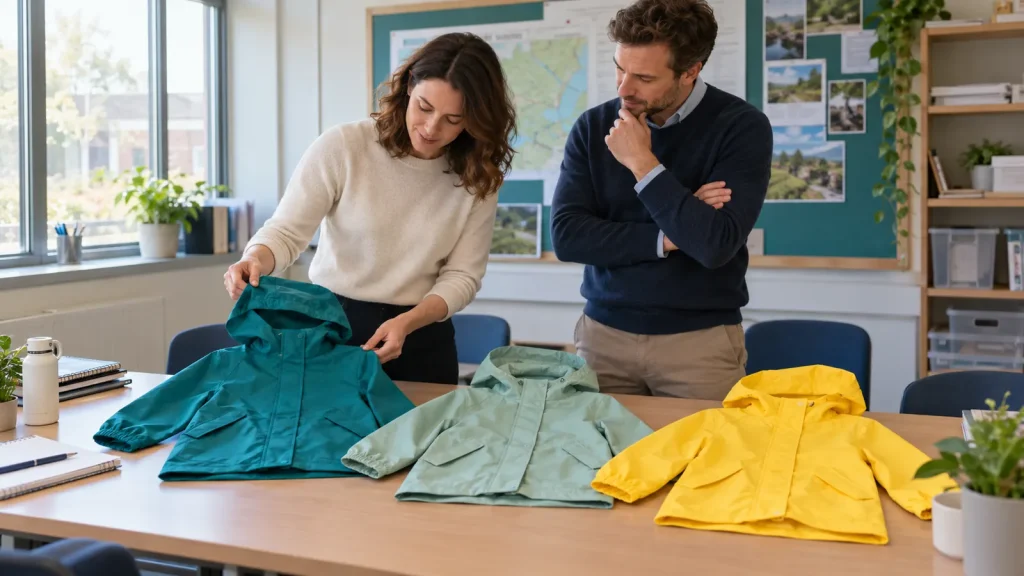
Describe the itinerary, exposure and handout process
Start with the moment the raincoat will be needed. A coach group walking across a visitor centre car park has a different problem from a class spending the morning on an open nature trail. Both might ask for school trip rain ponchos, but the same quotation may not suit both activities. Describe where the group will be, how long it expects to remain outdoors and where it can shelter. Those details give a supplier a useful assignment instead of a vague request for children's rainwear.
Break the itinerary into stages. Include departure, arrival, outdoor activities, meal stops and the journey home. Note when children will carry bags and when adults can help them change clothing. You do not need to turn the purchasing brief into the entire trip plan. A short summary of the relevant stages is enough. The aim is to identify which garment features matter at each point, such as accessible closures during a handout or manageable coverage while children sit down.
Explain the clothing expected underneath. A raincoat sampled over a light shirt can feel very different over a school jumper and winter coat. If the program spans seasons, describe those combinations separately rather than assuming one fitting covers them all. Tell the supplier whether the garment must cover a small backpack or whether bags will remain elsewhere. Review that proposal with the trip leader because extra volume can change the way the hood, shoulders and hem sit on the wearer.
Map the handout process as carefully as the garment. Will rainwear be issued at school, placed in individual trip packs or carried by staff until needed? Who will identify sizes, collect packaging and help with unfamiliar fasteners? A packed sample should travel through that process before the order is approved. An attractive compact pack is less useful if the responsible adult cannot distinguish the sizes without opening every one while the group waits at a departure point.
Give the buying brief a clear destination and required arrival point. The country where the garments will be supplied matters for the evidence review, while the actual receiving location matters for packing and delivery. A central educational distributor may need cartons for several schools; a single school may need class packs ready for one visit. Describe those arrangements explicitly. Otherwise a supplier may quote a standard bulk carton that creates extra sorting work just when school staff have little time available.
Use an illustrative itinerary to test the brief. Imagine a morning museum visit with an outdoor walk between buildings, lunch indoors and a coach return. Ask what happens if rain begins before the walk, if a pupil needs a different size and if several opened garments return wet. The exercise does not prove that a particular product is suitable. It reveals unanswered operational questions that your team can resolve before requesting an OEM Program or comparing Bulk Pricing across different garment proposals.
Finish with a one-page use summary that everyone can recognize. Name the wearer group, activity, layers, expected issue method, receiving location and decision owner. Include uncertainties openly, such as an unfinished attendance list or an unconfirmed venue route. Ask suppliers to state which assumptions their proposal uses. A shared starting point reduces the risk of approving a material or pack because it looks convenient on a desk while overlooking how the school will actually distribute and manage the rainwear on the day.
Give purchasing, teaching and technical teams clear decisions
School rainwear procurement usually involves more than the person placing the order. A buyer may manage the quotation, a visit leader may understand the itinerary, and another colleague may review product documentation. Problems arise when each assumes someone else has approved the difficult parts. Establish the decisions before circulating samples. Name who approves fit, who confirms the destination requirements, who signs off artwork and who accepts the delivery plan. The roles can be simple, but they should be visible in the purchasing record.
Ask teaching and support staff about the tasks they will perform. They can explain whether a large number of separate packs is manageable, whether pupils are accustomed to particular closures and where replacement sizes will be kept. Capture practical observations without asking staff to certify technical claims outside their role. Their feedback is valuable precisely because it concerns everyday use. Keep it alongside the technical review rather than turning an informal preference into a statement that a garment has passed a safety standard.
Give the purchasing team a consistent commercial comparison. Each supplier should receive the same intended size mix, decoration brief, pack arrangement and delivery destination. Ask for MOQ by the variants that actually affect production, rather than assuming a single headline minimum applies to every colour and size. If the school changes the design after quotations arrive, issue a revised brief. A lower quote for an earlier specification does not provide a meaningful comparison with a later proposal that includes additional packing or artwork.
Identify the person who will resolve conflicts. The preferred logo placement may overlap a label location, or a requested pack may complicate size identification. These decisions should not move silently between email conversations. Give the order a short issue list with a question, owner, due date and recorded answer. The list is especially helpful when an educational supplier is coordinating several schools whose branding preferences differ. It makes the final approval understandable to people who were not present at every discussion.
Keep school-specific information proportionate to the supplier's task. A manufacturer generally needs aggregate size quantities and approved artwork, not a pupil register or personal information about individual children. Ask the school to translate its internal needs into a garment requirement that can be shared appropriately. For example, a request for an easier closure can be described as a functional preference without sending private background details. The school's own processes should govern any personal information retained for distribution or individual assistance.
Agree how approval will be expressed. A message saying a sample looks good may refer only to its colour, while the supplier reads it as acceptance of the entire garment. Use a short approval sheet that distinguishes accepted features from pending questions. If a sample is suitable for artwork review but has not been approved for fit or construction, say so. This protects the useful progress already made without allowing an unresolved issue to disappear beneath a general expression of satisfaction.
Before releasing the order, bring the decisions together once. Confirm that the selected sample, size schedule, artwork revision, evidence file and delivery arrangement all describe the same proposal. A clear release point saves later arguments about which attachment controlled the work. It also helps the next colleague take over if staffing changes during the term. The best purchasing file is not the longest one; it is the one that lets the school and supplier identify what was agreed and which person accepted each important decision.
Separate planned outdoor clothing from contingency rain cover
Contingency rainwear and planned outdoor clothing solve related but different problems. A reserve poncho may be intended for an unexpected shower during an otherwise sheltered visit. A recurring outdoor learning program may require individually allocated garments, a care routine and a wider range of sizes. Make that distinction in the brief. Calling both products emergency rain gear can hide the amount of wear, handling and storage the second program expects. The supplier needs to understand whether the garment supports a single contingency or a repeated activity.
Do not let the presence of rainwear decide whether a trip should proceed. The visit leader's weather decisions involve the route, transport, shelter, supervision and the children taking part. A coat is one item within that planning. The Department for Education publishes educational-visit guidance for England, and HSE describes a proportionate approach to school-trip planning. Use the guidance relevant to your organization and location. A procurement guide can help structure the garment order, but it cannot authorize an activity or replace the school's own decisions.
Specify the boundary of the contingency stock. State which groups it serves, where it is stored and how staff can access it. If several classes may need rainwear at once, a cupboard containing a nominal quantity is not enough information. Check the actual size distribution and condition of the stock before calling it available. Separate unopened reserve packs from returned garments awaiting review. This makes the inventory useful for planning instead of allowing an impressive total to conceal sizes that do not match the next group.
For planned repeated use, ask who owns the garment between trips. Individually allocated raincoats create a different responsibility pattern from a shared school pool. The first may require instructions for families; the second needs an identified collection, drying and storage process at school. Agree which arrangement applies before requesting a reusable construction. A material label does not establish how many successful uses the school will obtain. That depends on the specific product and on the program that looks after it after each outing.
Keep adult staff rainwear in a separate size and use schedule. A coordinator may need different coverage, pockets or clothing compatibility from a pupil. Adding adult garments casually to the children's order can confuse quantities and approval requirements. If the event includes volunteers, confirm which organization supplies their clothing and whether its requirements differ. The goal is a complete plan for the group, while retaining enough separation that a children's garment is not assessed against an adult sample or vice versa.
Consider what happens when the contingency is exhausted. Staff need a defined response when a pack is missing, a garment is damaged or a suitable size is unavailable. That response belongs with the trip planning team, not with a promise that one poncho will fit everyone. Procurement can support it by identifying accessible reserve stock and clear contact arrangements. Avoid ordering an arbitrary spare percentage simply because it appears in a generic checklist. Base the reserve on attendance uncertainty, size variation and the program's experience.
Review the distinction after the first use. If contingency garments are repeatedly issued for routine outdoor sessions, the original buying model may no longer match reality. Conversely, a large shared pool may receive little use and create storage work without serving the planned activity. Record what changed and update the next brief accordingly. Treat the first purchase as a source of operational learning, with the product specification and supply arrangement revised through deliberate approval rather than quietly stretched into a different role over time.
Further guidance: Department for Education educational visits guidance, HSE school trips guidance.
Use our Rainwear Product & Material Guide for Wholesale Buyers to connect the school brief with the wider material, construction and purchasing decisions.
02 / 12
Choose children's raincoat sizes through measurements and fit
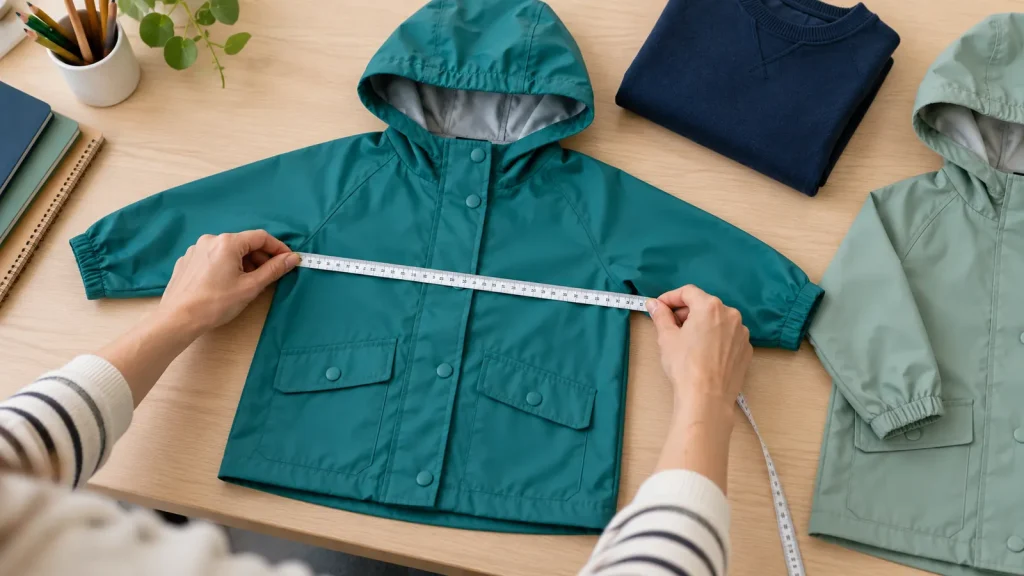
Compare garment dimensions rather than age labels alone
Age labels help staff sort a range, but they are not a complete fitting specification. Children in the same class can have different heights, proportions and clothing layers. Suppliers may also use different size conventions. When comparing kids raincoats wholesale, ask for garment measurements and the supplier's intended wearer range together. Keep those two descriptions separate. A finished coat's width is not the child's body measurement, and a label such as junior does not explain the amount of room built into the design.
Request a measurement drawing before comparing numbers. The drawing should show where the supplier measures length, width, sleeve and any other relevant dimension. Ask whether the garment is laid flat, whether closures are fastened and which seam or edge forms each reference point. Two width values can look different simply because one describes a flat measurement and another describes a circumference. Resolve those differences early so the buyer does not reject a suitable proposal or approve an unsuitable one through a misunderstanding of units.
Compare a sample against the drawing using the agreed method. Record the sample code and size, rather than writing measurements on an unlabelled photograph. If your team finds a discrepancy, check the method with the supplier before changing the order. A measuring exercise is most useful when both sides can repeat it. Ask for tolerances appropriate to the proposed construction and agree them in writing. Do not invent a universal tolerance or assume that the same allowance makes sense for every dimension.
Review the size steps across the proposed range. A single middle-size sample cannot show whether the smallest hood or the largest sleeve has been developed appropriately. Decide which sizes need physical review based on the actual group and the design differences. If a garment is offered in broad size bands, ask how the supplier established the intended range and what evidence supports it. Treat a wide fit claim as a question to investigate rather than a reason to stop checking measurements.
Make room for the school's clothing expectations. A planned winter trip may need a different fit review from an indoor-centred summer visit. Avoid solving every uncertainty by ordering a larger coat. Additional length or sleeve volume can create its own handling problems, and a larger hood may sit differently around the face. Ask the sample reviewers to consider the complete shape over the intended layers. The correct purchasing question is whether the garment works for the identified wearers, not whether it contains enough spare material.
Create a conversion sheet only after the sample range is understood. If school staff use one naming system and the supplier uses another, show the relationship clearly with the approved measurements. Mark the sheet with a revision and retain it with the order. Do not reuse a conversion from another supplier just because the printed size letters match. A practical size sheet should help the receiving team identify the correct garment and should give the next buyer a reliable basis for replenishment.
Before approval, check that the size description also appears consistently on the garment, individual pack, class-pack list and carton schedule where those items are used. A well-developed size range can still cause confusion if its packing labels use different names. Ask someone who did not attend the sampling meeting to follow the labels and locate a requested size. That simple exercise can reveal ambiguous wording before hundreds of garments arrive. It tests the clarity of your system without pretending to replace a proper wearer fitting.
Review coverage, movement and layers in a supervised fitting
A supervised fitting should answer practical questions about the proposed garment, not turn children into product testers for unresolved hazards. Have the responsible adults review the design first and use the school's normal arrangements for participation, supervision and any necessary consent. Keep the activity ordinary and appropriate. The purpose is to observe fit over expected clothing, how the hood sits and whether the wearer can manage the garment during familiar movements. It is not a substitute for technical testing or a reason to expose pupils to difficult weather.
Prepare a short observation sheet before the fitting. Identify the sample, size, clothing layers and features being reviewed. Ask reviewers to record what they see rather than relying on a general statement that the coat fits. Useful observations might describe a sleeve covering the hand, a hem position during walking or a hood moving across the face when the wearer turns. Those details give the supplier something specific to examine. A score without context rarely explains what needs to change in the pattern.
Consider the movements that belong to the itinerary. A pupil might need to sit on a coach seat, carry a small bag or reach for a handrail. Ask the responsible adults which observations are relevant and comfortable to include. Do not assume a garment that looks tidy while standing still will behave the same way during those activities. Equally, do not add demanding movements that have no connection to the trip. A focused review is easier to supervise and produces feedback that the buyer can actually use.
Look at the hood with the closures in the intended wearing position. Check whether it remains manageable when the wearer turns their head and whether the design suits the planned clothing underneath. If staff need to adjust it repeatedly, record the issue rather than improvising a cord, clip or alteration. Any proposed design change should return to the supplier and the appropriate reviewer. An adjustment made casually during a fitting can create a feature that was never part of the original product assessment.
Ask about ease of putting the garment on and taking it off. Some pupils may manage a particular closure independently, while others will need assistance. That observation can affect both product choice and the time allocated for distribution. Keep individual needs within the school's own information processes and send the supplier only the functional feedback needed for development. A useful note might explain that the opening needs to be easier to locate or that a fastener is difficult to operate over the intended layers.
Keep feedback from different sizes identifiable. If the smallest size needs a hood change but the larger sample is acceptable, a single combined approval can obscure the distinction. Record the decision by size and feature. Ask the supplier whether a proposed change affects the rest of the range, then review the revised sample where necessary. Preserve the earlier sample reference so everyone understands what was changed. This prevents a successful correction in one area from being mistaken for approval of every unreviewed detail.
End the fitting with a decision, not just a collection of comments. Mark which sizes can proceed, which require a revised sample and which questions belong with a technical reviewer. Keep any photographs within the school's approved process and avoid unnecessary identifiable pupil images in the supplier file. The final record should let procurement describe the approved fit without relying on someone's memory of the session. That is what turns a helpful school observation into a clear, repeatable requirement for a bulk order.
Plan an inclusive size mix and a practical exchange process
The size mix is an operational decision as well as a purchasing one. Start with the actual groups expected to use the rainwear, the school's available information and the approved size range. Do not build the order solely around an average pupil. An average can conceal the children who need a different size or a different garment arrangement. Ask the school to identify the functional range it needs while keeping personal details within its own records. Suppliers normally need quantities by approved variant, not individual pupil information.
Review existing stock before adding new quantities. Check which sizes are genuinely usable, whether their construction matches the current plan and whether returned garments have completed any required care and inspection. A box labelled medium may contain several generations of rainwear with different measurements. Keep those differences visible in the inventory. If older garments will be used alongside the new order, decide how staff will identify them and whether they belong in the same distribution system. Do not silently treat different sizes as interchangeable.
Make the reserve stock purposeful. Attendance changes, fitting exchanges and damaged packs can all create demand, but the appropriate reserve depends on the program. Use previous records where available and ask the visit leader where uncertainty remains. Avoid presenting a fixed spare percentage as a universal solution. A reserve containing only the most common size may not help the pupil who needs an alternative. Review the spread of reserve sizes and decide which adult can authorize an exchange during the trip.
Plan the exchange process before distributing named or grouped packs. Staff should know where unopened alternatives are stored, how an opened garment will be handled and how the inventory will be corrected. Keep the process discreet and manageable so a pupil is not singled out because a garment does not fit. A clear size code can help adults make the exchange without announcing personal information. Where colour identifies a group, consider how an alternative size will retain that identification without adding unapproved attachments or labels.
Consider whether one garment style serves all intended users. A school may need to discuss different openings, coverage or wearing arrangements for particular functional needs. Those discussions should involve the responsible staff and, where appropriate, the people who support the child. Do not promise that a standard poncho is universally accessible. Ask suppliers what options they can actually provide, request suitable samples and keep the approval requirements explicit. A thoughtful alternative is more useful than forcing every requirement into a single stock description.
Keep size and colour quantities linked in the order schedule. If different classes use different colours, each colour needs its own size breakdown. Confirm the MOQ implications and ask whether the proposed manufacturing arrangement changes the commercial terms. Avoid rounding the size mix simply to make a quotation look tidy unless the school has accepted the practical consequences. The schedule should show what staff will receive, how it will be packed and which quantities form the accessible reserve rather than the routine allocation.
After the first distribution, record exchanges as a learning tool. Note which approved sizes were requested more or less often and whether the labels caused confusion. Do not assume every exchange proves that the supplier's sizing was wrong; attendance changes, layers and the original allocation method may also explain it. Review the pattern with the responsible team before the next purchase. Over time, a documented exchange process helps the school develop a better size plan without inventing a one-size promise that the garment cannot reliably fulfil.
03 / 12
Compare materials and construction for school trip rain ponchos
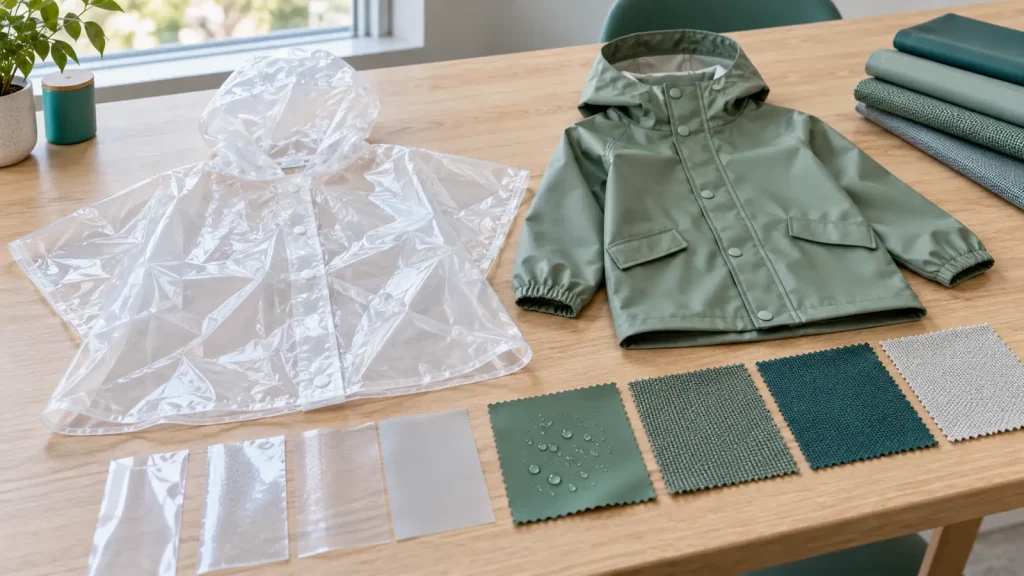
Distinguish film ponchos from coated textile raincoats
A school rainwear quotation should identify the complete construction, not just a familiar material name. Film garments and coated textile garments can look similar in a small catalogue image while feeling and handling differently in use. Ask whether the main body is a continuous film, a woven textile with a coating or another specified assembly. Request the proposed material description in writing and connect it to a sample. That gives the buying team something concrete to compare when reviewing school trip rain ponchos from different suppliers.
PE, EVA and PVC are material-family names, while polyester commonly describes a textile fibre within a garment construction. These terms do not establish a finished coat's thickness, size, seam quality or suitability for a particular group. A supplier offering a polyester jacket should explain the water-barrier construction as well as the outer textile. A film proposal needs an equally clear description of its sheet and joins. Keep any unanswered points visible rather than filling the gaps with assumptions drawn from a different product.
Use the measurements relevant to each construction. Film thickness and textile mass per unit area describe different attributes, so their numbers should not be placed in one comparison column as though they were equivalent. Ask for units, measurement methods and tolerances where those attributes affect the brief. A heavier sample is not automatically the better school garment, and a thinner sample is not automatically the easier one to issue. Compare the actual product against the agreed use, including its cut, closure and packed arrangement.
Review the joins and openings alongside the material. A continuous sheet may resist water while a garment opening still allows entry under particular conditions. A textile assembly may include a barrier layer whose usefulness depends on how the seams and closures are constructed. Ask the supplier to show the proposed seam and hood arrangement on a complete sample. Do not approve a bulk garment solely from a small swatch. The swatch can support discussion of texture or colour, but it leaves important assembly questions unanswered.
Ask how the construction affects decoration. The printing proposal should suit the actual surface and the intended handling, not simply the polymer name in the quotation. A school logo that looks acceptable on a flat sample may behave differently across folds or near a closure. Keep material and artwork approval connected so the supplier does not change one without considering the other. Where an OEM Program offers alternatives, request separate sample references and clearly identified differences instead of a loosely described upgrade.
Compare packed and unpacked samples together. The school may care about storage volume, but a compact fold should also be manageable during distribution. Ask adults to open the pack, identify the front and locate the closure. Record any sticking, confusing folds or awkward presentation for supplier review. These observations do not establish laboratory performance, but they do reveal whether the proposed construction works with the school's handout process. A garment can meet the material description and still need a better packing arrangement.
Use the material comparison to narrow the choice rather than to award a universal winner. A short contingency walk, a recurring outdoor lesson and a multi-day educational tour may lead to different priorities. Keep those priorities in the comparison sheet and ask each supplier to explain its proposal against them. If a material substitution is offered later, review it as a change to the approved construction. Familiar wording on a revised quotation should not conceal a different product from the one the school examined.
Ask what supports the proposed weather-protection claims
Weather-protection language is useful only when the buyer knows what it describes. Waterproof, water-resistant and weatherproof may appear in product descriptions without explaining the tested component or conditions. Ask the supplier to define the claim for the proposed children's raincoat. Is it referring to the material, a seam assembly or a finished garment evaluation? Record the answer beside the sample reference. A clear question at the quotation stage is easier to resolve than a disagreement after staff have distributed the order.
When a test result is supplied, start with identification. Check the product or material name, sample description, report date and the relationship to the construction being quoted. A result for an undecorated fabric may not answer every question about a decorated coat with different seams. Ask the appropriate technical reviewer to interpret the scope and any gaps. Do not translate a laboratory number into a promise about how long every child will remain dry during every kind of outdoor activity.
Compare results only when the comparison is meaningful. Different test methods, specimen preparations and reporting units can describe different things. A larger number is not necessarily a better answer to the school's requirement. Ask suppliers to identify the method and conditions, then have the reviewer explain whether the evidence addresses the agreed claim. If a report is unavailable or does not match the proposed item, mark the question as unresolved. Avoid turning the absence of an answer into an assumed pass or an invented performance rating.
Keep openings in the conversation. Hood shape, front closure, sleeve arrangement and body coverage all affect how a garment is worn. The school should review those features through samples and ordinary supervised fitting, while relevant technical questions remain with the appropriate reviewer. Separate the observations in the record. A teacher saying that the hood is easy to position is useful operational feedback; it is not a statement that the garment has met a named waterproof standard. Both types of evidence can matter without being interchangeable.
Ask what happens after the proposed care process when repeated use is intended. The supplier should provide instructions appropriate to the actual product, and any durability claim should be understood in that context. Do not assume that a reusable label includes unlimited washing, machine drying or an unrestricted storage life. If the school plans a particular cleaning routine, discuss it before approval. A purchasing decision is stronger when the product instructions and the organization's available facilities are considered together rather than discovered after the first wet trip.
Avoid adding protective claims because a garment looks substantial. Ordinary rainwear is not automatically suitable for every occupational, traffic or specialist activity. If a program needs an additional protective function, identify that requirement separately and obtain the relevant product-specific assessment. A bright colour, reflective-looking strip or thick material does not prove certification. Keep the public description and school communications consistent with the evidence actually available. Overstated language can create expectations that neither the supplier's report nor the garment's intended use supports.
Turn the evidence review into a short acceptance statement. It should identify the claim being accepted, the supporting document, the sample or variant covered and any limitations relevant to the order. Share that statement with the people approving the specification so they understand what remains outside its scope. The result is not a promise that weather becomes predictable. It is a better-defined product choice, with the school's trip decisions and the supplier's garment evidence each kept in their proper place throughout the buying process.
Match material handling to the children and the activity
The feel of a raincoat matters because people must put it on, move in it and manage it afterwards. Ask sample reviewers to describe handling in specific terms: stiffness at a fold, ease of opening the front, the way a sleeve sits over a jumper or the noise made during ordinary movement. Avoid reducing these observations to premium or cheap. Concrete feedback helps a supplier understand the concern and lets the buyer compare proposals without pretending that personal preference is a technical performance measurement.
Consider the activity's pace. A group moving between nearby buildings may value quick issue and simple packing, while a longer supervised outdoor session may place more emphasis on fit and the planned clothing system. Explain that context to the supplier before choosing a construction. Do not assume one material provides the same comfort for every wearer or weather condition. The school controls the activity, breaks and access to shelter; the garment proposal should be reviewed as part of those practical arrangements rather than in isolation.
Ask adults to handle samples in the way they will handle the bulk stock. Open a class pack, separate individual garments and locate the size information. If a folded film is difficult to separate or a closure is awkward to find, record the problem and ask whether the material, fold or pack can be changed. Sometimes the useful correction concerns presentation rather than the garment itself. Keeping the observation specific avoids replacing an entire construction when a simpler packing adjustment would address the actual issue.
Discuss comfort-related feedback with the responsible school team. Some children may have preferences or functional needs that affect how they respond to a garment's texture, sound or opening. Procurement should not diagnose those needs or make medical claims about a material. It can ask for samples and describe practical requirements to the supplier. Where the standard proposal does not work, identify an alternative through the school's normal support process. A clear exception plan is more credible than describing any single product as suitable for every child.
Think about what pupils must carry after the rain stops. A garment that packs neatly when dry may be inconvenient immediately after use. Staff need a plan for handling wet items and separating them from belongings according to the school's arrangements. Ask whether the supplied pouch is intended for temporary transport or longer storage, and follow the product's care instructions. Do not let a pouch photograph imply that a damp raincoat can simply remain packed until the next trip without further attention.
Use complete samples for the final handling decision. A material swatch cannot show how a hood folds into the pack, how a front opening behaves or how a child-sized sleeve works with the intended layers. If the supplier changes the material after a successful trial, review the effect on the complete garment. Record whether the change affects decoration, labels or packing as well. Those connections are easy to overlook when a revised quotation describes the alteration as a minor material adjustment.
Write the final handling requirements in practical language. State the intended issue method, the agreed closure arrangement, the approved fold and the care instructions that will accompany the order. Keep subjective preferences identified as preferences and measurable requirements identified as requirements. This makes the brief useful to the supplier and to the school staff who receive the stock. It also gives the next purchase a sensible starting point: a documented description of what worked for this program, with room to change it when the activity or wearer group changes.
Compare complete constructions in our PE, PVC, EVA and polyester raincoat material guide. Then ask for the specification of the exact children's garment being proposed.
04 / 12
Review hoods, closures and trim before ordering kids raincoats wholesale
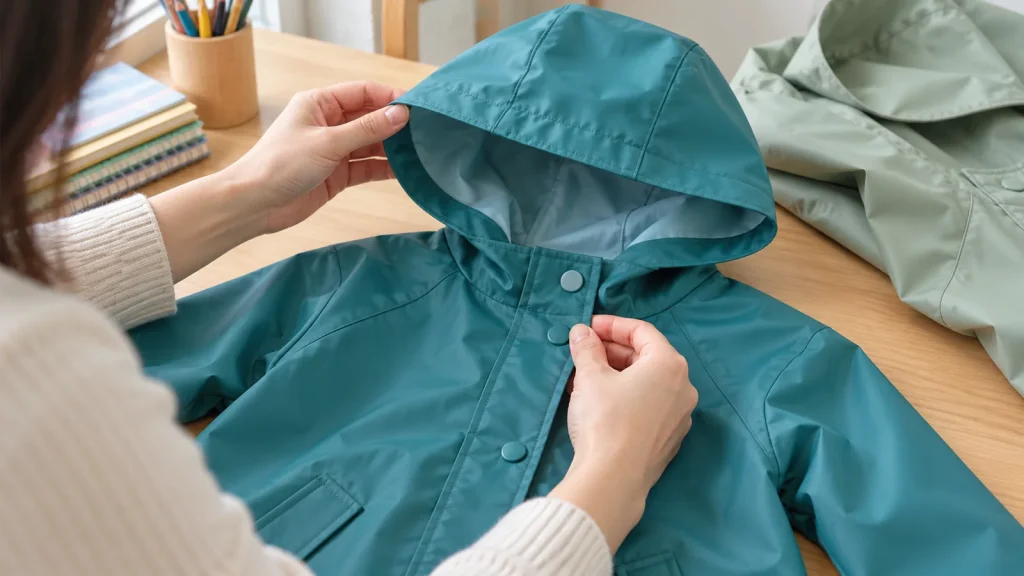
Specify the hood and cord design before approving the style
Review hood and cord details early, especially when a catalogue offers several similar-looking versions. The U.S. CPSC identifies hood and neck drawstrings on children's upper outerwear in sizes 2T through 12, or equivalent sizes, as a substantial product hazard. Its guidance treats waist and bottom drawstrings under a different size range and set of requirements. BSI's EN 14682 standard addresses cords and drawstrings on children's clothing. Ask the destination reviewer to confirm the applicable rules and scope for the proposed garment rather than accepting a generic safety statement.
Put the approved hood arrangement in the drawing and sample record. Do not leave it to a phrase such as standard hood, because that wording can mean different things across product lines. Identify the opening, attachment to the body and any adjustment features. If the buying brief calls for a cord-free design, make that explicit and review the complete sample for it. A photograph showing the front of the garment may not reveal details elsewhere around the hood or neckline.
Ask suppliers to identify all decorative and functional cords, not only the feature they call a drawstring. The purpose is to give the reviewer a complete design description. Avoid making a legal classification based on a sales label or assuming that a short decorative feature is irrelevant. Where a proposal raises a question, return the drawing and sample to the appropriate specialist before approval. The purchasing team should keep the decision visible rather than improvising a modification once production has already started.
Keep fit and design review connected. A hood that needs repeated improvised adjustment during a supervised fitting is a reason to revisit the sample, not a reason to add an accessory locally. Record the issue in terms the supplier can investigate: the position of the opening, how it moves during an ordinary head turn or how it sits over the intended clothing. Ask for a revised construction where necessary. Then confirm that the revised hood remains consistent with the rest of the approved garment.
Review the artwork and packing images against the physical sample. A supplier may send a catalogue picture of a related style while quoting a different hood arrangement. That mismatch can confuse the school's approval team and later appear in its own communications. Request images or drawings that accurately describe the proposal, and identify any reference-only picture clearly within the private purchasing file. The approved sample and written specification should control the order, with promotional images supporting the decision rather than silently changing it.
Avoid adding unreviewed accessories during distribution. Staff may be tempted to attach a clip, tie or decorative item to solve a practical problem, but that creates a different arrangement from the one assessed. Give them a clear route for reporting the issue and obtaining an approved alternative. Include the relevant wearing instructions with the stock. The aim is not to burden a teacher with product-development work during a trip; it is to resolve foreseeable design questions while the buyer and supplier still have time to act.
Make hood approval a named item on the release sheet. Record the sample revision, sizes reviewed, destination review reference and any outstanding questions. If a later production change affects the hood, reopen that item rather than assuming the original approval follows automatically. This small discipline is particularly useful for repeat orders, where a familiar colour and logo can distract attention from a changed pattern. A school raincoat should remain identifiable as the construction that was actually reviewed, even when its commercial description has stayed the same.
Evaluate fasteners, edges and attachments as an assembly
A snap, zip or hook-and-loop closure should be reviewed as part of the garment around it. The component alone does not show how it is attached, how the material supports it or how the wearer reaches it. Ask for a complete sample in the proposed construction and identify the components in the specification. If the supplier offers alternative closures, keep each version separate during review. Otherwise a team may approve the appearance of one sample and receive the fastening arrangement from another.
Observe ordinary opening and closing during adult sample review. Note whether the closure is easy to locate, whether adjacent material catches and whether the edges feel unfinished or awkward. Record the specific location and sample code if there is a concern. Do not prescribe an improvised strength test or a universal pulling force based on guesswork. Where attachment strength or another technical attribute needs verification, ask the responsible reviewer to define a suitable method and acceptance requirement for the product and intended market.
Look beyond the most visible front closure. Review cuffs, pockets, hood joins, labels, hanging loops and decorative pieces where present. A small feature can be overlooked when the discussion focuses on colour and printing. Ask the supplier to confirm which components belong to the production version and whether any sample detail is temporary. Keep those answers in the sample record. A prototype may be useful for one purpose without being a complete representation of the final assembly, and the approval should reflect that limitation.
Consider the adults who will help children put the garments on. They need a closure arrangement that fits the planned distribution process and can be explained simply. Ask staff to review the sample using the intended clothing layers and ordinary handling. Their feedback may reveal a need for a different opening or clearer orientation. Keep that practical feedback distinct from formal evidence about component performance. A fastener that adults find convenient still needs the applicable product review; a technically acceptable component may still be inconvenient for the school's use.
Review the finish where the garment contacts the wearer or clothing. Seams, cut edges and labels should match the agreed sample quality and construction. Record any roughness, unfinished area or inconsistent assembly with a clear description. Avoid using a photograph alone to decide how something feels or moves. Ask the supplier for a replacement or revised sample when the concern cannot be resolved from the available evidence. That is more useful than accepting a reassuring adjective that never identifies what was changed.
Check any detachable or decorative elements through the destination review. Do not assume that every component falls under the same rules simply because it is attached to clothing, and do not make blanket small-parts claims without checking applicability. Give the reviewer the intended age group, product function and component details. Procurement can then incorporate the resulting requirements into the order. The supplier should know exactly which attachments are approved and which alternatives require a new review before they can be used in production.
Retain the approved assembly reference for receiving checks. It may include a physical sample, close-up photographs and a short component list, each labelled with the same revision. Explain which differences require escalation rather than leaving warehouse staff to interpret them. For example, a changed closure type should not be dismissed as a harmless colour variation. The value of the reference is consistency: the buyer, supplier and receiving team can all identify the arrangement that was agreed without reconstructing it from scattered messages.
Turn construction concerns into recorded acceptance decisions
Sample reviews often generate comments that sound clear in a meeting but become vague in a purchasing file. Phrases such as improve the hood or make the fastening stronger do not tell the supplier what the buyer expects to see next. Convert each concern into a defined question. Identify the sample, feature, observation and person responsible for the decision. Then state what evidence or revised sample is needed. This turns a general worry into an issue that both sides can resolve and close deliberately.
Separate an observed defect from an unverified concern. A missing snap can be recorded as a visible difference from the approved drawing. A concern about attachment performance may require a technical evaluation before the team knows whether the design is acceptable. Both deserve attention, but they need different next steps. Do not label every uncertainty as a proven failure, and do not allow uncertainty to become approval through silence. Mark the status clearly so the order cannot proceed on an assumption that nobody intended to make.
Use photographs to locate a feature, then add the explanation that the photograph cannot provide. State which size was reviewed, whether the garment was fastened and what the reviewer was trying to do. If a dimension matters, connect it to the agreed measurement drawing. A close-up image without scale or context can be misleading. Good records help a supplier reproduce the observation and propose a targeted correction, which is usually more productive than exchanging a series of increasingly general assurances about quality.
Define the acceptance route before requesting a revision. Some changes can be checked against an updated drawing; others need a new physical sample or a fresh evidence review. Let the relevant decision owner specify the route. If the change affects multiple sizes or components, record which parts of the range must be reconsidered. Avoid accepting a revised photograph as proof that every consequence has been addressed. The scope of the recheck should follow the change, rather than the convenience of the material the supplier happens to send first.
Keep a concise history of the decisions. Record what the original issue was, how the supplier responded and why the final proposal was accepted. This is especially useful when a repeat order arrives months later and a different colleague asks why a particular detail was specified. The history need not preserve every informal message in the main approval sheet. It should point to the relevant evidence and explain the final choice in language that a new buyer or receiving colleague can understand.
Agree how unapproved substitutions will be handled. A supplier may face a component availability problem after the sample has been accepted. Ask it to identify the proposed substitute, the reason for the change and any effect on the garment, artwork or evidence. The buyer should review that proposal before it is incorporated, following the agreed approval process. Do not write a blanket permission for equivalent components unless the meaning of equivalent and the authorization route have been defined in a way the team can actually apply.
Close the construction review with a clear release status. List accepted features, remaining conditions and the exact revision permitted for the order. Make sure commercial staff receive the same status as the technical reviewer. An order can be commercially attractive while still awaiting a design decision, and those two facts should remain visible. Once the required decisions are complete, the supplier has a stable reference for production and the school has a defensible record of what it approved rather than a folder of unresolved sample comments.
Further guidance: CPSC children's outerwear drawstrings guidance, BSI children's clothing cords and drawstrings standard.
05 / 12
Build a destination-specific evidence file for bulk youth rainwear

Identify the product, market and responsible compliance reviewer
Begin the evidence file with a precise description of what is being supplied. Name the intended users, garment construction, components, decoration and destination market. Children's rainwear is not a single regulatory category with one universal certificate. The applicable requirements depend on the product and where it is placed on the market. Ask a qualified reviewer to establish that scope before the supplier commissions tests or the buyer promises a particular claim. A clear scope prevents the team from collecting documents that do not answer the order's actual requirements.
For the U.S., the CPSC's Children's Product Certificate guidance explains the certification responsibilities of domestic manufacturers and importers for children's products subject to applicable safety rules. Supporting testing and any applicable exceptions need to be considered correctly. A laboratory report and a Children's Product Certificate serve different roles; neither should be replaced by a supplier's generic declaration that its factory is certified. Have the responsible reviewer identify the rules relevant to the ordered item and the party responsible for the required documentation.
Material construction can affect the technical review. CPSC guidance distinguishes the flammability standard for clothing textiles from the standard for vinyl plastic film used in apparel. Ask the reviewer and laboratory to classify the exact proposed assembly and identify the appropriate requirements. Do not assume that a test for one material automatically covers a different coated or layered garment. Keep the construction description with the evidence request so the laboratory is not asked to interpret an ambiguous catalogue name without knowing what the buyer intends to order.
Keep markets separate when necessary. A document prepared for one destination does not automatically establish compliance elsewhere, and a familiar standard number may address only one feature. If an educational supplier distributes across several countries, identify those destinations before approving the evidence plan. Ask the reviewer to distinguish legal requirements, relevant standards and additional buyer specifications. The distinctions matter because they affect what must be demonstrated and how the final product should be described. Avoid combining them into an unexplained all-market certification claim.
Assign a person who can approve the scope and interpret the response. The purchasing team can collect documents and check that references match, but it should not guess at technical applicability when the answer is unclear. If a supplier proposes a different component or formulation, route the change to that reviewer. State the intended age and use honestly rather than changing a label to avoid a question. The review should describe the product that will actually be supplied and the people expected to use it.
Plan the review early enough to affect the design. Evidence questions discovered after artwork and production have been approved can create avoidable rework. Include the scope decision among the sample-development milestones and ask the supplier which documents are already available for the exact proposal. Record what still needs to be obtained. A gap is easier to manage when it has an owner and a realistic next step. It becomes a larger problem when a delivery promise is made as though every compliance question were already closed.
Use careful wording in the finished purchasing file and any school-facing description. Describe the specific evidence and its scope rather than saying the product is completely safe, non-toxic or certified for every use. Do not add a CE mark or another conformity claim without confirming that it is applicable and supported for the exact product. The practical goal is a defensible decision about this order, with the responsible parties and supporting records identified. It is not to collect the greatest possible number of impressive-looking logos on a quotation.
Connect reports and certificates to the exact ordered product
A useful report should be traceable to the product being considered. Start by matching the sample description, model or reference code, material construction and relevant components to the quotation. Check whether the document concerns the undecorated material, a component or a completed garment. If the relationship is unclear, ask the supplier to explain it in writing and let the appropriate reviewer decide whether the evidence is sufficient. A familiar company name on the first page does not establish that every item in its catalogue is covered.
Keep complete documents where they are required for review. A cropped result page or a marketing screenshot can omit the sample description, method, conditions or limitations that explain the result. Ask for the relevant full report and retain it with the order reference. Give reviewers access through the organization's normal document process rather than scattering copies across unrelated message threads. The purchasing file should make it possible to find the evidence that was actually considered when the product was accepted.
Check dates without inventing a universal expiry rule. The significance of a report's age depends on the requirement, the product and whether anything relevant has changed. Ask the reviewer to assess that relationship instead of assuming every document becomes invalid after an arbitrary period or remains useful forever. A recent report for a different material is not automatically better evidence than an older report that is properly connected to an unchanged construction. The connection and applicable requirements need to be understood together.
Include decoration and trim in the product description. A new print, coating, closure or label may introduce a question that was not addressed by the original sample evidence. Ask the supplier to identify which components and variants the supporting documents cover. Where grouping or representative testing is proposed, have the reviewer assess the basis rather than accepting a broad statement that one colour covers everything. The buyer's task is to keep the proposed scope visible and ensure the appropriate person accepts it.
Use a document register with a small number of meaningful fields. Record the document title, issuer, date, product reference, subject covered, reviewer and decision. Add a link to the stored file and note any follow-up question. This makes the register a practical index rather than a decorative checklist. If a document is supplied only for background, mark it accordingly. Staff should be able to distinguish evidence supporting the order from a general brochure, factory audit or unrelated product example that happens to be in the same folder.
Resolve mismatches before using a document to support a claim. A different model number, unexplained material description or missing component reference should trigger a focused question. Ask the supplier for the connection, corrected documentation or additional evidence as appropriate. Do not alter a supplier report to make it appear to match the order. Keep the original and record the explanation or replacement. This preserves a clear trail and avoids giving later colleagues a file whose apparent consistency was created by editing away the differences.
At final approval, confirm that the evidence register matches the released specification. If a late design change has occurred, check whether the reviewer has considered its effect. Record any conditions that remain relevant to supply, labelling or use. The resulting file should let the responsible importer, educational supplier or school purchasing lead explain why this product was accepted. That explanation depends on connected evidence and clear decisions, not on a large attachment collection whose relationship to the delivered rainwear nobody can establish.
Keep traceability and change control in the purchasing record
Traceability starts with a product and batch that people can identify consistently. In the U.S., CPSC tracking-label guidance calls for distinguishing permanent information on children's products and their packaging to the extent practicable. The information supports identification of the responsible source and production details. The guidance also explains that the tracking-label requirement is not itself a safety rule requiring CPC certification. Have the responsible reviewer confirm the appropriate marking arrangement for the garment rather than treating a removable sales tag as an automatic solution.
Translate the traceability plan into the school or distributor's receiving process. Staff should know which references to retain when cartons are opened and garments are allocated. If stock is split between several schools, preserve the relationship between the received batch and the allocation records. The level of detail should be practical for the organization, but it should not disappear simply because the original carton is recycled. Ask the supplier to show the proposed markings and pack information during sampling so the receiving team can review them in advance.
Use distinct references for product style, size, artwork revision and production batch. These fields answer different questions. A style code can identify the general design while a batch reference distinguishes a particular production run. If everything is recorded under a single informal product name, the team may struggle to identify which garments are affected by a later question. Agree the terminology with the supplier and use it consistently across the order, packing list, evidence register and the school's internal stock record.
Keep changes connected to those references. When a supplier proposes a material, closure or packing alteration, record the affected specification and the proposed effective batch. Ask which earlier approvals need review and who is authorized to release the change. Avoid a blanket instruction to use the latest version unless the team can identify what that version is. A simple revision number and dated approval can prevent the receiving department from comparing new stock against an obsolete sample without realizing the specification has changed.
Prepare a route for product concerns after delivery. Staff should know whom to contact, which product information to provide and how to keep affected items identifiable while the organization reviews the concern. Follow the responsible organization's procedures and any applicable reporting obligations; do not improvise a public conclusion from an isolated observation. Procurement can help by maintaining supplier contacts, batch references and the approved specification. Those records make a focused investigation possible when the original buyer is unavailable or the stock has already been distributed.
Separate personal distribution information from product traceability. A school's internal allocation process may involve named pupils, but the supplier generally needs product and batch information to investigate a garment question. Share only the information necessary for that purpose through the organization's approved process. A photograph of a label or component may be sufficient without identifying the child who wore it. Keeping those records distinct can make the purchasing file easier to manage while still preserving the information needed to connect a concern to the relevant stock.
Review the file before a repeat order. Confirm that the supplier is still quoting the approved construction and identify any changes since the previous batch. Update the evidence and sample references where the responsible reviewer requires it. Familiarity is helpful, but it should not replace verification of the new proposal. A repeat purchase is most efficient when the earlier record is clear enough to reuse and the changes are visible enough to assess. That balance supports continuity without allowing a different garment to arrive under an unchanged informal name.
Further guidance: CPSC Children's Product Certificate guidance, CPSC tracking label guidance, CPSC Flammable Fabrics Act guidance.
06 / 12
Customize school rainwear without complicating identification or fit

Use colour and group identity with a clear operational purpose
Colour can help a school organize rainwear, but the purpose should be clear before the palette is chosen. One program may use a single colour across the school, while another may distinguish classes or departure groups. Ask staff how that distinction will work during issue and return. If several sizes are needed in each colour, include the full matrix in the quotation request. A colour choice that seems simple in a meeting can create a complicated stock arrangement when the size and group requirements are added later.
Do not use colour as the only source of essential information. Staff may handle folded packs in different lighting, and similar shades can be difficult to distinguish. Pair the agreed colour arrangement with clear size or group codes that fit the school's process. Review a packed sample to check that those identifiers remain visible. The purpose is to make distribution easier for the adults responsible, not to create a system that works only when the person who chose the colours is present to explain it.
Keep group identification separate from protective visibility claims. A bright raincoat or reflective-looking detail does not, by appearance alone, establish that the product meets a visibility standard. If a trip or activity requires a specific protective function, refer that requirement to the responsible safety team and obtain appropriate product evidence. For ordinary school branding, describe the colour choice in terms of organization and identity. Avoid adding safety language to a brochure simply because a vibrant colour looks conspicuous in a sample photograph.
Review the proposed colours on the actual material. A translucent film, matte coating and woven textile can present the same nominal shade differently. Ask the supplier how colour will be specified and what reference will be used for approval. A screen image is useful for discussion, but it may not settle the final appearance. If a school has strict brand colours, discuss the practical options and any limitations before committing to the design. Do not promise an exact match that has not been sampled and accepted.
Consider continuity for replenishment. A class-colour system may need additional garments later, possibly in smaller quantities or a different size mix. Ask the supplier what can be confirmed about the proposed arrangement without inventing future availability. Keep the approved colour reference and product revision with the order. If a later batch differs, give the school enough information to decide whether it can still use the same identification system. Small appearance differences may be acceptable commercially yet confusing operationally if colours carry meaning for staff.
Think about the reserve stock before fixing a complex palette. If every class uses a different colour, a shared reserve may not match every group. Decide whether staff will accept a neutral reserve colour, maintain separate reserves or use another approved identification method. Avoid solving the problem by adding unreviewed ribbons, cords or accessories to children's garments. A simpler colour plan may be more useful than a visually elaborate one that makes exchanges difficult. Let the distribution process guide the design rather than the other way around.
Document the final arrangement in one colour-and-size schedule. Show the school or group code, garment colour reference, quantities by size and packing instruction. Share the same schedule with the artwork reviewer, supplier and receiving team. When the order arrives, staff should be able to compare the pack labels with that schedule without reconstructing the original discussion. Clear colour planning can support a tidy OEM Program, but its real value is practical: the correct garments reach the correct groups with fewer avoidable questions.
Approve OEM artwork on the actual raincoat construction
Begin custom school rainwear artwork with the available garment area. A logo that fits a flat design file may cross a seam, closure or fold on a small raincoat. Ask the supplier for a placement drawing linked to each relevant size. Identify the proposed print dimensions and reference points rather than describing the position as roughly on the chest. Smaller sizes may need a different artwork scale or placement, and that decision should be reviewed before the school approves one image for the entire range.
Provide the artwork through the school's authorized process. Confirm that the organization has approved the logo and any accompanying wording for this use. Give the supplier the correct file revision and specify which version controls if several formats are supplied. A filename alone can be ambiguous when an earlier crest or sponsor design is still circulating. Keep a simple approval note with the final artwork, colour references and placement drawing. That helps prevent a familiar but outdated logo from finding its way onto a repeat order.
Ask the supplier to propose a decoration method for the exact construction. Film, coatings and textile surfaces may need different approaches, and a method should not be selected merely because it worked on a different garment. Request a decorated sample where the artwork is important to the order. Review the appearance and any agreed handling or care checks with the appropriate team. Do not describe every print as permanent or unaffected by rain unless the claim has been defined and supported for the proposed product.
Keep decoration away from functions it could compromise. Review its relationship to seams, closures, labels and areas that fold during packing. If a proposed placement creates a concern, ask for an alternative drawing and sample rather than accepting a last-minute adjustment made without review. A school logo is useful only when it sits comfortably within the garment's design. The artwork approval should therefore include the complete product, not just a cropped photograph that hides the surrounding construction and gives no sense of scale.
Check the design at ordinary viewing distance as well as close up. Fine detail that looks crisp on a large digital proof may become difficult to read on a small garment. Ask the school to prioritize the information that actually matters, such as a simple crest or group identity, and avoid crowding the surface with unnecessary wording. If a sponsor is involved, resolve the relative size and placement before production. These are editorial and branding decisions that should not be delegated accidentally to the printer through an incomplete file.
Approve the packed presentation when branding must remain visible at issue. A fold may hide the logo, which might be acceptable if the individual pack has clear identification. If the school expects the artwork to help staff recognize a garment before opening it, include that expectation in the packing brief. Review the sample exactly as it will arrive. This links the design decision to the distribution process and prevents a well-executed print from being treated as a packing failure because the two teams assumed different priorities.
Record artwork changes as specification changes. A revised colour, larger logo or additional print area can affect sampling, production planning and the quotation. Ask the supplier to confirm the consequences before accepting the revision. Keep the earlier approval clearly superseded so there is one current reference. A disciplined artwork process does not need to slow down a school order; it prevents repeated clarification and makes the final design easier to reproduce. The supplier can work from an approved brief, and the school knows which version it will receive.
Keep names, labels and instructions useful for school staff
Labels should help staff use and manage the garments without creating unnecessary complexity. Start by separating size identification, product traceability, care information and optional school branding. Each serves a different purpose and may need a different location or format. Ask the responsible reviewer to identify any required product information, then plan the school-specific details around it. A large crest should not displace information the receiving team needs to identify the garment or follow the instructions supplied for its intended use.
Decide whether individual names belong on the garment at all. A school may use its own internal method for allocating rainwear, while shared stock may work better with an inventory code. The supplier generally does not need pupil names to manufacture a size and colour schedule. If personalization is requested, follow the school's authorization and privacy processes and share only what is necessary. Avoid printing personal information prominently by default simply because the decoration process makes it technically possible.
Review label placement on the finished sample. A location that is convenient for production may be difficult for staff to find when a garment is folded or worn over layers. Ask someone unfamiliar with the sample to locate the size and care information. Observe whether the labels are easy to distinguish from optional branding. Keep any concern specific, such as an identifier hidden by the approved fold. The correction may be a better packing arrangement or clearer label design rather than additional labels everywhere on the garment.
Make instructions appropriate for the people who will act on them. Staff need practical information about issue, intended wearing arrangement and product-specific care. Families may need different information if garments go home after the trip. Confirm the required languages and the organization's preferred communication format. Do not invent washing temperatures, cleaning chemicals or drying methods from the material name. Use the supplier's confirmed instructions for the exact product and have the appropriate reviewer resolve any conflict with the school's planned care process before ordering.
Keep external pack information and garment information consistent. A class pack can show a group code and size count, while the garment carries its own required identifiers. The two should connect without forcing staff to retain an unmanageable stack of unrelated labels. Ask the supplier to provide a packing proof and a labelled sample. Check spelling, revision, size terminology and the relationship between codes. Small inconsistencies are easier to correct before production than after garments have been distributed across several schools.
Avoid language that promises more than the product evidence supports. Terms such as completely safe, allergy-free or certified for all school activities should not appear simply because they sound reassuring. Use precise descriptions and necessary instructions instead. If the school needs to communicate a specific feature, connect the wording to the approved specification. The same care applies to online listings prepared by educational distributors. A useful product description helps buyers understand what is proposed and which requirements must be confirmed for their order.
Include label and instruction proofs in the final approval bundle. Record who checked them and which revision the supplier should use. If the material, care process or destination changes, ask whether those proofs need revision too. Keep a copy available to the staff who receive and manage the rainwear, rather than leaving it only in a supplier correspondence folder. Good labelling is part of the working product: it helps the right garment reach the wearer, supports the agreed care routine and keeps the order identifiable later.
Planning rainwear for a school community festival or a wider group event? Explore our Wholesale Festival Rain Poncho Collection Here for the event procurement context, while keeping children's fit and product requirements in your school brief.
07 / 12
Choose disposable or reusable children's rain gear for the program
Compare issue models before comparing commercial proposals
Start the disposable-versus-reusable discussion with the way the school will issue rainwear. A sealed contingency pack handed out only when needed creates different work from a shared pool returned after every trip. An individually allocated coat creates another arrangement again. Describe the model before asking suppliers to recommend a construction. Otherwise the quotations may answer different questions, with one assuming occasional emergency cover and another assuming an organized care program that the school has not actually agreed to operate.
For contingency packs, identify the likely issue points and the storage arrangement. The buyer should know how staff recognize sizes, whether packs travel with each class and what happens to unopened stock after the visit. Ask the supplier to provide the packed dimensions and the intended storage instructions for the proposed product. Do not treat a compact package as proof of unlimited storage life. Check stock condition through the school's process and keep the batch information available, especially when reserves are carried from one term to the next.
For a shared reusable pool, map the return journey before discussing the purchase. Someone needs to collect the garments, distinguish those needing attention, follow the confirmed care instructions and return usable stock to storage. Ask whether the school has the people, space and time for that process. A reusable label describes an intended product role; it does not create a functioning return system. The proposal should make sense for the organization's capacity, including what happens when several classes return wet garments on the same afternoon.
For individually allocated garments, clarify ownership and responsibility. Will the raincoat remain at school, travel home or move between both locations? Who supplies care information, and how will replacement sizes be handled as the program changes? These questions affect the quantity and replenishment plan. Keep the distinction visible in the supplier brief so a quotation for a shared institutional pool is not compared casually with one intended for individually branded items. The same garment could be supplied under either arrangement, but the program requirements differ.
Compare the product scope alongside the issue model. A film poncho proposed for an occasional emergency may differ in cut, closure, labelling and packing from a coat intended for repeated activities. Ask suppliers to identify those differences clearly. Do not reduce the choice to a single material acronym or a statement that one option is always better. The useful comparison concerns the actual approved products and the work the school expects them to do, with any unresolved questions retained in the comparison sheet.
Use a simple scenario discussion to expose assumptions. In an illustrative school program, several classes might share reserve stock but only one group travels on a particular day. Ask what changes when two visits overlap, when rainwear returns late or when the size mix shifts. These are planning questions, not forecasts or promised outcomes. They help the buyer identify whether the proposed model remains practical under ordinary variations. A supplier can then quote quantities and packing that support a realistic program rather than an idealized handout.
Request Bulk Pricing only after the scope is comparable. Give each supplier the same construction brief, size schedule, decoration requirement and packing basis, or label the alternatives explicitly. Ask how MOQ applies to each option and what assumptions govern the delivery proposal. The school can then discuss commercial differences in the context of the work involved. A purchasing decision is more useful when it explains what the organization will operate, rather than choosing a nominally reusable or disposable category without defining the program around it.
Make drying, cleaning and storage part of a reuse plan
A reuse plan needs an owner after the trip ends. Before approving reusable children's rain gear, ask the school to identify where returned garments will go and who will check their condition. Separate the collection point from the storage location for ready-to-issue stock. This helps staff avoid counting damp or unreviewed garments as available for the next class. The procedure can be straightforward, but it should reflect the actual facilities and staffing rather than an assumption that someone will deal with the rainwear later.
Obtain the supplier's confirmed care instructions for the exact construction. A film garment, coated textile and decorated assembly may have different limitations. Do not infer a washing temperature, detergent, disinfectant or drying method from the word reusable. If the school's normal cleaning process differs from the supplied instructions, resolve that conflict before ordering. Ask the relevant reviewer and supplier what is appropriate. A convenient routine is not automatically suitable for every product, and an unsupported care method can undermine the basis on which the sample was accepted.
Plan the space needed to handle returned stock. Ask staff to walk through the proposed process using a realistic number of sample garments or a simple allocation plan. Consider where items can be separated, checked and dried according to their instructions without interfering with other school operations. Do not promise a drying time that has not been established for the actual conditions. The point is to identify whether the organization can manage its expected returns and whether the timetable leaves usable stock for the next planned activity.
Keep condition checks distinct from cleaning. A garment can be dry and still need attention because of a damaged closure, unclear label or other reported issue. Give staff a way to set it aside and record the reason without mixing it back into the available stock. Follow the school's process for deciding whether an item can return to use. Do not improvise repairs or add components that change the approved design. Ask the supplier for appropriate guidance where a recurring issue suggests the construction or handling instructions need review.
Store the garments in a way that preserves identification. Staff should be able to find the required sizes and distinguish batches or versions where that matters to the program. Use the product's confirmed storage guidance and keep the area consistent with the school's facilities. Avoid compressing a care question into a generic instruction to put everything back in the pouch. A pouch may be useful for transport, but the storage plan still needs to account for condition, dryness and the instructions that accompany the actual product.
Record the work involved during the first few returns. Note the staff time, space constraints, missing garments and questions that arise. These observations help the school judge whether the planned model is manageable. They should not be turned into a universal product-life claim or a promised number of uses. Keep them as evidence about this program under its actual conditions. If the process proves difficult, review the garment, packing and allocation model together rather than assuming the material choice alone explains every problem.
Build the return procedure into the handover for new staff. A shared rainwear pool can lose consistency when the colleague who organized it moves to another role. A short written routine, supplier instructions and clear stock labels help preserve the system. Review it when the product or cleaning arrangements change. Reuse becomes a practical purchasing option when the organization can carry out the whole cycle, from issue to the next ready garment. The garment's construction and the school's operating process need to support one another.
Evaluate total program effort and specific environmental claims
A bulk rainwear decision should consider the program's work as well as the supplier's quotation. List the activities each option creates: ordering, receiving, sorting, issue, return, care, storage and replacement. Identify which are performed by school staff, a distributor or another organization. This does not require publishing unit prices or inventing a financial model with unsupported figures. It gives the buyer a clearer basis for comparing proposals and helps reveal when a seemingly simple garment choice shifts substantial work to a team that was not consulted.
Use the school's own observations where available. Previous trip records may show how many packs were opened, which sizes were exchanged and how much stock was returned ready for use. Keep the limits of those observations visible. One visit in mild weather does not predict every future trip, and a new itinerary may change the pattern. If data is missing, describe the uncertainty rather than filling it with an industry average that has no connection to the school. A modest, honest comparison is more useful than a precise-looking unsupported forecast.
Treat environmental attributes as specific claims requiring evidence. The FTC's Green Guides summary cautions against broad, unqualified environmental-benefit language and distinguishes claims such as recycled content, recyclability and compostability. Those terms do not mean the same thing. Ask which part of the proposed garment or package a claim describes and what supports it. Do not assume that a material name, a leaf symbol or an intended reuse program proves an overall environmental advantage for the school's complete rainwear purchase.
Connect any collection proposal to the actual receiving service. If the school hopes to recover material after use, ask its waste or recovery provider what it will accept in the condition and form expected. Keep that operational confirmation separate from a supplier's material description. A garment may contain several materials, decoration and fasteners that need consideration. Do not tell pupils or staff to place rainwear in a particular recycling stream based only on the polymer acronym. Confirm the local arrangement and communicate it accurately through the school's process.
Compare reuse assumptions with the process the school can deliver. A calculation based on repeated wearing is meaningful only if garments are actually returned, maintained and available for later use. Record the assumptions and revisit them after experience is available. Avoid claiming a universal break-even point without an appropriate assessment. The buyer can still make a useful practical decision by identifying which model is likely to be manageable and which evidence is needed for any environmental statement the organization plans to make publicly.
Keep packaging claims separate from garment claims. A paper sleeve, reduced pack size or recycled carton does not automatically describe the raincoat inside. Ask suppliers to identify the scope of each proposed statement and preserve that distinction in the product listing. If the school changes the packing format, review whether the wording remains accurate. Clear claims can be helpful in a responsible procurement brief, but they should explain a verified attribute rather than create the impression that every part of the order has the same environmental characteristic.
Summarize the decision in ordinary language. State which operating model was selected, what work it requires, which environmental attributes were supported and what remains uncertain. That explanation is useful to the school leadership team and to the next buyer reviewing a repeat order. It also gives the supplier a clear brief for improvement. The aim is a rainwear program the organization can run responsibly, with evidence that supports its specific claims and a practical method for learning from actual use rather than relying on reassuring labels alone.
Further guidance: FTC Green Guides summary.
Develop the operating comparison with our disposable versus reusable rain poncho guide. For environmental wording and evidence, read the sustainable rainwear buying guide.
08 / 12
Prepare school-trip distribution before the first rain shower
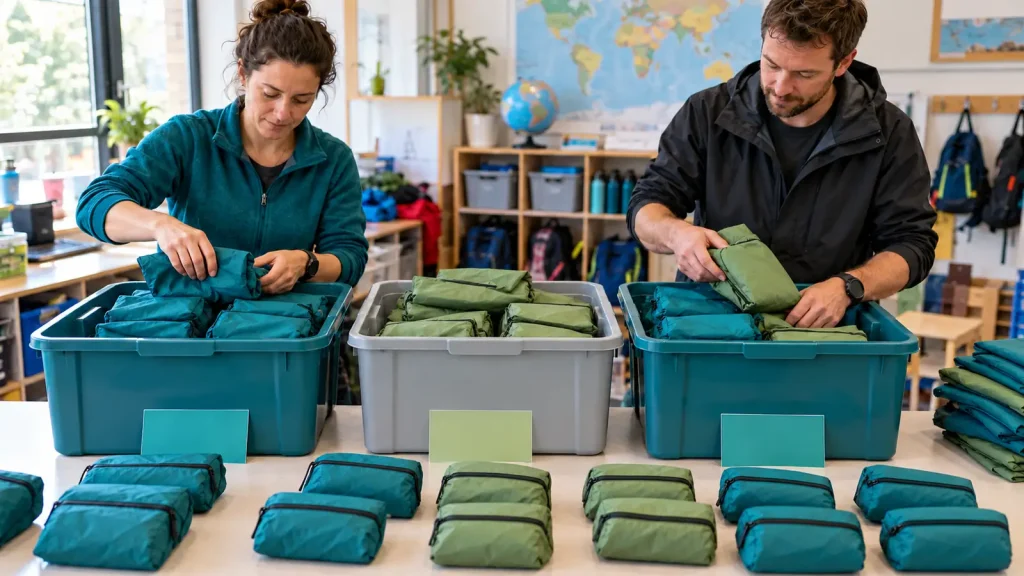
Build class packs that staff can identify and issue
A class pack should make the handout easier, not merely divide a bulk carton into smaller boxes. Start with the adult who will receive it and the place where it will be opened. That person needs to know which group the pack serves, what sizes it contains and where the reserve stock is located. Ask the school to describe the process in a few steps. Then request a packing proposal that supports those steps, with the labels and counts reviewed before the supplier prepares the bulk order.
Keep the contents schedule separate from the outer group name. A box labelled for a particular class still needs a clear size breakdown, especially if attendance or allocations change. Use the approved size terminology and show whether the pack contains individually allocated garments or a pool for staff to distribute. If several schools share a delivery, include the receiving-school reference as well. The aim is to prevent a coordinator from opening multiple packs simply to discover which one contains the size needed for a particular group.
Review how individual garments are folded and identified. Staff should be able to locate the size or relevant code without fully unfolding every item if that is part of the agreed issue process. Ask for a packed sample and try the sequence with an adult who has not seen it before. If the labels are unclear, revise them while the order is still in preparation. A simple pack that people can understand quickly is often more useful than an elaborate presentation that adds several layers to remove.
Decide who will handle the packaging. Where individual wrapping is used, the school's plan should explain how adults open or distribute it and where discarded material goes. Keep packaging choices connected to the intended age group and the organization's supervision arrangements. Do not treat a bag or pouch as an extra play item. Ask the supplier for the proposed packaging information and have any relevant requirements reviewed. The product and its pack should be considered together rather than leaving the pack outside the sample-approval process.
Make reserve garments accessible without disrupting the main allocation. A separate, clearly identified reserve pack can be easier to manage than spare items scattered through every class box. The right arrangement depends on how groups move during the trip, so ask the visit leader to decide where reserves will travel. Record their sizes and quantities in the packing schedule. Avoid a reserve that exists on paper but is stored on a different vehicle or at the school when the group needs it elsewhere.
Use a short handover note for each responsible adult. It can identify the group, pack contents, location of alternatives and the person to contact about a discrepancy. Keep the note focused on the actions staff need to take. The complete supplier specification belongs in the purchasing file, not in every teacher's handout. A good distribution note translates the approved plan into a manageable task and helps a substitute colleague understand it without having to read the entire history of the order.
Verify the class-pack arrangement at receiving. Compare the supplier's packing list with the approved schedule before the boxes are allocated to groups. Record shortages or mismatches while the original carton and batch information are still available. If staff repack garments locally, update the allocation record so the link to the received stock is preserved. Class packing is a useful service only when it is specified and checked. Otherwise it can move the sorting problem from the supplier's table to the school at the least convenient time.
Connect the rainwear plan with the trip's weather decisions
The rainwear plan should support the visit leader's decisions, not make those decisions on its own. Ask when staff will review the forecast, who can change the itinerary and where the group can shelter if conditions require it. Keep those responsibilities within the school's established trip process. Procurement can ensure that the garment stock, instructions and reserves are ready, but it cannot define a universal weather threshold for every school or venue. The relevant people need to decide how the clothing fits their actual activity.
Include rainwear in the pre-departure briefing where it helps staff act consistently. Explain where the packs are, who issues them and how a different size can be obtained. If garments will be worn before boarding transport or entering a venue, coordinate that sequence with the people responsible. Avoid a plan that assumes everyone can stop in the same place at the same time. The physical route, available shelter and group organization may determine where distribution is practical, and those details should be checked in advance.
Do not rely on the garment to solve every weather-related concern. A raincoat does not determine whether a route, transport arrangement or outdoor activity remains suitable. HSE's school-trip guidance emphasizes a proportionate focus on real risks and practical planning. Apply the guidance and policies relevant to the school and destination. The purchasing contribution is narrower: provide the approved product, clear instructions and an issue process that the staff can use as part of the wider plan without confusion about what the garment has been assessed to do.
Ask how staff will communicate a change in plan. If groups separate during a visit, they may need access to the same rainwear instructions and reserve arrangements. Keep communication responsibilities clear without creating an unnecessarily complicated garment procedure. A class-pack label, brief handover and known contact may be enough for the clothing part of the plan. The exact arrangement should follow the school's organization. Avoid inventing additional monitoring tasks that do not improve the decisions staff need to make in the actual setting.
Consider the transition when the weather improves or the group moves indoors. Staff may need a place for wet garments, a way to keep them separate from belongings and a plan for carrying them home or back to school. Discuss that sequence before approving the pack. A pouch included for dry storage may not answer every temporary handling question after use. Follow the product's instructions and the school's arrangements. The useful purchasing question is how the garment moves through the whole visit, including the period after it is taken off.
Make exceptions manageable. A pupil may need a different garment arrangement, an opened pack may be damaged or a group may use more reserve stock than expected. Staff should know the school's response rather than improvising an alteration to the coat or assuming an unsuitable size is acceptable. Keep the supplier contact and product details available to the purchasing lead for later follow-up. During the visit, the responsible adults need a practical plan that fits their authority and the school's established procedures.
Review the weather-related use afterwards without treating a single trip as a laboratory test. Ask staff when the garments were issued, whether the packing helped and what caused difficulty. Record specific observations and separate them from conclusions about technical performance. If a concern needs investigation, preserve the relevant product and batch information. This feedback can improve the next buying brief while keeping the roles clear: trip leaders decide the activity, technical reviewers assess relevant product questions, and procurement coordinates the garment and supply arrangements between them.
Organize returns, exceptions and stock reconciliation
Plan the return process before the first pack leaves the storeroom. Decide whether garments will return with each class, go home with pupils or be handled through another agreed arrangement. The answer changes what staff need to count and what stock can be considered available afterwards. A shared pool should not be treated as replenished merely because a pile of garments has arrived back at school. Condition, care and identification still need to be managed through the approved process before the items return to ready stock.
Use clear status categories that match real actions. Staff might distinguish unopened packs, returned items awaiting care, garments ready for issue and items set aside for review. The names matter less than their consistent use. Avoid mixing these categories in a single total that makes the inventory look healthier than it is. Give each status a location or identifying method so a colleague can understand the stock without relying on the person who last handled it. This is particularly helpful when several visits overlap in the same week.
Record exceptions while the details are still available. A size exchange, missing pack or damaged closure is easier to investigate when staff can identify the group, garment reference and relevant batch. Keep the record proportionate and avoid collecting unnecessary pupil information. The purchasing team usually needs the product facts and the operational context. If a concern requires further action, follow the organization's process and retain the item or evidence appropriately rather than making a quick repair that obscures what the reviewer needs to examine.
Reconcile issued and returned quantities with an explanation for differences. Some garments may have been intentionally allocated to individuals, while others remain with a group awaiting collection. A mismatch is not automatically a supplier shortage or a pupil loss. Ask the responsible adult to clarify the status before the stock record is changed. A simple explanation prevents the next buyer from ordering replacements for items that are still available elsewhere, and it helps the school identify whether the distribution model itself needs adjustment.
Keep unopened reserve stock identifiable. If packs return from a trip without being used, check them through the school's normal receiving or stock process before combining them with other supplies. Preserve the relevant labels and batch relationships. Do not assume that all unopened-looking packages are identical to the current order. Older stock may have a different size scale or construction. A clear inventory makes those differences visible and helps staff choose the appropriate garments for the next group instead of relying on colour alone.
Use the return record to plan replenishment deliberately. Review which sizes were consumed, which were repeatedly exchanged and which remain unused. Compare that pattern with the upcoming itinerary and wearer group. Do not automatically reorder the original quantities if the program has changed. Ask the supplier to confirm the current proposal against the approved specification, including any material or component changes. Replenishment works best when it connects actual stock information with a current buying brief rather than simply repeating an earlier purchase order number.
Close the cycle with a short review shared by the people who need it. Identify what worked, what should change and who will update the specification or packing plan. Keep the conclusions practical and supported by observations. A school does not need an elaborate report after every handout, but it does benefit from retaining useful lessons. The return process is therefore part of procurement quality: it shows whether the selected garment and distribution system served the program and gives the next order a better starting point.
Further guidance: HSE school trips guidance.
09 / 12
Use an EAV specification for comparable school raincoat quotations

| Entity | Attribute | Value or requirement to agree | Acceptance evidence |
|---|---|---|---|
| Wearer group | Intended users and activity | Age and size range; itinerary and clothing layers | Approved trip and wearer brief |
| Garment | Dimensions by size | Measurement points in cm and agreed tolerances | Size drawing and measured samples |
| Material | Complete construction | Named film or textile, coating and lining as applicable | Construction sheet tied to sample code |
| Film or fabric | Thickness or mass | Relevant units, measurement method and tolerance | Matched measurement record |
| Hood | Fit and cord arrangement | Reviewed design without unapproved cord features | Drawing, sample and destination review |
| Closures and trim | Attachment and finish | Approved components and assembly criteria | Sample review and applicable evidence |
| Weather protection | Claim and test scope | Agreed requirement, method and specimen identity | Relevant product-matched report |
| Decoration | Artwork and placement | Revision, dimensions, colour and location | Approved decorated sample |
| Labels | Size, traceability and instructions | Required content, location and permanence | Approved label proof and finished sample |
| Individual pack | Issue arrangement | Fold, pack and identifying information | Packed-sample review |
| Class pack | Variant quantities | Count by group and size; accessible reserve | Approved packing schedule |
| Commercial order | Supply basis | MOQ, quantity bands, OEM scope and milestones | Written quotation and deviation list |
Write measurable attributes and name the evidence required
An EAV table describes an entity, an attribute and the value or requirement to be agreed. For school rainwear, the entity might be the garment, hood, label or class pack. The attribute identifies the question, such as dimensions, closure arrangement or quantity. The final column should explain how the requirement will be checked. This structure helps buyers replace broad phrases such as good quality with specific decisions, while leaving genuinely unresolved items visible rather than filling every cell with an invented number.
Begin with the wearer and activity brief. Record the intended size range, clothing layers and distribution model before listing material details. Those fields explain why the other attributes matter. A supplier should be able to see whether it is quoting contingency school trip rain ponchos or garments for a recurring program. Do not overload the table with the entire educational visit plan. Include the product-relevant information and point to the approved use summary where a longer explanation is needed.
Use units consistently for measurable attributes. State dimensions in an agreed unit and refer to the measurement drawing. Identify whether a material value concerns film thickness, textile mass or the complete assembly. Include tolerances and methods where the team has agreed them; otherwise mark them for confirmation. A table becomes misleading when precise-looking values have no agreed measurement basis. The purpose is to make supplier responses comparable, not to create a technical appearance that the buyer cannot verify when samples or bulk stock arrive.
For descriptive attributes, use clear references instead of forcing a number. A hood arrangement may be defined by a drawing and sample, while artwork may be controlled by a file revision and placement proof. State which reference governs and where it is stored. If the supplier proposes an alternative, ask for it to be identified separately. This prevents a commercial quotation from appearing compliant simply because it repeats a general product name while quietly changing a feature that the school considered important during sampling.
Assign an evidence type to each requirement. Some can be checked through a measured sample, some through a packing trial and others through product-specific documents reviewed by the appropriate person. Do not ask a classroom fitting to answer a laboratory question or use a test report to settle whether a class-pack label is clear. Matching the question to the evidence keeps the approval process practical. It also helps the supplier understand why the buyer is requesting a particular sample, record or clarification.
Keep the commercial fields in the same revision-controlled brief. Record the quantities by variant, requested packing, destination, MOQ questions and delivery milestones. Bulk Pricing is only comparable when the quoted scope is comparable. If one proposal includes class packing and another supplies unsorted cartons, make the difference visible. A lower commercial total may reflect less work or a different construction rather than a better offer for the same requirement. The table should help the team understand those differences before deciding which proposal to develop.
Use the EAV table as a conversation tool, then as an approval reference. At the first enquiry, it can contain questions and proposed values. By order release, the important fields should have accepted answers or clearly recorded conditions. Keep the revision date and decision owner visible. The completed table gives purchasing, technical and school staff a shared description of the order. It also provides a useful starting point for future replenishment, because the next buyer can see which attributes were deliberate requirements and which were supplier options.
Ask suppliers to quote the same size and packing schedule
Comparable quotations start with the same quantity schedule. List the approved sizes and colours, the amount required in each combination and the intended class-pack arrangement. Do not ask several suppliers for a broad total and assume their standard assortments will be equivalent. A school may need more of one size than a catalogue pack contains. Ask each supplier to respond to the actual schedule and identify any proposed variation. This lets the team compare the offer with the need rather than discovering a mismatch after selection.
Separate firm quantities from planning ranges. Early attendance may be uncertain, but suppliers still need to understand the likely order structure. Give them clearly labelled scenarios if useful, then identify the date when the final schedule will be confirmed. Avoid presenting a tentative quantity as an unconditional order. Ask how changes in the size mix or decoration affect the proposal. The answer helps the school plan its decision points without relying on an assumed flexibility that the supplier has never agreed to provide.
Define packing at each relevant level. An individual garment pack, class pack and transport carton serve different purposes. State which levels are required and what information should appear on them. Ask for proposed counts, dimensions and handling information where these affect receiving or distribution. A quotation that includes only the transport carton may leave substantial sorting work to the school. Keep that work visible in the comparison and decide deliberately whether the supplier or the buyer will perform it.
Ask for MOQ in terms of the actual variants. A minimum may relate to the overall order, a material, a colour, a print design or a size arrangement. Do not assume the supplier's first number covers every combination in the school schedule. Request a clear explanation and record any alternatives. If the school changes the artwork or requests an additional colour, ask whether the commercial basis changes. The objective is to understand the proposed production arrangement, not to force a generic minimum into a more complicated specification.
Require deviations to be stated plainly. A supplier might offer a different closure, available colour or pack size to meet the requested timetable. Those alternatives may be worth considering, but they should not be hidden inside a quotation that appears to accept the original brief. Use a deviation column and ask the relevant decision owner to review each change. Keep the original requirement visible until the alternative is accepted. This supports a fair comparison and avoids treating an unreviewed substitute as an agreed equivalent.
Compare delivery proposals using the same milestone definitions. Clarify whether a stated date means production completion, dispatch or arrival at the specified receiving point. Ask what approvals and information the supplier needs before that timetable can be confirmed. Keep transport and receiving assumptions explicit, especially for cross-border supply. Do not interpret an indicative production interval as a guaranteed school delivery date. The useful proposal shows the sequence of decisions and responsibilities that connects sample approval with stock available for the intended visit.
Summarize the comparison in terms of differences that matter. The team should be able to see which suppliers meet the brief, which require changes and which questions remain unanswered. Avoid a single score that hides an unresolved mandatory requirement behind a favourable commercial figure. Discuss the practical effect of each variation with the people who will use or manage the stock. A disciplined quotation comparison makes the eventual choice easier to explain and gives the selected supplier a clear basis for the next development and approval steps.
Use the approved sample to control the final order revision
The approved sample connects the written brief with a physical product. Give it a reference and record which features it represents. A sample may be approved for fit, decoration, construction, packing or several of these together. Do not assume that acceptance in one area automatically covers all the others. If the supplied sample contains temporary components or unapproved artwork, note that clearly and identify what must change. The final order should point to a complete set of accepted references rather than a vaguely described sample that different people remember differently.
Keep the sample and specification consistent. When the team accepts a revision, update the relevant drawing, EAV field or artwork record. A handwritten note on a sample tag may help temporarily, but it should not remain the only record of a change that affects production. Ask the supplier to acknowledge the current revision through the agreed process. The goal is one clear order basis, with earlier versions retained for history but unmistakably superseded. This is especially useful when several schools approve different branding on the same garment style.
Identify the samples needed across the range. One decorated size may establish the print appearance, while another sample is needed to review the smallest hood or a different material option. Record those relationships rather than calling one item the master sample for everything. Ask the appropriate reviewers which variations require further evidence. The purchasing team can then maintain a manageable approval bundle that reflects the actual product range without making unsupported assumptions that every unexamined variant behaves exactly like the first sample received.
Agree how the supplier will handle production questions. If a component becomes unavailable or an approved fold proves impractical at scale, it should raise the issue before making an unapproved change. Ask for the proposed alternative and its consequences for the specification, evidence, artwork and timetable. Route the decision to the correct owner. The procedure need not be elaborate, but it should prevent a supplier's internal substitution from becoming the buyer's unexpected problem when the cartons reach the school.
Prepare a receiving reference that is simpler than the full development history. Staff checking the delivery need the current approved sample or photographs, key dimensions, pack schedule and escalation route. They do not need to interpret every rejected concept. Keep the technical evidence available to the responsible reviewer while giving receiving staff a clear description of what they can check. This division makes the process more usable and reduces the risk of asking a warehouse or school office colleague to make a specialist judgment without appropriate information.
Record the release decision with its date and scope. State which product revision, artwork, sizes, colours and packing schedule are authorized. Include any conditions that still need to be satisfied before shipment or acceptance. Do not allow a general message of thanks to serve as the only evidence that a bulk order was approved. A short, precise release note helps both sides work confidently because it identifies the proposal that has actually passed the agreed review rather than relying on assumptions about the latest attachment.
Use the same discipline for repeat orders. Retrieve the earlier reference, ask the supplier to confirm the current construction and identify changes. If the school has altered its use or size schedule, revise the brief rather than assuming the old approval remains sufficient. A well-kept sample record makes this process faster because the team can focus on what has changed. It preserves the practical value of earlier work while leaving room for a different requirement, a better packing arrangement or a new product proposal to receive the review it deserves.
10 / 12
Plan bulk school rainwear deliveries and replenishment
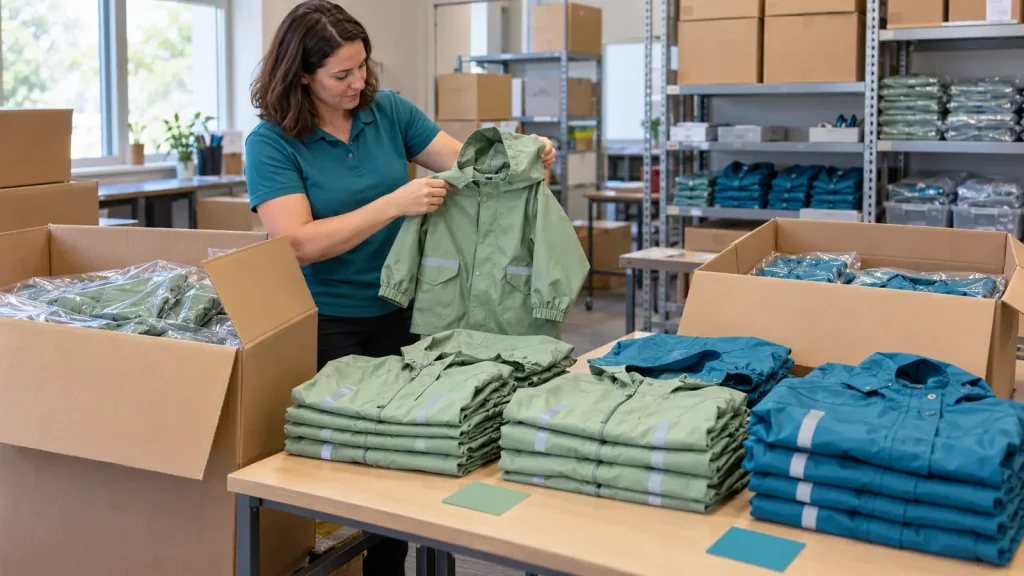
Build quantities from attendance, sizes and existing stock
The quantity plan should begin with the groups expected to use the rainwear, not with a convenient carton multiple. Ask the school or educational supplier for an approved attendance estimate and the relevant size distribution. Keep the date and certainty of that information visible. A preliminary figure can support an enquiry, but it should not be mistaken for the final order schedule. Identify when the organization expects to confirm quantities and who will communicate changes to the supplier before production is released.
Check existing stock by usable size and condition. A total garment count can hide a shortage in the sizes needed for the next visit. Separate ready stock from items awaiting care or review, and distinguish older constructions where their fit or instructions differ. If stock is held at several schools or locations, confirm whether it is actually available to this program. The buyer should not reduce the new order based on garments that another group has already allocated or that cannot reach the receiving point in time.
Build the quantity schedule at the same level as the intended packing. If class packs are required, show the allocation by group and size, then calculate the overall totals. Check that the totals agree in both directions. This avoids an order that contains the correct aggregate amount but the wrong assortment within individual packs. Ask a second responsible colleague to review the schedule before sending it for quotation. A simple cross-check can catch a copying error that would otherwise become a difficult distribution problem.
Keep reserves separate from routine allocations. State why they are included and where they will be held. The size spread should reflect the program's uncertainty and experience rather than an arbitrary addition to the most common size. If the supplier needs a rounded production quantity, ask how the extra stock would be allocated and whether the school wants it. Do not silently change the size mix to fit a commercial minimum. The organization should understand the practical result of any quantity adjustment it accepts.
Consider the time horizon of the purchase. A single visit, a term's activities and a distributor's replenishment program have different inventory questions. Larger quantities may create storage and identification work that needs to be considered alongside the commercial proposal. Avoid presenting bulk purchasing as automatically efficient without examining the actual plan. Ask how long the stock is expected to remain available and what product-specific storage guidance applies. Keep future demand assumptions explicit so later reviewers understand which parts of the order were based on confirmed need.
Use variants deliberately. Additional colours, logo versions and pack formats can make the quantity schedule harder to manage. Ask whether each variation serves a real school or distribution need. If several schools can use the same approved construction with different artwork, identify the common and variable elements clearly. The supplier can then explain the MOQ and production implications of the proposal. A simpler range may be easier to replenish, but that choice should follow the program's requirements rather than an assumption that fewer variants are always acceptable.
Freeze the schedule at an agreed decision point and retain a record of later changes. If attendance shifts after production begins, discuss the options with the supplier and the school's decision owner. Do not assume that every alteration can be absorbed without affecting timing or packing. A clear quantity plan makes those conversations more productive because both sides can identify exactly what changed. It also gives receiving staff a reliable basis for checking the delivery and helps the next buyer distinguish planned reserves from stock left over through an allocation error.
Work backward from the trip's usable-stock deadline
The trip departure date is not the same as the required delivery date. Staff may need time to receive cartons, check the contents, resolve discrepancies, organize class packs and communicate instructions. Ask the school to identify when the stock must be ready for use, then work backward through those tasks. Give the supplier the actual receiving deadline and destination. A proposal based only on the day of the visit can leave no practical time for the school to turn a delivery into an organized distribution.
Separate the supply milestones. Artwork approval, sample acceptance, evidence review, production release, dispatch and arrival describe different events. Ask the supplier to explain which approvals are needed before its timetable can be confirmed. Record any dependencies that remain with the buyer, such as final size quantities or a school logo revision. This makes the schedule a shared plan rather than a one-sided promise. It also helps the school see how a delayed approval can affect later steps without assuming the supplier can recover every lost day automatically.
Clarify what quoted timing means. A statement about production time may begin after a specific approval and may not include transport or receiving arrangements. Ask for the basis in plain language and retain it with the quotation. Do not turn an indicative interval into a guaranteed arrival date in school communications. If the supplier cannot yet confirm an element, show it as pending. A realistic schedule with visible uncertainty is more useful than a precise date that depends on assumptions nobody has checked.
Discuss the receiving point in detail. A school office may have limited opening hours, term-time restrictions or a different location for larger deliveries. A distributor may require an appointment or specific carton information. Provide the relevant operational details without unnecessary personal information. Ask the transport and supply contacts to confirm their responsibilities. A correctly made garment can still be unavailable for the trip if the delivery is directed to the wrong place or arrives when no authorized person can receive it.
Build a decision point for delays into the school's planning. The responsible team should know when it needs to consider an alternative supply or distribution arrangement if a milestone is missed. Procurement can provide current information and the available options, while the school decides the effect on its program. Avoid promising a substitute garment before its fit, construction and evidence have been reviewed. An urgent change still needs a clear product brief; urgency does not make an unexamined alternative equivalent to the approved order.
Keep progress communication tied to evidence. Ask for the agreed updates that actually help the buyer understand the status, rather than a stream of reassuring messages without a clear milestone. A sample dispatch reference, accepted artwork revision or confirmed packing schedule may be more useful than a general statement that everything is progressing. Record changes promptly and share them with the people affected. The goal is to make decisions early enough to be useful, not to create a reporting exercise that adds work without clarifying the order.
After delivery, compare the planned and actual sequence. Note which approvals took longer than expected, whether receiving was straightforward and which information would have helped earlier. Use those observations to improve the next schedule. Do not publish a universal lead time from one successful order, and do not assume a future season will have identical conditions. A dependable procurement process keeps its milestones clear, confirms the current supplier proposal and gives the school enough time to prepare usable stock before the children need it.
Receive and identify cartons before allocating garments
Give the receiving team the current order schedule before the cartons arrive. It should identify the supplier reference, expected carton count, size and colour assortment, packing arrangement and person responsible for questions. Include the approved product reference or a clear way to access it. Staff should not have to search through a long email history to discover what was ordered. A concise receiving sheet helps them distinguish an expected variation from a discrepancy and keeps the first check focused on information they can verify.
Check the delivery at the appropriate stages under the organization's process. Outer carton condition, labels and counts can be reviewed before the contents are allocated. Record visible damage or discrepancies with the relevant references and follow the agreed escalation route. Do not assume an intact outer carton proves every garment inside is acceptable. Equally, do not make an unsupported technical conclusion from a transport mark alone. Keep the observation precise so the purchasing lead and supplier can investigate the issue using the actual evidence.
Compare the contents with the packing schedule. Where class packs are supplied, confirm that the group references and size quantities match the approved arrangement. If the order arrives in unsorted cartons, use the agreed local sorting plan and retain the connection to the received batch. Avoid mixing new stock immediately with older garments before the initial checks are complete. Once items have been redistributed without a record, a simple packing question can become much harder to trace back to the original delivery.
Use the approved sample or receiving reference to check the features assigned to this stage. Staff might verify the visible closure type, colour, label wording or pack format. Technical matters outside their role should go to the designated reviewer. Do not ask a school office colleague to interpret laboratory results merely because they are the first person opening the cartons. A clear division of tasks makes the receiving process more reliable and ensures that a question reaches someone who has the information and authority to resolve it.
Keep questionable stock separate while a decision is pending. Label its status through the school's or distributor's normal process so it is not issued accidentally. Record the quantity and the reason for the hold without treating the observation as a final conclusion. Contact the supplier with the relevant order and batch details, and retain any requested evidence appropriately. Avoid local alterations that could obscure the original condition or change the approved product. The objective is a prompt, traceable decision about the affected stock.
Update the available inventory only after the required receiving decisions are complete. Distinguish accepted stock, pending items and any agreed replacements. Then allocate garments or class packs using the approved schedule. If staff change the packing locally, update the records so the new arrangement can be understood at the next handout. A delivery is not operationally complete merely because the courier has left. It becomes useful stock when the school knows what it has, where it is and which items are ready to issue.
Retain enough information for later questions and replenishment. Store the accepted specification, relevant batch references, packing list and receiving outcome together. Make supplier contact details available to the purchasing lead without circulating unnecessary documents to every member of staff. This final step connects the commercial order with the school's actual inventory. It also gives future buyers a better starting point: they can see what arrived, how it matched the brief and which changes would make the next delivery easier to receive and distribute.
11 / 12
Approve samples and review bulk rainwear consistently

Separate visual review, wearer feedback and technical testing
Sample approval works best when each review has a clear purpose. A visual check can identify the wrong colour, missing component or different print placement. A supervised fitting can provide practical feedback about coverage and ease of use. Technical testing addresses defined properties through an appropriate method. Keep those activities separate in the record, even when they concern the same garment. Combining them into one unexplained passed box can give later readers the false impression that every aspect was assessed in the same way.
Prepare an adult visual review before involving pupils in an ordinary fitting. Compare the sample with the current drawing, component description and artwork proof. Record visible differences and unresolved questions. If the design raises a concern that needs specialist review, resolve it through the appropriate process before proceeding. The school should not use a fitting session to investigate an unassessed hazard. A well-prepared review lets the later fitting focus on the practical questions it is suited to answer, under the school's normal supervision arrangements.
Make wearer feedback specific and proportionate. Ask the responsible adults to observe the intended clothing layers, ordinary movement and the tasks associated with putting on or removing the garment. Record the sample size and the feature being discussed. A comment such as the sleeve covers the hand in this fitting is more actionable than a broad statement that the coat is uncomfortable. Keep personal details within the school's own process and share functional observations with the supplier only as needed to resolve the product question.
Let the technical reviewer define technical evidence needs. If a claim requires a laboratory method or component assessment, identify the relevant specimen, method and acceptance requirement through that review. Do not invent a home test and present it as equivalent to a recognized procedure. An informal water demonstration may help explain a feature, but it should not become a certification claim. The buying file should show what was tested or observed, who interpreted it and how it relates to the construction being ordered.
Use realistic sample references. Label each item with the supplier code, revision, size and any known differences from the proposed production version. If a sample is intended only for colour discussion, say so. A supplier may legitimately send an early development sample that is not yet the final product. The problem arises when that limitation is forgotten and a later colleague treats it as the complete approved reference. Clear labels keep useful development work from turning into accidental authorization of unfinished details.
Plan how findings move between the reviews. A fitting observation may lead to a pattern change, which may require the technical reviewer to consider its effect. A revised decoration process may need a new appearance check and an update to the evidence file. Record those connections so the team does not close one review while another still relies on the earlier construction. The approval process should follow the product as it develops, with the scope of each decision updated when a change affects it.
Finish with a combined release summary that preserves the distinctions. State which visual features were accepted, which sizes received fitting feedback and which technical evidence supports the relevant requirements. Identify any conditions still outstanding. This gives the purchasing lead a complete view without pretending that one activity answered every question. It also makes the next order easier to manage, because the school can reuse relevant information while recognizing which aspects need another review when the garment, wearer group or intended activity changes.
Record defects and decisions without vague quality labels
Useful defect records describe what differs from the agreed requirement. Instead of writing poor stitching, identify the location, sample or batch and the visible condition that prompted the concern. Instead of saying the size is wrong, record the agreed measurement point and the result obtained using that method. These details help the supplier investigate and let the buyer distinguish a product discrepancy from a misunderstanding of the specification. Precise records usually lead to a more focused response than broad criticism that neither side can verify.
Use photographs as supporting evidence, not as the whole description. Include enough context to locate the feature and explain whether the garment was flat, fastened or being handled in a particular way. Where a measurement is relevant, show the agreed reference points clearly. Avoid photographs that expose unnecessary pupil information. The supplier generally needs to see the product concern, not identify the wearer. A concise written note alongside the image often prevents several rounds of clarification about what the reviewer intended to show.
Distinguish a single observation from a statement about the entire delivery. Record how many items were examined and what the agreed inspection process covers. Do not claim that one acceptable sample proves every garment is acceptable, or that one defect establishes the condition of every carton. Ask the responsible quality reviewer to determine the appropriate next step. The school or distributor can still act promptly to hold affected stock while keeping its conclusions proportional to the evidence actually available at that stage.
Agree the escalation route before it is needed. Receiving staff should know whom to contact, how to identify the stock and which items should remain unavailable pending review. The purchasing lead should know how to send the supplier a clear issue record. If a concern involves product safety or a possible regulatory issue, follow the organization's applicable process and obtain the appropriate specialist input. Do not reduce every concern to a commercial negotiation about replacements when a different kind of review may be required.
Record the supplier's proposed action and the buyer's decision. A replacement sample, revised component or packing correction should have a reference and an acceptance route. If the proposal changes the approved specification, update that specification rather than leaving the correction only in correspondence. Keep rejected alternatives identifiable so they are not reintroduced accidentally during a later order. The decision record should explain what is now permitted and why, while preserving the original observation that led the team to reconsider the feature.
Avoid informal repairs that hide the issue. A locally added fastener, trimmed edge or altered hood can change the garment and make the original concern harder to assess. Ask the supplier and responsible reviewer for an appropriate response through the agreed process. Keep affected items traceable while that decision is pending. The objective is not to prevent sensible problem-solving; it is to ensure that a quick local change does not create an unreviewed product or leave different versions circulating without anyone knowing which one was approved.
Close the issue only when the agreed action has been checked. Record the replacement or revised batch reference, the review performed and the outcome. Share the relevant conclusion with the receiving and school teams so they know which stock is available and which instructions apply. A closed issue should leave the next buyer with a clearer specification, not merely a satisfied email exchange. That is how a defect record becomes useful purchasing knowledge: the observed problem, accepted correction and current order basis remain connected.
Use trip feedback to improve the next purchase
The most useful feedback often comes from the adults who handled the garments during an ordinary trip. Ask them about the practical sequence: finding the right pack, issuing sizes, helping with closures, managing wet returns and locating reserves. Keep the questions short enough that staff will answer them. A long survey can produce less useful information than a focused discussion about the few moments that caused difficulty. The aim is to learn how the rainwear program worked, not to ask teachers to write a technical product report.
Separate product observations from distribution problems. If the wrong size was issued, check whether the garment label, class-pack schedule or allocation process caused the confusion. If staff could not find reserves, examine where they were stored and how that information was communicated. Do not assume every difficulty requires a new material or pattern. Some improvements belong in the packing brief or school handover. Identifying the source helps the buyer request the right change instead of replacing a product that was not the main cause of the problem.
Record the context of feedback. The itinerary, clothing layers, group size and issue method may explain why a feature worked well or poorly. A comment from one visit should not automatically become a universal judgment about the raincoat. Keep it as evidence about that use, then decide whether the same conditions apply to the next program. Where a concern suggests a technical issue, preserve the product reference and route it to the appropriate reviewer. Practical feedback can identify a question without resolving its technical cause.
Review the size mix with actual exchanges and unused stock. Compare those records with the original schedule and the next expected group. Ask whether the school's information was accurate enough, whether the size labels were clear and whether the reserve spread was helpful. Avoid making a large change based on one unexplained exchange. Look for a pattern that the team can understand and discuss with the supplier. A revised quantity schedule should address a documented need rather than simply reacting to the most memorable comment from the trip.
Assess the care and storage process if reuse was planned. Ask which tasks were completed easily, which needed more time and which were not practical with the available facilities. Keep the product's confirmed instructions in view when discussing changes. If staff could not carry out the planned routine, the next decision may involve the operating model as well as the garment. Do not describe the program as a successful reuse system merely because the original order was labelled reusable. Review what actually happened between issue and the next ready item.
Turn accepted lessons into revisions before requesting another quotation. Update the use brief, size schedule, artwork or pack arrangement as appropriate and identify the new revision. Ask the supplier to confirm the effects on its proposal, including MOQ and timing where relevant. Retain the earlier record so the reason for the change remains understandable. A good repeat order uses experience to become more precise; it does not start from an empty enquiry or assume that every detail of the previous purchase should be repeated unchanged.
Keep the feedback loop proportionate. The school does not need to measure every possible attribute after every outing. Focus on information that can improve a real decision about product choice, distribution, care or supply. Share relevant conclusions with the people who approve and manage the next order. Over time, this creates a useful institutional memory even when individual staff members change. The result is a more practical children's rainwear program, built from clear specifications and observed needs rather than a succession of disconnected bulk purchases.
12 / 12
B2B FAQ for children's raincoats and educational tour ponchos

Can one rain poncho size cover the whole school group?
Do not assume that it can. A single size is a purchasing option to evaluate, rather than a reliable description of fit across a school. Children in the same year group can need different garment dimensions, and the clothing worn underneath changes the available room. Start with the intended wearer range and the supplier's measured size drawing. Then arrange an appropriate supervised fitting with the school's staff. If one proposed size does not provide suitable coverage and movement for the intended group, build the order around a workable size mix.
The first practical question is what the garment must fit over. A raincoat used with a light shirt on a summer visit has a different layering brief from one worn over a winter coat. Do not settle this by choosing a larger age label and hoping it works. Ask for the finished garment measurements, the locations used to take them and the agreed tolerances. Compare those details with the approved samples. The supplier's small, medium and large labels are useful identifiers only after everyone understands the dimensions behind them.
During a fitting, staff can observe whether the wearer can reach, walk and handle the closures comfortably in the intended clothing. They can also look at sleeve coverage, hood position and the way the garment hangs. Record practical observations against the sample size and revision. Avoid turning this ordinary fit review into a claim that the product has passed formal safety or performance testing. If a concern needs specialist assessment, refer it to the responsible reviewer before accepting the design. A fitting helps answer fit questions; it does not answer every product question.
Consider an illustrative tour group combining several school years. The purchasing team might initially favour one pack size because it simplifies counting. A sample review may show that a second size would make issue more practical for part of the group. The better response is to update the packing schedule and identification system, then check that staff can distinguish the options. Keeping one size solely to preserve a simple spreadsheet can move the complexity to teachers during the trip. A small amount of planning before ordering can make the actual handout clearer.
Agree how exchanges will work as well. Put the reserve garments where the responsible adult can access them, identify the available sizes clearly and keep the record simple enough to use at the issue point. An exchange should lead to an updated count, so the school knows what remains for another class. When garments will be shared between trips, review the returned stock before describing it as available. A garment in an unprocessed return bag is different from one that has been checked and prepared for the next wearer.
There may be pupils for whom the standard options do not work well. Let the school's usual arrangements guide how those needs are discussed and accommodated. Purchasing generally needs a practical product requirement, such as a different dimension or an easier closure arrangement, rather than unnecessary personal information. Confirm what can be supplied, obtain the relevant sample and decide who approves it. Keep that decision within the same order revision as the main size mix, so an individual arrangement is not lost when the final quantities are confirmed.
For the quotation, send a provisional quantity by measured size and ask the supplier to identify any restrictions on mixing sizes. Separate a confirmed requirement from an estimate that still depends on fitting feedback. If the quantity mix changes after approval, obtain a revised packing and commercial confirmation. The objective is a set of garments that staff can identify and issue to the intended wearers. One size can be considered where the evidence supports it, but the order should never depend on the phrase one size fits all alone.
What MOQ, evidence and customization details should we request?
Ask for the MOQ that applies to your actual combination of garment, size mix, colour, decoration and packaging. There is no useful universal minimum to assume from the words kids raincoats wholesale. A supplier may distinguish an available style from a new material colour or a different packing arrangement. Request those distinctions in writing, together with any quantity bands relevant to your proposed order. A clear commercial reply should explain what is included and which changes would require a new quotation, sample or approval before the order moves forward.
Present the quantities in a small schedule rather than one undifferentiated total. Show the sizes, colours, decoration variants and class packs that matter to your project. If two schools share the same garment but need different identification, explain whether that means separate printing, labels or simply different outer cartons. Ask which parts can be combined commercially and which remain separate production requirements. Bulk Pricing is easier to compare when each supplier is responding to the same schedule. Otherwise, an apparently simpler offer may be based on fewer sizes or a different packing arrangement.
For evidence, identify the intended market and ask the responsible reviewer to define the applicable requirements for the finished product. Then request documents that can be connected to the proposed construction, components, decoration and manufacturing information. An impressive document title is not enough if nobody can show how it relates to the ordered sample. Keep a list of the records requested, received and still under review. The detailed evidence section of this guide explains the difference between product identification, relevant reports, certificates where required and the purchasing team's approval record.
Do not ask the supplier to answer every question with a single general statement that the raincoat is safe or compliant. Break the request into the decisions your team needs to make. Which construction is proposed? What labels will be used? Which supporting records match that construction? Who will review a change to a closure, print or material? This approach makes unanswered questions visible without creating a catalogue of unsupported promises. It also helps the responsible reviewer ask a focused follow-up rather than trying to interpret a collection of unrelated files.
For customization, provide the artwork and the intended placement before expecting a meaningful OEM Program proposal. Identify the version, approximate dimensions, required colours and any school approval restrictions. Ask how the supplier proposes to apply the decoration to the particular raincoat, and request a decorated sample when the project requires one. A screen proof can help agree the composition, but it cannot show every feature of the finished garment. Review the actual placement in relation to the hood, folds, closures and size range before treating the artwork as approved.
Packaging deserves its own questions. Confirm the individual fold and pack, the information visible to staff, the quantities per class pack and the outer carton identification. If the school needs a specific issue sequence, include it in the brief rather than expecting the packing team to infer it. Ask what preparation or approvals the supplier needs to provide the requested arrangement. Keep any packaging cost or MOQ implications with the commercial comparison. A garment proposal and a distribution-ready proposal may involve different work even when the underlying raincoat is the same.
Finally, request a concise deviation list. The supplier should identify any difference between the quotation and your brief, including unresolved artwork, evidence, quantities or delivery assumptions. Review those differences before selecting a proposal, and carry accepted changes into the final specification. Keep sample approval, technical review and purchase authorization as distinct recorded decisions with named owners. The useful outcome is not the largest collection of attachments. It is an understandable order file that connects the commercial offer, the approved garment, the supporting evidence and the packing instructions your school team expects to receive.
What should we send to start a school rainwear quotation?
Send a concise brief describing the wearer group, the activity, the quantity range, the destination and the date when usable stock must be available. Add what you already know about sizes, clothing layers, branding and distribution. You do not need a fully completed technical specification to begin a discussion, but you should identify which details are confirmed and which remain open. That distinction helps a supplier offer relevant options without turning an early assumption into an apparent approval. Name one contact who can coordinate questions across the purchasing and trip teams.
Describe the use in everyday terms. Explain whether the garments will be issued for a particular educational visit, held as contingency stock, allocated to individual pupils or returned for future trips. Include the expected handout location and the adults' role in distribution. State whether the rainwear needs to fit over a separate coat and whether your school has already selected a preferred garment style. This information provides a practical starting point for product discussion. It is more useful than asking for the cheapest raincoat without explaining what the order needs to achieve.
For quantities, supply a provisional breakdown by size or wearer group and identify any existing stock that the new order must complement. If the size allocation is not ready, request the measurement information and samples needed to make it. Avoid presenting an uncertain estimate as a final purchase quantity. A supplier can explain the commercial implications of alternative quantity bands while the school completes its allocation. Once the fitting and attendance information are settled, replace the estimate with an approved schedule and ask for the quotation to be confirmed against that revision.
Include the delivery destination and the school's usable-stock deadline, rather than only the date of the trip. Your team may need time to receive cartons, check the contents, resolve discrepancies and assemble class packs. Ask the supplier to state the milestones and assumptions behind the proposed delivery plan. If the timeline depends on artwork approval or a sample decision, put those dates into the shared schedule. Do not treat an early indication of production time as a promise that the full order will be ready for issue on your preferred day.
Attach approved artwork where available, along with the intended placement and any restrictions on school identity. If the design is still being considered, label it as a draft and explain who will approve it. Include the relevant packaging and identification requirements, particularly where the garments will be distributed by class or destination. Suppliers need to know whether the school expects individual packs, grouped quantities or another arrangement. Keep pupil information out of the initial enquiry unless there is a specific, properly managed reason to include it; practical product requirements are usually sufficient.
State who will define and review the destination-specific product evidence. Ask the supplier to identify the proposed construction and the documents available for that exact proposal. Do not imply that a buying enquiry itself confirms compliance or suitability. If the school already has a technical checklist, attach the current version and invite a clear response to each applicable item. Where a question remains open, record it as open. This makes the first quotation a useful basis for review while preserving the distinction between a commercial discussion and an approved order.
Finish with the decisions you want the first reply to support: a product shortlist, a sample plan, a confirmed MOQ, a comparable Bulk Pricing proposal or clarification of the delivery sequence. Ask for deviations and exclusions to be stated plainly. Then keep the reply, sample identifiers and revised brief together as the project develops. Use the quotation form to share the project summary and request the next appropriate step. A well-prepared enquiry gives both teams enough context to move forward, while leaving room to resolve measurements, evidence and packing before purchase authorization.
Return to the wholesale rainwear product and material pillar guide to bring your size mix, construction, branding and purchasing requirements into one approval process.