
Seasonal rainwear inventory · A working guide for B2B sales teams
Planning Your Seasonal Rainwear Inventory: A Guide for Sales Managers
A strong rainwear season starts before the first wet forecast. Your team needs the right assortment, approved branding and usable stock at the right locations. This guide connects demand planning with samples, MOQ, replenishment, packaging and delivery so a bulk order supports the selling window instead of arriving after it.
Define the demand. Confirm the supply route. Put usable stock where the season needs it.
01 / 12
Build seasonal rainwear inventory around the selling window

Define the dates when stock must be usable
Seasonal rainwear inventory has a deadline that a shipment date cannot describe on its own. A carton may have left the factory while your stores still have nothing to issue. Start the plan with the moment an approved product must be available to the person who needs it. For a distributor, that may be the first customer dispatch. For a festival organiser, it may be the staff packing day. For a retail group, it may be the date every branch must have its opening assortment on the shelf.
Put those requirements on a calendar by destination. Include the first useful date, the main demand window and the last date at which another delivery would still help. A season rarely has one uniform deadline. An attraction that opens daily can use replenishment differently from an event that lasts a weekend. A customer preparing employee kits may need everything together, even if the employees receive them later. Ask the operational team what happens between receipt and use, then reserve time for those tasks instead of treating them as instant.
Distinguish warehouse arrival from available stock. Receiving staff may need to count cartons, inspect samples, confirm the assortment, resolve discrepancies and release the goods. Custom packs may then need allocation to branches or assembly into project kits. Record these steps with responsible people and working calendars. If the warehouse does not accept deliveries on a particular day, an arrival estimate for that day is not a usable receiving plan. The same applies when a temporary venue allows access only during a short setup period.
Work with dates that can be confirmed rather than vague labels such as early spring or before the rainy season. Write the destination, local date and relevant opening hours. Where a delivery window is provisional, mark it as provisional and identify who will confirm it. This small distinction protects the plan from becoming more certain as it passes between departments. A purchasing manager should be able to tell which dates are customer commitments, internal targets or supplier estimates without reconstructing the original conversations.
Consider an illustrative order for several visitor sites. The central warehouse needs rain ponchos before the sites open, but one location wants staff training packs earlier. That early requirement may justify a separate sample or approved initial allocation; it does not automatically mean the entire bulk order must arrive on the earliest date. Split the operational needs visibly, then ask whether the supplier and logistics route can support them. Keep any proposed split subject to confirmed quantities, packing arrangements and delivery responsibilities.
The calendar should also show the point at which the team must change course. If artwork approval slips beyond a stated review date, perhaps a standard colour or previously approved design remains feasible. If a transport milestone changes, perhaps a local reserve can cover the first days. Record these as options to investigate, not promises. A useful seasonal calendar gives sales a clear picture of what is still achievable and gives procurement enough notice to discuss alternatives before the original target becomes unrealistic.
Keep the agreed available-to-use date at the top of the enquiry, quotation comparison and purchase handover. Supplier lead times can then be assessed against the same destination requirement. That makes the conversation more precise: your team is planning a complete route to usable stock, with time for approvals and receiving, rather than merely asking how quickly a factory can finish a garment.
Separate committed demand from commercial ambition
A sales target is an important planning input, but it is not the same as an order book. Treating the two as interchangeable can create unnecessary stock or conceal a genuine shortage. Build the seasonal rainwear forecast in layers. Start with confirmed customer commitments and project allocations, then add an estimate for demand that has not yet become an order. Keep the assumptions behind that estimate visible. This lets a manager support growth without pretending that every opportunity has the same likelihood or delivery deadline.
For committed demand, record the exact product configuration, quantity, destination and required date. Confirm whether the order can still change and who has authority to accept a revision. A request for teal reusable ponchos with a particular logo cannot automatically be covered by unbranded emergency stock. Equally, an internal reservation should not become permanent simply because someone asked for it informally. Use a dated allocation record so the team can distinguish a contractual requirement, an approved project reserve and a tentative expression of interest.
For uncommitted demand, begin with a reasoned baseline. Relevant evidence might include comparable sales periods, customer plans, visitor numbers or known distribution programmes. Separate ordinary repeat business from a new campaign whose response is still uncertain. A large prospective order should have its own scenario and decision date rather than being hidden inside the general forecast. If the opportunity converts, procurement can see which additional quantity is needed. If it does not, the base plan remains understandable instead of appearing to have inexplicably underperformed.
Avoid double counting when an opportunity becomes a confirmed order. Suppose the forecast already includes expected demand from a particular distributor. When its purchase order arrives, move the appropriate quantity from the forecast layer into the commitment layer; do not simply add the whole order on top. The exact process depends on your planning system, but the principle is consistent. Each expected unit should have one place in the demand plan at a given time. Make the reconciliation part of the regular sales and procurement review.
Marketing plans deserve the same discipline. A promotion, new branch or sponsor campaign may increase demand, change the assortment or shift the timing. Ask what operational evidence supports the proposal and what stock would be stranded if the activity changes. A campaign requiring dated artwork has different carryover potential from a core unbranded line. Discuss those consequences while the project is still being shaped. Procurement can then compare a dedicated production run with a more flexible configuration without making unsupported claims about future sales.
Use a short demand bridge at each review: the previous baseline, new confirmed orders, cancellations, forecast revisions and the resulting requirement. Explain the reasons for material changes in plain English. A larger number is not necessarily a stronger plan if nobody can explain it. Sales managers should be able to defend the assumption, while buyers should be able to translate it into feasible order quantities, MOQ discussions and delivery milestones. Both teams benefit from a forecast that can be challenged constructively.
The final commitment should reflect the organisation's appetite for missed demand and leftover stock, along with the practical options available later. There is no universal percentage that turns ambition into a safe purchase. Document the choice, the uncertainty that remains and the conditions that would trigger another review. This produces a seasonal purchasing decision that people can manage as circumstances change, rather than a number that is treated as fixed until something goes wrong.
Give each planning assumption an owner
An inventory plan can look complete while relying on several unanswered questions. Someone expects the artwork tomorrow, someone assumes the factory can repeat last year's material, and someone believes the warehouse has spare space. Unless those assumptions have owners, they tend to survive until the point when they cause delay. Create a simple assumptions register alongside the seasonal rainwear plan. Each entry should describe what is believed, the evidence available, the person who will confirm it and the date by which the answer matters.
Assign ownership to a person who can obtain or approve the information. Sales should confirm the customer requirement; the artwork owner should approve the current file; procurement should establish the supplier's proposed production route; logistics should verify the delivery arrangement. These roles can overlap in a small business, but the responsibilities should still be explicit. A shared label such as the team is rarely enough when a decision has to be made quickly. Name the person who will close the question and the person who can approve an exception.
Use different statuses for confirmed facts, working assumptions and unresolved decisions. An approved sample is evidence of an agreed product reference, while an estimated production window is a forecast about future work. Neither should be presented as the other. Attach the relevant document or reference number where practical, and record when it was last reviewed. A quotation from an earlier season may still be useful background, but it does not establish current availability, MOQ, transport capacity or the suitability of unchanged packaging.
Make dependencies visible. Final carton dimensions may depend on the selected pouch, which depends on the garment construction and folding method. A shipping comparison based on an unfinished pack is therefore provisional. Instead of allowing every department to refine its own estimate independently, show the sequence. This helps managers choose where an early decision would unlock several later tasks. It also prevents a convenient estimate from being copied into a final order simply because it appeared in a polished spreadsheet.
Build a review rhythm around decisions, not reporting for its own sake. Early in the season, a broader review may be enough to confirm the assortment and commercial scope. As the available-to-use deadline approaches, focus on approvals, production readiness and exceptions that still have a remedy. Ask three questions about each unresolved item: what changed, what decision is needed and when does the option disappear? A short meeting that resolves those questions is more useful than a long update that repeats percentages without explaining their meaning.
Keep an exception log when the plan changes. Record the original requirement, the approved revision, its effect on quantity or timing and the people informed. If a customer accepts a revised colour, make sure the product specification, packing plan and sales record all reflect that decision. Do not rely on a message that only one department has seen. The purpose is to preserve a reliable current brief, while retaining enough history to understand how the final order differs from the first enquiry.
At the end of the planning cycle, hand over one coherent version. Include the demand assumptions, approved product references, delivery milestones, allocation rules and open risks. The warehouse and sales teams should receive the same practical picture of what is coming and what they can promise. Clear ownership does not remove uncertainty from seasonal purchasing, but it makes uncertainty manageable and gives the next person a dependable place to start.
Connect your seasonal plan with the complete purchase through our Wholesale Rainwear Buyer’s Guide to Sourcing, Branding and Logistics. Use the same product, approval and delivery references across the whole programme.
02 / 12
Turn rainwear sales history into a usable demand baseline

Clean the history before forecasting the next season
Last season's sales are a useful starting point only when you understand what they represent. An invoice total can include delayed shipments, stock transfers, promotional giveaways or a one-off project that will not repeat. Before using it to plan wholesale rainwear, reconcile the data to the question you are trying to answer. You may need customer demand by requested week, units actually shipped, or packs issued at a venue. These measures describe different parts of the business and should not be mixed casually in one forecast.
Choose a consistent unit. If one channel reports cartons and another reports individual ponchos, convert both using the actual pack configuration for the period. Do not assume that every carton contains the same quantity across products or years. Keep the original record and the conversion basis so the calculation can be checked. The same care applies to reusable sets, mixed-size packs and kits containing more than one garment. A clean unit definition prevents an apparent change in demand from being nothing more than a packaging change.
Review the product history before combining it. A new garment construction, revised sizing or different brand position may make the previous SKU an imperfect comparison. Link predecessor and successor items where that relationship is meaningful, but retain the distinction. If a raincoat was replaced because it did not suit the intended use, its sales history should not automatically become the target for the replacement. Ask whether the new product is serving the same customer, channel and season before deciding how much weight the older record deserves.
Identify periods when stock was unavailable. Observed sales during a stockout are constrained by supply, so they may understate what customers would have requested. Record lost-order enquiries, backorders or other available evidence separately rather than inventing an exact missing quantity. A simple flag saying unavailable for part of the week is more honest than a precise adjustment without support. Likewise, a large shipment after a stockout may be clearing accumulated demand rather than showing a new normal weekly sales rate.
Remove internal movements from external demand where appropriate. Moving cartons from the central warehouse to a branch is an allocation event; the branch's eventual sale or issue is a different event. Counting both as demand exaggerates consumption. Returns also need interpretation. An unopened customer return that passes inspection may re-enter usable stock, while a used or damaged item does not. Keep the financial transaction, physical movement and availability decision distinct so the forecast does not inherit errors from an accounting shortcut.
Document the cleaning rules in a short note that another colleague can apply. State the period, products, channels, units, exclusions and known gaps. Preserve unusual events with explanatory flags instead of deleting inconvenient observations. A cancelled festival, exceptional campaign or prolonged supply problem can still teach the team something, even if it is not representative of the coming season. The aim is a defensible baseline, not a smooth chart that hides every difficult week.
Finish by reconciling the cleaned totals to the source system and investigating meaningful differences. Then use the dataset as a starting point for commercial judgement. The history tells you what happened under particular conditions; it does not decide what to buy next. That distinction leaves room for new customer commitments, product changes and operational plans while giving the discussion a consistent factual foundation.
Read weather, attendance and distribution together
Rainwear demand is influenced by more than the amount of rain recorded in a month. A wet day with few visitors can create less demand than a short shower at a crowded outdoor event. A retailer that keeps stock behind a counter may see a different response from one that makes it easy to locate. When reviewing history, put weather alongside exposure, attendance and the way the product was offered. This helps explain patterns without claiming that a single variable predicts every purchasing decision.
Start with the business setting. For each location or event, record the operating days, visitor or staff population where reliable, and whether rainwear was sold, included in a package or issued on request. Note changes in opening hours, distribution points or staff instructions. A jump in issued units may reflect a new policy rather than a wetter season. If these details are missing, label the comparison as limited. You can still learn from it, but you should avoid presenting the result as a controlled measurement.
Match the time scale to the decision. Monthly sales may be suitable for a broad seasonal order, while daily or event-level data may be needed for local replenishment. A monthly rainfall total does not reveal whether rain fell during operating hours or on closed days. Similarly, an annual attendance number can conceal a concentration of visitors during a short holiday period. Use the most relevant available detail without manufacturing precision from sparse records. The purpose is to understand the demand window your stock must support.
Check whether the product was actually accessible when demand occurred. A central reserve does not help a busy gate if staff cannot obtain it promptly. A branch may report low sales because its display was empty even while the warehouse held cartons. Record these availability and distribution failures as operational observations. Otherwise, the next forecast may reduce the allocation to the very location that needed better replenishment. Ask the colleagues who worked through the period to explain the exceptions before interpreting the numbers.
Separate genuine customer behaviour from a change in the offer. A promotional handout, a bundled admission package and a paid purchase have different demand mechanisms. A sponsor-funded programme may distribute a fixed quantity regardless of the immediate weather, while an emergency kiosk depends more closely on conditions and visitor need. Compare like situations when possible. Where you must use a different channel as a reference, explain the differences and use a range rather than treating its issue rate as a transferable industry benchmark.
Use these observations to improve the next data collection cycle. A simple event log can capture opening stock, replenishments, closing usable stock, weather notes, attendance context and unusual problems. It need not be a complex analytics project. Choose fields that staff can complete reliably and define who checks them. A small amount of consistent context often supports a better buying discussion than an elaborate dashboard built from transactions whose meaning nobody has verified.
Bring the findings into the seasonal review as explanations, not certainties. You might conclude that a location needs a more accessible reserve, that a programme is driven by attendee allocation, or that the available history is too limited for a narrow forecast. Those are useful commercial conclusions. They help procurement shape quantities and replenishment options while keeping the distinction between observed evidence and judgement clear.
Build low, base and high demand scenarios
A scenario plan is most useful when each version changes a specific assumption. Three arbitrary quantities labelled low, medium and high do little to guide a purchase. Begin with a base case that reflects the current operating plan, then describe credible reasons demand could fall below or exceed it. For seasonal rainwear, these might include a change in event attendance, a confirmed new distributor, a cancelled campaign or a longer period of outdoor operation. The scenarios should be understandable to the people who will act on them.
Keep the product and location detail that matters. An increase in demand for unbranded emergency ponchos cannot automatically be covered by extra custom reusable coats. Model the relevant SKU groups, dates and destinations rather than increasing the entire assortment by the same percentage. Where there is insufficient evidence for a detailed split, show that limitation explicitly. A scenario can use broader product families while a specific size or colour allocation remains subject to later confirmation. Do not let a total quantity conceal a mismatch in usable assortment.
Distinguish demand uncertainty from supply uncertainty. A high-demand case asks what happens if customers need more units. A delayed-receipt case asks what happens if planned stock becomes available later. Combining them can be a useful stress scenario, but name both assumptions. Otherwise, a safety buffer may be counted twice or expected to solve a problem it cannot address. Extra stock at the wrong location, for example, will not automatically resolve a local distribution delay unless a transfer route is available in time.
For each scenario, list the practical response. The base case may support the initial bulk commitment. The upside case may require a provisional repeat-order discussion, a central reserve or a simpler approved configuration. The downside case may call for tighter release quantities or a carryover plan. Ask the supplier which options are actually available and what would need to be agreed. A forecast scenario is not a capacity reservation, and a conversation about a possible repeat order is not confirmation that it can be produced at short notice.
Use a small hypothetical example to make the decision visible. A distributor expects a core requirement, has a larger opportunity awaiting approval and knows that some customers can accept an established unbranded format. The first commitment can be evaluated against the core requirement, while the opportunity has a separate decision date and the alternative format has a defined role. The appropriate quantities depend on actual demand, MOQ and risk tolerance. The value of the example is the separation of decisions, not a universal formula for how much to hold.
Review the consequences in both directions. Too little stock may mean missed commitments, substitution discussions or urgent handling work. Too much may tie up storage, require later reallocation or leave dated branding without a use. Keep monetary comparisons in the private commercial model and make their assumptions explicit. Sales, finance and procurement should agree which risks the organisation is prepared to accept. A scenario should clarify that choice rather than hide it behind an apparently precise forecast number.
Update the scenarios when evidence changes, retaining the previous version for comparison. Record which assumption moved and what action follows. If all three quantities rise every week without an explanation, the model has become a moving target. A disciplined scenario review gives the team a stable base, a visible range of uncertainty and a set of responses that remain connected to real purchasing and distribution options.
03 / 12
Use weather information without overpromising seasonal demand

Distinguish climate normals from event forecasts
Weather information becomes useful for purchasing when its time scale matches the decision. A long-term description of a location can help frame a seasonal plan, while a short-range forecast may help decide where to position stock already available. Neither should be treated as a guaranteed count of future poncho orders. Start by asking what the information measures, which place and period it covers, and what operational choice your team can still make when it arrives. Those questions are more useful than searching for one supposedly decisive weather number.
NOAA NCEI describes U.S. Climate Normals as statistics representing typical conditions over a standard thirty-year period. Its current standard release covers 1991–2020 and includes precipitation information. These records provide historical context; they do not promise the weather on a particular event date. For other markets, use the relevant national meteorological service or another authoritative local source. Keep the location, period and source with your planning note so colleagues understand what the comparison represents and can retrieve the same information later.
Seasonal outlooks answer a different question. NOAA CPC explains its outlook categories in terms of probabilities for above-, near- or below-normal conditions over the forecast period. A higher likelihood of above-normal total precipitation is not a prediction that every operating day will be wet, nor a direct percentage increase in rainwear sales. Read the issuing agency's explanation rather than interpreting the colour of a map alone. The business implications still require a separate assessment of attendance, outdoor exposure, available stock and the way rainwear is distributed.
An event forecast becomes more relevant as the event approaches, but by then a new custom production run may no longer be a practical response. Use that information for choices within the remaining horizon: moving approved stock, checking access to reserves, briefing staff or reviewing a previously agreed replenishment route. Do not build a seasonal procurement plan that depends on waiting for detailed weather certainty and then assumes every manufacturing and transport step can be compressed. The timeline should reflect what can actually be changed at each stage.
Consider a hypothetical attraction with a long operating season and several outdoor areas. Historical climate information can help identify periods worth reviewing, while local operating data explains which areas generate demand. A later forecast might influence the distribution of available packs between gates. These are different decisions using different evidence. The attraction does not need to convert a seasonal outlook into a precise sales multiplier to benefit from it; it needs a documented way to connect changing information with feasible stock movements.
Keep weather interpretation separate from safety decisions. This inventory guide does not establish whether an event should operate, whether a site is safe or what protective equipment a worker requires. Those decisions belong to the responsible operational and safety teams using the relevant guidance. Rainwear stock may support an approved activity, but its availability is not a reason to ignore a weather warning or continue an unsuitable operation. Procurement should understand the resulting demand requirements without presenting an ordinary poncho as a complete response to severe conditions.
Record the information date and review it at appropriate intervals. Old outlooks can remain in planning files long after newer guidance is available. A dated source note and a named reviewer prevent that confusion. Use weather evidence to improve the range of choices your team considers, while keeping the final quantity decision grounded in the business context and the time required to supply usable products.
Translate forecast uncertainty into purchasing choices
The practical value of a forecast is the decision it helps you make. If every weather update leads to an immediate increase in the bulk order, the process may be reacting to uncertainty rather than managing it. Begin with the approved demand scenarios and ask whether the new information changes a relevant assumption enough to justify action. The response might be a review, a transfer or no change at all. What matters is that the action is proportionate to the evidence and still feasible within the remaining supply timeline.
Separate decisions that must be made early from those that can remain open. Material selection, custom colours and approved decoration may need to be settled before production. Local allocation of an already approved core product may remain flexible for longer. Ask the supplier which quantities or specifications can genuinely be adjusted, by when and on what commercial basis. Do not assume flexibility merely because the garment looks simple. A change can affect materials, printing, packing or another customer's production allocation even when the buyer sees only a small difference.
Evaluate a flexible core assortment where it suits the programme. An established, undated configuration may be easier to use across several locations than a narrowly branded event variant. That does not make it the best choice for every customer; some programmes require dedicated artwork or construction. Make the tradeoff explicit. You can compare the value of specific branding with the ability to redirect unused stock later. The supplier discussion should establish the available product options, while the buyer decides which commercial and operational requirements have priority.
Use decision thresholds that your team can explain. A threshold might be a confirmed increase in attendee allocation, a change in committed orders or a forecast-related operating decision made by the event team. It should not be an unsupported rule that any wet-looking map means ordering a fixed additional percentage. Link the trigger to a person, an action and a deadline. This makes the response repeatable and prevents different colleagues from placing overlapping requests after seeing the same weather update.
Think through the cost of waiting as well as the cost of committing. Delaying a decision may preserve information, but it can also remove options for custom production or the preferred delivery route. Committing early may secure a defined plan while increasing exposure to surplus stock. Neither choice is universally correct. Compare the alternatives using current quotations, actual customer obligations and realistic handling requirements. Keep financial amounts in the private buying model and document the assumptions so the decision can be reviewed when circumstances change.
Prepare communication for both outcomes. If additional demand emerges, sales should know which products, quantities and dates have been confirmed and which remain proposals. If demand softens, the team should know whether stock can be reassigned, carried forward or used in another approved programme. Avoid language that turns a contingency into a promise. A proposed repeat order is only useful when its specification, capacity, lead time and delivery arrangement have been confirmed by the parties responsible for supplying it.
A good response to uncertainty often looks deliberately modest: clarify the available stock, maintain a useful reserve, confirm a decision date and review the evidence again. The objective is not to eliminate every possible shortage or leftover unit. It is to choose a defensible level of commitment and preserve worthwhile options without creating an inventory plan that depends on perfect weather prediction.
Set review points that match your remaining options
The same review agenda is not useful at every stage of a seasonal order. Months before use, the team can still reconsider the assortment, packaging or branding approach. After production has started, the useful questions are narrower. Once goods are in transit, local receiving and allocation may matter more than changes to the garment. Design the review schedule around these changing options. Each meeting should identify the decisions still available and the point at which they become difficult, costly or impossible to implement.
Begin with a concept review that connects the demand plan to the product brief. Confirm the intended users, channels, approximate quantities and required dates. Identify any special material, colour, decoration or packaging requirements that need investigation. The output should be a brief that suppliers can assess, not an assumed commitment to an unverified configuration. Record what evidence is needed next, including representative samples and the information required for a meaningful quotation. This prevents an early commercial discussion from being mistaken for production approval.
Follow with a sample and scope review. Check that the physical reference, artwork, size information and packing arrangement describe the same item. Resolve differences before comparing final offers. A change in pouch or fold can affect carton space; a change in material can affect decoration suitability; a revised assortment can affect variant minimums. These are reasons to revisit the proposal, not reasons to assume the original price or lead time still applies. Ask for an updated response when the approved scope changes materially.
Before releasing a bulk order, review readiness against the actual purchase conditions. Confirm the current specification, quantity matrix, approval responsibilities, milestones and required evidence. Clarify when the supplier's stated production period begins and which buyer actions are prerequisites. A nominal lead time is difficult to use if one party counts from enquiry and the other counts from final approval. Keep the start condition visible in the schedule so a delayed decision is recognised when it happens rather than discovered at the expected dispatch date.
During production and transport, focus reviews on exceptions with an operational consequence. Ask whether a milestone has changed, which quantities are affected and what options remain. Request evidence appropriate to the stage rather than a reassuring percentage alone. A report that goods are nearly finished may not tell you whether packing, checks and dispatch arrangements are complete. The useful update connects the current state to the next milestone and identifies what the buyer must do to keep the plan moving.
As arrival approaches, shift attention to receiving appointments, documentation, stock release and local allocation. Confirm who will handle a discrepancy and how sales will learn when stock is actually available. A shipment arriving earlier than expected can still cause problems if the warehouse has no space or the allocation file is unfinished. The review should prepare the receiving team with the same configuration and quantity information used by procurement, including any approved changes made after the original order.
Close the cycle with a short review after the first demand period and another at season end. Compare what was expected with what was observed, separating forecast errors from supply or distribution problems. Carry the findings into the next brief. A well-timed review process does more than track a shipment: it helps the organisation make the right kind of decision while that decision can still improve the result.
Further guidance: NOAA NCEI U.S. Climate Normals, NOAA CPC seasonal outlook interpretation.
04 / 12
Build a rainwear assortment that earns its inventory space

Assign core, seasonal and project-specific roles
An assortment becomes easier to manage when every rainwear line has a reason to be stocked. Some items serve recurring requirements throughout the year, some support a predictable seasonal window, and others belong to one customer or campaign. Assign those roles before debating quantities. A core line may justify a different replenishment policy from a dated promotional poncho, even when the garments share a similar material. The distinction helps buyers understand which stock can support several opportunities and which units need a clearly defined destination.
Define a core item by evidence of a repeatable need, not simply by familiarity. Look for consistent customer requirements, an approved specification and a practical use beyond a single event. Confirm whether customers accept the same colour, sizing and packing arrangement. If each order requires a different configuration, the apparent core line may actually be a family of custom projects. It can still be commercially valuable, but the inventory plan should reflect the limited interchangeability of its components and finished goods.
Seasonal items need a clear window and a review at its end. A particular construction or pack may suit an outdoor visitor programme that operates only part of the year. Establish when stock becomes useful, when replenishment stops being worthwhile and whether any remainder can be used later. Avoid assuming that every rainwear product has the same carryover potential. Branding, condition, specification changes and the customer's next programme can all affect whether an unopened item remains commercially suitable.
Project-specific stock should be tied to an approved requirement. Record the customer, artwork revision, allocation and any restrictions on alternative use. A sponsor's dated design may have little relevance to another event, while a neutral staff poncho may be more adaptable. Discuss the consequence of surplus during planning rather than after production. Where appropriate, compare a dedicated configuration with an approved common garment plus project-specific packaging, but confirm technical suitability and branding requirements before treating that approach as an available solution.
Use a simple assortment review to challenge unnecessary overlap. If several products serve the same audience and use case, ask what meaningful difference justifies each one. It may be fit, construction, expected reuse, carrying format or a customer's established specification. A small colour variation alone can create another minimum quantity, stock location and artwork reference. That does not make variation undesirable; it means the benefit should be weighed against the additional planning and handling it creates.
Keep technical suitability ahead of assortment convenience. A readily available poncho is not automatically appropriate for a workplace requiring defined protective performance, and an adult product is not automatically suitable for children. Confirm the intended use and evidence requirements with the responsible reviewers. The inventory role describes how the business plans stock; it does not establish compliance or performance. When requirements differ, maintain separate approved specifications rather than broadening a product claim to make the assortment appear simpler.
Record the chosen role in the SKU master and revisit it when demand changes. A project may develop into repeat business, while a former core item may become intermittent. The classification should help decisions, not freeze them. By giving each line a practical job, the sales manager can explain why it belongs in the plan and the buyer can select an order and replenishment approach that fits that job.
Control size, colour and branding fragmentation
Inventory fragmentation begins when a reasonable product choice multiplies into many small combinations. A garment offered in several sizes, colours, logos and pack formats may create far more distinct stock positions than the initial assortment suggests. Map those combinations before committing to a bulk order. The question is not how many options look attractive in a catalogue; it is which combinations customers actually require and whether the quantities, minimums and handling work make sense for the season you are planning.
Build a quantity matrix with one row for each configuration that must remain distinct. Include size or dimensions, colour reference, artwork version, pack type and destination where relevant. Use clear identifiers rather than abbreviated descriptions that staff interpret differently. If two customer names refer to the same physical item, establish one approved product reference. If two apparently similar items differ in a way that matters to the customer, keep them separate. This prevents both unnecessary duplication and accidental substitution.
Check the basis of MOQ with the supplier. A total order quantity does not tell you whether each colour, print or size combination meets the required production conditions. Ask which minimum applies to the garment, which applies to a material or colour run, and which applies to custom packaging. Confirm the answer for the proposed configuration rather than relying on an old general statement. A commercially attractive overall volume can still be difficult to manufacture if it is divided into too many small variants.
Look for consolidation that preserves the actual requirement. Several locations may accept a common undated design, or a customer may prefer fewer carefully chosen colours over a broad range that is difficult to replenish. These are decisions for the buyer and brand owner, not assumptions for procurement to make silently. Present the operational consequences clearly: fewer distinct lines may simplify counting and allocation, while dedicated variants may support an important campaign objective. Let the responsible people approve the tradeoff with the sample and quantity matrix in front of them.
Review the size distribution using relevant evidence. Previous sales, wearer measurements or a defined staff population may help, depending on the programme. Do not apply a generic size curve to every audience or treat a single sample as proof of fit across a group. Confirm dimensions and the intended layering with the product team. If uncertainty remains, show it in the allocation and sample plan. A perfectly balanced total quantity is of little value if the available sizes do not suit the people who need them.
Plan identification and storage for the variants you retain. Carton marks, inner-pack labels and location records should allow staff to find the correct item without opening every package. Test the identification with someone who was not involved in development. Similar colours or subtly different artwork can be easy to confuse under time pressure. A short handling trial can reveal whether the naming and packing system is clear enough for receiving, picking and emergency replenishment at the locations that will use it.
Finally, set a rule for adding new variants during the season. Require a defined customer need, quantity, approval owner and review of the remaining supply options. This keeps the assortment from expanding through disconnected small requests. The aim is an intentional range that supports real business, with enough clarity to order, count and replenish it accurately throughout the season.
Review product specifications before carrying stock forward
Unopened stock is not automatically ready for another season. Its suitability depends on the product, storage history, current condition and the requirements of the next programme. Before subtracting carryover units from a new order, review what those units actually are. Confirm the material and construction reference, size, colour, decoration, packaging and lot information available. A count described only as last year's ponchos is too vague to establish whether it can meet a new customer commitment or an updated purchasing brief.
Compare the old approved specification with the current requirement. A revised logo, changed dimensions or different pack information may make the previous item unsuitable for some channels even if the garment appears sound. Ask the brand and product owners to decide which differences are acceptable. Do not quietly substitute old stock to improve the inventory position. Where a change is approved, record the scope and destination so warehouse staff know which units may be used and sales knows exactly what has been agreed.
Inspect representative stock using criteria appropriate to the product and the concerns identified. Review packaging integrity, visible condition, identification and any signs of unsuitable storage. The appropriate assessment may require technical input from the supplier or another qualified reviewer. There is no universal shelf-life claim that can be inferred from the words PE, PVC, EVA or polyester alone. Construction, additives, coatings, components and storage conditions can matter, so rely on the relevant product information rather than assigning an unsupported expiry period.
Keep units under review out of the available balance. A spreadsheet that counts them as usable while the warehouse waits for a decision can lead sales to promise stock that cannot yet be released. Use a separate hold status with a reason and owner. Once the review is complete, record whether the stock is released for the original use, approved for a different use or excluded from the plan. The decision should be traceable to the evidence and the person authorised to make it.
Check documentation when the next programme has different requirements. A new destination market, intended audience or workplace use may need a different assessment even if the physical garment has not changed. Do not assume that a historic report covers every current order or that a general supplier statement proves compliance for the exact stock. Ask the relevant reviewer to match the product, evidence and destination requirement. The inventory plan should allow time for that review instead of treating paperwork as something to resolve after allocation.
Consider the condition and relevance of the packaging separately from the garment. A clean, suitable garment inside obsolete promotional packaging may require an approved repacking plan, while a damaged pack may raise questions about the contents. Confirm the work, materials and checks needed before assuming repacking is straightforward. Keep any revised labels or instructions accurate. The purpose is to identify a legitimate route for usable stock, not to conceal its history or imply that an old configuration is identical to a newly approved one.
After release, place the carryover quantity into the seasonal plan with its actual limits. Identify the locations, programmes or order types it can support and the stock rotation rule to follow. This turns carryover from an optimistic deduction into a verified resource. It also gives procurement a more reliable basis for deciding how much new rainwear to order and which specifications genuinely need replenishment.
Build the assortment around a suitable construction with our raincoat material guide to PE, PVC, EVA and polyester and disposable versus reusable rain poncho buying guide.
05 / 12
Calculate stock cover, reorder points and safety buffers

| Entity | Attribute | Value or unit to record | Decision and evidence |
|---|---|---|---|
| Rainwear SKU | Approved configuration | Material, construction, size, colour, artwork revision | Current specification and matched sample |
| Selling window | Available-to-use deadline | Calendar date and destination | Channel or event plan |
| Demand scenario | Uncommitted demand | Units per week by SKU and location | Dated baseline and assumptions |
| Physical stock | Usable quantity | Counted units excluding holds and damage | Released stock record |
| Reservations | Existing commitments | Units by customer or project | Confirmed allocation register |
| Inbound order | Usable receipt date | Quantity and dated milestone status | Supplier and receiving confirmation |
| Replenishment route | Effective lead time | Calendar days or weeks on one consistent basis | Current approval, production and logistics plan |
| Safety buffer | Uncertainty allowance | Units with an explicit rationale | Reviewed scenario or suitable demand model |
| Pack configuration | Handling and storage | Units per carton, external cm, gross kg | Filled packing sample and warehouse review |
| Reorder decision | Trigger and owner | Stock threshold, review interval, named approver | Approved purchasing rule and exception log |
Measure usable stock rather than counting every unit
The stock figure that matters to a sales manager is the quantity that can meet the relevant requirement at the relevant time. Physical stock, usable stock and unallocated stock are not necessarily equal. Some units may be reserved, under inspection, damaged, incorrectly identified or located too far away to serve the immediate need. Define these categories before calculating cover. A large headline balance can create false confidence when only a smaller portion is approved, available and in the right configuration for the orders being considered.
Start with a verified physical count by SKU and location. Identify units on hold separately and record the reason for the hold. The usable balance should include only stock released for the intended use. Then identify existing reservations and commitments. Do not subtract the same commitment twice: if a planning report already shows an available balance net of allocations, subtracting the allocation register again understates supply. Write the definition beside the figure and use it consistently across the sales, warehouse and purchasing reports.
Treat inbound stock according to timing and confidence. An order that is still awaiting artwork approval is different from an approved shipment with a confirmed receiving appointment. Both may belong in the supply plan, but neither should be presented as stock physically available today. Record the expected usable receipt date and the milestone supporting it. If the receipt date changes, update the period in which the quantity is available. Counting a late delivery against an earlier demand window can conceal a shortage even when total seasonal supply appears sufficient.
For a simple stock-cover calculation, divide the relevant available quantity by the expected demand rate over the period being reviewed. Keep the units consistent, such as units divided by units per week. Label the result as a planning estimate, not a promise of availability. The method becomes less informative when demand is concentrated in a single event, highly intermittent or changing quickly. In those cases, compare dated demand and supply directly rather than allowing an average weekly rate to hide a short, intense requirement.
Consider an illustrative case with 1,200 usable units, 300 already allocated and a forecast of 150 additional units per week. If that forecast excludes the allocated orders, the unallocated balance is 900 units and its simple cover is six weeks. If the forecast includes those same orders, the calculation must be structured differently to avoid double subtraction. The arithmetic is straightforward; the definitions are the important part. This example is a teaching model, not a recommended stock level or a statement about any supplier's actual availability.
Use a time-phased view for the seasonal decision. Show opening usable stock, receipts available during each period, commitments and additional expected demand. Carry the resulting balance forward. Review any negative or unusually low position before assuming that a later receipt solves it. A delivery after an event cannot recover the original opportunity merely because the monthly total balances. Equally, a high closing balance may be acceptable for a core line but problematic for dated promotional stock with limited alternative use.
Make the availability definition visible in customer-facing discussions. Sales should know whether a quantity is ready to dispatch, awaiting release or dependent on a future milestone. That clarity supports more reliable promises and gives procurement a realistic starting point for the next bulk order. Inventory planning improves when everyone understands what the number can actually do, not just how many units the system says exist.
Model replenishment demand and safety stock explicitly
A reorder point should connect the time needed to obtain usable stock with the demand likely to occur during that time. In a simple continuous-review model, the trigger is expected demand during replenishment lead time plus a chosen safety allowance. That expression is a starting framework, not a universal answer. It depends on the definitions of demand, lead time, inventory position and the service objective. Seasonal, intermittent or event-driven requirements often need a dated scenario model rather than a single fixed threshold used throughout the year.
Define effective lead time from the decision that can actually release an order to the point when the goods are usable. Include outstanding approvals, supplier preparation, production, packing, checks, transport and receiving where they apply. Do not insert a factory production estimate into a model that assumes delivery to the selling location. If the replenishment route changes during the season, update the lead-time assumption. A repeat item with approved artwork may follow a different route from a new custom variant, and the stock policy should reflect that difference.
For an illustrative calculation, suppose expected uncommitted demand is 100 units per week, the effective replenishment period is four weeks and the chosen uncertainty allowance is 150 units. The simple trigger would be 550 units on the inventory-position basis defined by the planner. These figures are hypothetical. They do not establish a suitable buffer, service level or delivery promise for a real programme. The useful lesson is that the demand period and the additional allowance are separate components that can be reviewed when evidence changes.
Define inventory position consistently before applying the trigger. A common planning basis considers usable stock plus relevant open supply, less commitments or backorders not already accounted for elsewhere. Your system may use different terminology, so reconcile it with the demand model. Exclude supply that cannot arrive within the period it is meant to cover, or show it in a dated projection. A purchase order number alone does not make a quantity available. Review the expected usable date and avoid counting uncertain inbound stock as if it were already released.
Choose the safety allowance for a reason. It may reflect demand variability, supply uncertainty, a defined contingency or a management decision about the consequences of shortage. Keep those reasons visible and avoid layering several buffers that cover the same risk without recognising the overlap. Statistical methods can be useful when the data and assumptions suit them, but they should not be applied mechanically to a small set of irregular events. A transparent scenario allowance can be more defensible than a sophisticated calculation whose assumptions are not met.
Account for the review interval. A stock position reviewed weekly can change before the next purchasing decision, so a periodic-review approach generally needs to consider the time until the next review as well as replenishment. The exact model should be selected by the planning team for its operation. Whatever approach is used, record the cadence, decision owner and order constraints such as carton multiples or variant MOQ. A mathematically neat trigger is not operationally useful if the resulting order cannot be placed or handled as specified.
Reassess the rule as the season closes. A reorder that was sensible near the start may create avoidable carryover if it arrives after the remaining demand window. Compare the projected receipt date with the remaining requirement and approved alternative uses. The purpose of a replenishment model is to support a timely decision, not to keep ordering automatically after the commercial reason for holding the stock has changed.
Define an EAV planning record your team can maintain
An entity-attribute-value record gives each planning fact a clear home. The entity identifies what you are describing, the attribute identifies the characteristic, and the value records the current agreed information. For a rainwear programme, an entity might be a SKU, a destination, an inbound order or a pack configuration. This structure is useful because it prevents a vague description from standing in for several different facts. A line called custom poncho should resolve into a defined specification, quantity basis and delivery requirement.
Start with the product identity. Record the approved material and construction reference, dimensions or size, colour, artwork revision and packing arrangement. Link the current sample or specification document. These fields describe the item that the forecast and stock balance refer to. If the configuration changes materially, decide how the new version will be identified rather than silently editing an old description. Historical sales and current stock are easier to interpret when the relationship between versions is visible and the warehouse can distinguish them physically.
Add the demand and timing attributes. Useful values include the available-to-use deadline, destination, planning period, committed quantity and additional forecast quantity. State the unit and the date of the estimate. A number without a unit or time basis is difficult to compare and easy to misuse. If a location requires stock in several deliveries, use separate dated entries or a clear schedule. Do not compress the requirement into one arrival date that hides the actual sequence in which the units are needed.
Record supply facts separately from demand assumptions. For each inbound order, include the quantity, current milestone, expected usable receipt date and evidence supporting that date. For physical stock, include the released quantity, reservations and holds. This separation allows the plan to show whether a shortage arises from stronger demand, delayed supply or an availability problem within the warehouse. It also makes updates easier: a revised transport estimate should change the relevant supply field rather than forcing someone to rewrite an entire narrative report.
Include the commercial and handling constraints that influence a decision. MOQ basis, order multiples, units per carton, carton dimensions and receiving restrictions can all affect the feasible quantity and route. Mark provisional values as provisional until confirmed. Do not invent a minimum or lead time to complete the table. An unresolved field with an owner is better than a plausible-looking number that later becomes an accidental commitment. Keep actual prices and confidential commercial terms in the appropriate internal documents rather than a public-facing article or sample sheet.
Set simple maintenance rules. Define who can change each category, which source is authoritative and how revisions are dated. A shared planning record should reduce conflicting copies, not create another one. Review exceptions rather than asking every owner to rewrite unchanged information. If the system is a spreadsheet, use clear column definitions and avoid formulas that depend on undocumented manual adjustments. If it is an inventory platform, make sure its labels mean the same thing to the people entering and interpreting the data.
Use the accompanying EAV table as a starting template, then retain only fields your organisation can maintain reliably. The value is not the number of columns. It is the ability to trace a purchasing decision back to a defined product, a dated requirement and evidence about supply. That makes the seasonal enquiry clearer for the supplier and gives the sales manager a more dependable basis for discussing availability with customers.
06 / 12
Work backwards through bulk rainwear order lead times

Separate sample approval from production readiness
Bulk order lead times are difficult to compare when the starting point is unclear. One supplier may describe time after all approvals, while a buyer assumes the clock begins with the first enquiry. Separate product development from production readiness in the seasonal plan. Sampling, artwork review, material confirmation and packing decisions can require their own work and revisions. Ask which conditions must be satisfied before the proposed production period begins, then record those conditions beside the estimate rather than leaving them in a separate email thread.
Define the purpose of each sample. An early reference may help compare construction or feel, while a later decorated and packed sample may establish the approved production configuration. Do not treat a stock sample as approval of an untested custom design. Identify what is representative and what remains to be confirmed. The buyer's technical, brand and operations reviewers should understand the limits of each sample so they can make the appropriate decision without assuming that every detail already matches the final order.
Build review time into the plan on both sides. Samples need to reach the right people, be examined and receive a consolidated response. If several departments send conflicting instructions, the supplier may have to wait for a clear decision. Name one person to assemble the comments and distinguish required corrections from optional preferences. A review deadline is useful only if the organisation has arranged the people and information needed to meet it. Procurement cannot recover time that was never allocated for internal approval.
Use a controlled approval record. Identify the sample version, specification, artwork and packing details that are accepted, along with any conditions or unresolved points. A phrase such as looks fine can be ambiguous when several samples are circulating. Make clear whether the approval authorises production or only allows the next development step. If a change is requested afterwards, ask the supplier to assess its effect on the confirmed scope and timeline before assuming the original plan still applies.
Clarify the production readiness checklist with the supplier. Depending on the project, it may include final specifications, quantity by variant, approved artwork, packing instructions and agreed commercial prerequisites. Do not assume every supplier uses the same process. The purpose of the checklist is to make the proposed start condition explicit, not to invent a standard factory workflow. Ask for confirmation when the required inputs are complete and record the resulting milestone so the schedule reflects a real shared understanding.
For repeat orders, verify what is genuinely unchanged. The customer may use the same product name while revising a colour, logo, label or destination requirement. The supplier may need to reconfirm materials or packing arrangements. A repeat reference can save work, but it should not become permission to overlook a meaningful difference. Compare the current order against the previous approved file and list changes explicitly. This makes it easier to identify which approvals can be reused and which need to be renewed.
The result should be two connected views: the work needed to reach approval and the proposed route from readiness to usable receipt. Sales can then see why a late artwork decision affects the order, and procurement can discuss realistic alternatives while there is still time. Clear readiness conditions support a credible lead-time conversation without promising a universal number of production days for every custom rainwear programme.
Map transport and receiving to the available-to-use date
A production completion date is one milestone in a longer route. The goods still need the agreed checks, packing, dispatch preparation, transport, any applicable import procedures and receiving work before they can support sales or distribution. Map that route backwards from the required usable date. Identify which estimates come from the supplier, logistics provider, broker and warehouse. This creates a more realistic schedule than adding a generic transit period to a factory estimate and treating the result as a guaranteed arrival.
Clarify the agreed delivery basis and named place. ICC's guidance explains that Incoterms rules address delivery and risk responsibilities but do not replace the wider sales contract. They should not be treated as a complete schedule or a substitute for agreeing product quality and commercial terms. Use the appropriate rule with a clearly named place and the agreed version, with professional advice where needed. Then record the actual operational milestones separately so everyone understands what the stated delivery commitment does and does not establish.
Ask the logistics provider to assess the route using the current packed shipment information. Carton count, dimensions, gross mass and destination details can affect the options. If these values are still provisional, keep the transport comparison provisional too. A new pouch or mixed packing arrangement can change the shipping profile even when the garment quantity is unchanged. Confirm the final packing information before treating a quotation or route estimate as applicable to the finished bulk order.
Prepare documentation early enough for review. U.S. CBP advises importers to understand applicable policies and commodity requirements before importing; other destinations have their own procedures. Confirm the necessary information with the appropriate broker or qualified adviser for the actual shipment. Do not copy an assumed tariff classification, duty rate or clearance period from a previous order without review. The planning objective is to identify responsibilities and document needs in advance, while leaving legal and customs determinations to the relevant current guidance and competent reviewers.
Include the final delivery constraints. A central distribution centre may need an appointment, particular pallet arrangements or advance shipment information. A temporary event venue may have limited access, restricted unloading equipment or a specific receiving contact. Confirm those details before dispatch. A shipment can reach the correct city and still miss the operational requirement if nobody has arranged the final handover. Put the receiving address, contact, access window and unloading responsibilities into the logistics brief rather than relying on a postal address alone.
Allow for the work that converts receipt into available inventory. Staff may need to count, inspect, label locations, allocate cartons and resolve discrepancies. If the stock must then move to branches, show that distribution step as well. The allowance should reflect your actual operation and the product's review requirements, not an arbitrary universal buffer. Ask the receiving team what information and capacity they need, and confirm when they will report that the goods have been released for the intended use.
Review the route when a milestone changes. A later departure, revised destination or packing change can affect several subsequent steps. Update the available-to-use estimate and inform the people making customer promises. Keep forecasts and confirmed commitments distinct. A complete transport and receiving plan gives the sales manager a practical basis for discussing availability while avoiding the false impression that departure, arrival and usable stock are interchangeable events.
Protect decision time with clear milestones
A milestone is useful when it describes an observable result. Artwork approved, packed sample accepted and receiving appointment confirmed are more actionable than phrases such as progressing well. Build the seasonal order schedule around those results and identify the evidence that will show each one has been achieved. This helps the buyer distinguish a completed decision from an encouraging update. It also gives the supplier a clearer understanding of what information the customer needs in order to coordinate the next step.
Begin with the critical dependencies. Some work can proceed in parallel, while other tasks depend on a final choice. For example, a packing trial may require the approved garment and container, while the allocation matrix may be developed alongside sampling. Ask the relevant parties to explain those dependencies rather than assuming that every task must happen in a simple sequence. The plan should reflect the actual proposed process and show where an unresolved decision would prevent later work from being completed.
Place review dates before the last practical decision point. A meeting scheduled on the final artwork deadline leaves little room to correct a problem discovered during review. Arrange enough time to resolve foreseeable questions, and identify an escalation route for issues that cannot wait until the next routine meeting. The appropriate allowance depends on the project and the people involved. The principle is to protect time for a real decision, not merely to put an approval label on a calendar after all other dates have been chosen.
Agree what happens when a milestone is missed. The response may be to reconfirm the delivery estimate, reduce the number of variants, use an already approved configuration or investigate another route. These options require assessment and approval; they are not automatic substitutions. Record who can authorise a change and which stakeholders must be informed. A clear exception process reduces the chance that different departments make incompatible recovery plans or that the supplier receives conflicting instructions from several contacts.
Use a concise status record with the planned date, current estimate, evidence and next action. Avoid treating a percentage-complete figure as sufficient evidence by itself. A project can be mostly finished while a small unresolved component prevents dispatch. Ask what remains and whether it affects the usable date. This keeps attention on the part of the work that still matters to the customer rather than encouraging updates that sound positive but provide little basis for a decision.
Maintain one current schedule and preserve revisions. When a date changes, record why it changed and whether the downstream milestones have been reassessed. A supplier's new estimate should not sit beside an unchanged sales promise without an explicit decision. Equally, an internal approval delay should be visible as part of the chronology rather than attributed automatically to production. A fair record helps the team understand the cause of an exception and makes the end-of-season review more useful for the next order.
The goal is a schedule that creates room to act. Sales should know which promises are supported, procurement should know which decisions need attention, and the warehouse should know what is arriving and when it can be released. When milestones are concrete and responsibilities are clear, the team can respond to changes with less confusion and keep the seasonal rainwear programme connected to its original operating deadline.
Further guidance: ICC guidance on the role of Incoterms rules, U.S. Customs and Border Protection guidance for new importers.
Develop the supplier and delivery brief with our guide to sourcing rainwear from China. Bring the current specification, sample approvals and receiving deadline into the same enquiry.
07 / 12
Plan OEM branding and packaging before the seasonal rush

Freeze the decisions that make a repeat order repeatable
An OEM Program becomes easier to repeat when the approved product is defined well enough to reproduce and review. A familiar product name or an old photograph is not a complete specification. Before the seasonal rush, assemble the current garment reference, dimensions, material description, colour standard, artwork and packing instructions. Confirm which details are unchanged from the previous order and which have been revised. This gives the supplier a coherent brief and gives the buyer a reliable basis for judging the new samples and delivered goods.
Start with the physical garment. Record the construction details that matter to the intended use, including relevant measurements, closures, seams and accessories. Use the approved specification and sample as the reference rather than relying on a generic material label. If the earlier order had an accepted variation, decide whether that variation belongs in the new standard or was a one-time exception. Unresolved exceptions can become recurring disagreements when neither party knows which version the next order is supposed to match.
Control the artwork as carefully as the garment. Keep a clearly named final file, its revision date, finished dimensions, placement and approved colour references. Confirm that the brand owner has reviewed the actual decorated sample or agreed proofing process. A file that looks correct on a screen does not establish how every material and print method will perform. Technical suitability and the final approval route should be confirmed for the selected construction. Do not assume that a previous method transfers unchanged to a revised film, coating or fabric.
Bring packaging into the same release file. The fold, individual pack, inserts, labels, inner quantities and carton marks influence both presentation and distribution. A repeat garment packed differently may create a new receiving or storage requirement. Confirm the filled pack rather than approving an empty container in isolation. If the programme includes several channels, identify which packing arrangement belongs to each one. This prevents a supplier from having to infer whether a convenient standard pack is acceptable for a customer with specific handling needs.
Set a clear approval point for the seasonal configuration. Freezing a decision means identifying the version authorised for the next stage; it does not mean that changes are impossible. Changes should go through a documented review of timing, materials, cost and evidence. Ask the supplier to assess the effect before accepting the revision. Sales should understand that adding a logo colour or changing a pouch after approval can have consequences beyond the small visual difference that the customer sees.
Keep an accessible master file and retire superseded versions from active use without deleting their history. The people preparing a repeat enquiry, checking a sample and receiving the goods should all know which reference is current. Include a short change summary when issuing a new version. This reduces the risk of a factory following the latest artwork while the warehouse checks against an older pack sheet, or a sales colleague promising a feature that was removed during development.
A well-defined repeat item can support more efficient communication, but current MOQ, availability and lead times still need confirmation. The master file establishes what you want to buy; it does not reserve materials or capacity by itself. Use it to ask a precise seasonal question: can this approved configuration be supplied in the proposed quantities and timeframe, and what conditions need to be met before the order is ready to proceed?
Test the packed assortment against channel handling
Packaging should be assessed in the place where it has to work. A pack that looks tidy in a meeting can be awkward to count, store or issue at a busy location. Before finalising seasonal quantities, test representative filled packs with the people who will handle them. Include the garment, inserts, identification and proposed carton arrangement. The purpose is a practical handling review, not a certification claim. Record what the trial reveals and update the packing brief where a change is needed.
Begin at receiving. Ask whether staff can identify the product and variant without opening every pack. Check that carton marks correspond to the allocation sheet and that mixed cartons, if used, have a clear contents record. Consider how the receiving team will count units and investigate a discrepancy. If the naming system is confusing in a quiet sample review, it is unlikely to become clearer during a peak delivery period. Resolve ambiguous descriptions before they are repeated across a bulk shipment.
Move through storage and picking. Measure the filled pack and proposed carton using the agreed units, and review how they fit the intended storage arrangement. Confirm any warehouse restrictions with the responsible team rather than inventing a safe stacking limit. Consider whether frequently requested variants are easy to reach and whether similar packs can be distinguished quickly. A compact individual container may still create an inefficient carton or picking process, so assess the full handling sequence instead of assuming that smaller always means better.
At the distribution point, rehearse the opening and handout process. A staffed registration desk may have time to explain a pouch, while a busy gate may need a simple, clearly identified pack. Ask whether the selected format can be handled with the available space and replenishment access. Do not promise a universal issue speed. Observe the actual arrangement and note difficulties such as snagging, unclear opening points or variants that look identical from the staff member's side of the counter.
Review information requirements with the relevant channel owner. Product identification, instructions, barcode requirements and campaign information should be approved for the intended use and destination. If the pack is expected to be scanned, test the actual final layout and material through the appropriate channel process. A graphic proof alone may not answer every handling question. Keep the approval evidence associated with the correct pack revision so a later artwork change does not silently invalidate the reference used during the review.
Consider what happens after the first issue. A reusable product may need a suitable drying and storage routine before it returns to a pouch. A managed programme may collect unopened surplus and move it to another site. Define those processes with the operational team and check whether the packaging supports them. Do not assume that a container creates a reuse system by itself. People, storage conditions, inspection decisions and clear identification are still needed to make returned or carried-over stock usable.
Finish with a short packing decision record: the selected configuration, the channel it serves, the problems resolved and any outstanding requirements. Use that record when comparing Bulk Pricing and confirming the order quantity. Packaging is then part of the inventory plan, with known handling implications, rather than a decorative choice that is left until the rest of the purchase has already been agreed.
Manage artwork changes without stranding approved stock
Artwork changes can turn physically suitable rainwear into stock that no longer fits a campaign. A new sponsor, revised logo or changed event date may affect garments, pouches, inserts and cartons in different ways. Establish a change process before production starts. The first question is what has already been approved or produced, not simply whether a new file can be sent. A useful response separates the remaining work from completed stock and identifies which decisions require the brand owner's agreement.
Ask for a clear status by component when a change is proposed. The garment may be unprinted while packaging is already prepared, or finished goods may be packed for only part of the order. Avoid treating the entire programme as one undifferentiated quantity. Request the information needed to assess the options and have the supplier explain what can be changed within its actual process. Do not assume that an overprint, replacement label or repack is technically suitable merely because it appears possible in a digital mockup.
Have the brand owner define the acceptable outcome. Some changes may be essential for every unit, while others may apply only to a future allocation or a later order. Procurement should not decide this implicitly to protect the schedule. Present the available options with their known effects and unresolved questions. If an older approved version can still be used in a specific channel, record that permission and identify the stock clearly. This preserves an honest distinction between approved alternatives rather than blending them under one description.
Review technical and presentation consequences before authorising rework. A new decoration layer, changed label or different pack can affect appearance, handling and the suitability of the original approval evidence. Ask for a representative sample or other appropriate review where needed. Keep the change within the requirements of the intended market and audience. The goal is a properly approved revised product, not a cosmetic workaround that creates a new problem or implies that reworked units are identical to the original configuration without assessment.
Update the quantity matrix and allocation plan. If part of the order uses one artwork version and the rest uses another, show the distinction in the SKU references, packing records and customer communication. Warehouse staff need to know which units belong to which destination. Sales needs to know what can be offered. A precise change record is especially valuable when the difference is subtle enough to be missed during a quick visual check but important enough to matter to the customer or sponsor.
Evaluate the remaining stock deliberately. Unused approved packaging or garments may have a legitimate future use, but that use should be established rather than assumed. Consider whether an undated component can support a later programme, whether storage conditions are appropriate and whether any additional approval is needed. Do not claim that all surplus can be repurposed or that changing the artwork eliminates waste. Record the actual disposition decision and the responsible owner, including unresolved quantities that remain outside the usable inventory plan.
Use the experience to improve the next seasonal brief. A campaign with frequent sponsor changes may benefit from a different approval timetable or an agreed distinction between core garment branding and project information. Those options need design and technical review, but they can be considered early. The most effective way to avoid stranded stock is to make the timing and consequences of artwork decisions visible before the order reaches a stage where the available choices have narrowed.
Use our custom printing guide for branded rainwear and rain poncho packaging guide to balls, pouches and compact kits to define the approved seasonal configuration.
08 / 12
Allocate rainwear inventory across retailers, events and sites
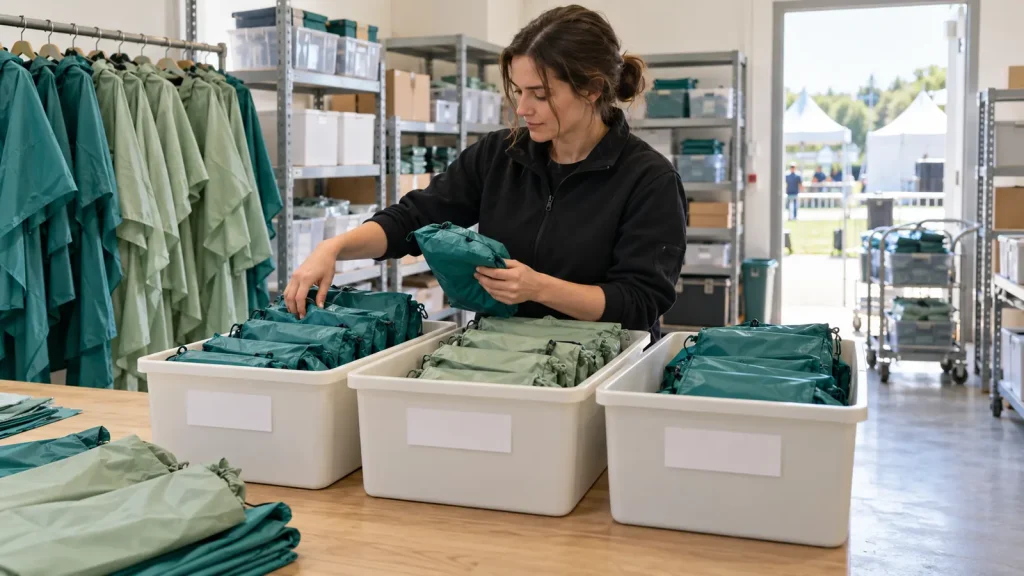
Create allocation rules before demand accelerates
When rainwear demand rises quickly, an undefined allocation process can create conflict between channels. One branch asks first, another has a confirmed customer deadline, and an event team assumes its reserve is protected. Agree the rules while there is time to discuss them calmly. State which commitments take priority, which stock is reserved and who can approve an exception. The rules should reflect the organisation's actual obligations and operating priorities, not an informal contest between the most persistent requesters.
Begin with confirmed requirements by product, location and date. Separate customer orders, internal operating needs and discretionary campaign allocations. Identify any stock that is physically or commercially dedicated to a particular use. A custom logo or size requirement can limit interchangeability even when the item appears similar. Make those restrictions visible in the central record so a planner does not offer the same units to two channels or assume that an unbranded substitute will be accepted without customer approval.
Define the opening allocation for each location using the available evidence. Relevant inputs may include the operating plan, historical issue patterns, confirmed orders and the time needed to replenish locally. Avoid giving every branch the same quantity merely for administrative convenience if their requirements differ materially. At the same time, do not disguise a judgement as a precise forecast. Record the rationale and the review date, especially for new locations with limited history. An allocation can be provisional while still being clearly managed.
Choose how additional requests will be evaluated. Require the requesting location to provide its current usable balance, existing commitments and the period the extra stock is meant to cover. This helps distinguish genuine replenishment from precautionary accumulation. A branch may ask for more because it lacks visibility of the central reserve, not because its expected demand has changed. Clear information can sometimes resolve that concern without moving additional cartons. Where a transfer is justified, record the receiving location and the effect on the remaining pool.
Set an escalation path for conflicts. The person approving an exception should see which other commitments would be affected and whether an alternative product or delivery date has been accepted. Do not allow a quiet reassignment to leave another customer with an unsupported promise. The decision may still favour the urgent need, but it should be deliberate and communicated. Keep the exception log concise enough to maintain, with the reason, quantity, authorisation and affected stakeholders recorded together.
Review allocations as the season develops. A location with slower demand may be able to release unopened, approved stock, while another may need a larger share of the remaining supply. Confirm condition, identification and transfer time before counting that stock as available elsewhere. Do not make an apparent surplus disappear from one report before the receiving location can actually use it. The central view should show the transfer as an in-progress movement until the handover and any required receiving checks are complete.
Good allocation rules protect trust as well as availability. Sales teams can explain what is reserved, local operators know how to request replenishment, and buyers can see whether another bulk order would solve a real network need. The result is a more coordinated use of the stock already purchased, with fewer competing assumptions about which location owns the final cartons.
Keep central reserves and local replenishment visible
A central reserve is valuable only when the locations it supports understand how to access it. Holding cartons in a warehouse does not guarantee that they can reach a branch or event in time. Define the reserve's purpose, eligible products, release authority and practical replenishment route. Some reserves may protect confirmed commitments, while others support uncertain additional demand. Keep those roles distinct. Otherwise, several teams may assume that the same stock is available for their contingency while no one has agreed how competing requests will be handled.
Calculate local cover using the relevant demand window and transfer lead time. A location with frequent deliveries can operate differently from one that is difficult to reach during an event. Include the time needed to request, approve, pick, transport and receive the stock. Do not use the carrier's travel time alone if internal processing adds meaningful delay. A reserve that arrives after the main demand period is not effective protection for that period, even if the network's overall inventory balance looked comfortable.
Make the reserve balance visible with clear definitions. Show usable unallocated units, protected commitments and movements already approved but not yet received. Update the record when a transfer is released and confirm when it arrives. This prevents two locations from being promised the same cartons. It also reduces unnecessary local hoarding: staff are more likely to trust a central reserve when they can see what is available and understand the process for obtaining it rather than relying on informal assurances.
Agree practical replenishment quantities. Carton or inner-pack multiples may simplify handling, but they should be evaluated against the destination's storage and demand. Sending a full carton to solve a small short-term need may be sensible in one operation and create avoidable surplus in another. Confirm whether partial cartons can be picked and identified reliably. If they can, define the counting and repacking process. If they cannot, include that constraint in the allocation rule instead of discovering it during an urgent request.
Prepare the receiving location for a transfer. Confirm the contact, access window, space and product identification before dispatch. A temporary venue may need the stock at a particular gate rather than its administrative address. A retail branch may have a restricted delivery schedule. These details are easy to overlook when everyone focuses on the quantity. The central reserve plan should include a usable route to the actual issue point, with responsibility for confirming the handover and reporting any discrepancy.
Review whether the reserve remains appropriate as the season changes. Stock protected for an early event may be released after that event closes and its commitments are reconciled. Conversely, a newly confirmed requirement may need a defined allocation. Make these changes explicit rather than allowing a reserve label to persist indefinitely. The aim is a current picture of what can be used, where and under whose authority. A reserve should support decisions, not become an unexplained block of inventory that nobody feels able to touch.
At the end of the season, compare reserve use with the problems it was intended to address. Did it cover a genuine demand increase, compensate for a local stock-record error or remain unused because the transfer process was too slow? Those outcomes call for different improvements. The review can refine the next season's quantity, placement and release process without assuming that simply holding more stock is the answer to every availability problem.
Match event kits to attendee and staff requirements
An event allocation should begin with the actual distribution policy. Some programmes give every attendee a pack, some issue rainwear only when requested, and others reserve it for staff or a specific activity. These policies produce different quantity requirements and handling plans. Confirm the intended recipients and the point at which they receive the product. A broad attendance estimate is useful context, but it is not automatically the number of ponchos to order. The event team must define how attendance translates into an approved issue requirement.
Separate staff and attendee needs where their use differs. Staff may work outdoors for longer periods, need a particular fit or require rainwear assessed for specific duties. Attendee packs may be designed for a different duration and distribution method. Do not assume that one ordinary promotional product suits every role. Ask the responsible operational and safety reviewers to define requirements, then maintain distinct specifications and quantities where necessary. The inventory plan should follow the approved use case rather than simplifying it through an unsupported product claim.
Build the kit contents list before finalising the pack quantity. If a poncho is combined with other items, confirm who supplies each component, who assembles the kit and how the finished kit will be checked. Record the rainwear quantity per kit and any separate reserve. Avoid counting the same units once as loose stock and again as completed kits. If assembly is performed at a warehouse or venue, include its time, space and staffing requirements in the available-to-use schedule.
Plan distribution by location and session where relevant. A multi-day event may have different attendee groups, staff shifts or entry points. Decide whether recipients receive one pack for the programme or a new pack at each relevant activity, according to the actual policy. Keep assumptions explicit and consider how staff will identify prior allocations where needed. Do not invent a universal issue rate or assume that every registered attendee will collect the same item at the same time.
Use a rehearsal to check the kit arrangement. Ask staff to open the outer carton, identify the correct pack, hand it to a recipient and replenish the issue point. Include the final labels and assortment information where available. Observe whether the arrangement causes confusion, unnecessary unpacking or difficulty keeping variants separate. A small practical trial cannot prove performance in every condition, but it can reveal avoidable handling problems while the packaging and allocation instructions can still be revised.
Decide how unopened surplus will be reconciled. Name the person who counts remaining stock, confirms its condition and records any return to the central pool. Dated branding or sponsor restrictions may limit further use, so obtain the appropriate decision before assuming it can serve another event. Used or damaged items need a different process and should not re-enter usable inventory automatically. Keep the stock records connected to the actual physical condition and approved destination of the remaining products.
After the event, compare issued quantities with the original assumptions and document the operating context. Record changes in attendance, weather, distribution policy or access to reserve stock that affected the result. This creates a more useful basis for the next event than a single total labelled consumption. It also helps the sales manager discuss future Bulk Pricing and quantities with a clear explanation of what the previous order was designed to achieve.
Preparing an outdoor event programme? Explore our Wholesale Festival Rain Poncho Collection Here and connect the attendee allocation, branded pack and handout deadline with your inventory plan.
09 / 12
Compare MOQ and Bulk Pricing within an inventory plan

Distinguish total order quantity from variant minimums
MOQ is meaningful only when its basis is clear. A supplier may be able to discuss a total bulk order while applying separate conditions to a custom colour, material, print or packaging component. Ask how the minimum relates to your actual assortment. Do not assume that a combined quantity can be divided freely across every size and design. The seasonal plan needs to show which configurations are feasible and how each one contributes to the total commitment, rather than relying on one headline minimum.
Present the quantity matrix with the enquiry. Identify the garment specification, colour, size or dimensions, artwork and pack type for each line. State whether quantities are firm requirements or planning estimates. This allows the supplier to explain the production implications of the proposed mix. If the supplier suggests consolidation, ask which requirement would change and have the responsible buyer or brand owner assess it. A simpler assortment can be useful, but it should remain an approved commercial decision rather than an unrecorded assumption.
Separate garment minimums from component requirements. A custom pouch, printed insert or special colour material may have its own ordering conditions. Ask how unused components would be handled and whether any proposed future use is actually agreed. Do not treat component stock as finished rainwear or assume that it can be converted into a later order without further cost, approval or availability checks. The inventory plan should distinguish what the buyer is committing to now from what might support a future programme.
Review order multiples as well as minimums. Packing and handling may be based on cartons, inner packs or other agreed quantities. A forecast can produce a number that is not convenient to manufacture or receive. Compare the feasible rounded quantities with the demand scenarios and show the resulting surplus or shortage explicitly. Do not hide rounding inside a spreadsheet formula that nobody reviews. The appropriate decision depends on the product's role, remaining demand window and approved carryover options.
Ask for alternatives when a small variant does not fit the proposed MOQ. The supplier may be able to assess an established colour, common construction or different approved packing route, but availability must be confirmed. Avoid promising the customer that an alternative is interchangeable before reviewing fit, appearance and intended use. If the original requirement remains essential, the commercial decision may be to accept a larger commitment or reconsider the project. The important point is to make the consequence visible before the order is released.
Use the current proposal as the authority for the current order. A minimum quoted for an earlier season or another customer's specification may not apply. Record the date, configuration and conditions alongside the quotation. If the assortment changes, obtain a revised response where necessary. This protects both buyer and supplier from comparing offers that appear similar but refer to different production scopes. It also makes later review easier when the team asks why a particular quantity was selected.
The objective is an order quantity that fits real demand and a confirmed supply route. MOQ is one constraint within that decision, alongside delivery, storage, branding and commercial exposure. Treating it clearly helps the sales manager explain the available options to customers and gives procurement a more precise basis for negotiating the seasonal programme without inventing a universal minimum for all rainwear products.
Evaluate committed, staged and repeat purchasing options
There are several ways to structure a seasonal requirement, but their availability depends on agreement with the supplier. A single committed order, a staged delivery arrangement and separate repeat orders have different implications for timing, stock and flexibility. Compare them using the same approved specification and demand scenarios. Do not assume that spreading deliveries means the supplier carries the risk of unsold goods, or that discussing future demand reserves production capacity. The obligations and practical arrangements need to be stated explicitly.
For a single bulk commitment, assess when the full quantity becomes payable, produced, delivered and usable under the agreed terms. Consider the storage and handling requirement at the receiving location. A consolidated order may suit a firm programme, but it can also create a larger early stock position. Evaluate that position against the forecast range and the product's carryover potential. Keep the actual commercial amounts in the private comparison and record the assumptions that make the option acceptable to the organisation.
For staged deliveries, clarify what is committed and what remains optional. Ask where completed goods or components would be held, how release quantities are agreed, which deadlines apply and what happens if the plan changes. Confirm responsibility for storage conditions and the relevant contractual arrangements with appropriate advice. A staged schedule should not be described as flexible merely because the cartons arrive on different dates. The buyer may still be committed to the entire quantity, and the supplier may need firm instructions well before each release.
For separate repeat orders, confirm that each order is assessed on its own current conditions. An approved specification can simplify the brief, but materials, MOQ, production timing and transport still need confirmation. Consider how much demand could occur while a repeat order is being prepared and delivered. If the remaining season is short, the repeat route may not address the relevant shortage. Record the latest useful decision date so sales knows when a new opportunity can still be supported by the proposed replenishment option.
Compare the options against the same operational questions. How much stock is available at the start? What happens if demand is higher or lower? Which decisions can change later? What information must the buyer provide, and by when? Which quantities are already committed? A clear comparison often reveals that an apparently flexible option depends on conditions the organisation cannot reliably meet. It may also show where an earlier approval or a simpler configuration could create a more useful range of choices.
Consider an illustrative programme with a stable core demand and several uncertain projects. The buyer might assess a firm core order alongside separately quoted project quantities, rather than asking one arrangement to cover every possibility. Another programme with a confirmed total requirement but limited warehouse space might investigate staged delivery. These are planning patterns, not claims that any supplier offers a particular service. The next step is a project-specific discussion that confirms the feasible structure and the responsibilities attached to it.
Document the selected approach in the purchasing handover. Sales, finance, logistics and the warehouse should understand which quantities are firm, which are forecasts and which require a later order. This avoids a common mismatch in which one department treats a future release as guaranteed stock while another treats it as an uncommitted possibility. A useful seasonal agreement makes the remaining choices explicit and connects them to dates the team can manage.
Make the commercial comparison show inventory consequences
Bulk Pricing should be compared against a defined product and delivery scope. A lower headline amount can be misleading if the offer excludes packaging, uses a different construction or assumes a quantity mix that does not match your requirement. Start the comparison with the approved specification and ask each proposal to identify what is included. Keep actual prices confidential to the purchasing process. The public buying discussion should explain how to compare scope and consequences without presenting retail unit prices or unsupported savings claims.
List the commercial components relevant to the programme. These may include samples, decoration, individual packing, inserts, assembly, outer cartons and the agreed delivery basis. Clarify exclusions and provisional charges. Where one proposal uses a different approach, show the difference explicitly rather than forcing it into an apparently equivalent column. The buyer can then decide whether the alternative meets the requirement. A comparison is fair only when the team understands which outcomes and responsibilities each offer actually covers.
Translate the order quantity into inventory consequences. Show expected opening stock, projected usage during the relevant window and possible closing stock under each demand scenario. Include the effect of variant minimums and carton rounding. A larger order may support availability while increasing exposure to slow stock; a smaller order may preserve flexibility while requiring a credible replenishment route. Neither result is inherently right. The decision depends on the product's role, customer commitments and the organisation's approved tolerance for shortage and surplus.
Include handling work that the organisation will actually need to perform. A proposal with mixed cartons, extra repacking or incomplete identification may require more receiving and allocation effort. Assess those tasks with the warehouse rather than attaching an arbitrary cost assumption. Similarly, a different pack format may affect storage capacity or distribution convenience. Use measured packed dimensions and a practical handling review where available. The aim is to compare the delivered programme, not just the garment in isolation.
Treat urgent recovery options cautiously. Faster transport or a late order may be possible, but it needs a current assessment of product readiness, routing and the remaining useful date. Do not use an assumed emergency solution to justify a routine plan that is otherwise unsupported. If a recovery option is part of the comparison, identify what would trigger it, who must confirm it and which costs or obligations require approval. Keep it separate from the base plan until those conditions are satisfied.
Record the reason for the final choice. A useful decision note explains the accepted scope, quantity, timing assumptions and tradeoffs, including why another proposal was not selected. It should be understandable to a colleague who did not attend the quotation discussions. This is particularly valuable when the chosen option is not the lowest amount, because the organisation may be prioritising a confirmed requirement, a clearer approval route or a more suitable packing arrangement. Avoid vague claims about value when the actual reason can be stated concretely.
After delivery and the main demand period, compare the outcome with the assumptions used. Separate price differences from specification changes, forecast errors and operational exceptions. This helps the next buyer improve the comparison rather than repeating a familiar quantity because it was used last year. A strong commercial review connects Bulk Pricing with the stock the business can actually use, the work needed to handle it and the risks the organisation has deliberately accepted.
10 / 12
Keep receiving, storage and stock accuracy ready for rain

Prepare a receiving check that protects usable stock
Receiving is where a planned order becomes a physical inventory position. Prepare the check before the shipment arrives so staff know what to identify, count and review. The scope should reflect the agreed product specification, packing arrangement and relevant risks. A receiving check does not automatically establish every technical or compliance characteristic, but it can reveal discrepancies that should prevent stock from being released prematurely. Give the team a clear reference and a clear process for reporting anything that does not match it.
Start with shipment identity and quantities. Match the delivery documents, carton marks and order references. Record the number of cartons received and any visible concerns with their condition. If the shipment contains several variants or allocations, confirm that the identification corresponds to the current packing list. Do not assume that a correct total means the assortment is correct. A shortage in one size or artwork version can be hidden by an excess in another, leaving the overall unit count unchanged but the customer requirement unmet.
Define the sample review appropriate to the order with the responsible quality team. Identify which characteristics will be checked, how samples will be selected and what action follows a discrepancy. Avoid inventing a universal inspection percentage or presenting a quick visual check as proof of all product performance. The agreed plan should be proportionate to the product and the evidence already required. Where a technical assessment is necessary, make sure the receiving team knows when to hold stock and seek the relevant review.
Use the approved reference for the checks. Compare garment dimensions or configuration where specified, decoration placement, pack information and variant identification. Keep the reference version clear so staff are not checking a revised delivery against an obsolete sample sheet. If an authorised change was made after the purchase order, include it in the receiving file. A correct shipment can appear wrong when internal documents are stale, while a real discrepancy can be missed when staff rely on a broad product name instead of the agreed details.
Record evidence that supports a useful supplier discussion. Describe the affected SKU, carton or lot references, observed issue and quantity known to be involved. Photographs may help show a visible discrepancy, but they should be associated with the correct record and not treated as a substitute for every measurement. Keep the language factual. The aim is to identify the problem and decide the next step, not to assume its cause before the supplier and relevant reviewers have examined the evidence.
Maintain a separate hold status for affected stock. Sales should not promise it while the decision is unresolved, and warehouse staff should be able to distinguish it physically or through the approved location controls. Name the person authorised to release, rework or otherwise disposition the goods. Do not allow a temporary hold to disappear merely because a delivery deadline is approaching. The appropriate resolution depends on the actual issue, the customer requirement and the evidence available, and it should be documented.
Once the check is complete, communicate the usable quantity and any remaining exceptions to the planning team. Update the inventory record with the released assortment and location, rather than simply marking the whole purchase order received. This final step connects receiving to the seasonal sales plan. It gives the business a reliable balance from which to allocate stock, confirm customer deliveries and decide whether any additional purchasing action is needed.
Store and rotate rainwear against its actual specification
Storage planning should follow the product information and the conditions at the intended location. Different rainwear constructions, coatings, components and packaging can require different handling. Ask the supplier for relevant storage guidance for the approved product and have the warehouse review it against its operation. Do not assign a universal shelf life or temperature limit based only on a generic material name. The objective is to preserve the condition and identification of the stock you have actually purchased.
Keep cartons and individual packs organised so their contents remain traceable. Use clear SKU and lot references where available, and record the location of each approved variant. Avoid combining similar-looking products in a way that loses the distinction between sizes, artwork versions or specifications. If partial cartons are used, maintain an accurate quantity and contents record. A neat warehouse is helpful, but the important question is whether staff can identify the correct usable item without relying on memory or opening several packages to investigate.
Review the physical storage arrangement with the responsible warehouse team. Confirm suitable shelving, stacking and access for the actual carton size and mass. Follow the relevant product and facility guidance rather than copying a limit from another shipment. Consider exposure to moisture, contamination or other conditions that could affect the goods, and establish how concerns are reported. A stock planning article cannot certify a storage arrangement; the people responsible for the facility must assess it using the appropriate information and procedures.
Choose a rotation rule that suits the product and programme. Where earlier approved stock remains suitable for the same use, issuing it before later receipts may help avoid forgotten carryover. However, customer-specific branding, condition reviews or specification changes can limit interchangeability. Do not use a simple first-in rule to bypass those restrictions. Make the allocation decision first, then apply rotation within the eligible stock. Staff should know when an older lot is available for use and when it remains subject to a separate review.
Keep used or returned rainwear distinct from unopened saleable stock. A reusable programme may have its own drying, cleaning, inspection and release process, but that process needs to be defined for the actual garment and use. Do not assume that folding a used item into a pouch makes it ready for reissue. Follow appropriate care information and the organisation's approved procedures. The inventory record should reflect the item's current status so operational teams do not confuse a return awaiting assessment with a ready-to-distribute pack.
Check stored inventory at appropriate intervals and after relevant incidents. The frequency and scope should reflect the product, facility and risks identified by the responsible team. Look for changes in condition, damaged packaging, missing identification or discrepancies in quantity. Record findings and actions rather than relying on an informal impression that the stock looks fine. If concerns arise, seek the necessary product or quality advice before counting the affected units as available for the next seasonal commitment.
At season end, reconcile the physical stock with the plan and identify what requires review before carryover. Include any restrictions, unresolved holds and relevant storage history in the handover. This gives the next planning cycle a verified starting point. Good storage and rotation support inventory reliability because they preserve both the product and the information needed to decide where it can legitimately be used.
Use cycle counts and returns to improve availability
An inventory system is only as useful as the accuracy of its stock records. Small picking errors, unrecorded transfers and unclear returns can accumulate until the reported balance no longer matches what staff can find. Use a practical counting process to keep the seasonal rainwear plan connected to physical stock. The frequency and scope should reflect the operation, movement patterns and known problem areas. Focus on obtaining reliable information and correcting causes, rather than treating a count as a ritual that ends once a number is entered.
Define the counting unit and location before staff begin. A carton, inner pack and individual poncho are different units, and mixed or partial cartons require particular care. Use the current pack configuration rather than assuming that every box contains the standard quantity. Make it clear how stock under inspection, reserved stock and items awaiting transfer are counted. Without those definitions, two careful people can produce different totals because they are answering different questions, not because either person has counted inaccurately.
Manage movements during the count through the organisation's approved process. If stock continues to be picked or received, the team needs a way to reconcile those transactions with the physical observation. Avoid making unexplained adjustments simply to force the system to match. Investigate significant differences and record what is known. A missing transfer entry calls for a different correction from a pack-size error or a misidentified variant. Understanding the cause helps prevent the discrepancy from returning in the next busy period.
Give returns their own decision path. Record the customer or location, product identity, quantity and reason for return. Inspect condition according to the appropriate procedure before deciding whether the units can re-enter usable stock. An unopened return may still need identification and review, while used or damaged items require a different status. Keep financial credit decisions separate from physical release decisions. A customer receiving a credit does not by itself establish that the returned product is suitable for another order.
Use discrepancy patterns to improve the process. Repeated confusion between two similar colours may call for clearer labels or separate locations. Frequent differences in partial cartons may indicate that picking quantities are not being recorded consistently. Returns attributed to an unclear size description may require a better product brief or customer discussion. These observations are valuable because they connect inventory accuracy with the way the product is specified, packed and communicated, rather than assuming every issue can be solved by counting more often.
Feed the corrected usable balance into the replenishment review. A stock adjustment can change the apparent cover and the need for another order, but the planner should understand whether it reflects a real change in demand or a correction to past records. Keep those explanations visible in the seasonal review. Otherwise, the forecasting model may interpret an administrative adjustment as customer consumption and recommend a larger purchase for the wrong reason. Accurate definitions protect both the stock position and the demand history.
Close each significant discrepancy with an owner and an action. Confirm that labels, records or procedures have been updated where necessary and that affected teams understand the change. This turns cycle counts and returns into a source of operational learning. The sales manager gains a more dependable availability picture, and procurement can base the next bulk rainwear decision on stock that exists in the required condition and configuration.
11 / 12
Manage slow stock, disruptions and the end of season

Set action triggers for shortage and surplus scenarios
A contingency plan should say when the team will act, who decides and what options will be assessed. A list of possible problems is not enough. For seasonal rainwear, useful triggers may relate to a dated stock shortfall, a missed supply milestone, a confirmed increase in demand or a growing balance that no longer has an identified use. Define the trigger in terms the organisation can measure. This makes it easier to respond consistently without treating every unusual week as a reason for an urgent new order.
For a potential shortage, look at the product, location and date involved. A total seasonal deficit is different from a temporary local gap or a missing variant within an otherwise sufficient order. Identify the commitments affected and the time remaining to respond. Check the usable balance and inbound evidence before assuming the forecast is the problem. Sometimes the appropriate action is to correct a stock record, release an approved hold or arrange a transfer, rather than increasing the total purchase quantity.
Define the options to investigate in a logical order. These may include available stock at another location, a customer-approved alternative, an already confirmed delivery or a new supplier proposal. Each option needs evidence about suitability and timing. Do not promise that expedited transport or a last-minute custom order will solve the issue before the relevant parties confirm the route. The contingency process should make those checks faster and clearer, not replace them with optimism when the deadline becomes uncomfortable.
For a potential surplus, compare the remaining usable stock with the remaining demand window and approved future uses. Distinguish a temporary slow week from a material change in the programme. A cancelled event, obsolete artwork or revised customer requirement may justify action even when the total quantity is modest. Identify what is still committed with the supplier and what can legitimately be changed. Do not assume that an unshipped order can be cancelled or revised without reviewing the agreed terms and obtaining the necessary agreement.
Use thresholds appropriate to the business rather than a universal percentage. A small shortage may be critical for a fixed staff allocation, while a larger variation may be manageable in a flexible distribution programme. The same applies to surplus: a core undated item may have a reasonable future use, while a small quantity with expired event branding may not. Document the reason for the threshold and revisit it when the product role or operating plan changes. The trigger should reflect consequences, not just numerical size.
Prepare communication for affected customers and internal teams. State what is confirmed, what remains under review and when the next decision will be made. Avoid presenting a proposed substitute or shipment as a completed solution. Sales should coordinate the customer response, procurement should establish supply facts and operations should confirm the handling plan. A shared exception record prevents conflicting messages and allows everyone to work from the same current understanding of the available options.
After the issue is resolved, record the outcome and the cause as far as the evidence supports it. Was the trigger early enough? Did the planned response remain feasible? Did the team need information that had not been collected? These questions improve the next seasonal plan. A useful contingency process does not promise that every disruption can be avoided; it helps the organisation make a clear, timely decision when the original assumptions no longer hold.
Evaluate transfers, late orders and carryover carefully
Transfers, late purchases and carryover are different tools with different limitations. A transfer moves existing approved stock, a late order creates a new supply commitment, and carryover assigns remaining stock to a future period. Compare them against the specific requirement rather than treating them as interchangeable ways to fix an inventory balance. The relevant questions are whether the product is suitable, whether it can be available in time and what commitments or handling work the option creates for the organisation.
Before transferring stock, confirm its identity, condition and release status at the sending location. Check that the receiving location can use the same specification and branding. A system balance may include reserved or held units, so obtain the actual available quantity. Agree the packing, transport and receiving arrangement, including any required checks on arrival. Keep the movement visible as a transfer in progress until the receiving team confirms it. This avoids creating simultaneous availability in two places or losing track of stock between them.
Assess the opportunity cost at the sending location. Moving its remaining reserve may solve one problem while exposing another confirmed requirement. Review the local demand window and the ability to replenish before authorising the transfer. The decision may still be appropriate, but it should be based on the network's priorities and communicated to the affected team. A central allocation owner can help prevent a series of well-intentioned local decisions from producing an overall shortage that nobody anticipated.
For a late order, start with the latest useful receipt date and ask for a current project-specific proposal. Confirm the product configuration, quantity, approval conditions and complete route to usable stock. Do not assume that a familiar supplier can repeat an order immediately or that a faster transport mode removes production and receiving work. Compare the realistic outcome with the remaining demand. An order arriving after the main event may create stock without solving the original shortage, even if it eventually improves the system balance.
Review carryover as an approved use decision. Confirm product condition, storage requirements, branding relevance and any changes in the next programme's specification or destination. Keep stock awaiting that review outside the usable future balance. A proposed future use should have an owner and a plausible requirement, not simply be a label attached to surplus to make the season appear closed. Avoid claiming an environmental benefit from holding stock unless there is appropriate evidence for the specific claim being made.
Consider repacking or reassignment only through a suitable approval process. A garment may remain appropriate while its campaign insert does not, but the revised pack still needs accurate identification and any required information. Confirm the work, materials and checks before counting the option as available. Do not conceal the change or imply that a revised configuration has already been assessed when it has not. The same discipline used for the original OEM Program should apply to material changes in the way the stock will be supplied or used.
Document the selected route and reconcile its quantities. Record what moved, what was ordered, what was released for future use and what remains unresolved. Update the demand and supply plan without erasing the original reason for the decision. This gives the next reviewer an honest picture of the season's outcome and helps prevent the same stock from being repeatedly reassigned on paper without a confirmed destination or practical route to use.
Turn the season review into the next purchasing brief
The most useful season review ends with changes to the next brief. A report that merely lists sales, remaining stock and delivery dates may describe the result without explaining how to improve it. Compare the original assumptions with the observed outcome and separate demand, supply and execution issues. A shortage caused by an inaccurate stock record needs a different response from one caused by stronger customer demand. A surplus linked to obsolete branding needs a different response from a temporary delay in a continuing core programme.
Start with a reconciled record of quantities. Show opening usable stock, new receipts, transfers, issued or sold units, returns, approved adjustments and closing stock by relevant product group. Explain material differences rather than forcing them into a balancing category with no meaning. Confirm that internal transfers are not counted as final demand and that held stock is distinguished from usable carryover. This creates a reliable basis for discussing the outcome and prevents the next forecast from inheriting unresolved record errors.
Review the forecast assumptions. Identify which customer commitments converted as expected, which opportunities changed and which new requirements emerged. Consider whether the time scale and product detail were appropriate. A forecast might be accurate in total while missing the weeks or variants that mattered operationally. Ask what information would have improved the decision and whether it could realistically have been obtained earlier. Avoid judging the original plan only with hindsight; assess whether the reasoning was sound given the evidence available at the time.
Review the supply timeline separately. Compare approval, production, dispatch, arrival and usable-release milestones with the plan. Record the causes of significant changes where supported by evidence, including internal approval delays as well as supplier or logistics issues. Identify which contingency options were useful and which existed only on paper. The purpose is a fair account of the process, not a search for one party to blame. A precise chronology makes the next discussion of lead times and responsibilities more productive.
Include feedback from the people who handled the product. Ask about variant identification, pack opening, storage, picking and replenishment at the issue point. A programme can meet its sales target while creating unnecessary work that should be addressed before the next order. Conversely, a packing improvement may have helped operations even if demand was lower than forecast. Record these observations as specific design or process requirements, with a named reviewer to decide which changes belong in the next approved configuration.
Translate the findings into a short action list. Each action should state the change, owner, evidence needed and decision date. Examples might include simplifying a colour range, revising carton identification, moving the artwork deadline or collecting better event-level usage data. Do not expand the next programme automatically just because the review identified many possible improvements. Prioritise changes that address a demonstrated problem or a confirmed new requirement, and assess their effect on MOQ, approval work and the available supply route.
Finish by issuing the next seasonal enquiry with the updated product references and planning assumptions. Keep the prior record accessible so the supplier and internal team can understand what has changed. This closes the loop between sales experience and procurement decisions. The next bulk order then starts from a clearer brief, supported by actual learning about demand, handling and supply, rather than from a copied quantity and a hope that the coming season will behave exactly like the last one.
12 / 12
Seasonal rainwear inventory FAQ and purchasing checklist

When should we order and how much should we commit?
When should a business place its seasonal rainwear order? Work backwards from the date the stock must be usable at the destination. Include development and approval, the supplier's confirmed readiness conditions, production, packing, checks, transport and receiving. There is no single lead time that applies to every material, branding method, quantity and route. Ask for a project-specific schedule and clarify when each period begins. A statement about production days is not enough if the team still needs samples, artwork approval or a final packing decision before production can start.
How much should the first order cover? Begin with verified usable carryover, confirmed commitments and a reasoned forecast for additional demand. Compare low, base and high scenarios, then assess the replenishment options that remain feasible. The appropriate commitment depends on the product's role, customer obligations, MOQ and the consequences of shortage or surplus. Avoid using a generic percentage simply because it is easy to communicate. Record why the selected quantity makes sense and which changes in demand or supply would trigger another decision.
Should every location receive the same opening quantity? Only if its actual requirement supports that choice. Locations can differ in attendance, customer commitments, operating hours, storage and the time needed for replenishment. Use the available evidence to create an opening allocation and retain a review process for changes. New locations with limited history may need a broader scenario range and closer observation. Make the basis visible so staff understand why allocations differ and how they can request more stock with relevant information.
Can last year's sales determine this year's purchase? They can inform it, but first check product changes, stockouts, returns, internal transfers and unusual events. Sales during a period of poor availability may understate demand, while a one-off project may overstate the repeat requirement. Separate the historical baseline from new confirmed business and campaign assumptions. Keep the cleaned data and the adjustment reasons together. This allows the team to challenge the forecast constructively without losing the evidence that supports it.
How should reusable and emergency rainwear be combined in a seasonal plan? Define the intended use and customer requirement for each line rather than assuming they are direct substitutes. Different constructions, fit, care expectations and packing arrangements may serve different programmes. Establish the approved specification and relevant evidence before assigning an inventory role. A common planning framework can cover both, but quantities and replenishment rules should reflect the actual use case. Consult the product and safety reviewers where the intended activity creates specific requirements.
What does a useful first enquiry contain? Provide the product brief, quantity matrix, intended users, destination, required usable date, artwork status and packing needs. Explain which quantities are firm and which are scenarios. Ask the supplier to identify MOQ, sample steps, production start conditions and the information needed for a reliable proposal. This produces a more useful response than asking only for the fastest lead time or the best bulk amount. The supplier can assess a defined project, while the buyer can compare the response against the actual seasonal requirement.
Before committing, make sure the internal owners agree on the same version. Sales confirms demand, the brand or technical team approves the product requirements, procurement confirms the supply proposal and operations confirms receiving and distribution. That shared brief is the foundation of a usable seasonal order. It keeps the quantity decision connected to a product the business can approve and a schedule the organisation can realistically support.
How do we handle forecasts, minimums and late changes?
Should a wetter seasonal outlook automatically increase the order? No automatic multiplier is appropriate for every programme. First understand the forecast's location, period and meaning, then assess whether it changes a relevant demand assumption. Rainwear usage also depends on attendance, outdoor activity, distribution policy and product availability. Use the new information to review the scenarios and remaining options. The response may be a local transfer or a reserve review rather than a new custom production commitment. Keep weather interpretation separate from operational safety decisions.
What if a required colour or logo does not meet MOQ? Ask the supplier to explain the minimum's basis and assess feasible alternatives against the actual brief. A standard colour, common construction or different packing arrangement may be worth considering, but its suitability and availability need confirmation. The buyer or brand owner should approve any change. Do not assume that a large total order removes all variant minimums. Keep the quantity matrix explicit so the commercial consequence of each retained configuration can be evaluated.
Can a staged delivery arrangement reduce inventory risk? It may change where and when stock is held, but the commitment depends on the agreed terms. Clarify total quantity obligations, release dates, storage arrangements and what happens if demand changes. Receiving goods in several shipments does not necessarily make the later quantity optional. Compare the proposal with separate repeat orders and a single delivery using the same demand scenarios. The useful arrangement is the one whose actual responsibilities and timing fit the programme, not the one with the most flexible-sounding label.
What should happen when artwork changes after approval? Establish the status of garments, decoration and packaging, then ask the supplier to assess the revised request. Have the brand owner define which units must change and whether any approved alternative remains acceptable. Review the technical and timing implications before authorising rework. Update the specification, quantity matrix and allocation records together. This prevents one department from using the new file while another continues to promise or check the old configuration without understanding the difference.
Can urgent transport rescue a late order? Only a current assessment can establish whether a route is available and useful. Faster transit does not remove unfinished approvals, production, packing, documentation or receiving work. Ask for the complete expected usable date, not just the travel period. Compare that date with the remaining requirement and confirm the relevant commercial approvals. An urgent shipment that arrives after the event may create inventory without solving the original problem. Keep proposed recovery options separate from confirmed customer commitments until their conditions are established.
How should the team respond to a possible shortage? Verify the usable balance, reservations and inbound milestones first. Identify the exact product, location and date affected. Then review approved transfers, customer-accepted alternatives and feasible supply proposals in line with the allocation rules. Name the decision owner and communicate what is confirmed. Do not create a second problem by quietly moving stock that another customer has already been promised. A clear exception process is valuable because it coordinates the response while there is still time to act.
What if demand is lower than expected? Review the remaining selling window, committed inbound supply and legitimate future uses. Changes to orders or delivery arrangements require the appropriate agreement; carryover requires a product and condition review. Record the decision and keep unresolved stock outside the usable future plan. This allows the business to address surplus honestly and gives the next seasonal forecast a more accurate starting point.
What should a seasonal rainwear enquiry include?
A strong enquiry gives the supplier enough context to propose a supply plan that can be assessed. Begin with the intended use, customer group and destination market. Describe whether the products support retailers, staff, visitors, promotional campaigns or a combination of channels. Include the available-to-use date and the main demand window. These details explain why the order matters and help identify questions about construction, fit, packaging and delivery before the discussion narrows to MOQ and Bulk Pricing.
Provide a product reference for each proposed line. State the material and construction requirements, dimensions or size information, colour references and any features that need review. Attach the relevant existing specification or sample reference where available. If you are still comparing options, say so and identify the decision criteria. Do not present an uncertain preference as an approved technical requirement. The supplier's response should make clear which proposal addresses the current brief and which details require further sampling or specialist assessment.
Add a quantity matrix that separates variants and destinations. Show firm commitments, planning estimates and any proposed phased requirements. Explain whether pack or carton multiples can be considered, and ask the supplier to clarify the basis of any minimum quantity. If you expect a possible repeat order, identify it as a forecast rather than implying a reservation already exists. This helps both sides distinguish the immediate commercial proposal from future possibilities that will need their own confirmation.
Describe artwork and packaging status. Include the current design revision, proposed placement and the people responsible for approval. Specify the intended individual pack, inserts, identification, inner quantities and carton requirements, or ask for options against a clearly described distribution process. Request a filled sample or packing review where appropriate. The garment, decoration and pack should be assessed as one programme so an attractive product does not arrive in a configuration that creates avoidable receiving or allocation work.
State the delivery and receiving requirements precisely. Provide the destination, required usable date, access or appointment constraints and the expected division of logistics responsibilities. Ask the supplier to identify production readiness conditions and the milestones supporting its proposal. Confirm current route and document needs with the relevant logistics and import specialists. Avoid asking the supplier to guarantee an undefined arrival simply by supplying a city name and a target month. A clear handover makes the resulting timeline much easier to evaluate.
Include the evidence and approval process needed for the intended use. Identify who will review samples, technical information, claims and any destination-specific requirements. Do not request or advertise certifications as a generic badge; the relevant evidence must match the product and requirement being assessed. State how changes will be approved and who will consolidate feedback. A supplier can respond more effectively when it knows which decisions are needed before the order is released and which documents the buyer will use at receiving.
Close the enquiry with the decisions you want the proposal to support: a feasible assortment, confirmed MOQ basis, sample route, bulk scope and a timeline to usable stock. Bring the response into the shared seasonal plan, compare it against the demand scenarios and resolve open assumptions before committing. If you are ready to discuss a programme, use the quotation form to share the brief and the required date. The next useful step is a project-specific conversation grounded in your actual product, quantity and distribution needs.
Return to the wholesale rainwear sourcing, branding and logistics guide to combine the demand scenarios, approved product and delivery milestones in one purchasing brief.