
Wholesale material guide · PE, PVC, EVA and polyester
Raincoat Material Guide: Choosing Between PE, PVC, EVA, and Polyester
A material name is a starting point, not a finished raincoat specification. Two garments described as EVA can feel different, and a polyester shell can use very different waterproof constructions. This guide helps wholesale buyers compare PE, PVC, EVA and polyester through the details that affect a bulk order: film or fabric construction, thickness, seams, wearer comfort, branding, care and evidence. Use it to turn a shortlist into a material brief your team and supplier can both approve.
Compare complete constructions. Review the evidence. Approve a material specification that fits your bulk order.
01 / 12
Start your raincoat material comparison with the complete construction

Separate polymer, film, fabric and finished garment
The word on a quotation may describe only one part of the product. PE, PVC and EVA identify polymer families. Polyester can identify the fibre used in a woven outer fabric, while another material provides the water barrier. A finished raincoat also contains joins, openings, closures and possibly a lining. Before comparing proposals, ask which part each material name describes. This prevents a surprisingly common purchasing problem: comparing a film garment with a coated textile garment as though their descriptions were equivalent.
A film construction uses a continuous sheet as the principal garment material. A textile construction starts with fibres or yarns assembled into fabric and may add a coating or laminated layer. That distinction changes the questions you ask. Film specifications need an agreed thickness and information about the finished sheet. Textile specifications may need yarn details, fabric construction, mass per unit area and the identity of additional layers. Neither description, on its own, tells you how the completed raincoat will perform.
Ask the supplier for a simple construction description from outside to inside. It does not need to reveal a confidential manufacturing recipe to be useful. It should identify the material being proposed, the layers present and the terminology used in the quotation. If a description says only “polyester waterproof fabric,” request clarification about the barrier. If it says “EVA material,” ask whether that refers to the complete film or an element within a more complex construction. Leave unresolved details visible in your comparison sheet.
Distinguish a material sample from an assembly sample. A small swatch can help you discuss colour, surface texture and handling, but it does not show how the hood joins the body or how a closure loads the surrounding material. Request a finished sample when those decisions affect the order. Give the swatch and garment separate reference codes, then record their relationship. Otherwise a team can approve a pleasant sample strip while the factory interprets the approval as permission to use a different finished construction.
Avoid treating familiar terminology as a substitute for identification. “Vinyl,” “plastic,” “fabric” and “premium” can be useful conversational shorthand, but they are not sufficiently precise purchase descriptions. Ask the supplier to translate its marketing name into the construction information your team needs. Keep the original name in the record so correspondence remains traceable, and add a clarified specification beside it. This allows sales, technical and purchasing colleagues to discuss the same proposal without repeatedly interpreting different versions of a product description.
The distinction also matters when reading evidence. A result associated with a resin, a plain film or an undecorated fabric is not automatically a result for the raincoat in your order. Record what was tested, how it was identified and which proposed component it represents. Where the connection is unclear, ask a focused question instead of assuming either success or failure. You may need additional material information, an assembly review or a new sample, depending on the claim your organization intends to make.
Use the construction description as the first line of the buying brief. Follow it with the intended wearer, required coverage, packaging arrangement and approval reference. That short sequence keeps the conversation grounded in a product your team can evaluate. It also makes later substitutions easier to discuss: a change to the face fabric, film formulation or seam system becomes an identified proposal for review, rather than an invisible alteration hidden behind the same material name on the purchase order.
Translate the wearing assignment into material requirements
Start with what the wearer will do, not with a favourite material acronym. Someone walking from a coach to a covered attraction has a different assignment from a coordinator moving repeatedly between outdoor work areas. Describe the exposure, movements, clothing underneath and access to shelter. These details give the supplier something practical to respond to. Without them, a request for “good-quality rainwear” invites assumptions about weight, fit and intended use that may not match the people receiving the garments.
Write down the expected issue process. Will staff hand out sealed packs at several entrances, or will employees receive individually allocated garments before the season starts? A compact pack might matter greatly for the first arrangement. An accessible closure, size identification and workable care routine might be more important for the second. Material selection should support that process. Ask the people who distribute rainwear to review the brief before purchasing requests Bulk Pricing, because they often recognize handling problems that a sample-room comparison misses.
Define the duration of the assignment without promising a fixed product life. An event may require cover for an afternoon, while a team program may expect repeated use under specified conditions. State the intention and ask what evidence and care instructions support the proposed product. Do not translate “reusable” into an assumed number of successful wearing occasions. The garment, activity, handling and recovery process all affect that outcome, and your approval plan should reflect the aspects your organization can actually manage.
Consider the clothing and equipment worn underneath. A jacket that fits over a shirt may behave differently over a padded layer. A poncho covering a backpack may lift at the sides or change the hood position when the wearer turns. Describe those combinations during sampling. Ask reviewers to sit, reach and walk in ordinary conditions appropriate to the intended use. Record which garment and size they tried. A material discussion becomes much more useful when it includes the complete shape being evaluated.
Make storage part of the assignment. State whether rainwear will wait in indoor shelving, travel in event boxes or be carried between venues. Ask for suitable storage instructions and review the packed sample accordingly. Do not invent temperature limits from the material name or assume an unopened pack has an unlimited storage life. Agree how the receiving team will identify batches and inspect older stock before issue. A carefully chosen material can still disappoint if the logistics plan ignores its product-specific handling requirements.
Identify any requirements that need a separate specialist review. Occupational protection, children's products and destination-specific chemical requirements should not be reduced to a preference for one polymer. Explain the intended market and application to the relevant technical reviewer and supplier. Ask them to identify the evidence needed for the exact product. Keep these requirements in the brief alongside commercial needs, so a convenient packaging or colour choice does not distract the team from an unresolved requirement that controls whether the item is suitable.
Finish with a concise statement of priorities. For example, an illustrative visitor program could prioritize rapid issue, broad coverage and compact storage, while a recurring team program could prioritize fit, closures and a documented care process. These are planning examples, not product recommendations or measured outcomes. Use your own operating details to establish the priorities, and invite suppliers to explain their proposed construction against them. That gives the eventual material comparison a clear purpose and makes disagreements easier to resolve.
Build a shortlist without a universal best-material ranking
There is no useful universal winner among PE, EVA, PVC and polyester. The answer depends on the actual construction and the assignment you have described. A ranking that gives each material a single score can conceal more than it explains. Instead, establish a small set of requirements and compare identified products against them. This shifts the discussion from which acronym sounds better to which proposal has the most convincing fit with your wearer, distribution process, evidence needs and commercial constraints.
Separate mandatory requirements from preferences. A mandatory requirement needs an agreed basis for acceptance before an order can proceed. A preference allows a trade-off when the buyer understands the consequence. For example, the destination and intended use may create evidence requirements that cannot be traded away for a preferred colour. A pouch style or finish might allow more flexibility. Label the two categories in the comparison rather than mixing them into a single total that can make an unresolved mandatory item disappear.
Use comparable evidence for comparable claims. When suppliers quote different test methods, conditioning or specimen types, record those differences instead of assigning the larger number a higher score. When a claim is qualitative, identify what the team has actually observed. “Preferred by our sample reviewers for handling” is a different statement from a laboratory performance result. Both may help a purchasing decision, but each belongs in its own column with its own limits. Clear distinctions reduce the risk of overstating a sample review.
Keep a separate uncertainty column. A supplier may have answered the material identity question but not yet confirmed a decoration process or care instruction. Mark that item as awaiting confirmation. Do not silently fill the gap from another product in its catalogue. An incomplete proposal can remain on a shortlist while the team requests the missing information, provided it is not treated as approved. This is especially helpful when comparing stock products with an OEM Program that still needs development work.
Discuss trade-offs in sentences. A hypothetical proposal might offer a convenient pack but require a different distribution method, while another might support a preferred garment shape but need more storage space. Explain those consequences in the meeting notes. Numbers alone do not tell the operations manager what will change. Ask the department affected by each trade-off to confirm whether it is acceptable. Procurement can then compare commercial proposals that reflect realistic operating choices rather than preferences detached from daily use.
Limit the first shortlist to options worth sampling. Collecting every available material and colour can create a large review exercise without improving the decision. Ask suppliers to explain why each proposed construction deserves consideration against the brief. Request an alternative only when it addresses a meaningful requirement or uncertainty. Keep rejected options and reasons in the record, so the same discussion does not restart when someone later discovers a different product name that describes a substantially similar construction.
Make the shortlist a working document rather than a final verdict. Update it when samples, evidence or quantities change, and show the revision date. Before approval, confirm that the commercial quotation matches the construction actually reviewed. Check the variant, packing and intended use again at that point. The purpose of the material guide is to help you reach a defensible buying decision, not to assign permanent reputations to polymers. A disciplined shortlist supports that decision while leaving room for a supplier to propose a genuinely useful alternative.
Connect this comparison with the wider procurement framework in our Rainwear Product & Material Guide for Wholesale Buyers. It brings material, product, branding and supply decisions into one buying brief.
02 / 12
PE rain ponchos: specify lightweight film beyond the material label
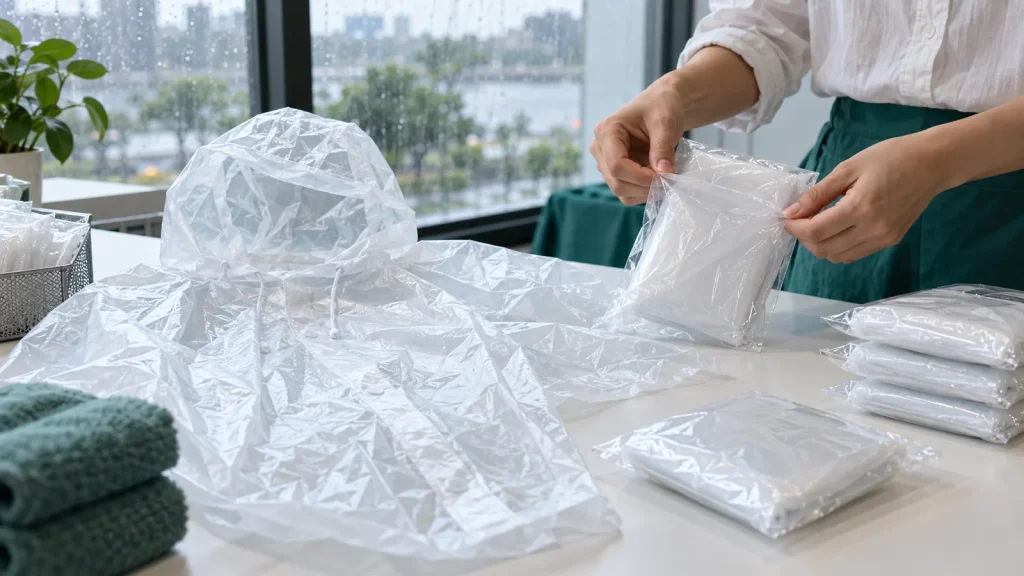
Ask what the polyethylene film specification actually includes
When a proposal says PE rain poncho, the first useful follow-up is about the film actually being offered. Polyethylene is a family of materials, not a single finished-film specification. Resin portfolios distinguish grades and families such as LDPE, LLDPE and HDPE. That distinction helps explain why two clear ponchos need not behave alike, but a resin name alone still does not tell you how a converted garment will fit, unfold or withstand normal handling.
Ask the supplier to identify the proposed film construction in language your technical team can use. Is the product based on a single film, a blend or another declared arrangement? Which details are controlled in the purchase specification, and which remain the converter's production choices? You do not need to demand confidential formulation information that has no bearing on your order. You do need a clear description of the product you are approving and a procedure for notifying you about material changes.
Next, connect that description to a physical sample. A photograph of a folded pack cannot establish film thickness, dimensions, seam quality or the ease of separating the layers. Give each sample a reference code and record its size, colour, packing format and relevant production details. Ask whether it represents the intended bulk construction. If it is only an early shape sample, keep that limitation visible in your review notes rather than allowing it to become an accidental approval of production material.
For transparent or translucent rainwear, discuss appearance as a separate requirement. Clarity, surface finish, folds and print visibility influence how the item looks when it is packed and worn. Decide which of those features matters to the project. An emergency supply programme may prioritise opening and coverage, while an event sponsor may also care about how a printed panel appears over dark clothing. Neither team should assume that the same word, clear, communicates an identical visual acceptance standard.
Avoid turning a supplier's general material brochure into a promise about the poncho. A resin data sheet may describe tests on a particular resin specimen under stated conditions. Your purchase concerns a converted film and assembled product. If a property is important enough to affect the buying decision, ask how it will be evaluated on the proposed material or garment. Keep the source document, sample reference and requested acceptance check together so that the relationship remains understandable to the next person reviewing the order.
This is also the right stage to clarify what the quotation excludes. A standard PE poncho proposal may use a particular cut, hood shape and packing arrangement unless you specify otherwise. If your brief includes a larger coverage area, separate sleeves, a different closure or individual branding, identify those changes explicitly. Request the resulting MOQ and production implications for that version. A custom feature should appear in the agreed specification rather than survive only in an email discussing a similar previous project.
The practical output is a short, traceable film description attached to a garment specification. It should let procurement explain what is being purchased, let quality staff identify the approved reference, and let the supplier flag a proposed substitution before production. That is a stronger basis for comparing PE rain ponchos wholesale than asking every bidder whether its material is premium. Descriptive adjectives can support a conversation, but they cannot replace the details that determine whether the delivered product matches your actual brief.
Check thickness, cut and packed handling together
Film thickness is useful only when the unit and measurement basis are clear. Ask for the stated value in micrometres or millimetres, the agreed tolerance and the method used to check it. A number without a unit is not a specification. Nor should a nominal thickness be treated as a guarantee that every point on every finished garment has exactly that value. Your quality plan should explain where measurements are taken and how variation is assessed for the proposed product.
Do not compare thickness figures in isolation from garment dimensions. A generous cut and a narrow cut can use the same nominal film thickness yet provide very different coverage over clothing or a small bag. Record the finished dimensions at defined points and ask for a drawing that makes those points unambiguous. If the wearer needs to lift their arms, sit down or reach into a bag, include those movements in the sample review. The film must work as part of the complete shape.
The neck opening, hood connection and any closure deserve particular attention because users handle them while putting the garment on. Inspect the supplied sample without deliberately abusing it or creating an improvised strength claim. Does the opening separate as expected? Can a wearer identify the front? Are the joins consistent with the approved construction? Note the circumstances of any difficulty. A specific observation about a tight opening is much more actionable than a general comment that the material feels weak.
Packed handling adds another layer to the comparison. Ask reviewers to open the actual individual pack rather than a loose demonstration sample. Check the opening direction, the relationship between pack size and garment folding, and the risk of catching the material while removing it. If staff will hand out stock quickly, review the same process at the issue desk. A compact format is useful only if the product can be identified and opened without creating avoidable confusion during a wet-weather rush.
For a hypothetical outdoor exhibition, imagine two proposed packs that both fit the storage shelf. One opens easily but leaves the poncho tightly creased; the other requires a clearer opening instruction. The decision should come from an observed trial with representative users, followed by a defined packing adjustment if necessary. Do not convert that small trial into a statistical promise about all recipients. Use it to find practical problems early and to decide what the production packing sample must demonstrate before approval.
Garment mass can be another useful recorded attribute, provided it is defined properly. State whether the figure includes the individual pack, labels or other components, and compare the same size and construction. Mass can help identify an unexpected difference between samples, but it does not independently prove film thickness or product quality. Keep it alongside dimensions, construction and inspection findings. When several attributes change at once, ask the supplier to explain the differences instead of selecting whichever isolated number looks most favourable.
Close this review by approving a complete reference: film description, nominal thickness and tolerance, cut, joins, pack and opening method. Store photographs of the approved arrangement with the physical sample where practical. If any one of those features changes, decide which checks need repeating. This keeps a lightweight PE rainwear order manageable without pretending that procurement can reduce the whole product to a single gauge figure. The objective is consistent, usable stock that matches the agreed task and can be checked at receipt.
Evaluate PE samples for emergency and promotional distribution
Begin an emergency or promotional PE poncho trial at the place where the product will be issued. That may be a visitor counter, a coach departure point, a sports registration desk or a staff supply station. Each setting creates different handling questions. Identify who retrieves the stock, who opens the carton, whether recipients open their own packs, and what help is available. A material choice that looks straightforward in a meeting can become awkward when several people need rain protection at once.
Invite a small, representative group to review the proposed sizes and instructions. Ask them to wear the sample over the type of clothing expected at the event, using normal movements relevant to the setting. Record coverage, visibility around the hood, access to pockets and ease of removal. This is a practical product review, not a substitute for any required safety assessment or standardised test. Keep specialist workwear requirements separate from general visitor rain protection, even when the garments share a similar colour or shape.
Consider accessibility in the issue process. Some recipients may have difficulty finding a pack opening or separating thin layers, particularly while holding other belongings. Clear instructions and trained staff can address problems that a material change alone would not solve. Ask the supplier what packing and instruction options can be considered for your OEM Program, then review the actual proposal. Do not assume that every available printing or packing method is suitable for the selected film, order quantity or distribution timetable.
Branding should be reviewed on both the packed and worn item. A sponsor mark that looks strong on a flat sample may sit in a fold or become less visible over patterned clothing. Check the artwork dimensions, placement and contrast using the intended garment colour and surface. Keep any claimed print durability tied to an agreed check on the decorated sample. A successful initial appearance is an approval of appearance at that stage; it is not evidence for an unlimited service-life or wash-resistance claim.
Decide how staff should respond to a damaged or unsuitable item. Set aside replacement stock according to your own operational assessment, and explain how concerns will be recorded. A simple record of the sample or batch reference, issue point and observed problem can be more useful than an informal pile of returns with no context. If the same difficulty appears repeatedly, the team can then distinguish a packing issue, a sizing mismatch or a possible product defect and discuss a focused correction with the supplier.
Include the end of the distribution process in the plan. Tell recipients what your organisation actually supports after use, and align any collection arrangement with the local operator who will handle the material. Do not describe a PE garment as automatically recyclable in every location because of its polymer name. Where no verified collection route exists, avoid creating misleading instructions. Procurement can still make a responsible operational decision by specifying suitable quantities, reducing preventable damage and giving clear, accurate information about the programme.
Finally, compare proposals against the complete distribution brief. Bulk Pricing should reflect the approved film, garment dimensions, artwork, individual pack and carton arrangement, with differences clearly identified. Ask for MOQ by variant and the milestones needed for sample approval and delivery. A PE poncho can be a practical candidate for compact contingency stock, but suitability comes from the proposed product and the way it will be used. A documented trial turns that candidate into a purchasing decision your event, marketing and operations teams can all understand.
Technical references: LyondellBasell polymer portfolio.
Explore bulk disposable rain poncho options, then confirm the film, dimensions and packing proposed for your order.
03 / 12
EVA rainwear: compare flexibility, construction and intended reuse
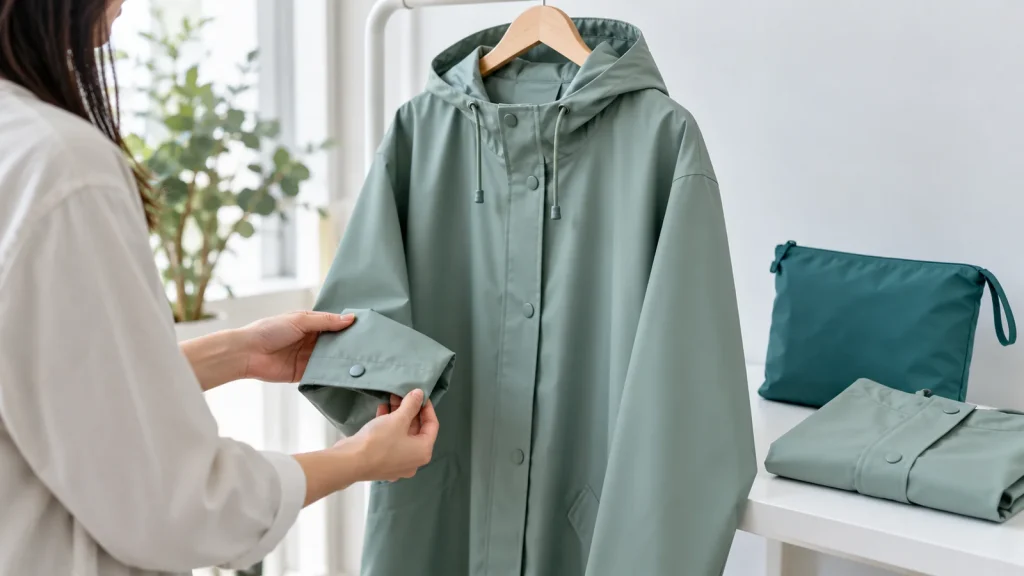
Understand EVA composition without treating it as a performance grade
EVA stands for ethylene-vinyl acetate. The name identifies a copolymer family, but it does not specify the complete behaviour of a raincoat. Technical guidance from resin producers describes differences between grades, including composition and processing characteristics. For a wholesale buyer, the useful conclusion is straightforward: two products described as EVA may use different material specifications. A familiar label can help you organise the shortlist, but you still need to review the proposed film, garment construction and evidence before approving an order.
Start by asking what the supplier means by EVA in the quotation. Is that the declared principal material of the garment film, and how is the finished construction described? Are separate components made from other materials? A pouch, snap, label or printed area should not disappear from the specification simply because the main body has an EVA description. Record the components that affect your purchase requirements, particularly where a claim or destination-specific requirement applies to more than the main film alone.
Avoid requesting a technical number merely because it appears in a resin brochure. For example, a formulation detail is useful only if it helps your team control a relevant property or identify the approved material. Ask your supplier to explain which product attributes it can specify and verify. Procurement may gain more from an agreed thickness range, sample reference and finished-garment inspection than from a composition figure that nobody has connected to an acceptance decision. Technical detail should make the order clearer, not simply longer.
Softness and flexibility are common reasons buyers consider EVA rainwear, but those impressions should be assessed on the actual proposal. Ask reviewers to handle the sample, unfold it and wear it over the intended clothing. Compare like with like: the same size, similar temperature and a consistent review process. Record the observations in plain language. If one sample is easier to fold or feels less restrictive at the elbow, describe that finding without turning a subjective preference into an unsupported numerical material-performance claim.
Transparency, colour and surface finish also deserve separate decisions. A translucent garment may reveal clothing or printed material beneath it, while a more opaque proposal presents a different appearance. Ask to see the chosen colour and print on a representative sample rather than relying entirely on a screen image. A colour name can be a useful reference during discussion, but the approved physical standard and any agreed tolerances should govern production. This is especially helpful when your brand team and procurement team review samples at different times.
Keep environmental and chemical descriptions out of the material definition unless they are independently supported. EVA does not automatically mean biodegradable, compostable, universally recyclable or suitable for every destination requirement. If such a claim matters to your programme, treat it as a separate evidence question tied to the finished product and intended market. The same discipline applies to statements about skin contact, odour or restricted substances. A comfortable feel or a familiar material name is not a substitute for relevant documentation.
Your final material shortlist should therefore describe EVA as one candidate construction with defined attributes. Note what the sample demonstrates, what the supplier has declared and what remains to be confirmed. That separation helps commercial discussions move forward without overstating certainty. It also makes a later material change easier to assess: the team can compare the proposed replacement against the approved attributes and decide which checks must be repeated, instead of assuming that any product carrying the same polymer label is an equivalent substitute.
Review drape, closures and reinforcement on a complete sample
A flat EVA swatch gives you a useful first impression, but the finished garment reveals how the material interacts with the pattern and components. Begin with a sample in the proposed size, including the intended hood, front opening, sleeves or side closures. Ask whether every component represents the bulk version. Where a sample uses temporary snaps or a different pouch, mark those differences clearly. An early development sample can support a design decision without being sufficient for final production approval.
Drape is best reviewed on a wearer as well as on a hanger. Check where the garment rests across the shoulders, how the hood sits when the wearer turns their head, and whether the lower edge interferes with the movements required in the intended setting. Use the expected base layers and any ordinary bag that the product is meant to cover. A sample that looks generous on an empty hanger may behave differently over a jacket, and a longer cut may create a different handling experience when seated.
Closures should be assessed as a system. Review the snap or other fastener, the surrounding material, its position and the way users will open it. Ask for the supplier's proposed construction and any reinforcement details. During an ordinary usability review, note whether users understand how to release the closure without pulling unnecessarily on the surrounding film. Do not claim a measured pull strength unless an appropriate test has actually been performed and documented. Clear instructions and suitable construction both matter to the finished experience.
Look closely at transitions where the garment changes direction or connects to another component. These may include the hood join, sleeve connection, pocket edge or fastener area, depending on the design. Ask the technical reviewer to record the construction visible on the sample and compare it with the drawing. If the purchase specification requires a particular join or reinforcement, show where it applies. A broad instruction to improve durability is difficult to verify; an agreed construction detail gives the supplier and inspector a concrete reference.
Review the sample through the whole handling sequence: remove it from the pack, unfold it, put it on, use the closures, remove it and return it to the proposed storage format. Where repeat use is intended, discuss the appropriate care process before attempting it. Keep the trial within the manufacturer's instructions. The purpose is to identify practical obstacles and decide whether the product suits your programme, not to improvise an accelerated test that might damage a sample in ways unrelated to normal use.
For a hypothetical branded staff programme, the marketing team might favour a long printed panel while operations prefers easier access to an identification badge. Bring those requirements into the same sample review. A change in closure placement, panel dimensions or garment cut may resolve the conflict, but each change needs supplier confirmation. Record the approved artwork and construction together. Otherwise, a later print approval can accidentally refer to a garment version that the fit team has already rejected or asked to revise.
Conclude with a signed or otherwise controlled sample record that distinguishes accepted features from open actions. Photographs are useful for showing placement and shape, while the retained physical sample supports texture and handling comparisons. Include any unresolved points in the quotation review so they cannot be overlooked when the order is released. This approach makes EVA rainwear procurement more predictable: the decision rests on a complete, reviewed garment rather than on the assumption that a flexible material will automatically solve every design, handling or service-life concern.
Plan care and repeat use around verified product instructions
Calling a garment reusable is only the beginning of a repeat-use programme. Buyers also need to know how it should be cleaned, dried, stored and inspected between uses. Request instructions for the exact proposed product, including any limitations associated with decoration, closures or accessories. Do not borrow care directions from another EVA raincoat with a similar appearance. The complete construction determines which instructions are appropriate, and a change in printing or components may affect the guidance that should accompany the finished item.
Decide who will be responsible after the garment is issued. A recipient who keeps a branded raincoat has a different experience from an organisation that collects, checks and reissues shared stock. In the first case, instructions should be clear enough for the recipient to follow. In the second, the organisation needs space, staff time and a practical process for handling returned garments. Procurement should confirm that process before treating expected reuse as an established benefit in an internal business case or external promotional claim.
Ask the supplier about drying and storage in terms relevant to your operation. Will staff have a suitable place to let garments dry according to the product guidance? Can the chosen pouch accommodate the approved folding arrangement? How will the team distinguish stock ready for issue from items awaiting inspection? These are operational questions, and their answers may influence the preferred garment and packing format. A reusable product does not create a functioning return system simply by being purchased in a larger quantity.
Set practical inspection criteria for the people managing stock. They should know what to do when a garment has a damaged closure, a compromised join, an unclear care label or another concern. Use the supplier's guidance and your own programme requirements to establish the decision process. Keep uncertain items out of the ready-to-issue stock until they are reviewed. Avoid promising a fixed number of uses unless that statement has relevant evidence and clearly defined conditions; individual handling and the actual use environment can vary.
If decoration must remain presentable through the intended care process, include that requirement in sample development. Review the printed sample before and after the agreed procedure, recording the method and observations. A simple visual check may be useful for an internal approval, but describe it accurately and distinguish it from a standardised test report. Where a formal durability requirement is necessary, agree the appropriate method and acceptance criteria with qualified technical support. The claim should match the evidence, including its limitations.
Consider how replacement orders will fit the programme. A later batch should not quietly arrive with a different pouch, closure or care instruction if those details affect the way staff manage stock. Keep the approved version and change history with the purchasing record. Ask the supplier to flag proposed substitutions early enough for review. That makes replenishment easier for both sides and reduces the chance that a small component change creates confusion across stock issued at different events or stored in different locations.
Finally, use realistic language in your commercial brief. State that the organisation is evaluating an EVA rainwear option for a defined repeat-use arrangement, then list the care, handling and sample requirements that support that plan. Request Bulk Pricing and MOQ for the agreed configuration, including any instructions or packing needed. This produces a more useful proposal than asking for the most durable EVA raincoat without defining the service. The aim is a product and operating process that work together, with any public claims limited to what can actually be supported.
Technical references: Celanese EVA technical guide.
Review the EVA rain poncho product options alongside the sample and care requirements in your brief. For the wider operating decision, read our disposable versus reusable rainwear comparison.
04 / 12
PVC raincoats: review the formulation and the garment system
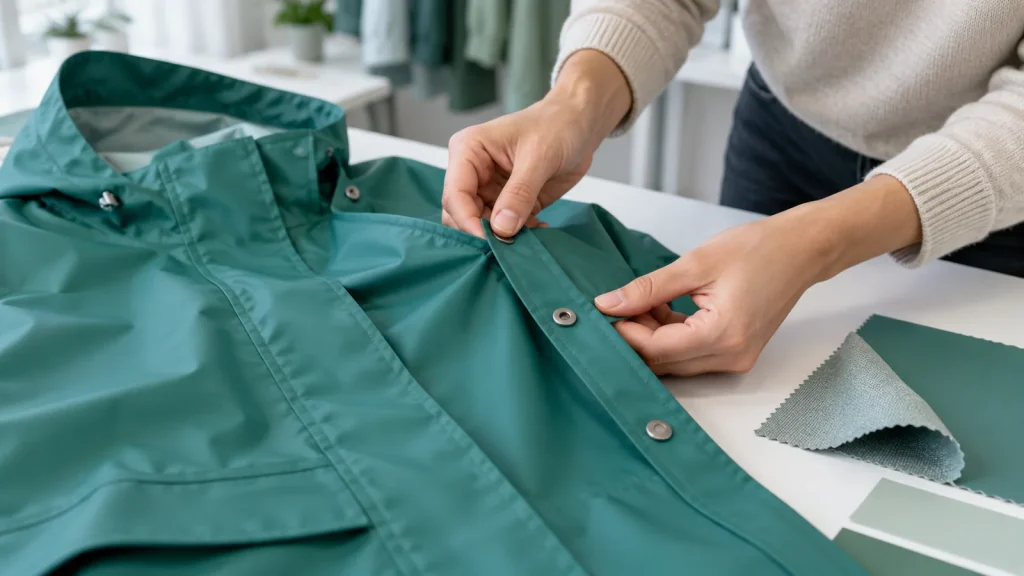
Distinguish flexible PVC film from PVC-coated textile
PVC, also called vinyl, can appear in different rainwear constructions. A flexible film garment and a textile carrying a PVC coating should not be treated as the same product simply because both descriptions contain PVC. Ask which construction the supplier is proposing and request a cross-sectional description in ordinary language: what forms the main body, whether a textile substrate is present, and which additional layers or components are included. That answer establishes the basis for a meaningful technical and commercial comparison.
For a film-based product, the specification may focus on the film, its thickness, surface, colour and joining arrangement. For a coated textile, the fabric substrate and coating need separate attention. Record the textile identity and relevant construction details, then clarify whether a quoted mass or thickness refers to the substrate, the coating or the complete assembly. Without that distinction, two proposals can appear numerically similar while describing different things. Ask the supplier to resolve the ambiguity before the figures enter your comparison sheet.
The substrate can also affect how you review the finished garment. A textile-backed construction may present a different feel and folding behaviour from an unsupported film, but do not assume the direction or magnitude of every difference. Handle the proposed samples and compare the attributes relevant to the wearer. Record the garment size, assembly and conditions of the review. The practical question is whether this construction meets your brief, rather than whether one broad material category deserves a universal durability ranking.
Pay attention to joins and any areas where components meet. Ask the supplier how the proposed construction is assembled and which details are intended to resist water entry. A photograph of a smooth outer surface does not reveal the complete join. Review the inside where possible and request a drawing or sample detail if an important feature is difficult to see. The garment's hood, front opening, sleeves and closures should be considered alongside the main material rather than approved as an afterthought.
When comparing PVC raincoat manufacturers, use a consistent request for information. Give each supplier the same wearer group, quantity range, intended use, size requirements and destination. Invite the supplier to propose a construction and explain its deviations from your starting brief. This creates room for useful technical recommendations without losing comparability. A proposal for a coated textile may be worth considering, but it should be labelled as an alternative when your original request specified a film garment with a different packing requirement.
Review the appearance of the full construction as well. Surface sheen, colour, backing visibility and the way the garment folds can influence the final presentation. If the raincoat is part of a corporate programme, show the sample to the people responsible for brand approval and practical use. Agree which appearance features are controlled and which variations are acceptable. A retained sample can help communicate those decisions, provided it is identified and linked to the written specification rather than kept as an anonymous reference in a cupboard.
The resulting buying description should be precise enough that another team member can distinguish the approved product from a superficially similar one. Include the main material system, garment design, joins, closures, decoration and packing. Keep any unresolved detail visible until it has been agreed. This makes Bulk Pricing discussions more productive because bidders are responding to a defined construction, and it gives your receiving team a clearer basis for checking whether the delivered rainwear matches the version that procurement and the wearer group actually approved.
Ask focused questions about additives and destination requirements
Flexible PVC relies on formulation choices, including the use of plasticisers. That fact is a reason to ask focused questions, not to make an automatic judgement about every PVC garment. Requirements depend on the substances involved, the article and the destination market. Begin with the actual product and intended use, then ask your compliance specialist or qualified testing partner to identify the relevant scope. Procurement should avoid replacing that assessment with a broad request for a certificate saying that the material is completely safe.
Provide the supplier with the destinations in which the finished rainwear will be supplied. If an order will be split across several markets, say so before sample approval. Also identify the intended wearer group and any special contractual requirements from your customer. These details can affect the evidence requested for the product. A document prepared for a different article or market may still contain useful information, but its existence alone does not establish that your order meets every requirement applicable to the planned distribution.
Ask what components the available evidence covers. The main film or coating may be only one part of the finished garment. Printed decoration, fasteners, labels and other components can introduce separate questions. A report should identify the tested sample and the relevant scope clearly enough for your reviewer to understand its relationship to the proposal. If the artwork, colour or material system changes, ask whether the existing evidence remains applicable or whether an updated assessment is needed before the revised version is approved.
ECHA's information on phthalates explains that restrictions apply to specified substances in relevant products, including certain clothing and other articles. It does not support a blanket statement that all PVC rainwear is compliant or non-compliant. Keep public wording specific and supported. If a supplier uses a phrase such as phthalate-free, ask how it is defined, which substances are covered, what evidence supports it and whether the description applies to the complete proposed product. Marketing shorthand should not outrun the underlying documentation.
Review declarations and test reports with someone able to interpret them. Check the issuing organisation, date, sample identity, methods, reported findings and any limitations. Where a document cannot be connected to the proposed garment, request clarification instead of assuming equivalence. A supplier may have legitimate evidence for a related product while still needing to provide more information about your variant. Record the question and the response so that the final purchase decision is based on a traceable review rather than an informal reassurance during a sales call.
Do not use smell, softness or colour as a compliance test. These observations may be relevant to acceptance or wearer experience, and unusual findings should be investigated, but they cannot replace appropriate chemical evidence. Similarly, the absence of a particular substance claim does not by itself establish a problem. The useful procurement task is to define the requirement, obtain suitable information and resolve gaps with the supplier and technical reviewer. That process is more reliable than treating a sensory impression as proof of either safety or risk.
Before releasing the order, connect the approved evidence to change control. Ask the supplier to notify you if a relevant formulation, component source, print system or construction changes. Decide how such a change will be reviewed and who can authorise it. Keep the evidence record accessible to the people managing repeat orders. This protects the integrity of your original approval and prevents a familiar product name from becoming a shortcut around the destination-specific checks that made the first procurement decision defensible.
Assess construction, handling and storage before a bulk commitment
Once the PVC material system is clear, assess how the proposed garment will move through your operation. Start with the packed sample and work forward: receipt, storage, issue, wearing, removal and any planned return. Note where the product will be handled and by whom. This sequence often reveals requirements that do not appear in a material comparison chart, such as the need for a clear pack label, a manageable carton arrangement or a storage pouch that matches the garment's actual folded size.
Review garment mass and flexibility in the intended context. A heavier-feeling sample may be acceptable for one programme and inconvenient for another, but the observation needs to be connected to the user and task. Ask representative wearers to try the proposed size over their normal layers. Check movement, coverage and access to any ordinary items they need to carry. Record what happened rather than assigning a general comfort score with no explanation. The notes should help the supplier understand what needs adjusting if the sample is unsuitable.
Inspect the details that users touch repeatedly. A closure, pocket opening or hood adjustment may influence the experience as much as the main material. Where those features are present, confirm their construction and ask for appropriate operating instructions. If the garment is intended for an assessed industrial task, involve the responsible safety team and keep relevant protective requirements separate from ordinary weather protection. A substantial-looking PVC raincoat should never be treated as proof that a particular workplace protection requirement has been met.
Storage conditions should come from the supplier's guidance for the exact product. Ask about the recommended environment, folding arrangement and precautions relevant to the material, print and components. Share the conditions you can realistically provide, including whether stock will be held for a later season. If your warehouse or distribution route creates a concern, discuss it before ordering. Do not promise a fixed shelf life based only on the polymer name, and do not assume that instructions for a different coated garment apply automatically.
Packing trials are especially useful when the garment will be issued through multiple locations. Check whether staff can identify sizes and variants without opening every individual pack. Confirm the carton count, dimensions and gross mass of the proposed arrangement, then compare them with your receiving and storage process. If the supplier suggests a different folding method to meet the packing brief, review the result on the actual decorated garment. A change that improves carton use should still preserve an acceptable product presentation and practical opening process.
Include a straightforward route for handling discrepancies. Decide who reviews incoming concerns, what information should be recorded and how affected stock will be separated while a decision is made. A clear photograph, batch reference and description of the observed issue help the supplier respond. Keep the approved sample and specification available for comparison. This is not a promise that every future problem can be prevented; it is a way to make decisions faster and more consistent when a delivered product differs from the agreed reference.
Finally, treat sample approval as a gate in the bulk-order plan. Confirm the construction, fit, appearance, handling, packing and relevant documentation before authorising the next commercial milestone. Ask for the MOQ and timing implications of any requested change rather than assuming that a revised feature can be added without consequence. A well-defined PVC rainwear order gives both buyer and supplier a practical reference for production, inspection and replenishment, while leaving specialist performance and compliance claims tied to the evidence that actually supports them.
Technical references: Vinyl Council material overview, Vinyl Council plasticisers overview, ECHA phthalates information.
Use the PVC rain poncho collection as a starting point for a product-specific enquiry. Ask for the exact construction and relevant destination evidence before approval.
05 / 12
Polyester rainwear: specify the textile, coating and membrane separately
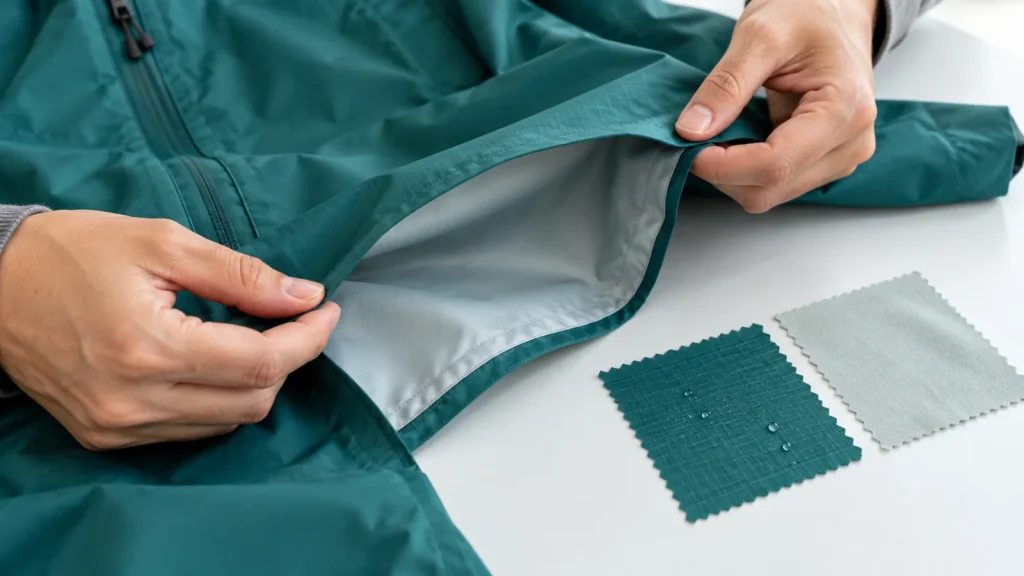
Read the layer structure behind a polyester product description
Polyester describes a fibre used in textiles; it does not, by itself, describe a complete waterproof rainwear system. A proposal may combine a polyester face fabric with a coating, a membrane, a lining or other layers. Ask for each part to be identified separately. The answer should explain what you are buying in terms of construction, not simply repeat the word waterproof. This is the starting point for comparing polyester rainwear with film-based PE, EVA or PVC proposals on a useful basis.
Request a simple layer diagram or written sequence from the outside of the garment inward. Identify the face textile, the water-barrier element where present, and any backing or lining. Ask which layers are bonded together and which are separate garment components. You do not need an elaborate technical drawing to begin the discussion. A clear description linked to a swatch and finished sample can expose misunderstandings that would remain hidden in a quotation listing only a fibre percentage and a garment photograph.
Keep fibre composition distinct from the composition of the complete assembly. A statement about the face fabric should not automatically be read as a statement about coatings, membranes, thread, closures or trims. If your customer needs a composition declaration or an environmental claim, clarify exactly which part it describes. This matters particularly when comparing a textile-based raincoat with a film garment: the two descriptions may be written at different levels of detail. Align that detail before drawing conclusions about suitability or material content.
A supplier may refer to two-layer, three-layer or another construction format. Ask what the term means in that specific proposal rather than assuming all suppliers use it identically. Have the technical reviewer connect the description to the sample and the intended care guidance. Branded membrane systems, such as those described in Toray's technical information, illustrate how a textile and barrier can form a combined system. They do not establish that a particular supplier uses that system or offers its published performance.
Look at the garment inside as well as outside. A lining, backing surface or exposed internal construction can affect the wearing experience, packing and access for inspection. Note how the sleeves, hood and openings are finished. If the sample includes a feature that is optional in the quotation, make that distinction visible. Procurement should not approve the feel of a lined sample and then accept an unlined bulk proposal on the assumption that both versions are equivalent because their face fabrics share a polyester description.
Ask which attributes are controlled at the textile level and which at the garment level. Textile mass per unit area, weave details and barrier construction may belong in a material specification, while finished dimensions, pocket placement and seam treatment belong in the garment specification. Keep them connected through the sample code and revision. This makes it easier to investigate a mismatch later. A fit concern and a fabric concern may need different corrective actions even when they appear on the same physical sample.
The final construction record should allow your team to follow the product from fibre description to finished raincoat without filling gaps with assumptions. Include the proposed layers, relevant material attributes, garment design and any evidence requested for performance claims. Then use that record to compare alternatives and discuss MOQ or OEM Program changes. A polyester rainwear proposal becomes much more useful when it explains the complete system that the wearer will receive, rather than asking the buyer to infer waterproofing, comfort or service life from the fibre name.
Separate water repellency from the water barrier
A photograph of droplets on a fabric surface can be visually persuasive, but it does not tell you everything about rain protection. Surface water repellency and resistance to water passing through a material are different questions. Ask which property a supplier is describing and what evidence supports it. The distinction matters when buying polyester rainwear because the face textile, its surface treatment and the underlying barrier may each play a different role in the complete construction proposed for your order.
Begin with the claim wording. If a proposal says water-repellent, ask what that means for the intended product and how it has been assessed. If it says waterproof, ask for the relevant material evidence and the garment details that support the intended use. Avoid treating either word as a complete specification. The buyer and supplier need a shared understanding of the requirement, including any test method, sample condition and acceptance criteria that will be used to support the final description.
Consider a hypothetical sample meeting in which one swatch sheds visible droplets and another has a less dramatic surface appearance. That observation alone cannot establish which finished garment better suits a prolonged outdoor assignment. The team still needs to know the barrier construction, seams, openings, fit and relevant test evidence. A visual demonstration can start a conversation, but it should not become a substitute for the agreed evaluation. Record what was actually observed and keep broader conclusions open until the appropriate information has been reviewed.
Ask how the proposed product should be cared for and how that guidance relates to its surface and barrier components. Do not recommend a treatment, washing process or restoration product unless it is appropriate for the exact garment and supported by its instructions. If your programme requires a particular cleaning routine, tell the supplier before choosing the construction. A material system that cannot accommodate the operation's actual care process may be a poor fit even if its initial sample appearance is attractive.
Review the print or branding area as part of the same conversation. The surface that accepts a decoration process is also part of the garment's material system. Ask the supplier to confirm that the proposed printing method is suitable and to identify any relevant limitations. Check the decorated sample after the agreed handling or care procedure. Do not assume that a successful result on an undecorated fabric swatch proves that every printed version will behave identically under the same conditions.
For procurement documentation, give the different attributes separate lines. One line can record the surface description and any agreed evaluation; another can record the barrier construction and material performance evidence; additional lines can cover seams, openings and care. This prevents a strong result in one area from concealing a missing requirement elsewhere. It also helps commercial teams compare proposals without reducing a complex construction to an attractive photograph or a single marketing phrase that different suppliers may interpret differently.
The buying decision should come back to the wearer and the service. Decide what level of evidence is proportionate to the intended use, obtain qualified technical input where needed, and keep claims aligned with the approved product. A polyester raincoat is a combination of materials and design choices. Separating surface behaviour from the water barrier makes those choices easier to discuss and helps your team explain why one proposal meets the brief while another requires more information or a different construction.
Compare textile constructions through samples and measurable attributes
Textile specifications often contain several numbers that look easy to rank. Fabric mass, yarn linear density and thread construction can all be useful, but each describes something different. Ask what a value represents before using it to choose a product. Denier or dtex describes yarn linear density; it is not a waterproof rating. A mass stated in grams per square metre also needs a defined basis, particularly when a proposal includes a coating, membrane or other layers in addition to the face textile.
Build a comparison sheet with one column for the attribute and another for the part of the product it describes. For example, distinguish face-fabric mass from complete-assembly mass and finished-garment mass. If a supplier cannot provide a value at the stage of enquiry, mark it as unconfirmed rather than entering an assumed figure. That visible gap gives the team a useful follow-up question and prevents an apparently complete spreadsheet from creating confidence that the available information does not yet justify.
Use swatches to review texture and appearance, then move to a finished sample for the wearing assessment. A fine-looking swatch can become a garment with an unsuitable cut, and an acceptable garment shape can still use a surface that your brand team dislikes. Ask reviewers to separate those observations. Record whether a concern relates to material feel, colour, drape, noise, fit or construction. Clear categories help the supplier propose a targeted adjustment instead of changing several variables at once and making the next comparison harder.
Where a specification includes a weave or surface structure, confirm how it relates to the proposed bulk fabric. A visible grid or textured finish should not be used to infer a particular tear resistance or service life without supporting evidence. If resistance to a specific kind of damage matters to the brief, define that need with the technical team and agree an appropriate evaluation. Appearance can identify a construction feature, but it cannot establish every performance property associated with similar-looking outdoor fabrics.
Review consistency across colours and sizes where relevant. A sample in one colour can establish part of the design, but it may not answer every question about another variant's appearance or documentation. Ask which parts of the approval can be shared and which require separate review. The same applies when a supplier offers an alternative fabric because of availability or MOQ. Treat the alternative as a documented option, with its own sample and relevant evidence, rather than accepting a verbal assurance that it is essentially the same.
Ask for a clear account of the commercial implications of each construction. A different lining, barrier system or textile specification may affect the proposed MOQ, sampling steps, production timing and packing arrangement. Compare those implications alongside the technical findings. Bulk Pricing becomes more meaningful when the offer states exactly which construction and quantity mix it covers. Keep the approved sample and the final quotation aligned so that a commercially attractive revision does not quietly remove a feature that the wearer review considered necessary.
Your aim is a shortlist that can survive a handover between marketing, procurement, quality and operations. Each team should be able to identify the proposed textile system, understand the relevant measurements and see why the finished sample was accepted or rejected. That level of clarity supports a better polyester rainwear order without requiring every buyer to become a textile scientist. The technical details earn their place by helping the team compare real proposals, resolve uncertainty and control the product that eventually arrives.
Technical references: Toray Dermizax construction examples.
Explore polyester rainwear options and request a complete layer description for the proposed garment.
06 / 12
Read waterproof and breathability evidence without mixing test methods

Connect hydrostatic results to the tested specimen and method
A waterproof figure becomes useful when you can connect it to the specimen, method and conditions behind the result. ISO 811:2018 describes a hydrostatic-pressure method for assessing textile resistance to water penetration. A result from that method is evidence about the tested material under the reported conditions. It is not, on its own, a certification that every seam, opening and component of a finished raincoat will keep every wearer dry in every situation. Keep that boundary clear in purchasing and public claims.
Start a report review with sample identity. Does the document identify the same material construction, colour or relevant variant being proposed for your order? Can the supplier connect the report reference to the sample you are holding? If that relationship is unclear, request a written explanation. A technically detailed report can still be unsuitable evidence for your purchase if it concerns a different construction. Resolving identity first avoids spending time comparing impressive results that may not apply to the actual garment under discussion.
Next, record the test method and edition, units, conditioning and any preparation described in the report. Ask your technical reviewer to explain unfamiliar terms rather than stripping them out of the comparison sheet. Those details can affect how a result should be interpreted and whether it can reasonably be compared with another result. Where two proposals use different methods or conditions, keep them separate until a qualified reviewer has established an appropriate basis for comparison. Do not create a simple ranking from unlike numbers.
Check whether the reported result represents a new material specimen or a specimen after an identified treatment. If your specification requires evaluation after a particular care or conditioning process, the evidence should reflect that requirement. Do not assume that an initial result also describes the material after repeated handling or cleaning. Equally, do not invent a deterioration rate. The appropriate response to a missing condition is to identify the evidence gap and agree how it will be addressed for the proposed product.
Agree the acceptance requirement before testing or final sample approval where practical. A buyer who receives a number without a defined decision rule may struggle to decide whether it is sufficient. Work with the technical team to connect the requirement to intended use, relevant standards and customer obligations. Avoid selecting a threshold simply because it appears on a competitor's product page. That page may describe a different construction, use case or method, and copying its figure does not establish that it is suitable for your order.
Keep the original report accessible alongside the summary. A procurement spreadsheet can record the key result, but it should also include the report reference, sample code and review status. If the reviewer raises a qualification, preserve it rather than reducing the entry to a green tick. This is particularly valuable when a project changes hands or moves into a repeat-order phase. The next buyer can understand what was actually accepted and which assumptions or limitations were part of the original decision.
Finally, use careful wording when the evidence moves into a customer-facing description. State a supported material result only with the context needed to avoid misleading readers, and do not imply a broader certification that has not been established. The strongest buying position is not the largest number in a quotation. It is a traceable relationship between the proposed product, an appropriate evaluation, the agreed acceptance requirement and the claims your organisation intends to make about the rainwear it supplies.
Compare water-vapour data with its conditions and limitations
Breathability is often used as a broad marketing term, so begin by asking which property and method a proposal refers to. ISO 11092:2026 addresses thermal and water-vapour resistance under steady-state conditions. The current edition was published in 2026, replacing the earlier edition. Its results describe specified laboratory measurements; they do not directly predict every wearer's comfort during an event or shift. Record the method and edition stated in the actual report instead of silently updating an older report's reference to the newer standard.
Different water-vapour methods can report different quantities and units. A value described as water-vapour resistance should not be placed in the same ranking column as a moisture-vapour transmission figure without technical interpretation. Ask the supplier to provide the complete method reference and relevant conditions. If one proposal offers only the word breathable, mark the supporting evidence as unresolved. A shared adjective does not make two constructions comparable, and a large or small number has little meaning until the team knows what was measured.
Connect the evidence to the tested assembly. Was the specimen the face textile alone, a coated fabric, a laminate or another arrangement? Does that match the material system in the proposed garment? The layer description developed earlier in the buying process helps answer these questions. If the construction has changed since the reported test, ask whether the evidence remains relevant. Do not assume that adding a layer, changing a backing or substituting a component leaves every reported property unchanged.
Discuss the wearing assignment separately from the laboratory result. Activity level, weather, clothing layers, garment fit and ventilation features all belong in the practical comfort review. A stationary visitor waiting briefly under cover has different needs from staff moving equipment for an extended period. Write those differences into the brief. This does not mean a laboratory report is unhelpful; it means the report answers a defined technical question while the wearer trial addresses additional questions about the finished product in the planned setting.
Be especially careful when comparing a closed film garment with a textile system that includes a specified barrier and ventilation features. Do not label a PE, EVA or PVC poncho breathable simply because the cut is loose, and do not assume every polyester raincoat has a documented breathable construction. Material transport properties and garment openings are distinct. Ask the supplier to describe both accurately, then decide which combination meets your operational needs. Clear language prevents a useful design feature from turning into an unsupported material claim.
If comfort is a significant procurement requirement, plan a structured wearer review with appropriate technical support. Give reviewers the same task, record relevant conditions and ask specific questions about restriction, heat, moisture sensation and ease of adjustment. Treat the findings as observations from that review, with its limitations, rather than a universal comfort guarantee. Where specialist protective clothing requirements apply, involve the responsible safety team. A general buying guide cannot select a protective performance level for an unassessed workplace or substitute for the relevant assessment.
Summarise the decision in two parts: the available material evidence and the practical garment findings. This lets procurement explain why a proposal remains on the shortlist even when another product has a different laboratory figure, or why more information is needed before approval. Keep the original units, method references and qualifications intact. A disciplined comparison of water-vapour evidence helps buyers ask better questions and communicate more accurately without pretending that one isolated breathability number can settle the whole rainwear selection.
Review seams, openings and wear alongside laboratory evidence
Rainwear performance depends on more than a sheet of material. The hood opening, front closure, sleeves, seams and overall fit shape how the garment works when worn. Once the material evidence is understood, inspect the complete construction with those features in mind. Ask the supplier to identify the proposed joining methods and any seam treatment. Where a feature is important to the purchase, include it in the drawing or specification so that the bulk version can be checked against an agreed reference.
Use the sample to understand how the garment directs and covers ordinary exposure in the intended setting. Review the relationship between the hood and collar, the front opening and any cover flap, and the sleeve ends and underlying clothing. Keep observations descriptive. If a concern appears during a practical trial, record where it occurred and under what circumstances. Do not assign the cause automatically to the main material; a fit issue, opening design or construction detail may require a different response from the supplier.
Check mobility before finalising dimensions. Ask representative wearers to turn their heads, reach, sit or perform other ordinary movements relevant to the programme. A garment that covers well while standing still may expose a different area during movement. Record the intended clothing layers and size used in the review. This helps the pattern or product team interpret the findings and propose adjustments. It also prevents a later discussion about material performance from becoming confused with a problem caused by an unsuitable size or cut.
Where an agreed evaluation involves water exposure, define its purpose and limits with the appropriate technical support. A controlled garment assessment and a casual demonstration are not interchangeable. Do not turn an informal spray or wear trial into a certification claim. If the customer requires a particular standard or performance classification, confirm the applicable product scope and evidence before purchase. The supplier should understand whether you are requesting a developmental check, an internal acceptance review or evidence needed for a formal product requirement.
Consider how handling and care will be represented in the approval process. The proposed garment may be folded, packed, decorated and cleaned before later use. Identify the steps that matter to the programme and agree suitable checks for them. If a new print method or closure is introduced after the main material has been approved, review the effect on the complete sample. A material report remains part of the evidence, but it cannot answer every question created by changes elsewhere in the finished product.
Define the limits of the product's intended use in the commercial brief. Visitor contingency rainwear, promotional gifts and assessed workwear programmes can require different levels of evaluation and documentation. Keep those purposes visible when comparing quotations. A supplier should not have to infer a demanding workplace application from a request that mentions only branded ponchos. Equally, a buyer should not add unsupported protective claims to a general promotional garment because its appearance resembles a more specialised product seen elsewhere.
Bring the findings together in a release decision that covers both material and garment. Record the accepted construction, fit, relevant evidence, artwork, packing and any remaining conditions. Give the final approval to the exact version intended for bulk production. This balanced review makes technical evidence useful without asking it to prove more than it does. Procurement can then explain that the order was selected through a defined process, while the public description remains aligned with the product and the evidence actually available.
Technical references: ISO 811:2018, ISO 11092:2026.
07 / 12
Match rainwear materials to climate, movement and wearer comfort

Build a climate brief around actual exposure and activity
A climate brief should describe the assignment in terms the supplier can use. Start with where the rainwear will be worn, the expected season, the likely duration of outdoor exposure and the activity involved. Then identify the clothing normally worn underneath and whether people can move into shelter. These details are more useful than asking for a raincoat suitable for all weather. They help the supplier propose a construction and help your team decide which features and evidence deserve the most attention.
Distinguish local expectations from confirmed operating conditions. A festival organiser may know the event dates and venue but still face uncertain weather. A site manager may know the work pattern but need a formal assessment of the protective clothing required. Record what is known and what needs specialist input. Avoid making a material decision from a broad climate label alone. A warm location can include different activities, exposure periods and indoor transitions, while a cooler setting can involve substantial physical movement.
Ask how long the garment is likely to remain on the wearer. A short walk between covered areas creates a different comfort and handling brief from several hours of outdoor duties. Consider whether people need frequent access to pockets, identification, communication equipment or bags. Describe the ordinary items involved without assuming that a general raincoat is suitable around every machine or workplace hazard. Where a safety assessment is required, the responsible team should define the relevant requirements before procurement selects a garment design.
Temperature and activity should be discussed together. A buyer comparing PE, EVA, PVC and polyester rainwear should not assume that a particular material name settles comfort in either warm or cool conditions. The complete construction, fit, openings and clothing system matter to the wearer. Ask the supplier to explain its proposed design and provide relevant evidence for any performance claim. Then include representative conditions in the practical review where feasible, documenting the limits of that review rather than treating it as a universal prediction.
Consider transitions during the day. Event staff may move between outdoor queues and indoor rooms, while visitors may put a poncho on only when rain begins. The ease of removing, carrying and storing the garment can therefore affect whether the product suits the programme. Review the proposed pouch or folded format as part of the brief. A material system selected only for its worn appearance may prove inconvenient when users spend much of their time carrying it or handling a damp garment after use.
For a hypothetical coastal event, procurement might separate the needs of seated guests from those of a mobile operations team. Guests may prioritise straightforward issue and coverage over ordinary clothing, while staff may need a more detailed fit and movement review. That does not establish a predetermined material choice for either group. It creates two clear briefs against which samples can be assessed. The supplier can then explain suitable options and the commercial implications without pretending that one garment must satisfy every role equally well.
Finish the climate brief with the decisions it is meant to support. List the wearer groups, exposure pattern, movement needs, clothing layers and evidence requirements, then identify the people responsible for reviewing them. Keep the document short enough to be used during sampling and quotation review. A focused brief makes discussions about lightweight rainwear materials more productive because it turns general weather concerns into concrete product questions, while leaving specialist safety and performance decisions with the people qualified to make them for the actual setting.
Compare fit, noise, drape and packability in a practical trial
Practical trials are most useful when reviewers know what they are comparing. Select samples that represent the proposed construction and identify each one clearly. Use the same basic sequence for every sample: open the pack, put the garment on over the intended clothing, perform relevant movements, remove it and return it to the proposed storage format. This creates a consistent set of observations. It also prevents a particularly attractive colour or presentation from dominating a review that is supposed to assess several functional attributes.
Fit should be described through specific points and movements. Record the size, shoulder and body coverage, sleeve position where relevant, and the way the hood behaves when the wearer looks to either side. Note whether the garment is intended to cover an ordinary bag or only clothing. If the review involves different body sizes, keep those observations separate. A statement that the sample fits everyone is unlikely to be a useful buying specification; defined dimensions and a representative size review provide a clearer basis for approval.
Drape and surface feel can affect perceived comfort and appearance, but they are subjective observations. Ask reviewers to describe what they notice: stiffness at a fold, restriction at an elbow, a surface that clings to an underlying layer, or a shape that sits away from the body. Avoid converting those comments into material-science claims without evidence. The observations can still guide development. A supplier may be able to adjust the cut, construction or packing arrangement, and the revised sample can then be reviewed against the original concern.
Noise is another feature worth discussing when the use case makes it relevant. A garment worn by staff in a quiet visitor setting may be judged differently from one issued at a busy outdoor concert. Ask reviewers to move normally and note whether sound affects the intended task. Do not publish a claim that one polymer is always quieter than another based on a small informal comparison. Keep the finding attached to the specific samples and conditions, and use it to decide whether further development is needed.
Packability should include the user's effort, not just the initial factory fold. Check whether the garment can be returned to the proposed pouch using the intended instructions and reasonable handling. If staff will repack collected stock, ask them to try the process. If recipients keep the garment, consider whether the pack remains useful after opening. Record the dimensions of the packed sample, but also note practical difficulties. A compact presentation that requires unfamiliar folding steps may need clearer instructions or a different pouch arrangement.
Separate observations from priorities when the team meets to decide. One reviewer may prefer a softer feel while another values a smaller pack. The brief should explain which attributes matter most for this programme and which are negotiable. Discuss trade-offs openly with the supplier rather than asking for every preferred feature without considering the resulting construction, MOQ or timing. A weighted decision can be useful internally, provided the weighting reflects actual programme needs and is not presented as an objective ranking of all rainwear materials.
Keep the trial record with photographs, sample references and the final decision. Note the limits: who participated, which sizes were reviewed and what conditions were represented. Those details make the findings more useful for later orders and help prevent overstatement. The purpose of the trial is to choose and refine a product for a defined use, not to produce a sweeping verdict on PE, EVA, PVC or polyester. A consistent process gives your team a practical, human-centred basis for the next procurement step.
Create separate specifications when user groups need different products
One bulk order does not have to mean one identical garment for every user. An organisation may have visitor contingency stock, branded gifts and staff rainwear within the same programme. Before choosing a material, map those groups and identify the requirements that differ. This can reveal where a shared product is sensible and where separate specifications would produce a clearer result. The aim is not unnecessary variety; it is to avoid forcing incompatible needs into a single proposal that satisfies none of them particularly well.
Start with the role and issue process for each group. Visitors may receive an individually packed item at a counter, while staff may use assigned garments stored between shifts. A promotional recipient may keep the product and its pouch. Record the expected use pattern without promising a fixed service life. Then identify the attributes each group needs: size range, coverage, decoration, care guidance, packing and any relevant performance or compliance evidence. Use those requirements to define the shortlist before comparing the commercial offers.
Look for opportunities to share controlled elements without assuming the complete products are interchangeable. The same artwork family, colour reference or carton-label system may support several specifications. However, the print process and final appearance still need approval on each proposed material surface. A logo accepted on a clear film does not automatically establish an identical result on a textured polyester construction. Keep shared design assets organised while retaining separate sample and specification references for the finished products that use them.
Ask suppliers to show MOQ and quantity requirements by variant. A split programme can affect how an offer is structured, so discuss the quantity mix early. Request a proposal that identifies which features can be shared and where separate development or production steps are needed. Avoid combining unlike products into one average figure that conceals the configuration of each item. A transparent Bulk Pricing proposal lets procurement understand the scope while giving operations a clear view of what stock will arrive for each group.
Plan storage and distribution labels around the differences. If two garments look similar when packed but serve different roles, staff need a reliable way to select the correct one. Agree clear product codes, size identification and carton information appropriate to the programme. Review the labels on the actual packing sample. Do not rely solely on a colour distinction that may be difficult to interpret under poor lighting or that could change in a later order. The product record should remain understandable across locations and teams.
Keep specialist requirements visible. Industrial rainwear, children's products and general promotional garments may involve different assessment questions. Do not transfer evidence or claims from one specification to another simply because they belong to the same purchasing project. Ask the responsible technical or compliance reviewer to confirm the scope for each intended product. Where the organisation needs a separate specialist review, schedule it as part of procurement rather than discovering the need after artwork approval or bulk production has already begun.
The final programme can then use a simple matrix: wearer group, approved product reference, material system, issue method, care or return arrangement and reorder contact. That matrix helps operations manage stock and helps procurement maintain continuity. It also creates a sensible path for future changes: revise the specification that needs adjustment while preserving the others. A material strategy built around real user groups is easier to explain and maintain than a universal best-raincoat claim that ignores the different jobs your rainwear is expected to do.
For event programmes, Explore our Wholesale Festival Rain Poncho Collection Here. For assessed workwear requirements, use our industrial rainwear procurement guide to develop a separate brief with the responsible safety team.
08 / 12
Plan OEM printing and colour on PE, EVA, PVC and polyester

Choose a decoration process for the exact surface
The right printing discussion begins with the proposed material surface, not with a favourite decoration method. PE, EVA, flexible PVC and polyester constructions can present different surfaces, and products within each category can also differ. Give the supplier the exact garment reference, colour and artwork before asking for a recommendation. Request confirmation that the proposed process is suitable for that construction. A method that works on one sample should not be assumed to work identically on every raincoat carrying the same broad material label.
Ask the supplier to explain the proposed process in terms relevant to your approval. What artwork limitations, print area, colour choices and sample steps should the brand team consider? Which parts of the garment can be decorated without conflicting with seams, folds, closures or other features? Keep the discussion tied to the actual product. A general list of available printing services may be useful background, but your OEM Program needs a defined process and approved result for the specific version intended for bulk production.
Do not prescribe production temperatures, chemicals or surface-treatment recipes from a general guide. Those decisions require suitable expertise and knowledge of the exact material and equipment. Procurement's role is to communicate the required result and obtain a proposal with appropriate evidence. Ask how the supplier will assess appearance and any agreed handling or care performance. If a heat-based decoration method is proposed, confirm its suitability for the complete construction rather than assuming that a familiar transfer process can be applied to any film or coated fabric.
Provide artwork in the format requested by the supplier, with an identified revision and clear dimensions. Include the intended background colour and placement reference. If the design contains fine lines, gradients, multiple colours or a large solid area, ask whether adjustments are needed for the proposed process. Review those adjustments with the brand owner before sampling. This prevents a technical simplification made during production preparation from becoming an unexpected visual change when the first decorated sample reaches your marketing team.
For transparent rainwear, consider what sits behind the print. Clothing, folds and the opposite side of the garment can affect the apparent contrast. Ask for a sample that lets you review the artwork in a realistic worn position as well as flat on a table. A small printed swatch may establish part of the colour discussion, but it may not resolve final placement or visibility. Keep those approval stages distinct so that acceptance of an early print trial is not mistaken for approval of the complete garment.
Confirm how the decoration interacts with other requirements. If the order includes chemical documentation, a care claim or a material performance requirement, ask the technical reviewer whether the printed version needs additional evidence. Do not assume that documentation for an undecorated base product covers every ink, transfer or artwork variation. The supplier can help identify the relevant production details, while the responsible reviewer determines what is needed for the intended market and claim. Record the agreed scope before the order moves beyond sampling.
The result should be a decoration specification attached to the material and garment record. It should name the proposed process, artwork revision, location, dimensions, colour reference and acceptance checks. Request the associated MOQ and timing implications for that configuration. This gives your brand team a clear approval target and gives procurement a comparable commercial basis. It also avoids a common source of disappointment: a well-selected raincoat material arriving with decoration that was never properly reviewed on the exact surface and garment being purchased.
Approve colour, placement and artwork at production scale
A digital mock-up is a useful planning tool, but it cannot settle every question about colour or placement on rainwear. Screens, lighting, material transparency and surface texture can change the way a design appears. Agree which physical reference will govern approval and review a representative decorated sample. Where the project uses a brand colour standard, identify it clearly and ask the supplier what matching and tolerance approach is proposed for the chosen material and print process. Keep expectations specific and achievable.
Check the artwork at its intended finished size. A design that looks balanced in a small preview may become too dominant, too low or difficult to read when placed on a full garment. Include measurements from defined garment points so that the location can be reproduced. For example, a placement instruction should identify its reference point rather than relying on the phrase centred on the front. The clearer the drawing, the easier it is for the supplier and inspector to compare production with the approved sample.
Review the print while the garment is worn in a normal position. Folds, closures, sleeves and body movement can interrupt a design that looks continuous when the product is laid flat. Ask representative wearers to perform the movements relevant to the programme and note the appearance. This is especially useful for event branding where the sponsor wants a visible mark without obstructing practical garment features. If an adjustment is needed, revise the artwork or placement record and ensure the next sample uses the updated version.
Consider the relationship between garment colour and printed colour. A translucent base can make the background visible, while an opaque or textured surface presents a different visual context. Ask whether the proposed print system needs an additional step to achieve the intended appearance, and let the supplier explain the commercial and production implications. Do not assume that a colour approved on paper or another material will look identical on rainwear. The physical decorated sample should resolve the expectation for the exact proposal under review.
If the programme includes several sizes, decide whether artwork dimensions and placement remain fixed or change by size. Review the consequences on representative samples or appropriate production references. A design positioned acceptably on a larger garment may sit differently on a smaller version. Record the agreed rule in the artwork specification so that production staff do not have to infer it. The same discipline applies when the order contains several colourways or related designs that share part of the artwork but require separate approvals.
Control revisions carefully when multiple teams are involved. Marketing may update a logo, procurement may change the garment version, and the supplier may suggest a print adjustment. Give each final artwork file and sample a clear reference, and withdraw superseded approval instructions from the active order record without losing the history. Ask the supplier to confirm the version it will use. A brief final reconciliation can prevent an older mock-up or sample from being treated as the current production standard after the team has moved on.
Once approved, retain the physical sample or an agreed reference arrangement and record the conditions of approval. Identify any remaining actions, such as a separate packing review or documentation check. A colour approval should not silently become approval of every other product attribute. This focused approach makes the OEM branding process easier to manage and gives your team a concrete answer when someone asks what was agreed. The approved result is the combination of material, artwork, placement and process, not simply a logo file sent at the beginning of the project.
Check decoration after handling and the intended care process
Initial print appearance is one part of approval. The next question is whether the decoration remains suitable after the handling and care relevant to your programme. Define those conditions with the supplier and technical reviewer before deciding what evidence is needed. A promotional item opened once at an event and an assigned garment managed through a repeat-use process may require different evaluations. Avoid applying a generic durability promise to both simply because they use the same artwork or broad rainwear material category.
Start with the normal handling sequence. Review the decorated sample after packing, opening, unfolding and ordinary wearing movements. Look at areas where the design crosses a fold or sits near a closure. Record any observed change with photographs and the sample reference. A practical review can identify issues worth investigating, but it should be described accurately. Do not label it a standardised test unless an appropriate method has actually been followed and documented by the people responsible for that evaluation.
Where cleaning is intended, use the care instructions approved for the exact garment. Do not improvise a harsher process and then treat the result as a prediction of normal service, or use an unusually gentle process to support a broader claim. If your organisation requires a particular cleaning routine, disclose it during development so the supplier can assess suitability. Keep the agreed procedure and any acceptance criteria with the sample record. This allows the team to understand what the review does and does not demonstrate.
Ask how the decoration evidence relates to the bulk version. A sample printed on a different material, colour or process may establish an early design direction without proving suitability of the final proposal. Confirm that the approved sample represents the intended construction. If a production change is proposed later, decide whether the relevant decoration checks need to be repeated. A familiar logo is not a reason to skip review when the surface or process carrying that logo has changed.
For a hypothetical staff rainwear programme, the team might require the mark to remain presentable through its agreed care arrangement and normal handling between shifts. The technical reviewer should translate that need into appropriate checks and acceptance decisions. Procurement can then request evidence and compare supplier responses on the same basis. Do not invent a number of washes or uses to make the brief look precise. A numerical claim should follow a justified requirement and relevant evidence, rather than being added as an unsupported marketing target.
Review the presentation after repacking as well as after wearing. If garments will be stored in individual pouches, check whether the print placement and folding arrangement produce an acceptable appearance when reopened. Ask the supplier about any handling or storage guidance relevant to the decorated product. Keep that guidance with the operational instructions. A print that meets an initial appearance requirement can still create practical concerns if staff do not understand how the finished garment should be handled within the approved programme.
Close the loop by connecting the decoration approval to the final order specification. Record the artwork version, material reference, process, sample, agreed evaluation and decision. Include a change-notification requirement for relevant substitutions. This keeps branding quality connected to procurement rather than treating it as a separate visual exercise. The buyer can then request a bulk proposal with confidence that the supplier understands the intended result, while any public durability or care statement remains limited to the conditions and evidence that have actually been established.
09 / 12
Use an EAV specification table to compare raincoat material quotations
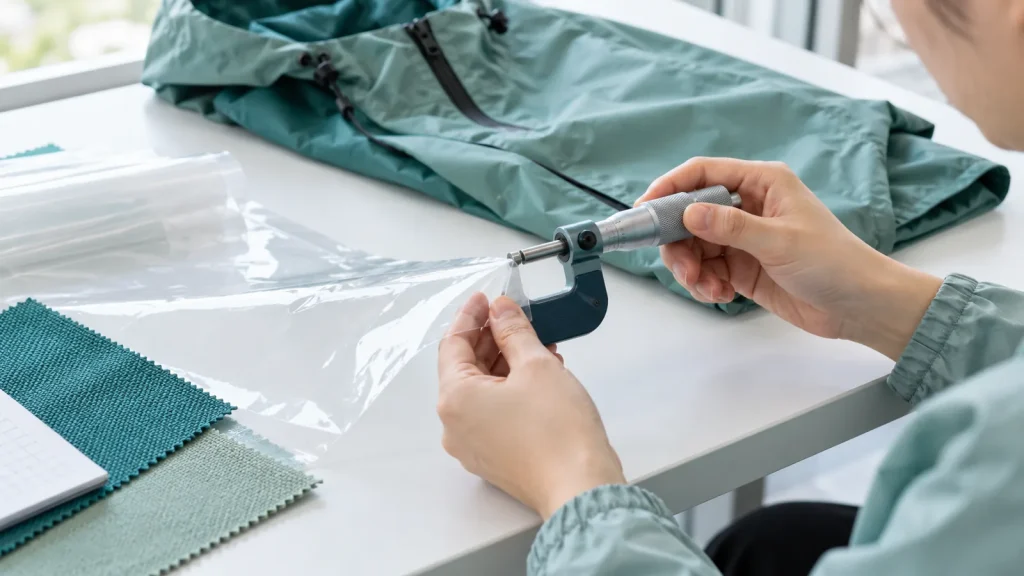
| Entity | Attribute | Value or requirement to agree | Acceptance evidence |
|---|---|---|---|
| Material system | Identity and layers | Named film or textile substrate; coating, membrane and backing identified separately | Supplier construction sheet tied to sample code |
| Film | Thickness | Value in micrometres or millimetres, location, method and tolerance | Measurement record on the proposed film |
| Textile assembly | Mass per unit area | g/m²; state whether substrate or complete assembly | Matched sample measurement |
| Yarn specification | Linear density | Denier or dtex where relevant; not a waterproof rating | Textile specification with construction details |
| Garment | Dimensions and mass | cm and g by size; defined points and tolerance | Drawing and finished-sample measurements |
| Barrier material | Water penetration resistance | Agreed method, edition, conditioning and acceptance requirement | Product-matched laboratory report |
| Textile assembly | Water-vapour performance | Named method, units and conditions if claimed | Relevant report; no cross-method ranking |
| Seams and openings | Construction | Join type, seam treatment, closures and reinforcements | Assembly specification and garment review |
| Decoration | Print and colour | Process, artwork revision, dimensions and location | Approved decorated sample and checks |
| Components | Chemical requirements | Destination and use-specific substance scope | Declarations and applicable product evidence |
| Environmental claim | Claim scope | Specific component, percentage or end-of-life conditions | Claim-matched substantiation |
| Pack and carton | Packing arrangement | Fold, pack type, count, dimensions and gross mass | Approved packing sample and record |
| Commercial proposal | Order basis | Quantity by variant, MOQ, OEM Program scope and milestones | Written quotation with deviations identified |
Make every material attribute measurable or explicitly unresolved
An EAV table organises information by entity, attribute and value. In a rainwear request for quotation, the entity might be the film, textile assembly, finished garment, decoration or pack. The attribute is the feature you need to define, and the value is the agreed requirement or the information still needed. Adding an evidence column makes the table more useful for procurement because it shows how the team expects to verify each entry. The format is simple enough to share across commercial and technical teams.
Begin with the material system rather than a catch-all product description. Give the film or textile assembly its own row, then identify relevant layers and components. For each measurement, state the unit and basis. Film thickness, fabric mass per unit area and finished-garment mass are separate attributes, even when they appear together in a supplier's catalogue. Keeping them separate prevents a value from being copied into the wrong field and makes it easier to spot when two quotations describe different constructions or measurement scopes.
Use an explicit status when a value is not yet agreed. Terms such as supplier proposal required, sample review pending or technical confirmation needed are more honest and useful than a guessed figure. Assign an owner and a next step to important gaps. The table then becomes a working procurement tool rather than a static document that looks complete only because every cell contains something. Before order release, review which unresolved items must be closed and which have an agreed process for later confirmation.
Define tolerances and measurement points where they matter. A finished length needs a clear start and end point; a film thickness requirement needs a measurement basis; a print location needs a reference on the garment. Ask the supplier to propose practical methods if your team has not already defined them. Have the appropriate reviewer confirm that the approach supports the buying requirement. Precision is valuable when it improves agreement and inspection, but an unexplained decimal place does not make an otherwise ambiguous specification reliable.
Keep evidence requirements proportionate and relevant. A garment dimension may be checked against a drawing and sample measurement record, while a performance claim may need a suitable laboratory report. A commercial attribute such as MOQ belongs in the written quotation. Do not request the same type of certificate for every line simply to create a large document pack. The evidence should answer the specific question raised by the attribute and be connected to the product, component or proposal it is meant to support.
The table below provides a starting structure for PE, EVA, PVC and polyester rainwear enquiries. It deliberately leaves order-specific values to be agreed. Your team should adapt the rows to the intended product and market, adding specialist requirements where appropriate. It is not a declaration that every listed test or document is mandatory for every raincoat. Its purpose is to make the conversation explicit: what is being specified, what the supplier proposes and what the buyer needs before making an approval decision.
Use the completed table during sample review and quotation reconciliation, not just at the beginning of the enquiry. As decisions are made, update the relevant values and references. Keep a revision date and identify the version attached to the final purchase order. That discipline makes the EAV model practical: the same information can guide supplier discussion, internal approval, inspection and replenishment. It also reduces the risk that a clear early brief becomes disconnected from the product configuration eventually accepted during commercial negotiation.
Compare supplier deviations without hiding differences
A useful quotation comparison preserves differences instead of smoothing them away. Ask each supplier to identify deviations from the requested specification and explain any proposed alternative. Keep the original requirement visible alongside the response. If one bidder offers a different film thickness, lining, print process or packing arrangement, record that difference before comparing the commercial terms. A lower or higher total proposal has little decision value unless the team understands the product configuration and scope behind it.
Separate compliant responses, unresolved responses and alternatives in your internal review. An alternative may be attractive and worth evaluating, but it should not silently replace the requested product. Ask what benefit the supplier expects from the change and what evidence or sample supports that explanation. Then decide whether the alternative deserves its own review. This approach gives suppliers room to contribute technical experience while protecting the buyer from accidental specification drift during a busy enquiry process involving several versions and stakeholders.
Use the same quantity assumptions for each comparison. State the total order range, the split by size or colour, the artwork variants and the packing requirements. Ask for MOQ by relevant variant rather than relying only on a general factory minimum. If the supplier's offer depends on a different quantity mix, record that condition. Bulk Pricing should be reviewed as a proposal for a defined programme, with its scope and assumptions visible, rather than as an isolated number detached from the actual order configuration.
Compare timing through milestones. Ask when the supplier expects to complete material confirmation, artwork review, sampling, approval-dependent production and dispatch preparation. Identify which steps depend on buyer decisions. Do not treat an estimated production period as the complete time needed for the project. A proposal that requires additional material development or evidence review may need a different plan from a standard configuration. Procurement should understand those dependencies before committing to an event date or replenishment promise that the current information does not support.
Give technical reviewers a focused set of questions. Instead of sending an unstructured folder of every supplier attachment, link each unresolved attribute to the relevant document or sample. Ask the reviewer to record the conclusion and any qualification. This makes the comparison easier to audit and reduces repeated questions. It also prevents a persuasive commercial presentation from obscuring a missing material detail. The commercial and technical decisions can then inform each other without either team assuming the other has already resolved an important gap.
Where a supplier cannot meet a requirement, ask whether the issue concerns the proposed product, the quantity, the available process or the evidence requested. Those are different problems and may have different solutions. Your team might revise a non-essential feature, evaluate another construction or decide the proposal is unsuitable. Record the reason for the decision. A clear rejection or approved deviation is more useful for future sourcing than an unexplained ranking that leaves the next buyer unable to understand why a particular supplier was selected.
Before the final award, reconcile the preferred quotation against the current specification and approved sample. Confirm that every accepted deviation appears in the final documents and that superseded assumptions are no longer active. This is the point at which the EAV table becomes a shared order reference. The result is a comparable, reviewable bulk rainwear proposal that procurement can explain to management, while the supplier receives a clear account of the construction, commercial scope and approval conditions it is expected to deliver.
Connect the approved specification to samples and change control
A specification is strongest when it points to identifiable samples and records. Give the approved raincoat, material swatch, decorated sample and packing sample clear references, and state which attributes each one governs. One physical sample may cover several approvals, but do not assume that every early sample represents the final version. A development sample can establish shape while still using temporary material or components. The approval record should explain those limits so that later teams do not treat it as an unconditional production reference.
Create a simple version structure that both buyer and supplier understand. Identify the product code, specification revision, artwork revision and sample reference in the order documents. Include the date of approval and any remaining conditions. The system does not need to be elaborate, but it must make the current version distinguishable from earlier alternatives. This is particularly useful when a project spans several departments or when the person placing a repeat order did not participate in the original sampling discussions.
Define which changes require notification before production. Relevant examples may include the main material system, coating or backing, film specification, component source, print process, garment dimensions or packing format. The exact list should match your product and requirements. Ask the supplier to explain proposed changes in writing, with the reason and any effect on performance evidence, appearance, care, MOQ or timing. Procurement can then route the proposal to the right reviewer instead of allowing a substitution to become visible only after delivery.
Decide how a change will be approved. Some adjustments may need a revised drawing, others a new sample or updated documentation. Have the responsible team identify the checks required for the particular change. Avoid two extremes: accepting every substitution on a verbal assurance, or demanding a complete restart for a minor change that has been properly assessed. A proportionate process keeps the order moving while preserving the attributes and evidence that mattered to the original buying decision.
Retain the approval history without creating confusion about the active standard. Store superseded files in a way that preserves traceability but makes the current version easy to find. Ask the supplier to confirm receipt of the final specification and artwork. Where physical reference samples are held by both parties, label them consistently and record any known differences. A photograph can support the record, but it should not be treated as a complete substitute for a physical reference when texture, handling or other tactile attributes govern approval.
Connect inspection records to the same references. When an incoming or production review identifies a concern, the reviewer should be able to state which requirement and version it relates to. That makes the discussion more concrete and helps distinguish a true deviation from a difference that was already approved. Keep corrective decisions with the order record. The resulting history can inform replenishment, supplier development and future material choices without relying on the memory of whoever handled the original project.
For repeat orders, begin by confirming whether the approved construction and evidence remain current. Ask about proposed substitutions, relevant document updates and any operational feedback from the previous supply. Do not assume that a familiar product code means every underlying detail is unchanged. A brief, structured review protects continuity and gives the supplier an opportunity to raise issues early. It turns the material guide into a practical procurement system: define the product, approve the reference, control changes and keep the next order connected to what your team actually accepted.
10 / 12
Evaluate environmental and chemical claims for the complete rainwear product

Separate material identity from environmental claims
A material name tells buyers something about composition; it does not establish a complete environmental conclusion. PE, EVA, PVC and polyester rainwear can differ in construction, use pattern, decoration, packaging and available end-of-life routes. Those differences matter when evaluating a claim. Begin by writing the exact statement your organisation wants to make, then ask what product-specific evidence would support it. This is more useful than asking a supplier for an eco-friendly raincoat without defining what that phrase is intended to mean.
Broad environmental descriptions can imply more than the available evidence demonstrates. The FTC's Green Guides summary encourages specific, substantiated claims and appropriate qualifications. For procurement, that means separating questions such as recycled content, compostability, collection availability and intended reuse. They are different attributes, and evidence for one does not automatically establish the others. A garment may be proposed for repeated use without having a supported compostability claim, and a material description alone cannot establish a universal local recycling route for the finished item.
Build a claim register alongside the specification. Record the proposed wording, the component or product it refers to, the evidence supplied and the reviewer responsible for approval. If the evidence is incomplete, mark the claim as pending rather than allowing it into artwork or sales copy. This is particularly helpful for promotional gifts, where environmental wording can move quickly from a supplier conversation into a printed pack. The cost and timing of correcting printed material make early review a practical procurement priority.
Keep comparative claims especially clear about their basis. If your organisation wants to say that one option has a lower environmental impact than another, it needs an appropriate comparison with a defined scope and assumptions. Do not invent a percentage or infer a complete life-cycle result from one material attribute. The buyer can still compare operational features such as expected handling, storage and the planned return process, provided those are described accurately and not presented as proof of a broader environmental advantage.
Treat intended reuse as a programme decision that needs practical support. A product selected for repeated use requires appropriate care guidance and a realistic ownership or return arrangement. If the organisation does not yet know whether recipients will keep and reuse the garment, describe that uncertainty in the internal assessment. Avoid turning an aspiration into a guaranteed outcome. Procurement can improve the plan by asking how the product will be issued, maintained and replaced, then evaluating samples and instructions against that actual process.
Check the relationship between the main garment and its packaging. A claim that applies to one component should not be presented as if it covers the entire kit. If a pack has a different material or end-of-life instruction, make the distinction clear. Ask the supplier for the relevant component descriptions and have the proposed wording reviewed for the intended market. This avoids a common source of confusion in compact rainwear products, where the garment, pouch, label and outer packaging may all be discussed under one broad environmental label.
The strongest result is a precise, understandable statement that matches the evidence and the programme. Where no supported public environmental claim is available, the team can still make a sound purchase based on fit for purpose, controlled quantities, suitable construction and clear instructions. Those practical decisions do not need exaggerated language to be worthwhile. A careful claim review protects the credibility of the brand and keeps the material selection focused on what the proposed product and documented operating plan can actually support.
Check the scope of recycled-content and end-of-life evidence
When recycled content is proposed, ask what part of the product the claim describes. Is it the main film, the face textile, a particular component or the complete item by a stated calculation basis? Request the percentage, scope and supporting documentation appropriate to the claim. Do not infer recycled content from colour, texture or the word polyester. A clear description lets procurement compare offers and gives the brand team a reliable basis for deciding whether and how the information can appear in customer-facing material.
Ask how the evidence connects to the proposed supply. A general company statement may describe a supplier's activities without identifying the material used in your order. Your reviewer needs to understand the relationship between the documentation, the product reference and the planned production. Where a certification or chain-of-custody system is cited, have a qualified reviewer check its scope and relevance rather than reproducing a logo automatically. This guide does not claim that any particular rainwear offered by the site holds a certification.
For compostability or biodegradability claims, keep the required conditions visible. Ask exactly what has been evaluated, under which method and conditions, and whether the evidence covers the complete finished product including relevant decoration and components. Avoid treating these terms as interchangeable or as a promise that a garment will disappear safely in any environment. If the intended disposal route cannot support the conditions behind a claim, that mismatch needs to be resolved before procurement relies on the description in a programme brief or public message.
Recycling questions also need local operational information. A material may have a technical recycling possibility while the actual collection system available to recipients does not accept the finished item. Contact the relevant waste or recycling operator for the planned programme and confirm what it can handle. Keep the product description and any collection instructions aligned with that confirmation. Do not use a generic recycling symbol as a substitute for an established route, and do not assume that a garment and its individual pack belong in the same stream.
Consider contamination and mixed components in the practical collection plan without inventing a universal outcome. Ask the operator what condition and separation requirements apply to the specific route. Then decide whether your event or organisation can follow those instructions. Staff training, collection points and clear recipient information may be needed if a route is available. Where it is not, avoid promising collection or recovery that the operation cannot deliver. Accurate instructions are more valuable than an attractive claim that leaves users unsure what to do after use.
Keep evidence and operational assumptions separate in the buying record. One document may support a material-content statement, while another records acceptance by a local operator. A third may describe the organisation's issue and return process. None should be treated as a substitute for the others. This separation helps the team identify gaps and adapt if the product, location or collection arrangement changes. It also makes it easier to review a repeat order without assuming that an earlier end-of-life plan remains available indefinitely.
Before approving public wording, ask whether a reader could reasonably misunderstand the scope. Does the statement name the relevant component, percentage or conditions where necessary? Does the packaging make a broader impression than the evidence supports? Have the appropriate reviewer assess the final wording in context, including artwork and labels. The aim is a practical sustainable-rainwear enquiry with specific evidence questions, not a collection of environmental labels. Precise scope helps procurement choose suitable options and helps the brand communicate them honestly.
Keep chemical requirements connected to components and destinations
Chemical requirements should be defined for the actual product and destination, with appropriate specialist support. Start by identifying where the rainwear will be supplied and who will use it. Then list the main material, decoration, closures, labels and other relevant components. This creates a practical basis for discussing documentation with the supplier. A generic request for non-toxic rainwear does not tell either party which substances, methods, markets or product categories need to be considered for the proposed order.
Ask the responsible compliance reviewer to define the scope before collecting documents. The requirements may depend on the destination, intended wearer group and claims or contractual conditions associated with the product. Procurement should communicate that scope clearly and request evidence tied to the proposed construction. Do not assume that a report from one market resolves every question in another. Where several destinations are involved, show them in the brief so the supplier and reviewer can identify the information needed for the complete distribution plan.
Review component coverage carefully. A material report may concern only the base film or textile, while the finished garment also includes print, fasteners and other parts. Ask how those components are addressed where relevant. If a report refers to a particular colour or variant, have the reviewer determine its applicability to the proposed order. Avoid filling gaps with a broad statement that all versions are the same. A focused clarification from the supplier can prevent a much larger misunderstanding once the product has entered production.
Check sample identity and document context. Record the report number, issuing organisation, date, tested sample description and the scope of the findings. If a declaration is provided, understand who makes it and what it covers. These records help the reviewer assess relevance, but procurement should not interpret unfamiliar chemical results beyond its expertise. Route technical questions to qualified support and preserve the resulting conclusion. The objective is a traceable approval process, with any limitations visible to the people authorising the order.
Keep restricted-substance questions distinct from unrelated performance claims. A document addressing a chemical requirement does not establish waterproofness, breathability, mechanical durability or suitability for a workplace hazard. Likewise, a material performance report does not settle chemical compliance. This distinction may sound basic, but it is valuable when a supplier sends a large mixed document pack. Organise the evidence by requirement so that a familiar logo or an impressive report title does not create a false impression that every procurement question has been answered.
Plan for changes in components and supply. Ask the supplier to notify you before substituting a relevant material, print system or component. The reviewer can then decide whether the change affects existing evidence or requires additional assessment. Include that process in the order conditions and repeat-order review. A product that keeps the same commercial name can still change in ways that matter to the documentation. Clear change control preserves the connection between the approved evidence and the rainwear actually delivered.
Finally, keep public language narrower than the evidence when necessary. Avoid sweeping descriptions such as completely chemical-free or universally safe. Use specific, reviewed statements only where they are relevant and supported for the proposed product and market. Procurement can communicate that appropriate documentation is part of the order review without claiming certifications or capabilities that have not been established. This disciplined approach helps brand owners and technical buyers work together while keeping the material conversation factual, practical and connected to the actual supply arrangement.
Technical references: FTC Green Guides summary, ECHA phthalates information.
Develop your evidence questions with our sustainable rainwear buying guide, covering environmental claim scope, product evidence and practical collection planning.
11 / 12
Validate raincoat materials from incoming sample to bulk shipment
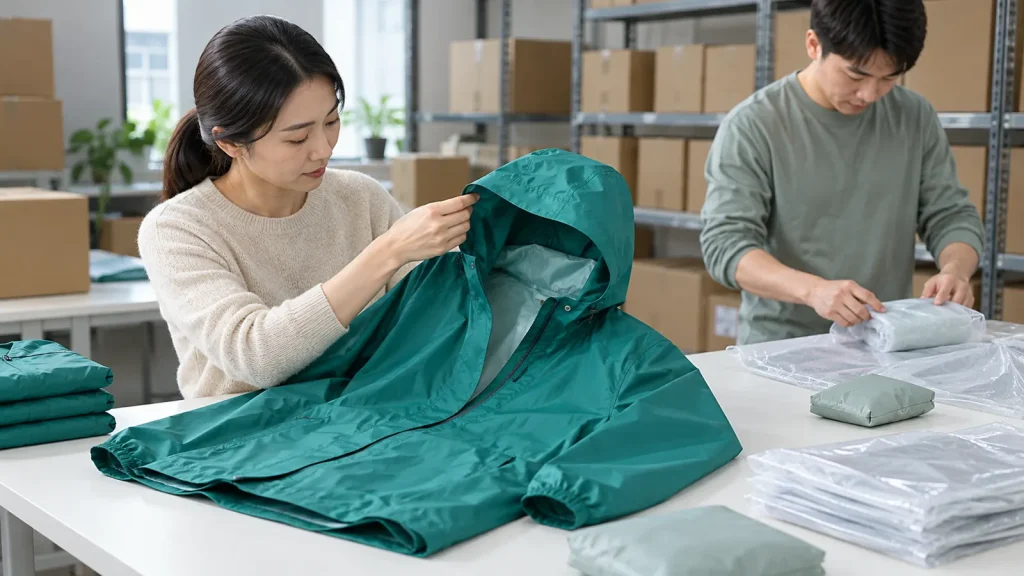
Design a sample review with clear acceptance decisions
Sample review works best when the team knows what decision each sample is meant to support. A material swatch, an undecorated fit sample, a decorated pre-production sample and a packing sample may answer different questions. Identify the purpose before the review begins. Ask the supplier which features represent the intended bulk version and which are temporary. That distinction prevents an early development sample from becoming an accidental approval of material, artwork or components that were never intended to be final.
Build the review around the current specification. Use the EAV table, garment drawing and artwork record to identify the attributes that need checking. Assign the relevant people: procurement for commercial scope, brand staff for appearance, operations for handling and qualified technical reviewers for specialist requirements. The same person may cover several roles in a small business, but the questions should remain distinct. A sample that looks good can still have unresolved dimensions, documentation or packing details that need attention before bulk release.
Record observations in a form the supplier can act on. Instead of writing poor quality, identify the feature, location and concern. Include the sample reference and a photograph where useful. State whether the issue is a deviation from an agreed requirement or a request to change the brief. Those are different conversations. A supplier needs to know whether it is correcting a mismatch or developing a new version, particularly when the requested adjustment affects material availability, MOQ, artwork or the project timetable.
Use clear decision statuses. Accepted, accepted subject to listed actions, revise and resubmit, or unsuitable for this brief can all be useful when their meaning is agreed. Do not allow a casual positive comment during a meeting to replace the formal approval record. If an action remains open, identify the owner and the evidence needed to close it. The buyer and supplier should both understand whether production is authorised or whether the sample is still part of a development discussion.
Retain a representative approved reference where practical. Label it with the product and revision details and store it according to suitable guidance. Keep supporting photographs and documents together. If a physical sample cannot be retained, agree another reference arrangement and understand its limitations. Photographs can show placement and visible construction, but they may not fully communicate feel, drape or other tactile attributes. The reference system should support the actual acceptance criteria rather than creating a false sense that every detail has been captured digitally.
If the organisation needs formal inspection or laboratory evidence, plan it before the last production milestone. Give the relevant provider a clear scope and connect the results to the product reference. Do not ask a general visual sample review to establish properties it cannot measure. Equally, do not assume that a laboratory report replaces the practical approval of size, artwork and packing. The two forms of review answer different questions and should be brought together in the release decision for the exact bulk configuration.
Close the process with a concise approval summary sent through the agreed business channel. It should identify the accepted version, remaining conditions and the next authorised step. Keep the history available for repeat orders and later questions. A structured sample review saves confusion because everyone can see what was decided and why. It gives the material comparison a concrete outcome: a rainwear configuration that has been reviewed against a defined brief, with any limitations understood before the organisation commits to the bulk order.
Track material, print and packing consistency during production
Production consistency begins with a stable reference. The supplier should have the current material specification, approved sample, artwork and packing instructions before the order enters the relevant production stage. Confirm receipt and resolve conflicting versions early. A clear set of documents does not eliminate every possible issue, but it reduces avoidable ambiguity. It also provides a common basis for discussing findings during production, rather than relying on memories of sample meetings or old email attachments that describe a different configuration.
Agree which checks will be performed, by whom and at what stage. The plan should reflect the product and order requirements rather than use a generic inspection label without a defined scope. Relevant checks may include dimensions, visible construction, print placement, packing arrangement and the specific material attributes agreed for the order. If sampling procedures or formal standards are required, have qualified personnel define them. Do not invent a universal inspection percentage or acceptance rule that may be unsuitable for the actual purchase.
Link findings to identifiable production or shipment references. Ask how the supplier records the relevant batch, material or order information and how that information will appear in the documents available to you. The aim is practical traceability, not unnecessary administrative complexity. When a concern arises, the team should be able to identify the affected stock and compare it with the approved requirements. A clear reference makes the discussion more useful than an isolated photograph whose product version and production context are unknown.
Review print and garment consistency together. A correctly coloured print on the wrong garment size or material is not an acceptable match to the order. Inspect the relationship between artwork, placement, closure and folds on the finished item. Where several variants are involved, make sure the checking plan distinguishes them. Ask the supplier how it will prevent a mix of artwork or packing references. The final product should be identifiable as the approved combination, with the variant differences reflected clearly in the order and packing records.
Packing checks should include the practical details needed by the receiving team. Confirm product counts, size or colour identification, carton arrangement and any agreed labels. Review the individual pack for the correct garment and instructions. If the supplier proposes a packing adjustment during production, ask whether it changes the approved dimensions, presentation or handling. Treat the adjustment through the agreed change process rather than assuming that a packaging difference is always minor. For an event programme, an unclear pack can affect the entire issue operation.
Define the response to a discrepancy before it occurs. Identify who can authorise a correction, approve a justified deviation or hold the affected stock pending review. Ask for evidence that the agreed action has been completed where appropriate. Keep decisions tied to the relevant requirement and product reference. This avoids informal fixes that solve an immediate problem but leave the final shipment different from the buyer's understanding. It also gives the supplier a clear route for escalating a concern instead of making an unapproved substitution under time pressure.
At shipment review, reconcile the final documents and any inspection findings with the approved configuration. Keep unresolved concerns visible and make a deliberate release decision through the agreed process. Production tracking should support that decision, not become a collection of reports nobody reads. A focused approach helps wholesale buyers maintain continuity across material, decoration and packing while giving suppliers clear expectations. It also creates useful evidence for the next order, especially when the programme will be repeated across seasons or distributed through several locations.
Plan storage, replenishment and substitutions before the next order
The procurement process continues after the cartons arrive. Confirm that the receiving and storage teams have the product identification, packing information and relevant storage guidance. Keep stock organised by the references that matter to the programme, such as size, colour, artwork or batch. If a concern is found at receipt, record it promptly with the appropriate details and separate affected stock while it is reviewed. A clear handover helps the organisation preserve the value of the sample and specification work completed before ordering.
Use the supplier's guidance for storage and care of the exact product. Share any operational constraints, such as seasonal holding periods or movement between distribution sites, so that potential issues can be discussed. Do not assign a universal shelf life to PE, EVA, PVC or polyester rainwear based only on the material name. The complete construction, decoration, packing and storage conditions matter. Where a particular storage period is important to the programme, ask what evidence or guidance supports that expectation for the proposed product.
Collect practical feedback from issue points and wearers in a structured way. Record the product reference, location, use context and specific observation. Distinguish fit preferences, handling difficulties and possible defects. This gives procurement information it can use when reviewing a repeat order. An unstructured complaint that a raincoat is wrong may be difficult to investigate, while a clear note about pack opening or hood fit can lead to a targeted discussion with the supplier and a defined change in the next sample.
Plan replenishment around the actual approval process. If a repeat order uses the same approved configuration, confirm that the supplier can still provide it and that relevant documentation remains applicable. If the quantity mix, artwork or material changes, identify the review steps needed before release. Do not assume that a previous production schedule automatically applies to a revised version. Ask for current milestones and dependencies, then align your internal decisions with those dates so that late artwork or unresolved technical questions do not compress the remaining work unexpectedly.
Agree how substitutions will be proposed when availability changes. Ask the supplier to identify the exact difference, the reason for it and the potential effect on the agreed attributes. Review the replacement against the original brief rather than accepting a similar appearance as proof of equivalence. A change in film, textile backing, print system or closure may require different checks. The buyer can then approve a suitable alternative, request further development or retain the original specification and adjust the procurement plan.
Keep an approved-alternative record if the programme benefits from more than one construction. Each alternative should have its own reference, sample approval and relevant documentation. Do not merge them into a vague description that makes later deliveries hard to identify. Operations should know which version it is issuing, and procurement should know which version a quotation covers. This controlled flexibility can make future sourcing discussions clearer without weakening the acceptance standard or implying that every rainwear product within a material family is interchangeable.
Before the next order, review what changed in the programme itself. New wearer groups, destinations, collection arrangements or branding requirements may justify a different material decision even if the previous product performed as expected. Use the stored specification and feedback as a starting point, then update the brief deliberately. Good replenishment preserves what worked and revisits what has changed. It turns a one-time comparison of PE, PVC, EVA and polyester into a repeatable buying process that remains connected to the organisation's real users and operations.
12 / 12
Raincoat material FAQ for wholesale and OEM buyers

Is PE, EVA, PVC or polyester best for our rainwear order?
There is no universally best raincoat material for every wholesale order. The appropriate choice depends on the complete product, the wearer, the intended use and the evidence required for your programme. PE and EVA descriptions commonly point buyers toward film-based options, PVC may appear as flexible film or a coating on textile, and polyester describes a textile fibre that can form part of a more complex rainwear system. Start by identifying the actual construction proposed rather than choosing from material names alone.
If compact contingency stock is the priority, compare complete proposals for packing, opening, coverage and distribution. A lightweight film option may be a candidate, but the sample still needs to demonstrate practical handling and suitable dimensions. If the programme involves assigned garments or repeated use, give more attention to care, fit, closures, storage and the operating process that supports reuse. These are buying scenarios, not automatic material rankings. The supplier should explain its proposed construction and the team should review it against the relevant brief.
For polyester rainwear, ask what creates the water barrier and how the layers are arranged. The fibre name does not establish waterproofness or breathability. For PVC, distinguish film from coated textile and review the relevant formulation and destination questions with qualified support. For EVA, assess the proposed film and garment rather than assuming that the family name guarantees a particular flexibility or service life. For PE, clarify the film specification, dimensions and packing. Each route leads back to a defined product and a traceable sample review.
A useful shortlist normally begins with a small number of credible constructions that meet the essential requirements. Ask suppliers to identify deviations and provide the information needed to compare them. Keep optional features separate from mandatory ones. This makes it easier to discuss trade-offs involving appearance, packability, care, quantity requirements and timing. Avoid requesting every desirable feature in one universal garment without considering whether the complete proposal is practical for your wearer group and commercial programme.
When several teams disagree, return to the use brief. Marketing may prioritise print presentation, operations may prioritise issue speed and technical staff may need specific evidence. Those priorities can often be reconciled through a better-defined product, but sometimes separate specifications are more sensible. A visitor poncho and a staff raincoat can share branding while serving different purposes. Ask for MOQ and Bulk Pricing by configuration so that the commercial comparison reflects the actual products and quantity mix the organisation intends to purchase.
Do not let an environmental label settle the material decision without supporting detail. Recycled-content, compostability, collection and reuse claims have different evidence needs. Ask what the statement covers and how it relates to the complete proposed product and operating plan. The same caution applies to safety or protective claims: a general rainwear material comparison does not replace a workplace assessment or specialist compliance review. Keep those requirements explicit and obtain suitable input before selecting a product for a specialised role or destination.
The best answer for your order is therefore a documented selection, not a slogan. Define the wearer and task, compare the complete constructions, review samples and relevant evidence, then approve the exact version intended for production. Record why the selected option meets the brief and which limitations remain. That decision is easier to explain to management, easier for the supplier to follow and easier to maintain during replenishment than a blanket statement that one material is always superior to all the others.
What thickness, waterproof rating and breathability should we request?
Request values that have a clear purpose in your specification. Film thickness, textile mass, water-penetration resistance and water-vapour performance describe different attributes, so they should not be collapsed into one quality score. Begin with the intended use and ask your technical reviewer which measurements and evidence are appropriate. A number copied from another product page may describe a different construction or method. The right requirement is one that can be justified for your programme and checked on the proposed product.
For film thickness, state the unit, measurement basis and tolerance to be agreed. Ask whether the value applies to the proposed film and how it will be checked. Compare garment dimensions and construction alongside it. A thicker nominal film does not independently prove that the complete raincoat has better fit, stronger joins or a longer useful life. If a particular handling or mechanical property matters, define that need and agree an appropriate evaluation rather than expecting thickness alone to serve as evidence for every desired outcome.
For a textile-based proposal, clarify whether a mass figure describes the face fabric or the complete assembly. Treat yarn linear-density terms such as denier or dtex as textile information, not waterproof ratings. Ask for the layer description and relevant finished-garment details. This helps prevent a common comparison error in which one supplier quotes a face-fabric attribute and another quotes the coated assembly, yet the figures are ranked as if they describe the same thing. Resolve the basis before making a commercial decision.
For water resistance, ask for the method, edition, specimen identity, units and conditions behind the reported result. ISO 811:2018 is a hydrostatic-pressure test method for textile water penetration resistance; a material result should not be presented as whole-garment certification. Review seams, openings, fit and intended use separately. If the customer requires a particular classification or formal product standard, involve qualified technical support to define the appropriate requirement and evidence. Do not infer that requirement from a generic description such as heavy duty or professional grade.
For breathability, first ask what is being measured. Different water-vapour methods and units should not be directly ranked without appropriate interpretation. ISO 11092:2026 addresses thermal and water-vapour resistance under steady-state conditions, while practical comfort also involves the finished garment and wearing situation. Keep the method and edition actually used in the report. An older report should not be relabelled as a new-edition test, and a broad breathable claim should remain unresolved until the supplier provides an adequate explanation and relevant evidence.
If the team does not yet know which threshold to request, say so in the enquiry. Describe the use case and ask for a proposed construction with supporting information, then have the appropriate reviewer help define acceptance criteria before final approval. This is better than inventing an exact figure to make the RFQ appear complete. The supplier can contribute product knowledge, but the buyer still needs to confirm that the resulting requirement suits its customer obligations, intended market and actual operational needs.
The finished specification should connect each value to a decision. Identify what is measured, how it is measured, which sample it concerns and what evidence is needed for acceptance. Include the relevant garment and care checks rather than relying entirely on laboratory numbers. This creates a practical waterproof fabric specification that procurement can compare and quality staff can use, while keeping public claims within the scope of the evidence. A clear method and product match are more valuable than an impressive figure with no traceable context.
What should we send a manufacturer to receive a useful bulk proposal?
Send a concise brief that explains who will wear the rainwear, where it will be used and what the organisation needs to achieve. Include the intended destinations, quantity range, size or colour mix, event or replenishment timing and any essential product requirements. If you have not selected a material, say that you want to compare suitable constructions. A manufacturer can respond more usefully to a defined buying scenario than to a request for the cheapest waterproof raincoat with no information about the programme.
Add the material and garment details already known. These may include a preferred film or textile system, dimensions, hood and closure requirements, packing format and any relevant evidence needs. Mark open questions clearly rather than filling them with assumptions. The EAV table in this guide can help organise the enquiry. Ask the supplier to complete the proposal fields and identify deviations. This gives your team a consistent structure for reviewing alternatives without preventing the supplier from suggesting a construction that may better suit the brief.
Provide the branding information at the appropriate stage. Include a current artwork reference, intended print dimensions, location and colour requirements. Ask which process is proposed for the exact surface and what sample steps are needed. If the brand team has not finalised the artwork, identify that dependency in the schedule. Do not let a preliminary mock-up become the production instruction by default. A useful OEM Program proposal explains the approved configuration and the decisions still required before material, printing and production can be confirmed.
State the commercial scope you want compared. Request MOQ by relevant variant, Bulk Pricing for the defined quantity mix, sampling requirements and milestone-based timing. Include the agreed packing and shipment basis in the commercial discussion with the supplier. Keep any quotation assumptions visible to the people making the decision. A proposal can only be compared fairly when the team understands which construction, artwork, packing and services it covers, and which requested features remain optional or excluded from the current offer.
Explain your approval process. Tell the supplier who will review fit, branding, technical evidence and packing, and identify any customer approval that must occur before release. Ask for representative samples and clarify what they will demonstrate. If the project has a fixed event date, work backwards through the required decisions rather than asking for production to begin while important details remain unresolved. The manufacturer should understand the sequence of approvals and the buyer's response responsibilities, so that the proposed plan reflects the actual work involved.
Include a clear evidence request for any claims that matter to the project. Specify the intended market and ask for documents tied to the proposed product or components, with qualified review where needed. Avoid asking for a generic bundle of certificates and assuming that its size proves suitability. Connect each request to a requirement: material performance, chemical scope, environmental wording or another relevant attribute. The supplier can then answer focused questions, and your reviewer can assess the information without searching through unrelated documents for a possible match.
Finish by asking the supplier to summarise its recommended construction, accepted requirements, deviations and next steps. Review that response against the brief before choosing a sample route or approving the order. A good enquiry creates a shared understanding of the rainwear programme and leaves a clear record for later production and replenishment. Bring the wearer group, quantity range, material questions and artwork to the discussion, and use the resulting proposal to move from a broad PE, PVC, EVA or polyester comparison to a specific bulk-order decision.
Technical references: ISO 811:2018, ISO 11092:2026.
Return to the wholesale rainwear product and material pillar guide to connect your shortlist with the complete sourcing and approval process.