
Industrial rainwear · Construction and outdoor work
Industrial Strength Raincoats for Construction & Outdoor Work
Heavy duty work raincoats must fit the job, the wearer and the rest of the workwear system. A thick fabric or bright color alone cannot settle that decision. This procurement guide helps construction companies, outdoor service teams and workwear buyers turn rain exposure, visibility needs and daily handling into a clear specification. Compare materials, question performance evidence and plan an OEM Program that can be sampled, approved and maintained.
Define the work. Verify the evidence. Approve a rainwear program your team can use.
01 / 12
Define industrial rainwear around the work and weather

Describe the shift before choosing the raincoat
Industrial rainwear buying starts with a description of work, not a fabric adjective. A supervisor walking between sheltered buildings has a different exposure pattern from a grounds crew working outside through repeated showers. A delivery worker may spend much of the shift seated, while a maintenance technician reaches overhead or kneels beside equipment. Describe these movements and transitions before asking an industrial rainwear supplier for recommendations. Otherwise, suppliers may quote garments that look similar in a photograph while solving quite different problems.
Create a short use-case record for each main wearer group. Include the normal task, outdoor intervals, expected season, access to shelter and clothing worn underneath. Add the practical details that are easily missed: whether the worker carries a radio, uses a tool belt, regularly enters a vehicle or needs frequent pocket access. These facts help determine coat length, sleeve design and closure placement. They also identify where a jacket-and-trouser system might deserve evaluation instead of assuming that one long coat will serve every role.
Separate ordinary weather exposure from other workplace hazards. Rain protection does not establish chemical splash resistance, electrical arc protection, flame resistance or suitability around moving machinery. The site's responsible safety team should identify those requirements and any restrictions before purchasing begins. If specialized protection is necessary, it becomes a defined part of the product selection process. Do not try to infer it from a heavy fabric, a reflective stripe or a supplier's general description of industrial use.
Record what currently goes wrong. Ask workers where water appears, whether closures are difficult to operate and which movements feel restricted. Ask stores staff which sizes are exchanged and which components most often require replacement. A complaint such as “the coat leaks” needs more detail: location, activity, weather, garment age and the layers underneath. The result may point to a seam problem, an open collar, a worn closure or moisture from inside. This diagnostic information is more useful than simply demanding a thicker replacement.
Use an illustrative comparison to structure the discussion. A facilities team might need compact rain shells that can be put on quickly during inspections, while a landscaping team might prioritize freedom of movement, durable contact areas and a reliable drying routine. Neither example establishes a universal best material. It shows why the buying brief should describe the service the garment must provide. Give suppliers the same scenarios so their proposed differences can be evaluated against the same practical needs.
Turn the record into a decision document with named owners. Operations confirms the work pattern; the safety team confirms hazard-related requirements; procurement manages quantity and delivery; workers contribute fit and usability feedback. Keep unresolved questions visible rather than allowing assumptions to become purchase specifications. A brief can be concise and still identify these responsibilities. It should make clear who can approve a change when a sample reveals that the original requirement was incomplete.
The output is a usable starting point for heavy duty work raincoats: a defined wearer group, a described work pattern, known constraints and a list of evidence still required. Bring that record to the first supplier conversation. It helps distinguish essential features from attractive extras and gives later sample trials a clear purpose. Most importantly, it lets your team explain why a particular rainwear configuration was selected for that job.
Divide requirements into mandatory gates and negotiable preferences
Not every feature in a workwear brief has the same importance. Some requirements come from the intended task or applicable site rules. Others are preferences about appearance, storage or branding. Put them in separate columns before requesting quotations. This prevents an appealing color or competitive commercial proposal from masking a failure to meet a basic requirement. It also makes it easier for suppliers to suggest alternatives that preserve the important parts of the brief.
Mandatory gates should have a clear basis and an owner. A required garment configuration might come from a site assessment. A visibility requirement might be specified by the responsible safety professional for a particular operating environment. A delivery deadline may be tied to a contract mobilization date. Write the requirement in terms that can be checked, and state who will accept the evidence. “Suitable for all construction” is too broad to function as either a technical gate or an approval instruction.
Negotiable preferences can include a particular pocket arrangement, a preferred shade within an approved range or an individual packaging style. Ask suppliers to identify the effects of changing these features. A pocket alteration may affect seam layout; a different pack may change carton quantities; a custom shade may affect material sourcing. Treat each as a proposal with consequences, not as a free adjustment. This keeps the commercial discussion connected to the garment that will actually be supplied.
Use a compliance response sheet with three answer choices: meets, deviates or requires clarification. Require a short explanation and supporting reference for each response. A supplier who openly identifies a limitation is giving procurement useful information. An unqualified “yes” without a product reference is harder to assess. During review, resolve unanswered questions before scoring optional features. Otherwise, a proposal can appear strongest simply because its assumptions were never challenged.
Keep minimum performance requirements distinct from preferred sample characteristics. Your team might like the hand feel of a particular shell, but that preference does not replace agreed rain protection or durability criteria. Conversely, a material report does not establish whether the hood fits the issued helmet or whether workers can operate the closure with their normal gloves. Plan both evidence review and practical evaluation. Each answers a different question, and neither should silently substitute for the other.
Consider an illustrative tender with two compliant options: a simpler stock configuration and a more customized version. The customized option may offer improved organization of tools or clearer company identification, while the stock version may simplify replenishment. Compare their documented benefits, approval steps and supply constraints. Do not assume that customization necessarily improves performance. Ask what the extra complexity achieves for the wearer and whether your organization can maintain that configuration across future orders.
Finish with a short approval hierarchy. Specify which deviations require safety review, which require operations review and which procurement can resolve commercially. Record accepted deviations in the final order documents, including any limits on where the garment may be used. This approach supports a practical OEM Program because suppliers can see where they have design freedom. It also protects the buyer from receiving a technically different product under a familiar style name after several rounds of informal discussion.
Plan the whole issue-and-use system
A raincoat does not begin working when a carton reaches the warehouse. It must be received, identified, issued in the right size, worn correctly, dried and made available for the next shift. Include that operating system in the buying brief. A garment that performs well in a sample room can still create problems if workers cannot find their size or have nowhere to dry it. Procurement can address many of these issues before the first bulk order is placed.
Map the garment's route through your organization. Identify the receiving location, the person responsible for inspection, the storage area and the issue point. Decide whether rainwear is allocated to individuals or held as shared stock. Individual issue simplifies ownership but needs a process for new starters and departures. Shared stock needs careful attention to fit, cleanliness and availability. The right arrangement depends on the workplace; the key is to make the choice explicitly rather than leaving it to the stores team.
Build the size plan from actual demand where possible. Ask for a measurement guide and arrange a representative fitting exercise before finalizing the quantity split. Include the layers worn in the relevant season. Do not order every garment in one oversized size simply to reduce stock lines. Excess fabric can interfere with movement and equipment, while inadequate room can pull at shoulders and closures. A smaller number of well-planned variants may be easier to manage than a large stock of poorly fitting garments.
Think about the moment rain begins. Workers may need to reach a protected issue point, put on trousers over footwear or secure a hood without removing other equipment. Evaluate these steps in a controlled setting with the actual workwear combination. Keep the trial separate from hazardous operations. Record awkward movements, confusing adjustments and items that must be removed. This gives the supplier concrete feedback about usability and helps the site write clear instructions for normal use.
Plan the return path as carefully as the issue path. Wet garments need an appropriate place to drain and dry according to their care instructions. Damaged garments need a clearly identified holding area so they are not accidentally reissued. If professional cleaning is involved, agree how garments are tracked and how replacement stock covers the turnaround. These arrangements influence how many garments the program needs; headcount alone rarely describes the full stock requirement.
Specify useful identification without overcomplicating the product. A readable size label, an internal inventory reference and clear carton markings may solve more daily problems than an elaborate branded pouch. Check that any added label or marking is compatible with the garment and does not interfere with required information. Where the product has protective claims, obtain the appropriate review before adding permanent identification. Keep the approved identification layout in the same file as the garment specification.
Review the first issue period as a pilot for the operating system. Record exchanges, missing sizes, drying problems and reasons garments were taken out of use. Separate these from manufacturing defects so the response fits the cause. A storage shortage needs a different remedy from an incorrectly sealed seam. By treating construction site rain gear as an ongoing supply program, the buyer can make better decisions about replenishment, care capacity and the next order instead of repeatedly reacting to avoidable shortages.
For the broader material and sourcing framework, use our Rainwear Product & Material Guide for Wholesale Buyers. This industrial guide develops the workwear decisions in more detail.
02 / 12
Compare materials for heavy duty work raincoats
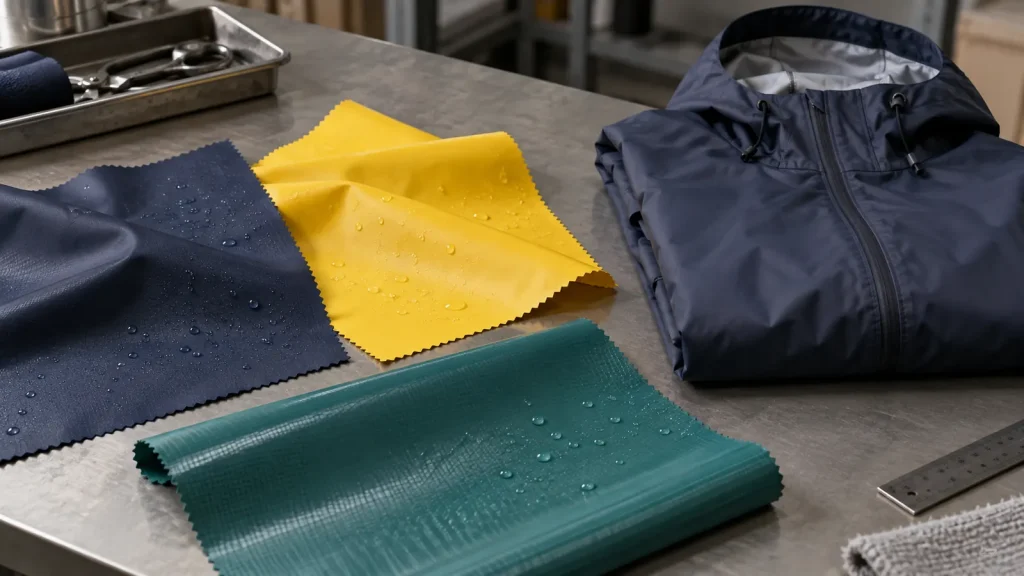
Read the complete material construction
The material name on a quotation rarely describes the entire raincoat. “Polyester” may identify the textile face or backing, while a coating or membrane supplies another part of the construction. “PVC” may refer to a coating on a textile rather than a free-standing film. Ask for a clear layer description, including the supporting fabric, barrier layer, lining and reinforcement areas. This prevents comparisons between products that share a marketing label but have very different structures.
Request a bill of materials at an appropriate level of detail for the order. It should identify the main shell, lining where present, seam-sealing system, closures and relevant trims. You do not need confidential manufacturing recipes to understand what is being proposed. You do need enough information to link the sample, quotation and performance evidence to the same construction. A named style code and revision help keep that connection intact as development progresses.
Distinguish textile mass from film thickness. Mass per unit area, commonly expressed in grams per square meter, describes a different property from thickness expressed in millimeters or micrometers. Neither measurement by itself establishes tear resistance, flexibility or finished-garment rain protection. Ask where and how the measurement will be made and what tolerance applies. Avoid comparing a coating-only figure with a figure for the complete coated textile. That mismatch can make one proposal appear lighter or stronger without a sound basis.
Look beyond the shell to the contact surfaces. A backing can influence how the garment feels over work layers; a lining can change bulk and drying arrangements; reinforcement panels can introduce additional joins. Evaluate whether these features serve the actual task. More layers are not automatically a better specification. A simpler construction that meets the agreed requirements may be easier to inspect and maintain, while another job may justify added structure in specific areas.
Use material samples for questions they can answer. They are useful for examining texture, flexibility, appearance and the proposed print surface. They are less useful for predicting how an assembled hood, shoulder or pocket will perform. Ask for an assembled garment early enough to review these interfaces. Keep the swatch reference linked to that garment so a later replacement material cannot be accepted simply because its color looks similar under office lighting.
Ask what changes are allowed between approval and production. A supplier may need to source an alternative lining, tape or fastening component. Require notification and an impact review before a change is made. Depending on the feature, this may involve a new sample, revised documentation or further testing. Agreeing this process in advance is more practical than discovering at inspection that the supplied raincoat differs from the approved construction in a way nobody recorded.
For a useful material comparison, place complete descriptions side by side and leave unsupported properties blank. Record evidence references separately from supplier statements. This makes uncertainty visible and gives the next sample round a purpose. The aim is to identify the construction that fits the work and the supply program, not to declare a universal winner among PVC, polyurethane, polyester, nylon or other material families. Product-specific evidence should settle the final specification.
Compare durability through likely failure modes
“Heavy duty” is an invitation to ask more questions, not a measurable performance class. Start with the ways a garment is likely to be damaged in the intended job. Abrasion against a vehicle seat, repeated bending at the knees, snagging at a pocket edge and pulling at a cuff place different demands on the product. List these contact points and movements before selecting durability checks. A single impressive material number cannot represent every likely failure mode.
Review returned garments if your organization already has a rainwear program. Sort observations into shell damage, seam problems, closure failures, coating changes and fit-related stress. Note the age of the garment and its use and care history where available. A torn pocket may result from the way tools are carried, while a strained shoulder may indicate inadequate room over winter layers. Use these records to improve the specification rather than assuming every failure requires a heavier fabric.
Discuss appropriate tests with a competent laboratory or technical reviewer. The method, sample preparation, direction of testing and conditioning matter when interpreting results. Ask whether the report covers the material used in the proposed style and whether relevant areas of the assembled garment are also evaluated. Do not compare figures from different methods as if they were interchangeable. Procurement's role is to make the comparison basis explicit and obtain informed interpretation where the evidence needs it.
Inspect how reinforcement is attached. A patch may protect one area while adding seam lines, stiffness or a new edge that catches during movement. Evaluate the transitions between reinforced and unreinforced areas on the sample. Ask the wearer to perform ordinary movements in a safe trial area and record whether the design restricts reach or bunches when seated. Reinforcement should solve a documented problem without creating a new usability issue that workers compensate for by wearing the garment incorrectly.
Include closures and adjustment components in durability discussions. A sound shell is of limited use if the zipper cannot be operated, the storm flap no longer stays closed or the cuff adjustment detaches. Check repeated normal operation during sampling, following agreed procedures rather than improvised destructive demonstrations. Record the precise component and fault when something fails. This gives the supplier actionable feedback and helps distinguish a design limitation from a manufacturing inconsistency.
Avoid translating a laboratory result directly into a promised number of working months. Actual service life depends on use, care, contamination, storage and damage. A test can provide useful comparative or acceptance evidence within its scope, but it does not automatically predict every workplace outcome. If service life is a major purchasing concern, combine appropriate evidence with a controlled pilot and a replacement record. State clearly what the pilot observed and where its conditions differ from the wider rollout.
The final durability brief should name critical areas, relevant checks and the response to a failure. It should also identify what the garment is not intended to withstand. That boundary is useful to supervisors and workers as well as procurement. A raincoat selected for routine outdoor maintenance should not acquire new protective claims simply because it has survived a demanding week. Keep the approved use and the evidence attached to the actual product throughout its service.
Evaluate practical material tradeoffs without a universal ranking
Material selection is usually a balance of requirements rather than a contest with one winner. Buyers may need a particular combination of rain protection, flexibility, cleaning compatibility, weight and commercial availability. The relative importance of those factors changes by role and season. Ask suppliers to explain why a proposed construction fits the brief and where it has limitations. A useful response connects features to your use case rather than repeating a generic claim that one polymer is best for industrial work.
Handle samples in the way workers will encounter them. Unfold the garment, operate the fasteners and assess how it sits over the intended layers. Compare the weight of the complete garment in the same reference size. A lighter shell can be offset by a substantial lining or extensive hardware. Likewise, an apparently substantial fabric can be used in a garment with limited coverage. Keep the comparison at the whole-product level while recording the individual construction details that explain the differences.
Treat flexibility as an observed characteristic under stated conditions. An office sample review tells you how the garment behaves in that room; it does not establish performance in every temperature or after repeated care. If cold conditions or repeated folding are important, describe them in the brief and ask what evidence or evaluation is appropriate. Avoid unsourced claims that an entire material family always remains flexible or always becomes brittle. Formulation and construction can matter as much as the broad material name.
Consider cleaning and drying before choosing the most appealing surface. The approved care process must suit the actual workplace arrangements. If your team uses a laundry service, involve it while samples are being reviewed. If garments are cleaned locally, check that the proposed instructions can be followed consistently. A product that requires a process your site cannot provide may be a poor operational choice even if its initial sample appearance is attractive. Resolve that mismatch before placing the order.
Discuss environmental attributes as separate, evidence-based requirements. A recycled-content claim does not establish rain performance, and a reusable description does not demonstrate a particular environmental outcome. Ask which component the claim concerns and what documents support it. For industrial rainwear, maintaining suitability for the job remains essential. If a proposed material change affects protective evidence or care instructions, evaluate those consequences alongside the environmental objective rather than approving the substitution on the strength of its label.
Build a comparison sheet with room for uncertainty. For each option, record confirmed construction, evidence available, wearer observations, care requirements and unresolved points. Then compare the commercial proposal on the same quantity, branding and delivery basis. This avoids treating an incomplete offer as a lower-cost equivalent. It also gives a supplier a fair opportunity to clarify an omission or propose a better-supported alternative before the buyer makes a final decision.
A practical shortlist often contains more than one suitable configuration. One may suit frequent mobile work, another occasional inspections or a different season. Decide whether the benefits justify multiple stock lines and explain the allocation rules to stores staff. The best procurement result is a manageable set of garments with clear uses, documented specifications and a reliable replenishment path. It is not a material ranking that ignores how the rainwear will be worn and maintained.
Explore product starting points for PVC rainwear, polyester rainwear and nylon rainwear. Confirm the exact proposed construction and evidence; a product category does not establish suitability for industrial hazards.
03 / 12
Inspect seams, closures and practical weather protection
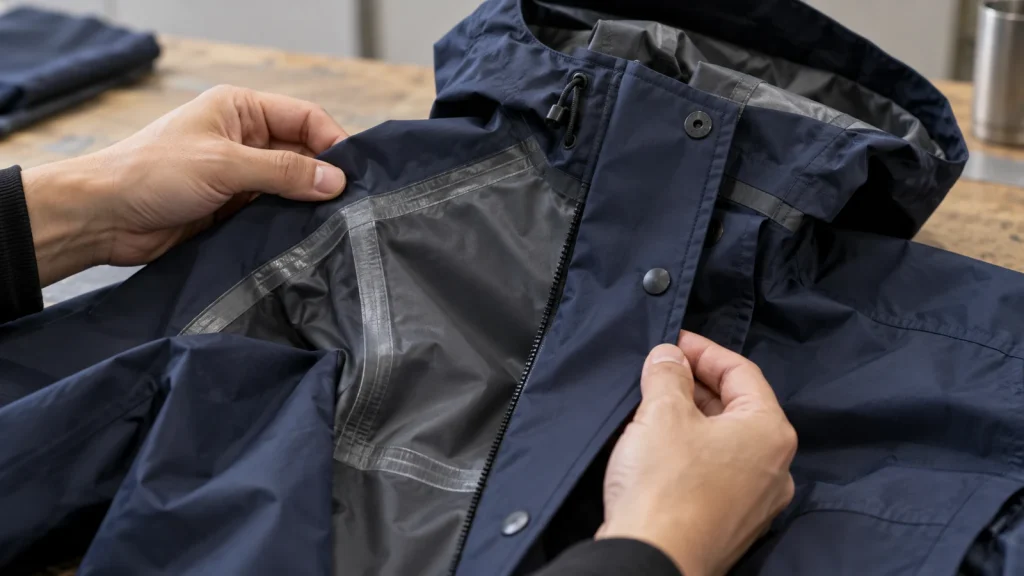
Follow water paths through the assembled garment
A raincoat is a system of surfaces, joins and openings. Water can reach the wearer through a damaged shell, an inadequately protected seam or an opening that changes shape during movement. Begin construction review by tracing likely paths from the shoulders, hood and front closure toward the inner layers. This turns a vague discussion about waterproofness into a structured examination of the actual garment. It also helps procurement ask for evidence that covers more than a flat piece of fabric.
Inspect the hood-to-collar connection, shoulder joins, sleeve attachments and pocket openings. Look at how water is intended to drain away from each area when the wearer stands, bends or turns. A flap that overlaps neatly on a hanger may lift when the worker reaches forward. A pocket may sit under an exposed seam or have an opening that is difficult to close with gloves. Record these observations with photographs and sample references so the supplier can respond to a specific construction detail.
Examine the inside as well as the outside. Where seam tape is used, check the approved sample for consistent placement, visible lifting or obvious gaps. Where welded construction is proposed, ask how the join is specified and inspected. Appearance alone cannot prove a watertight seam, but visible inconsistencies are useful reasons to request closer review. Agree the relevant performance and workmanship checks before bulk production rather than relying on a general statement that all seams are sealed.
Use material test information within its actual scope. ISO 811:2018 describes a hydrostatic pressure method for determining textile resistance to water penetration. A result for an identified material can support that material's assessment, but it does not by itself establish the performance of a completed raincoat with its hood, seams and fasteners. Ask the technical reviewer what additional garment or seam evidence is appropriate for the specified use and any protective claims being made.
Define the state of the sample being assessed. New material, material after agreed cleaning and a garment after an agreed conditioning procedure are different test subjects. Record the procedure and acceptance requirement rather than collecting numbers without context. If durability after care matters, include it early in the verification plan. Do not invent a conversion from a laboratory result into guaranteed hours in rain; real use also involves fit, movement, openings, care and the weather encountered.
Keep practical rain exposure trials controlled and proportionate. A buyer may evaluate ordinary usability in a suitable setting, but an informal spray demonstration should not be presented as certification or as proof of suitability for hazardous work. Decide in advance what the exercise is intended to reveal, such as whether the collar remains closed during normal head movement. Record observations honestly and use an appropriate laboratory when the requirement calls for a defined test method or formal performance evidence.
The review should produce a short water-path checklist for the final sample: hood, collar, shoulders, sleeves, front opening, pockets and hem interfaces. For each area, identify the construction, the evidence needed and any unresolved concern. This checklist is useful again at pre-production approval and receiving inspection. It helps ensure that the rainwear delivered in bulk follows the same design logic as the sample your team actually evaluated.
Make closures and pockets usable during the shift
Closures are small components with a large effect on everyday use. Workers need to fasten the garment reliably, adjust it without excessive effort and keep frequently used items accessible. Review those actions with the gloves and layers normally worn for the task. A closure that is convenient with bare hands at a showroom table may be frustrating during a wet shift. Usability problems can lead to open flaps or improvised adjustments that change the garment's intended performance.
Start at the main front opening. Check that the zipper or fastening system can be aligned without trapping the lining or inner clothing. Examine how the storm flap is secured and whether the intended overlap is maintained when seated or reaching. If the garment uses multiple closure stages, make sure the sequence is understandable. Record any step that users repeatedly miss. The solution may be a clearer design, better instruction or a different component, depending on what the trial reveals.
Review cuff adjustment as part of the glove interface. The required arrangement depends on the work and the other equipment, so ask the responsible safety reviewer to confirm compatibility where protective gloves are involved. Check range of adjustment, ease of operation and whether excess material catches during ordinary movements. Do not recommend cutting sleeves or making unapproved alterations to solve a fit problem. A suitable size or an approved design change is a more controlled response.
Treat pocket design as an operational requirement. List what workers actually need to carry and what should remain in other storage. A raincoat pocket is not automatically an appropriate place for every tool or electronic device. Specify useful opening dimensions and closure arrangements where relevant, then evaluate the loaded sample without exceeding intended use. Check whether contents distort the garment, interfere with bending or prevent a flap from lying correctly. Avoid making unsupported claims that a pocket is waterproof.
Consider access to identification and communication equipment. A radio, pass holder or company identifier may need a particular position, but attaching it can affect other garment features. Ask for an approved arrangement rather than improvising holes, clips or stitching after delivery. If visibility or another protective function is claimed, the effect of added equipment needs appropriate review. Keep the placement drawing in the approval file so procurement, branding and operations all use the same reference.
Check maintenance implications of the proposed hardware. Ask whether a damaged closure can be repaired through an approved process and what limitations apply. A repair may need specialist equipment or may not be appropriate for a particular protective configuration. Do not assume a local alteration shop can restore the original performance. The supplier should explain the permitted route, and the buyer should decide whether it is workable within the organization's replacement and downtime arrangements.
Document closure and pocket acceptance criteria in plain terms that inspectors can apply consistently. Include the approved component reference, correct attachment, normal operation and absence of specified workmanship faults. Pair that checklist with photographs of the accepted sample. This makes the buying brief more useful than a feature list containing only “zipper,” “pockets” and “adjustable cuffs.” It defines how those features are expected to work together during the tasks for which the raincoat is being purchased.
Distinguish manufacturing faults from use and interface problems
When a raincoat disappoints in use, the quickest useful response is a structured description of the problem. Ask where moisture or damage appeared, what the worker was doing and which parts of the garment were open or adjusted. Record the style, size, batch and approximate use history. This information does not excuse a defect; it helps identify the correct remedy. Replacing a garment with the same design will not solve a problem caused by an unsuitable interface or an incomplete wearing instruction.
Create a simple issue-report form before rollout. Include a body diagram or photograph location, the date, weather description, activity and relevant care history. Ask whether the issue occurs consistently or only during a particular movement. Keep the worker's account separate from the investigator's conclusion. “Wet at left shoulder after lifting” is an observation; “seam failure” is a diagnosis that may need examination. This distinction improves communication with the supplier and prevents premature assumptions from spreading through the organization.
Inspect the returned garment against the approved sample. Look for visible damage, construction differences, missing components and signs that closures were not functioning normally. Check whether the garment was the correct size for the issued layers. Where the concern could involve a protective function, remove the affected item from use pending appropriate assessment. Follow the site's established process for replacement and investigation. Do not ask workers to continue wearing suspect equipment merely to collect more observations.
Consider the whole clothing arrangement when interpreting dampness. Moisture may come from outside, from perspiration or from a wet inner layer put on before the raincoat. A collar or cuff interface may also allow entry during a specific task. The purpose of investigation is to distinguish these possibilities with evidence, not to dismiss user feedback. If the cause remains uncertain, agree a suitable examination or test with the supplier and a competent reviewer rather than repeating an informal demonstration until it gives the preferred answer.
Separate isolated defects from recurring patterns. One damaged fastener and several identical failures at the same seam call for different levels of investigation. Use batch references and issue dates to see whether reports cluster by shipment, size or construction revision. This can help identify whether the problem belongs to production consistency, a component change or the underlying design. Retain representative evidence and document the agreed corrective action so the next order does not repeat the same uncertainty.
Make any change traceable. If the supplier revises a seam, pocket or closure, assign a new specification revision and decide which checks must be repeated. Confirm whether the change affects performance evidence, labeling, care or branding. Do not accept an improved-looking sample as a complete resolution without identifying what changed. The receiving team needs to know which version should arrive, and operations needs to know whether wearing instructions or allocation rules have also changed.
Use the findings to improve both the product and the program. A manufacturing issue may require corrective action and replacement; a fit issue may require a different size range; a drying issue may require better facilities. Record the result and the person responsible for follow-up. This turns complaints into usable procurement evidence. Over time, the organization develops a more accurate specification for its own work instead of relying on broad industrial-strength language that cannot explain why garments succeed or fail.
04 / 12
Evaluate high-visibility rainwear with product-specific evidence
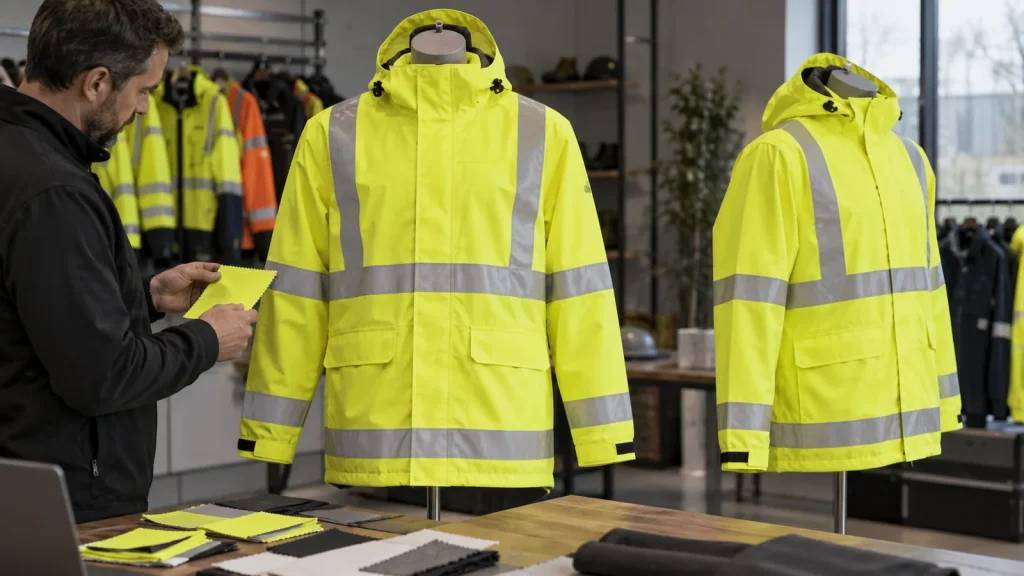
Keep bright colors separate from verified visibility performance
A bright raincoat can be visually distinctive without having verified high-visibility performance. For procurement, those are different propositions. If the job requires protective visibility, ask the responsible site specialist to define the applicable requirement and evaluate the proposed garment against it. A photograph of yellow fabric and silver bands is not enough. The evidence must relate to the actual style, configuration and intended market, including the sizes and decoration that will be supplied to your team.
ISO 20471:2013 addresses high-visibility clothing with requirements covering color, retroreflection, material areas and placement. Its catalog also identifies an amendment and a revision under development. Buyers should confirm the applicable edition and amendments when specifying an order. A draft under development should not be presented as an already published replacement. Equally, a supplier's reference to an older standard name should prompt clarification rather than an automatic assumption that every garment in its catalog meets the current requirement.
Request a product identification trail. The garment style on the quotation should match the evidence, the label and the sample. Ask how size variations and garment combinations are covered. If the supplier offers a jacket and trousers as a system, clarify what is claimed for each item separately and for the specified combination. Do not add class numbers together or assume that wearing two unrelated garments produces a particular classification. Obtain an assessment that addresses the proposed configuration.
Review the actual wearing arrangement. A vest under an opaque raincoat may be hidden, while a tool belt, backpack or large logo may cover parts of a visibility layout. The procurement team should surface these interfaces early so the responsible reviewer can evaluate them. Bring the equipment list and intended branding artwork to sampling. This is more useful than discovering during deployment that the rainwear cannot be worn in the way the site originally expected.
Be precise with supplier questions. Instead of asking “Is this hi-vis?”, ask for the exact standard reference, claimed class, covered style code, size range, relevant documentation and wearing limitations. Ask whether the decorated version is included in the assessment or requires further review. These questions do not presume a particular certification route or imply that the website's illustrative products are certified. They create a clear evidence request for the specific commercial proposal under consideration.
Maintain a distinction between procurement screening and a safety decision. Buyers can check that documents are complete and product references agree, but technical suitability for a particular site may require a competent specialist. Do not use an attractive classification as permission to relax traffic separation, lighting or other controls. Garment selection belongs within the site's broader safety arrangements. The purchasing process should support those arrangements by delivering the specified product consistently and preserving its instructions.
When comparing hi-vis waterproof jackets wholesale, remove unsupported claims from the scoring sheet until they are clarified. A proposal with complete, matching evidence is easier to assess than one with broad promotional language and unrelated reports. Record any outstanding limitation before commercial approval. This gives your team a defensible basis for selecting a visibility configuration and prevents a bright garment from silently acquiring a protective claim that its documents do not establish.
Preserve visibility through branding, layering and normal use
Visibility requirements can be undermined by changes made after a garment is selected. Company logos, job-role patches, extra pockets and identification holders all occupy space or change the garment's layout. Treat them as part of the design approval, not as a finishing step that happens outside technical review. The person responsible for the protective specification needs to see the final decorated garment, including the smallest and other relevant sizes, before the bulk order is released.
Start with an artwork placement drawing. State the intended location and dimensions of each mark, and show the underlying garment features. Include front, back and sleeve views where needed. Ask the supplier to identify any restricted areas and explain how the proposal will be reviewed against the garment's claimed performance. Do not set a universal allowable logo size from memory; the effect depends on the applicable requirements and the exact garment configuration. Obtain product-specific confirmation.
Check layering with the equipment actually issued. A rain jacket may sit over a vest, under a harness or alongside a radio system, depending on the approved arrangement. These combinations can affect both access and what remains visible. Where specialist equipment is involved, use its manufacturer's instructions and the site's competent reviewer. Do not improvise a layering order merely because it looks convenient in a fitting room. The trial should verify an approved arrangement, not invent one.
Include normal posture changes in the review. A wearer may be seen from the side, may bend to access a cabinet or may sit in a vehicle before stepping outside. Procurement should document the practical movements so the safety reviewer understands the use case. Avoid conducting informal visibility experiments around live traffic or moving plant. A controlled review area and appropriate specialist assessment provide a safer and more useful basis for identifying problems with fit, obstruction or garment configuration.
Plan for cleanliness and condition. Mud, wear and damage can affect the useful condition of the garment and its visibility materials. Obtain the care instructions and inspection criteria for the exact product. Decide who will check garments before issue and how workers report concerns during use. Do not assume that a stated cleaning allowance guarantees continued suitability regardless of contamination or damage. Actual condition and the manufacturer's instructions remain part of the decision to keep a garment in service.
Make change control practical for local teams. A supervisor may want to add a department badge, a contractor may propose a new logo and a laundry provider may suggest an alternative treatment. Give each group a clear route to request approval before changing the product or process. Keep the approved artwork, care method and equipment arrangement easy to retrieve. This reduces the chance that a small local adjustment creates a different garment from the one procurement originally approved.
At receiving inspection, compare the final branded items with the agreed reference. Check placement, component identity and the presence of required information without treating a visual check as a substitute for performance evidence. Record deviations and obtain a decision before issue. A consistent review process preserves the link between the supplier's documents and the garment workers receive. It also makes future reorders more predictable because the organization has a complete specification for the decorated product.
Build a visibility evidence file that can survive a reorder
A visibility evidence file should answer a simple question: what supports the claim on this exact product? Organize it around the garment, not around a collection of impressive documents. Start with the supplier's legal identity, style reference, specification revision and intended destination market. Add the relevant reports, declarations, certificates where applicable, instructions and approved artwork. A file that cannot connect those records to the supplied garment is difficult to use when a concern arises months later.
Check document scope before document appearance. A laboratory report for a reflective material may be useful evidence for that component, but it is not automatically a complete assessment of the assembled raincoat. A certificate may identify a limited set of models or configurations. Read the product references, dates, restrictions and issuing organization carefully. Where authenticity or applicability is uncertain, ask the supplier and the appropriate issuing body for clarification through normal channels. Do not fill gaps with assumptions based on a logo.
Create a one-page evidence index. List each requirement, the document that addresses it, the relevant product reference and the reviewer who accepted it. Mark unresolved items plainly. This index helps commercial staff understand whether an order is ready without asking them to interpret every technical detail. It also prevents the same report from being used to support unrelated claims simply because it is the only file available in the shared folder.
Include the approved size range and garment combinations. A later request for a different size or separate trouser style may need review even if the main jacket name remains unchanged. Likewise, a change in reflective material, background fabric or panel layout should trigger the agreed change process. Ask the supplier to notify your team before substitution. Keep the old and new revisions distinguishable so stores staff can identify which configuration has been received and where it is approved for use.
Record the destination and application assumptions. An item accepted for one project should not automatically be transferred into a different jurisdiction or a different type of work without review. The same applies when a distributor adapts a product for another customer. Procurement can make this manageable by keeping a clear allocation note with the item record. That note should explain the approved use in ordinary language and direct technical questions to the responsible person.
Before reordering, ask whether anything has changed since the previous supply. Request confirmation of construction, component sources where relevant, documentation status, instructions and branding. The answer should refer to the existing specification revision. If a change is proposed, assess it before treating the new quotation as a direct repeat. A familiar catalog photograph does not prove that the underlying garment or evidence remains identical, especially when a long time has passed between orders.
The file should remain useful after the purchasing team changes. Store final approvals in a shared location with clear filenames and access for the people who manage issue, inspection and replacement. Avoid relying on a single person's email thread. This is a practical business benefit as well as an evidence discipline: the next buyer can request the correct item, identify a deviation and explain the order requirements without rebuilding the entire decision from incomplete memories.
See the existing high-visibility raincoat sourcing overview for additional product discussion. Request current, style-specific evidence before relying on any protective claim.
05 / 12
Choose fit and coverage for real construction tasks
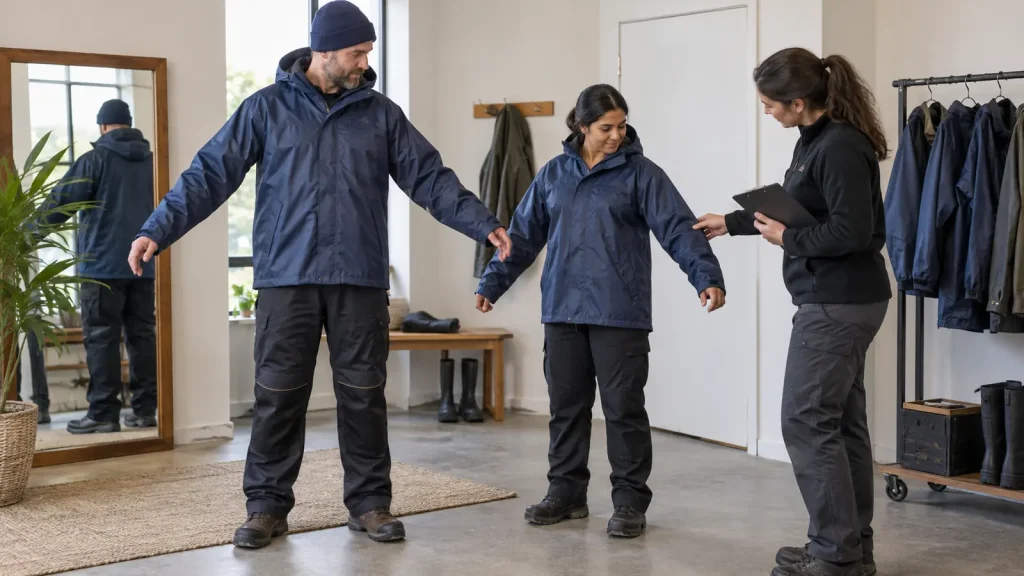
Build the size range from workers and their clothing layers
Size selection is a technical purchasing decision, not simply an allocation of small, medium and large labels. Different suppliers may use different measurements for the same letter size. Ask for a garment measurement chart and an explanation of the intended body range, including how the product is meant to fit over work clothing. Keep those two types of measurements distinct. A garment's chest circumference is not the same thing as the wearer's body circumference, and confusing them can produce an unsuitable order.
Start with the people who will use the rainwear. Include representative body shapes, heights and roles in a controlled fitting exercise. Where possible, use existing workforce information responsibly and collect only the measurements needed for fitting. Avoid making assumptions from job title or gender. The goal is to establish a workable range that provides suitable movement and coverage, including for workers who are poorly served by a limited selection of standard sizes.
Conduct the fitting with the actual layers expected in use. A sample that fits over a shirt may behave differently over a fleece or other approved workwear. Record the layer combination with the fit result so the supplier understands the context. If summer and winter arrangements differ substantially, evaluate both. Your team may decide that one shell range accommodates them or that separate configurations are justified. Either decision should follow the trial rather than a blanket instruction to order one size larger.
Check more than standing appearance. Ask wearers to reach forward, lift their arms, sit and perform other ordinary movements relevant to the role in a safe setting. Observe sleeve coverage, shoulder tension, hem movement and closure strain. Do not use hazardous work as a fitting test. A simple controlled sequence can reveal whether the garment restricts movement or produces excess material at important interfaces, without exposing the wearer to the risks of the actual task.
OSHA's construction PPE rule at 29 CFR 1926.95(c) requires safe design and construction for the work and selection that properly fits each affected employee. This requirement is relevant when the garment is being selected as PPE under that rule. It does not mean every ordinary raincoat is certified protective equipment. The practical procurement lesson is to involve the appropriate safety reviewer and document fit where protective equipment is required, rather than treating fit as an optional comfort preference.
Use the trial to build a quantity split and an exchange plan. Record which sizes were suitable, which were unavailable and where adjustments did not resolve a problem. Ask the supplier whether alternative lengths or other approved options are available, without assuming that every requested variation can be manufactured or covered by existing evidence. Include the commercial effects of additional variants in the quotation. A realistic size range is easier to manage when its replenishment requirements are understood before rollout.
Keep the final chart, fitting instructions and approved sample references with the order. Provide stores staff with a clear method for helping workers select and exchange garments. Review exchange data after issue; repeated changes in one direction may indicate that the guidance is confusing or that the range needs adjustment. This creates a feedback loop for future procurement and helps the organization avoid carrying a large quantity of rainwear that technically exists in stock but does not fit the people who need it.
Compare coat, jacket and trouser configurations by movement
Coverage is useful only when it remains practical during the intended work. A long raincoat, a shorter jacket with trousers and other configurations can create different movement and handling requirements. Begin by describing the areas that need weather coverage and the tasks that must remain possible. Avoid choosing length solely from a catalog photograph. A garment that covers well while standing may bunch when seated, pull during a step or interfere with access to equipment.
For a long coat, examine the hem and opening arrangement during ordinary walking, sitting and bending. Consider whether excess fabric can contact surrounding equipment or create a snagging concern in the intended environment. Have the responsible site reviewer assess these interfaces. Do not assume that maximum length always means maximum suitability. The required balance depends on the task, and some environments may rule out loose or trailing garments regardless of how convenient they appear for rain coverage.
For a jacket-and-trouser system, check the overlap during movement and how the trousers are put on and removed. Evaluate the waist arrangement, leg openings and compatibility with footwear according to the approved use. Ask whether the worker needs to remove boots to change garments and whether there is a suitable place to do so. These practical steps influence whether the system is likely to be used correctly when weather changes quickly during a shift.
Consider the differences between individual components and an assessed combination. Where protective performance is claimed for a system, obtain evidence and instructions for that particular arrangement. Do not substitute another trouser or jacket because the colors match. If the garment is ordinary weatherwear without such claims, the buyer still needs to check practical compatibility. Consistent identification of components makes both situations easier to manage at the issue point and during replenishment.
Review pocket access and carried equipment in each configuration. A long coat may cover a trouser pocket or tool belt; a shorter shell may leave another interface exposed during reaching. The answer may be a different garment design, an approved equipment arrangement or a change in storage practice. Avoid cutting openings or adding attachments after delivery without the appropriate review. Such changes can alter water paths, strength and any protective functions associated with the product.
Use a simple comparison record for each trial participant. Note the garment combination, layer arrangement, movements completed and specific concerns. Ask for direct observations such as “hem catches on the seat edge” or “trouser opening cannot pass over issued boot,” rather than only a general comfort score. This information can guide a targeted sample revision. It also gives decision-makers a practical reason for selecting one configuration over another when the commercial offers are otherwise similar.
Finalize allocation rules alongside the product choice. If different roles receive different configurations, explain the reason and identify who can approve substitutions. Keep shared stock clearly labeled so a convenient spare does not become an unsuitable replacement. A carefully chosen rainwear system should simplify daily decisions for workers and supervisors. It should provide the agreed coverage while respecting movement, equipment compatibility and the operational steps needed to put it into use.
Check hood, helmet and peripheral interfaces together
The hood is often one of the most noticeable parts of a raincoat in use, but it should not be reviewed in isolation. Its fit can change when worn with head protection, hearing protection, glasses or other equipment. Begin with the exact combination required for the task and the relevant manufacturers' instructions. The purpose is to identify a compatible arrangement, not to force an ordinary hood over equipment for which it was never designed.
Ask the supplier how the hood is intended to be worn and adjusted. Record whether it is fixed, detachable or stowable and what limitations apply. Check that adjustment controls are accessible and that unused material is managed as intended. Do not assume that a detachable hood can be omitted while preserving every product claim. If the garment has assessed protective performance, confirm the permitted configurations and keep those instructions with the issue guidance.
Evaluate normal head movement in a controlled setting. The wearer should be able to perform the movements relevant to the job without the hood unexpectedly shifting across the face or pulling the collar open. Observe how the hood behaves when looking left, right, up and down. Where vision or hearing is critical, involve the appropriate competent reviewer. A brief fitting observation can identify a concern, but it should not be represented as a formal assessment of every possible workplace condition.
Examine the collar and front closure together. A high collar may provide useful coverage but can feel restrictive with certain layers or equipment. Check whether it can be secured in the intended position and whether the wearer understands the adjustment. Note any tendency to leave the top open because the fit is uncomfortable. This gives the supplier a specific problem to address and helps the buyer decide whether the proposed size or design is suitable.
Consider storage and transition points. A hood that is stowed for indoor work should be able to return to its intended configuration without confusion. A detachable component needs a reliable way to remain with the correct garment. If shared stock is used, determine how missing parts will be identified before issue. Small detachable items can create operational problems when the product specification depends on their presence but stores procedures do not track them.
Avoid improvised modifications as a fit solution. Cutting a peak, shortening adjustment cords or adding a clip can change the design and introduce new problems. Seek an approved alternative or a revised garment specification through the supplier and responsible reviewer. HSE's PPE selection guidance emphasizes fit and compatibility and warns against modifying PPE to make it fit. Keep this principle in the procurement process so local teams have a practical route for raising a problem without altering the product themselves.
Document the accepted arrangement with clear photographs and brief instructions appropriate to the workforce. Identify the garment, relevant equipment and adjustment points, while avoiding unnecessary personal information. Repeat the compatibility review if either the rainwear or the other equipment changes. This is a small but valuable part of managing construction site rain gear: the garment must remain usable within the actual workwear system, including the interfaces that are easy to overlook in a quotation table.
06 / 12
Balance weather protection with wearer comfort
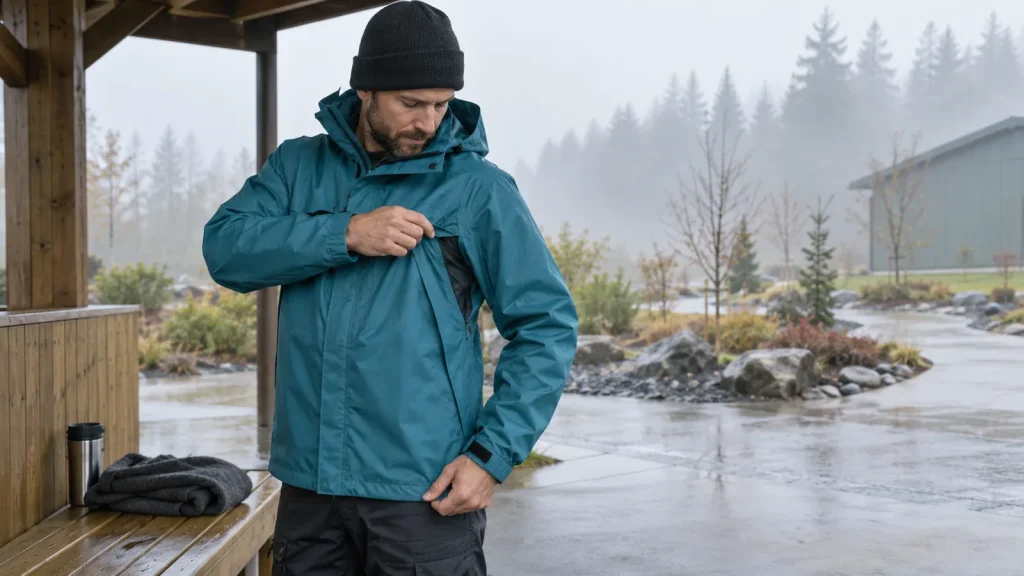
Separate rain penetration from internal moisture
Comfort complaints need careful description because “wet inside” can refer to several different situations. Water may enter through an opening or damaged area, or moisture may accumulate from the wearer and inner clothing. Procurement should not assume the cause from a short comment. Ask when the dampness appears, where it is concentrated, what the worker was doing and which layers were worn. This helps the team choose the right investigation instead of changing materials without understanding the problem.
Describe the activity pattern in the original brief. A worker who alternates between physical activity and stationary duties may experience the garment differently from someone conducting short inspections. Include access to shelter and opportunities to change layers. These details do not determine a single fabric choice, but they help suppliers explain the proposed construction and its limitations. They also help the organization decide whether one rainwear configuration is suitable for the whole workforce or whether different roles need different options.
When a supplier describes a product as breathable, request the underlying test method and result for the relevant construction. Different methods and reporting conventions cannot automatically be compared as equivalent scores. Ask the technical reviewer to explain what the evidence measures and what it does not predict. A material result does not guarantee a dry inner layer for every wearer, workload or weather condition. Keep those limitations visible in the purchasing file and avoid converting a marketing term into an operational promise.
Review the complete layer system rather than only the outer shell. Inner garments, insulation and other equipment can influence how the combination feels and functions. The buyer should document the intended arrangement and test it during the sample trial. Do not use a successful office fitting as evidence for a demanding shift. A controlled pilot can provide useful observations under stated conditions, while specialized thermal or physiological questions may need advice from appropriate occupational health or technical professionals.
Use a structured feedback form to make comfort information actionable. Ask participants to record the task period, layers, adjustments and location of discomfort. Separate observations about weight, restriction, warmth and dampness. A single satisfaction score can conceal important differences: one worker may like the fit but find the collar difficult, while another may prefer the closure but need a different size. Specific comments allow targeted changes instead of a complete redesign based on unclear feedback.
Investigate a suspected leak against the construction and care record. Check whether moisture follows a seam, opening or damaged area and whether the problem repeats under comparable conditions. Avoid using this process to dismiss worker reports as perspiration without examination. If the cause cannot be established through ordinary inspection, agree a suitable technical assessment. Clear evidence protects both the buyer and supplier from costly changes that do not address the actual source of the problem.
The procurement objective is a realistic comfort specification: defined use, relevant material evidence, an appropriate clothing arrangement and recorded wearer feedback. It should also state when work practices, breaks or other controls are needed under the site's arrangements. A raincoat is one part of managing outdoor work. Its description should help workers understand its intended use and limitations, rather than suggesting that any garment can make every weather and activity combination comfortable indefinitely.
Evaluate ventilation as a controlled design feature
Ventilation can make a rainwear design more adaptable, but every opening must be considered alongside weather coverage and the intended task. A vent is not automatically beneficial in every location or configuration. Ask how it is protected, when it is intended to be used and whether its operation affects any claimed performance. Review the actual sample rather than accepting a feature list that simply says “ventilated.” The details of placement, overlap and adjustment determine how the feature can be used.
Inspect the relationship between ventilation and water paths. A covered opening may behave differently when the wearer bends or carries equipment over it. Check the approved arrangement during ordinary movements in a safe trial. Record whether the vent remains covered and whether the wearer can operate it without removing essential equipment. Where the product has protective claims, confirm the permitted configuration with the responsible reviewer and supplier. Do not assume a garment remains within every claimed condition when all adjustments are open.
Consider whether users will understand the controls. Complicated adjustment systems can be difficult to operate with gloves or while wearing other equipment. Ask trial participants to use the garment with the instructions that will be supplied, then note repeated misunderstandings. The answer may be a simpler design, clearer information or a different product. A feature that exists on paper but cannot be used reliably during the intended work has limited value to the purchasing program.
Review snagging and obstruction concerns. Loose flaps, cords and openings may interact with nearby equipment or carried items. These issues belong in the site's assessment of suitability and should be raised before purchase. Avoid informal modifications such as adding ties or cutting material to hold a vent open. Seek a design that works within the approved use. Procurement can support this by making the actual equipment and movement requirements available to the supplier during development.
Include ventilation in the decorated sample review. A large print, added pocket or identification holder may cover an opening or change how a flap lies. Show all proposed customization on the approval drawing. If the design changes, review whether the vent still operates as intended and whether the change affects construction evidence. This is one reason branding should be integrated into sampling rather than applied after a blank garment has already been accepted as the final reference.
Evaluate care and inspection requirements for the feature. Mesh, protective flaps, zippers or other components can become damaged or obstructed in use. Ask what workers and stores staff should check and what constitutes a reason to remove the item from service. Keep the instructions practical enough to follow. An inspection process that requires unexplained technical judgments at the issue desk is unlikely to produce consistent decisions across different shifts and sites.
Make the commercial comparison explicit. If one proposal includes adjustable ventilation and another uses a simpler design, identify the actual benefit observed for the intended task, any added handling requirements and the evidence still needed. This lets the buyer assess whether the feature justifies its complexity. It also prevents procurement from treating a longer feature list as proof of a better industrial raincoat when the basic fit, coverage and operating arrangements have not yet been resolved.
Include seasonal change and drying capacity in the program
An industrial rainwear program should account for the way work changes through the year. The same shell may be worn over different layers, issued more frequently in one season and stored for long periods in another. Describe those transitions in the procurement plan. They affect size availability, care capacity and the number of garments that must be ready for use. A single headcount figure cannot capture all of these demands, especially across multiple sites.
Map seasonal clothing combinations with operations. Record the normal layers for each period and identify where the rainwear trial needs to be repeated. Do not assume that an insulated garment is always preferable in cold weather or that a light shell is suitable for every warm-weather task. The correct arrangement depends on the work and the site's assessment. Procurement should provide options and evidence for that decision rather than prescribe a universal clothing system from a catalog description.
Look at drying facilities before calculating spare stock. If many workers return wet garments at the same time, the available space and approved drying process may limit how quickly items can be reissued. Hanging garments too closely or putting them away damp may conflict with the intended care routine. Ask the supplier for product-specific instructions and check whether the site can follow them. Where professional cleaning is used, include transport and turnaround in the availability calculation.
Keep wet, dry and damaged stock distinguishable. The storage system should make it difficult to issue a garment that is awaiting inspection or care. Clear locations and simple status labels can be more effective than an elaborate inventory application that nobody updates. If garments are individually allocated, provide instructions for storage between shifts and a route for reporting damage. Shared stock needs an equally clear process, with responsibility assigned to the people who actually manage the issue point.
Plan for weather-driven demand without promising that stock can cover every disruption. Use previous issue records where available and identify the consequences of a shortage. Agree a replenishment trigger that considers usable stock, incoming supply and garments unavailable for care or investigation. Discuss realistic lead times and minimum order quantities with the supplier. A contingency arrangement should be documented, including which approved alternatives can be used if the preferred configuration is temporarily unavailable.
Review dormant stock before the season changes. Check that product identification, instructions and allocation rules are still clear and that stored items remain in suitable condition. If the specification or site requirements have changed, separate older versions until their suitability is reviewed. A carton that has never been opened is not automatically the right stock for a new application. Maintaining that distinction prevents procurement from treating all garments with the same color as interchangeable.
Use the seasonal review to improve the next order. Compare actual size demand, cleaning turnaround, replacement reasons and user feedback with the assumptions in the original plan. Adjust quantities and operating arrangements based on those observations. This creates a practical link between comfort, availability and cost. The supplier can then quote a better-defined program, while the site receives rainwear that fits its real schedule and care capacity rather than an idealized purchasing spreadsheet.
07 / 12
Manage standards, chemical requirements and product claims

Check the current rain-protection standard and the exact claim
Standards references need a date check before they enter a new purchasing specification. Older rainwear literature often refers to EN 343, but a familiar reference is not necessarily the current national edition. At the October 2026 research check for this guide, BSI's EN 343:2019 catalog entry was marked withdrawn, while BSI's EN ISO 24232:2025 entry was current. The latter identifies ISO 24232:2024 as its international counterpart. Buyers should verify the applicable edition and market requirements for their actual order.
The current BSI entry describes protection against precipitation, fog and ground humidity, with other effects such as water splashes and waves outside that stated scope. This distinction matters for industrial buying. A garment supported for rain protection should not be promoted as suitable for every liquid exposure. Chemical splashes, pressure washing, immersion and other hazards need their own assessment and appropriate evidence. Do not stretch the meaning of a rain standard to cover tasks simply because water is involved.
Keep three questions separate: which technical standard applies, what evidence supports the product and what legal market-access requirements apply to its supply. A standards catalog update alone does not answer every question about an existing certificate, transition arrangement or harmonized status. Ask the supplier and an appropriate technical or regulatory specialist to clarify those details. Do not declare all older stock invalid, or all newly labeled stock acceptable, based only on a change in the standard number.
Request the complete product claim in writing. It should identify the garment, applicable standard and edition, claimed performance and relevant limitations. Match that statement to the sample and supporting documents. If a quotation uses a shorthand such as “EN343 material,” ask whether it refers to a material test, a finished-garment assessment or something else. The distinction affects what the buyer can reasonably infer and what further evidence is needed before approval.
Avoid copying classification thresholds from memory into the order. Obtain the current standard and competent interpretation when detailed requirements are necessary. A public catalog summary can establish scope and publication status, but it does not replace the full technical text. Procurement should record the criteria approved by the responsible reviewer and the method for checking them. This keeps the tender usable without turning an incomplete online summary into an invented test specification.
Use a claims register alongside the evidence index. List proposed statements for the quotation, garment label, packaging and website. For each, record the supporting document and its scope. If the evidence supports a narrow construction or configuration, keep the wording equally narrow. Do not generalize one product's assessment across an entire supplier range. This is especially important when an OEM order changes the shell, trim, decoration or garment arrangement after an initial sample was reviewed.
Before release, ask the reviewer to confirm that the final specification, instructions and proposed claims agree. Record the date of that review and the approved revision. Repeat the check when standards, product details or destination requirements change. This process gives an industrial rainwear supplier a clear target and helps the buyer communicate accurately with its own workers or customers. It also prevents a familiar standard label from replacing the more demanding task of verifying the actual garment.
Treat chemical requirements as a component-level evidence task
A statement such as “REACH compliant” needs context before it can support an industrial rainwear order. The garment may contain a shell, coating, print, fasteners, labels and packaging, each with its own materials. Ask the supplier what the statement covers, which requirements were considered and how the supplied configuration is identified. A generic declaration with no product reference or review date may leave important questions unanswered, particularly when the order includes custom colors, prints or alternative trims.
ECHA's guidance on Candidate List substances in articles explains that inclusion of a substance can trigger obligations for producers, importers and suppliers of articles under specified conditions. Clothing is among the examples of articles it identifies. The Candidate List is only one part of the broader REACH framework. Buyers should have the applicable requirements assessed for the product and destination rather than treating one screening report as proof that every possible obligation has been resolved.
Create a component map for the compliance discussion. Identify the main material, coating or laminate, printing process, closure materials, reflective components where present, labels and relevant packaging. Ask the reviewer which components need declarations, testing or other evidence for the intended market. This targeted approach is more useful than requesting an undefined “full test” and receiving a report whose sample description does not match the finished product.
Control changes in the same way as other technical requirements. A new pigment, print process or fastening component can make an old document less relevant to the supplied article. Require the supplier to identify changes before production and explain what evidence needs updating. Procurement does not need to know every proprietary formulation to manage this process. It needs a reliable link between the approved component set, the evidence reviewed and the goods delivered.
California Proposition 65 uses an exposure-based warning framework. OEHHA's business resources explain that businesses determine whether warnings are required and describe circumstances where they are not. The presence of a listed chemical does not by itself answer every warning question, and “Prop 65 certified” is not a useful substitute for a product-specific assessment. Obtain appropriate specialist advice for the actual product, exposure and distribution arrangement when California is part of the intended market.
Keep warning decisions and artwork approvals connected. If information must appear on the product, packaging or sales materials, identify who supplies and approves it and how it will remain consistent through distribution. Do not improvise legal wording during the final print approval simply to meet a shipping deadline. Equally, do not assume a warning replaces other applicable product requirements. Record the basis of the decision and retain the approved version with the order documents.
The commercial brief should state destination markets early, before materials and branding are finalized. Ask suppliers to identify any gap between the requested evidence and what they can currently provide. Resolve that gap with the responsible reviewer before bulk production. This makes chemical requirements an organized procurement task rather than a last-minute request for a certificate. It also prevents broad compliance language from implying that this guide's illustrative rainwear has already been tested or approved for a particular jurisdiction.
Keep weatherwear, PPE and specialized protection clearly distinguished
Industrial use is a description of an application, not proof of a particular protective capability. An ordinary raincoat may be used for weather coverage, while another garment is supplied with defined PPE claims. Specialized tasks may require additional protection that ordinary rainwear does not provide. Begin the order by clarifying which category of requirement applies to the actual job and market. This avoids allowing the word “industrial” to carry more technical meaning than the evidence supports.
Ask the site's responsible safety professional to identify hazards and required controls before the product is selected. Procurement should explain the task to the supplier and obtain proposals that respond to the approved brief. Where chemical, heat, flame, electrical or other specialist risks exist, involve appropriate expertise and require relevant evidence. Do not infer resistance from a material's thickness, a dark color or a general reputation for durability. Those characteristics do not establish protection against a specific hazard.
Define the role of each document. A test report describes testing of an identified sample under a method. A declaration communicates a manufacturer's stated conformity within its scope. A certificate, where part of the applicable route, has its own coverage and conditions. A factory management-system audit addresses a different subject again. None should be casually substituted for another. The buyer's evidence index should explain what each record supports instead of collecting them under a single “certifications” heading.
Review the wording used by sales and purchasing teams. Phrases such as “safe for construction,” “all-weather protection” or “chemical resistant” can become broader than the underlying assessment. Replace them with precise descriptions of the intended use and verified properties. If a claim is not yet established, treat it as a requirement to investigate rather than a statement about the proposed product. This allows useful commercial discussions to continue without implying that a quotation has already passed technical approval.
Consider the effect of customization on responsibility and evidence. A private-label program may change names, instructions, packaging or product features. Ask who is responsible for each part of the final supply arrangement and what review is required before the product is placed on the intended market. Do not assume that putting a buyer's logo on a garment transfers or preserves every existing claim automatically. These responsibilities should be resolved with appropriate regulatory advice for the specific arrangement.
Make limitations useful to the people who issue and wear the garment. A technical file that never reaches operations will not prevent unsuitable substitutions. Provide clear allocation rules, approved configurations and instructions for reporting damage or a change in task. If a worker moves to a different role, the rainwear may need reassessment along with other equipment. The stores label should help identify the correct item, while detailed questions go to the responsible technical owner.
Before approving the bulk order, reconcile the commercial description with the technical decision. The style name, quotation, labels, instructions and evidence should describe the same product and scope. Resolve discrepancies in writing and preserve the accepted revision. This discipline supports accurate industrial rainwear sourcing without making unsupported claims about any particular supplier's capabilities. It also gives procurement a practical boundary: buy the garment that has been approved for the defined task, and refer new protective requirements back for proper assessment.
08 / 12
Customize industrial rainwear without compromising the brief
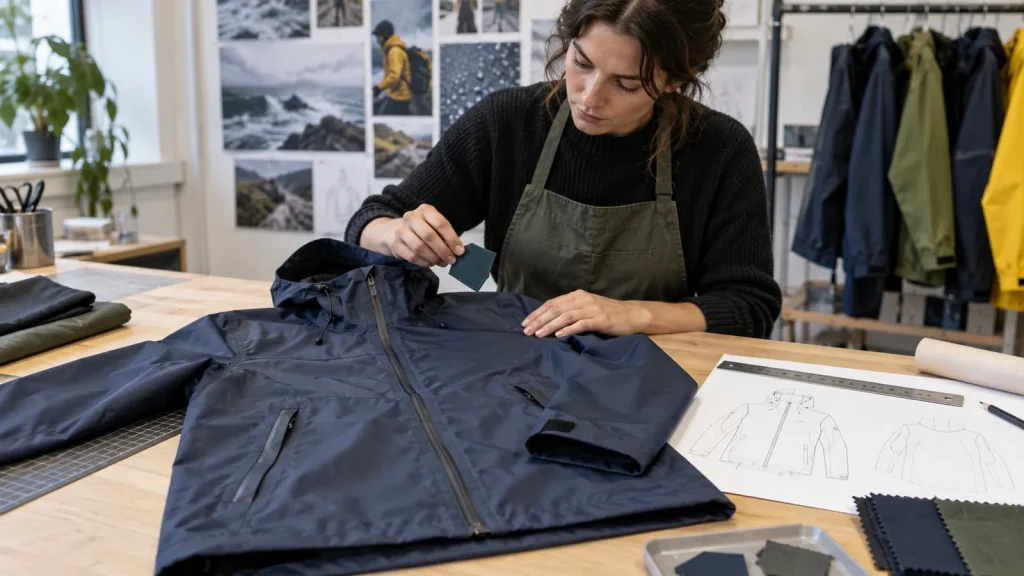
Define the purpose of branding before selecting a method
Industrial rainwear branding should solve an identification or communication need. A company logo may help customers recognize a service team, while a department mark may help a site allocate shared garments. Start with that purpose and decide what needs to be visible, where and to whom. This prevents the OEM Program from accumulating decorative features that complicate sourcing without improving the garment's usefulness. It also gives the designer a clear reason for each proposed mark.
Create a branding brief separate from, but linked to, the technical specification. Include the approved artwork file, intended colors, dimensions, placement and whether different roles need variants. State whether the garment has visibility or other protective requirements that constrain decoration. Ask the supplier to review the proposal against the exact construction. A print method suitable for one shell may not be suitable for another, and an attractive digital mockup does not establish adhesion, durability or compatibility.
Discuss the effect of the application process. Printing, transfers, stitching and patches involve different materials and manufacturing steps. Ask what the process changes on the garment and what checks are needed after application. Where stitching penetrates a weather barrier, for example, the resulting construction needs appropriate consideration. Do not assume any method is universally suitable for waterproof workwear. Require a decorated sample and relevant evidence for the proposed combination of shell, artwork and process.
Review placement in the actual wearing arrangement. A chest logo may be covered by a strap or identification holder; a back mark may be obscured by equipment. If the garment is intended to provide high visibility, decoration must be evaluated against the applicable requirements for that configuration. Avoid inventing a universal maximum print area. Ask the responsible reviewer and supplier to confirm what is acceptable for the specific style, size range and evidence package.
Keep visual approval distinct from technical approval. Marketing may accept color and logo proportions, while operations assesses recognition and practical placement, and the technical owner reviews any effect on performance. Each approval should refer to the same sample and artwork revision. Otherwise, the factory may receive one team's latest file after another team has already approved an older version. A clear release record prevents that common source of confusion.
Plan how branded variants will be ordered and replenished. Separate department names or project logos can multiply stock lines, especially across sizes. Ask whether the supplier can support the proposed split, what MOQ applies to each configuration and how repeat artwork is controlled. Do not assume a total order quantity automatically satisfies the minimum for every color, size or print variation. Have the quotation state its basis so the buyer can compare a consolidated program with a more fragmented one.
The output should be a concise decorated-product specification: garment revision, artwork revision, placement drawing, application method, approval responsibilities and evidence requirements. Keep a physical or clearly documented reference where appropriate. This turns “custom logo raincoats” into a controlled purchasing requirement. It also lets the supplier identify a practical alternative early if the original idea conflicts with the garment's construction, intended protective functions or realistic production arrangements.
Approve the decorated sample under the intended care process
A blank garment and a decorated garment are not identical approval subjects. The logo may affect appearance, flexibility, local surface behavior or the way a panel lies. Review the final proposed decoration on the actual shell construction before treating the OEM sample as complete. A digital rendering is useful for placement discussion, but it cannot show how the applied artwork behaves when the garment is folded, worn or cared for.
Define the sample's status when it is requested. State whether it is an artwork mockup, a process trial or a production-representative sample. If substitute materials are used to demonstrate layout, label that limitation clearly. The buyer should not approve the entire construction based on a sample intended only to show logo size. Ask for the remaining checks and the date when the production-representative version will be available. This makes the sample sequence more efficient because each stage has a defined decision.
Inspect the decoration against the approved artwork and placement drawing. Check legibility, proportions, alignment and the way it sits on the garment in its normal worn position. Note whether folds, seams or pockets distort the mark. For multi-size orders, ask which sizes need separate review because the available panel area changes. Do not allow a design that fits one reference size to be scaled or repositioned informally across the range without an agreed rule.
Evaluate the decoration after the relevant approved care process where that is part of the acceptance plan. Agree the method and criteria with the supplier and technical reviewer. Observations might include visible lifting, cracking, unwanted transfer or other specified changes, but the exact checks should fit the construction and claim. Avoid presenting a casual home wash as proof of industrial laundry suitability. If the program uses professional cleaning, involve that provider and obtain the appropriate product-specific evidence.
Check the relationship between decoration and garment features after conditioning. A print can cross a fold or sit close to a flap, and a patch can change how an area flexes. Inspect closures, ventilation and panel movement again on the decorated sample. Where protective performance is relevant, obtain the required technical review rather than relying on appearance alone. The final release should cover the product as it will be supplied, not a blank version that no worker will actually receive.
Record feedback as specific correction requests. “Move the logo away from the pocket opening by the agreed distance” is more useful than “make it look better.” Use a marked drawing and revision number rather than a series of loosely connected email comments. Confirm which changes require a new sample and which can be checked through another agreed method. This prevents repeated sampling caused by misunderstandings and protects the delivery schedule from avoidable artwork changes.
Retain the accepted decoration reference with the garment approval. During bulk inspection, compare the supplied items with that reference and the written tolerances. If a different print process or material is proposed later, reopen the relevant approval steps before production. A reliable OEM Program depends on this continuity. It gives the buyer consistent branding while maintaining the connection between appearance, care, construction and any evidence required for the garment's intended use.
Keep labels, instructions and packaging useful to the wearer
Labels and packaging are part of the product's operating information. They help workers identify a size, understand care and recognize the garment's intended configuration. Plan them while the product is being specified, not after all production decisions are complete. A supplier can only quote and prepare useful information when the buyer has provided the destination, language needs and private-label arrangement early enough for proper review.
List the information required by the applicable product and market rules with the responsible reviewer. Then add the practical information your organization needs, such as an internal item reference or issue identifier. Keep these categories distinguishable so a warehouse convenience does not displace mandatory product information. Do not invent certification marks or copy another garment's label layout. The label should describe the actual supplied product and use the wording approved for its evidence and destination.
Make size information easy to use at the issue point. Where letter sizes are used, provide access to the relevant measurement guidance rather than assuming workers understand the supplier's sizing system. Check that garment and individual-pack labels agree. A mismatch can cause avoidable exchanges even when the garment itself was manufactured correctly. For shared stock, consider how the size remains identifiable after the outer packaging has been removed and the garment has entered normal care circulation.
Review instruction readability and language needs. The people using the garment may not be the people who placed the order. Important limitations, care procedures and configuration instructions should be accessible to those users in the form required for the intended market and workplace. Ask operations to review the practical wording, while technical or regulatory staff approve relevant claims. Avoid filling the instruction sheet with promotional text that makes essential information difficult to find.
Choose packaging around protection and handling. A garment may need to arrive clean, dry and identifiable, but elaborate individual packaging can slow issue and increase storage volume. Compare bulk packing options against the actual receiving and distribution process. Ask for a packing sample and carton specification. Confirm pack count, carton dimensions, gross weight and markings, with units stated clearly. Do not accept a packaging change that damages closures, obscures identification or creates confusion between garment variants.
If sustainability claims appear on packaging, assess them separately from the garment's protective or performance claims. Specify exactly which component a recycled-content or other environmental statement concerns and what evidence supports it. A packaging claim should not imply the same property for the raincoat inside. Use the sustainable rainwear guide linked in this article for a broader claim-review framework, and obtain current product-specific documentation before approving any environmental wording for the order.
Finish with a complete information approval set: garment label, care instructions, individual pack where used, carton marks and artwork revisions. Check consistency before production release and again at receiving inspection. This is a practical way to reduce errors without adding unnecessary complexity. The worker gets a garment that can be identified and used as intended, while procurement retains a clear record of what was approved and what the supplier was asked to deliver.
For packaging and material claim questions, consult our sustainable rainwear procurement guide. Keep environmental claims distinct from weather and protective performance.
09 / 12
Write an EAV specification suppliers can quote accurately
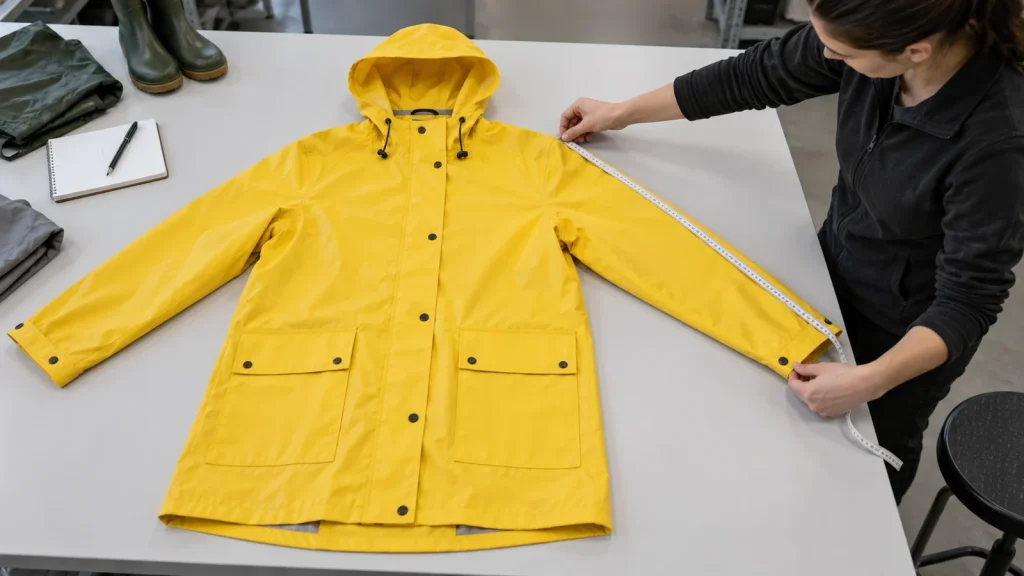
| Entity | Attribute | Value to specify | Evidence or acceptance check |
|---|---|---|---|
| Use case | Task and exposure | Activity, shift pattern, weather and site constraints | Approved use-case brief |
| Shell | Construction | Named fiber/polymer, coating/laminate and layer structure | Identified bill of materials and sample |
| Material | Mass or thickness | g/m² for textile; mm or µm where relevant; tolerance | Agreed method and sampling positions |
| Material / seams | Rain protection | Named test method, conditioning and acceptance values | Product-matched report; seams evaluated separately |
| Visibility system | Required performance | Applicable standard/edition, class and garment combination | Evidence for exact style, size range and branding |
| Garment | Dimensions | Chest, length, sleeve, hood and openings in cm; tolerances | Measurement drawing and representative fit trial |
| Closures | Operation and protection | Zipper, storm flap, cuffs, pockets and fastening design | Approved sample and practical wearing assessment |
| Whole garment | Weight and comfort | Garment mass in g by reference size; ventilation arrangement | Sample weighing and controlled wearer feedback |
| Care | Permitted treatment | Approved wash/dry procedure and stated limitations | Manufacturer instructions and relevant evidence |
| Branding | Placement and process | Artwork dimensions in mm; location; application method | Decorated sample and compliance review |
| Order | Variant and supply plan | Quantity by size/color, MOQ, delivery destination and milestones | Written quotation and deviation register |
| Carton | Packing and logistics | Pack count, dimensions in cm, gross weight in kg | Packing list and receiving inspection |
Turn an EAV table into an unambiguous buying specification
An EAV table organizes each requirement as an entity, an attribute and a value. For rainwear procurement, the entity might be the shell, a closure, the finished garment or the packed order. The attribute describes what is being specified, and the value states the agreed requirement. Add a fourth column for evidence or acceptance checks. This extra column prevents the table from becoming a list of aspirations that nobody knows how to verify when samples or bulk goods arrive.
Use the table above as a framework, not as a set of universal performance values. The correct values depend on the job, product and applicable requirements. Leave an item marked for clarification when the responsible reviewer has not yet decided it. Do not fill gaps with figures borrowed from an unrelated catalog. A clearly unresolved field is more useful than a precise-looking number that has no basis in the intended task or the proposed construction.
Define units and measurement methods together. For textile mass, state whether the figure covers the full construction or a particular layer. For garment dimensions, identify the measurement points, whether the garment is laid flat and what tolerance applies. For carton weight and dimensions, use consistent units and distinguish gross from net weight where relevant. These details can seem minor during quoting, but they prevent disagreements caused by suppliers answering different questions with similar-looking figures.
Keep requirements measurable without forcing every useful observation into a number. Some features are best defined by an approved drawing, component reference or practical acceptance check. A pocket arrangement may require a placement drawing; a closure may need normal-operation criteria; a particular appearance may use an agreed reference sample. State which reference controls the decision. Avoid vague phrases such as “good quality” when a more concrete description of the accepted condition is available.
Separate required values from supplier-proposed values. Early in sourcing, the buyer may define the use case and ask suppliers to propose an appropriate construction. Label those proposals as proposals until they are reviewed. Once accepted, move them into the controlled specification with a revision and date. This preserves useful supplier input without allowing an unexamined quotation detail to become an approved requirement simply because it appeared in the first spreadsheet.
Give each requirement an owner where several teams are involved. The technical reviewer may approve performance evidence, operations may confirm pocket access and procurement may finalize packing quantities. A short owner column or linked approval sheet can make responsibility clear. It also helps resolve conflicts: a request for larger branding should be routed back to the person responsible for any affected visibility requirement, rather than being approved only as an artwork change.
The completed EAV specification should be readable by the supplier, sample reviewer and receiving inspector. Test it by asking each to explain what they would check for a few critical rows. If their interpretations differ, revise the wording before production. This is a low-cost way to discover ambiguity early. A good technical buying sheet does more than collect information; it creates a shared definition of the garment and order that the parties intend to approve, manufacture and receive.
Attach evidence, tolerances and deviations to the same revision
A specification becomes difficult to manage when its values live in one file, test reports in another and exceptions in scattered messages. Link these records through a common product and revision reference. The buyer should be able to select a requirement and find the supporting evidence or accepted deviation without reconstructing the full conversation. This is especially important for customized industrial rainwear, where several sample rounds can produce small but consequential changes.
Number the important documents in a simple, consistent way. The style, material list, measurement drawing, artwork and packing specification should each have an identifiable revision. The approval record should state which combination is released. Avoid relying on filenames such as “final” and “final new” without dates or revision control. A supplier may otherwise manufacture to one drawing while the receiving team inspects against another, even though both believe they are using the approved version.
State tolerances where variation is expected and meaningful. The tolerance should be appropriate to the feature and agreed with the technical reviewer and supplier. Do not use a single percentage for every dimension merely because it is easy to enter in a spreadsheet. A closure placement, a body width and a carton dimension may need different treatment. Also identify features where a deviation cannot be accepted without review because it affects suitability or a protective claim.
Create a deviation register during quotation and sampling. Each entry should describe the requested requirement, the proposed difference, its reason and the decision. Include any effect on evidence, care, branding, timing or commercial terms. An accepted deviation should lead to an updated controlled specification or a clearly referenced exception. A verbal agreement is hard to apply consistently when the people inspecting the goods were not present during the supplier call.
Link reports to the sample they address. Record the report identifier, issuing organization, sample description and relevant scope. Ask the supplier to explain how that sample relates to the ordered style and components. If the report predates a construction change, have the responsible reviewer decide whether it remains relevant. Do not assume that a more recent date automatically means better evidence; a current report for the wrong material may be less useful than an older report that matches the approved construction.
Use a release checklist before production. Confirm the required specification, evidence review, decorated sample, quantity split, packing and delivery milestones. Identify unresolved items explicitly and decide whether they prevent release. The checklist should not be a ceremonial signature exercise. It should make clear what the supplier is authorized to produce and what still requires approval. If a conditional release is appropriate, record the condition and the point beyond which production must not proceed without resolution.
Preserve the released set for receiving inspection and future reorders. Keep superseded versions available for traceability but clearly distinguish them from current instructions. This gives the buyer a practical way to handle a complaint, investigate a substitution or request an identical repeat order. The discipline is particularly valuable when multiple factories, decorators, distributors or site teams are involved, because it reduces the chance that each party works from a different understanding of the same style name.
Request comparable quotations with a complete RFQ packet
A useful request for quotation gives suppliers enough information to price the same job. For industrial rainwear, include the use-case brief, technical specification, artwork, quantity split, destination and delivery requirements. State which documents are fixed and where alternatives are welcome. Without this packet, one supplier may quote a stock garment with no decoration while another includes custom material, testing and individual packaging. Their commercial totals would not represent equivalent offers.
Begin the RFQ with a concise project summary. Identify the wearer groups, intended tasks, applicable technical requirements already approved by your team and the planned issue date. Include the expected order range without presenting it as a commitment before approval. Ask the supplier to confirm whether the proposed configuration is available and which elements require development. This separates a ready option from a project that still needs material sourcing, sample work or further evidence.
Request quantity details by style, size, color and branding variant. Ask what MOQ applies at each relevant level and what assumptions the quotation makes about combining variants. A total quantity can hide a difficult split across many small lines. Invite suppliers to explain a more practical configuration where appropriate, but require them to identify any change from the original brief. The buyer can then assess consolidation against operational needs rather than accepting it as an unexplained commercial condition.
Ask for a milestone schedule instead of a single lead-time phrase. Separate time for sample development, artwork approval, evidence review, production, inspection and transport. State when the clock begins and what buyer decisions can delay progress. Request the quoted delivery basis, destination and responsibilities for transport and import arrangements. Do not assume that “door to door” or a familiar trade term resolves every operational detail without checking the written proposal.
Make included and excluded work visible. Identify whether sample charges, decoration setup, testing, inspection, packaging development or other project-specific services are included in the proposal. No public unit price is needed to explain this discipline. The purpose is to compare Bulk Pricing on a consistent scope and avoid surprises after a supplier has been selected. Ask how changes in quantity, artwork or material will be quoted and approved during development.
Use a quotation comparison sheet with separate technical and commercial decisions. First confirm that mandatory requirements are met or that deviations have been accepted. Then compare the total program implications, including stock complexity, care, replacement and replenishment. A commercially attractive offer with unresolved evidence is not yet a like-for-like alternative. Give suppliers a defined opportunity to answer clarification questions, and keep the final responses attached to the version being evaluated.
Close the RFQ process with a written acceptance package that identifies the agreed product and scope. Confirm the approved revisions, quantity matrix, milestones and outstanding conditions. Do not rely on a purchase order line reading only “industrial raincoats.” A complete packet helps the supplier deliver the intended garment and gives your organization a clear basis for inspection. It also makes the next buying cycle faster because the successful specification and commercial assumptions can be retrieved and reviewed rather than recreated.
10 / 12
Approve samples and inspect bulk industrial rainwear

Give every sample round a specific approval decision
Sampling works best when each sample has a defined purpose. A material swatch can support an early construction discussion; a fitting sample can help establish measurements; a decorated sample can confirm the proposed branding process. A production-representative sample may then bring those decisions together. Tell the supplier which decision you expect to make at each stage. This avoids approving a convenient substitute sample as if it represented every aspect of the eventual bulk order.
Request a sample identification sheet. It should state the style, size, material and artwork revisions, date and any known differences from the proposed production garment. Keep that sheet with the sample during review. If a zipper, lining or color is temporary, record the limitation before comments are collected. Otherwise, one reviewer may reject a detail that was never intended for production while another assumes that the same detail has already been accepted.
Organize sample review around the people who own the requirements. Operations can assess practical access and issue arrangements, representative wearers can report fit and movement, and the technical reviewer can assess evidence and relevant performance requirements. Procurement coordinates the record and commercial consequences. Give each reviewer a focused checklist so feedback remains specific. A general request to “approve the sample” often produces enthusiasm about appearance while leaving critical questions unanswered.
Use controlled practical trials for ordinary usability observations. Keep the activities representative but separate from hazardous operations, and follow the site's arrangements for any protective equipment involved. Record the garment combination, layers, participants' relevant size range and conditions. Do not claim the trial proves universal suitability. Its value is in identifying issues that the sample room may miss and providing a documented basis for a targeted revision or a more formal assessment where needed.
Consolidate feedback before sending it to the supplier. Resolve conflicting requests internally and identify mandatory corrections separately from preferences. Use photographs or marked drawings with a single revision reference. Ask the supplier to confirm its understanding and explain any consequence for cost, timing, construction or evidence. This reduces repeated sample rounds caused by disconnected comments and helps the buyer preserve the parts of the design that already work well.
Decide how each correction will be verified. Some changes may require a new physical sample, while others may be checked through an agreed drawing or document review. The appropriate method depends on the feature and risk. Do not assume a photograph can establish a hidden seam detail or a performance characteristic. Conversely, avoid repeating an entire sample program for a minor information correction when a simpler, appropriate check would resolve it. Record the reason for the chosen verification route.
Release the final sample only when its status is clear. Identify it as the agreed production reference and link it to the specification, artwork and evidence set. State any remaining conditions that must be resolved before manufacture or shipment. Preserve the reference in a way that receiving staff can use. A well-managed sample process creates a shared understanding of the product; it should not end with an ambiguous email saying “looks good” that leaves the factory and buyer to interpret what was actually approved.
Build a bulk inspection plan around meaningful defects
Bulk inspection should check whether the goods match the approved requirements. Begin with a defect list that reflects the product and intended use, not a generic clothing checklist copied without review. Include product identity, materials, measurements, construction, closures, decoration, labeling and packing as appropriate. Identify which deviations require technical review or prevent issue. This gives inspectors a clear basis for decisions and reduces arguments about whether a visible difference is merely cosmetic or operationally important.
Agree the inspection method and sampling plan with the relevant parties before production. State the lot definition, selection procedure, checks and acceptance rules. Where a formal sampling standard is used, specify the applicable plan and have competent staff interpret it. Avoid choosing an arbitrary acceptance number because it appeared on a previous order. Inspection sampling manages defined acceptance decisions; it does not guarantee that every item in an accepted lot is free from defects.
Separate workmanship inspection from laboratory performance testing. Inspectors can check a closure's normal operation, compare measurements and identify visible faults. They cannot establish every rain protection, chemical or visibility claim by looking at the garment. The verification plan should state which requirements rely on reports, which need production-related testing and which are checked visually or functionally. Keeping these routes distinct makes the inspection report more informative and prevents a general “passed inspection” statement from becoming broader than the checks performed.
Use approved references at the inspection point. Provide the current specification, measurement drawing, artwork, labels and sample photographs or physical reference as appropriate. Confirm that the inspector is using the released revision. If the supplier proposes a substitute component during production, resolve it before inspection rather than asking the inspector to decide whether it is equivalent on the spot. That equivalence may require technical evidence outside the inspector's assignment.
Make defect descriptions reproducible. Identify the location, measured difference or failed operation and include clear photographs where useful. Avoid entries such as “bad quality” without explanation. Distinguish a missing required label from a label printed in the wrong position, or a closure that cannot engage from one that simply feels different. Specific records help the supplier investigate the cause and allow the buyer to evaluate whether the proposed corrective action addresses the actual issue.
Plan the response to nonconforming goods. Define who can authorize rework, replacement, further assessment or rejection under the agreed commercial arrangements. Keep affected goods identifiable and prevent accidental issue while a decision is pending. If rework changes the garment, determine which checks must be repeated and whether any evidence or instruction needs revision. A quick local repair is not automatically an acceptable solution, especially where protective performance or traceability is involved.
Close inspection with a clear release decision and supporting record. State the scope checked, results, unresolved limitations and the authorized next step. Share the information with receiving staff so they know what to verify when the shipment arrives. This creates continuity from supplier inspection to site issue. It also gives future procurement a useful history of recurring defects and successful corrective actions, allowing the next order to focus on demonstrated concerns rather than an ever-growing generic checklist.
Make receiving inspection and field feedback part of acceptance
Receiving inspection is the point where the purchasing specification meets the site's physical stock. Check the shipment identity, quantities and condition against the order and packing documents before distributing garments. Confirm that style, size, color and branding variants are identifiable. Even a shipment that passed an earlier inspection can arrive with transport damage, packing errors or paperwork discrepancies. The receiving process should be proportionate, clear and connected to the evidence already collected.
Prepare the receiving team before arrival. Give it the approved item references, carton markings, quantity matrix and instructions for handling discrepancies. State which checks can be completed locally and which need referral. A stores employee should not have to infer whether an unfamiliar label or component is acceptable. Provide a contact and a simple holding process so uncertain goods remain identifiable while the responsible person reviews the issue.
Check carton and garment identification together. A correctly labeled carton can still contain the wrong size mix, and a garment can have a mismatched individual pack. Use the agreed receiving procedure to verify the relevant details. Record discrepancies by carton and item reference rather than only reporting a total shortage. This helps the supplier investigate efficiently and lets the buyer determine whether a problem affects a limited portion of the delivery or the wider shipment.
Inspect the condition of packaging and selected goods for signs of damage or unsuitable storage during transit. Follow the product's instructions when unpacking and handling wet or suspect items. If contamination or a protective-function concern is possible, use the site's established process and appropriate expertise. Do not issue questionable garments merely because the project start date is approaching. Procurement should have a documented route for replacement stock and commercial follow-up when acceptance is delayed.
Track the initial issue period as part of program review. Record size exchanges, missing components, closure difficulties and any reported performance concerns. Keep manufacturing complaints separate from allocation or care problems, while recognizing that more than one cause may be involved. A short review after the first rollout can reveal whether the fitting guidance, packing sequence or instructions need improvement even when the delivered garments match the order.
Give the supplier structured feedback linked to the shipment and specification. Include the facts needed to investigate, with personal information limited to what is necessary. Ask for a response that distinguishes cause, containment and proposed corrective action. If the solution changes the product, follow the established revision process. Do not let a complaint resolution create an undocumented version that later arrives mixed with the original design under the same item description.
Use acceptance data to improve future sourcing. Repeated packing errors may justify clearer carton requirements; repeated size exchanges may call for better fitting guidance; recurring construction faults may require a design or process review. Preserve the evidence and update the brief deliberately. This gives the industrial rainwear program a practical learning cycle. The next bulk order can reflect actual receiving and wearer experience, while the buyer retains a clear record of what was supplied, accepted and changed.
For a wider sampling discussion, read our wholesale rainwear sample buying guide and agree the current sample terms for your specific project.
11 / 12
Control care, replacement and total program cost
Compare total program cost on an equivalent service basis
The purchase quotation is only one part of an industrial rainwear program's cost. The organization also manages fitting, issue, cleaning, drying, storage, replacement and administration. Compare proposals against the same service requirement before deciding which offer is commercially preferable. A lower initial cost may be useful, but it does not answer whether the proposed configuration can be maintained and replenished in the way the workplace needs. Equally, a more expensive feature needs a practical reason, not an assumption that it will pay for itself.
Define the comparison unit carefully. It might be a worker equipped for an agreed period, a site supplied through a season or a specific project with a known issue plan. State what each option includes: garment configuration, expected availability, approved care arrangements and the stock held for exchanges or downtime. This makes the comparison meaningful. Counting garments alone can conceal differences between a single-coat proposal and a program that includes trousers, spare sizes or care support.
Build a cost model from your own records and supplier quotations. Include acquisition, decoration, relevant verification, transport, storage, care and replacement where they apply. Keep assumptions visible, especially for service life and loss rates that have not yet been observed. Do not use invented industry averages to make one material look economical. An honest range or a pilot-based assumption is more useful than a precise total built on unsupported durability claims.
Use a sensitivity check to identify what drives the decision. For example, compare what happens if cleaning turnaround is longer than expected or if size exchanges require more reserve stock. These are planning scenarios, not predictions. If a small change in one uncertain assumption reverses the preferred option, collect better evidence before committing to a large rollout. The exercise can show that a modest pilot or improved stock record has more value than negotiating a small change in the garment quotation.
Keep operational consequences visible even when they are difficult to price. Confusing size labels, repeated closure problems or inconsistent replenishment can consume staff time and disrupt issue. Record these concerns alongside the financial model rather than assigning arbitrary monetary values. Where your organization has reliable time or incident records, use them carefully and explain the basis. The objective is a transparent decision, not a spreadsheet that gives a false impression of certainty.
Ask suppliers to quote alternatives on the same scope. A stock color, simplified artwork or consolidated packaging arrangement may reduce complexity without changing the essential performance requirement. Have each alternative identify what changes and what remains subject to approval. Do not accept savings achieved by quietly reducing coverage, changing an assessed construction or omitting required evidence. Commercial negotiation should occur within a clear technical brief so the buyer knows what it is comparing.
Record the final decision in a short business case. Explain the selected configuration, confirmed costs, major assumptions and the observations that will be reviewed after rollout. Include the person responsible for updating the model. This makes Bulk Pricing part of a complete procurement decision rather than an isolated number. It also gives the next buyer a useful baseline: they can see which benefits were expected, which were actually observed and where the program needs adjustment.
Establish care, inspection and replacement rules before issue
Care instructions are only useful when the workplace can follow them. Obtain the instructions for the exact garment and discuss them with the people who manage cleaning, drying and storage. Confirm whether the proposed process matches available facilities or the laundry provider's service. Do not assume all coated or laminated rainwear can be treated in the same way. The approved shell, trims, decoration and protective features may impose different limitations that need to be understood before the first garments are issued.
Create a practical pre-use check based on manufacturer instructions and the site's requirements. It may include visible shell damage, seams, closures, labels and relevant visibility materials, with clear referral points for uncertainty. Avoid asking workers to make technical judgments that require laboratory equipment or specialist interpretation. The check should help identify obvious concerns and route them to the responsible person. Where suitability is in doubt, use the site's process for taking the item out of service and providing an appropriate replacement.
Distinguish cleaning from repair. Removing dirt according to the instructions does not restore a damaged seam or failed component. A proposed repair needs its own approval route, particularly if the garment has protective claims. Ask the supplier whether an approved repair is possible, who can perform it and how the item is assessed afterward. Do not promise that a patch, adhesive or replacement zipper will preserve the original performance without product-specific support.
Define replacement triggers in terms users can understand. These should follow the product instructions and relevant technical review, rather than an arbitrary calendar rule alone. Visible damage, an inoperative closure or another identified concern may require action before a nominal service period ends. Conversely, a purchase date by itself does not describe the condition of every garment. Keep the decision process clear, including who evaluates borderline cases and how the result is recorded.
Track why garments leave service. Separate wear, accidental damage, missing items, fit changes and unresolved performance concerns. This information helps procurement distinguish product issues from operating-system issues. A high number of lost garments may need a better issue process; repeated seam damage may need investigation of construction or use; frequent size exchanges may indicate inadequate fitting guidance. Combining every reason under “replacement” hides the evidence needed to improve the next order.
Plan for garments that are unavailable during care or assessment. Reserve stock should be based on actual demand and turnaround where possible, with the necessary approved sizes and configurations. A spare that cannot be used for the role is not effective contingency stock. Review shortages and overstock periodically. This keeps availability aligned with the working population and avoids buying large quantities of a common size while workers at the edges of the range remain poorly served.
Provide brief, usable instructions at issue and maintain a route for questions. Workers should know how to wear the garment as intended, where to store it and how to report a concern. Supervisors should know when a change in task requires reassessment. This connects procurement with daily use. A clear care and replacement system can preserve the value of a suitable garment, while also making it easier to identify when the product or the program needs to change.
Replenish deliberately and review sustainability with evidence
Replenishment should preserve the approved product while responding to actual demand. Start with a stock record that distinguishes usable garments, items awaiting care or inspection and incoming orders. Track by the variants that matter: style, size, color, branding and approved configuration. A total stock count can look healthy while the required size is unavailable. The purchasing trigger should reflect what can actually be issued to the workforce, not only what is physically present in the storeroom.
Review supplier lead times and MOQ when planning repeat orders. These can change with material availability, customization and the size of the replenishment batch. Ask for a current proposal that references the existing specification. If the supplier cannot repeat the exact construction, require an identified alternative and the appropriate review. Do not treat a visually similar garment as an automatic substitute, especially where evidence, care or equipment compatibility depends on the approved design.
Use demand records to simplify variants where practical. Several nearly identical branded versions may create slow-moving stock and complicate exchanges. Consider whether a common approved garment with a controlled identification arrangement can meet the operational need. Any simplification should preserve relevant technical and branding requirements. The aim is to reduce unnecessary complexity, not to force different jobs into one garment merely because it is easier to count in a warehouse.
Discuss sustainability through specific, supportable objectives. Extending useful service through suitable care, improving stock accuracy or documenting a particular recycled-content attribute are different projects. Define the baseline and evidence for each. Do not assume that a reusable garment automatically has a lower environmental impact in every scenario. Actual use, care, replacement and after-use arrangements influence the program, and a broad environmental comparison may require a more rigorous assessment than ordinary purchasing records can provide.
If environmental claims are proposed for a material or finished garment, identify the exact component and the supporting documentation. Keep these claims separate from rain protection and other performance evidence. A material change intended to meet a CSR objective still needs review for suitability and any affected protective claims. Use the linked sustainable rainwear guide to structure those questions, then obtain current evidence for the specific product. Avoid suggesting that a general material family is universally recyclable or biodegradable.
Plan the route for retired garments according to their condition, composition and local acceptance. Contaminated or specialized workwear may need handling arrangements beyond ordinary textile collection. Ask the responsible site team and receiving organization what they accept before describing a recycling or reuse program. Do not print an end-of-life promise simply because a collection bin exists. A credible plan identifies the responsible party, accepted material and practical process, including what happens when an item is unsuitable for that route.
Hold a periodic program review using procurement, stores and wearer feedback. Compare forecast demand with actual issue, examine replacement reasons and confirm that product documentation remains current for the intended use. Record changes and update the next RFQ deliberately. This gives the organization a sustainable operating habit in the ordinary sense of maintaining a workable supply system. Any stronger environmental claim should remain tied to evidence, clearly defined scope and outcomes the program can actually demonstrate.
Review recycled-content, reuse and after-use questions in the eco-friendly and sustainable rainwear guide. Product suitability and environmental evidence need separate review.
12 / 12
Industrial rainwear FAQ for procurement teams

Which industrial raincoat material should our company choose?
Choose the material as part of a complete garment specification for the work. There is no reliable universal answer based only on a polymer or fiber name. Begin with the task, weather exposure, movement, other equipment and care arrangements. Then ask suppliers to propose constructions that meet the approved requirements. Compare the shell, barrier layer, seams, closures and garment configuration together. This gives the material choice a practical purpose and avoids selecting a familiar name that does not solve the actual problem.
For an initial inquiry, send a short use-case brief and ask for two or three clearly described options if appropriate. Request the complete construction, available evidence, limitations and project-specific commercial requirements. Ask what differs between the options and why that difference matters for your task. Do not assume that a thicker material is automatically more durable in every respect, or that a lighter one is necessarily more comfortable through a full shift. Those conclusions need a relevant comparison.
Request samples that answer the unresolved questions. A swatch can help compare texture and appearance, while a complete garment is needed for fit, closure operation and coverage. If branding is part of the order, evaluate the decorated version before final release. Identify any substitute materials in early samples so their limitations are understood. Keep the sample reference tied to the quotation and documents, ensuring that the product your team approves is the product the supplier is asked to manufacture.
Use technical evidence carefully. A material report may establish a property under a particular method, but it does not automatically establish every property of the finished garment. Ask a competent reviewer to interpret the evidence required for protective claims or demanding applications. Do not compare unrelated test results as if the largest number always wins. The method, conditioning, sample identity and acceptance criteria are part of the result's meaning and should remain visible in the comparison.
Include operational fit in the decision. The preferred construction must work with your cleaning process, drying space, size range and replenishment plan. An option that requires care your site cannot provide may create recurring availability problems. A highly customized material may also have different MOQ or repeat-order implications from a stock configuration. Ask suppliers to explain these conditions in writing and compare alternatives on the same quantity, decoration and delivery basis.
If sustainability is part of the brief, define the specific objective and evidence separately. A documented recycled-content attribute, a longer useful service period and a confirmed collection route are different claims. Each needs its own basis, and none replaces suitability for the intended work. Review any resulting material change against the full specification. The linked sustainable rainwear article can help structure the environmental questions, while this industrial guide keeps the decision grounded in use, evidence and program management.
Your final selection should be explainable in a few sentences: this construction meets the approved requirements, fits the intended users, has the necessary supporting evidence and can be maintained and replenished within the program. Record the remaining assumptions and review them after rollout. That is a stronger purchasing decision than declaring one material the best industrial rainwear for every company. It also gives the supplier a stable reference for future orders and a clear process for proposing improvements.
Can we use one branded raincoat for every construction role?
Sometimes a common garment can simplify a workwear program, but that conclusion should follow assessment of the roles rather than precede it. Construction and outdoor service work can involve different movements, equipment, visibility needs and exposure patterns. Map those differences first. A single raincoat may be appropriate for several groups, while another role may require a different configuration or specialized protection. Procurement should consolidate where the approved requirements allow it, without erasing meaningful differences for the sake of fewer stock lines.
Start with a role matrix. For each group, record the task, normal layers, required equipment, weather coverage and any defined protective requirements. Identify which fields are shared and which differ. Ask operations and the responsible safety reviewer to confirm the matrix. This creates a factual basis for deciding whether one style can serve multiple roles. It also helps suppliers propose a sensible range instead of either overcomplicating the offer or promising that one generic garment suits everyone.
Evaluate fit across representative workers and clothing combinations. A common style still needs an appropriate size range and possibly different lengths or other approved options. Do not use a single oversized garment as the solution to workforce variation. Controlled fitting should check ordinary reach, sitting, walking and relevant equipment interfaces. Record specific concerns and resolve them before ordering the final quantity split. A simple issue system depends on garments that fit the actual users, not merely on a short inventory list.
Keep role identification compatible with the garment's requirements. Department logos or color coding may be useful, but decoration can affect panel layout, visibility or other features. Obtain the appropriate review for the final decorated configuration. If a common base garment is used with different markings, define the approved artwork and placement for each variant. Do not allow local teams to add unreviewed patches or attachments after issue simply because the base style has already been accepted.
Check whether specialist tasks require a separate decision. Ordinary rain protection does not establish suitability for chemical, flame, electrical or other hazards. A garment used successfully for routine site inspections should not be reassigned to a different task without considering those requirements. The responsible technical or safety personnel should decide what is needed. Procurement supports that decision by obtaining accurate proposals and matching evidence, rather than extending the meaning of an industrial-strength description.
Balance consolidation against supply resilience. A common approved style may simplify spares and repeat orders, but it also makes changes to that style relevant to more users. Ask the supplier how continuity is managed and what happens if a component or construction changes. Maintain a documented alternative-review process. Avoid treating another jacket as interchangeable merely because it has the same color and logo; the approved measurements, construction and evidence remain part of the item identity.
The practical answer is to standardize deliberately. Group roles that share requirements, retain necessary differences and document who can approve substitutions. Provide stores staff with clear allocation rules and keep the evidence accessible to the people responsible for technical decisions. Review actual issue and feedback data after rollout. This approach can reduce unnecessary variants while preserving fit, compatibility and the defined purpose of each garment, giving the company a manageable rainwear program rather than a one-style promise it cannot consistently support.
What should we send an industrial rainwear supplier for a bulk proposal?
Send a concise project packet that explains the work and the purchasing decision you need to make. Include the intended wearer groups, tasks, season, normal clothing layers and other equipment. State the destination market and planned issue date. Add any technical or protective requirements already defined by your responsible reviewer. If those requirements are still being assessed, identify them as unresolved rather than asking the supplier to assume a universal construction-site specification.
Provide an estimated quantity range and a preliminary split by size, color and garment configuration. Explain whether the order is for individual issue, shared stock or a phased rollout across sites. Ask the supplier to identify MOQ at the relevant variant levels and suggest practical alternatives where the split creates difficulties. Do not present a forecast as a guaranteed commitment before internal approval. Clear quantity assumptions let both parties discuss Bulk Pricing and supply planning on a realistic basis.
Attach the EAV buying sheet or an equivalent technical brief. Include material and construction requirements where already decided, measurement guidance, closures, pockets, care arrangements and packing needs. State which values are fixed and which require supplier proposals. Ask for a response that identifies compliance, deviations and questions. This avoids a quotation that silently substitutes a different product and gives procurement a structured way to compare offers without guessing what each supplier included.
Add the branding brief if an OEM Program is planned. Supply usable artwork, intended colors, dimensions and placement, together with any restrictions associated with protective requirements. Ask for the proposed application method and a decorated-sample plan. Identify who will approve visual appearance and who will review technical effects. Keeping those responsibilities clear helps prevent late changes that disrupt production or create a decorated garment different from the one supported by the original evidence.
Specify the evidence and approval process. Request documents matched to the proposed style and construction, with relevant scope and limitations. Outline the intended sample stages, practical fitting review, any necessary testing and the bulk inspection arrangement. Ask the supplier to state what is currently available and what requires additional work. A transparent gap is easier to manage than a general assurance that every requirement is covered, particularly when the product is being customized for a new application or market.
Request a milestone-based commercial proposal. Separate sample preparation, buyer approvals, production, inspection and transport, and clarify the delivery basis and destination responsibilities. Ask which project-specific services are included and how changes will be handled. Keep public discussion focused on MOQ, customization and the scope of Bulk Pricing rather than unsupported unit-price claims. The supplier's written quotation should make its assumptions visible so your team can compare equivalent proposals and plan decisions before the required issue date.
Finally, name a project contact and the internal owners for technical, branding and operational approval. Consolidate questions and return one controlled set of comments after each review. Once a proposal is accepted, preserve the released specification and sample references with the order. This gives the supplier a concrete assignment and gives your organization a clear basis for receiving inspection and future replenishment. A well-prepared inquiry is the first useful step toward a rainwear program that can be approved, supplied and managed consistently.
Planning rainwear for event crews as well as other outdoor teams? Explore our Wholesale Festival Rain Poncho Collection Here. Keep visitor ponchos and assessed workwear requirements distinct in the buying brief.