
PVC rainwear - Coats, ponchos and purchasing checks
PVC Rainwear: Coats, Ponchos and Practical Selection Checks
A PVC raincoat quotation is easier to assess when the material description, finished design and intended use are defined together. This guide helps buyers compare coats, ponchos and longer styles, examine the sample, and turn practical observations into a clear wholesale order.
Connect the material description, finished sample and purchasing specification before approving an order.
From a wearing brief to an approved raincoat order
- 1. Define the useIdentify adult wearers, clothing, activity and destination.
- 2. Identify the constructionClarify film or coated fabric, dimensions, components and packing.
- 3. Review the sampleCheck fit, seams, closures, decoration and handling.
- 4. Verify the evidenceMatch proposed claims and instructions to the exact product.
- 5. Approve and controlAlign the specification, quotation, receiving checks and changes.
Return unresolved material, fit or evidence questions for review before release. Recheck affected decisions when the construction, artwork or destination changes.
| Buying question | What to request | Decision to preserve |
|---|---|---|
| What does PVC or vinyl identify? | Supplier material description and component scope | Exact offered construction and finished model |
| Will the garment suit the task? | Dimensions and production-representative sample | Fit, coverage, closures and handling |
| What can be claimed? | Relevant reports and supported instructions | Exact wording, destination and limitations |
| What will be delivered? | Agreed EAV specification and current quotation | Variants, packing, acceptance and change control |
01 / 12
Understand PVC, vinyl and the finished construction
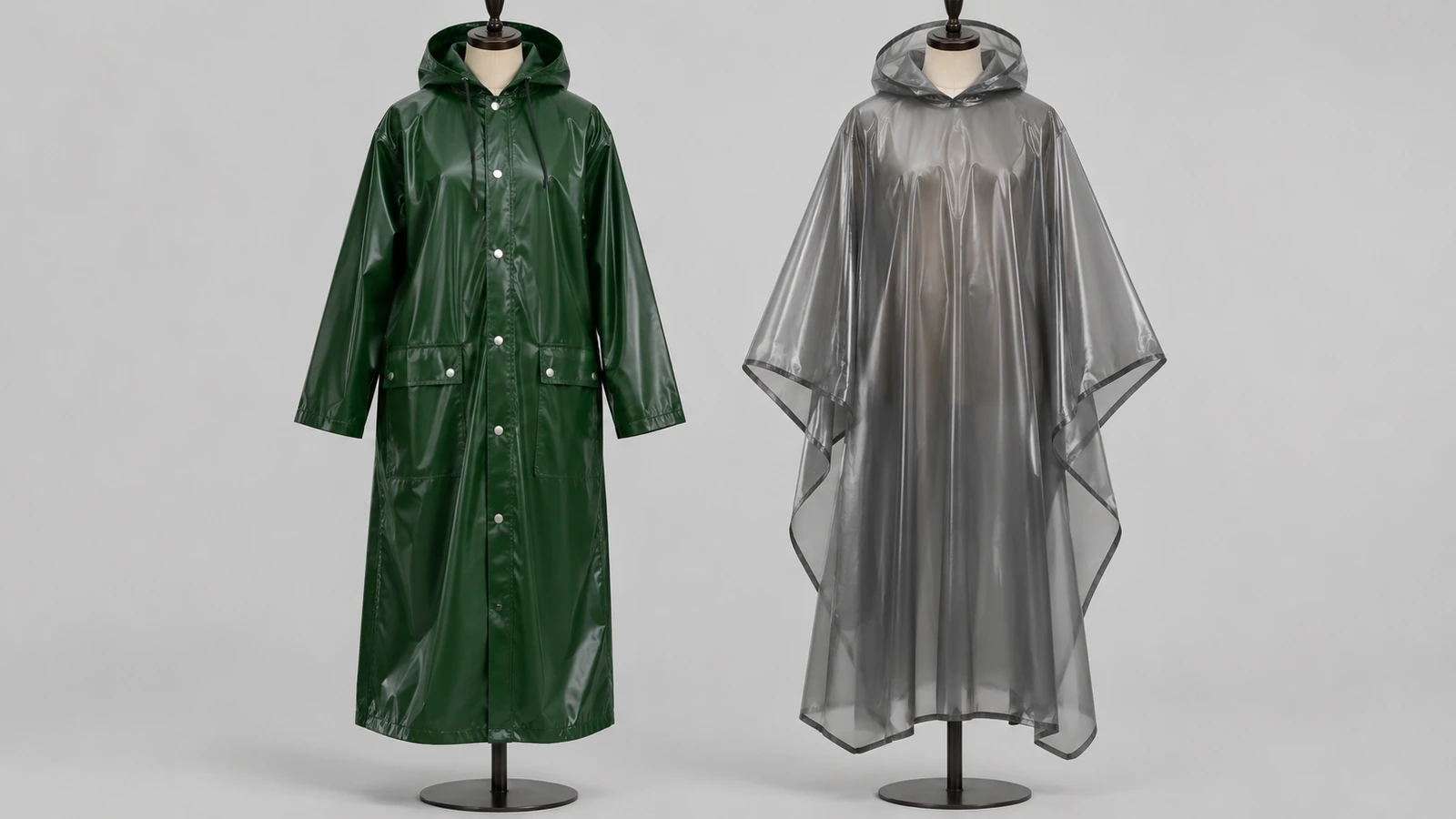
Translate material names into a clear specification
A PVC raincoat enquiry should begin with a written description of the material and the garment it belongs to. PVC is the common abbreviation for polyvinyl chloride, and vinyl is often used as a commercial shorthand in this product category. Those words help identify a family of materials. They do not describe the complete recipe, the thickness of the sheet, the way the panels are joined, or the performance of a finished coat. A buyer who records only “vinyl raincoat” leaves several important decisions open to interpretation during quotation and sampling.
Ask the supplier to identify the body material in ordinary language and connect that description to a model or drawing. Establish whether the proposal concerns a flexible film garment, a textile carrying a PVC coating, or a combination of materials. List the hood, body, sleeves, pocket parts, fastening reinforcements and any separate pouch. Components that look alike may have different constructions. A useful response explains the material at the component level without requiring the supplier to disclose a confidential recipe to everyone involved in the purchase. Technical evidence can be reviewed through an appropriate confidential route when necessary.
Keep descriptive names separate from approval decisions. “Soft vinyl” may describe the feel of one sample, while “heavy duty” may be a marketing description without an agreed test or use condition. Neither phrase gives the receiving team a measurable acceptance rule. Translate subjective descriptions into a retained reference sample, dimensions, agreed material information and any relevant assessment. For appearance and handling, it can be useful to keep both an unfolded garment and a flat sample of the proposed material. Identify them together so that later discussions concern the same revision.
A hypothetical promotional buyer might receive two offers with the same material name. One could concern a thin open-sided poncho in a small packet; the other could concern a sleeved coat with a front placket and separate pouch. Comparing the totals before resolving those differences would produce a misleading purchasing decision. The first step is to return a common brief to both suppliers, state the intended format and ask each to identify any deviation. The buyer can then decide whether a difference is useful, unacceptable or simply outside the original request.
The supplier's current website lists PVC among its custom plastic raincoat and poncho materials. That establishes a relevant category for an enquiry, while the exact proposed model, options and commercial terms still need confirmation. Avoid extending a category description into an assumption that every photographed silhouette, color or construction is immediately available. Request the current specification and a sample appropriate to the intended order. If an existing catalogue description is incomplete, add the missing details to the quotation rather than relying on a conversation that the production and inspection teams may never see.
Finish this first stage with a concise identity statement that can travel through the order. Include the supplier model reference, material description, construction type, relevant component differences and drawing revision. Mark any unresolved point explicitly and assign someone to resolve it before approval. This creates a practical connection between the buyer's search terms and the physical product under discussion. It also makes later changes easier to recognize: a new material description, backing, finish or component should prompt a review of the affected specification, sample and evidence before it is accepted as an equivalent replacement.
Distinguish unsupported film from coated fabric
Two raincoats can both be described as PVC rainwear while presenting very different surfaces on the inside. An unsupported film construction uses the sheet itself as the panel material. A coated fabric combines a coating with a textile substrate. The distinction matters because a thickness reading, a mass per area figure and a description of the inner surface answer different questions. Buyers should ask which construction is proposed before comparing measurements. An overall measurement of a coated textile should not be silently compared with the film thickness of an unsupported poncho as if the values described identical structures.
Start with a simple inspection of the sample and request a written construction description. Look at an accessible edge or a separate material swatch, rather than cutting up the only approved garment. Ask the supplier to identify the backing, if present, and explain which face is intended to contact clothing. Record whether the inner and outer surfaces differ in finish. These observations help the team ask better questions, but visual inspection alone cannot establish the chemical identity of a coating or backing. The written specification and appropriate evidence must identify what is actually being supplied.
Next, connect construction to the intended experience. A buyer may care about how the garment slides over a jacket, how much space it occupies when folded, whether the surface shows creases, and how the hood holds its shape. Those are useful sample review topics. They should be examined on the proposed garment in the intended clothing combination. It is unhelpful to declare one construction universally more comfortable or durable without defining the comparison. A lightweight event poncho and a structured reusable coat can serve different briefs even when both have a place in a rainwear range.
Construction also influences the questions sent to the technical reviewer. A report on one coating may not describe the backing, seam materials or decoration used in the assembled coat. A care instruction appropriate to a plain sheet may not be suitable for a lined, printed or bonded construction. Ask the supplier to map any available reports and instructions to the actual components and final assembly. When a specification includes multiple layers, record whether an offered measurement describes the complete construction or an individual layer. This small clarification can prevent substantial disagreement after samples arrive.
For example, an apparel buyer reviewing a coated textile coat might request total material mass per area, a description of the backing and a finished garment weight for each relevant size. An event buyer evaluating film ponchos might instead place greater emphasis on film thickness, folded packet dimensions and ease of opening. These are illustrative purchasing priorities, not recommended universal values. The correct specification follows the task, the proposed construction and the evidence available. It should explain why each measurement is useful, so a later supplier does not satisfy the number while changing an important part of the design.
Keep the final construction record readable. A short component table can identify the main panels, any backing or lining, closure parts, reinforcement pieces and packaging. Link the table to photographs or drawings and retain a material swatch with the approved sample. If the supplier proposes a change from film to coated fabric, or changes the substrate within a coated product, review the sample and affected evidence again. Treat the new offer as a defined construction change, even when its commercial description still contains the same familiar PVC or vinyl terminology.
Separate formulation information from garment evidence
Flexible PVC products are formulated for particular uses, so the polymer name should not be treated as a complete recipe. Additives and the way the material is processed can affect its characteristics. A practical buyer does not need to become a compound formulator, but should recognize the boundary between information about a material ingredient and evidence about the finished raincoat. That boundary is especially important when a supplier forwards a chemical brochure, a resin data sheet or an ingredient statement in response to a question about the whole garment.
Hallstar's information for a plasticizer intended for PVC film, sheet and coatings illustrates that formulation choices can be directed toward a particular handling property. It does not establish that a raincoat offered by another supplier contains that ingredient or achieves the same result. Use such technical literature to frame questions, not to fill gaps in the garment's evidence. Ask which actual material and construction the supplier proposes, which characteristics are supported for that proposal, and what further review is needed for the intended use. Avoid transferring numerical properties from an unrelated material page into a purchase specification.
Build an evidence map with three separate columns: the item described, the question it answers, and its limits. A material statement may identify a film. A laboratory report may address specified substances in a named component. A finished sample may show the placement of a snap or the practical fit of a hood. None of these documents automatically answers every other question. The map makes it easier to see where a file contains useful support and where an attractive-looking document is simply unrelated to the decision the buyer is trying to make.
Check identification before studying the result. Look for a model number, sample description, color, material reference, report date and any relevant photograph or supplier declaration linking the report to the offered item. If a report uses an internal code that differs from the quotation, ask for an explanation of that connection. A mismatch is a question to resolve, not proof of misconduct. The buyer should nevertheless avoid accepting a document solely because it has a familiar laboratory name or a favorable conclusion. A correct result for the wrong sample does not establish the status of the proposed order.
Keep public claims narrower than the evidence. If available information concerns a specified body film, do not expand it to every fastening, print layer, pouch and carton without checking the scope. If a sample has been evaluated only under a particular procedure, preserve that limitation when describing the result. Ordinary rainwear should not be presented as certified occupational protection on the strength of a material brochure. Where the intended application involves a workplace hazard or a regulated protective claim, arrange a separate assessment with the relevant qualified people before deciding that a generic coat is suitable.
The final purchasing file should make these distinctions easy to maintain. Store the material statement, component list, reports, care instructions and approved sample record together, with a clear version reference. Ask the supplier to notify the buyer when a formulation or component change could affect those documents. Define who reviews such changes and which approvals must be repeated. This approach allows the purchasing team to use technical information responsibly without pretending that one certificate, ingredient description or visual inspection can stand in for a complete evaluation of the finished rainwear product.
Compare the material categories in the PE, PVC, EVA and polyester raincoat guide.
02 / 12
Choose between coats, ponchos and longer silhouettes
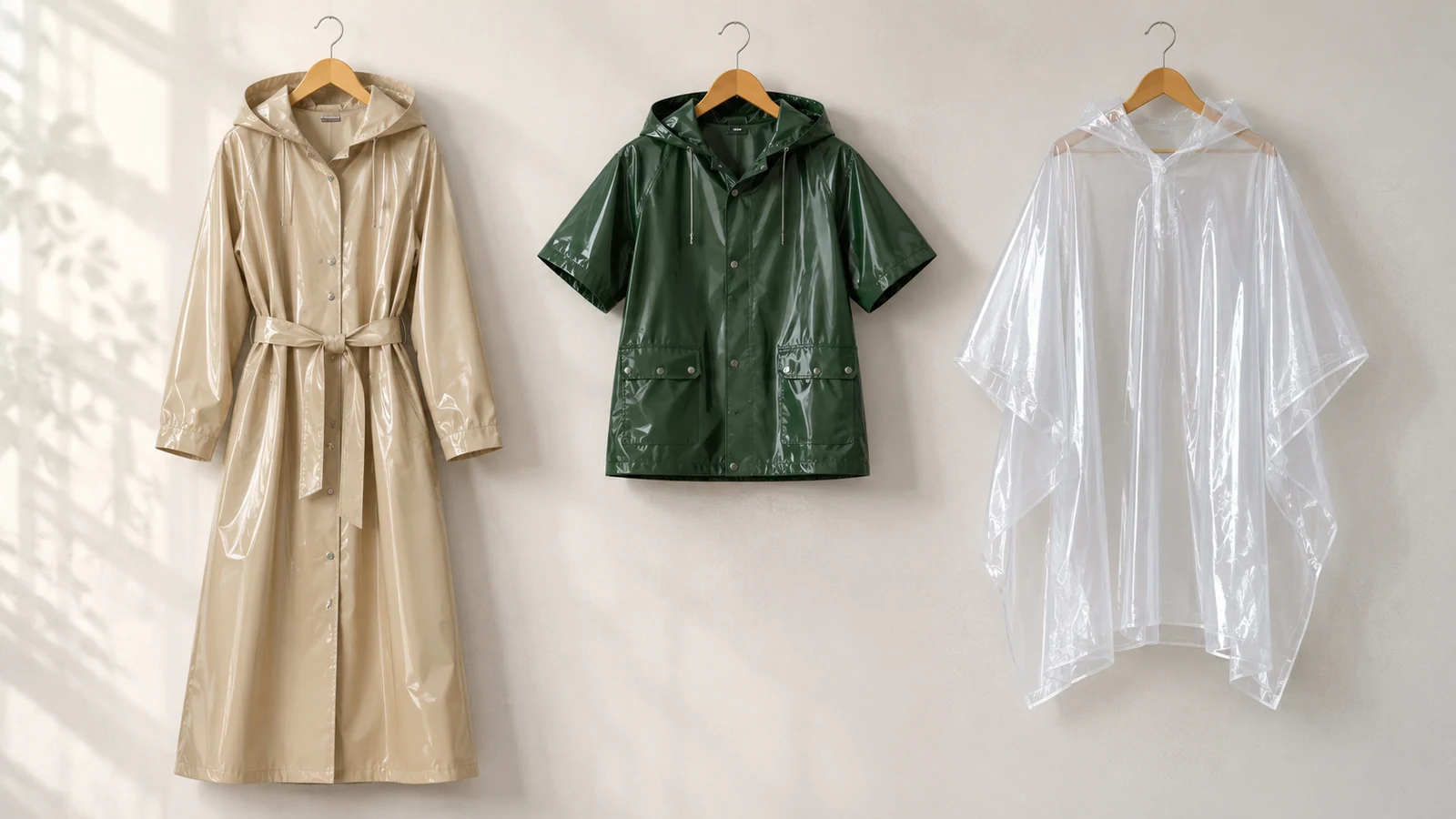
Match the garment format to the wearing task
Choose the rainwear format by describing what the wearer will actually do. The same adult may need different coverage while waiting outside a venue, walking between buildings, carrying a shoulder bag or working through a planned outdoor activity. Record the expected clothing underneath, the way the garment is issued, and what happens after use. A purchasing brief that starts with these details is more useful than a request for the “best PVC raincoat,” because it gives the supplier a concrete problem to address and gives the buyer a basis for comparing alternatives.
Begin with the audience and activity, then list practical constraints. Will the wearer put the garment on while standing in a queue? Is a front opening helpful for removing it without lifting it over the head? Does the wearer need access to a pocket or bag? Will the garment be carried all day in its own pouch? These questions influence the usefulness of sleeves, side openings, closures and folded size. They do not prescribe one correct design. Their purpose is to reveal how the proposed style will interact with ordinary actions before a large quantity is ordered.
Consider the issue and return process as part of the product decision. A garment handed out once at an entrance presents a different operational problem from a coat assigned to an individual for repeated use. If garments will be collected, someone needs to inspect, dry and store them according to supported instructions. If they remain with the wearer, the packet should contain clear information about care and later handling. Include the people responsible for distribution or storage in the sample review. They may identify practical problems that are invisible in a studio photograph or a material specification.
Use a modest trial to compare proposed formats under the intended routine. Ask representative adult users to put on the garment over the expected clothing, close it, reach for ordinary items and remove it. Observe coverage and ease of use without exposing participants to hazardous conditions. Record the size, clothing combination and sample reference. A comment such as “sleeves pull when reaching forward over this jacket” is more useful than a general score for comfort. It identifies a design question that the supplier can investigate and the buyer can recheck on a revised sample.
Keep specialist applications outside an ordinary purchasing assumption. A poncho selected for occasional walking is not automatically suitable around machinery, for road work, for chemical exposure or for other activities with specific hazards. The product brief should identify any such requirement early so the appropriate safety and technical review can determine what is needed. Do not let a familiar rainwear shape or a bright color stand in for that assessment. This guide focuses on ordinary rainwear buying decisions; specialist protective selection requires evidence and review matched to the actual task.
Write the outcome as a use statement rather than a list of vague preferences. An illustrative statement might specify adult visitors wearing everyday jackets, walking between covered areas, receiving one folded garment at arrival and keeping it afterward. Another might describe an individually assigned coat that must fit over a uniform and return to a drying area after use. Neither statement guarantees a particular design will work. Each gives the sample review a useful target, allowing the buyer to accept, revise or reject a proposed format for clear reasons.
Compare a PVC mac, poncho and trench style
A PVC mac usually refers to a raincoat-style garment, while a poncho generally has a looser form and different openings. A PVC trench coat describes a longer silhouette associated with coat details such as a belt or more structured front. Commercial naming varies, so the drawing and sample must settle the actual design. These search terms are useful for finding options, but they should not become substitute specifications. Record the body length, sleeves, hood, front opening, side construction and fastening arrangement for each candidate before deciding which one suits the brief.
A sleeved coat can give the wearer a familiar relationship between the garment and the arms. Its usefulness depends on the sleeve pattern, shoulder room, cuff opening and clothing underneath. A front placket may make dressing and removal straightforward, but the number and placement of fasteners affect the routine. Inspect the coat both open and closed. Check whether ordinary movement pulls the front apart or leaves an unwanted gap. These are design observations to discuss with the supplier, not a reason to assume that every sleeved coat will outperform a poncho in all circumstances.
A poncho can offer a broad, loose shape that is convenient for some distribution and wearing situations. Its side openings, width and length still need careful attention. A generous flat dimension does not automatically explain how much of a wearer or bag is covered once the garment is worn. Check the hood, the point where the hands emerge and the movement of the hem during walking. Where the intended activity creates risks from loose material, the responsible reviewer should assess the design rather than relying on a general claim that one size fits everyone.
A longer trench-style design introduces another set of practical questions. A belt changes the way the garment sits on the body, and extra length may affect steps, seating and storage. Decorative details can also introduce additional components and care considerations. A buyer interested in this silhouette should ask whether the supplier currently offers the required construction and request a relevant sample. Treat a style image as a starting point for discussion. Do not assume that a factory producing simple film ponchos can provide every tailored feature, lining or fastening system shown in a fashion reference.
Compare the candidates with the same wearing and packing routine. For a hypothetical branded visitor program, the team might review a short coat, a loose poncho and a longer coat over the same clothing combination. Record how each is opened, worn, removed, dried and folded. Add the proposed packet and instructions to the review, because an easy-to-wear garment can still be awkward to distribute if its packing does not suit the operation. The result should show the advantages and unresolved questions for each candidate without forcing all formats into an artificial universal ranking.
Choose a format only after resolving the features that matter to the use statement. If the best candidate needs a different hood depth or closure position, record the revision and review the corrected sample. If two styles serve distinct users, maintain separate specifications instead of combining their features into one ambiguous quotation. This allows a purchasing team to use terms such as PVC mac, vinyl raincoat and poncho naturally while keeping the order tied to a clearly described physical product. The commercial name remains helpful, and the controlled drawing carries the detail.
Confirm which design options are actually offered
An attractive buying guide should help a reader ask better questions without implying that every possible option is available from a particular supplier. For PVC rainwear, separate the published product category from the exact construction offered for an order. A website may establish that PVC coats or ponchos are within the supplier's range, but it cannot answer every question about current patterns, colors, trim, packaging or production constraints. Confirm those details through the actual proposal and sample. This is especially useful when a buyer brings a reference design with features that differ from standard promotional rainwear.
Prepare an option list with three statuses: required, preferred and open for supplier recommendation. Required features define the intended use or brand need. Preferred features can be discussed if they affect practicality or commercial terms. Open items allow the supplier to suggest an available solution without guessing the buyer's priorities. For example, a buyer might require a front opening and a specified logo position, prefer a separate pouch, and leave the exact fastening arrangement for sample review. The distinction helps avoid spending time on an attractive alternative that cannot satisfy the essential brief.
Ask the supplier to mark deviations directly against that list. A response should identify which features match an existing model, which require development and which are not offered. If a new pattern or component is proposed, request the steps needed to evaluate it and clarify any associated commercial conditions. Do not insert assumed minimum quantities, lead times or tooling capabilities into the buying file. Those details belong in a current quotation for the actual project. A useful supplier conversation produces specific choices and dependencies rather than a broad promise to customize everything.
Treat branding and packaging as part of the same feasibility review. A particular print location may cross a seam or sit close to a fastening. A desired folded packet may place pressure on a decorated surface. A pouch chosen for appearance may not accommodate the garment after an ordinary user folds it. These questions can be examined with a production-representative sample and a practical packing trial. Bringing them forward makes it easier to choose a workable combination before artwork, labels and order quantities are finalized across several departments.
Keep a clear record when several options are sampled. Give each candidate its own reference and identify differences in material, pattern, trim, color and packing. Photograph the full garment and the details relevant to the decision. If a buyer approves the hood from one sample and the body from another, request a combined revised sample before treating the order as settled. Otherwise, different people may understand the approval differently. A single signed-off construction should show the actual combination that the supplier will be asked to deliver, with any permitted variation explicitly recorded.
The final confirmation should be understandable to someone who did not attend the sampling discussion. State the selected model, required changes, material description, dimensions, decoration, packaging and supporting documents. Add unresolved items to a short action list with a responsible person and a decision deadline. Release the purchase only when the relevant issues are resolved or a clearly defined approval condition has been agreed. This gives the buyer a practical route from design inspiration to an order, while preserving an honest distinction between available capabilities, proposed development and features that have not yet been verified.
Explore the PVC plastic raincoat range and confirm the offered construction and options for your enquiry.
03 / 12
Compare thickness, weight and flexibility correctly

Specify units, measurement locations and tolerance
A thickness value is useful only when the buyer and supplier understand what has been measured. For an unsupported PVC film, the value may describe the sheet at a specified point. For a coated textile, it may describe the complete layered construction. A folded garment, an overlapped seam and a reinforced fastening area contain more than one layer and should not be confused with a single panel. Start the discussion by identifying the object of the measurement, the units and the locations. This is more effective than asking for a vaguely “thicker” coat.
Use one unit consistently in the controlled specification and show any conversion clearly. Millimeters and micrometers are common ways to express small thicknesses; one millimeter equals one thousand micrometers. A hypothetical requirement written as 0.15 mm therefore represents the same nominal thickness as 150 micrometers. That example illustrates unit conversion, not a recommended thickness for a particular raincoat. If an offer uses “gauge” or another convention, ask the supplier to state the corresponding physical unit rather than guessing which convention was intended. Keep the original quotation and the clarified value together.
Agree how the measurement will be obtained and reported. ASTM's D6988 guide addresses determination of plastic film thickness, and its current catalogue listing is a useful reference when discussing an appropriate approach with a competent testing provider. Merely naming a standard does not establish that a supplier followed it or that it is suitable for every construction. The purchasing record should identify the agreed procedure, specimen condition, measurement points and any relevant equipment details. Ask the technical reviewer to resolve those matters where the result will determine acceptance or support a performance comparison.
Define the nominal value and permitted variation separately. A single favorable reading from one location cannot describe an entire order. The buyer and supplier should agree what sampling is appropriate, how individual results are summarized, and what happens if a result falls outside the agreed range. Avoid inventing a universal tolerance without considering the material, manufacturing process and intended use. If the supplier proposes a range, ask how it relates to the approved sample and quotation. The receiving team needs a rule that both parties have understood before goods arrive.
For coated constructions, add the measurements that answer the actual design question. Total thickness may be useful, but it may not explain the contribution of the substrate or coating. Material mass per area, a construction statement and a finished sample can provide complementary information. Keep these measures in separate fields with their units. Do not calculate a supposed coating thickness from an unrelated fabric weight unless the necessary method and assumptions have been established by a qualified reviewer. A specification should reduce ambiguity rather than replace missing information with an attractive but unsupported calculation.
Present the final requirement in a compact record: component, material reference, nominal value, units, method, locations, tolerance and acceptance procedure. Include the sample or drawing revision to which it applies. During a repeat order, check whether the supplier has changed the film, finish or construction before reusing an old result. Clear measurement language helps the buyer compare offers and investigate differences without turning thickness into a universal quality score. The chosen value remains one part of a garment specification that also includes fit, construction, handling, care and relevant evidence.
Evaluate drape and handling on the finished sample
The way a PVC raincoat hangs and moves is easier to judge from a finished sample than from a thickness figure alone. Drape describes the visible behavior of the material and pattern together. Handling includes the way a person opens, lifts, folds and wears the garment. These observations can reveal whether the proposed product suits the buying brief, but they are not substitutes for chemical identification or a formal performance test. Review them systematically so that useful practical impressions can become specific feedback rather than a collection of conflicting adjectives.
Begin with the sample as it will be delivered. Note the packing method and open the packet without forcing the garment. Allow the sample to be examined under the agreed review conditions, then record how it unfolds and whether folds affect its appearance or use. Keep the packet and any instructions with the sample. A coat that looks different immediately after unpacking and after hanging may need a clearer presentation decision. The supplier should explain any model-specific handling guidance rather than asking the buyer to assume that every crease or surface change will disappear.
Review the garment on an appropriate adult wearer or form, then repeat useful movements with the expected clothing underneath. Observe whether the material hangs comfortably, bunches at the shoulders, pulls across the back or interferes with a closure. Ask the wearer to describe the location and action associated with a problem. “The front lifts when I reach forward over a winter jacket” gives the pattern reviewer something concrete to consider. “It feels wrong” may be a valid first reaction, but it needs more detail before the supplier can propose a meaningful revision.
Compare samples under similar conditions and avoid turning a subjective preference into a material claim. A softer-feeling sample is not automatically safer, more durable or better for every use. A more structured sample may support a particular silhouette while being less convenient for compact packing. Temperature and storage conditions may also be relevant to handling, so discuss the intended environment with the supplier and request appropriate evidence where a specific condition matters. Do not improvise extreme heating, freezing or chemical exposure as a substitute for a suitable technical assessment.
Use photographs and short notes to preserve observations. Photograph the same views for each candidate: front, back, hood, a normal reaching posture and the folded garment. Record the sample reference and clothing combination rather than collecting images without context. If the buyer prefers the handling of one sample, retain a physical reference and explain which features matter. Ask whether the proposed production construction will match it. A supplier may otherwise interpret “make it softer” as permission to change a formulation or thickness that also affects other agreed aspects of the order.
Close the review by separating accepted characteristics from open questions. The buyer might accept the drape and packet size while asking for a revised hood or a different front closure. Those decisions should be visible in the sample report, with a revised sample required where the change affects the finished experience. This preserves the value of practical observation while keeping its limits clear. The goal is a garment that works for the stated routine, supported by a controlled reference and appropriate evidence, rather than a purchasing decision based on touch alone.
Balance coverage, packing volume and garment weight
Garment weight, material thickness and folded size are connected purchasing considerations, but they do not measure the same thing. A longer coat uses a different panel area from a short jacket. Sleeves, pockets, fasteners, a lining and a separate pouch can also affect what is carried or shipped. Buyers should therefore compare like-for-like samples before treating a heavier garment as better value or a lighter one as easier to use. State which weight is being quoted and which size and construction it represents. That clarification is especially useful when offers include several silhouettes.
Separate the unpacked garment weight from the weight of the individual selling or distribution unit. The latter may include a pouch, printed sleeve, insert or bag. Carton gross weight includes further packaging and must be recorded separately. Use clear units and identify whether the value is a measured sample result or a proposed specification. If several sizes are included, do not assume that one garment weight represents all of them. The supplier should explain how weight information will be provided for the actual mix and how any agreed variation will be assessed.
Folded dimensions should be measured on the proposed packed sample, using the packing method intended for delivery. An exceptionally tight factory fold may not be easy for a wearer to repeat after use. If the garment is meant to return to a pouch, ask representative adults to repack it using the supported instructions. Observe whether the pouch closes comfortably and whether the routine places stress on the garment or decoration. A practical carrying format should be assessed as a whole, including the opening, closure and information provided to the user.
Use an illustrative distribution scenario to make the tradeoffs visible. A visitor program might prioritize a compact packet that staff can hand out quickly, while an individually assigned coat might justify more storage space for easier repeated handling. The buyer should compare the actual candidates against the relevant routine. It is not necessary to declare one format universally superior. What matters is whether the chosen coverage, weight and packing work together for the intended use, and whether the commercial proposal reflects the same configuration that was reviewed in the sample.
When logistics information is needed, request carton dimensions, quantity per carton, gross and net weights, and the allocation of sizes and colors. Confirm how those figures were obtained and whether they are provisional before production packing is finalized. Freight quotations and warehouse plans depend on the agreed packed order, so avoid calculating a final shipment from a generic catalogue carton. If packing changes, update the associated figures and any affected commercial arrangements. Keep the practical benefit of a smaller packet separate from an unsupported claim about environmental impact or guaranteed freight savings.
The approved specification should make the chosen balance explicit. Record the garment dimensions, relevant material measurements, unpacked weight, individual packing and carton arrangement together. Add a photograph of the approved packed sample and a description of any required repacking routine. This prevents later pressure to reduce packet size from quietly changing the garment or its presentation. It also gives buyers a consistent basis for comparing future offers: the product, the unit package and the shipment configuration are each defined, rather than hidden inside one ambiguous weight or bulk-price figure.
Turn the measurements into the controlled wholesale specification.
04 / 12
Inspect seams, closures and vulnerable details
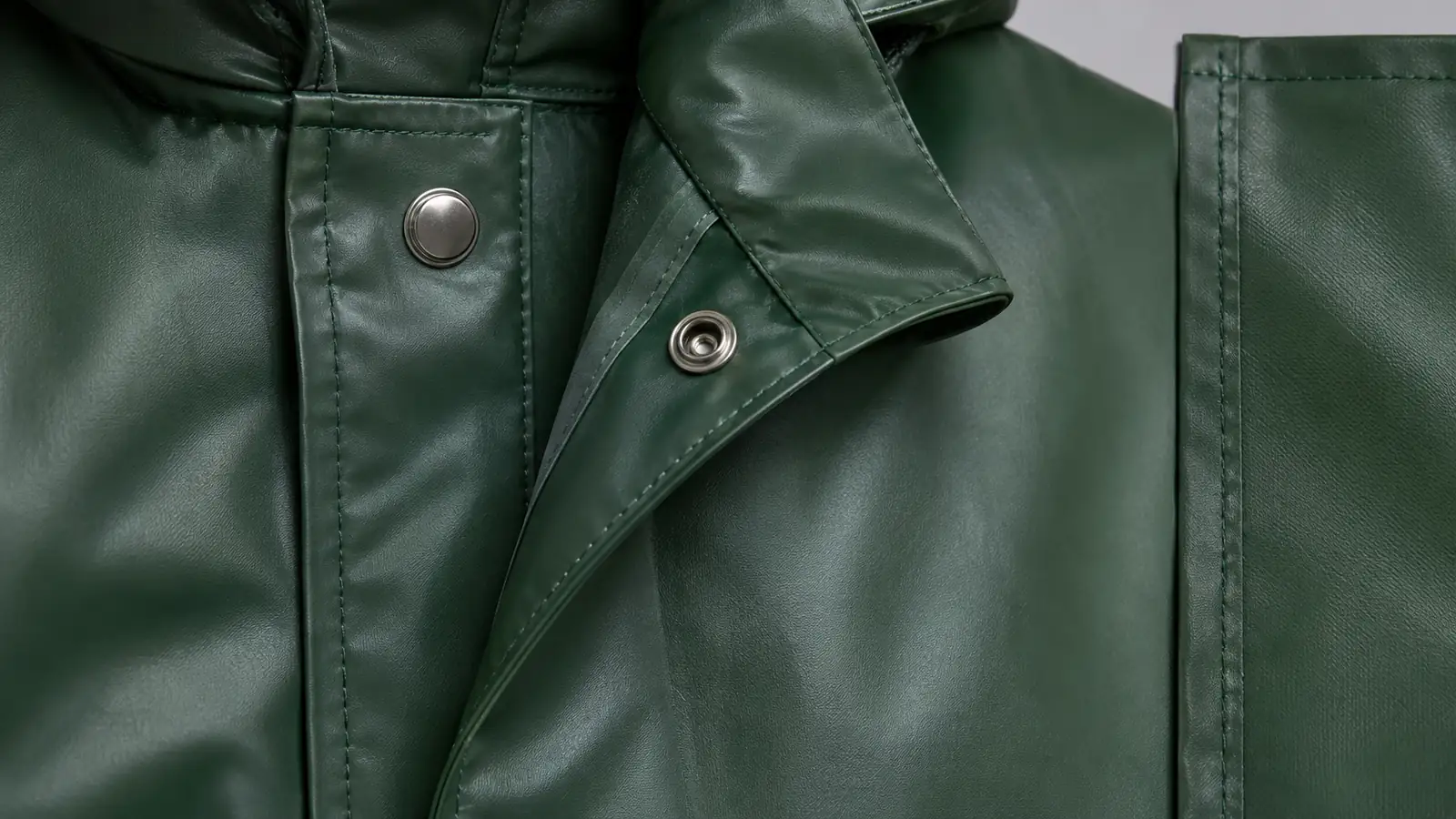
Follow water paths through the garment construction
A raincoat is an assembly with openings, joins and edges. Reviewing only the broad body material misses many of the places where the design interacts with water and movement. Start at the hood and follow the garment down through the neckline, shoulders, front opening, sleeves, pockets and hem. Ask how each area is constructed and what evidence supports any proposed performance description. This does not require an improvised certification exercise. It is a practical way to identify the details that deserve attention during sample review and any subsequent technical assessment.
Examine the garment in the position in which it will be worn. A placket that lies neatly on a flat table may behave differently when the wearer moves or the coat is sized over a thicker layer. A hood opening may change shape when the head turns. Observe where panels overlap and where openings remain part of the design. Record these details with photographs and the relevant sample size. The aim is to connect construction questions to ordinary use, so the supplier can understand what the buyer expects the finished garment to accomplish.
Ask the supplier to describe the joining method used in each relevant area. Film garments and coated textile garments may use different constructions, and a single product can include more than one type of join. A smooth-looking seam is not by itself proof of a particular process or performance. If the supplier describes a seam as welded, sealed or otherwise treated, request the corresponding construction detail and relevant evidence for the finished assembly. Avoid assuming that a technique used in one part of the coat has also been used around every pocket, closure and attachment.
Look closely at changes in direction and places where several layers meet. These areas can be harder to understand from a general photograph, so they are useful candidates for a detailed sample discussion. Check whether the construction matches the drawing and whether the sample shows visible gaps, distortion or inconsistent finishing. Record observations without inventing a technical cause. A buyer can identify a concern and request investigation; determining the process cause or an appropriate remedy may require the supplier's technical team or a competent independent reviewer.
If water resistance is important to a claim or acceptance decision, agree an appropriate evaluation with qualified support. Specify whether the question concerns the material, a seam, an opening or the whole garment, and identify the relevant conditions. A casual spray demonstration or a photograph of droplets on the surface does not establish a universal waterproof rating. It can be useful as a limited observation if described honestly, but should not be transformed into a certified claim. Keep the proposed marketing language aligned with what the available evidence actually supports for the exact model.
Finish with a construction map that identifies the reviewed areas and any unresolved points. Link the map to the approved sample, drawings and relevant reports. When a hood, pocket or closure is revised, return to the affected water paths rather than assuming that the change is purely cosmetic. This approach keeps the buyer's attention on the complete garment. It also helps the supplier respond to a precise question about a particular detail, reducing the chance that a broad material description will be used to answer a construction concern it cannot resolve.
Assess snaps, plackets, pockets and reinforcements
Closures and attachments deserve their own review because they affect how the wearer handles the garment. A snap may be visually small but repeatedly used. A pocket adds an opening and may encourage the wearer to carry items. A reinforcement changes the local construction around a stress point. Examine these details on the actual sample and ask the supplier to identify their materials and arrangement. Do not treat them as interchangeable accessories that can be substituted after approval without considering the effect on use, appearance, care or supporting evidence.
Check a front opening from the wearer's perspective. Confirm that the fastening positions match the drawing and that the placket can be aligned without pulling the body into an uncomfortable shape. Ask representative adults to open and close it in an ordinary way, following any instructions. Observe whether they can locate the fasteners and grip the surrounding material comfortably. Record any difficulty by position and action. The purpose is to identify practical issues, not to prescribe an arbitrary number of opening cycles or a force value that has no agreed technical basis.
Inspect the area around each fastening for the intended reinforcement and consistent finishing. Compare the sample with the construction description rather than assuming that a thicker-looking patch is necessarily better. If a reinforcement changes the material layers, it belongs in the component record. Ask how the buyer will recognize an approved substitution, if one is proposed later. Where a fastening or attachment requires a formal strength or safety assessment, arrange a suitable method and acceptance rule with competent support. Hand pulling can reveal an obvious concern, but it does not establish a standardized test result.
Pockets should be reviewed according to their intended function. A decorative pocket, a hand pocket and a pocket intended to hold an item are different design decisions. Check placement, access, closure and the way the pocket sits when the coat is worn. Avoid describing a pocket as waterproof or secure for valuables without evidence supporting that statement. If the buyer does not need pockets, consider whether their inclusion adds useful function to the brief. If they are required, specify the construction and any limitations that need to be communicated in the product information.
For longer or belted styles, include belt loops, ties and adjustment points in the same review. Confirm that the design suits the intended adult audience and ordinary activity. A fashionable detail can still complicate dressing, packing or movement. Ask the supplier which details are available on the proposed model and inspect a complete sample containing the selected combination. If a change is made to the front opening, recheck the relationship with pockets and the belt. Reviewing each detail separately is helpful, but the final decision must consider how they work together on the garment.
Preserve the accepted arrangement with a drawing, photographs and a retained sample. Record closure type, count, position, material references and relevant reinforcements. Include the supported care guidance for the complete assembly. During receiving inspection, the team can then compare the delivered product with a clear reference instead of relying on memory or a product title. If a supplier proposes a different snap, pocket shape or reinforcement, review the affected fit, appearance and evidence before approval. Small components can remain manageable purchasing details when they are defined as part of the product from the beginning.
Define workmanship acceptance before production
Workmanship acceptance is easier to manage when the buyer describes what will be checked before the order is produced. General phrases such as “good quality” or “same as sample” leave too much room for disagreement unless the sample and inspection criteria are clearly identified. Start with the approved garment and list the visible and measurable features that matter to its use and presentation. Include the construction, dimensions, fastenings, appearance, decoration and packing. The goal is a shared inspection reference that a supplier and receiving team can apply consistently.
Separate measurable requirements from visual judgments. Dimensions, component counts and artwork placement can often be expressed directly with a drawing and agreed tolerance. Surface appearance or seam finishing may require photographs and physical reference examples. Define which conditions are acceptable and which require review, using language specific enough to guide the inspector. Avoid creating a long list of abstract defects without explaining how they relate to the actual product. A short, well-illustrated standard for the proposed raincoat can be more useful than a generic checklist copied from an unrelated garment category.
Agree the inspection approach with the supplier and any appointed inspection provider. The purchasing file should identify the applicable lot, sampling arrangement, checks, reporting method and decision process. Do not insert an arbitrary sampling level or acceptance number merely because it appears in another company's document. The appropriate arrangement depends on the order and the buyer's requirements. Where a formal sampling standard is used, confirm its current edition and correct application with the responsible professional. The commercial agreement should explain what happens if goods do not meet the agreed criteria.
Use a clear procedure for differences discovered before shipment. Ask the supplier to identify the affected quantity, provide photographs or measurements, explain the proposed disposition and obtain approval where required. A revised sample should not quietly replace the original reference. Label it and record the decision that makes it acceptable. If rework is proposed, determine what must be checked afterward. Keeping this sequence visible helps prevent a minor-looking deviation from becoming an unreviewed change to material, construction or presentation across the entire order.
Consider an illustrative case in which the delivered samples have a pocket placed differently from the drawing. The buyer should first establish whether the difference is consistent, whether it affects access or appearance, and which reference was used. The resolution might be correction, a revised approval or rejection, depending on the agreed requirements. The example does not justify accepting any particular deviation. It shows why a documented reference matters: the discussion can focus on the actual feature and its consequence, rather than on competing recollections of what “similar to the sample” was supposed to mean.
Complete the acceptance file before issuing final production approval. Include the selected reference sample, dated drawing, material and component descriptions, appearance references, packing sample and inspection instructions. Assign a decision maker for unexpected findings and keep the supplier informed of the communication route. This makes receiving and shipment decisions more predictable without pretending that inspection eliminates every possible issue. The buyer has a practical standard to apply, the supplier knows what has been agreed, and any later change can be reviewed against the same clearly documented product requirements.
Compare format and construction questions in the rain poncho selection guide.
05 / 12
Plan adult sizing, mobility and comfort
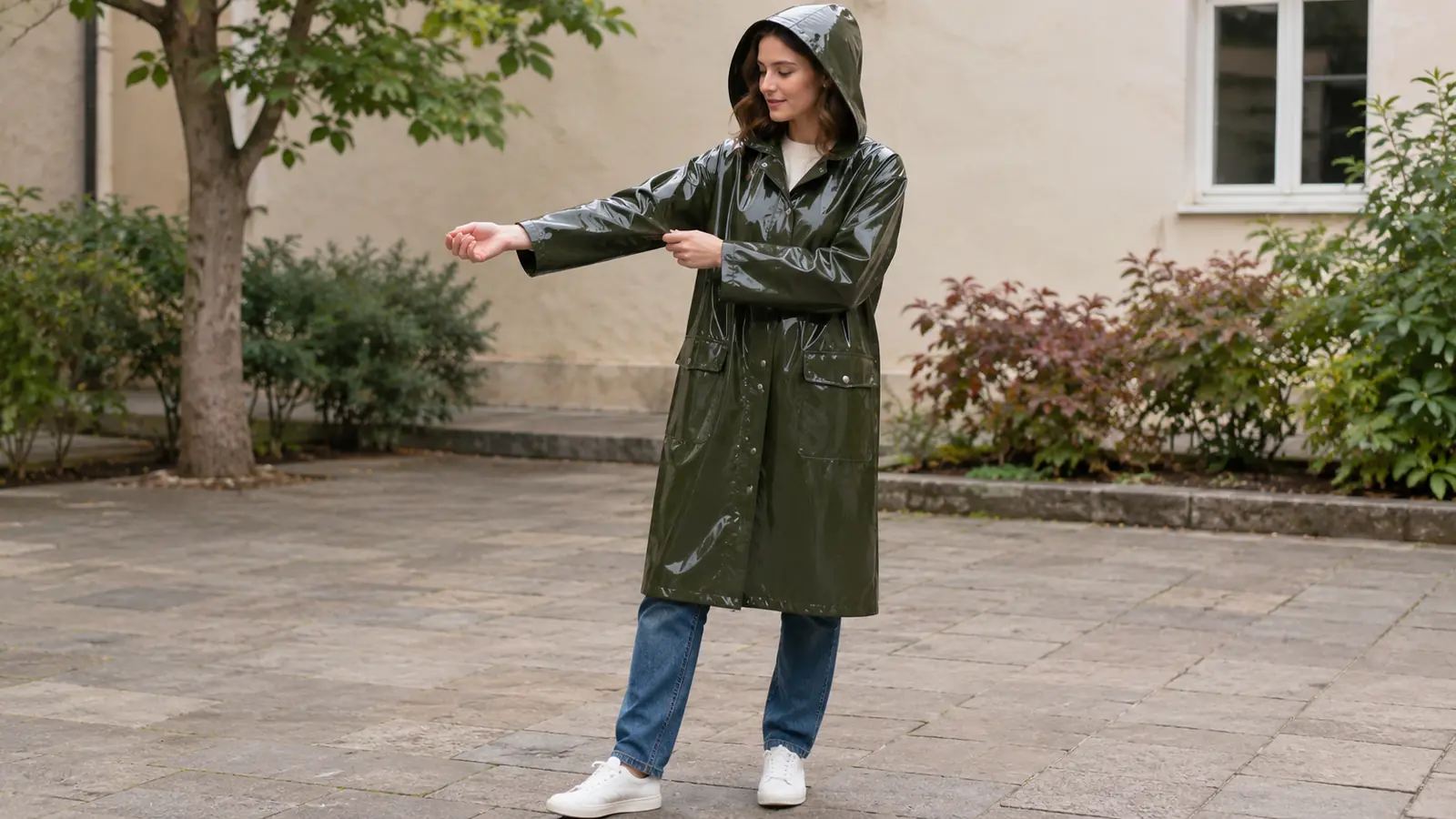
Measure coverage over the intended clothing
Sizing a raincoat starts with the wearer and the clothing it must cover. A size label alone does not show the relationship between body dimensions, garment measurements and the room needed for movement. Ask the supplier for a dimension chart with a drawing that explains each measurement point. Then review the proposed sizes over representative clothing for the intended season and activity. This is particularly useful for a wholesale order distributed to many adults, where assumptions based on one person's fit can leave important differences unnoticed.
Distinguish body measurements from finished garment measurements. A chest measurement taken around a person is not the same as a flat width measured across a closed coat. Record the supplier's measurement method and avoid converting between the two without understanding the pattern and intended ease. Specify whether the garment is laid flat, closed and unstretched, and identify where lengths and widths begin and end. A clear drawing can prevent two inspectors from obtaining different results simply because they measured from different points or included a different part of the hood or cuff.
Review the full coverage requirement rather than focusing only on chest width. Body length, sleeve length, shoulder arrangement, armhole shape and hood dimensions can all affect the finished experience. A coat may close comfortably while its sleeves pull back during an ordinary reach. A poncho may look generous on a table while leaving a particular clothing layer exposed when worn. Observe these features on the actual sample. The buyer should describe the intended coverage and movement, then let the pattern review determine which dimensional changes may be appropriate.
Use a representative range of adults for a practical fit review where feasible, with their participation and without collecting unnecessary personal information. Record the garment size, relevant clothing combination and observed fit issues. The purchasing team usually needs a useful pattern decision, not a detailed personal profile of every participant. A simple anonymous review sheet can capture whether the wearer could fasten the coat, move normally and access intended features. Keep sensitive personal information out of the general supplier file unless there is a clear need and an appropriate handling process.
An illustrative uniform program might review a coat over a light shirt and over the heavier jacket expected during colder periods. If one size works in the first combination but restricts movement in the second, the team must decide whether to change the pattern, adjust the size allocation or define separate options. Do not assume that a larger size resolves every problem. Extra width can also change the hood position, sleeve reach or hem. Review a complete revised sample so that the intended improvement does not introduce a different practical difficulty.
Once the size arrangement is approved, preserve the dimension chart, measurement method, tolerances and sample references together. Identify any size-specific construction or packing differences. Give the distribution team information that helps them select the appropriate garment without making unsupported universal-fit claims. For a repeat order, compare the current sample and chart with the retained version before accepting a change. A well-defined size specification turns fit from a vague preference into a manageable purchasing decision while recognizing that a garment must be assessed in the context of the clothing and activity it is intended to cover.
Check hood vision, sleeves and everyday movement
A practical rainwear review includes ordinary movement, not only a front-facing photograph. The wearer needs to look around, reach, walk, sit where relevant and handle the garment's closures. The hood, sleeves and body pattern should be considered together because a change in one area can alter another. Plan a simple review in a safe environment with representative adult users and the intended clothing. The purpose is to identify design concerns early, without exposing participants to hazards or implying that an informal trial certifies the garment for a specialist activity.
Start with the hood in its intended wearing position. Ask the wearer to turn the head normally and describe whether the opening remains comfortable and allows the needed view. Observe whether the hood moves with the head or stays behind, and whether any adjustment is understandable. Record the sample reference and adjustment position. Avoid judging only from the apparent depth of the hood on a hanger. A hood that looks generous in a product image may sit differently on a person, especially when the coat is worn over another layer or fastened in a particular way.
Next, review sleeves and cuffs through the movements expected in the use statement. Reaching forward, bending an arm and using the front closure can reveal how the sleeve and shoulder pattern behave. Check the cuff opening against the intended clothing and ordinary hand access. Do not add specialized equipment or protective accessories to the trial unless the product has been selected and assessed for that application. If a buyer identifies an occupational need, the relevant safety reviewer should determine how the garment interacts with the required equipment and task.
Observe the body and hem while the wearer walks or sits in an ordinary setting. Look for unwanted pulling, excessive bunching or a closure that opens under normal movement. Longer styles should be reviewed carefully for the intended steps and seating arrangements. A belt or adjustment can change how the garment moves, so include it in the final sample configuration. If a concern appears, document the action and location rather than asking for a general improvement in comfort. Specific feedback makes it easier to evaluate whether the next sample has addressed the issue.
Comfort also depends on the environment, activity and clothing combination. Do not promise breathability or a fixed comfort level based solely on the PVC name or a loose silhouette. Ask for suitable evidence when a performance claim matters, and keep practical wearer comments separate from laboratory results. A short sample session can identify immediate handling issues but cannot establish a universal long-term experience. The buyer should use the observations to refine the brief and determine whether further evaluation is needed, rather than presenting a small informal review as proof for every user.
Close the movement review with a decision for each relevant feature. The hood might be accepted, the cuff opening revised and the body length retained for another check. Make the decision record clear enough that the supplier can act on it without guessing. When the corrected sample arrives, repeat the affected movements and confirm that other accepted features remain satisfactory. This gives the buyer a disciplined way to improve a garment through sampling while keeping the final claim proportionate: the design has been reviewed for a defined routine, with any specialist performance questions handled through appropriate evidence and expertise.
Compare fit options without relying on gender labels
Search phrases such as ladies pvc macs and pvc raincoat mens can help a buyer locate commercial ranges, but the labels do not define the fit of a particular garment. Different suppliers may use different patterns, size charts and styling conventions. A useful procurement decision therefore connects the selected range to actual dimensions and a representative sample review. Treat the search terminology as a starting point for finding options. The controlled specification should describe the garment itself, including the room, coverage and features needed by the intended adult audience.
Ask for the dimension chart for each proposed pattern rather than assuming that two similarly named sizes are interchangeable. Compare body length, chest or body width, sleeve measurement, shoulder arrangement and any shaping relevant to the design. A belted coat, a straight-cut mac and a loose poncho may organize fit differently. Where the supplier offers several cuts, request a clear explanation of the differences and a sample appropriate to the planned order. Avoid making assumptions about a person's preferred fit from a marketing label when a simple size and movement review can provide better information.
Consider how the garment will be allocated. An individually ordered coat can be matched to a known size choice, while a visitor program may need a manageable range that staff can distribute quickly. The latter does not justify claiming that one size fits every adult. It means the buyer should balance the audience, size range, stock arrangement and practical issuing process. Provide a clear way for users to request an appropriate alternative where the program allows it. These operational decisions belong alongside the pattern selection because they influence whether a theoretically suitable size range works in practice.
Use neutral, specific feedback in the sample report. Statements about sleeve reach, closure room, hood position and hem length are more useful than broad judgments that a garment looks too masculine or too feminine. Styling preferences can still matter to a brand, but they should be expressed as design details such as silhouette, color, length or belt arrangement. This helps the supplier respond to the actual requirement and avoids turning stereotypes into technical specifications. It also makes the approved design easier to describe consistently in product information and internal ordering forms.
A hypothetical apparel buyer might evaluate two coat patterns with different lengths and shaping, then choose to offer both with their own dimension charts. Another buyer might select a straight-cut poncho format and define a limited set of adult sizes after a practical review. Neither arrangement is inherently correct for all programs. The important point is that the decision is based on the actual audience and product. If a pattern changes later, update the size information and recheck fit rather than keeping an old marketing label while assuming that users will experience the same garment.
Finish with a size allocation and communication plan that matches the approved samples. Identify the supplier pattern references, dimensions, tolerances, labeling and packing distinctions for each option. Make the information usable by purchasing, receiving and distribution staff. Keep the commercial terms used to find the product separate from promises about universal suitability. This allows a buyer to address common searches for men's or women's vinyl raincoats while maintaining a more reliable purchasing process: choose and describe the actual fit, verify the proposed construction, and give adults clear information about the available garment options.
Review practical coverage in the reusable rain poncho selection guide.
06 / 12
Approve color, surface finish and branding
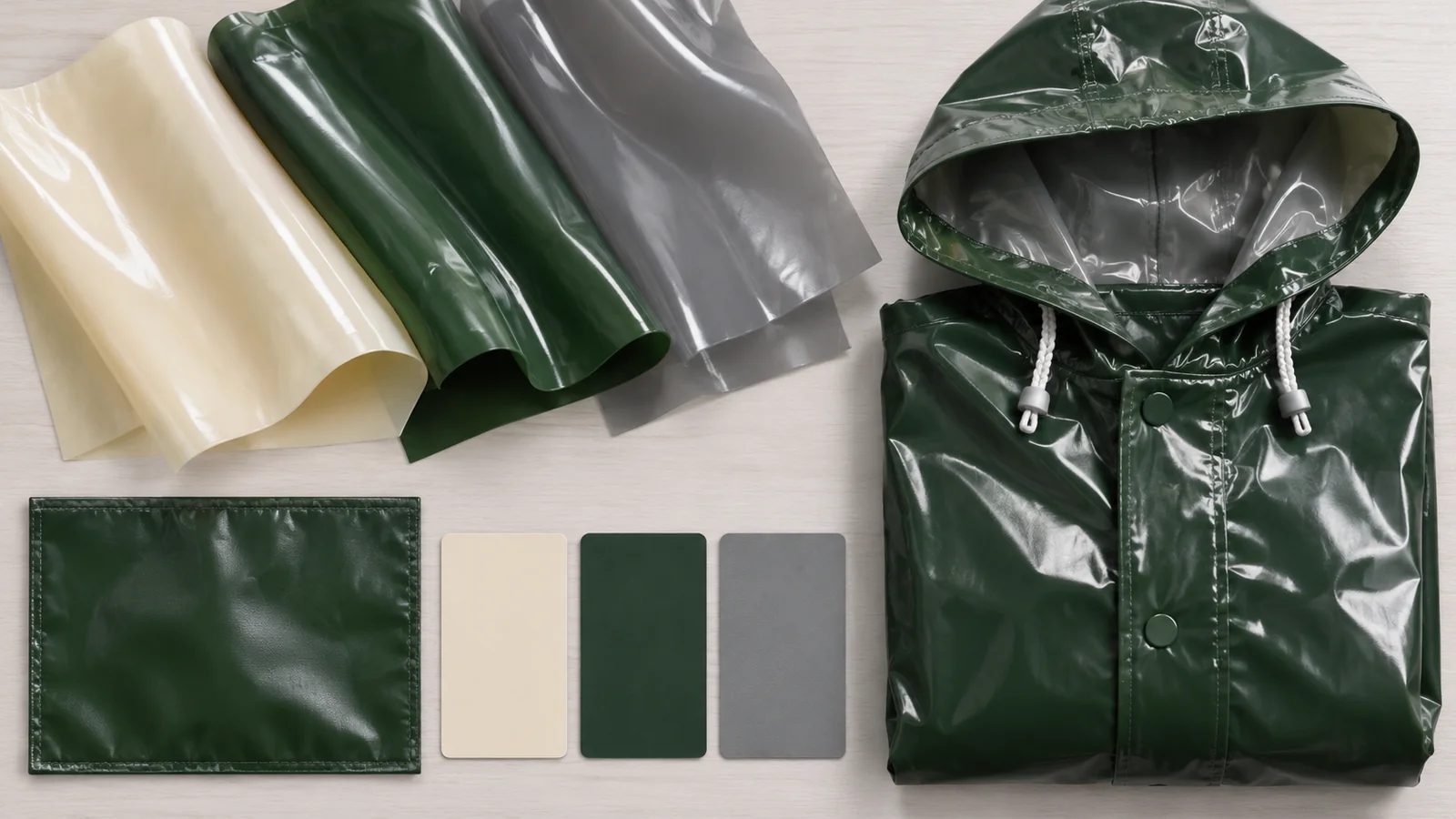
Use physical references for opacity and appearance
Color and surface finish can strongly influence how a vinyl raincoat is perceived, especially in a branded program. A screen image is useful for discussion but does not establish the exact appearance of a flexible material under real lighting. Ask for physical references on the proposed construction and review them with the finished sample. Record the intended color, opacity, gloss or texture and the conditions used for comparison. This helps the buyer distinguish a deliberate design choice from a difference caused by photography, display settings or a different material surface.
Opacity deserves a specific conversation. A clear, translucent and opaque garment can produce different visual results over the same clothing. Examine the material against representative backgrounds and clothing colors so the team understands what remains visible. A logo or printed panel may also look different when the garment is worn than when a swatch is placed on a white desk. Keep photographs for communication, but retain the physical sample that supports the decision. Avoid describing a product as fully opaque or transparent in every condition unless the claim has been appropriately defined and supported.
When a color reference system is used, confirm how it will be applied to the actual material and finish. A printed paper reference, a textile reference and a glossy vinyl surface may not look identical even when a similar color is intended. Ask the supplier to provide a proposed material sample and agree how variation will be reviewed. Do not promise an exact match without the necessary process and evidence. The purchasing file should identify the accepted reference and any agreed visual or instrumental assessment, with the responsible reviewers named for decisions that require judgment.
Examine surface finish across the garment, including folds, joins and reinforced areas. Embossing, gloss and texture can influence the visual effect of the style and the way decoration appears. Check whether the finish is consistent with the proposed body material and whether components intentionally differ. If a reinforcement or pocket has a different appearance, decide whether that is acceptable before production. A buyer should not assume that every visible difference is a defect, but should ensure that intended differences are recorded so inspectors can distinguish them from unapproved substitutions.
For a hypothetical brand launch, the team might compare a matte green swatch with a glossy green swatch using the same artwork and clothing background. The review could favor one finish for its intended visual character without claiming a general performance advantage. Record the chosen material and decoration combination rather than approving color and printing in separate files with no connection. If the body finish changes later, review the decorated sample again. This prevents an apparently minor material adjustment from changing the brand presentation after the artwork has already been signed off.
Use a small set of controlled appearance references instead of a folder full of conflicting images. Identify the accepted swatch, garment and printed sample with matching revision information. Store them according to the supplier's guidance and note if a reference becomes damaged or unsuitable for comparison. During receiving inspection, compare like conditions and document any difference before deciding what it means. The result is an appearance specification that supports a coherent branded product while remaining honest about the limits of screen previews, subjective impressions and material changes.
Assess decoration on the exact vinyl construction
Decoration should be evaluated on the actual material and finished construction proposed for the order. A print that looks satisfactory on a different plastic, color or surface finish may not answer the questions relevant to a PVC raincoat. Ask the supplier which decoration methods are offered for the selected model and what sample review is needed. Keep the discussion focused on the exact artwork, placement and intended care. Do not assume that a method listed elsewhere in a general product catalogue is automatically suitable for every vinyl garment and component.
Provide a controlled artwork file with the intended dimensions, colors and location. Identify any small text, fine lines, large solid areas or other details that are important to the design. Ask the supplier to explain limitations and propose a production-representative sample. The buyer should review the artwork at its actual size rather than judging only from a large screen enlargement. If a detail is not practical, resolve the change in the artwork approval process. Avoid leaving a production team to simplify the design without a recorded decision from the appropriate brand reviewer.
Review the printed sample as part of the garment, not only as a flat decoration swatch. Check how the image sits when the coat is fastened and worn, whether folds interrupt the intended message, and whether seams or pockets affect placement. Consider the interaction with translucent material and the clothing underneath. These are practical presentation questions. For any claim about print durability, adhesion or resistance to a particular condition, obtain suitable evidence for the actual combination. An attractive initial appearance does not establish how decoration will behave after repeated handling or supported cleaning.
Include packing and storage in the decoration review. Examine the proposed folded arrangement and any contact between printed surfaces and other parts of the garment or packaging. Ask the supplier for relevant guidance and evaluate a packed sample using the agreed process. Do not invent a storage temperature, curing period or chemical cleaning method based on a general printing article. Those details need support from the people responsible for the actual materials and process. The buyer's role is to identify the required outcome, ask the right questions and preserve the agreed instructions and evidence.
A useful hypothetical comparison might involve a small chest mark and a larger back design. The buyer could review each at the intended scale, check their relationship with the hood and folds, and decide which version better suits the wearing brief. Commercial differences should be quoted for the selected construction and artwork rather than assumed from the number of colors alone. If the supplier proposes a different print system or surface treatment, return to the relevant sample and evidence review. A method change can affect more than the visible artwork and should be treated as a controlled decision.
The approval record should identify the artwork revision, size, placement reference, color reference, decoration method and sample. Include supported care instructions and any limitations that need to accompany the garment. Keep the final file accessible to the people ordering, producing and inspecting the goods. During repeat orders, confirm that the material and decoration combination remains the same or review the proposed change. This allows a branded vinyl raincoat program to maintain a consistent presentation without turning an unverified printing assumption into a promise about the finished product.
Control artwork placement and packed presentation
A branded rainwear order has more than one presentation surface. The wearer sees the garment, distribution staff handle the packet, and receiving teams work with cartons and labels. These surfaces should be planned together so that the order remains recognizable and practical at each stage. Start with the intended use of the artwork and decide which information belongs on the garment, the individual package and the outer carton. Avoid repeating decorative content everywhere if it makes essential handling or identification information harder to find.
Define artwork placement from stable measurement points on the approved pattern. A phrase such as “centered on the chest” may be insufficient when the garment has a front opening, asymmetric details or several sizes. Ask for a placement drawing and a sample that shows the selected design. Where size grading changes the apparent position, decide whether placement will be adjusted or held to a specified reference. The buyer and supplier should understand the rule before production. A clear placement requirement reduces the risk of treating several visibly different interpretations as the same approved artwork.
Review the garment in its proposed individual packing. Confirm that the intended information is visible, the packet can be opened in the planned distribution setting, and any instructions remain legible. If the garment is folded to display a particular mark, check whether that arrangement is practical and consistent with supported handling guidance. Do not let a presentation requirement create an unreviewed stress on a fastening, printed surface or material fold. A packed sample should demonstrate the actual combination of garment, insert, sleeve, bag or pouch that the quotation includes.
Plan identification for size and color variants. The receiving team should be able to distinguish cartons, and the issuing team should be able to select the right packet without unnecessary unpacking. Use agreed product references and clear labels suited to the program. If a buyer supplies translated instructions, establish who checks the language and approves the final version. Keep regulatory information and care instructions separate from promotional claims that have not been reviewed. The artwork approval process should account for the actual destination and audience rather than assuming that one packet is suitable for every market.
Consider a hypothetical order with two coat sizes and two body colors. A simple carton allocation and visible packet identifier can help staff issue the intended item. Mixing variants may still be appropriate if it suits the operation, but the arrangement should be specified and checked. Ask for the exact packing breakdown and a representative carton example when needed. Do not infer the allocation from the total quantity alone. The logistics file should explain what each carton contains and how that information connects to the purchase order, inspection record and delivery documents.
Close the presentation review with a single approved package of references. Include the garment artwork, placement drawing, individual packing sample, care text, variant identifiers and carton marks. Give each a revision and explain which version controls if an older file appears in a conversation. When a marketing change is requested late in the process, review its effect on the garment and packing before approving it. This keeps the finished order coherent from the first sample to distribution, while allowing the buyer to manage branding as a defined part of the product rather than a last-minute decorative addition.
Develop artwork and packets with the custom rain poncho branding guide.
07 / 12
Run a useful sample evaluation
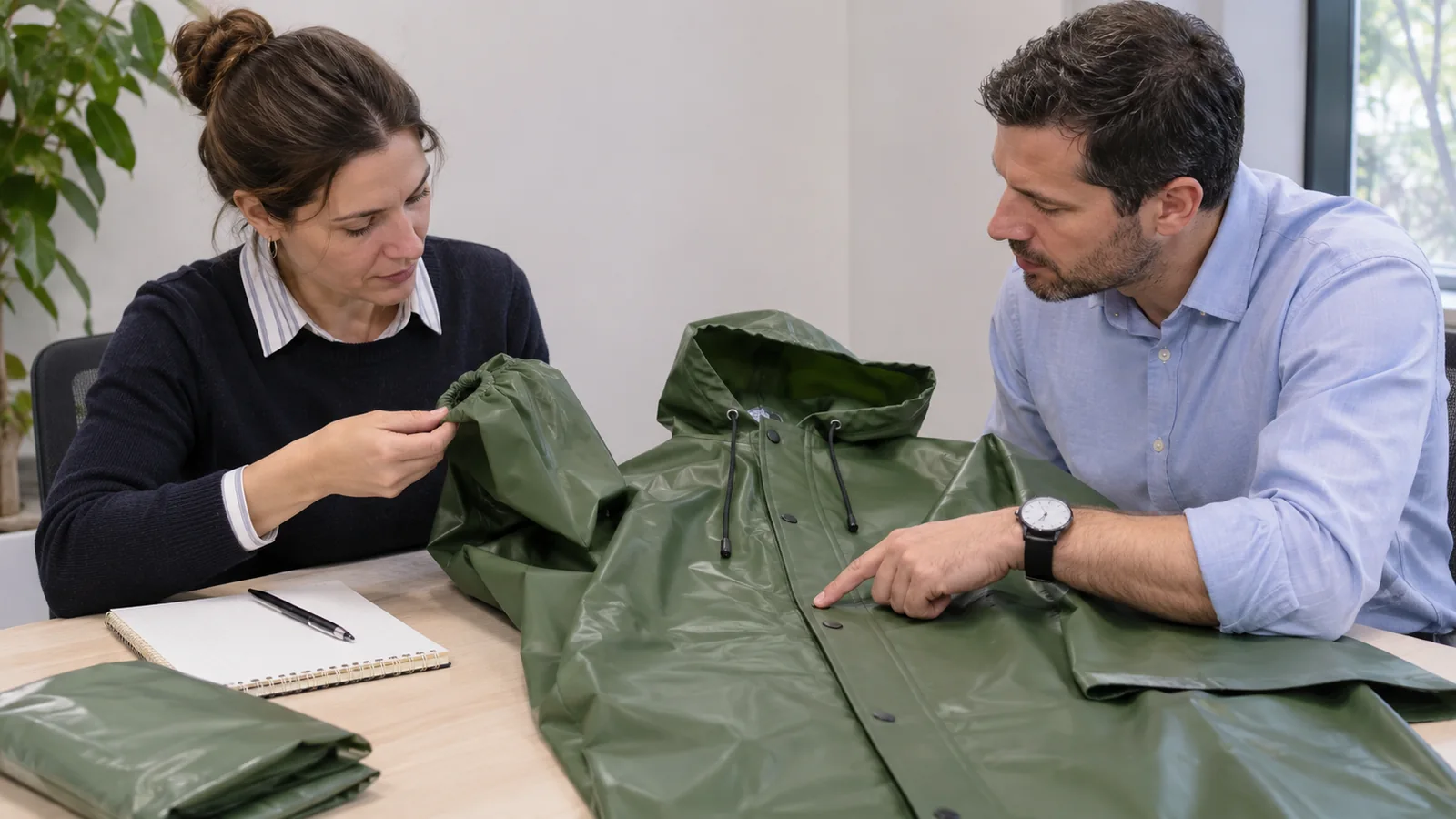
Organize a repeatable sample review
A sample review is most useful when it answers a defined set of buying questions. Begin by identifying the sample, the proposed specification and the decision the review is meant to support. A development sample may help select a silhouette, while a later sample may represent the intended production construction and packing. Label those stages clearly. Otherwise, a team may approve the appearance of an early prototype and later discover that colleagues assumed the same approval also covered material identity, care instructions, decoration and delivery packaging.
Create a short review plan before unpacking. List the features to examine, the people who need to participate and the references available for comparison. Include purchasing, the relevant product or technical reviewer, and the people responsible for use or distribution where appropriate. Assign questions to reviewers rather than asking everyone for a general opinion. One person might check dimensions against the drawing, another examine the packed presentation, and representative adult users assess ordinary fit and handling. The final decision should bring those findings together without confusing one type of evidence with another.
Record the condition in which the sample arrived. Note the packaging, identification, supplied instructions and any obvious transport damage or discrepancy. Photograph the garment before making changes to its arrangement. Keep accessories and inserts with the sample so that the package remains traceable. If a component is missing, ask whether it was intentionally omitted at this stage or differs from the proposed order. A review can still proceed on unaffected questions, but the missing part should remain visible as an unresolved item rather than disappearing from the approval record.
Use the same basic sequence for comparable candidates. Check identity and documents, examine construction, measure the agreed dimensions, review fit and movement, assess appearance and decoration, and then inspect packing and instructions. Record objective findings and subjective comments separately. A dimension outside the proposed range is different from a preference for one color or a request for easier fastening. Clear categories help the supplier understand what requires correction, what needs clarification and what is a design choice for the buyer. They also make a revised sample easier to compare with the earlier version.
For an illustrative two-sample comparison, the team might find that one coat has the preferred silhouette while the other has more practical packing. Rather than approving both in general terms, document the desired combination and ask for a revised complete sample. Keep the previous candidates as development references and identify the new sample as the proposed approval version. This prevents an informal conversation about selected features from becoming an ambiguous production instruction. The supplier should be able to point to one finished configuration that incorporates the decisions the buyer actually made.
End the review with a concise disposition: accepted for the stated stage, accepted subject to defined conditions, or returned for revision. List each open question, the person responsible and the evidence needed to close it. Avoid using a favorable overall impression to hide unresolved material or safety questions. A repeatable sample review does not need elaborate scoring to be valuable. It needs a clear purpose, traceable samples, specific observations and a decision record that connects the chosen garment to the specification and the next purchasing action.
Separate practical observations from performance claims
A buyer can learn a great deal by handling a raincoat, but the description of the result must match the way it was obtained. Opening a packet, checking a hood and wearing a sample over a jacket are practical observations. They can inform fit, handling and presentation decisions. They do not automatically establish a standardized waterproof rating, a chemical compliance conclusion or a guaranteed service life. Keeping these categories separate makes the buying file more credible and helps the team decide when a further technical assessment is actually needed.
Describe an observation with enough context to be useful. State which sample was reviewed, what the reviewer did, the conditions relevant to the question and what was seen. A note that a closure was easy for one adult to operate during a sample session is more precise than a claim that the garment is universally easy to use. A note that no visible issue appeared during a particular handling check should not become a promise that no issue can occur. The record should preserve both the finding and the limited circumstances in which it was obtained.
When a performance claim matters, first define the claim. A broad request for a “waterproof coat” can conceal several questions about material resistance, seams, openings, duration and conditions. Ask a competent reviewer to identify the relevant evaluation and acceptance criteria for the proposed product and use. Confirm whether available evidence addresses the complete garment or only a material specimen. Do not reproduce technical ratings from another model because its material looks similar. The connection between the offered construction, the evaluated sample and the proposed wording is essential to a defensible decision.
Apply the same discipline to durability and comfort language. A successful first fitting does not prove a fixed number of uses, and a pleasant touch does not establish breathability. If the buyer needs a specific durability or comfort claim, request suitable evidence and define its limits. Otherwise, describe the product and supported care routine without adding a quantified promise. There is commercial value in clear, accurate information. Buyers can compare construction and handling while recognizing that a material category alone does not predict every aspect of a wearer's experience.
Review supplier demonstrations carefully. A video can show how an item was handled, but may omit sample identity, preparation, conditions or the full result. Use it as a prompt for questions and request the underlying evidence where it supports an important claim. A laboratory report should likewise be read for scope, method, result and sample connection rather than treated as a decorative reassurance. If the report is outside the purchasing team's expertise, obtain an appropriate review. The useful question is whether the evidence answers the decision at hand, not whether the document looks impressive.
Before approving product copy, compare each proposed claim with its support. Keep a brief claim record containing the exact wording, the product reference, the evidence and any necessary qualification. Remove or revise statements that exceed what has been established. This is particularly important when a promotional description is shortened for a packet or sales page, because a missing condition can change its meaning. Separating observations from claims allows practical sampling to remain useful while ensuring that technical, safety and environmental statements receive the level of review their meaning requires.
Resolve differences before releasing the reference sample
The reference sample should represent a settled product decision. It is not simply the most recent garment to arrive or the sample that happened to receive a positive email. Before release, compare it with the current drawing, material description, component list, artwork and packing requirements. Identify every difference that matters to the order. Some differences may be acceptable, some may need correction and others may require more information. The important step is to resolve them explicitly so that production approval does not depend on assumptions scattered across separate conversations.
Use a revision list that describes the location and nature of each issue. For example, identify a hood dimension, a fastening position or a printed area rather than writing only “improve quality.” Add a photograph or marked drawing where it clarifies the point. Ask the supplier to respond to each item and state how the proposed revision will be demonstrated. If a change affects another feature, include that consequence in the review. Moving a fastening might alter the placket arrangement, while changing the body length could affect folding and carton allocation.
Do not combine approvals from incompatible sample versions without checking the complete result. A buyer may like the material from one sample, the hood from another and the print from a third. That can be a useful development direction, but it is not yet a verified finished configuration. Request a sample that brings the selected details together and review the affected requirements. If a full revised sample is not available at a particular stage, record the limits of the approval clearly and decide what remains necessary before production can be released.
Define who has authority to approve each type of change within the buying organization. A brand reviewer may approve artwork, while a technical reviewer addresses material or performance evidence. Purchasing should coordinate the decisions so that one person's acceptance does not unintentionally override another unresolved requirement. Keep the final approval accessible to the supplier and the inspection team. A practical record names the version, the approved scope and any remaining conditions. It avoids vague language that might be interpreted as permission to substitute components or omit a later check.
An illustrative revision could involve replacing a packet that is difficult to open. The buyer should review the new package with the same garment, confirm that the required information remains present, and update the packing reference. If the garment itself is unchanged, there is no reason to repeat unrelated development work. Conversely, if the new folding arrangement changes how a printed surface contacts another panel, the decoration and handling questions deserve another look. The review should follow the actual effect of the change, keeping useful prior evidence while addressing what has materially changed.
Once all required decisions are closed, identify and retain the approved sample appropriately. Give the supplier and buyer matching reference information, store associated photographs and documents, and explain how later substitutions will be handled. If a reference sample is damaged or replaced, record that event rather than letting an unmarked substitute take its place. The resulting file provides a stable point for production, inspection and repeat ordering. It does not eliminate the need for ongoing control, but it gives everyone a clear answer to the practical question of which PVC rainwear configuration was actually approved.
Connect sample observations to the product evidence review.
08 / 12
Write realistic cleaning and storage instructions

Obtain care guidance for the complete garment
Care instructions should come from evidence and guidance for the exact raincoat construction, including its decoration, fastenings and any backing or lining. A generic instruction for “plastic clothing” is not a reliable substitute. Ask the supplier to provide the proposed cleaning, drying and storage directions before the order is approved. Review the wording with the relevant product specialist where necessary. The buyer should understand what the wearer is expected to do and whether the instructions are practical for the intended program, rather than discovering an inconvenient routine after the garments have been distributed.
Confirm the scope of the guidance. A plain PVC sheet, a coated textile and a printed assembled coat may not share the same care requirements. Ask whether the instructions apply to the full selected model and whether any component needs special attention. If machine washing, a cleaning agent or a drying process is proposed, request support for that recommendation instead of borrowing a method from another rainwear product. Similarly, do not assume that instructions for a different waterproof fabric or brand can be transferred to the current vinyl garment simply because both are sold as raincoats.
Keep everyday care language understandable. The wearer needs to know the permitted cleaning method, drying approach, storage arrangement and actions to avoid for that model. Where a symbol is used, ensure that the accompanying information and destination requirements have been reviewed appropriately. Avoid vague phrases such as “wash normally” that leave the user to choose a method. If a particular instruction is unclear, return it to the supplier for clarification before printing labels or inserts. Clear directions can reduce avoidable confusion without making an unsupported promise that following them guarantees a fixed service life.
Consider the actual distribution setting. An individually assigned coat may be cared for by its wearer, while a shared program may use a central handling process. Ask whether the supported routine can be followed in that setting and identify the people responsible for it. If a central process uses cleaning or drying equipment, do not assume compatibility. The product and process need to be reviewed together. Ordinary rainwear guidance also should not be presented as a validated disinfection procedure or as evidence of protection against contamination when those applications have not been established.
Review the instruction format on the sample. Text should be legible and remain associated with the garment in a way that suits the intended use. A separate insert can provide detail, but the buyer should consider what information remains available if the insert is discarded. If instructions are translated, have the meaning checked rather than relying on an unreviewed literal conversion. Keep the final language and artwork revision in the approval file. This connects the user's routine to the same construction that was evaluated during sampling and avoids contradictory directions across labels, packets and sales descriptions.
Treat a care change as a product-information change that may need further review. If a supplier later proposes a different print system, coating or component, ask whether the existing instructions still apply. Update the approval record and affected packaging where necessary. A useful care file includes the exact model, supported instructions, review responsibility and the version printed for the order. This makes the buyer's promise to the wearer specific and manageable: follow the guidance supplied for this garment, inspect its condition, and seek clarification when an intended handling method falls outside the supported routine.
Plan drying, folding and storage around the design
Storage should be planned as part of the rainwear program rather than treated as an afterthought. A garment may need to be handled differently between uses than when it first arrives in a compact factory packet. Ask the supplier for the supported drying and storage arrangement for the exact construction and decoration. Then examine whether the proposed routine can be carried out by the intended wearer or operating team. The purchasing decision should account for that practical requirement, especially if garments will be collected, stored and issued again.
Begin with the transition from use to storage. Determine where the garment will be placed, who will inspect it and how the supported drying instructions will be followed. Do not assume that a used coat can immediately return to its original packet. If the program relies on a shared drying area, consider space, identification and separation of items awaiting review from those ready for use. The details should follow the product's guidance and the organization's actual routine. Avoid improvising heat exposure or other accelerated methods simply to fit a storage deadline.
Review the proposed hanger, shelf, pouch or folded arrangement with a representative sample. Check whether the garment can be handled without forcing the closures, creasing a decorated area unnecessarily or putting concentrated pressure on a small part. Ask the supplier to clarify any material-specific storage limitations. The buyer should not invent universal temperature or humidity limits for all PVC rainwear. Where environmental conditions matter to the intended storage location, request a suitable specification and evidence for the offered product, and confirm that the planned location can satisfy it.
Repacking deserves a practical trial if the product is meant to be carried in a pouch. Ask a representative adult to follow the instructions and return the dry garment to the pouch in an ordinary way. Observe whether the opening and closure are usable and whether the finished packet meets the carrying requirement. A factory-packed sample may demonstrate the initial presentation but not the ease of later repacking. If the pouch is too small for a realistic routine, discuss a revised package or instructions before making a compactness claim that users may struggle to achieve.
For stored bulk stock, keep cartons and variants identifiable and follow the agreed handling requirements. Record the packing date or lot information needed for the program and avoid mixing unreviewed returns with unused stock. If a carton is damaged or storage conditions depart from the supported arrangement, inspect the affected goods through an appropriate process before issuing them. This is an operational control, not a claim that visual inspection can detect every possible material problem. Where there is uncertainty about the product's condition, obtain guidance from the supplier or a competent reviewer.
Document the storage plan in language the responsible staff can use. Identify where new stock, used items awaiting care, reviewed reusable items and rejected items belong. Preserve the garment's reference information so a later issue can be connected to the correct order and instructions. Review the arrangement when the garment or program changes. By treating drying, folding and storage as part of the use case, a buyer can select a product and package that fit the real workflow instead of relying on a neat initial packet to answer every question about later handling.
Inspect returned garments before reuse or repair
A returned raincoat should be assessed for its intended next use rather than automatically placed back into circulation. The review should follow the product's supported instructions and the organization's handling process. Identify who is responsible for examining the garment and how uncertain items are kept separate from those approved for reuse. This is particularly useful in a shared program, where the person receiving an item may not know how it was used or stored. The aim is to make a deliberate decision based on the actual garment and available information.
Create a practical inspection list linked to the approved design. Check the body panels, joins, hood, closures, pockets, decoration and any accessory that is necessary for use. Look for visible damage, missing parts, unusual changes or conditions that require further assessment. Record the location of an issue and the garment reference where appropriate. Avoid turning the list into a promise that an item is safe merely because no visible problem was found. Visual inspection has limits, and specialist concerns should be referred to a person qualified to assess the relevant question.
Clarify when an item should be withdrawn from the ordinary reuse process. A closure that no longer works, a damaged seam or an unclear contamination history may require a different response from a cosmetic mark. The responsible organization should define its decision process with appropriate guidance for the product and intended setting. Do not provide generic repair or cleaning instructions for unknown damage. In particular, improvised adhesives, solvents, heat treatments or replacement parts can alter the construction and should not be treated as approved simply because they appear to work during a casual attempt.
If repair is contemplated, ask whether the supplier supports a suitable repair route for the specific model and issue. Establish which materials, methods and checks are required and whether the repaired item remains appropriate for the intended use. A buyer should distinguish a supported repair process from an unverified modification. Record the work and any follow-up assessment needed before reuse. If no appropriate route is available, make a separate decision about withdrawal and local disposal rather than returning a questionable garment to service to meet an inventory target.
Use returned items as feedback for purchasing without making unsupported statistical claims. If several users report difficulty with the same fastening or packing routine, document the observations and ask whether the pattern, instructions or allocation should be reviewed. Keep the number and context of observations accurate. A small collection of comments can identify a useful question, but should not be presented as a universal failure rate or a precise lifespan prediction. The supplier can investigate a specific issue more effectively when the report includes the model, lot, use and visible condition.
Close the loop between return handling and the next order. Update the use brief, instructions or sample review where evidence supports a change, and preserve previous versions so the decision remains traceable. A planned reuse program depends on more than the material name: people need to follow the supported routine and make informed decisions about condition. By defining inspection, escalation and repair boundaries, the buyer can manage returned rainwear responsibly while avoiding a blanket promise that every garment can be reused indefinitely or restored through an improvised repair.
Compare the handling routine with the reusable rain poncho guide.
09 / 12
Request relevant formulation and compliance evidence
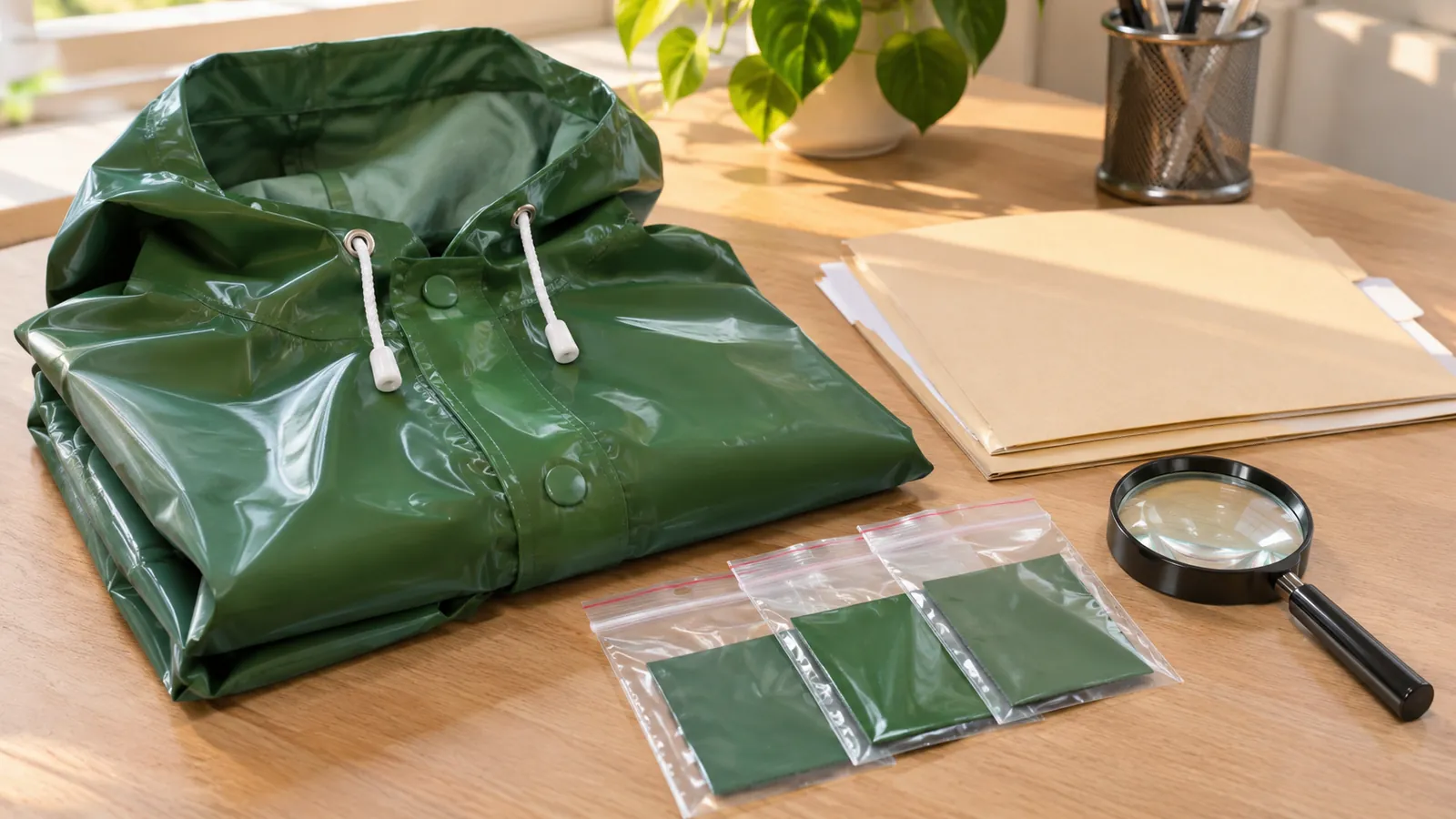
Map destination requirements to materials and components
Begin a compliance enquiry with the product and destination, not a request for a universal certificate. State whether the purchase is an ordinary adult raincoat, a poncho, or another specifically described garment. Identify the country of sale, intended wearer, sales channel and proposed claims. A garment promoted for everyday showers presents a different assessment question from equipment advertised for a particular occupational protection function. Giving the supplier and your technical adviser this context helps them identify relevant evidence. It also prevents a familiar document from being accepted simply because its title sounds appropriate to rainwear.
Create a component list that follows the physical sample. Include the main PVC material, any backing, reinforcement patches, closures, drawcords, print, labels and packaging. Ask which components share a formulation or production source and which need separate identification. A report describing a clear film sample may not describe a printed green coat with additional hardware. The purpose of the list is traceability: each document should have an understandable relationship to the part actually supplied. It does not mean every component automatically requires every possible test, or that a procurement team should design a chemical testing programme without qualified advice.
Use the European Commission's REACH restrictions overview as a starting point for identifying relevant EU restrictions, then have the applicable legal entries and current scope checked for the proposed article. A general statement that a company is familiar with REACH is not a description of a particular garment. Request the substance or restriction addressed, product identification, evidence date and basis of the declaration. If a report is provided, retain its complete scope and any qualifications. Do not convert a report covering selected substances into a claim that every chemical requirement in every destination has been assessed.
Review document consistency before debating the result. The company name, model, material code, color, sample description and report identifier should be intelligible together. Different names may have an ordinary commercial explanation, but the explanation should be documented. If the sample was supplied by an intermediary, ask how it corresponds to the production material. Where a laboratory report is important to the purchasing decision, use an appropriate independent verification route to establish its authenticity. A logo on a copied cover page alone should not decide whether the evidence belongs in the approved purchasing file.
Assign responsibilities explicitly within your buying organization. A sourcing manager can collect documents and compare identifiers, while a qualified compliance specialist determines legal applicability and whether further information is needed. Marketing should see the boundaries of the evidence before drafting public claims. Warehouse staff need practical batch and model identifiers, rather than an unexplained folder of certificates. This division keeps each decision with the people able to make it. It also gives the supplier one coordinated request instead of several conflicting demands that use different product names or describe different intended uses.
Finish the review with a short evidence matrix. Record the requirement being considered, relevant component, document supplied, remaining question, responsible reviewer and release decision. Mark unresolved questions as unresolved; a blank cell should not be interpreted as approval. For example, a buyer might accept the sample's dimensions while holding the final order pending clarification of a printed component. That is a controlled partial review, not a claim that the finished garment is compliant. Once the questions are resolved, preserve the reviewed product specification with the evidence so a later material or decoration change can trigger a focused reassessment.
Review phthalate information within the correct scope
A request for phthalate information should identify the substances, product scope and destination that matter to the proposed order. The word PVC does not by itself identify every ingredient in a flexible material. Equally, a statement that one ingredient is absent does not describe the complete chemical profile of the finished garment. Ask the supplier to explain what its declaration covers and how the declaration is supported. If the answer is a test report, compare the tested sample description with the material, color and construction you intend to buy before discussing a pass or fail result.
Avoid treating different jurisdictions as though they use one identical rule. The European Commission describes restrictions concerning specified phthalates in plasticised materials under REACH. The US Consumer Product Safety Commission explains a different statutory context for specified phthalates in children's toys and child care articles. Those product categories and definitions matter; the CPSC explanation should not be repurposed as a blanket rule for all ordinary adult raincoats. The appropriate review begins by classifying the actual product and examining the current applicable requirements, rather than copying a limit from an unrelated product listing into a purchase order.
Ask your qualified reviewer to define the evidence request before commissioning testing. Useful questions include which substances are relevant, which components are covered, what sample preparation and method are appropriate, and how results should be reported. Procurement staff should not assume that an aggregate headline answers a question about individually identified substances, or that one tested component represents every other component. The testing plan should follow the legal and technical question. This is especially helpful when the garment contains a main film, printed area and additional flexible accessories whose formulations may differ from one another.
Read the language of a proposed marketing claim separately from the laboratory result. A result below a stated reporting limit is not the same sentence as an absolute promise that a substance is never present. A report about selected phthalates does not support a general claim that a raincoat is free of all potentially relevant chemicals. Keep the wording specific to the evidence and have any proposed public claim reviewed. In many buying files, the most useful outcome is a precise documented requirement with supporting evidence, rather than an expansive slogan printed on packaging or repeated throughout a sales catalogue.
Plan what happens if the supplier changes material source, formulation or decoration. Ask which changes require advance notice and whether an existing declaration remains applicable to the changed construction. Do not assume that unchanged garment dimensions mean unchanged chemistry. A clear material revision code can connect the commercial specification with the evidence folder, while a signed change request can identify exactly what has moved. The buyer can then decide what further review is necessary. This approach is more useful than asking for the same generic certificate on every email without checking whether the underlying sample description has changed.
Keep the final purchasing record understandable to the next person. Record the model, destination, relevant components, reviewed documents and exact accepted wording. If a particular question remains outside the review, say so plainly in the private file. Do not allow a conditional supplier statement to become an unconditional customer promise through repeated copying. A procurement team that preserves scope can compare quotations more accurately and explain why an apparently similar material needs additional evidence. That discipline helps maintain a consistent order without implying that PVC terminology, a supplier assurance or a single test report independently settles every safety or compliance question.
Treat California warnings as an exposure question
California Proposition 65 questions require a different conversation from a simple material-name check. OEHHA's guidance explains responsibilities around exposure to listed chemicals and warning decisions. The presence of a listed substance and the question of whether a warning is required should not be treated as interchangeable conclusions. A buyer should obtain advice appropriate to the product, anticipated exposure and current rules. A generic supplier phrase such as California compliant is too broad to explain the basis of that decision. Request a clear account of what was assessed and who is responsible for the resulting determination.
Describe the intended product use accurately when asking for that assessment. An ordinary adult raincoat worn over clothing, its handles or closures, and its packaging can present different factual questions. Provide the actual construction, relevant material information and intended sales context to the qualified reviewer. Do not invent an exposure scenario merely to obtain a preferred answer. Similarly, do not assume that a laboratory concentration result alone is an exposure assessment. The evidence required depends on the question being answered, and a professional review may identify missing information that procurement staff would not recognize from the garment's appearance.
Keep warning artwork out of early sample approval until the responsible parties have agreed the approach. A warning copied from another product may contain unsuitable wording, identify a different chemical, or reflect a different assessment. If a warning is required for your product and channel, the current applicable format and delivery requirements need their own review. Treat the approved wording, placement and packaging version as controlled artwork. A supplier can reproduce an approved file, but reproduction accuracy and the legal adequacy of that file are separate responsibilities that should be understood before the order is released.
Avoid using a warning as a shortcut for evaluating an unexplained product change. If a component or formulation changes, collect the relevant information and refer it to the responsible reviewer. The existence of a warning on an older package does not answer every question about a new material. Conversely, absence of a warning on a sample is not proof that someone completed the necessary assessment. Ask for the basis of the decision and retain it in the purchasing file. This keeps the conversation anchored to the product being supplied rather than the visual presence or absence of a label.
Coordinate the physical package with the sales channel once a reviewed decision is available. Procurement, packaging design and the team responsible for online listings should work from the same approved information. An accurate carton file does not ensure that a retailer has received the correct product information, and an accurate listing does not ensure that the supplied package matches it. Use version identifiers and a practical release checklist to connect these pieces. Where responsibilities are shared with a distributor or retailer, clarify who supplies the reviewed information and how subsequent changes are communicated and acknowledged.
The useful purchasing outcome is a traceable decision, not a claim of legal certainty created by an attractive sample. Store the product identity, assessment scope, reviewer decision, approved artwork if applicable, and change triggers together. Seek qualified advice when the evidence or responsibility is unclear. This guide describes the questions a buyer can organize; it does not determine whether a particular PVC raincoat requires a warning. Keeping that distinction visible allows the commercial team to proceed with dimensions, packing and delivery planning while the appropriate specialist resolves the product-specific legal question before final approval.
Coordinate supplier questions with the rainwear sourcing guide for procurement managers.
10 / 12
Assess reuse and disposal claims carefully

Define a practical reuse plan without promising lifespan
A reusable rainwear purchase needs a plan for what happens after the first wearing. Identify who keeps the garment, where it can be dried, and how it returns to storage. Personal issue and shared stock create different practical requirements. A commuter who takes a coat home may be able to follow the supplied care instructions individually, while an event team collecting many garments needs a defined inspection and drying process. Neither arrangement can be assumed from the word reusable on a quotation. Describe the intended operating arrangement before comparing models or deciding which packing format is convenient.
Begin with the supplier's model-specific care information and the approved construction. Reuse decisions depend on the condition of the finished garment, including closures, seams, coating or film, and any decoration. Do not promise a fixed number of uses without relevant evidence and a clearly defined use scenario. A garment that is repeatedly packed while wet, handled roughly or used in an unsuitable activity may not behave like a carefully maintained sample. The purchasing file should therefore distinguish an intended reuse programme from a demonstrated service-life claim. These are related ideas, but they are not equivalent statements.
Design a simple return pathway that staff can actually follow. Provide a place to separate garments awaiting assessment from garments already approved for storage. Give the inspection team clear reasons to hold a garment, such as a closure that no longer works as intended or visible damage affecting coverage. Decide who can make the final return-to-use decision and who can answer questions about cleaning or repair. This arrangement reduces uncertainty at the point of issue. It also prevents a clean-looking folded item from being mistaken for one that has passed the organization's agreed review.
Track observations that can improve the next order without converting them into unsupported general conclusions. A private log might record that particular units developed damage near a frequently handled closure or that users found the original packing pouch difficult to use. Connect observations to model, batch and circumstances where possible. This helps the buyer discuss a specific design or handling issue with the supplier. It does not establish an overall durability ranking between materials. If comparison is important, the evaluation needs a consistent method, comparable garments and enough relevant evidence to support the conclusion being considered.
Consider the resources needed to operate the programme as part of the commercial decision. Storage space, drying arrangements, staff time and replacement stock all affect whether repeated use is realistic for your organization. A lower initial unit price does not automatically produce a lower operating cost, while a heavier garment does not automatically produce a better result. Use clearly labeled assumptions when building an internal cost scenario and revise them when actual records become available. Such a scenario is a planning tool, not a measured environmental benefit or a promise that every purchased garment will remain suitable indefinitely.
Review the programme after use and use the findings to refine the specification. The next order might need a clearer size identifier, different pouch dimensions or an easier inspection point, provided those changes are available and approved. Preserve successful details rather than changing the entire design because one aspect was inconvenient. When communicating externally, describe supported product features and appropriate care without inventing a lifespan or environmental saving. A practical reuse plan is valuable because it makes responsibilities and decisions clear. Its value does not depend on a claim that cannot be traced to relevant evidence for the actual product and use.
Check local collection before making recycling claims
End-of-use planning begins with the complete garment and the collection route available to the intended buyer. Identify whether the item is unsupported PVC film, a coated textile construction or a garment with mixed components. Closures, printing, labels and other attachments may matter to the receiving organization's acceptance criteria. Do not assume that an indication of the main polymer is a collection instruction for the whole product. The question is practical: will a specific local route accept this particular used item in its expected condition, and what preparation does that route require before the item is delivered?
The US Federal Trade Commission's Green Guides summary cautions against broad, unqualified environmental benefit claims and explains that recyclable claims depend on the availability of appropriate facilities. Use that principle to separate material terminology from an actual collection pathway. An item should not be advertised as readily recyclable merely because some form of the underlying polymer can be processed somewhere. Ask the relevant local collector or specialist programme about the finished rainwear, then document the answer. Where access is limited or uncertain, public wording should reflect those limits rather than implying a service that customers cannot realistically use.
Contact the receiving organization with enough detail to get a useful answer. Describe the garment construction, approximate condition, added components and expected volume. Ask whether it accepts post-use garments of this type, whether mixed colors or printed areas are acceptable, and whether there are minimum quantities or preparation requirements. Avoid assuming that a facility accepting manufacturing offcuts also accepts used raincoats. These are different material streams. Retain the response and the date because an acceptance arrangement can change. A purchasing team should not turn an old conversation about a different material stream into a permanent disposal instruction.
Design customer instructions around verified options and the actual destination. A general reminder to follow local disposal guidance may be more accurate than a confident recycling symbol with no identified collection route. If a specific take-back arrangement is proposed, establish who operates it, what it accepts and how customers access it before mentioning it publicly. Do not imply that this supplier operates such a programme unless that has been confirmed. The same discipline applies to packaging: a recyclable carton and a garment inside it are separate items, and a statement about one should not silently be interpreted as a statement about both.
Keep environmental comparisons proportional to the evidence. Avoid describing PVC rainwear as biodegradable, compostable, non-toxic or environmentally superior on the basis of its material name, appearance or intended reuse alone. Each claim raises its own factual question and may need different supporting evidence. A buyer can still compare practical issues such as packing dimensions, care instructions and the availability of a verified collection route without making a broader environmental ranking. Record the limits of what is known. This creates a more useful commercial discussion than a competition between attractive labels whose definitions and evidence are unclear.
Before approving packaging or catalogue copy, ask a reviewer to follow each disposal statement from the words to the supporting record. The record should identify the product, destination, accepted condition and any restrictions. If the route is unavailable, state the limitation and reassess the claim rather than adding an unsupported assurance. Review the information when a component changes or the distribution area expands. This process keeps disposal information usable for the customer and prevents a purchasing assumption from becoming an unqualified promise. It also leaves room for a genuinely verified collection option to be described accurately if one becomes available later.
Compare alternatives with a consistent purchasing brief
PVC rainwear is one option within a broader purchasing decision, so comparisons should begin with the same task. Define the expected wearer, coverage, clothing layers, issue method, storage arrangement and decoration requirement before asking about alternative materials. A lightweight emergency poncho and a longer coat intended for repeated personal use solve different problems. Comparing their unit prices without acknowledging those differences tells the buyer very little. Use a common brief to identify which options are genuinely comparable and which represent a deliberate change in the purchasing objective rather than a simple material substitution.
Separate features that must remain fixed from features that can change. For example, a buyer might require a particular packed size and adult coverage while remaining open to different closure arrangements. Another buyer might prioritize a specific coat silhouette and accept a larger package. Mark these decisions clearly on the request. Suppliers can then explain tradeoffs without having to guess which feature matters most. This is especially useful when comparing PVC with EVA, PE or coated textile constructions, because a familiar garment name does not ensure the same weight, surface, drape, seam design or packing characteristics across those alternatives.
Use actual samples and comparable evidence for the questions that affect the order. Evaluate fit over the same clothing, inspect closures in the same way and measure packed items under an agreed arrangement. Ask for the material identity and care information for each candidate rather than assuming instructions transfer between them. If a formal performance claim is important, request evidence relevant to each finished construction. A side-by-side photograph can show appearance, but it cannot establish a chemical profile, service life or certified performance. Keep the comparison method aligned with the conclusion the buying team intends to draw.
Build a comparison table with a place for unknown information. Columns can include construction, dimensions, finished weight, packing, available colors, decoration evidence, care guidance, document scope and quoted terms. Mark missing information as not yet confirmed. An empty value should not be treated as zero cost, automatic compliance or an available customization option. This approach prevents an incomplete quotation from appearing more attractive simply because it omits difficult details. It also provides a focused follow-up list, allowing the supplier to answer specific questions and the buyer to decide whether an unresolved point materially affects the selection.
Consider existing internal experience carefully. If your organization has already purchased an EVA poncho or disposable PE option, use recorded observations about that exact model as context. Do not assume that every product using the same polymer behaves identically. Changes in construction and use can affect what the comparison means. Discuss the experience in concrete terms: a packed unit was difficult to distribute, a hood adjustment was unclear, or a size range did not match the intended group. These observations suggest useful purchasing questions without turning a limited experience into an unsupported statement about an entire material category.
Choose the option that best fits the documented brief and explain the decision in that language. The conclusion might emphasize a preferred silhouette, workable storage format, clearer evidence or an acceptable sample review, rather than declaring one polymer universally best. Retain the alternatives considered and any reasons they were not selected. If circumstances change, that record allows the team to revisit the decision efficiently. A disciplined comparison also improves the PVC order itself: it clarifies which requirements are essential, which are negotiable and which claims remain unsupported, making the final specification easier for both the buyer and supplier to understand.
Compare a different material category using the EVA raincoat and poncho buying guide; for separate disposal questions, see the biodegradable poncho materials and disposal guide.
11 / 12
Turn the sample into a controlled wholesale order
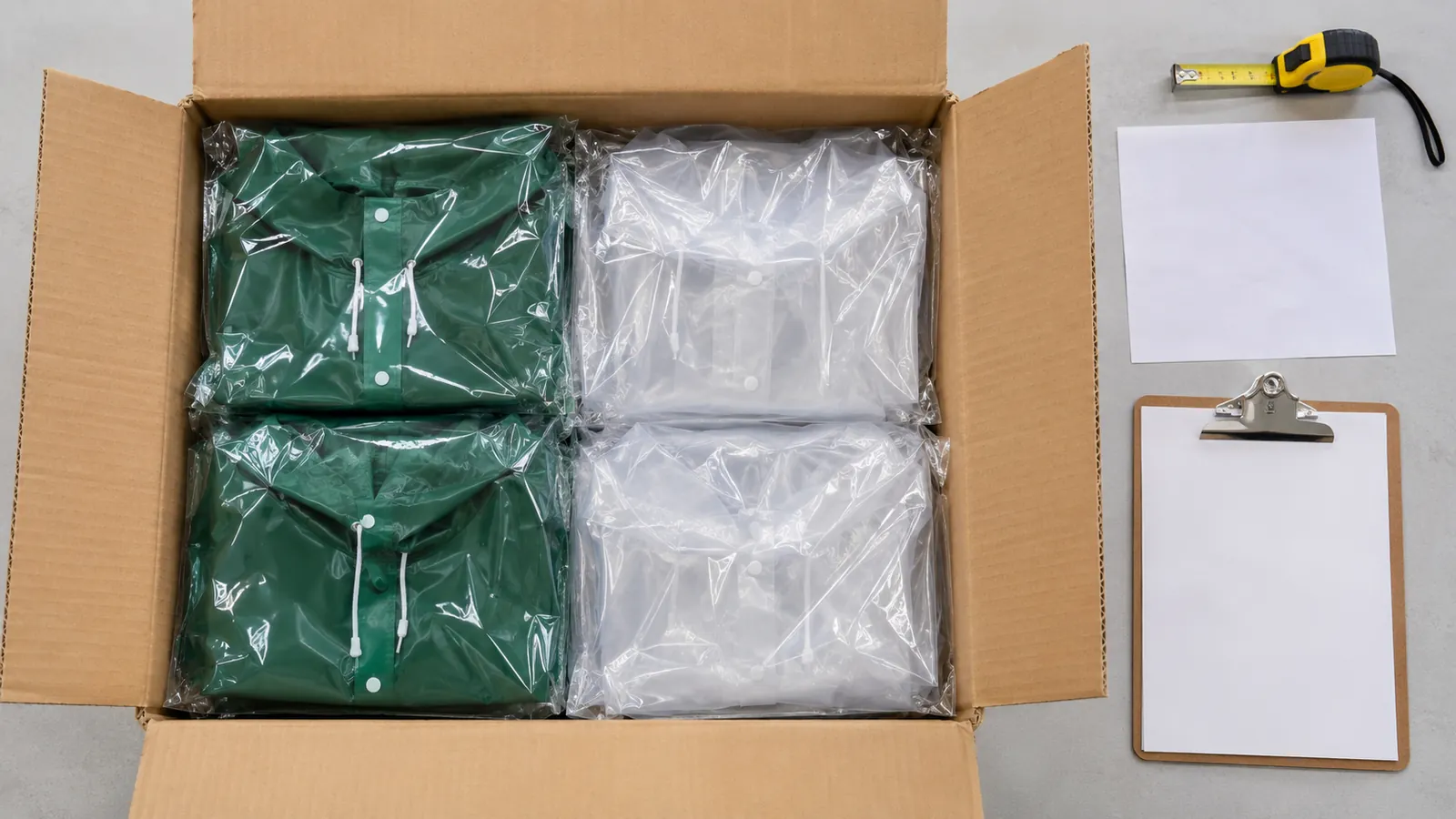
| Entity | Attribute | Value to agree | Verification |
|---|---|---|---|
| Finished raincoat | Identity | [Model, revision and sample reference] | Approved sample and current specification |
| Main material | Construction | [Confirmed PVC film or coated textile construction] | Material statement linked to sample |
| Material | Thickness | [Value, units, points, method and tolerance] | Agreed measurement record |
| Garment | Weight | [Size-specific unpacked value and permitted variation] | Sample weighing procedure |
| Fit | Dimensions | [Drawing values, points and tolerances] | Representative adult fit review |
| Hood and openings | Configuration | [Approved drawing and component references] | Finished-sample review |
| Seams and closures | Construction | [Join and fastening specification] | Workmanship and relevant performance evidence |
| Appearance | Color and finish | [Physical reference and agreed variation] | Actual material and decorated sample |
| Decoration | Artwork | [Revision, placement, size and print system] | Approved decorated sample |
| Care | Instructions | [Model-specific cleaning, drying and storage] | Supported supplier guidance |
| Claims | Exact wording | [Statement, destination and conditions] | Applicable product evidence and review |
| Packing | Unit and carton | [Packet, pouch, carton allocation and dimensions] | Approved packed sample |
| Order | Commercial scope | [Variants, quantities, terms and dates] | Current quotation and final purchase order |
| Change control | Approval | [Reviewer and release conditions] | Dated revision and disposition record |
Build an entity attribute value specification
An entity attribute value specification turns a long discussion into a structured description of the order. The entity is the item being described, such as the main garment, a closure or the retail pack. The attribute is the feature that matters, such as construction, dimension or packing quantity. The value is the agreed requirement, reference or approved range. This structure is useful because it prevents a general description such as green PVC raincoat from carrying more meaning than it contains. Each important purchasing decision receives its own identifiable place in the specification and can be checked against the sample.
Start with identity fields before adding measurements. Give the garment a model reference, specification revision, approved sample reference and intended adult use. Identify the main material construction and any relevant material code supplied for the order. Include the color and artwork version rather than relying on an email subject line. These fields connect commercial, technical and visual records. Without them, a perfectly clear dimension table may still refer to the wrong sample. The table accompanying this section uses request fields rather than invented product values; replace them only with information that has actually been agreed for the chosen model.
For dimensions, describe where and how the measurement is taken. A coat's chest width measured flat is not the same quantity as a wearer's body circumference. Sleeve length needs defined start and end points, and a poncho's overall width should identify whether it is measured flat with closures open or in another agreed arrangement. Record the unit and approved tolerance alongside the value. If different sizes use different measurements, use a size-specific schedule. This makes the specification practical for sample review and receiving checks without asking an inspector to infer the intended method from a photograph or informal description.
Link attributes that belong together while keeping them separately visible. A snap specification can identify the component, location, attachment arrangement and approved appearance. A packaging entry can identify the pouch dimensions, folded arrangement, unit label and number of garments in the carton. A decoration entry can identify the approved file, position reference and sample used for review. Separating these attributes helps when one detail changes: the team can see what is affected instead of replacing the entire specification with a new sentence that accidentally omits a previously agreed requirement or introduces an unreviewed substitution.
Add evidence references and decision owners to the table where necessary. A care instruction can point to the approved model-specific text, while a compliance entry can point to the reviewed evidence matrix and responsible reviewer. Avoid embedding a broad assurance in the value field if the underlying record is conditional. For instance, an entry can state that a specified document must be supplied and reviewed before release, rather than claiming an unverified certification. This keeps the table honest during development. It also makes the transition from pending to approved visible when the necessary information has been obtained and assessed.
Use the completed specification as the shared reference for the quotation, sample approval and order confirmation. Ask both sides to identify discrepancies before production is authorized. Retain a dated version and record later amendments explicitly, including the reason and affected attributes. Do not overwrite the original agreement in a way that makes earlier decisions impossible to reconstruct. A structured specification cannot eliminate every manufacturing or communication problem, but it gives the parties a concrete basis for resolving them. The benefit is clarity: when a question arises, the buyer can point to the relevant attribute and approved reference instead of relying on memory.
Compare MOQ, packing and bulk pricing on the same basis
A bulk quotation is meaningful only when the quoted product and quantity structure are clear. Ask whether the minimum order applies to the overall order, individual model, color, size or decoration version. A single total quantity can hide several smaller production groups with different terms. State the proposed mix explicitly and ask the supplier to confirm what is available. Do not assume that a price shown for a basic garment also covers a printed version, special pouch or multiple color assortment. These are commercial details to confirm for the actual enquiry, not fixed capabilities that can be inferred from a material category.
Create a quotation schedule that separates the garment from additional services and packing choices. Identify sample charges, decoration setup if applicable, unit packaging, carton configuration and any other quoted items. Ask how each item is charged and whether the quotation includes the requested artwork or labeling arrangement. The aim is not to require a particular pricing model, but to make competing offers understandable. A lower headline unit price may reflect a different package or omitted preparation work. Once the differences are visible, the buyer can decide whether to change the brief or request a revised quotation on the same basis.
Confirm the physical packing arrangement before using freight estimates to compare options. Request the number of garments per inner pack and outer carton, the proposed carton dimensions and the relevant weight information for the agreed configuration. Distinguish a preliminary estimate from confirmed packed measurements. A longer PVC coat, a compact poncho and a garment with a separate pouch may occupy different space even when the order quantity is identical. Record the assumptions used for logistics planning, then update them when the final sample or packing confirmation is available. Do not present an estimate as an assured shipping cost or delivery outcome.
Define the quoted delivery basis and responsibilities clearly. The commercial team should understand what location, transport scope and charges the supplier's offer covers, and obtain suitable advice where trade terms are unclear. Compare payment conditions, quotation validity and the events that start the production timeline. Artwork approval, material confirmation and sample acceptance can all be relevant dependencies in a particular order, so ask which apply. Avoid promising a lead time that has not been confirmed for the chosen quantity and construction. A useful quotation records both the estimate and the conditions on which it depends.
When evaluating quantity breaks, distinguish a real purchasing need from an attractive unit-price reduction. Additional stock requires storage, handling and an eventual use. If the organization is testing a new fit or packing arrangement, committing to a much larger quantity before the sample review is complete can amplify a correctable problem. Build a private comparison that shows total expenditure and the assumptions behind demand, rather than selecting the lowest unit figure in isolation. Such a comparison can support a commercial decision without inventing market demand, guaranteed savings or a universal optimal quantity for all buyers of PVC rainwear.
Finish the negotiation with one consolidated confirmation that references the final specification revision. Include the approved assortment, packing arrangement, artwork, evidence requirements, quoted basis and agreed review points. Ask the supplier to identify any exceptions explicitly. Resolve conflicts between the quotation and specification before treating either as the final production instruction. Keep the approved commercial record with the sample and document file so the receiving team can identify what was ordered. This discipline makes bulk buying more predictable because it connects the price to an identifiable product and scope, rather than leaving essential details scattered across separate messages and attachments.
Agree receiving checks and control later changes
Receiving checks should be planned while the order is being defined, rather than improvised when cartons arrive. Identify what the warehouse can verify directly and which questions require the purchasing or technical team. Carton labels, assortment, visible condition and selected dimensions may be practical receiving checks, while chemical evidence and specialized performance questions belong in the relevant review process. Give staff an understandable instruction for holding uncertain stock. A warehouse should not have to decide whether an unfamiliar document proves compliance or whether an unexplained design change is commercially acceptable simply because a delivery needs to be processed quickly.
Agree how inspection will be organized for the order's size and risk. If a sampling plan is used, have the appropriate parties define it and understand its limitations. Do not choose arbitrary acceptance numbers from an unrelated online table or imply that inspecting a few units guarantees every garment is identical. Specify the defects or discrepancies that matter and the agreed response when they are found. Useful categories might distinguish an incorrect model, an unapproved artwork version, a damaged closure and a packing-count discrepancy. The classification should reflect the actual agreement and the buyer's intended use, not an unexplained generic grading scheme.
Prepare a receiving pack with the final specification, approved photographs, sample reference and label examples. Use clear measurement diagrams where dimensions are part of the check. Explain how size and color codes correspond to the ordered assortment. If the purchase includes several versions, avoid a single photograph that represents only one of them. The goal is to make a correct comparison easy. Staff should be able to identify whether a carton and garment belong to the order before spending time on detailed inspection, and they should know where to record observations that need follow-up.
When a discrepancy appears, preserve the evidence and separate observation from conclusion. Record the relevant carton or batch identifier, affected quantity, photographs and the specific requirement in question. Describe what was found without immediately guessing its cause. A closure positioned differently from the approved reference is an observable discrepancy; the explanation may require discussion with the supplier. Keep affected stock under the agreed hold process while the responsible parties decide what to do. This creates a useful basis for correction and avoids mixing unresolved items with approved inventory in a way that makes the scope difficult to establish later.
Control changes during repeat orders with the same attention given to the first sample. Ask the supplier to notify the buyer before substituting material, components, decoration methods or packing arrangements that affect the agreed specification. A proposed change should identify the reason, affected attributes and any evidence requiring review. The buyer can then approve, reject or request a new sample for that change. Do not assume that a similar appearance or unchanged model name means the underlying construction remains identical. Clear revision management protects the meaning of the original approval and gives both sides a practical route for necessary improvements.
Close the order with a record of accepted goods, resolved discrepancies and lessons relevant to the next purchase. Keep these records linked to the specification revision and supplier confirmation. If a change was accepted after delivery, document its limits so it does not silently become permission for unrelated future changes. Use the experience to improve ambiguous instructions, not simply to add more paperwork. A receiving process works best when it tests the requirements that actually matter and feeds clear information back into sourcing. That connection turns the approved sample into an ongoing purchasing reference rather than a display item forgotten after the first shipment.
Align quantities and packing with the bulk rain poncho buying guide.
12 / 12
PVC rainwear procurement FAQ

Is a vinyl raincoat the same as a PVC raincoat?
In many rainwear descriptions, vinyl is used as a familiar commercial term for PVC, but the label alone is not enough to specify a product. Ask the seller to identify the material and finished construction explicitly. A garment may use unsupported plastic film or a PVC coating on a textile backing, and those descriptions are not interchangeable purchasing specifications. The useful answer is therefore qualified: the terms may refer to the same polymer family in a particular listing, but the buyer still needs confirmation of what the actual garment is made from and how its parts are constructed.
This distinction matters when comparing offers that use different naming conventions. One supplier might call a style a vinyl raincoat while another uses PVC mac, even though the commercial descriptions refer to broadly similar silhouettes. Another offer may use the same words for a different construction. Do not attempt to settle the comparison through vocabulary alone. Ask for the material description, photographs of the inside and outside, model reference and a representative sample. These details let the buyer compare tangible attributes. They also reduce the chance of approving an attractive image whose construction differs from the product ultimately quoted.
Consider a hypothetical buyer comparing a long coat with a poncho for an adult visitor programme. The coat may have sleeves, a front closure and a particular length, while the poncho may offer a different opening and packed arrangement. Even if both are described as PVC, their fit and distribution requirements can differ. The purchasing decision should examine those differences before trying to rank the materials. The word vinyl does not answer whether the hood permits the intended movement, whether the packed unit fits the available storage, or whether the closure arrangement suits the planned issue and return process.
Use the terminology question to open a more precise conversation about evidence. Ask whether material declarations, care instructions and any test documents relate to the finished model, the main film or another component. A broad material name should not be used to transfer a claim from one construction to another. If decoration or a backing is added, ask whether the existing information still covers the revised article. The buyer does not need to become a polymer specialist to organize these questions. The key is to keep the sample identity and document scope connected so technical review can address the correct product.
When preparing your own catalogue or internal purchasing description, choose words that help the intended reader. State the confirmed material construction and describe the garment format plainly. Avoid adding unsupported terms such as certified, non-toxic, recyclable or protective merely because they appear in another listing. If a shorter commercial name is used, ensure the detailed specification remains available to the people who need it. For example, the buying file can distinguish a coated construction from a film construction even when the customer-facing style name is simply raincoat. Clear naming supports the product description without pretending to replace the underlying evidence.
The practical next step is to request a completed product identity sheet and sample, then compare the details against your intended use. Keep a record of any ambiguity resolved during the enquiry. If the supplier cannot yet confirm a construction or component, mark it as pending and avoid building a firm claim around it. Once confirmed, use the same wording consistently across the quotation, approved sample and order. That consistency is more useful than insisting on a particular shorthand term. It ensures that both parties understand the product being purchased and gives later reviewers a reliable starting point for fit, care, quality and compliance questions.
What should a buyer request before ordering PVC rainwear?
Request enough information to identify the garment, evaluate its suitability and understand the commercial offer. Start with a model-specific material description, dimensions, available size and color options, closure details and packing arrangement. Add a representative sample and the relevant care guidance. If branding is required, supply the proposed artwork and ask what decoration options can be confirmed for that exact construction. These requests form a connected brief. Asking only for a catalogue, a price and a general certificate leaves too much uncertainty about the item that will actually be supplied and the conditions attached to the quotation.
Prioritize the requests according to the decision stage. During initial sourcing, a clear product description and preliminary quotation may establish whether a candidate is worth reviewing. Before sample approval, the buyer needs the details necessary to assess fit, construction, appearance and intended handling. Before production release, unresolved evidence questions, final artwork and the commercial specification need their agreed decisions. This staged approach avoids treating every early enquiry as a finished order while also preventing provisional information from being mistaken for final approval. Mark each document's status so a preliminary estimate cannot quietly become a promised delivery or accepted specification.
Provide useful information from the buyer's side as well. State the intended adult wearer, destination, likely clothing layers, issue method, quantity mix and packaging needs. Explain which features are essential and which are open to discussion. If the product will be sold with a specific performance or environmental claim, raise that question explicitly and seek suitable evidence and review. Do not expect a supplier to infer an occupational protection requirement from a request for an ordinary raincoat. A precise brief improves the relevance of the response and reduces repeated exchanges about details that could have been stated at the start.
Request compliance information by reference to the actual product and market, with qualified help where needed. Ask for the evidence scope, sample identification and relevant component information rather than an unlimited promise that the product meets every rule worldwide. The document checklist should make room for unanswered questions and the person responsible for resolving them. A buyer can continue practical sample review while those questions are addressed, but final release should follow the agreed approval process. Keep technical and commercial decisions connected without assuming that a well-made sample substitutes for evidence or that a document substitutes for inspecting the finished garment.
Ask for a written response to exceptions. If the supplier cannot provide a requested pouch, color reference or dimension, it is better to see that difference clearly than to receive a quotation that appears to accept everything. Record the proposed alternative and decide whether it meets the purpose of the order. If a sample differs from the intended production version, label that difference and establish what additional approval is needed. This makes negotiation constructive: the buyer can adjust a nonessential feature while protecting the requirements that matter, and the supplier knows which details remain unresolved rather than assuming silence means acceptance.
Before placing the order, gather the final specification, approved sample reference, artwork, evidence decisions and quotation into one release pack. Check that the same model and revision appear throughout. Confirm the quantity mix, packing and agreed responsibilities, then retain the correspondence that resolves material exceptions. The checklist below is designed to support that final review without supplying invented values. Complete it with information from the actual enquiry. A buyer who can explain what is approved, what is pending and who owns each decision is in a stronger position than one holding a large collection of documents with no clear connection to the selected PVC rainwear.
How can a repeat order preserve the approved specification?
A repeat order should refer to a controlled specification and sample, rather than relying on the phrase same as last time. Identify the previous model, revision, approved construction, color, artwork and packing arrangement. Ask the supplier to confirm that the repeat quotation refers to those exact requirements and to disclose proposed differences before production. Even a successful first shipment does not eliminate the need for a clear reference. People change roles, component availability changes and informal descriptions lose context. A concise, well-maintained purchasing record helps the next order preserve the decisions that made the first one acceptable.
Keep the reference sample in a condition that makes it useful, with its identity visible in the private storage record. Follow appropriate storage guidance and retain photographs of important details as supplementary evidence. A sample that has been heavily used, damaged or separated from its revision information may no longer provide a reliable comparison. If the reference needs replacement, agree how the replacement will be established and documented. Do not casually substitute a convenient garment from remaining stock without checking that it represents the approved version. The purpose of the reference is to resolve questions, so its own identity should not be uncertain.
Review the previous order's receiving and use records before confirming the repeat. Separate isolated observations from patterns that justify a specification discussion. If a packed arrangement caused distribution difficulties, describe the problem and request a targeted proposal. If the existing design worked well, preserve the relevant details explicitly. Improvements can be valuable, but they should be reviewed as changes rather than blended into a supposedly identical repeat order. A new pouch dimension or artwork placement might affect the packaging reference, while a material or component change may require additional technical evidence and sample review before it can be accepted.
Ask whether the documents supporting the first order still apply to the proposed repeat. Check product identity and scope, and have the responsible reviewer determine whether current requirements or changed circumstances call for updated evidence. Avoid using a document date alone as the entire decision rule: an old document may have a specific continuing relevance, while a newly issued generic statement may fail to identify the product. What matters is whether the evidence supports the actual order and relevant question. Record that review so later teams can understand why the existing file was retained or why additional information was requested.
Use a change register that is small enough to maintain. Each entry can identify the proposed change, affected attribute, reason, supporting sample or document, reviewer and decision. Keep the approved revision available to the supplier and receiving team. If a request is rejected or deferred, record that outcome rather than leaving competing files in circulation with similar names. This prevents an early proposal from being mistaken for the final instruction. It also allows a commercial team to discuss availability or cost adjustments transparently without losing sight of which construction, decoration and packing arrangement has actually been approved for the repeat order.
Close the repeat-order review by checking the same essentials as the first release: identity, quantities, specification, evidence, artwork, packing and commercial terms. The process can be faster when the records are clear, but speed should come from reusing reliable information rather than omitting important decisions. After delivery, connect receiving observations to the current revision and retain any resolution of discrepancies. Over time, this creates a practical history of the product your organization buys. The goal is not to claim that variation can never occur; it is to make expectations explicit, detect meaningful differences and give both buyer and supplier a clear route for maintaining or deliberately improving the approved rainwear.
PVC rainwear purchase checklist
- Define adult users, activity, clothing and destination.
- Confirm PVC or vinyl identity, film or coated construction, and components.
- Agree thickness, dimensions, closures and appearance references.
- Review the decorated finished sample and practical packing.
- Obtain model-specific care and storage instructions.
- Match every proposed claim to appropriate evidence and review.
- Align the specification, quotation, receiving checks and change control.
| RFQ field | Buyer entry |
|---|---|
| Use | [Adult audience; activity; clothing; destination] |
| Construction | [Material identity; drawing; thickness; components] |
| Branding and packing | [Artwork; placement; pouch; sleeve; carton allocation] |
| Care and evidence | [Instructions; exact claims; reports; unresolved questions] |
| Commercial scope | [Variants; quantities; dates; delivery basis; current terms] |
| Approval | [Reference sample; reviewers; acceptance; change process] |
Return to the rain poncho types, materials and uses guide to compare the complete selection brief.