
Wholesale buying guide · Disposable vs. reusable rainwear
Disposable vs. Reusable Rain Ponchos: Which is Best for Your Business?
A disposable poncho can be the right emergency backup. A reusable raincoat can make sense for a team that will wear it again. The difficult part is matching the product to what happens after issue. This wholesale buying guide compares bulk disposable ponchos and reusable EVA raincoats through coverage, handling, repeat use, branding and total program cost, so you can build an RFQ that suppliers can answer clearly.
Match the product to the wearer. Plan what happens after issue. Compare the complete program.
01 / 12
Choose disposable or reusable rain ponchos around the use model

Define the service you need before counting ponchos
A useful comparison starts with the service the rainwear must provide. Are you covering a visitor's short walk from a gate to a venue, equipping a tour group for an afternoon, or giving the same employees rain protection throughout a season? Those are different assignments, even when the order quantity looks similar. Write the assignment in a sentence before selecting a material. It gives your buyer, operations team and supplier a shared basis for discussing disposable and reusable options.
Choose a unit of service that your organization can actually observe. For a festival, that might be one attendee issued suitable rainwear for the event. For a recurring volunteer team, it could be one person equipped for each planned outdoor session. State what counts as a completed use and what happens when a garment is unsuitable or unavailable. A carton delivered to stores is an input; it is not evidence that the intended number of people received useful protection.
Describe the exposure without inventing a universal weather rating. Include the time spent outdoors, access to shelter, expected movements and clothing underneath. A person waiting in a seated audience needs different coverage from someone repeatedly reaching across a service counter. A backpack can change how a poncho hangs. Share these details with suppliers and ask them to identify limitations. Treat specific protective requirements as a separate technical review, particularly if the clothing will be used for occupational work.
Next, distinguish predictable demand from contingency demand. A scheduled series of outdoor sessions gives you opportunities to allocate garments and learn from previous use. An emergency reserve may sit untouched for months and then be issued rapidly to unfamiliar users. The reserve needs clear packing, accessible storage and reliable identification. The recurring program also needs a workable routine between uses. Neither operating pattern automatically dictates a material, but each changes which features deserve attention during sample review.
Define the comparison period. A one-day buying decision can make a compact disposable pack look particularly convenient, while a season-long program may reveal opportunities for repeat use. Be fair to both options: include the same coverage requirement and the same users, and count the work needed to deliver it. Do not credit a reusable garment with future uses beyond the period your business can reasonably manage. Equally, do not ignore unused emergency stock that remains suitable for a later event.
Put the service statement at the top of the RFQ. Below it, list the quantity range, destination, issue date, expected ownership and unresolved questions. Ask each supplier to explain how its proposal supports that service, rather than merely supplying a product name. A useful response might identify a stock poncho for contingency distribution and a separate reusable option for returning staff. You can then compare those proposals against a clear brief instead of guessing what each seller assumed.
Finally, agree who owns the decision. Procurement can manage commercial comparison, but the people issuing and using rainwear must confirm the operating assumptions. Ask them whether the proposed pack, size range and recovery process are realistic. Record the answers before requesting final Bulk Pricing. This short alignment step often exposes the real choice: not simply disposable versus reusable, but which combination of product and daily handling will provide the service your business intends to buy.
Separate visitor take-home, individual issue and shared stock
Ownership determines whether a reusable raincoat has a realistic route to another use. A visitor may take it home, an employee may keep it in a locker, or an organization may collect it for another person. Each arrangement requires different instructions and records. Decide which arrangement you are designing before assigning value to repeat use. Calling a product reusable describes an intended capability; it does not tell you who will keep it, care for it or bring it back.
For visitor take-home programs, focus on usefulness beyond the first event. Consider whether the garment fits comfortably, folds into a practical pack and carries information the recipient can understand. Avoid assuming that a prominent logo guarantees retention. A visitor may appreciate a well-designed poncho yet never need it again. Procurement can evaluate the product and ask for feedback, but should distinguish those observations from a measured claim about future wearing occasions that it cannot directly track.
Individual issue gives an organization more control over the garment's route. Staff can receive the correct size, learn the care instructions and report problems through a named contact. This can suit recurring outdoor duties, provided the product is appropriate for the task. Build a process for new starters, role changes and replacements. A personal allocation still needs oversight; a coat stored wet or left at another site may be unavailable when the next shower arrives.
Shared stock introduces a return and turnaround process. Someone has to collect garments, assess their condition, arrange appropriate cleaning when needed, dry them and identify what is ready to issue. Do not treat all returned garments as immediately available. Define separate states for ready stock, items awaiting attention and items taken out of service. Those simple distinctions help the stores team avoid distributing a damp or damaged garment because the inventory total appeared sufficient.
Consider a venue that serves occasional visitors and a regular volunteer group. It may choose compact emergency ponchos for visitors who leave through several exits, while allocating reusable rainwear to volunteers who return to the same office. The difference follows the ownership route rather than a judgment about which group deserves a better product. Both products still need appropriate coverage and clear instructions. This segmentation can be easier to operate than trying to collect every garment through one complicated scheme.
Write the ownership arrangement into packaging and communication requirements. Take-home rainwear needs information that travels with the garment. Individually issued stock may need a compatible internal identifier. Shared garments may need a size label that remains easy to read after the approved care process. Check any additional marking on a sample, and ensure it does not interfere with garment function or required information. Keep administrative convenience connected to the product people will actually handle.
Before ordering, ask the operating team to walk through a complete cycle using the proposed sample. Follow it from the delivery carton to the wearer and then to its next destination. Identify every handoff and the person responsible. If the route ends with “someone will probably collect it,” the reuse assumption is not ready for a purchasing model. A clear ownership plan makes the disposable-versus-reusable discussion practical and gives suppliers a much more useful customization brief.
Use decision gates instead of a single material score
A scorecard can help compare rainwear, but only after essential requirements are settled. Otherwise, a product can win points for appearance or compact packing while missing the coverage or operating requirements that matter most. Start with a few decision gates: suitability for the intended use, acceptable fit, an achievable delivery plan and evidence for any specific claims. Only proposals that pass those gates should move into the preference and commercial comparison stage.
Make each gate observable. “Good quality” is too vague to guide approval. A clearer requirement identifies the garment dimensions, fastening arrangement or sample check your team will use. Where performance testing is needed, name the requirement and ask an appropriate reviewer to establish the method and acceptance basis. Do not invent a test threshold to make a tender look technical. The gate should reflect the actual use and the evidence your business needs to approve it.
Separate hard constraints from things you can change. A fixed event date may be a constraint; a preferred pouch color may be negotiable. A requirement to fit the intended wearer range needs resolution, while a decorative feature might be simplified. Give suppliers permission to propose alternatives in the negotiable areas, with their effects explained. This can reveal a practical option that meets the service brief without adding unnecessary variants, tooling or approval stages to the order.
Evaluate operations as a gate when reuse depends on them. If shared reusable stock requires drying space that the venue does not have, the proposal is incomplete until that problem is solved. This does not mean reusable rainwear is unsuitable in principle. It means the buying decision includes an operating requirement that has not yet been funded or assigned. Keep the issue visible rather than awarding the product assumed reuse benefits and leaving the stores team to improvise later.
After the gates, compare preferences such as pack convenience, wearer feedback, branding flexibility and replenishment simplicity. Use a consistent scale with a brief explanation of each score. Ask reviewers to record observations rather than impressions alone: a closure was easy to operate, the pouch accepted the dry folded sample, or a size label was hard to read. These comments are more useful in supplier discussions than a spreadsheet containing unexplained numbers and an apparently precise ranking.
Keep uncertain items separate from failures. A missing document may require follow-up; an identified mismatch may require a different product. Mark each proposal as confirmed, awaiting clarification or unsuitable for the stated requirement. Set a date for resolving open questions before the order decision. This prevents a supplier with incomplete information from appearing equivalent to one that has already disclosed the limitations of its proposed construction and commercial scope.
The final recommendation should explain the selected operating model, the products that passed the gates and the assumptions still being monitored. It may support disposable stock, reusable stock or a defined mix. Avoid presenting the outcome as a universal ranking of materials. Your decision is stronger when colleagues can see why the chosen rainwear fits this program, who will manage it and what evidence would cause you to reconsider the next bulk order.
For the wider material framework, start with our Rainwear Product & Material Guide for Wholesale Buyers. Use this comparison to develop the disposable-versus-reusable decision within that specification.
02 / 12
Where bulk disposable ponchos fit an emergency supply plan
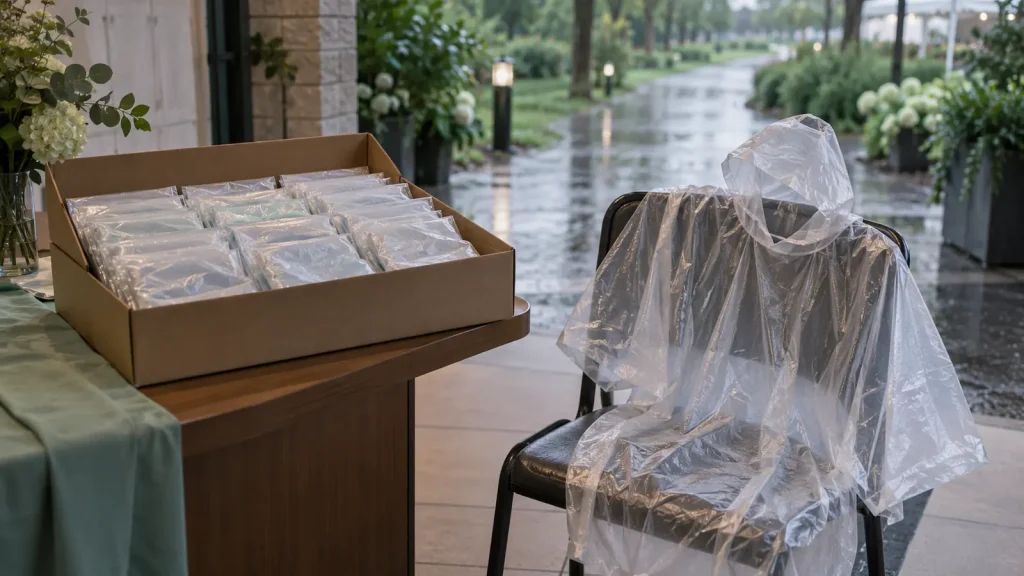
Compare emergency film ponchos by complete specification
Bulk disposable ponchos are often considered for compact contingency stock and rapid distribution. That is a starting point for a brief, not a complete specification. Two folded packs can look almost identical while containing garments with different dimensions, film thicknesses, opening shapes and joining details. Ask for a full product description and an unpacked sample. The buying decision should be based on the garment the recipient wears, together with the pack your staff handles.
If polyethylene is proposed, ask the supplier to identify the construction clearly rather than treating “PE” as a quality grade. Record the film specification, color, nominal thickness and relevant tolerance. Ask how thickness is measured and whether the quoted figure refers to one layer at the stated location. Avoid comparing figures that use different units or measurement conventions. A specification can be concise, but it must let both sides understand what will be checked on the supplied product.
Measure the complete garment as well. Agree the body length, width, hood dimensions and openings, using a simple drawing that identifies the measurement points. A heavier sample may simply be larger, so garment mass alone does not establish a more substantial material. Conversely, a compact pack may achieve its size by reducing coverage. Keep dimensions, mass and film information in separate fields so the comparison does not reward a product for a difference your team has not noticed.
Inspect the joins and the areas people pull when putting the poncho on. Check the hood connection, neck opening, side arrangement and any fasteners against the approved sample. Agree practical handling checks with the supplier rather than relying on an improvised demonstration in which someone stretches a corner until it fails. The question is whether the supplied construction meets the defined use and acceptance criteria, not whether a salesperson can make a sample survive a theatrical tug.
Consider how the poncho will be worn over bags and clothing. A broad body may accommodate some combinations but still leave the lower legs or arms exposed. There is no useful one-size promise without a defined wearer range and a fit review. Ask representative users to put on the sample in a controlled setting, identify the front and hood, and move normally. Record confusion or restricted movement before committing to the size and packing format for a large distribution.
Keep single-use positioning separate from unsupported durability or environmental claims. A disposable program does not establish that the product is compostable, recyclable locally or suitable for specialist protection. Request the evidence needed for any proposed statement and review the destination requirements. For ordinary emergency rain cover, a clear, modest description of the product's intended use is more useful than a list of broad claims that cannot be connected to the exact garment on the order.
At approval, retain a specification and sample reference that identify the actual film, cut, joins and pack. Ask the supplier to disclose proposed changes before production. Even a small alteration in fold, opening or material can affect how the product performs during issue. This gives purchasing a defensible basis for comparing bulk disposable ponchos and gives receiving staff something concrete to check when the cartons arrive, beyond whether the outside label matches the purchase order.
Test the pack at the moment rain begins
Emergency poncho packaging is part of the service, because recipients usually need the garment quickly. A pack that looks neat in an office may be difficult to open at a crowded entrance or while holding a bag. Review the actual opening method, fold and instructions with the people who will distribute it. The goal is a straightforward handoff from stored stock to a wearer who can identify and put on the garment without a lengthy explanation.
Start with the staff workflow. Decide whether workers hand out individual packs, place them in preassembled event kits or distribute them from several sheltered points. A pack suited to a gift bag may not be the best arrangement for high-volume issue from cartons. Ask for a packed sample and an example of the proposed carton arrangement. Check how staff find the opening, separate packs and identify the right variant while keeping the remaining stock protected from rain.
Then test the recipient workflow. Ask someone unfamiliar with the product to open the pack and put on the poncho using only the intended instructions. Observe where they pause or pull at the wrong part. Do not coach the first attempt, because that can hide a confusing fold or unclear opening. Follow with a short explanation and a second review if you revise the pack. Record which change helped, so the approved packing instruction is specific enough to reproduce.
Keep loose packaging in the plan. If many people open packs at the same location, staff need a practical route for collecting the packaging material. Decide who places and services the collection points and confirm the accepted waste stream locally. Do not print a recycling promise merely because a bin is available. The immediate operational requirement is to prevent loose wrappers from becoming a handling problem around the issue area and to communicate an accurate disposal instruction.
Consider information density. The front of a small pack cannot carry every technical detail, sponsor message and care instruction at equal prominence. Put the essential identification and opening information where it is easiest to find. Use an insert or a clearly referenced information page when appropriate, while making sure users do not need a phone connection to understand basic use. Ask the design team to review the printed sample at its actual size, rather than only enlarged on a screen.
Test the planned storage and distribution configuration before approving a custom shape or novelty container. A distinctive pack may support a promotional brief, but it can also change carton capacity, shelf arrangement and opening steps. Ask what the format achieves for the event and whether the operating team values that benefit. Compare it with a simpler option on the same garment specification. This keeps packaging design connected to practical use instead of allowing novelty to decide the entire purchase.
The final pack approval should describe the fold, enclosure, opening, printed information and carton count. Keep photographs or an approved physical reference alongside the artwork. Explain which details are essential and how any proposed changes will be reviewed. A well-defined pack can make emergency rainwear easier to deploy, while a poorly specified one can undermine an otherwise suitable garment at exactly the moment users need it most: when the weather changes and the issue queue starts moving.
Manage unused emergency stock as a controlled reserve
An emergency reserve should remain useful when it is needed, whether that happens next week or at a later event. Plan the stock's storage, identification and review process before buying it. Ask for product-specific storage guidance and any relevant limitations rather than assuming that every sealed poncho pack can be kept indefinitely. The condition of the garment, printed pack and enclosure all matter when deciding whether stock remains suitable for issue.
Choose a storage location that follows the supplier's instructions and supports reliable stock control. Record where cartons are placed and how staff identify the item and batch. Keep the intended route to distribution points clear. A reserve that is buried behind unrelated equipment may be counted as available yet be difficult to reach when weather changes. Review access with the operations team, particularly when the same space is rearranged during event setup or seasonal changeovers.
Separate unopened stock from opened or returned packs. A pack returned from a distribution point may have a different handling history from one that remained in controlled storage. Establish a simple review process before returning it to the ready reserve. Check the information needed for the product and its condition; do not make assumptions from the outside appearance alone. Where there is uncertainty, identify the stock and refer it to the responsible person instead of mixing it invisibly into a fresh carton.
Use a rotation method that fits the product guidance and your records. Keep dates, batch references and the reason for any hold or replacement. Avoid inventing a universal shelf life in a purchasing policy. If the supplier specifies a storage period or inspection requirement, record the conditions attached to it. If the information is missing, ask for clarification and set a review process based on the actual program rather than letting unverified stock accumulate until somebody notices a problem.
Think about branding obsolescence as well as physical condition. An event date or short-lived sponsor message can make unused packs harder to redeploy even when the garment itself remains suitable. Consider whether evergreen branding on the rainwear and event-specific information on a separate component would meet the commercial brief. Any such arrangement needs approval from the relevant brand owners, but it is worth discussing before artwork turns a flexible emergency reserve into stock tied to one occasion.
Count stock by usable issue units and location. Record cartons assigned to gates, kits assembled elsewhere, damaged packs and quantities held for review. Reconcile returns after the event so the next forecast starts from an accurate balance. A total purchase quantity is not a reliable measure of what remains ready for use. Simple, consistent records can prevent unnecessary repeat orders and help planners distinguish a genuine demand increase from stock that has merely moved to another storeroom.
Finally, review the reserve after each deployment. Ask which points ran short, whether staff could open cartons efficiently and whether the pack information was clear to recipients. Keep those observations separate from manufacturing defects, then update the next RFQ where needed. The value of disposable contingency stock lies partly in readiness. Treating it as a managed reserve, with a defined condition check and a sensible replenishment trigger, supports that readiness far better than treating a bulk purchase as a one-time administrative task.
Explore the bulk disposable rain poncho options, then confirm the complete construction, packing and intended use for the product proposed for your order.
03 / 12
When reusable EVA raincoats become a practical business choice

Specify a reusable garment rather than relying on the EVA label
Reusable EVA raincoats are a common starting point for buyers who want a garment intended for more than one wearing occasion. The material name does not settle the specification. Ask what the supplier proposes in terms of film construction, thickness, dimensions, closures and care. A reusable description should lead to practical questions about the complete product and its intended service, rather than an assumed number of uses that nobody has defined or demonstrated.
Compare the sample as a garment. Check how the hood sits, how the front or side closures operate and whether the body allows the intended clothing underneath. Look at the points where users pull when fastening, removing and folding it. Record construction details and measurements so the approved version can be identified later. The smooth appearance of a film surface is not enough to establish how every join, opening and attachment will behave through normal handling.
Ask the supplier to explain the proposed use and care boundaries. These may depend on the exact construction, decoration and components. Do not assume that an instruction appropriate for one raincoat applies to another product with a similar material name. Obtain written guidance for cleaning, drying, folding and storage, and clarify anything your organization cannot realistically follow. A reusable garment only makes operational sense when the handling routine is compatible with the people and facilities responsible for it.
If the brief includes a desired service period, describe the use conditions and ask how that objective will be evaluated. Avoid converting an informal demonstration into a guarantee of a particular number of wears. A carefully recorded trial can show what happened to identified samples under stated conditions; it does not establish every outcome in the field. Use the trial to identify questions about closures, joins, fit and care, then agree how the supplier will address those questions before bulk approval.
Evaluate alternatives when the proposal does not fit the brief. A coated textile garment, a different cut or another closure arrangement may deserve comparison, depending on the use. Keep the discussion open while the requirements are being defined. The point is not to force every reusable program into EVA, nor to assume another material is automatically superior. Ask for complete descriptions and samples that let you compare relevant tradeoffs against the same service requirement and operating conditions.
Consider the whole ownership experience. A garment that folds neatly when new may be less convenient to repack after use if the pouch is too small or the instructions are unclear. Check the dry sample after the agreed handling process and confirm that users can manage it without excessive force. Include the pouch, labels and fastening components in the approved specification. Those details affect whether the raincoat is kept ready for the next occasion or abandoned because it is awkward to store.
The output should be a product-specific reusable rainwear brief: construction, dimensions, intended users, handling instructions, sample evidence and unresolved limitations. Tie the commercial offer to that version and require proposed changes to be identified. This gives the buyer a clearer basis for an OEM Program and makes future replenishment easier to control. It also keeps the reusable claim connected to a real garment and a workable service plan, rather than allowing one familiar polymer name to carry the entire decision.
Make drying, inspection and storage part of the reuse plan
The interval between uses is where many reuse plans succeed or fail. After rain, the garment needs appropriate handling before it can return to a ready state. Identify the people, space and time required for that work. Do not assume that a durable-looking raincoat can simply be folded wet into its original pack and counted as available. Follow the instructions for the exact product and make those instructions practical for the operating team.
Map the return sequence in plain language. A shared program might involve collection, identification, condition review, the approved cleaning process where required, drying and storage. An individually issued program may place some of these steps with the wearer. In either case, state who deals with uncertainty or damage. People should not have to decide alone whether an unfamiliar mark, failed closure or damaged join is acceptable for another issue when the organization has promised a consistent service.
Assess available space using the proposed garment and actual throughput. A small trial can reveal whether the planned racks, hangers and storage areas accommodate the product without crowding or obstructing normal work. Use the supplier's instructions when selecting drying arrangements. Do not introduce heat, chemicals or other treatment simply to shorten turnaround without checking compatibility. The operational question is whether your process can return enough suitable garments to ready stock before the next demand period begins.
Use clear status identification. Ready stock, items awaiting care and items awaiting a decision should not look identical in the stores system. Simple location rules or compatible tags may be enough. Check that any added identification does not damage the garment or obscure required information. This is particularly important when several people share responsibility across shifts, because an item that was deliberately set aside can otherwise be put back into circulation by someone who does not know its history.
Keep inspection expectations proportionate and understandable. Staff can identify visible tears, missing components, inoperative fasteners or other concerns specified in the instructions. They should not be expected to infer technical performance from appearance alone. Establish an escalation route when the condition is uncertain, and maintain suitable replacement stock. Record the reason an item leaves service so procurement can distinguish wear, handling problems and product defects rather than treating every replacement as evidence that the material choice was wrong.
Review the storage format after drying. The approved fold and pack should be achievable without forcing the garment into an unsuitable space. Keep size and style identification accessible so the next issue does not require opening every pack. If the garment is allocated to individuals, provide a practical way to keep it with the user or at the designated location. A well-cared-for coat stored in the wrong place is still unavailable when its owner needs rain protection.
Measure the workload during an initial rollout. Record how many garments enter the process, how many are ready again and what causes delay. Use those observations to adjust stock and staffing assumptions before expanding the program. This makes repeat use a managed activity rather than a hopeful description on the product page. It also helps the buyer explain what a reusable option requires and why the proposal includes turnaround stock, care instructions and a defined process alongside the garments themselves.
Distinguish intended repeat use from observed repeat use
A reusable raincoat may be capable of further service, but procurement needs to know whether that service actually occurs in the chosen program. Keep three ideas separate: the product's intended use, the organization's planned reuse process and the uses recorded after rollout. Each answers a different question. Confusing them can produce an optimistic business case in which every garment is credited with many wears even though the organization never checks whether it returned or remained suitable.
Choose a simple record that matches your ownership model. For individually issued garments, you may track issue, reported problems and replacement reasons without recording every shower. For shared stock, a return and reissue record may be more practical. State the limits of the data. A return proves that an item came back; it does not by itself prove that it was worn, cleaned correctly or ready for immediate reuse. Avoid presenting one administrative event as evidence of all the others.
Define what counts as a successful use for your internal analysis. It might require that the garment was issued to the intended user, remained suitable for the agreed task and was available as planned. Keep the definition consistent across the options being compared. If you count every disposable pack distributed as a successful service but apply stricter checks to reusable garments, the result will be biased. The same coverage and suitability expectations should apply to both sides of the comparison.
Track reasons for interrupted reuse. A garment may be lost, retained by a visitor, damaged, unavailable during care or simply no longer needed. These are different outcomes with different remedies. Better construction may address one problem, while clearer allocation or simpler return logistics may address another. Do not combine every missing reissue under a material failure category. The purpose of the record is to improve the product-and-operation combination, not to produce a misleading verdict on a whole material family.
Use a pilot to test the important assumptions before a wide rollout. Select a manageable group that represents the intended operation, describe the conditions and decide what will be recorded. Review the findings with the people doing the work. If the pilot uses unusually dedicated staff or a special care area, acknowledge that difference when planning the larger program. A successful small trial is useful evidence, but scaling the process may introduce constraints that the original setup did not encounter.
Keep financial and environmental interpretations distinct. Recorded repeat uses can inform a cost model, but they do not automatically establish a particular reduction in environmental impact. That comparison may need additional information about materials, production, transport, care and disposal, with a suitable assessment method. Similarly, a reusable garment that delivers fewer uses than forecast may still be the right operational choice for a specific group. Review the full brief rather than making every decision depend on one headline number.
At the next purchasing review, replace assumptions with the observations you have and retain uncertainty where information is missing. Explain whether the product, the care process or the ownership arrangement needs adjustment. This creates a useful learning cycle for reusable EVA raincoats and other repeat-use options. Your business can then request improvements based on actual handling and availability, while keeping external claims and internal forecasts tied to evidence that the program is capable of supporting.
Review EVA rain poncho options as a starting point. Agree the exact garment specification and care requirements before planning a repeat-use program.
04 / 12
Compare rain protection, coverage and wearer comfort
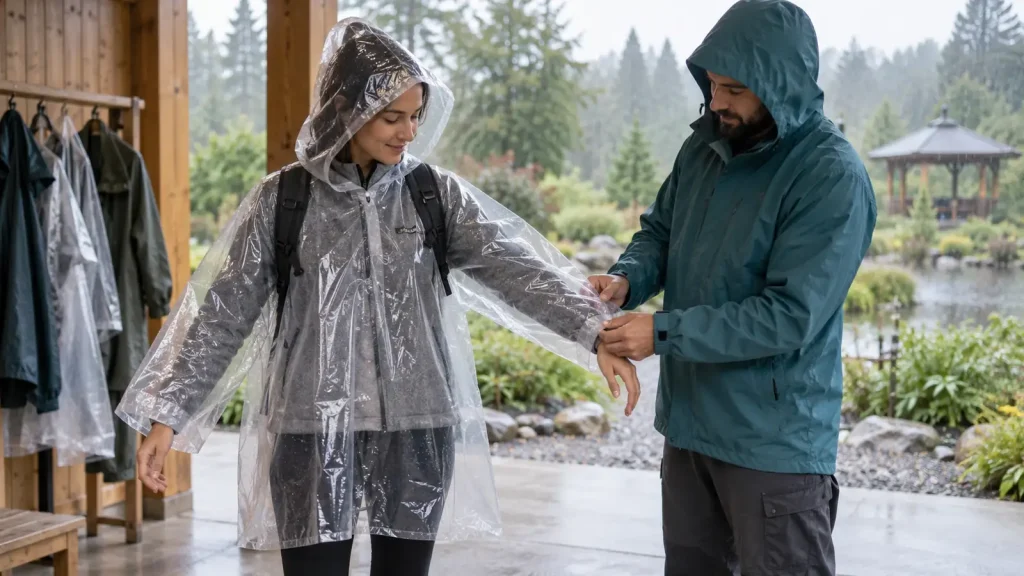
Review coverage through movement, not a hanger photograph
Rainwear protects only the areas its design covers in the way it is worn. A broad poncho and a fitted raincoat can therefore behave differently even when their materials resist water well. Compare them on representative people wearing the intended layers and carrying the relevant bags. A hanger photograph is useful for recognizing the product, but it cannot show whether the hood moves comfortably, the hem remains practical or the sleeves provide the coverage your users expect.
Start with ordinary movements from the intended setting. Ask participants to walk, sit, reach forward and turn their heads in a safe trial area. For a seated audience, review how the garment lies over the lap and seat edge. For a tour group, check the arrangement around a small backpack. For staff, include the normal uniform and equipment only where the garment is suitable for that use. Record the conditions so a later sample can be assessed consistently.
Look at the openings as carefully as the body panel. The neckline, hood, cuffs and side openings influence where water may enter or where coverage changes with movement. Ask the supplier to explain how the design is intended to be adjusted and worn. Do not assume a larger hood is necessarily better. It must remain practical for the intended wearer and activity. Likewise, a longer hem needs to be evaluated for movement rather than accepted solely because it adds coverage.
Include people across the proposed wearer range. A single office fitting cannot establish a universal size claim. Record the relevant body and garment measurements using a consistent method, and note the layers used during the review. If one size does not serve the group adequately, consider additional sizes or a different product arrangement. The operational simplicity of a single stock line is useful only if it still provides a suitable garment to the people receiving it.
Test the sequence of putting the garment on and removing it. Users may need to find the hood, orient the front, manage a pack or operate fasteners while holding other belongings. Identify confusing steps and unnecessary strain on the material. A clearer fold or instruction can sometimes resolve the problem; a restricted opening may require a design change. Keep those solutions distinct so the factory receives a specific request instead of a general comment that the product feels inconvenient.
Separate observed fit from rain-performance evidence. A comfortable sample review does not prove water resistance, just as a material test does not prove comfortable fit. Both can be necessary for a sound purchasing decision. If the product is intended for occupational work or a particular protective function, involve the responsible technical reviewer and use the applicable requirements. Ordinary visitor ponchos should not acquire specialist protective claims simply because a sample fits over a work uniform during a convenient office demonstration.
Keep a short fit record with photographs where appropriate, the sample reference and the decision for each important movement. Explain which concerns are resolved and which require another sample. This makes the disposable-versus-reusable comparison concrete: each option is evaluated for the same users and tasks. It also helps the supplier preserve the approved dimensions and opening arrangements during production, instead of relying on a vague description such as generous fit that different people may interpret differently.
Distinguish material test results from finished-garment performance
Water-resistance evidence needs a clearly identified subject. A report may concern a flat material sample, a seam arrangement or an assembled garment. Those are different pieces of information. Ask what was tested and how it relates to the exact product offered. A strong result for one material specimen should not be stretched into an unsupported promise about every opening, join and wearing condition of the finished rain poncho or reusable raincoat.
ISO 811:2018 describes a hydrostatic-pressure method for assessing fabric resistance to water penetration. It can be relevant evidence for an appropriate textile construction, but it is not a universal certification of a complete raincoat. Ask a competent technical reviewer or laboratory which method is suitable for the material and requirement in your brief. Keep the method, conditioning, result and sample identity together. A number without its test context is difficult to compare or use as an acceptance criterion.
Check that the report identifies a construction that matches the proposal. Look for the style or material reference, relevant revision and the scope of the tested specimen. Ask the supplier to explain any difference between the tested sample and the sample you received. Do not assume that a report for a similar color, coating or material family automatically supports the ordered version. Where a difference could matter, obtain an informed assessment rather than resolving it through appearance alone.
Review the joins separately. Depending on the construction, the product may use welded seams, stitching with a sealing system or another assembly approach. Ask how the relevant joins are specified and controlled, and what evidence is available for them. Inspect the sample for obvious gaps, inconsistent attachment or components that do not match the agreed design. Visual review is useful for workmanship questions, but it should not be presented as a substitute for testing that the requirement actually calls for.
Agree a practical whole-garment review where appropriate. Describe the conditions, observations and limitations in advance so the result is reproducible. Avoid informal demonstrations that become marketing claims without a defined method. If a sample is exposed to water during evaluation, record the garment, closure settings, duration and observations needed to interpret the result. Seek specialist input when the intended claim or application requires it. The purpose is to answer a purchasing question, not to manufacture an impressive-looking test story.
Interpret apparent dampness carefully. Moisture inside a garment may have more than one possible explanation, including entry through an opening or moisture associated with the wearer. A short observation alone may not establish the cause. Record where it occurred and under what activity, and ask the appropriate reviewer to investigate. This is more useful than declaring that an entire material category leaks or that a thicker replacement will necessarily solve the reported problem without examining the construction.
Create an evidence register that connects each requirement to its supporting document or sample check. Mark gaps clearly and assign an owner to resolve them. The final comparison should show what is known about each proposed disposable or reusable product and what remains uncertain. That approach helps procurement avoid both overconfidence and unnecessary testing. You can request the evidence needed for the actual brief while keeping every performance statement within the scope that the available information can support.
Balance comfort, practicality and the intended wearing interval
Comfort matters because rainwear has to be worn as intended to provide useful coverage. A user who repeatedly opens a closure, pushes back a hood or removes an awkward garment may experience a different result from the carefully arranged sample. Include comfort in the comparison, but describe the conditions and observations rather than making broad claims about an entire material family. The garment, layers, activity and wearing interval all belong in that discussion.
Ask users what they need to do while wearing the sample. A person sitting through a performance, a guide talking to a group and a staff member carrying supplies face different practical demands. Review movement, access to belongings and the ability to operate the garment normally. Keep the trial within safe conditions and the product's intended use. The aim is to discover whether the design fits the task, not to challenge participants with extreme or unsuitable activities.
Consider how the rainwear works with the clothing underneath. A garment that feels acceptable over a light shirt may fit differently over seasonal layers. Review the relevant combinations and record them with the size decision. Avoid solving every fit issue by simply ordering a much larger garment. Additional loose material can create its own practical problems. Where the intended users or layers vary substantially, a more deliberate size or product plan may be easier to manage than a universal oversized option.
Treat breathability and ventilation as specific questions. Do not infer them from softness, a matte finish or a familiar polymer name. Ask which construction feature or evidence supports a proposed comfort claim. Review openings or ventilation arrangements in the context of weather coverage and intended movement. Any tradeoff should be visible to the buyer. A comfortable-looking sample in a cool showroom does not establish how the same garment will feel during a longer active period in different conditions.
Include the experience before and after wearing. Can the user carry the packed garment conveniently, identify the correct opening and store it according to the instructions afterward? A reusable product may need a suitable pouch and a clear drying routine. Disposable contingency packs need an uncomplicated opening and an appropriate route for loose packaging. These are different practical needs, but both affect whether the rainwear program works smoothly. Ask for a packed sample so they can be evaluated together.
Use a short, consistent feedback form. Ask about defined movements, fit areas, closure operation and handling steps, with room for a concrete explanation. Avoid asking only whether the participant liked the garment. A preference score becomes more useful when you know whether it reflects restricted reach, unclear sizing or an appearance choice. Review conflicting feedback across the group rather than assuming the first enthusiastic response represents every intended wearer or every setting in the program.
Bring the findings back to the original service brief. Some concerns may justify a revised cut, another size or a different material construction; others may be resolved through clearer instructions or a changed issue process. Ask suppliers to identify the consequences of each proposed change before final approval. This keeps wearer comfort connected to procurement decisions and prevents a technically detailed comparison from overlooking the everyday reasons people may choose to keep, use or abandon the rainwear they receive.
05 / 12
Build a cost-benefit rainwear analysis beyond the purchase quote

Compare total program cost on the same service basis
A useful cost-benefit rainwear analysis compares the cost of providing the same defined service, not simply the amount on two product quotations. Begin with the wearer group, coverage requirement and comparison period already established in the brief. Then identify the costs that your organization will actually incur to supply that service. Keep the model understandable enough that operations and finance can challenge its assumptions before it becomes the justification for a large bulk order.
Separate acquisition from operation. Acquisition may include garment supply, agreed customization, sample development, relevant verification, packaging and transport within the quoted scope. Operation may include receiving, issue, storage, return handling, approved care and replacement. Not every program has every category. Use your own quotations and records, and leave unavailable figures clearly marked. A precise-looking total built from guessed industry averages is less useful than a transparent model that shows where better information is still needed.
Use the same boundaries for both options. If the disposable proposal includes delivery to the venue but the reusable proposal ends at a different delivery point, reconcile that difference before comparing totals. If one option includes packing into event kits, account for the equivalent work on the other side. The comparison should reveal real differences in product and process, not reward the offer that leaves more work outside the quotation and transfers it silently to your team.
Define the denominator carefully. Total program cost divided by completed suitable uses can be a useful internal measure when the uses are recorded consistently. Do not divide by the most optimistic possible number of wears for a reusable garment while using actual issue figures for disposable stock. For a program that cannot track use reliably, another unit such as an equipped team over a defined period may be more practical. Explain the limitation rather than hiding it inside the spreadsheet.
Keep one-time and recurring costs separate. Artwork preparation, a sample round or a new storage arrangement may affect the first order differently from a repeat order. Record whether a cost can genuinely be reused and under what conditions. A future order may require new artwork, a changed product or another approval step. Avoid automatically carrying a first-order saving into every later purchase. Ask the supplier to clarify what repeats, what changes and what requires a new quotation for the next batch.
Include availability and administrative effort without forcing unreliable monetary values onto them. A confusing size assortment or frequent packing discrepancy can consume staff time even if you cannot price it accurately. Record the issue and, where possible, measure the relevant work during a pilot. Keep qualitative concerns beside the financial model until you have a sound basis for quantifying them. This gives decision makers useful context without creating a false sense that every operational consequence has been calculated precisely.
Present the recommendation with the main assumptions visible. State the chosen service unit, cost boundaries, confirmed inputs and uncertain items. Explain which practical benefits justify any additional complexity in the proposal. Public discussion can remain focused on MOQ, OEM Program scope and Bulk Pricing rather than unit-price claims. Internally, your team gains a comparison that can be updated after rollout and used to improve the next purchasing decision with evidence from the actual rainwear program.
Test reuse assumptions with a transparent scenario model
The reusable option is particularly sensitive to how often suitable garments return to service. Build a scenario model that shows this dependency instead of hiding it behind a single expected-use figure. Start with the number issued and the possible planned use occasions. Then account for the observed or assumed share that remains available and suitable for another use. Label assumptions as assumptions until the program has evidence that supports replacing them with measured values.
For a simple internal illustration, imagine a program that issues one hundred reusable garments for an initial session. If eighty are ready for the next session, that creates eighty additional possible issues, not another one hundred. If sixty of those remain ready for a third session, the cumulative total is two hundred forty issues across the three sessions. These are invented planning quantities, not product performance claims. They show why the ready-stock count matters more than multiplying the original order by every planned occasion.
Keep the reasons for reduced availability separate. Lost items, garments awaiting care, damage and a change in demand have different effects on the next session. An item awaiting drying may return later, while an item lost from the program may not. Your model can remain simple while distinguishing temporary unavailability from permanent removal. Ask the operating team which categories it can reliably record. More detailed calculations are useful only if the underlying records can support the distinctions being made.
Model turnaround as well as retention. A garment may remain in good condition yet be unavailable when another group arrives. If demand peaks faster than the approved care process can return stock, additional garments or a different issue arrangement may be needed. Include that stock requirement in the acquisition comparison. Otherwise, the reusable proposal can appear to cover the program with fewer garments than the operating schedule actually permits, leaving the venue to solve shortages after the order has been approved.
Create a few clearly named scenarios using project-specific ranges. One might reflect a conservative return pattern, another the initial pilot, and another an achievable improvement supported by a defined operational change. Do not treat the most optimistic case as the default merely because it makes the preferred product look attractive. Explain what would have to happen for each case to occur. If improved returns require staff, collection points or better identification, include those requirements in the scenario rather than treating improvement as free.
Look for the assumptions that change the decision. If small differences in return readiness reverse the commercial comparison, collect better data before a large rollout. If the same option remains practical across the plausible range, the decision is less dependent on one uncertain forecast. This is a way to target investigation, not a promise that future behavior can be predicted precisely. The model should help identify where a trial, clearer process or supplier clarification would most improve the buying decision.
Keep the scenario file with the approved brief and review it after deployment. Replace estimates where you have reliable observations, explain departures from the plan and preserve the original basis for comparison. A transparent model makes it easier to learn without defending an outdated forecast. It also gives suppliers a concrete discussion about garment construction, packing and repeat-order needs, while leaving the organization's return behavior and operating responsibilities where they belong: within the buyer's own program.
Build a decision case that includes risk and flexibility
The lowest modeled cost does not automatically identify the most practical rainwear program. A business also needs a reliable way to supply the right product when demand occurs. Evaluate uncertainty, change requirements and operational flexibility alongside the commercial comparison. This does not require an elaborate risk score. A short record of the main assumptions, their consequences and the available response can be enough to make the decision more robust and easier to explain.
Start with demand uncertainty. A one-off event may have a firm attendance plan but an uncertain need for rainwear. A recurring outdoor program may have more predictable use but changing size or staffing requirements. Ask how each proposed product and pack can be redeployed if demand differs from the forecast. Consider whether unused stock remains appropriate for another occasion and whether the branding limits that flexibility. Keep the product's condition and storage requirements within the assessment rather than assuming every leftover item has equal future value.
Review supply flexibility at the variant level. A supplier may be able to repeat a standard construction more readily than a highly customized version, but the actual conditions need confirmation. Ask for the current MOQ, material availability and approval requirements for replenishment. Do not rely on a general lead-time statement from an earlier project. A program with many sizes, colors and sponsor versions may need a different stock strategy from one using a smaller number of controlled configurations.
Consider what happens when a key assumption fails. If a shared reusable program has a slower turnaround than expected, identify the practical response before the first event. If emergency demand exceeds the stock held at one gate, define how additional cartons move there. These responses may involve reserve stock, reassignment or a revised distribution plan. Keep them proportionate to the program, and avoid making an unverified promise that a supplier can always provide urgent replacements within a particular time.
Make change costs visible. A late artwork revision can affect sample approval, printed packaging and production planning. A changed wearer group can affect the size mix or garment design. Ask which decisions must be fixed before each production stage and how a revision will be quoted and approved. This helps the buyer understand the value of a stable brief. It also prevents a flexible-sounding proposal from being accepted without knowing what flexibility actually means once materials or printing have been committed.
Balance simplification with suitability. Consolidating variants can reduce stock complexity, but it should not force people into garments that do not fit the intended use. Similarly, choosing one product for visitors and staff may look administratively attractive while ignoring different ownership and wear patterns. Evaluate whether the additional complexity of a mixed program has a clear operational benefit. If it does, document allocation rules so the people issuing stock can apply the decision consistently without interpreting the procurement analysis themselves.
Close the business case with a concise recommendation and a review date. State the selected product mix, the evidence supporting it, the main commercial boundaries and the assumptions that will be monitored. Assign owners to the follow-up observations. This turns cost-benefit analysis into a usable management document rather than a one-time justification. The next order can then respond to actual demand, garment performance and handling experience, while preserving the reasons behind the original disposable or reusable rainwear choice.
06 / 12
Match festival, tourism and team programs to the right rainwear
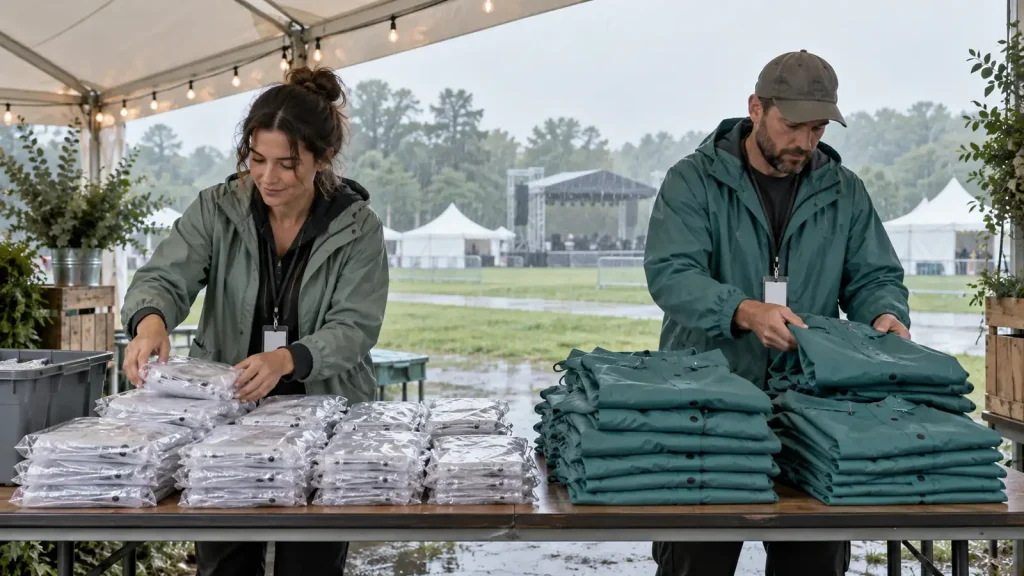
Design festival distribution around the attendee journey
Festival rainwear planning begins with the attendee's route through the event. Identify where people arrive, where they wait, where they can put on a garment and how they leave. Those details influence pack format and stock placement as much as the product material. A poncho that is easy to issue from a sheltered entrance may be awkward to distribute once a crowd is already moving between stages. Build the rainwear plan into the wider event operation early enough to test it.
Map the main distribution opportunities with the venue team. Some programs include rainwear in advance kits, while others hold stock at information points or release it when weather requires. Each arrangement has different staffing and storage needs. Ask how the proposed pack will be carried, counted and replenished. Keep access routes and event procedures under the venue's responsible team. Procurement should provide suitable products and clear packing information without improvising crowd-management decisions through the rainwear specification.
Choose the ownership model explicitly. If attendees keep the garment, a reusable option needs a practical take-home proposition and appropriate instructions. If the plan depends on collection, define the return points and the process after collection. Do not assume people will retrace their entry route or return a wet garment simply because the product is described as reusable. Discuss the actual event layout and attendee behavior with the organizers before giving the reuse plan credit in a commercial or environmental analysis.
Keep sponsor requirements aligned with the garment's use. A visible brand placement can be valuable to the promotional brief, but it should not interfere with openings, fit or the intended handling. Agree artwork dimensions and positions on an actual sample. Think about how the poncho looks when worn over common clothing and bags, as well as when folded. A large design that reads well on a flat drawing may be partly hidden by the hood, folds or the wearer's normal posture.
Plan for different attendee needs without a blanket sizing promise. Confirm the intended wearer range and assess the proposed options through sample fitting. Where children or other specific groups are included, use an appropriate product and review the relevant requirements separately. Avoid assuming that the adult event poncho can simply be scaled down or issued to everyone. The size and product allocation should be clear to distribution staff, with an agreed route for questions or unsuitable fit during the event.
Coordinate packaging information with the event's communication style. Keep the essential use and disposal or care instructions easy to find. Sponsor messages should not overwhelm practical information on a small pack. If the event promotes environmental objectives, approve the exact wording against the product evidence and the real collection arrangements. A clear operational message is more useful than a broad green claim that leaves attendees unsure what to do with the garment or wrapper after use.
After the event, review issued quantities, remaining usable stock, packing feedback and any product concerns. Separate those findings from unsupported assumptions about future use by attendees. For a recurring festival, the records can improve the next quantity forecast and artwork decision. They can also show whether a disposable reserve, a take-home reusable option or a defined mix best fits the event. The right solution follows the attendee journey and the operating plan, rather than a universal rule about which rainwear category belongs at festivals.
Match tourism programs to repeat visits and operating capacity
Tourism businesses often serve several rainwear use cases at the same location. A visitor may need short-term cover during an attraction visit, a guide may wear rainwear repeatedly, and an organized group may require a prepacked allocation. Treat those as distinct service patterns. A single purchasing discussion can cover them, but the product and handling assumptions should remain visible. Otherwise, the easiest bulk order can become a difficult issue process for the people working at the attraction.
For visitor supply, review how rainwear reaches the user. It may be held at a welcome desk, included in a group package or placed at a specific service point. Ask staff how much storage is available and how quickly packs can be replenished. Evaluate the actual packed sample in that setting. A compact product can be useful, but the smallest possible pack is not automatically the best choice if it creates confusion when visitors open and orient the garment.
For organized tours, consider the group leader's workload. Clear counts, readable size identification and sensible carton or inner-pack arrangements can simplify preparation. Ask whether garments are handed out before departure or carried as contingency stock. If the group returns rainwear, define where the used items go and who manages them. The leader should not be left with an unplanned collection of wet garments that has no agreed storage, care or transport route after the tour ends.
Recurring guide or staff use may justify a different product and allocation. Individually issued reusable garments can be reviewed for fit and practical movement, with a defined care routine and replacement route. Confirm that the garment is suitable for the task and any relevant workplace requirements. Do not assume a visitor poncho meets staff needs simply because both groups are outdoors at the same attraction. The staff brief may involve longer use, different equipment and more frequent handling.
Evaluate take-home branding in terms of usefulness. A souvenir-oriented design can support the visitor experience when it is attractive, practical and accurately described. Ask whether the product, pouch and instructions make sense beyond the attraction. Avoid assigning a guaranteed number of future impressions or wears to the purchase. Those outcomes depend on user behavior and would need evidence to quantify. Procurement can approve the design and product quality without turning a plausible promotional benefit into an unsupported marketing statistic.
Plan stock movement across the season. Record what remains at each issue point and how replenishment is triggered. Review slow-moving variants and date-specific artwork before repeating the order. If the business operates several locations, define whether stock can move between them without confusing labels or branding. A common approved construction may support flexibility, but any local requirements still need review. Keep the supplier informed of the real distribution pattern so packing proposals reflect how the goods will be used.
Use feedback from visitor-facing staff to refine the next brief. They can identify recurring questions about size, opening, pack handling and after-use instructions. Combine those observations with stock and product records rather than relying solely on anecdotal preferences. The result is a more useful wholesale rain gear guide for your own operation: a documented set of products and allocation rules that serves visitors, groups and staff consistently, while giving procurement a clear basis for the next supplier comparison.
Separate returning teams from one-time visitor demand
A mixed rainwear program can be more practical than forcing every user into one ownership model. Returning teams often have a known issue point, recurring duties and a way to report product concerns. One-time visitors may leave through several routes and have no relationship with the organization after the event. Recognize those differences in the buying brief. A deliberate split can support clearer sizing, care and replenishment decisions without implying that either group should receive unsuitable rain protection.
Build a simple user matrix. For each group, record the task, expected wearing interval, repeat attendance, ownership route and responsible coordinator. Identify the requirements that are shared and the ones that differ. Ask operations to confirm the information before procurement translates it into quantities. This step can reveal that the important divide is not staff versus visitors, but repeated individual use versus unpredictable one-time distribution, or controlled return versus take-home ownership.
For returning teams, plan the allocation before deciding the bulk size mix. Use a representative fitting process and record the clothing layers relevant to the season. Identify how new team members receive a garment and how replacements are handled. If the product is shared, include the turnaround process and ready-stock requirement. A reusable program should have enough suitable stock for the actual schedule, not merely the total headcount listed when the original order was planned.
For one-time demand, concentrate on readiness and clear distribution. Confirm pack identification, opening instructions, storage guidance and the route for unused stock. If a reusable take-home option is selected, evaluate it on that basis rather than assuming an organizational return cycle. The product may still be a sensible choice for the brief, but the business case should reflect what the organization can control and observe. Keep future recipient behavior as an uncertainty unless there is evidence to support a stronger conclusion.
Use distinct stock identification where the products differ. Staff should be able to find the right garment without opening several packs or interpreting a complex SKU list. Choose labels, carton markings and storage locations that support the allocation rules. Check the proposed method with the people doing the issue work. A product mix that is clear in a procurement presentation can become confusing during a busy shift if the physical packs look almost identical and their intended users are not obvious.
Keep workplace protection decisions separate from the visitor program. Returning workers may have requirements that ordinary emergency ponchos do not meet. Ask the responsible safety and technical personnel to define those needs and review the proposed garment. A branded raincoat should not be assumed to offer high-visibility, chemical or other specialized protection without appropriate evidence. Where industrial workwear is required, use a dedicated specification and approval process instead of treating the event rainwear purchase as a substitute for that assessment.
Review the mix after deployment. Compare actual issue, available stock, fit concerns and handling effort for each group. Identify whether the split simplified operations or created unnecessary variants, then adjust deliberately. A mixed program is useful when the differences have a clear purpose and remain easy to manage. The buyer should be able to explain which product serves each group, why that choice fits its use and how the next order will preserve the approved specification while responding to real demand.
Planning an event order? Explore our Wholesale Festival Rain Poncho Collection Here. For assessed workwear requirements, consult our industrial rainwear procurement guide and keep staff protection requirements distinct from visitor contingency stock.
07 / 12
Evaluate environmental claims for disposable and reusable rainwear
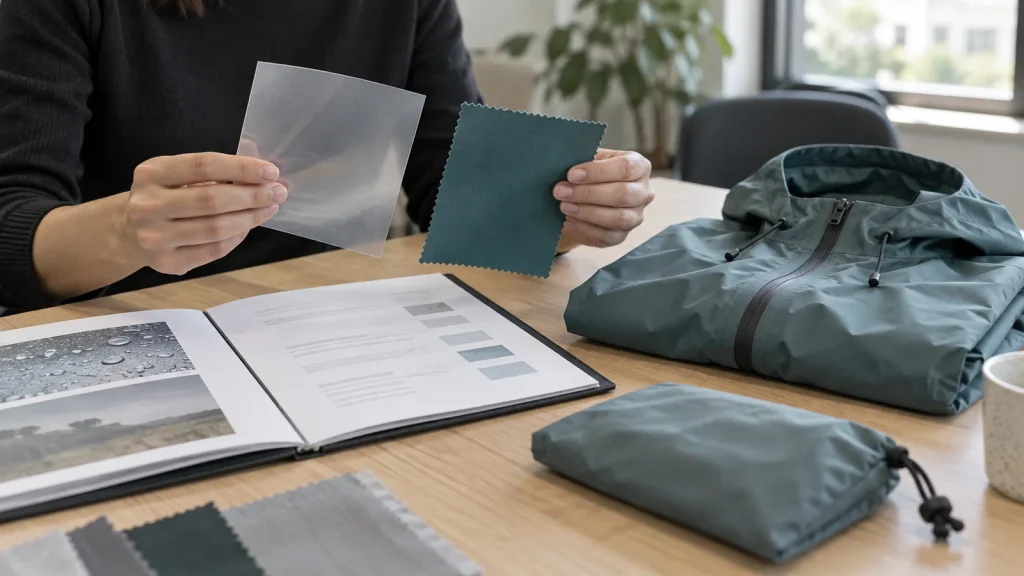
Define the environmental comparison before choosing a winner
Disposable and reusable rainwear cannot be compared responsibly through a single label. The environmental question needs a defined service, product construction and operating scenario. A garment intended for repeat use may be a useful part of a reuse program, but the program must actually deliver that service. Begin by stating what you want to compare and what information is available. Keep a purchasing preference separate from a quantified environmental claim that would require a more rigorous assessment.
UNEP's life-cycle approach to single-use products emphasizes the importance of considering alternatives within a wider system of use. That is a useful starting point for procurement, not a product-specific result for rain ponchos. A study of another product category does not establish how many times your particular raincoat must be worn to achieve a particular benefit. Avoid borrowing a break-even figure from bags, cups or other products and presenting it as evidence for your rainwear order.
Describe the functional comparison. Both options should provide the same intended service to a comparable wearer group over a stated period. Record the garment and packaging included, the distribution pattern and any care or return process. Ask a qualified assessor to establish the appropriate method if a formal comparison is needed. Procurement can assemble relevant data, but should not turn a simple weight comparison into a broad conclusion about total environmental impact without considering the limits of that calculation.
Gather product-specific information where it is needed. This may include the material composition, garment mass, packaging, manufacturing information available from the supplier, delivery assumptions and the actual care process. Distinguish measured values from estimates and identify gaps. A supplier may not be able to provide every requested detail immediately. Record that limitation and decide whether it prevents the proposed claim or calls for a narrower, supportable statement about one verified attribute of the ordered product.
Use real operating records for reuse assumptions whenever possible. Track the ready-stock and reissue patterns relevant to your program rather than relying solely on intended durability. If care, transport between sites or replacement affects the comparison, keep those activities within the agreed assessment boundary. Do not assume they cancel out simply because both products are used outdoors. The comparison should reflect the service your organization runs, including the practical steps needed to make reusable garments available again.
Separate different environmental objectives. Reducing packaging, documenting recycled content, extending useful service and establishing an accepted collection route are distinct projects. Progress on one does not prove progress on all the others. Choose the objective your team can define and support, then request the relevant evidence. This can produce a more useful CSR brief than demanding an undefined eco-friendly raincoat and expecting the supplier to decide which environmental property the buyer actually needs.
Keep external wording proportionate to the evidence. If the project has verified a specific material attribute, describe that attribute accurately. If it has only planned a reuse process, describe the process without claiming a measured outcome that has not occurred. Review stronger comparative statements with the appropriate specialist. This approach lets your business pursue practical improvements while keeping the disposable-versus-reusable decision honest about its assumptions, its scope and the information still needed before a broad environmental benefit can be asserted.
Confirm collection acceptance instead of relying on a recycling symbol
Recyclability is not established by a material name or a familiar symbol alone. The actual garment may include different components, printing, closures and packaging, and the available collection route may accept only certain materials in certain conditions. Ask the receiving organization what it will take before designing a return scheme or printing disposal instructions. This is a practical conversation about the proposed product and location, not a generic question about whether a polymer can theoretically be recycled.
Send the collector a clear description of the complete item. Identify the main material, relevant trims, printing and expected condition after use. Ask whether the garment and its packaging follow different routes. Obtain a usable response that states acceptance conditions and any exclusions. A general website statement about accepting plastic does not necessarily cover used rain ponchos. Keep the response with the project records so the event or stores team can explain the instructions it gives to users.
Review the collection process as carefully as the acceptance answer. Identify where items are collected, how they are kept separate and who checks the material before it moves onward. If contamination or mixed items could prevent acceptance, discuss that with the responsible parties in advance. Do not make a disposal promise that depends on a sorting step nobody has agreed to perform. The collection arrangement should have an owner, a destination and a practical response when an item is unsuitable.
The FTC's Green Guides summary cautions against broad, unqualified environmental claims and addresses qualifications for recyclable claims where access is limited. For a procurement program, the useful lesson is to make wording specific to the product and the available route. Obtain appropriate review for the destination market rather than assuming one label works everywhere. A factual instruction about a confirmed event collection point can be clearer than a sweeping statement that every recipient can recycle the garment wherever they live.
Keep compostability separate from recycling. A proposed compostable product needs evidence for the complete claimed item and the relevant conditions, together with an accepted processing route where the claim depends on one. Do not infer compostability from a soft feel, a plant-related description or the word biodegradable. Ask what the claim covers, which documents support it and what instructions users need. The garment, print and packaging may need separate review before any combined statement is approved.
Plan for exceptions. A receiving organization may reject some items or change its acceptance conditions, and a take-home user may have different local services from the event venue. Decide how the communication will handle those limits. Avoid printing an unconditional disposal claim on permanent artwork when it depends on a temporary local arrangement. Keep the approved wording and the supporting acceptance record together, and review them again before a repeat order uses the same pack in a new location.
Measure what the program can substantiate. Quantities collected, quantities accepted and quantities actually processed are different facts, each requiring its own record. Do not call every collected garment recycled merely because it entered a labeled bin. Ask the responsible organization what reporting is available and state the scope of any result accurately. This gives procurement a more credible basis for improving the program and protects the buyer from turning a well-intended collection idea into a claim that exceeds the evidence.
Give marketing a claim file tied to the ordered product
Environmental copy often passes through several people before it reaches a pack or product page. Procurement may receive a technical document, an agency may shorten the wording, and a distributor may reuse it in another market. Build a controlled claim file so the final message remains connected to the evidence. The file should identify the exact product version, the approved statement and the limits that need to travel with it whenever the statement is used.
Start with the wording, not a collection of logos. Write the specific claim the business intends to make and identify the component or activity it concerns. A statement about recycled content in a pouch is different from one about the raincoat itself. A statement about an organized collection process is different from one about processing outcomes. Separating those subjects helps the reviewer ask for the right documents and prevents a limited attribute from being presented as a benefit of the entire program.
Attach the relevant evidence and explain its scope. Identify the product, material or process covered, the document reference and any conditions important to the claim. Where the information does not match the ordered construction, resolve the gap before approving public copy. Do not expect a designer to interpret a technical certificate or decide whether it applies to a changed print, trim or material. Assign those decisions to the appropriate reviewer and record the approved conclusion in ordinary language.
Keep performance and environmental evidence in separate fields. A water-resistance result does not establish recycled content, and a material-content document does not establish rain protection. Both may matter to the same purchase, but they answer different questions. This distinction helps commercial teams avoid combining several unrelated documents into a general statement that the garment is certified in every respect. Use the exact claim supported by the evidence and obtain product-specific confirmation where the construction or destination requires it.
Review the full presentation, including images, headings and symbols. A short qualified sentence can still be surrounded by design elements that imply a broader benefit. Ask the marketing reviewer to consider the overall impression and the prominence of any necessary qualification. Use product images that accurately represent the approved design and avoid visual suggestions of certification or disposal routes that the project has not established. The claim file should cover the message users actually receive, not only a sentence isolated from its layout.
Define a change process. If the supplier changes a material, the agency changes artwork or the event moves to another location, identify which claims need review. Keep a version number and a named owner for the approved copy. Share the current pack artwork and product-page wording with the relevant partners, and remove obsolete versions from the working approval packet. This reduces the chance that a future order revives an old statement whose supporting conditions no longer match the product or program.
At handover, provide a concise approved-copy sheet alongside the evidence register. Explain what can be said, the required context and where questions should go. The result is clear product communication that supports the buying decision without exaggerated claims. It also gives procurement a practical way to maintain consistency across supplier proposals, packaging, website copy and future replenishment as the disposable or reusable rainwear program develops.
Develop the claim review with our sustainable rainwear buying guide. It explains the evidence questions behind recycled-content, compostability and other environmental descriptions.
08 / 12
Plan OEM branding for one-time distribution and repeat use
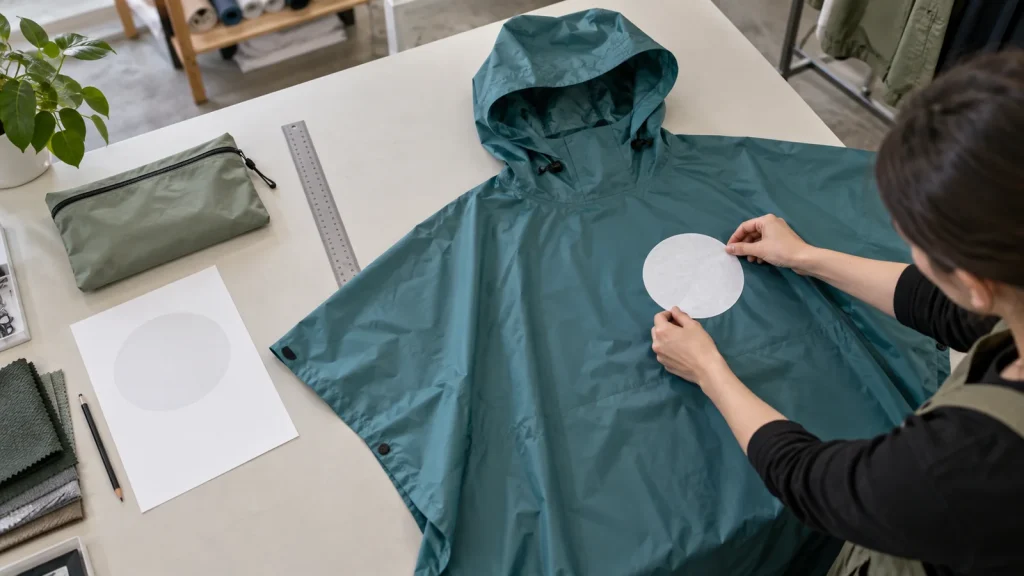
Choose the printing method after confirming the substrate
Custom branding starts with the actual rainwear construction. A printing method that works for one film or coated textile may need different preparation, settings or materials on another. Confirm the proposed substrate and garment version before approving the decoration process. Ask the supplier to explain the method, the intended print location and the evidence or sample checks used to evaluate it. A generic promise that a logo can be printed does not define an OEM Program clearly enough for bulk approval.
Provide usable artwork and a practical brief. State the intended dimensions, colors, position and the way the garment will be used. Identify whether the branding is for a one-time event, repeated staff use or take-home promotion. These contexts affect the questions you ask about appearance, handling and care. Keep the initial discussion open to an appropriate method rather than specifying a familiar technique without checking whether it suits the exact material and the desired design.
Ask for a decorated sample on the proposed construction. A print on paper or an unrelated swatch can help with layout, but it does not resolve the complete product questions. Review how the design sits on the assembled garment and whether it interferes with joins, openings or normal movement. If an early sample uses substitute material, record that limitation and obtain the required final approval before production. The commercial order should reference the construction and artwork that were actually accepted together.
Evaluate handling under agreed conditions. The printed area may be folded, packed, unfolded and, for a reusable garment, exposed to the approved care process. Ask the supplier which checks are appropriate and document the method used. Do not invent a durability claim from a brief office inspection. Record appearance changes or other concerns specifically and ask for a proposed correction. A useful review identifies where the print changed and under what treatment, rather than simply labeling it good or bad.
Keep chemical and market requirements within the specification where relevant. The inks, transfers, labels or other decoration components may need to be considered as part of the finished product review. Ask the responsible technical or compliance reviewer what evidence is needed for the destination and use. Do not assume that an undecorated garment's documentation automatically resolves every question about the branded version. The supplier should identify the decoration components sufficiently for the applicable review and approval process.
Discuss commercial consequences before finalizing the design. Artwork complexity, color count, placement and the number of variants may affect development, MOQ and production planning. Request an itemized scope for the OEM Program and ask which alternatives simplify the order. Keep public copy focused on bulk project discussion rather than unsupported unit-price statements. Internally, compare offers on the same approved artwork and garment so a simpler-looking quotation is not mistaken for an equivalent service when it excludes essential work.
Release the final decoration instruction with the garment specification. Include the approved artwork file, dimensions, position reference, colors, sample identity and change-approval contact. Ask the supplier to flag substitutions or process changes before they are made. This creates a clear connection between the buying brief and the product delivered. It also helps future replenishment preserve the appearance and function of the branded rainwear without relying on memory, an old email attachment or a vague instruction to repeat the previous logo.
Design artwork for a moving garment and a small pack
Rainwear artwork is worn on a flexible surface that folds, moves and changes shape. Design it with that behavior in mind. A layout that looks balanced on a flat template may sit differently once the hood is raised or the garment is worn over a bag. Ask the designer and supplier to review the placement on an assembled sample, and judge the pack at its actual size. Both reviews help turn an attractive screen design into a practical branded product.
Choose the main communication priority. For some programs, clear organization identification matters most; for others, the design supports a festival theme or a take-home promotional brief. Avoid trying to give every sponsor, slogan and instruction equal prominence on the same panel. Agree a hierarchy and the available area before detailed artwork begins. This makes approval easier and helps the supplier identify whether the requested placement conflicts with seams, openings, closures or other functional parts of the garment.
Review proportions across the approved size range. The same artwork dimensions may appear different on smaller and larger garments, while a scaled design may introduce additional production variants. Decide what the brief actually requires and ask the supplier to explain the implications. Keep the approved arrangement explicit for each relevant size or style. A clear reference drawing can prevent an avoidable dispute in which the buyer expected a consistent visual balance while the factory followed one fixed print measurement on every garment.
Consider the way the garment is normally seen. A poncho may be viewed from behind in a crowd, while a staff coat may need identification at the front during service. Review the design with the relevant posture, hood position and bag arrangement. Do not turn this into a guaranteed advertising-reach claim. The practical goal is to make the approved artwork readable and appropriate where it is placed, with observations from sample review rather than invented estimates of impressions or audience exposure.
Plan the pack as its own communication surface. It needs enough space for identification and essential use, care or disposal information, along with any approved brand elements. Keep small type legible and avoid relying on an enlarged digital proof. If a QR code is used, verify its destination and function on the printed sample, but retain essential instructions in a form that does not depend entirely on connectivity. Ask the operating team whether the pack helps or complicates fast distribution.
Separate permanent and event-specific information where that supports the program. An evergreen garment design with a replaceable event insert may offer different reuse and stock flexibility from a dated print on the rainwear itself. Treat this as an option to review with brand owners, not an automatic recommendation. The arrangement must still be practical, accurate and commercially agreed. Consider how unused stock would be identified and redeployed, and whether any additional packing work is justified by the flexibility it provides.
Approve the garment and pack together before final release. Check that names, colors, claims and instructions are consistent across both. Record the approved version and who can authorize changes. This reduces the risk of a correct garment arriving in outdated packaging or a revised sponsor layout being applied to only part of the order. A well-controlled design process supports the human experience of receiving and using the rainwear while giving procurement clear references for sample approval and bulk inspection.
Keep repeat orders and sponsor changes under control
Custom rainwear becomes easier to replenish when the product and artwork are treated as a defined version. Store the approved construction, size information, decoration and pack references together. A repeat order should identify that version explicitly rather than asking the supplier to make the same ponchos again. Staff changes, new sponsors and material availability can all alter what different people think the previous order contained. A controlled reference reduces that ambiguity before another batch enters production.
Create a variant matrix that reflects meaningful differences. Include style, size, color, artwork and pack where those attributes affect the supplied item. Avoid creating separate stock codes for differences nobody needs to manage, but do not combine variants that must be issued differently. Ask the supplier to quote quantities against the same matrix. This makes MOQ and packing discussions clearer and helps receiving staff reconcile the shipment without opening every carton to discover which sponsor or size is inside.
Plan sponsor changes as an approval event. A revised logo may have different dimensions, colors or placement requirements, and a new claim may need evidence review. Do not treat the replacement of one artwork file as proof that every other detail remains unaffected. Ask the supplier to identify the implications and confirm whether another decorated sample is needed. Keep the final approval tied to the garment version so a late sponsor request does not quietly create a product different from the accepted sample.
Ask about continuity of the base construction. A repeat order may encounter a proposed material or component substitution even when the branding has not changed. Require the difference to be disclosed and reviewed before it is used. A visually similar color or texture does not establish technical equivalence. Depending on the change, your team may need updated evidence, a revised sample or new care information. Record the decision so the next buyer understands whether the order is a repeat or a controlled revision.
Keep obsolete artwork out of the active production packet while preserving the approval history. Use a clear file name and version reference, and send one consolidated release rather than a chain of informal corrections. Identify which document governs if a drawing, email and sample note appear inconsistent. The aim is to make the supplier's task unambiguous. This is especially helpful when a promotional agency, brand owner and purchasing team all contribute comments through different channels during a busy campaign period.
Review the effect of customization on leftover stock. A dated event or discontinued sponsor can limit redeployment even when the garment remains suitable. Before repeating a highly specific design, compare the actual use and remaining quantities from the previous order. Consider whether a simpler base version or a different information arrangement would better support future demand. Any change should still meet the brand brief and practical distribution needs; simplification has value only when it solves a real stock or approval problem.
At replenishment, ask for a current proposal referencing the approved version, quantity matrix and required delivery scope. Confirm the sample and evidence requirements that remain applicable. Do not assume that an old quotation fixes future MOQ, timing or availability. A disciplined repeat-order process lets the business retain the value of a successful disposable or reusable rainwear design while adapting deliberately to new sponsors, users and supply conditions, instead of accumulating small undocumented changes across successive bulk purchases.
09 / 12
Use an EAV buying sheet to compare wholesale rain ponchos
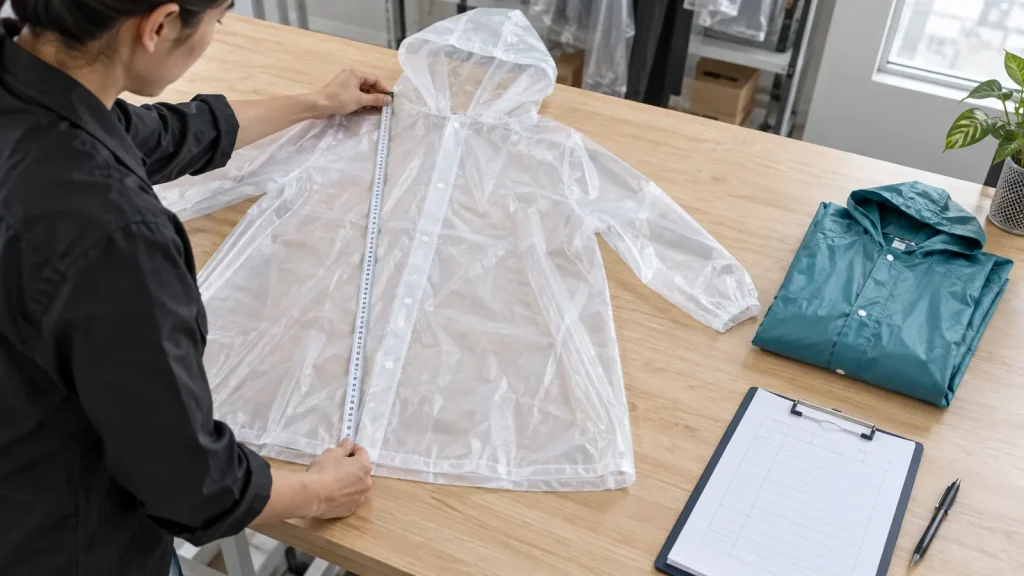
| Entity | Attribute | Value to agree | Acceptance evidence |
|---|---|---|---|
| Program | Service requirement | Wearer group, exposure and intended repeat use | Approved use-case brief |
| Garment | Material construction | Named film or textile system; each layer identified | Supplier specification and sample reference |
| Film | Thickness | Micrometers or millimeters; location and tolerance | Agreed measurement method |
| Textile | Mass per unit area | g/m² for the stated construction | Product-matched measurement record |
| Whole garment | Dimensions and mass | Length and width in cm; weight in g by size | Drawing, measurement points and tolerance |
| Hood and openings | Coverage and movement | Design, opening dimensions and closure type | Representative fit review |
| Barrier and joins | Water resistance | Method, conditioning and agreed requirements | Relevant material and garment evidence |
| Reusable option | Care and repeat use | Approved cleaning, drying and inspection process | Instructions and defined trial record |
| Branding | Artwork and application | Dimensions in mm, position, colors and method | Approved decorated sample |
| Individual pack | Ready-to-issue format | Fold, pouch, insert and opening method | Packed sample and issue trial |
| Carton | Transport and storage | Quantity, dimensions in cm and gross mass in kg | Packing list and physical checks |
| Order | Commercial basis | Quantity by variant, MOQ, delivery scope and milestones | Written quotation with deviations declared |
Record dimensions and units so proposals remain comparable
An EAV buying sheet records an entity, an attribute and the value required for that attribute. For rainwear procurement, its value is practical: it separates the garment, material, pack and order so a supplier can respond to specific requirements. The table above is a framework to complete for your project, not a set of universal product specifications. Add agreed values, tolerances and evidence references before treating it as the final basis for a quotation or inspection.
Begin with the garment dimensions that affect fit and coverage. Use a simple drawing to define length, width, hood and opening measurements. State whether a dimension is taken flat, along a seam or by another agreed method. Include the reference size and any relevant condition of the sample. Without those details, two suppliers may provide plausible numbers that describe different measurement points, leaving procurement unable to tell whether the proposed products actually offer comparable coverage.
Keep units explicit. Film thickness may be expressed in micrometers or millimeters, while textile mass per unit area is commonly expressed in grams per square meter. Whole-garment mass is another measure again. Record them in separate fields and avoid treating one as a substitute for another. Ask the supplier to identify the measurement method and tolerance where required. A heavier garment can result from a larger cut or different components, so mass alone does not describe the material construction.
State which values are fixed and which are open to proposal. If the size range is still being evaluated, describe the intended users and ask for an option rather than inserting an arbitrary number. If a pack must fit an existing kit, provide the relevant constraint and request a packed sample. This distinction helps suppliers offer useful alternatives while preserving the requirements that genuinely govern the purchase. It also prevents a provisional idea from becoming an accidental production instruction.
Define tolerances with the appropriate technical input. An exact nominal dimension without an agreed tolerance may be difficult to interpret during inspection, but a loosely chosen tolerance can undermine fit or pack compatibility. Discuss the practical requirement and measurement method before finalizing acceptance. Do not copy a tolerance from an unrelated product merely because it appears professional. The specification should support the decision your team needs to make about the actual supplied rainwear, using checks that can be performed consistently.
Connect measurements to the sample reference. Record the approved garment and the version of the drawing used to assess it. If a sample differs from the final requirement, state the difference explicitly and explain how it will be resolved. Do not allow a note such as sample approved to imply acceptance of an unrecorded deviation. The supplier and buyer should be able to identify which dimensions and components the bulk order must reproduce and which early sample features were temporary.
Use the completed sheet during quotation review and receiving preparation. Ask suppliers to mark compliance, deviations and questions for each relevant field. Share the released version with inspectors and stores staff, along with the approved references they need. This makes the EAV model a working procurement tool rather than a decorative technical table. It helps your team compare disposable and reusable rainwear accurately and gives later discussions about fit, packing or workmanship a common set of facts.
Separate construction requirements from verification evidence
A technical buying sheet should show what is required and how it will be checked. Keep those fields separate. The specification might identify a material construction, closure arrangement or intended rain-protection requirement; the evidence field identifies the document, sample review or agreed test that supports acceptance. This distinction prevents a supplier statement from being treated as a verified result and makes it easier to see where the purchasing file is complete or still needs follow-up.
Describe the main construction in enough detail to identify the product. Include the relevant film or textile system, joins, hood, closures and other components that affect the brief. You do not need a confidential manufacturing recipe to compare proposals. You do need a clear link between the quoted product, the approval sample and the supporting information. Ask for a style reference and revision so a later change can be identified without relying on color or general appearance alone.
Assign evidence according to the question being asked. A measurement record can support a dimension check; a decorated sample can support an artwork review; a relevant report may support a defined material property. A general factory audit or a photograph of a laboratory does not automatically prove the performance of the specific garment on your order. Keep the evidence matched to the requirement and ask for clarification when the supplied document addresses a different product, component or process.
Identify the limits of visual inspection. It can help reveal missing parts, inconsistent construction, incorrect artwork or obvious damage. It cannot establish every chemical, environmental or performance claim. If those claims are part of the brief, obtain the appropriate review and supporting evidence. Avoid using an overall quality inspection result as a substitute for all other checks. A clear acceptance plan states which requirements are assessed visually, which are measured and which depend on another defined verification route.
Use a gap register for unresolved items. Record the requirement, the information missing, the responsible person and the decision date. Distinguish a document still being obtained from a known product deviation. This helps the team focus its follow-up and prevents unanswered questions from disappearing when commercial negotiations accelerate. Where a requirement cannot be supported, narrow the proposed claim or choose another option rather than treating a confident verbal assurance as equivalent to the evidence the specification requires.
Include change control in the technical brief. Ask the supplier to identify proposed substitutions in material, component, print method or packing before production changes are made. Establish who reviews the effect and what further evidence or sample is needed. A small change may be straightforward, but the decision should be deliberate and recorded. This is especially important for reusable products whose care instructions or prior trial results may depend on the construction that was originally approved.
Finish with a release record that identifies the accepted construction and the evidence used. Keep any limitations visible to the people responsible for issue and communication. This creates continuity from supplier comparison to sample approval, inspection and later replenishment. It also makes future troubleshooting more efficient: your team can compare the delivered garment with a defined reference instead of reconstructing the order from scattered messages, broad product descriptions and documents whose connection to the final design is unclear.
Define the order and packing attributes alongside the product
Many bulk-order problems come from details outside the garment itself. A correct raincoat can arrive in an inconvenient pack, with an unclear size mix or at a delivery point different from the buyer's assumption. Include order and packing attributes in the same controlled buying packet as the technical specification. They do not need to crowd the garment drawing, but they should be explicit enough for suppliers to quote and for receiving teams to verify without guesswork.
Start with a quantity matrix. Show the proposed number by style, size, color, artwork and pack where those differences matter. Ask the supplier to identify MOQ at the relevant level rather than responding only with a total order minimum. A combined quantity can conceal several smaller variants with different production implications. If the initial split is provisional, say so and ask which changes can be made before approval. This supports a realistic commercial discussion without implying that the forecast is already a firm commitment.
Define the individual pack and inner-pack arrangement. Specify the approved fold, pouch or enclosure, information insert and identification. Ask how packs are grouped for issue and whether mixed variants are permitted within a carton. Keep the arrangement connected to the distribution plan. A warehouse-friendly bulk configuration may be unsuitable for a tour coordinator preparing separate group kits, while unnecessary individual packaging may add work where a controlled staff-issue process uses a different arrangement.
Request carton dimensions, gross mass and pack count for the proposed final configuration. State the units and clarify whether figures are confirmed or estimated pending a packing trial. Do not plan storage or freight from a photograph of a similar carton. Ask how changes to the garment size, pouch or quantity affect the packing information. The buyer needs a reliable basis for receiving and onward movement, and the supplier needs to know which packing constraints are essential to the program.
Make the delivery scope clear in the quotation request. Identify the destination and the responsibilities included in the proposal, with appropriate logistics advice where needed. Separate production completion, dispatch, arrival and the date the goods must be ready for issue. Those milestones are not interchangeable. Ask suppliers to state the assumptions behind their timing and the approvals required from your team. Avoid treating an optimistic production estimate as a guaranteed date when the complete sample and shipping process has not yet been agreed.
Define the documents and identifiers needed at receipt. The purchase reference, style version, quantity matrix and carton markings should agree with the packing information. Ask receiving staff which details help them reconcile deliveries and locate the correct stock. Keep the request proportionate, but do not leave essential identification until the shipment is already in transit. A clear packing list and consistent markings can make a mixed disposable-and-reusable program much easier to manage across several issue points or operating teams.
Approve the complete order packet before release. It should connect product specifications, artwork, packing, quantities, evidence and commercial scope to the same version. Record accepted deviations and the people authorized to resolve later questions. This gives the supplier a concrete assignment and gives the buyer a clear basis for acceptance. It also makes future bulk purchases easier to compare, because the organization can see exactly what was included in the previous program rather than remembering only the garment name and total quantity.
10 / 12
Plan bulk packaging, inventory and wet-weather deployment

Pack the order for the people who will actually handle it
The best packed sample is the one your receiving and distribution teams can use without improvisation. A small individual pouch may look efficient on a desk but create slow counting at a busy entrance. A large master carton may reduce the number of boxes yet be awkward for a small venue store. Ask who receives, moves, opens, counts and issues the goods. Their answers should shape the packing specification alongside freight requirements and the presentation expected by the final wearer.
Start with the individual unit. Agree whether the poncho arrives folded in a plain sleeve, a reusable pouch or another confirmed format. Check that the product can be removed without damaging the material and that necessary instructions remain with it. For a reusable raincoat, assess the return to storage as well as the first opening. A pouch that fits a carefully compressed factory fold may be inconvenient after normal use. Test the actual intended routine with the supplied garment and pack.
Then define the intermediate grouping. An entrance supervisor may need packs counted into small groups, while a central warehouse may prefer larger uniform quantities. Document how each group is identified and how partial groups are handled. If color separates visitor stock from staff stock, make the distinction clear on the outer identification as well as on the rainwear. A coordinator should not have to open every carton to discover its contents. Keep the identification factual and consistent with the order's approved variant list.
The master carton specification should include the agreed quantity, external dimensions, gross mass and marks. Ask whether the quotation uses those confirmed values or an early estimate. Changes in film thickness, pouch size or folding can affect the final packing arrangement. Review a packed sample before treating carton data as final for transport planning. Your receiving location may have restrictions on access, storage height or handling; communicate those requirements before production packing rather than after the shipment has been booked and the cartons are ready.
Mixed cartons need particular care. Combining several sizes or colors can help a small branch receive a useful assortment, but it makes checking and replenishment more complex. Write the assortment in a simple packing matrix with one row for each destination or carton type. Include an agreed way to identify any partial carton. Keep that matrix aligned with the purchase order so the packing team and the receiving team work from the same version. A convenient assortment is only helpful when it is consistently assembled.
Do not let packaging language create an unsupported environmental promise. A pouch described as reusable still needs to suit the intended use, and a carton carrying a recycling statement needs an appropriate basis for that statement. Ask for packaging material information separately from the garment specification. This also helps a buyer explain exactly what a requested change covers: removing an unnecessary insert is different from changing the poncho material, and neither automatically establishes a lower overall environmental impact for the complete program.
Finally, rehearse the handoff using one complete packed set. Have someone count it, identify the variant, open a unit and prepare it for issue. Record any confusion in the packing approval, then confirm the corrected arrangement with the supplier. This brief exercise can reveal a missing carton mark or an impractical fold before the full bulk order is packed. It gives procurement a clear acceptance reference and gives the operations team a format they have already handled, rather than a packaging promise they must interpret during rain.
Keep stock states visible from receiving to replenishment
Inventory accuracy depends on knowing what the count represents. For disposable ponchos, a sealed reserve carton is different from an open carton beside a distribution point. For reusable rainwear, returned garments are different from inspected garments ready to issue. Use stock categories that reflect those operational differences. A single total can make the program appear well supplied while hiding the fact that some units are inaccessible, wet, damaged or awaiting review. Define usable stock before setting a replenishment trigger for the next event.
A practical receiving record ties the shipment to its order and agreed packing list. Note the delivery date, carton count, variant quantities and any visible discrepancy. Follow the inspection procedure agreed for the order, and keep goods awaiting a decision distinguishable from accepted stock. This does not require an elaborate system for every small program. It does require a clear owner and a record that another coordinator can understand when the original buyer is away or when stock moves between two storage locations.
Allocate reserves deliberately. A multi-entrance event may need some stock at each gate and a central quantity for replenishment. The appropriate split depends on the layout, access and likely movement of attendees. Avoid treating a previous event's allocation as a universal formula. Review the issue pattern and the time needed to move supplies safely between locations. Keep the central reserve visible in the count, with an agreed contact for requesting more, so individual teams do not quietly hold competing buffers while another entrance runs short.
For reusable garments, record the transition from issued to returned and from returned to ready. The second transition should follow the approved care and inspection routine. Keep any garment awaiting a decision out of the ready quantity until that decision is recorded. If a wearer keeps the garment between uses, the central team may need a different record, such as individual allocation and replacement requests. Choose the method that matches the actual ownership arrangement instead of copying a shared-stock process into a take-home program.
Forecasting should distinguish consumption from movement. A carton transferred to another branch is not necessarily a carton used by visitors. Likewise, a returned raincoat is not a new purchase. Separate those transactions so the next buying decision reflects real demand. Review event attendance assumptions, distribution rules and remaining accepted stock together. Where demand is uncertain, discuss the operational consequences of different order quantities and delivery arrangements with the supplier. A quotation can support that comparison, but it cannot resolve uncertainty about the buyer's event calendar.
Use review dates as well as quantity triggers. An annual outdoor program can retain unused stock for a long period, during which branding, packing instructions or product requirements may change. Check stored goods under the supplier's stated storage guidance and your own stock-control procedure before relying on them for the next season. Do not infer a shelf life from the material name alone. If age, condition or storage history raises a question, ask for product-specific advice and assess the goods before counting them as available reserve.
Close each event or operating period with a short reconciliation. Record what was issued, what remained, what returned and what could not be used. Explain material differences between the opening and closing quantities. This creates a better basis for the next bulk order than an informal recollection that the site was either overstocked or short. It also helps separate a purchasing issue from a distribution issue: sufficient goods may have been delivered overall even when the wrong variant or the wrong allocation reached a particular team.
Work backward from the date the stock must be usable
The relevant delivery date is not always the first day of the event. Your team may need time to receive the cartons, check quantities, inspect samples, prepare destination packs and move goods to the issue points. State the date by which accepted stock must be available for those activities. Then work backward through transport, production, artwork approval and sampling. This makes the schedule a sequence of decisions and handoffs rather than a single arrival promise with several unspoken tasks crowded behind it.
Ask the supplier to separate its proposed milestones. A sampling estimate, a production estimate and a transport estimate answer different questions. Confirm which approvals must be complete before each stage can begin, and identify assumptions about material availability or decoration. Treat an early quotation as a planning proposal until the relevant details are confirmed. Avoid translating an approximate production period into a guaranteed arrival date yourself. The delivery scope and the responsibility for each transport stage should be clear in the written commercial discussion.
Build the buyer's approval work into that schedule. Artwork may need sign-off from a sponsor, a technical sample may need a wearer review, and packing marks may need agreement from the receiving warehouse. Assign an owner and a target response date for each decision. If several people can request changes, establish who consolidates their comments. Uncoordinated revisions can create a late conflict between a logo placement already approved by marketing and a packing or fit requirement introduced by operations after the sample has been accepted.
For a fixed-date program, discuss alternatives before a delay occurs. These might include a different approved color, a simpler decoration layout or an agreed split delivery, depending on what the supplier can actually offer. Assess the consequences rather than assuming an alternative is interchangeable. A different pack may change distribution handling; a different construction may require a new performance review. Record which changes can be considered and which require full reapproval. An emergency decision becomes easier when its boundaries have already been discussed.
Transport planning also needs accurate destination information. Confirm the receiving address, operating hours, contact arrangements and any access limitations through the normal order process. Where more than one venue is involved, decide whether the shipment goes to a central location or directly to each destination. Compare those approaches using the complete handling plan, including the buyer's work after arrival. A central shipment can simplify supplier packing while increasing the buyer's redistribution tasks. Direct delivery can have different coordination requirements that should be checked in advance.
Keep schedule updates tied to evidence. An approved sample, a confirmed packing list and a dispatch record each mark a different stage. Ask for the update appropriate to the stage rather than relying on a general statement that the order is progressing. If the required date is at risk, bring the decision to the people who can change the operating plan promptly. Do not wait until all flexibility has disappeared. Clear status reporting helps the buyer choose a practical response without assuming that production or transit can simply be accelerated.
After delivery, compare the planned milestones with what actually happened. Identify whether revisions, approval delays, packing changes or destination arrangements affected the outcome. Use that information to plan the next OEM Program, especially where repeat artwork or recurring event dates are involved. The goal is a more reliable process for the next order, with realistic approval windows and accurate packing information. A well-documented first order becomes useful procurement knowledge when the lessons remain attached to the product specification and the next purchasing brief.
11 / 12
Validate poncho samples before approving the bulk order
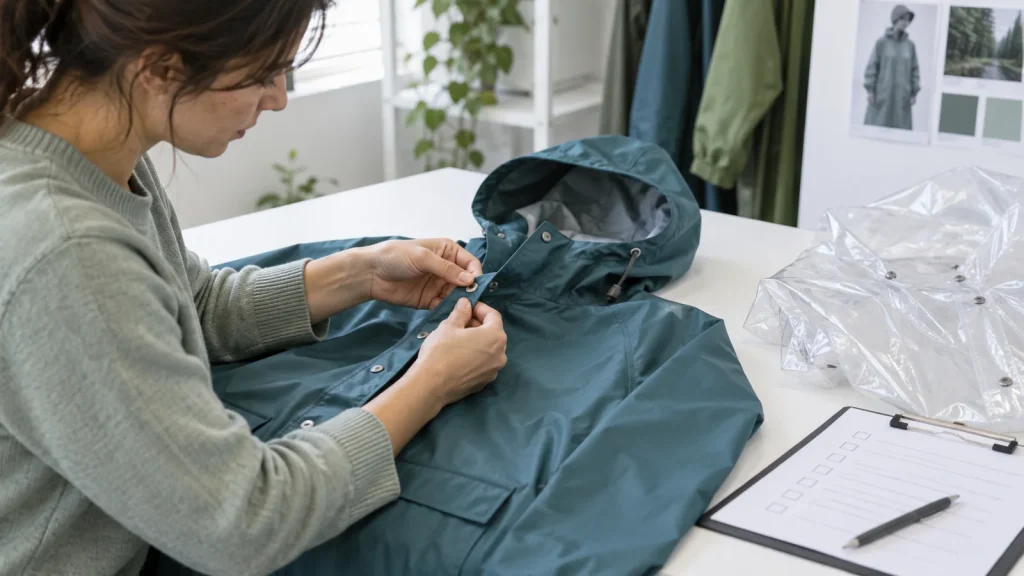
Approve a clear sequence of samples and decisions
Sample approval works best when each sample answers a defined question. An initial material sample can help a buyer understand feel and construction, but it may not show the final garment dimensions. A plain garment can support a fit review without proving that the chosen print will work on that surface. A decorated sample can establish artwork appearance while leaving final packing unresolved. Set out the decisions in sequence so an attractive early sample does not become accidental approval for every part of the bulk order.
At the first stage, compare the proposed construction with the written brief. Identify the material, key dimensions, closures and any stated limitations. Record the supplier's sample reference and the revision of the specification it represents. If the sample differs from the eventual proposal, list those differences explicitly. For example, a sample made in an available color may support an initial construction discussion but cannot confirm the final color match. Keep its purpose narrow enough that the next reviewer can tell what has and has not been accepted.
The fit review should involve people who reasonably represent the intended adult wearer group and the relevant clothing layers. Ask them to follow the movements described in the use case, within a suitable and safe setting. Record practical observations about reach, coverage, hood position and opening the garment. Avoid converting a small informal review into a universal fit claim. Its value is to identify requirements that the buyer can refine before committing to bulk quantities and to reveal obvious mismatches between the proposed dimensions and the intended use.
Decoration approval should use the agreed material and application method. Check the artwork size, placement, colors and the appearance of the garment when worn and folded. A flat digital proof remains useful for layout, but it does not show every interaction between ink, film, seams and folds. Ask the supplier what sample stage can represent the final process and what variation needs to be agreed. If the artwork changes after the decorated sample is approved, document whether the change requires another physical review or another specific approval step.
Packing approval brings the previous decisions together. Review the finished garment in its intended individual pack and inspect the agreed grouping and carton identification. Confirm that instructions, product references and variant information match the approved order. Check whether the packed sample is representative of the final folding and presentation. This stage matters for both compact disposable ponchos and reusable raincoats because the user first encounters a packed item. An otherwise suitable garment can still create avoidable problems if the pack is difficult to identify or open.
Keep a concise approval record for each stage. Include the sample reference, the decision, the reviewer, the date and any unresolved points. A photograph can help identify the sample, but it should accompany the specification rather than replace measurements or agreed criteria. Where the buyer and supplier retain reference samples, make sure they refer to the same revision. Record any accepted deviation clearly. Silence on a difference can be interpreted inconsistently later, especially when the people checking the bulk order were not involved in the original conversation.
Finally, define the release point. The production approval should refer to the complete agreed specification and the samples that support it, not simply to the last email saying the product looks good. Check that the quantity breakdown, branding, packing and required delivery arrangement are aligned. This gives the supplier a coherent instruction and gives the buyer a fair basis for reviewing the finished order. It also reduces the chance that an unresolved detail resurfaces during packing, when changing it may affect both the timetable and the commercial agreement.
Test the handling routine with a small operational trial
A useful trial follows the planned journey of the rainwear. For disposable ponchos, that journey may run from a reserve carton to an entrance desk and then to a wearer. For shared reusable raincoats, it may also include return, care, inspection and reissue. Write down the steps before starting. The trial should reveal whether the proposed product and process work together under the conditions you can reasonably examine. It is an operational learning exercise, not a substitute for any formal performance evidence required by the specification.
Choose participants and tasks that reflect the use case without overstating the result. A short trial with adult event staff can identify confusion in opening a pack or adjusting a hood, but it cannot establish suitability for every wearer or every weather condition. Keep the conditions in the record: the clothing worn underneath, the activity, the duration and the packing format reviewed. These details help procurement understand why a comment arose and whether it points to a product change, clearer instructions or a different operating arrangement.
Observe the first issue carefully. Ask whether staff can identify the correct pack, count units consistently and explain the basic use instructions. Watch for avoidable handling that slows the queue or exposes unused goods to wet conditions. Record the cause rather than simply reporting that distribution was slow. The problem might be an unclear variant mark, a difficult opening or an unsuitable desk arrangement. Different causes require different fixes, and only some of them belong in the supplier's product or packing specification.
For a reusable option, include the approved after-use routine. Follow the care instructions available for the exact sample and keep garments that need review separate from those ready for issue. Record the practical work involved in drying, checking and repacking. Do not assume that a successful first wearing means the return process will fit the buyer's staffing or storage capacity. The trial can expose a missing space, an unclear ownership rule or an inspection task that has not yet been assigned to anyone in the operating team.
Use a simple observation sheet with defined fields. Product reference, task, observed issue, likely consequence and proposed action are usually more useful than a single satisfaction score. Invite participants to describe what happened in their own words, then compare those comments with the requirement. If two people report different experiences, investigate the relevant differences rather than averaging them away. Their clothing layers, movement or understanding of the instructions may explain why the same sample felt practical for one person and inconvenient for another during the review.
After a proposed correction, check the affected step again. A larger pouch might solve repacking but alter carton quantities. A change to the opening might improve access but require revised instructions or another construction review. Keep these connections visible so the trial does not produce a series of isolated fixes that undermine the overall plan. Update the approved sample and the specification together where appropriate. The final buying record should describe the product and routine that were accepted, including any limitations discovered during the trial.
Summarize the outcome in terms procurement can act on. State which requirements were met, which changes were accepted and which questions remain open. Separate an operational preference from a mandatory requirement and identify who owns each remaining decision. If the reusable process is not practical for the intended program, reconsider the use model before increasing the order. If disposable distribution is suitable but the packaging needs refinement, focus the revision there. A small trial is most valuable when its findings change the buying brief before bulk production begins.
Check bulk consistency against the approved reference
Bulk inspection should start with the agreement, not with an improvised opinion about whether a shipment looks acceptable. The purchase order, specification, approved sample and packing matrix should describe the same product revision. Decide which characteristics will be checked and how the inspection will be carried out before the goods are ready. Where an independent inspection is requested, agree its scope, timing and reporting with the relevant parties. Do not assume that one inspection arrangement automatically covers material identity, garment performance, decoration and every legal requirement for every destination.
Define defects in terms the buyer and supplier can interpret consistently. A missing unit, an incorrect color, a damaged closure and artwork in the wrong position are different kinds of issue. State the relevant dimensions, tolerances or acceptance descriptions where they matter. If a formal sampling plan is part of the order, agree its details and the response to findings with a qualified inspection provider or the responsible quality team. A vague instruction to check quality leaves too much room for disagreement after the shipment has been packed.
Link the inspected goods to the production lot and variant information available for the order. Record which cartons or units were examined and what product references they carried. This makes the report useful if a later question affects only part of the delivery. Photographs should clearly show the observed issue and its context without being treated as evidence of characteristics they cannot demonstrate. A photograph can document a misplaced print; it cannot by itself establish the composition of a film or the performance of the finished garment in use.
Check packing as part of the release review. Confirm quantities, assortment, individual presentation and carton identification against the agreed records. Review the final dimensions and mass where those values support transport or receiving arrangements. If a correction changes the pack, update the relevant documents before dispatch. This prevents a situation in which the physical order has been corrected but the packing list still describes the earlier arrangement, leaving the receiving team to reconcile a discrepancy that could have been resolved before the goods left the supplier.
Agree how findings will be closed. The appropriate response depends on the issue and the terms of the order, so avoid a blanket assumption that every difference requires the same remedy. Document the proposed action, the responsible party and any necessary reinspection or revised approval. If the buyer accepts a defined deviation, record its scope rather than allowing the acceptance to become an open-ended change to future orders. Keep unresolved goods or questions visible in the release decision until the authorized people have reached a clear written conclusion.
After arrival, use receiving feedback to complete the quality picture. Inspect according to the buyer's agreed procedure and compare the delivered condition and quantities with the dispatch records. If a concern arises, preserve the relevant product reference, photographs and factual observations so it can be investigated. Avoid attributing every problem immediately to manufacturing; packing, transport, storage and use can each require examination. A clear record makes the discussion more productive and helps distinguish a one-off incident from a pattern that should change the specification or supplier review.
Carry the learning into the next order. Update the buying sheet with confirmed dimensions, practical packing improvements and any revised acceptance points. Retain the reference to the approved construction and decoration so a repeat order does not silently revert to an earlier version. Review whether the intended repeat use actually occurred and whether emergency reserves were appropriate. This closes the loop between procurement, operations and the supplier. It turns a bulk rainwear purchase into a documented program that can improve over time without relying on memory or unsupported assumptions about performance.
Return to the wholesale rainwear product and material guide when you need to align sampling with the wider material, branding and packing brief.
12 / 12
Disposable vs. reusable rain poncho FAQ for B2B buyers

Can a disposable rain poncho be used more than once?
Sometimes a wearer may keep an emergency poncho and wear it again, but a buyer should not build a repeat-use promise around that possibility without product-specific support. The word disposable describes the intended buying or use model more than a complete technical specification. It does not tell you the film thickness, closure construction, care instructions or condition after wearing. Ask how the supplier describes the exact product, then separate an occasional second use by an individual from a planned reusable rainwear program managed by a business.
Start with the intended service. A poncho purchased for unexpected rain during a short visitor stay may be selected for compact storage and straightforward distribution. That does not automatically make it suitable for repeated handling, shared issue or a demanding work setting. If repeated use is central to the brief, tell the supplier at the beginning and ask for a construction and care plan that address it. This gives the supplier a chance to propose an appropriate option instead of stretching the meaning of an emergency product label.
Condition matters each time a garment is considered for further use. Follow the product's instructions and the buyer's relevant inspection procedure. Damage, contamination, unclear care requirements or changes to closures can make a garment unsuitable for the next intended task. Do not assume that visual appearance alone answers every question about performance. Where the use involves protective requirements, the responsible person must assess those requirements and the relevant evidence. An ordinary promotional poncho should not be treated as assessed industrial workwear merely because it still appears intact after use.
Ownership also changes the decision. An individual who takes a poncho home controls what happens to it afterward, while a business collecting shared garments accepts responsibility for a more complicated process. Collection, suitable care, inspection and storage all need an owner. If your organization cannot manage those steps, do not describe the distribution program as a functioning shared reuse system. You can still provide accurate instructions for the supplied product and explain the intended use without claiming that garments will definitely return or achieve a specified number of wearings.
For procurement comparisons, keep observed reuse separate from assumed reuse. Record the actual number of acceptable issue events where your program can track them, and state the limits of that record. A wearer saying they intend to keep a poncho is different from a documented second issue of a returned raincoat. Neither observation should be converted into a broad environmental saving without a suitable assessment. The useful business question is whether the product and the operating model delivered the service the buyer planned, with manageable handling and acceptable product condition.
If you need a dependable repeat-use option, compare reusable EVA raincoats and other suitable constructions against a written brief. Review the garment, closures, fit, care and packing as a complete system. Ask for evidence appropriate to any performance claim and trial the intended routine before placing a large order. Material names can help organize the discussion, but they cannot answer every durability question. Two products described with the same material family can differ in their dimensions, construction, decoration and practical suitability for the buyer's particular program.
The clearest purchasing answer is therefore conditional: buy an emergency poncho for the emergency service you have defined, and buy a reusable program around a product and process that support repeated use. Avoid promising a universal number of wearings for either category. Give the supplier the intended exposure, wearer group and handling routine, then ask which proposal fits those requirements. This keeps the conversation focused on a defensible specification and makes it easier to explain the eventual choice to operations, marketing and the people approving the bulk order.
How many uses make reusable rainwear the better choice?
There is no universal number that makes every reusable raincoat preferable to every disposable poncho. The answer depends on what you mean by better and on the products and operating systems being compared. Financial cost, wearer convenience, storage requirements and environmental impact are different measures. A choice can perform well on one measure while creating work on another. Define the decision first, then compare equivalent service scenarios using evidence and assumptions that your team can review. A simple reuse count alone does not settle the complete procurement question.
For a commercial comparison, identify the relevant program costs and the number of acceptable uses actually expected. Include the purchase and delivery basis, packing, issue work and any collection, care, inspection or replacement activity that the buyer will manage. Keep assumptions visible rather than hiding them inside a single average. If a business intends individual take-home ownership, some central handling costs may not apply, but actual repeat wearing may also be harder to observe. Use a model that reflects that arrangement instead of borrowing figures from a shared-stock program.
Test several realistic scenarios before deciding. Consider what happens if fewer garments return, if the event requires fewer issues than expected or if inspection removes some units from service. The purpose is not to predict the future with false precision. It is to identify which assumptions have the greatest effect on the decision and where a small trial would provide useful evidence. If the conclusion changes sharply when one uncertain assumption moves, discuss that uncertainty with the people approving the order rather than presenting the result as settled.
For an environmental comparison, the relevant scope extends beyond purchase cost. Materials, manufacturing, transport, use and end-of-life arrangements may all matter, depending on the assessment. A heavier product that is used repeatedly should not automatically be called environmentally superior, and a compact product should not automatically be called lower impact. Product-specific evidence and a clear comparison basis are needed. Where your organization requires a formal claim, involve the appropriate technical expertise and review the wording against the evidence before using it in a sponsor presentation or public-facing campaign.
Practical service quality deserves its own review. Reusable rainwear may suit a returning staff team that can store and care for garments between shifts. Compact disposable ponchos may suit a one-time audience needing a readily available contingency item. A mixed program can be sensible when the wearer groups differ. Compare the actual needs of those groups instead of asking one product to solve every situation. Keep the quantities and handling plans separate in the RFQ so the supplier can respond clearly to each part of the intended program.
Use a trial to replace uncertain assumptions with observations where possible. Record how long the agreed routine takes, whether the product fits the intended users, what returns and what remains acceptable for another issue. Keep the trial conditions and limitations with the results. A small exercise does not prove every future outcome, but it can reveal whether the planned reuse system is plausible for your organization. Review the findings with operations before extending the model across multiple events or relying on it to justify a large purchasing commitment.
When you request a proposal, ask for a comparison that exposes the choices. Specify the same wearer requirement and delivery basis for the alternatives, then request the details needed to assess construction, packing and care. Discuss Bulk Pricing at the program level without reducing the decision to an isolated unit quote. The useful answer is the option your organization can use successfully under its own conditions. That answer may change between a visitor giveaway, a recurring festival team and a managed stock of garments for regular outdoor activities.
What should a buyer include when asking about MOQ and customization?
Begin with the use case and the quantity range rather than an unsupported expectation of a standard MOQ. Minimum order quantities and customization availability can depend on the proposed product, material, color, decoration, packing and production arrangement. Ask the supplier to confirm the current terms for the exact brief. If your program includes more than one variant, show the quantity for each one. A total order quantity by itself may not explain the work involved in several colors, sizes, prints or destination-specific packing combinations.
Describe the wearer and the service clearly. State whether the goods are for one-time visitors, individually allocated staff or shared stock intended for repeat issue. Include the relevant clothing layers, expected activities and any specific coverage requirements. Where the project involves industrial work or another use with protective requirements, provide the assessed specification and the evidence required by the responsible team. Do not leave the supplier to infer those requirements from a general phrase such as heavy duty or waterproof. Clear context makes the first proposal more useful.
Add the product attributes you already know and identify the decisions still open. The EAV buying sheet in this guide provides a structure for dimensions, material construction, closures, care, branding and packing. If you are unsure about a value, describe the outcome you need and ask the supplier to propose options with their differences explained. Avoid filling gaps with an arbitrary thickness or a test value copied from an unrelated product. The aim is a specification that matches the service, not a long list of numbers without a clear reason for them.
For an OEM Program, provide usable artwork and the intended placement, dimensions and colors. Explain whether the design is fixed for a recurring program or may change with each sponsor or event. Ask which decoration methods are suitable for the proposed substrate and what sample approval is available. Confirm whether the individual pouch or outer packing also needs branding. Keep artwork approval separate from any technical acceptance so a visually successful sample does not silently approve a material or garment construction that has not yet been reviewed by the responsible buyer.
Include the packing and delivery information that affects the proposal. State the individual presentation, grouping, carton requirements, destination arrangement and date by which accepted stock must be usable. Ask the supplier to separate the relevant milestones and declare assumptions or deviations. If the timing is fixed, say so early and discuss what flexibility exists in color, artwork or packing. Any alternative should still be reviewed against the use case. A faster proposal only helps when the delivered product and handling arrangement remain suitable for the program you need to run.
Request a written response that makes comparison straightforward. Ask for the proposed specification, MOQ by relevant variant, commercial basis, sample terms, production milestones and the evidence supporting any stated claims. Clarify what is included in the delivery scope and which details remain subject to approval. Keep the discussion at the level of the complete bulk order rather than publishing isolated unit prices. When proposals use different assumptions, reconcile those differences before comparing them. Otherwise the apparently simpler option may leave important packing, inspection or operational work outside the quoted scope.
Finish the RFQ with the next decision you want to make. That might be selecting two constructions for sampling, agreeing a decorated prototype or confirming a mixed visitor-and-staff order. Give the supplier a clear route to respond and identify who will consolidate your team's feedback. A focused request helps both sides move from a broad idea to an approvable product. Use the contact button to share your program brief, then confirm product-specific availability and evidence before treating any proposed material, customization or delivery arrangement as part of your final purchase plan.