Branded rainwear · A practical printing guide for bulk buyers
Custom Printing Guide for Branded Rainwear | Screen Print & Heat Transfer
A logo can look perfect on a screen and still disappoint on a finished raincoat. The material, decoration method, artwork size and approval process all shape the result. Use this guide to compare screen printing and heat transfer for bulk rainwear, brief suppliers clearly and check a decorated sample before your brand commits to production.
Match the material. Approve the artwork. Make the decorated sample your production reference.
01 / 12
Start custom rainwear printing with a clear brand and purchasing brief
Define what the decorated rainwear needs to achieve
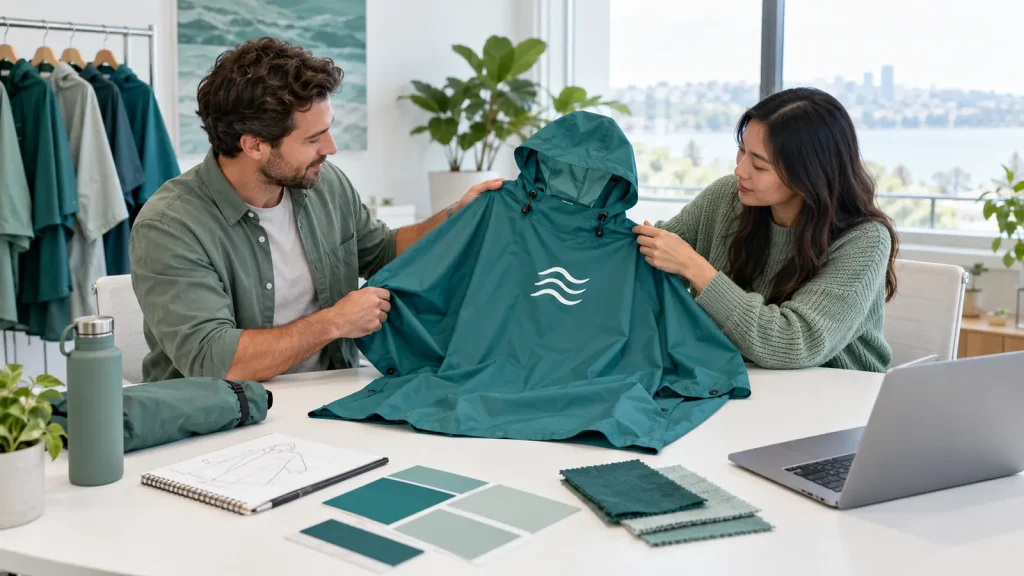
A useful printing brief starts with the job your rainwear will do. An event poncho might help attendees recognise a sponsor, while a staff jacket might help visitors find the right person. Those goals call for different artwork, placement and approval decisions. Describe the wearer, setting and intended period of use before selecting a print method. A supplier can then discuss a decoration route against a real requirement, rather than treating every request as the same logo applied to a different colour of garment.
Separate visibility from visual complexity. A large collection of small marks may satisfy a presentation slide but become difficult to read on a moving wearer. Decide which identity should be recognised first and which information can move to the packaging or a supporting card. This is particularly useful for promotional agencies managing several stakeholders. Agreeing the hierarchy early gives the designer a practical constraint and helps procurement explain why a simpler arrangement might meet the campaign objective more effectively than a crowded garment panel.
Describe the conditions in which the mark needs to remain acceptable. Include whether rainwear will be worn once, stored between events, folded into a pouch or cared for according to a reusable garment's instructions. Do not turn those expectations into an unsupported durability promise. Use them to define the sample review and the questions for the decorator. A print intended for an emergency giveaway and one intended for repeated staff issue may need different evidence, even when their artwork and initial appearance are very similar.
Consider how the rainwear will look alongside other campaign items. A brand colour approved on coated paper may appear different on a translucent poncho or a textured jacket. Tell the supplier which physical reference has priority and whether the purchasing team can approve a material-specific interpretation. Avoid requesting an unexplained perfect match to several dissimilar objects. A useful brief identifies the visual relationship you want: a recognisable family of branded items, a close match to an existing uniform, or a distinct event colour that separates staff from guests.
For example, a hypothetical outdoor conference might need a small chest identity for volunteers and a prominent back mark for attendees. The organisers could begin with one shared graphic, then approve two placements on the proposed garments. That approach keeps the identity consistent while acknowledging different use cases. It does not establish that either screen printing or transfer printing is automatically suitable. The material trial still decides feasibility. The brief simply ensures that the technical discussion is solving the right visual and operational problem from the outset.
Finish this part of the enquiry with a short outcome statement. You might ask for a clearly readable event identity on an approved rainwear construction, packed so the correct version can be distributed without confusion. Add the destination, quantity range and required delivery outcome, but leave unsupported process details open for discussion. Keep that statement with the project file. When a new proposal appears, your team can judge whether it meets the original purpose, instead of being distracted by a more elaborate print effect that adds complexity without helping the wearer or the campaign.
Build a variant matrix before asking for Bulk Pricing
The phrase custom printed rainwear can hide a surprisingly varied order. One project may combine several garment colours, two logo versions, different sizes and more than one delivery location. Write those combinations in a simple matrix before requesting Bulk Pricing. Each row should describe one identifiable finished item. Include the garment reference, colour, size range, artwork revision, print location, quantity and packaging version. This gives suppliers something concrete to quote and gives your team a reliable way to reconcile the proposal with the actual demand.
Keep artwork variants separate from garment variants. The same logo on two different materials may require separate decoration trials, while two logos on one construction may share some production preparation. Ask the supplier to explain those relationships rather than assuming that all versions can be grouped together. This is where MOQ becomes a practical question. Find out whether a minimum applies to the whole order, a garment colour, a printed design, an individual location or a packaging format. Record the answer alongside the affected rows.
Make the status of each quantity visible. Confirmed allocations, planning estimates and optional additions should not be indistinguishable in an enquiry. If a sports organisation is still waiting for regional participation numbers, show the likely scenarios and ask which choices would change the offer. A quotation based on one large repeated design may not remain comparable after demand is divided among many local identities. Keeping the uncertainty explicit helps both sides discuss alternatives without quietly treating an early estimate as a firm production instruction.
Link the matrix to distribution. A carton containing the correct total number of garments can still be inconvenient if staff and attendee designs are mixed without clear identification. Ask the receiving team how they want to recognise each version. A packing label, an approved folded presentation or separate carton groups may be worth discussing. Do not choose these details only after decoration is complete. The way printed areas are folded and the way variants are sorted should be considered while the finished product is still being sampled.
Review the matrix for unnecessary complexity. A sponsor might accept one shared logo treatment across several garment colours, or an organiser might move location-specific information onto a separate insert. These are options to evaluate, not automatic cost-saving promises. Request a comparison that keeps the intended outcome clear. If the alternative changes material, artwork area or packaging, show that openly. A proposal becomes easier to assess when your colleagues can see exactly which requirement has changed and which requirements remain part of the baseline offer.
Give the matrix a revision date and one owner. When a stakeholder changes a design, update the relevant row and circulate the complete current version. Ask the supplier to confirm any effect on MOQ, sampling and the production sequence. Avoid sending a new total in one message and an artwork change in another without linking them. Before placing the order, check that the line quantities add up, every artwork reference points to a real file and every destination has an agreed allocation. That small administrative discipline protects the visual consistency of the whole bulk order.
Give creative, technical and purchasing teams clear approval roles
Branded rainwear usually crosses several desks before it reaches production. Marketing owns the identity, technical colleagues assess the proposed product, and purchasing coordinates the commercial order. Problems arise when an approval from one group is treated as approval from all three. A designer may accept the logo placement without assessing adhesion, while a buyer may accept the quotation without authorising a revised brand colour. Define these decisions separately and identify the person responsible for each one. The supplier should know what a particular approval actually permits.
Start with a compact approval map. List artwork content, finished dimensions, colour reference, garment construction, decoration compatibility, packed presentation and release to production. Some projects can assign several decisions to one person, but the decisions should still be visible. Include who can act when the usual reviewer is unavailable. This matters when a fixed event date leaves little room for a sample to sit in an inbox. A clear substitute approver is more useful than a general request for everyone to respond urgently.
Ask reviewers specific questions. Instead of sending a sample photograph with a request for thoughts, ask the brand team to confirm the graphic revision and visual hierarchy. Ask technical colleagues to review the trial evidence and any changes to the garment. Ask operations to check that the correct version can be identified during distribution. Focused questions produce useful answers and reduce conflicting feedback. They also make it easier to distinguish a preference, such as a slightly different position, from a requirement that genuinely prevents the order from proceeding.
Keep conditional approval visibly conditional. A message that accepts the artwork but requests another adhesion check is not a complete release of the decorated product. Record the unresolved condition, the evidence needed and the person who will close it. Do not let a shortened email summary remove that distinction. For an OEM Program involving several organisations, send one consolidated decision back to the supplier. Procurement can collect internal comments, resolve contradictions and issue an instruction that the production team can follow without interpreting a conversation among stakeholders.
Use the same discipline for changes after approval. If a sponsor replaces its logo, identify the new file, the affected variants and whether a new sample is needed. Ask the supplier to explain what work has already been completed and which production decisions would need review. A late request may be feasible, but it should not silently inherit the approval of the previous design. Colour count, print area and fine detail can change even when the new artwork appears similar in a small presentation image.
Close each approval stage with a record that another colleague could understand without being present. Include the sample or file reference, the decision, its scope, the date and any conditions. Store the current approved package where the team can find it, with older versions clearly marked as superseded. This is not bureaucracy for its own sake. It gives the business a shared description of what it ordered and gives the supplier a stable reference for the work. When the cartons arrive, receiving checks can then compare the goods with an agreed result rather than a collection of personal recollections.
Keep branding connected with the whole purchase through our Wholesale Rainwear Buyer’s Guide to Sourcing, Branding and Logistics. Use this printing guide to develop the artwork, sample and decoration requirements within that plan.
02 / 12
Match the printing process to PE, EVA, PVC and coated rainwear
Identify the actual print surface, not just the material name
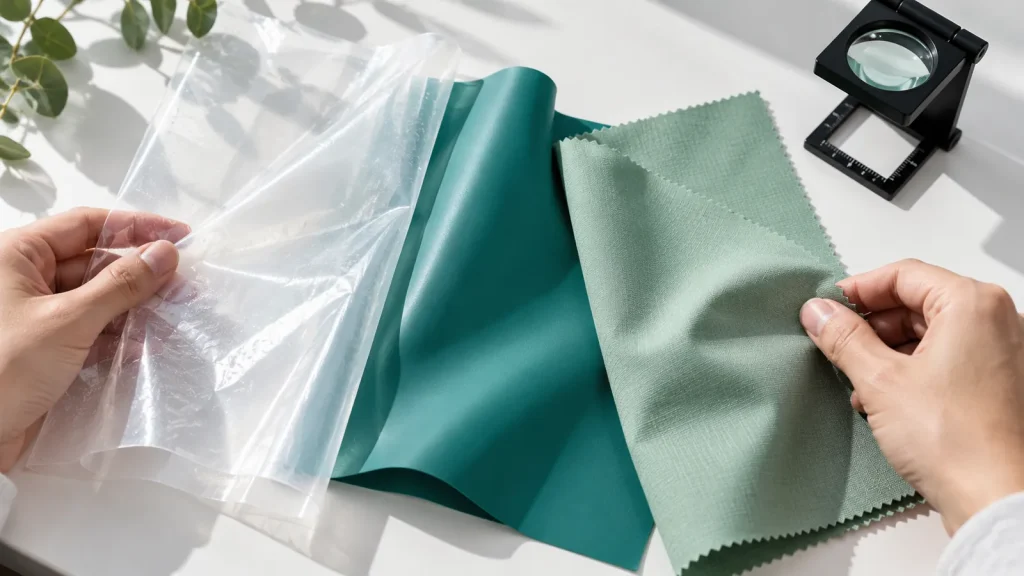
The material name is a starting point for a printing discussion, not a complete specification. A garment described as polyester may present a woven face, a coating or another finish to the decoration process. A flexible film can also vary in formulation, texture and treatment. Ask which surface will actually receive the ink or transfer and request a sample of that surface. The important question is whether the proposed decoration system works on the construction being ordered, in the colour and condition that production will use.
Marabu's technical guidance identifies pretreatment as important for printing polyolefins such as polyethylene and explains that plasticisers in soft PVC can affect the printed ink layer. These are material-specific considerations, not a universal recipe for rain ponchos. A buyer should ask the decorator to identify a suitable system and demonstrate it on the proposed substrate. Do not copy a treatment setting from a technical sheet for a different ink or application. The relevant process needs to be selected and controlled by the supplier responsible for the decoration work.
Request enough detail to distinguish the proposed sample from a convenient substitute. Useful identifiers include the material supplier's reference, surface finish, colour, thickness or fabric construction where relevant, and the production lot used for the trial. You do not need to demand a supplier's confidential formula to establish traceability. You do need a way to confirm that the approved print was applied to a representative surface. A visually similar sample from another garment can be helpful for discussing appearance, but it cannot close the compatibility question for your order.
Ask whether the proposed artwork is applied before or after the garment is assembled. A flat panel may offer different access from a finished jacket with seams, closures and pockets. The print face also needs to remain correctly identified throughout handling. If a film has two visibly similar sides, ask how the decorator controls orientation. These practical questions connect material selection with production planning. They also explain why a successful small swatch trial should be followed by a representative decorated garment before the whole order is released.
Treat any material substitution as a reason to review the decoration approval. A new colour, finish or source may be commercially convenient, but the existing sample does not automatically represent it. Ask the supplier to identify what changed and propose the evidence needed to accept the replacement. The review can be proportionate to the change, yet it should be explicit. This is especially helpful on repeat orders, where an identical artwork file can create the impression that the printing process is unchanged even though the garment surface has moved to a different specification.
Record the final decision as a combination of substrate and decoration system. A statement such as approved white motif on the identified teal material, using the agreed supplier process, is more useful than approved for polyester. Include the sample reference and intended use in the same record. If the team later asks whether the design can move to another raincoat, that record makes the next step clear: review the new surface and construction before relying on the earlier result. It preserves useful experience without stretching a narrow approval into an unsupported general claim.
Treat lightweight poncho films as their own decoration project
Lightweight rain poncho films need a printing brief that respects the finished product. The garment may be folded tightly, distributed in large quantities and pulled over clothing quickly during a shower. Its print needs to work within that handling pattern. Do not begin by assuming that a decoration method used successfully on a cotton shirt can be transferred unchanged. Ask the rainwear supplier which printing routes it proposes for the exact film and what sample evidence will demonstrate that the artwork and garment remain suitable together.
Look at the film in both a relaxed state and the condition in which the wearer will use it. A broad translucent panel can make a graphic look different against a white table, dark clothing or a busy background. Review the artwork on a representative garment over typical clothing rather than approving it only on a flat white surface. This does not require an elaborate photography exercise. A simple controlled comparison can reveal whether the selected colours, line weight and placement still communicate the intended identity when the poncho is worn.
Discuss the printed area in relation to folding. A design might cross the main fold line, meet another printed surface inside the pack or sit in a part of the garment that is repeatedly compressed. Ask the supplier to provide a packed decorated sample and agree a practical opening review. The aim is to find questions before shipment, such as unwanted transfer between surfaces or an appearance change after packing. The actual test conditions and acceptance criteria should reflect the product and proposed storage arrangements, rather than an arbitrary household experiment.
Keep a distinction between a print defect and a characteristic of the underlying film. Wrinkles, transparency and movement can affect how a design appears without necessarily indicating incorrect printing. Agree which visual features are acceptable and which are not. Reference samples are useful here because phrases such as smooth finish or clear logo can mean different things to different reviewers. A measured artwork size and a realistic visual reference make the discussion more objective while still allowing the buyer to judge whether the finished poncho looks appropriate for the campaign.
If a supplier proposes heat transfer for a film poncho, request a specific explanation and trial rather than accepting the method name as proof of suitability. Ask whether the process changes the film's shape, feel, appearance or functional construction around the decoration. If the proposal uses direct printing instead, ask equally clear questions about the ink system, handling and finished result. The purpose is not to prescribe one method for every PE or EVA product. It is to avoid treating a broad material category as a guarantee that any familiar decoration process will work.
For procurement, the practical output is a defined decorated sample and a matching packed sample. Keep their identifiers with the order specification and make sure the supplier knows which details are approved. Include the print size, location, colour reference and any agreed appearance limits. When the bulk goods arrive, the receiving team can unfold selected items and compare them with those references. This gives a lightweight promotional product a sensible level of control without burdening it with claims or test requirements that belong to a different type of garment.
Evaluate coated textiles and finished rain jackets separately
Coated textiles and assembled rain jackets introduce a different set of decoration questions from a flat film poncho. The outside face may have a particular finish, and the garment may include layers, pockets, zips or seam treatments that affect access to the printing area. Ask for the complete construction relevant to the chosen location. The fibre name alone does not explain these details. A useful review begins with the actual jacket or panel, the proposed mark and a decorator who can explain how the operation will be carried out.
Transfer manufacturers publish application guidance for their own products, and Siser specifically recommends testing a transfer on the nylon item being decorated. That is a helpful principle for procurement: suitability belongs to the combination of transfer, surface and application, not merely to the word nylon. Ask the supplier to identify the proposed transfer and current technical instructions. Then confirm that the garment supplier has considered the same process. A successful result on an uncoated bag should not be used as blanket evidence for a differently finished rain jacket.
Review how the garment can be supported during decoration. A chest position near a pocket, a sleeve with a narrow opening or a back panel close to a seam can make the practical operation different from the artwork mock-up. Ask whether a flat panel stage, a different location or a smaller motif would make the proposal more workable. The decorator should select appropriate equipment and settings. Your role is to ensure that the resulting product still meets the agreed construction and appearance, rather than approving a layout that cannot be repeated reliably.
Consider the complete garment after the print has been applied. Open and close the fastenings, inspect the inside of the decorated area where accessible, and compare the surrounding surface with an undecorated reference. Record visible changes or functional concerns for technical review. A smooth logo is only one part of the result. The garment also needs to retain its intended use characteristics. If a waterproof or protective performance claim is important to the order, ask the responsible specialist what evidence is needed for the decorated construction rather than relying only on an undecorated material report.
Be careful when one corporate identity is used across several jacket styles. The design may be consistent while the application route differs. A soft shell, a coated raincoat and a lightweight poncho should not automatically share one process approval. Keep a common artwork master but maintain a separate product-specific decoration reference where needed. This allows the brand team to recognise the shared identity while technical colleagues can track what was actually assessed. It also prevents a later supplier from interpreting a generic branding sheet as permission to use the same settings on every garment.
Finish the review by recording the approved position and any restricted areas. Include the garment style, size used for the reference, decorated surface and sample identification. If the chosen location has limited access on smaller sizes, resolve that before the quotation is finalised. A separate size range or adjusted placement may be appropriate, but it should be agreed rather than improvised during production. The result is a branded rain jacket whose appearance, construction and purchasing specification tell the same story, making repeat orders and receiving checks much easier to manage.
Further guidance: Marabu guidance on screen printing auxiliaries and substrates, Siser guidance on nylon transfer trials.
Still choosing the garment surface? Compare the construction options in our raincoat material guide to PE, PVC, EVA and polyester before fixing the decoration brief.
03 / 12
Specify screen printing for bulk logo rain ponchos
Understand the screen print proposal and its limits
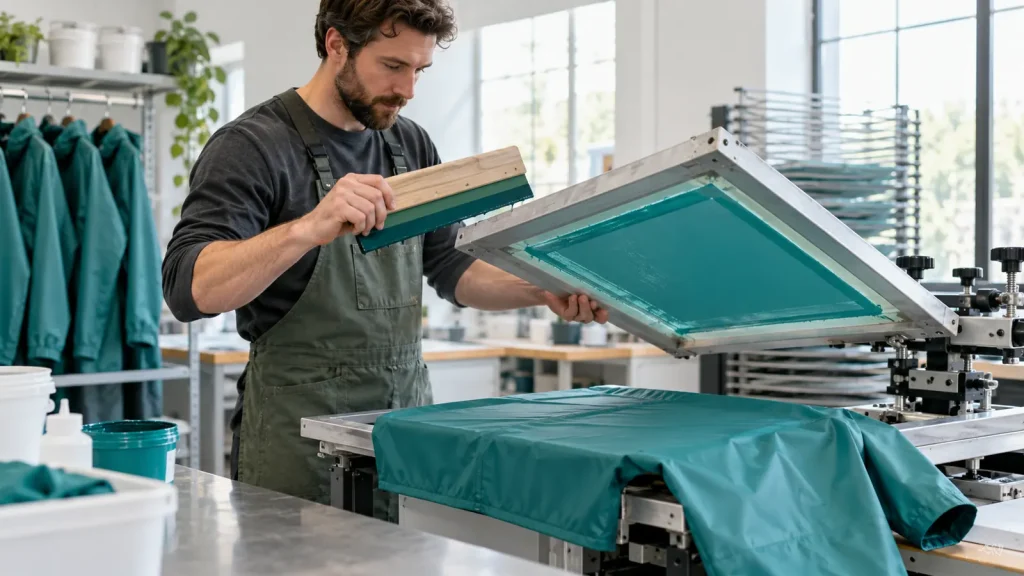
Screen printing uses a prepared screen to control where ink reaches the surface. For a buyer, the useful question is how the proposed process will reproduce the approved design on the chosen rainwear. Ask the supplier to describe the print locations, colour arrangement and substrate compatibility in its offer. The familiar term silk screen rain ponchos does not identify a particular ink system or establish performance. Treat it as the name of a decoration route that still needs a defined specification and an approved result for the order.
A repeated graphic with a limited colour palette is a sensible starting point for discussing screen printing in a bulk programme. That does not mean it is always the most suitable or least expensive option. Actual preparation, artwork, garment access and quantity matter. Ask for an offer against the same finished design you are comparing with other methods. If the supplier suggests simplifying the artwork, review the proposed change openly. A reduced colour count can be useful, but only if the brand team accepts the visual result and procurement understands the revised scope.
Ask whether the printing will take place on flat panels or finished garments. The answer affects placement references and the way the artwork relates to seams and construction. A graphic positioned accurately on a panel may need to be assessed again after assembly, when the garment hangs on a wearer. A finished garment can provide a direct view of the final location but may introduce access constraints. Neither route is automatically better. The supplier should explain its proposed sequence and provide a sample that represents the final product you will receive.
Avoid using the word permanent as a substitute for a durability requirement. A print can be intended for a particular use and care pattern without being guaranteed against every form of abrasion, storage or chemical exposure. Describe the expected handling, then ask what evaluation is appropriate. This makes the approval meaningful for a procurement manager. Instead of accepting a broad promotional phrase, you can assess a decorated sample and any supporting evidence against a clear brief. The same approach helps suppliers avoid agreeing to an undefined performance promise.
Request a sample that reveals both the strengths and the limitations of the proposed design. Include the actual logo, not just a large solid rectangle that is easy to print. If the design contains thin lines, reversed lettering or small sponsor marks, those details belong in the trial. Review the sample at its intended size and viewing distance. A close-up photograph is useful for diagnosing an edge, but the whole garment determines whether the branding communicates effectively. Both views are needed when visual presentation is important to the purchasing decision.
Keep the screen print approval linked to the agreed construction and artwork revision. If a quotation uses a different garment colour or a revised ink arrangement, it should identify the change. Ask the supplier which preparation can be retained on a repeat order and which details require another review. This helps the business plan an OEM Program without assuming that every later order is an exact repeat. Screen printing becomes a manageable purchasing option when its process description, sample and commercial proposal all refer to the same finished rainwear.
Plan colour separations, coverage and fine detail
A multicolour artwork file needs to be translated into a production arrangement. Ask the supplier to explain how the design will be separated for screen printing and whether the proposed appearance requires additional supporting layers. The quotation should reflect that arrangement rather than only the number of colours visible in a presentation image. You do not need to design the production setup yourself. You need to understand which parts of the proposed process influence the finished appearance, preparation work and sample approval for the specific rainwear surface.
Start with the most important visual relationships. Identify the main brand colour, the contrast between the mark and garment, and any detail that must remain readable. On a dark or translucent substrate, the same artwork may need a different treatment from a design on white paper. Ask the decorator to show a representative result and explain any proposed compromise. A physical sample is particularly useful when the buyer expects a bright colour, a fine outline or a clean reversed area. These qualities are difficult to settle by looking at a digital mock-up alone.
Discuss registration wherever colours meet. Registration describes how the separate printed elements align with one another. Instead of demanding an unexplained flawless result, agree what will be judged, under which viewing conditions and against which reference. Tiny offsets may matter greatly in small lettering while being less noticeable in a broad abstract pattern. Let the supplier identify production concerns, then involve the designer in resolving them. Adjusting a line, opening a gap or reducing unnecessary detail before approval can be more practical than rejecting an unsuitable design after the order has started.
Review solid coverage separately from fine detail. A design with a large filled area and delicate small text may present competing appearance priorities. Ask for both features to be represented in the sample so the team can assess them together. Look for the agreed consistency of colour and edges, but avoid inventing universal technical limits for every mesh, ink and substrate. The decorator should recommend process-specific artwork constraints. Record the accepted result in the order file so inspectors are checking the actual agreement rather than applying a personal standard developed at the receiving dock.
If the campaign has several sponsors, check each mark at its final size. A sponsor logo that is clear at the top of a presentation slide may become a dense shape after reduction. Ask the brand owner for an approved small-format version if necessary. Do not redraw a protected identity or remove required elements without permission from the appropriate stakeholder. Procurement can help by collecting the approved files and confirming which versions belong on the garment. That prevents a production team from making visual decisions that should have been settled by the organisations whose marks are being used.
Conclude the artwork review with a proof that names the final dimensions, colours and revision. Add a physical decorated reference when the process and substrate have been assessed. The proof explains what the supplier is asked to reproduce; the sample shows the accepted interpretation on rainwear. Both records are useful because neither replaces the other. A repeat order can then begin with a clear question about whether the same combination is available, rather than a vague instruction to print it like last time that leaves colour and detail open to reinterpretation.
Connect print preparation with drying, handling and assembly
The quality of a screen printed mark depends on more than the moment ink is applied. The supplier also needs a process for preparing the surface, handling the printed pieces and moving them through subsequent work. Ask how the proposed decoration stage fits into the wider rainwear production sequence. This is a planning discussion, not an invitation to prescribe chemical recipes. The decorator should follow the current requirements of its selected system and demonstrate a finished result that represents the production route proposed for your order.
Request confirmation that the sample includes the relevant downstream steps. If the production pieces will be folded, assembled or packed after printing, a sample delivered flat immediately after decoration may not answer every question. Ask for the finished garment and its intended packed presentation. Review whether printed areas contact one another or adjacent material when folded. Agree how the supplier will assess any unwanted transfer, sticking or appearance change. The conditions should be chosen for the actual product and storage plan, with technical input where necessary, rather than invented simply to make a checklist longer.
Keep the garment construction team involved when printing happens before assembly. Artwork may need to stay clear of joining areas or other operations. A flat print location must also translate into the intended position after the panel becomes a garment. Ask for a drawing that uses meaningful landmarks and then verify the placement on an assembled sample. This helps avoid a situation in which the print department and sewing or joining department each meet their own instructions, yet the finished logo sits differently from the brand team's approved visual reference.
Ask how the production team distinguishes approved work from pieces awaiting a check. Clear identification matters when several artwork variants move through the same area. A sample from one version should not become an accidental reference for another. The exact shop-floor system belongs to the manufacturer, but the buyer can request evidence that the current artwork and product reference are available where the work is performed. For a large or complex order, agree checkpoints that give the supplier a chance to identify a problem before it affects the remaining quantity.
Include packing readiness in the production plan. A shipment deadline should not encourage the team to compress process steps without considering their effect on the decorated product. Ask the supplier to identify the time required between relevant operations and the latest point at which artwork changes can be accepted. Do not assume that an apparently small design revision leaves the rest of the plan untouched. A different colour arrangement or printed area may change the sample work and handling requirements, even if the garment itself remains the same.
At handover, keep a representative approved sample and a record of the packed condition. If a receiving problem appears, these references help the supplier investigate the affected stage rather than starting with an argument about whether the logo looks right. Record the variant, carton identification and observed issue, and preserve relevant samples for review. This connects the creative brief with practical production control. The objective is a repeatable decorated product that reaches the user in the agreed condition, not merely an attractive print photographed before the rest of the manufacturing and packing process has taken place.
04 / 12
Evaluate heat transfer printing for branded rainwear
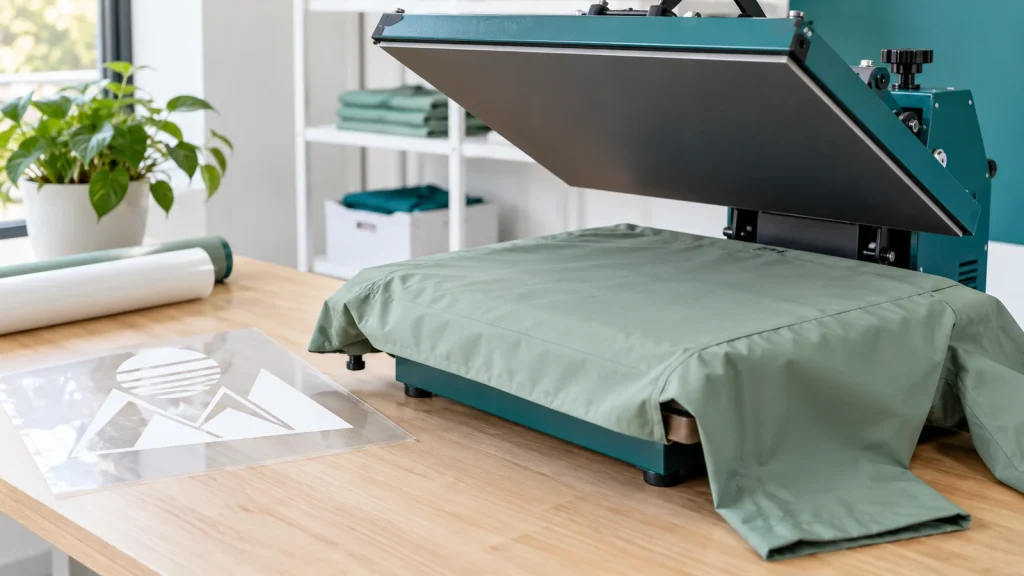
Ask which transfer construction is being proposed
Heat transfer describes a family of decoration processes, not a single material or universal application. A proposal might involve a cut graphic, a printed transfer or another supplier-specific construction. Ask what the finished decoration consists of and how it will be applied to the rainwear. The useful answer identifies the transfer system, the compatible surface and the process reference. A quotation that says only heat transfer leaves too much uncertainty for a buyer comparing appearance, durability, artwork flexibility and bulk production arrangements across several suppliers.
Begin by describing the graphic you need. Is it one simple mark, several colours, a detailed illustration or a small identification element? Ask the supplier to recommend a route against that actual artwork. A method that produces a convenient sample may not be the most practical way to handle every variant in a large order. Request a decorated reference at the final dimensions, including small lettering and any fine edges. The finished sample should represent the proposal, rather than a different transfer chosen simply because it was available in the sample room.
Review the visible shape of the decoration as well as its printed content. Some designs may have a surrounding area, an edge or a surface finish that changes how they sit on the garment. Ask the supplier to explain what will remain visible after application. A digital proof should make the finished boundary clear, especially when the brand team expects separate letters or a floating emblem. Comparing the sample with that proof helps avoid a technically correct transfer that looks different from the design everyone thought they had approved.
Ask how the proposed transfer feels on the intended rainwear. A larger decorated area can influence the local feel and movement of a lightweight garment, even when it looks attractive on a table. Evaluate the sample while worn, folded and handled in the way the product will be used. This is a product review, not a claim that every transfer is bulky or every direct print is softer. Different constructions produce different results. The buyer should assess the actual proposal rather than relying on a broad description of the printing category.
Clarify which parts of the process the supplier performs and which come from another specialist. A rainwear manufacturer may source a transfer from a decorator and apply it during production, or a decoration partner may handle the complete operation. The arrangement is not inherently a problem, but responsibility should be clear. Ask who confirms compatibility, controls the approved transfer reference and investigates a finished-product issue. Procurement benefits from one accountable contact, supported by a traceable process, rather than being asked to mediate between parties after a problem appears.
Keep the approved transfer identity with the garment specification and artwork revision. If a supplier proposes another transfer source later, ask what changes and whether a new trial is necessary. Do not assume that matching colour and shape proves equivalent construction or performance. Conversely, do not reject a useful alternative solely because its process name differs. Review it against the same intended outcome and agreed evidence requirements. This gives your OEM Program room to improve while ensuring that every accepted version is a deliberate purchasing decision supported by a representative sample.
Review heat, pressure and garment access as one process
Heat transfer application involves a process selected for the transfer and the receiving garment. Buyers should ask the decorator to follow the applicable technical instructions and verify the result on the proposed rainwear. Avoid treating a temperature copied from another product as a general recipe. Siser's guidance on heat-sensitive textiles recommends testing and checking the garment's response to heat. The practical lesson is to assess the complete application, including the surrounding material, instead of approving a transfer solely because its image appears to bond at first inspection.
Ask how the garment will be supported during application. A raised seam, fastening or pocket near the print position can make access different from a flat swatch. Show the supplier the exact location and request a representative garment trial. If the preferred position is awkward, explore a revised size or location before committing to the layout. The decorator should select suitable equipment and setup. Procurement should confirm that the process can be carried out consistently on the full size range without an unapproved change to the garment's appearance or function.
Review the area around the decoration, not only the graphic itself. Compare the decorated sample with an undecorated reference under similar lighting. Look for changes that matter to the agreed product, such as an unwanted outline around the application area or a difference in surface appearance. Record observations rather than immediately assigning a cause. A technical reviewer or decorator can then investigate them. This is more useful than a general rejection saying the print looks wrong, because it identifies the feature that must be corrected or discussed before approval.
Where the garment has layers or specialised construction, ask the supplier how the proposed operation relates to those features. The brand team should not decide process suitability from the outside appearance alone. If rain protection or another performance claim is part of the order, the responsible technical specialist needs to consider the decorated construction. Agree what evidence will close that question. A transfer manufacturer's application guide provides information about its product; it does not automatically establish that every finished rain jacket retains every claimed property after any decoration operation.
Make sure the trial represents the production sequence. A sample applied by a specialist under one arrangement may not tell you enough about a different bulk setup. Ask which process reference the production team will use and how the first output will be checked. You do not need unrestricted access to proprietary manufacturing details to establish this control. A documented approved sample, a defined method reference and agreed inspection points can give procurement a practical basis for release while leaving the decorator responsible for the detailed operation of its equipment.
Treat late placement changes as technical changes as well as design changes. Moving a motif closer to a zip or onto a narrower sleeve may alter the access conditions even when the artwork stays identical. Ask whether the revised position requires another sample and whether it affects the quotation or timeline. Record the answer before issuing a release. That keeps the production team from improvising around a location that was never assessed and helps the brand team understand why a seemingly small adjustment can matter to the finished rainwear.
Check appearance and adhesion beyond the first peel
A newly applied transfer can look convincing while leaving important approval questions unanswered. Ask the supplier when and how the decorated sample should be assessed under the selected system's instructions. Do not make an immediate visual check the sole basis for a bulk release. The review should include the intended garment handling, relevant care expectations and any technical evaluation agreed for the product. The exact conditioning and assessment requirements belong in the approval plan, supported by the decorator and, where necessary, a suitable testing specialist.
Start by comparing the sample with the approved artwork. Check that the graphic is complete, the dimensions and position are correct, and the finished boundary matches the agreed design. Look at edges and small elements as well as broad areas. A missing dot or an altered letter can have a large effect on brand identity even when the overall print seems neat. Use the current master file and an agreed physical reference. Personal memory of the artwork is an unreliable inspection tool when several versions have circulated during the project.
Then consider the decoration as part of a moving garment. Ask a representative wearer to put on the sample and perform ordinary movements relevant to the brief. Examine whether the print sits in a heavily folded or stretched area and whether its placement still communicates the intended mark. This review can identify design issues, but it should not be described as a certified durability test. Record the conditions and observations honestly. If the order requires a measured performance result, use an appropriate agreed method and evidence rather than elevating an informal handling check into a formal claim.
Review a packed sample as well. The transfer may contact another surface when the garment is folded, and the print could be positioned on a main crease. Ask the supplier to demonstrate the proposed fold and identify any handling or storage instructions relevant to the finished product. The purpose is to connect the decoration approval with how the goods will actually arrive and be used. A flat sample kept carefully in an office folder is helpful for colour comparison, but it is not a complete substitute for reviewing the intended packaged item.
For reusable rainwear, agree the care expectations of the complete garment. Do not assume that instructions for a transfer alone can replace the rainwear manufacturer's care instructions, or that an undecorated garment's care information covers every later addition. Ask the parties responsible for the finished product to resolve any conflict. The buyer needs one coherent set of instructions and supporting evidence for the proposed construction. If repeated cleaning is part of the intended use, include that requirement in the sample plan before selecting the final decoration route.
Document the decision with a representative sample reference and a list of any unresolved conditions. If an edge issue, colour change or surface mark appears, identify the affected location and share clear observations with the supplier. Request a revised sample or appropriate evidence before closing the concern. This approach helps distinguish a correctable application problem from a design that needs to change. It also avoids the false choice between accepting a questionable sample to protect the delivery date and rejecting the entire printing method without understanding the specific issue.
Further guidance: Siser guidance on heat sensitive textiles.
05 / 12
Prepare production artwork for custom logo printing on raincoats
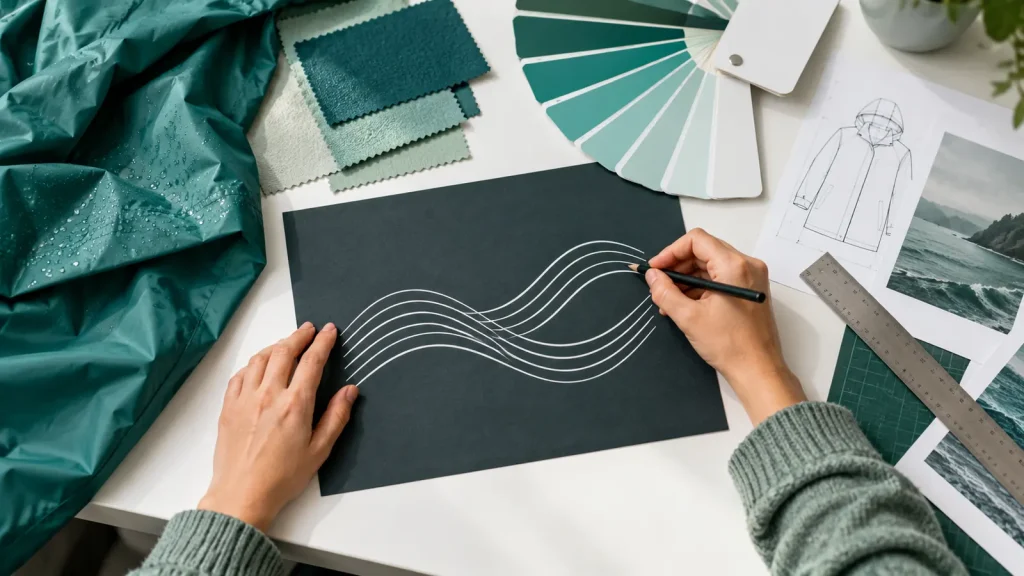
Supply artwork that defines the finished result
Good artwork handover removes uncertainty about what the supplier is expected to reproduce. Provide the approved master file in a format the decorator can use, together with a readable reference proof. Ask which file type is required before sending a collection of exports. A vector file can be useful for logos and shapes, but its presence alone does not guarantee that every element is ready for production. The supplier still needs to review the graphic, dimensions and proposed process, including any embedded images, fonts or effects that may need attention.
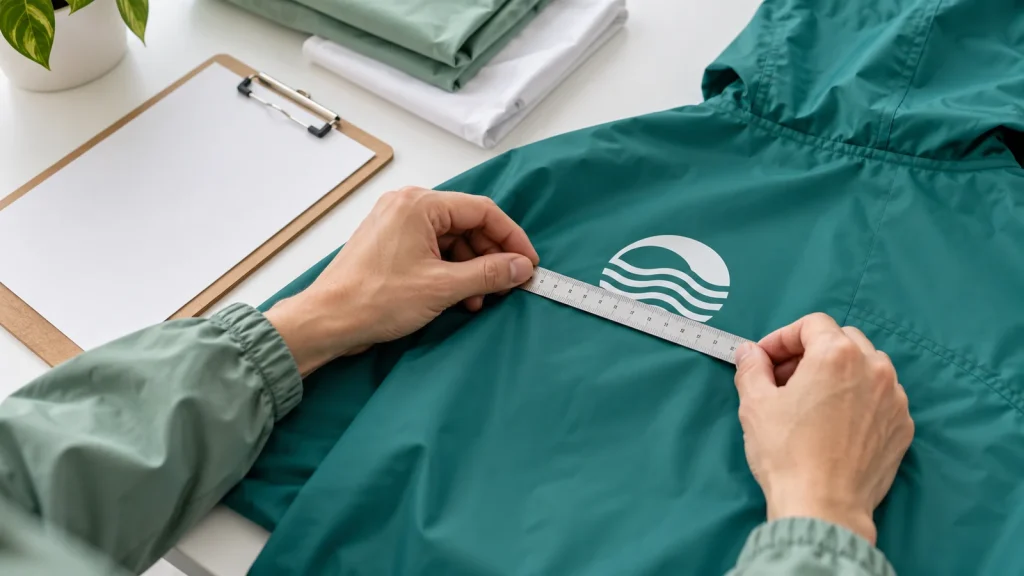
Specify the finished width and height in an agreed unit, normally millimetres for a production drawing. Do not rely on the size at which a graphic happens to appear on a presentation slide. Include a clear indication of whether dimensions refer to the entire design boundary or a particular element. This becomes important when a mark has generous empty space around it. A supplier measuring the file's outer area and a buyer measuring the visible emblem can both follow their own interpretation while producing different results on the garment.
Confirm how text should be handled. Where the decorator requests outlined lettering, keep an editable master privately and supply the agreed production version. Review the result carefully to ensure that the approved wording has not changed during export. Include punctuation, spacing and any required brand symbols in the proof. Avoid assuming that a supplier will recognise an incorrect name or event year. The organisation that owns the content should approve it explicitly, particularly when the design includes sponsor identities or wording supplied by several different partners.
Separate the artwork file from the placement drawing. The file describes the graphic; the placement drawing explains where it belongs on the garment. Combining them only in a photograph can make both tasks harder to interpret. Provide a clean graphic and a garment view with measurement references, then link them through the same revision identifier. If a production adaptation is proposed, ask for a revised proof that shows what changed. This keeps useful technical adjustments visible to the brand team without allowing an informal mock-up to become the only production instruction.
Check file names for ambiguity before handover. Terms such as final, final new and final latest are easy to confuse. Use a simple project reference, artwork variant and revision, with the approval date recorded in the accompanying specification. Remove superseded versions from the current release package while retaining them in your internal archive. The goal is not a complicated naming convention. It is to ensure that the person preparing the print can identify one current file without deciding which of several similarly named attachments the buyer probably intended.
Ask the supplier to acknowledge the production package it has received. The confirmation should identify the artwork revision, finished dimensions, garment reference and relevant variants. If anything is missing or technically unsuitable, resolve it before the sample stage is treated as complete. A clear handover saves time later because it narrows the source of any disagreement. When the sample arrives, the team can compare it with a defined instruction and decide whether the issue lies in the artwork, its interpretation or the production result, rather than reopening every earlier design conversation.
Approve colour on the actual garment background
Colour approval is most useful when it is tied to the material on which the mark will appear. A bright logo on a white digital page can look different on teal film, a dark woven jacket or a translucent poncho worn over patterned clothing. Give the supplier a meaningful colour reference and explain its priority. If the brand uses a recognised colour system, identify the reference clearly, but still request a decorated sample. The code helps communicate the target; the physical result on rainwear is what the buyer ultimately needs to assess.
Decide which reference governs when several branded items are involved. An event banner, a paper pack and a jacket may not all reproduce a colour in exactly the same way. Ask the brand team whether the requirement is a close garment-specific match or an acceptable coordinated appearance across the campaign. This decision should not be left to the purchasing assistant receiving the sample. A written priority helps the supplier make a useful proposal and gives the reviewer a fair basis for accepting a realistic result on the selected substrate.
Use consistent viewing conditions during comparisons. A sample judged under one light source and a photograph viewed on an uncalibrated screen can lead to confusing disagreements. Agree how the team will assess the physical reference and use photographs mainly to communicate the location or nature of a concern. If colour is especially critical, involve a suitable colour specialist and define the measurement approach and acceptance tolerance in advance. Do not introduce a numerical limit after the sample has arrived without discussing the method and whether it is appropriate for the surface and design.
Review both the printed colour and its surrounding contrast. A technically close colour may be difficult to recognise on the proposed garment background. Conversely, an approved light version of the logo may communicate better than the standard dark version on a particular raincoat. Ask the brand owner which approved alternatives are available. Procurement can then compare feasible options without encouraging unauthorised changes to the identity. This is especially useful for translucent rainwear, where the clothing underneath becomes part of the visual background and can change the apparent clarity of the mark.
Keep one physical approved reference for the project and record its condition. A sample repeatedly handled, exposed or used for demonstrations may become less suitable as the master comparison. Store the reference according to the supplier's guidance and distinguish it from working samples. For a repeat order, compare the new proposal with the retained reference but also review whether the material or process has changed. Colour consistency is easier to discuss when both parties know which object represents the agreed result and which objects are merely examples from earlier discussions.
If the sample needs adjustment, describe the issue precisely without prescribing an unverified technical fix. Identify the colour area, the reference and the observed difference under the agreed conditions. Ask the decorator to propose a correction and provide a revised sample where needed. A comment such as make it more premium offers little production guidance. A clear comparison gives the supplier something actionable and allows the brand team to approve the revised result. Record that decision with the final artwork and garment reference so colour approval remains connected to the complete custom printing specification.
Make small lettering, patterns and multiple marks readable
Rainwear branding needs to work at the distance and in the setting where people will see it. A detailed graphic can be attractive on a close-up proof yet become unclear on a moving wearer. Start by identifying the smallest element that must remain recognisable. This might be a sponsor name, a short event identifier or a simple symbol. Ask the decorator to review that element at the final size on the proposed material. Do not assume that enlarging a digital preview proves the production detail will be equally clear on the garment.
Use a hierarchy that reflects the campaign's priorities. One main identity, supported by a limited number of secondary elements, can make review easier for all stakeholders. If every partner requests equal prominence, resolve the layout before asking the factory to sample it. The supplier should not have to decide which organisation's logo deserves more space. A clear hierarchy also makes it easier to explore a simpler production alternative. You can reduce unnecessary detail while preserving the parts of the design that the buyer and brand owners consider essential.
Evaluate patterns differently from isolated logos. A repeated motif may cross folds, panel edges or seams, so ask whether continuity is required and how it will be assessed. An all-over visual in a design presentation can conceal these practical questions. If the pattern is intended to appear continuous, the construction and production route need to support that expectation. If the pattern is intentionally loose or irregular, state that clearly. The approval reference should show the accepted finished garment rather than leaving the production team to infer the designer's intended level of alignment.
Think carefully before adding a code or a long block of text to the rainwear itself. A functional code needs to be checked on the finished garment in its intended condition, including the way the surface bends and the contrast available. A long message may be better placed on packaging or a separate insert if it becomes unreadable at the available print size. This is a design choice to test, not a universal prohibition. Ask what the user is expected to do with the information, then choose a location and format that support that action.
Review multiple marks together rather than approving them only as separate files. Their spacing, relative size and combined printed area can change the overall result. A supplier may reproduce each logo correctly while the full arrangement feels crowded or visually unbalanced. Use a garment mock-up to settle the layout, followed by a decorated sample to assess the real appearance. Involve the brand owners where required and record their decisions. This avoids repeated sampling caused by a stakeholder seeing the complete arrangement for the first time only after production has been prepared.
Before release, perform a simple content check with someone who has not been involved in the design revisions. Give them the approved text and reference identities, then ask them to compare the final proof line by line and mark by mark. Fresh eyes can catch a missing element that the project team has stopped noticing. Keep this review focused on content accuracy rather than inviting another unrestricted design round. Once the artwork, readability and physical sample are approved, issue one controlled release so the supplier can reproduce the agreed arrangement consistently across the bulk order.
06 / 12
Choose logo placement that works on a worn rain poncho
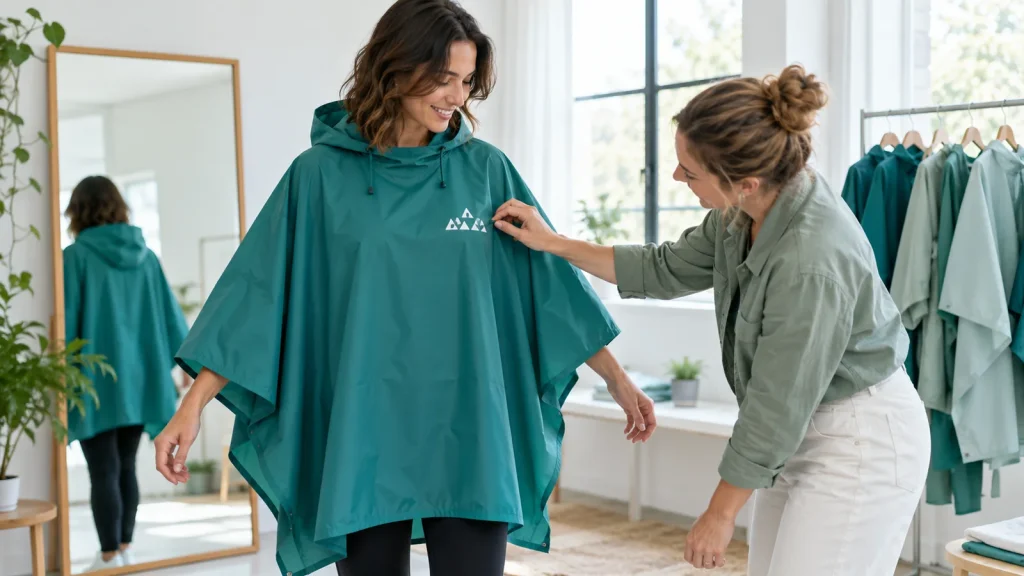
Map chest, back and sleeve positions on the real garment
Logo placement should be defined on the garment the buyer is actually ordering. A generic raincoat outline can help communicate an early idea, but it may not represent the hood, shoulder shape or panel layout of the final style. Ask the supplier for a suitable placement drawing and a representative sample. Mark the graphic's size and position from agreed landmarks, such as a seam or centre line. Avoid relying only on a phrase such as left chest, which leaves the exact relationship between the artwork and garment open to interpretation.
Decide whether the placement is intended to remain at a fixed measurement or follow a visual relationship across sizes. A position that looks balanced on one sample may sit differently on another size or on a loose poncho. Ask how the supplier proposes to manage the range and whether separate references are needed. This is especially relevant when the order combines adults' sizes, different jacket styles or a mixture of ponchos and fitted raincoats. A shared brand identity does not require every garment to use an identical measurement if that would produce an awkward result.
Review the back position with the hood in realistic use. A graphic placed high on a flat sample may be partly covered when the hood rests down, while a lower position may interact with folds or carrying equipment. Try the intended configurations and identify which view matters most to the project. An event organiser may prioritise recognition in a crowd, while a corporate buyer may prefer a more restrained appearance. Record that priority so later reviewers understand why the location was chosen instead of moving the mark to satisfy an unrelated personal preference.
For chest marks, check the relationship with openings, pockets and overlapping panels. The artwork should remain readable when the garment is fastened as intended. A placement drawing should show which side is being described from the wearer's perspective, avoiding confusion between a front-view illustration and a garment laid face down. Ask the supplier to confirm its interpretation during sampling. A small clarification at this stage is far easier than discovering that a neatly printed logo has been consistently placed on the opposite side from the approved uniform arrangement.
Sleeve positions need their own review. The available surface, garment movement and visibility differ from a broad back panel. Ask whether the selected graphic is practical at that location and assess it on a wearer rather than judging a detached sleeve photograph alone. Fine lettering may rotate away from the viewer or sit across a natural fold. A simpler approved symbol or another position may serve the purpose better. The decision should follow the communication goal and the actual garment, with the decorator confirming that the chosen route is feasible.
Keep the final placement record readable for production and inspection. Include the garment style, reference size, graphic boundary, measurement landmarks and agreed tolerance. Add photographs that show the accepted visual relationship, but retain the measurements rather than making the photograph the only instruction. This combination helps the supplier reproduce the position and helps the receiving team assess it. It also makes future adjustments deliberate: a change to the hood, panel shape or size range can trigger a placement review instead of inheriting a location that no longer suits the product.
Keep decoration clear of construction and functional details
Rainwear is a working garment before it is a branding surface. A print proposal should account for the construction features that make it usable, including openings, closures, pockets and relevant joining areas. Ask the supplier to identify where decoration can be applied and which locations need technical review. Do not assume that a large uninterrupted area in a photograph is equally available to every printing process. The production team needs access to the surface, and the finished garment still needs to function as intended after decoration.
Map the important features on the placement drawing. Show seams, pocket edges, fastenings and any existing labels or markings that the design must avoid. Where protective or occupational use is involved, ask the responsible specialist to review the decorated product and any effect on required visible areas or information. Do not treat a logo as harmless simply because it is small. The significance depends on the garment and its intended claim. The purchasing brief should make that context clear without inventing a universal clearance distance or assuming that a generic sample proves suitability.
Consider the sequence of operations. A graphic applied before assembly may need space around a joining area, while decoration on a finished garment may be constrained by access and support. Ask the manufacturer to explain the proposed route and confirm the workable print boundary. If the brand team wants artwork close to a structural feature, request a sample that includes that feature. A print on an isolated flat rectangle does not answer the same question. The approval needs to represent the interaction between the decoration and the completed garment construction.
Pay attention to components that move or overlap during use. A fastening flap can cover part of a mark, and a pocket opening can interrupt its visual outline. Check the garment open and closed in the intended configuration. If a motif crosses two sections, decide whether alignment is a requirement and how it will be evaluated. A supplier should not have to guess whether an interrupted design is intentional. Clear drawings and a worn sample help separate creative intent from an accidental placement that only becomes obvious once someone uses the garment.
When the desired position creates a problem, compare alternatives against the original purpose. Moving the mark slightly, reducing its size or using an approved simplified version may be preferable to changing the garment construction. Another project may justify a redesigned panel, but that becomes a broader development decision with its own sampling and quotation implications. Keep those options distinct. A printing request should not quietly turn into an unreviewed structural modification merely because the artwork was approved before the technical team had a chance to assess the location.
Record restricted areas in the same current specification as the approved print location. This prevents a future repeat order or additional artwork from occupying space that was intentionally left clear. If the garment changes, review those restrictions again rather than assuming they remain correct forever. The objective is a practical shared map of where the branding belongs and why. That gives designers useful boundaries, lets production plan the operation and allows inspectors to assess the complete product instead of checking only whether the logo is present somewhere on the rainwear.
Review the design while moving, carrying and packing
A rainwear sample should be reviewed as something people will wear and handle. Put it on over representative clothing and check ordinary movements relevant to the project, such as walking, reaching and carrying a bag. Look at how the graphic sits when the garment is relaxed and when its panels move. This can reveal a placement issue that is invisible in a flat mock-up. Keep the review focused on the intended use rather than creating dramatic movements or exposures that have no connection with the purchasing brief.
Consider what the wearer will carry. A backpack can cover a back mark, and a shoulder strap can cross a chest identity. Event staff may carry radios, passes or other equipment that affects the available visual space. Ask operations colleagues to demonstrate the typical arrangement during the sample review. The aim is not to guarantee that the logo will be visible in every possible situation. It is to choose a position that makes sense for the expected use and to recognise any practical limits before the brand team commits to the design.
Review the garment from realistic viewing distances. A mark that is easy to read while held close may become indistinct in a crowd, while a very large graphic may feel excessive in a corporate setting. Agree which context matters and judge the design accordingly. Use consistent photographs if several stakeholders need to review remotely, but explain the sample size and viewing arrangement. Avoid presenting a carefully selected close-up as evidence that every element will be equally clear during use. Honest sample review produces a more useful decision than an idealised presentation.
Then fold the garment using the supplier's proposed packing method. Check which part of the design remains visible, whether different variants can be identified and whether the print crosses a major fold. Ask for a packed decorated sample when the packaging is important to distribution. This connects branding with the practical experience of opening the product. A campaign may benefit from a mark that appears clearly when the pack is first handled, but that should be balanced with the garment's primary use and the feasibility of consistent folding during bulk production.
Include the receiving and distribution teams in this part of the review. They may notice that two artwork versions look nearly identical when folded or that an outer label would make allocation easier. These observations can prevent avoidable repacking work. Record the agreed variant identification and carton arrangement in the order file. Do not rely on the logo itself as the only stock identifier if the design is difficult to see through the packaging. The supplier and buyer should share a practical way to distinguish each finished item before it reaches the wearer.
Close the review with specific findings and a decision. Note the garment configuration, representative clothing, carrying arrangement and packed presentation that were considered. If a design adjustment is needed, update the artwork and placement references together. If the sample is accepted, preserve it as the visual reference while keeping another sample available for handling demonstrations where practical. This makes the approval useful beyond one meeting. Production, receiving and future procurement colleagues can understand how the chosen branding works on the real garment and which assumptions underpinned the decision.
07 / 12
Turn the branding brief into a measurable print specification
| Entity | Attribute | Value or unit to agree | Approval evidence |
|---|---|---|---|
| Garment surface | Construction and printable face | Material, finish, colour and lot reference | Actual production substrate sample |
| Artwork | Master file and revision | File name, revision and approval date | Approved artwork plus outlined type where required |
| Printed motif | Finished dimensions | Width and height in mm; agreed tolerance | Measured decorated sample |
| Print location | Position from fixed landmarks | Offsets in mm and garment size reference | Placement drawing and worn sample |
| Colour | Target and acceptance reference | Agreed reference, viewing conditions and tolerance | Signed physical print sample |
| Decoration system | Ink or transfer identification | Supplier system and process reference | Compatibility trial on the proposed surface |
| Appearance | Edges, coverage and registration | Agreed defect examples and inspection conditions | Reference photos and retained samples |
| Durability | Intended use and care exposure | Named method, conditions and acceptance criterion | Report tied to the decorated sample |
| Packed goods | Fold and variant identification | Fold reference, pack label and carton assortment | Packed sample and receiving checklist |
| Change control | Authority to release revisions | Named role and dated approval | One current specification shared with all parties |
Use an EAV table to define print attributes and evidence
An EAV table turns a broad branding request into a set of purchasing decisions. EAV means entity, attribute and value: identify the item being described, the feature that matters and the value or reference to agree. For custom rainwear printing, the entity might be the garment surface, artwork, printed motif or packed product. Add an evidence column so the table explains how each requirement will be checked. This gives the buyer and supplier a shared working specification without pretending that every feature can be reduced to one universal numerical limit.
Start with identity before measurements. Record the garment construction, the printable face, the artwork revision and the proposed decoration system. Without those references, a precise print dimension can still describe the wrong product. Then add the finished graphic width and height, its position from defined garment landmarks and the relevant size reference. Use consistent units and explain what is being measured. For example, distinguish the visible motif boundary from a surrounding transfer area or the outer dimensions of an artwork file containing empty space.
Include visual attributes alongside measurable ones. Colour, opacity, edge appearance and registration may need a combination of a physical reference, defined viewing conditions and an agreed evaluation method. Do not force a numerical value into the table simply because numbers look more technical. If the buyer and supplier will assess a feature visually, make that process clear and retain a suitable sample. If a measured tolerance is important, agree how it will be evaluated and whether the chosen method is appropriate for the design and surface.
Connect durability entries with intended use. A requirement should name the aspect being assessed, the relevant conditions and the acceptance criterion, rather than simply saying durable print. Adhesion, colour transfer, folding and care response are different questions. Ask the technical team or testing provider to identify suitable methods for the exact construction. The table should record the agreed plan and resulting evidence. It should not present a list of standard names as if their presence proves that the product has passed them or that every method is appropriate for every rainwear material.
Add the packed condition and variant identification. These details are easy to omit from a print specification, yet they influence how the branded product reaches the user. Record the approved fold, individual pack reference and carton assortment where relevant. Identify how the receiving team will distinguish artwork versions without opening every pack. A packed sample can support these entries in the same way that a decorated garment supports colour and placement. Bringing the information together helps prevent the print team and packing team from working from separate, inconsistent descriptions of the order.
Use the table as a live project document until release, then control changes. Every unresolved value should have an owner and a next action, so an empty cell is not mistaken for permission to choose freely. At approval, mark the current version clearly and link it to the sample and commercial order. A supplier can then confirm whether a repeat proposal matches the established specification. If it does not, the table shows exactly what needs discussion, making it a practical tool for an OEM Program rather than a decorative technical appendix that nobody uses.
Set tolerances and visual acceptance references together
An acceptance tolerance defines how much variation the buyer and supplier have agreed to allow. It should be chosen for the particular feature and product, not copied from an unrelated order. A print's position, width, colour and edge appearance may require different assessment approaches. Discuss these before bulk production so neither party introduces a new standard at inspection. The aim is a clear agreement about acceptable goods, supported by a sample and practical measurement instructions, rather than an unrealistic demand for absolute identity across every garment in a flexible material order.
Begin with the feature's importance to the intended use. A small shift in a chest emblem may matter differently from a misaligned word or an incorrect sponsor mark. Identify which defects affect content, which affect visual presentation and which might affect function. Ask the supplier to explain the process's practical capability and propose suitable controls. Procurement can then assess whether the expected variation is acceptable for the campaign. If it is not, reconsider the design or process before committing rather than accepting a proposal whose normal output would fail the buyer's expectations.
Make measurement repeatable. State whether the garment is laid flat, how folds are relaxed, which landmark is used and which boundary of the graphic is measured. Flexible rainwear can move during handling, so two people following different methods may report different results. A simple drawing and photographs can help the team apply the same approach. For critical measurements, ask the technical reviewer to define the procedure. The goal is to reduce disagreement about how the requirement was checked, not to create a complicated inspection routine for every minor visual feature.
Use boundary samples or clear examples where they help explain visual acceptance. A general statement such as no poor printing is too vague to guide a production or receiving team. Examples can show the kind of missing detail, unwanted mark or misregistration that needs review. Ensure that the examples are relevant to the chosen artwork and material. Keep them separate from the approved ideal reference so nobody mistakes a defect example for the target appearance. Record whether an example is acceptable, unacceptable or intended only to explain an issue under discussion.
Agree who resolves borderline cases. A receiving inspector should not have to invent a commercial decision when a sample falls close to a visual boundary. Define the escalation contact and the evidence needed, such as photographs under agreed conditions, measurements or retained samples. The purchasing team can then involve the right technical or brand reviewer. This is particularly useful when goods are distributed to several locations. A common process prevents one warehouse from accepting a feature that another rejects simply because their teams use different personal expectations.
Keep acceptance criteria stable after production release unless both parties agree a change. If a stakeholder decides the logo should be larger after seeing finished goods, that is a new design preference, not automatically a production defect. Conversely, a supplier should not replace an agreed requirement with a more convenient interpretation after the order has started. A controlled specification protects both sides. It gives the business a fair basis for inspection and creates a clear path for improvements on the next order without rewriting the terms of the current one retrospectively.
Control the artwork revision and approved decoration recipe
The approved product is a combination of garment, artwork and decoration process. Keeping only the final logo file does not preserve that combination. Create a release record that links the garment reference, artwork revision, placement drawing, physical sample and supplier process reference. The detailed recipe may belong to the decorator, but the buyer should know which approved system the supplier is using. This helps distinguish an exact repeat from an alternative proposal that looks similar yet changes a material, transfer source, ink arrangement or application route.
Assign one current release identifier to the package. Every document does not need an elaborate code, but the supplier should be able to tell which versions belong together. If the artwork changes from one revision to another, check whether the placement drawing and sample approval also need updating. A common failure is to replace the file while leaving an old dimension on the drawing. The production team then receives two conflicting instructions. A short release checklist can catch this by confirming that all references point to the same intended finished design.
Make supplier substitutions visible. Ask the manufacturer to notify the buyer before changing an approved substrate or decoration component when that change could affect the agreed result. Define how the proposal will be reviewed and what evidence may be needed. The process should allow useful alternatives without treating every substitution as automatically equivalent. A different material lot may require a proportionate check, while a new finish or transfer system may require more extensive sampling. The technical reviewer should assess the actual change rather than relying on the label repeat order.
Keep ownership and access practical. The person coordinating the order should be able to find the current production package, while brand and technical colleagues retain access to the records relevant to their decisions. Avoid relying on a former employee's inbox or an external link that may expire. Ask the supplier how the agreed sample and process reference will be retained for the project. The purchasing team should maintain its own record as well, so continuity does not depend entirely on one contact at either organisation remembering the earlier discussion.
Use a change log that explains the consequence of a revision. Record what changed, why, who approved it and which quantities or variants it affects. A new logo for one regional event should not quietly replace the shared master for every destination. If some goods have already been produced, separate the affected stages and agree how they will be handled. This gives operations a way to identify mixed versions deliberately. It also helps the supplier avoid applying an instruction too broadly when a brief email mentions a change without defining its scope.
At the end of the order, retain the final as-produced record alongside the original release. If the approved product changed during production, the completed file should reflect the accepted result rather than preserve an obsolete instruction as though nothing happened. Use that record when planning the next quotation, sample or complaint investigation. Good revision control is a practical form of brand protection: it keeps the organisation's visual identity connected to the actual decorated garment and makes future purchasing decisions depend on evidence instead of an ambiguous request to reproduce a previous order.
08 / 12
Test decorated rainwear against its intended use
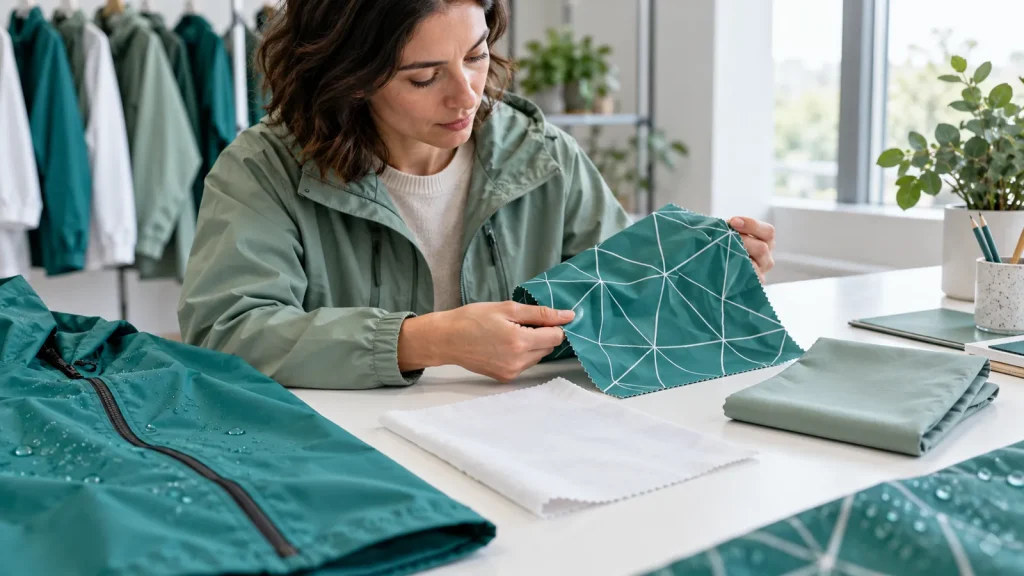
Separate print adhesion, colour transfer and rain protection
Print performance is not one single property. Adhesion concerns how the decoration remains attached to its surface. Colour transfer concerns whether colour moves onto another material during relevant contact. Rain protection concerns the garment's ability to perform its intended weather-related function. A sample can answer one question without answering the others. Define which aspects matter to your order and ask for an evaluation plan that addresses them separately. This prevents a convincing demonstration of one feature from being presented as proof that every aspect of the decorated rainwear is satisfactory.
For textile colour transfer, recognised methods have defined scopes. AATCC TM8 addresses colour transferred from coloured textile surfaces by rubbing, using dry and wet test cloth procedures. ISO 105-X12 also addresses rubbing fastness of textiles. These descriptions help a buyer ask a relevant question, but they are not instructions for an improvised test and do not establish universal applicability to every film poncho or tiny printed area. Ask a suitable laboratory or technical specialist to select the method and assess whether it suits the actual sample and feature being evaluated.
Adhesion needs its own agreed approach. Do not assume that a casual pull, scrape or tape demonstration is a standardised result. Ask the supplier what the procedure is intended to show, how the sample is prepared and what criterion defines acceptance. If a formal result is required, identify the method and sample construction in the report. If the exercise is an informal screening check, describe it honestly as such. Both can be useful within a project, but they should not be confused or presented to customers as equivalent evidence.
Rain protection should be reviewed at the level of the claim being made. A print that looks intact after getting wet does not by itself establish a waterproof rating for the finished garment. Likewise, a report for an undecorated material does not automatically resolve every question about a decorated construction. If the purchasing specification includes a performance requirement, ask the responsible technical reviewer whether the decoration process or location needs additional assessment. Keep the answer connected to the specific product and claim rather than making a broad statement that printing never affects rainwear performance.
Build a sample plan around realistic risks. A promotional poncho distributed for short use may raise different questions from a reusable staff rain jacket. Include the anticipated handling, contact, folding and care conditions in the brief. Let those conditions guide the technical discussion, rather than assembling a long list of unrelated tests because it appears more impressive. A smaller set of well-chosen evaluations tied to clear acceptance criteria is more useful for procurement than a large report collection that does not describe the finished product or its intended use.
Record what each piece of evidence can and cannot establish. The approval file should identify the sample, method, conditions, results and decision. Where a question remains open, keep it open rather than replacing it with a general claim such as tested quality. This discipline supports clearer communication with marketing and operations. The business can describe the product within the evidence it actually holds, while the supplier knows which requirements need to be met. It also makes later changes easier to assess because the team can see which part of the approval a new material or process might affect.
Review folding, storage and care with representative samples
The journey from printing table to wearer includes more than exposure to rain. Decorated rainwear may be folded into a pouch, held in cartons, transported to several locations and opened during a busy event. Reusable garments may also be cleaned and stored between uses. Tell the supplier about that journey and request representative samples. A sample kept flat in an office is useful for checking artwork, but it does not necessarily show how the proposed print and packaging behave together through the handling that matters to the order.
Start with the intended fold and individual pack. Ask the supplier to show which printed areas contact other parts of the garment or packaging. Review the opened sample for the agreed appearance and note any questions for technical assessment. If the buyer expects goods to remain packed for a particular period, include that expectation in the discussion. Do not invent an accelerated storage procedure or assume that a short warm-room experiment predicts every shipping condition. Agree any formal evaluation with people qualified to select suitable conditions for the materials and intended use.
Keep storage guidance specific and usable. Ask the supplier what conditions should be avoided for the finished decorated product and how the receiving team should handle cartons before distribution. The buyer should communicate those instructions to the people who actually manage stock. A care note buried in an artwork approval email is unlikely to help a warehouse colleague. Include relevant information in the product or logistics file, with a clear distinction between instructions from the responsible supplier and internal operating preferences adopted by the purchaser.
For reusable rainwear, examine the relationship between garment care and decoration care. The finished product needs coherent instructions that the user can follow. If a transfer's generic guidance differs from the raincoat's existing label, ask the suppliers responsible for the complete construction to resolve the issue. Do not choose whichever instruction is most convenient for the campaign. Where repeated cleaning is an intended requirement, specify it before approval and request appropriate evidence for the decorated sample. The outcome should support the actual use plan rather than a broad promise that the print will always remain unchanged.
Include ordinary handling in the sample review. Open the pack, put on the garment, fasten it, remove it and return it to the intended storage format where applicable. These steps can reveal a confusing fold, a hidden artwork variant or a design positioned in an inconvenient place. Record observations as product review findings, not laboratory results. If an issue appears, ask whether it is best addressed through artwork, placement, packing or a technical change. The solution may be simple, but it should be checked on a revised representative sample before being treated as resolved.
Preserve both a flat visual reference and a packed reference when the project warrants it. They answer different questions and help future receiving teams understand the accepted product. Label them clearly with the garment and artwork revision, and avoid using the only master sample for repeated demonstrations. When a complaint or repeat-order question arises, these references give the discussion a concrete starting point. The buyer can compare the observed condition with the approved arrangement and ask the supplier to investigate a specific difference, instead of debating a general impression of how the print looked before shipment.
Use test reports to answer specific approval questions
A useful test report should be traceable to the sample that matters to the purchasing decision. Check the product description, material or garment reference, decoration details and any sample identification photographs provided. A report for a plain fabric or a different print system may offer background information, but it should not silently become evidence for the current decorated rainwear. Ask the supplier to explain the relationship. If the connection is unclear, keep the requirement unresolved until the responsible technical reviewer confirms what the report actually supports.
Read the scope and conditions before focusing on the result. The method, preparation, exposure and assessment criteria determine what was evaluated. A report can be accurate and still answer a different question from the one in your brief. For example, a colour transfer evaluation does not automatically establish adhesion or overall garment rain protection. Match each requirement in the specification to the relevant evidence. This simple cross-check helps procurement avoid both overclaiming and unnecessary testing, because it shows where existing evidence is useful and where a genuine gap remains.
Distinguish a reported observation from a pass decision. Some reports provide results against a named method without deciding whether those results meet the buyer's intended use. The purchasing specification should state the agreed acceptance criterion, with technical advice where needed. Do not invent a pass threshold after seeing the result. If the supplier has used a different criterion, discuss it explicitly rather than assuming the word pass means the same thing to both parties. A clear agreement allows the technical reviewer to make a meaningful release recommendation.
Check whether the tested sample represents the proposed bulk construction. Artwork area, garment colour, surface finish and process changes can all be reasons to ask whether prior evidence remains relevant. This does not mean every small variation requires a full new test programme. It means the relationship should be assessed by someone qualified to judge it. Ask for a documented rationale when relying on an existing report. Procurement can then retain a defensible approval record rather than treating any document bearing a familiar material name as interchangeable with evidence for the order.
Keep document authenticity and scope separate. Confirming that a report came from its stated issuer does not expand what the report covers. Similarly, a supplier declaration and an independent laboratory report serve different purposes. Identify which form of evidence the requirement calls for and why. If a technical or legal claim will be used in marketing, involve the appropriate reviewer before publishing it. The buying team should not turn a narrow test result into a broad claim about certification, safety or lifetime durability merely because a report contains favourable language.
Create a short evidence summary for the final release. List each question, the document or sample reference that addresses it, the decision and any remaining limitation. This is more useful to a busy purchasing manager than a folder of unexplained attachments. Share the relevant conclusions with the brand and operations teams so their descriptions and handling plans remain consistent with the approved product. On the next order, review changes against that summary. It provides a clear starting point for deciding what can be retained and what needs fresh evaluation before custom printed rainwear returns to production.
Further guidance: AATCC TM8 colour transfer test scope, ISO 105-X12 rubbing fastness test scope.
Match the sample plan to the use model with our disposable versus reusable rain poncho buying guide. The intended handling and care help define which decoration questions need evidence.
09 / 12
Compare MOQ, print complexity and bulk production proposals

Ask how each design choice affects the quotation
A useful bulk printing quotation explains what is included in the finished product. Ask the supplier to identify the garment, artwork revision, decoration method, locations, dimensions and colour arrangement on which the offer is based. Include sampling, individual packaging and carton requirements in the same enquiry. This lets purchasing compare proposals without assuming that a short phrase such as custom logo included covers every design choice. The objective is a clear commercial scope, not a public unit-price comparison that hides the details responsible for the difference between two offers.
Ask how MOQ applies to the proposed assortment. A total order quantity may be divided among garment colours, sizes and artwork versions in ways that change the supplier's production plan. Request an explanation of any minimum associated with a particular design, material colour or packaging option. If the project falls outside the proposed arrangement, ask for alternatives that preserve the important requirements. Combining artwork versions, using an available garment colour or revising the pack may be worth discussing, but each option should be evaluated against the campaign's actual purpose.
Separate one-time preparation from repeat production considerations. The supplier may need to review files, prepare decoration materials or develop a sample before the bulk run. Ask which activities are included, which depend on the final artwork and what changes on a repeat order. Do not assume that every preparation element can be reused indefinitely or that a familiar logo eliminates the need for product-specific checks. The relevant commercial question is what the current proposal includes and which assumptions must remain true for that proposal to apply.
Discuss print area and complexity together. Two designs with the same number of visible colours can require different work because their dimensions, fine detail, locations or garment access differ. Ask the supplier to identify the main drivers in the specific proposal rather than offering a generic explanation that every added colour has the same effect. This helps the brand team understand which adjustments are worth exploring. A smaller motif, a different location or an approved simplified version may offer a practical alternative, but the revised result still needs clear approval.
Keep quoted alternatives separate from the baseline. If one offer uses direct screen printing and another uses a transfer, request comparable samples and a description of any difference in appearance, handling or evidence. If the garment construction also changes, show that explicitly. Otherwise the team may attribute a commercial difference to the printing method when it actually comes from a different raincoat. A comparison sheet should make the whole finished product visible, including packaging and approval work, so the decision reflects the proposed order rather than a single attractive headline.
Before accepting Bulk Pricing, reconcile the quotation with the latest variant matrix. Check quantities, artwork references, delivery assumptions and any exclusions. Ask the supplier to confirm the effect of unresolved decisions instead of treating them as minor details to be settled later. The purchasing manager can then make a deliberate commitment with the brand and technical teams' approvals in place. This approach supports a clearer OEM Program because the commercial agreement describes the same decorated rainwear that was sampled, reviewed and approved for the intended users.
Compare screen print and transfer offers on equal terms
Comparing screen printing and heat transfer is easier when the finished product requirement stays constant. Give both proposals the same garment reference, artwork, dimensions, locations, quantity matrix and intended use. Ask the supplier to identify any changes necessary for its suggested method. Without that common basis, a cheaper or faster offer may simply describe a simpler design or a different construction. The buyer needs to understand whether the comparison reflects a genuine process choice or a broader change to the product being purchased.
Use a comparison sheet that combines commercial and practical questions. Include artwork fidelity, approved colour appearance, local feel, access to the chosen location, sample evidence, packaging and repeat-order considerations. Avoid assigning automatic advantages to either method. A particular transfer may reproduce an accepted design well on one jacket, while a screen print may suit a repeated emblem on another construction. The sample and specification should decide the result. General descriptions can guide the initial discussion, but they should not replace evaluation of the actual proposals on the rainwear in question.
Compare the approval workload as well as production. One proposal may require an artwork adaptation or an additional material trial before it can be released. That work belongs in the purchasing plan. Ask when the supplier can provide the relevant sample and what the buyer must approve at each stage. A short production estimate is not necessarily a short path to usable goods if it excludes unresolved development. Keep the sequence visible so the team understands the full route from enquiry to approved decoration, finished packing and delivery to the intended location.
Review the consequences of variation across the order. If several garment colours or styles are involved, ask whether the proposed method can use one common arrangement or requires separate product-specific approvals. A method that is convenient for the main variant may be less practical for a small secondary group. Consider whether the programme should use one consistent visual identity with more than one decoration route, provided the differences are approved. Consistency for the wearer does not always mean identical manufacturing instructions for every item in a mixed rainwear assortment.
Consider repeat orders without assuming future demand is guaranteed. Ask what records and samples the supplier will retain, how a repeat quotation will be checked against the approved product and which changes would trigger a fresh trial. A proposal with clear repeat controls can be valuable to a brand that expects to reorder, but it should still stand on the current order's requirements. Do not commit to an unsuitable design solely because someone suggests it will be easier later. The first order needs to meet the present brief and establish a reliable reference.
Make the final selection with a short written rationale. State which proposal was chosen, which requirements it meets and any conditions attached to the approval. Record why an alternative was not selected in factual terms, such as an unresolved material trial or an unaccepted appearance difference. This helps future colleagues understand the decision without turning it into a permanent rule that one printing method is always superior. When the next project uses another garment or graphic, the team can revisit the comparison intelligently instead of repeating an old choice by habit.
Protect the production timeline when the artwork changes
Artwork changes need to be managed against the production stage they affect. A revision made during early design discussion is different from one received after preparation or printing has begun. Ask the supplier to identify the approval milestones and the point at which a change may alter the plan. The buyer should share these milestones with sponsors and internal stakeholders. A clear release process helps people understand that a new logo file is a production instruction with consequences, rather than an informal attachment that can replace the previous version at any time.
Build the timeline backwards from usable stock. Include artwork review, material compatibility work, decorated sample approval, bulk production, packing, transport and receiving. Ask which activities can overlap and which depend on a completed decision. Do not assume that a supplier's production estimate includes every approval round or the final delivery route. Keep those assumptions explicit. This gives procurement a realistic way to discuss a fixed event date while avoiding an unsupported promise that a late design change can always be absorbed without affecting the rest of the order.
When a change arrives, describe it completely. Identify the old and new artwork revisions, the affected variants and the reason for the revision. Ask the supplier which work has already been completed and what would need to be repeated or checked. A change in wording, print area or colour arrangement can have different implications. The buyer does not need to predict every technical consequence, but should give the supplier enough information to assess it. Avoid asking whether a change is possible before showing the exact file and scope.
Evaluate alternatives without losing control of the requirement. If the original request cannot fit the remaining plan, a smaller change or a revised allocation may be worth discussing. Keep the brand owner involved in deciding whether an alternative is acceptable. Do not let urgency lead the supplier to improvise a substitute logo or remove a required element. Procurement can coordinate the options, document their consequences and obtain one clear decision. That protects the campaign identity while allowing the team to respond practically to a constraint that has become real.
Use a release hold when a decision is genuinely unresolved, but define its scope. The supplier should know whether the hold applies to artwork preparation, decoration, packing or only a particular variant. An unclear message asking everyone to wait can disrupt unaffected work, while an overly narrow hold can allow the wrong version to proceed. Confirm the status in writing and identify who can release the next stage. This is especially useful in a mixed order where one sponsor changes its identity while other approved variants remain ready for production.
After the decision, update the complete current package and confirm receipt. Replace superseded files in the release set, update the variant matrix and record the revised timeline or conditions. At receiving, make sure the team knows which version to expect in each allocation. A well-managed change should leave a clear trail from request to accepted result. The next order can then use the final as-produced reference, instead of repeating the confusion caused by an old file that happened to remain attached to the original purchase enquiry.
For supplier checks and the wider OEM purchase, read our guide to sourcing rainwear from China for procurement managers and connect the printing proposal with your product specification and import plan.
10 / 12
Keep branded rainwear consistent from sampling to delivery
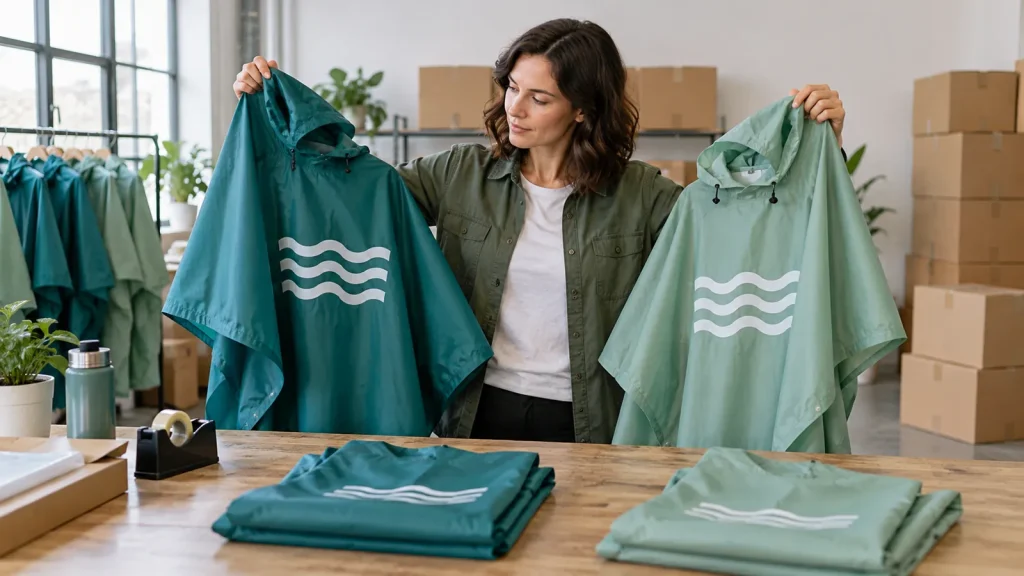
Approve a decorated reference before releasing bulk work
A decorated reference connects the design brief with the product the supplier is asked to reproduce. It should represent the agreed garment, printable surface, artwork revision, size, placement and decoration route. A catalogue photograph or a previous customer's sample can help an early discussion, but it does not replace this project-specific reference. Before releasing bulk work, confirm which sample is being approved and what the approval covers. If the sample differs from the proposed production construction, record the difference and resolve its significance with the responsible technical and brand reviewers.
Review the reference in a structured order. Confirm the garment identity and artwork content first, then dimensions and placement, followed by colour and appearance. Check the agreed handling or performance evidence separately. This order prevents the team from spending a meeting discussing a subtle shade difference before noticing that the wrong logo revision has been used. Give each reviewer the part of the decision they own and collect the results in one record. Procurement can then issue a clear release rather than forwarding a series of partially conflicting comments to the supplier.
Make conditional decisions precise. If the sample is accepted for layout but another check remains open, state that bulk decoration is not yet released unless the agreed process explicitly permits a limited next step. Identify the outstanding question, the evidence needed and the person responsible for closing it. This protects the supplier from interpreting enthusiasm about the appearance as full approval. It also helps the buyer manage time, because the unresolved requirement is visible and can be followed up directly instead of disappearing inside a long sample feedback message.
Retain a suitable master reference and distinguish it from working samples. The master should be identifiable by project, garment and artwork revision, with its approval status recorded. If the buyer and supplier each keep a reference, confirm that they represent the same accepted result. Do not assume two samples from different rounds are equivalent merely because both carry the same logo. Where practical, use photographs and measurements to supplement the physical reference, but recognise that they may not replace it for colour, feel or other appearance decisions important to the order.
Include a packed reference when folding and presentation are relevant. The decorated garment and its individual pack form one delivered item, and their relationship should be approved together. Check that the artwork variant can be identified and that the proposed fold matches the agreed arrangement. If packaging will differ across destinations, record the relevant version for each allocation. This helps the receiving team assess the goods without asking whether an unfamiliar pack is a production mistake or an alternative that somebody approved separately during the project.
Issue the final release with a concise list of controlled references. Name the current specification, artwork, placement drawing, approved sample and any supporting evidence. Confirm the quantity matrix and the next agreed production checkpoint. The release should be clear enough for a colleague to understand what was authorised without reading the entire project history. It gives the supplier a stable instruction and gives the buyer a fair basis for later inspection. Most importantly, it ensures that the bulk order begins from an accepted finished result rather than a collection of assumptions that different teams interpret differently.
Check the first production output and manage variation
The first production output provides an opportunity to confirm that the approved result has been translated into the bulk process. Agree this checkpoint before production begins, especially where the artwork, garment or decoration route is new to the project. Ask what evidence the supplier will provide and who will review it. The checkpoint should have a clear purpose: confirm the current references, inspect the relevant features and resolve any difference before the remaining work proceeds under the agreed plan. It should not become an undefined additional design round.
Compare the output with the approved specification and sample. Check the artwork revision, dimensions, placement, colour arrangement and relevant appearance features. Verify that the correct garment and surface are being used. If the order includes several variants, agree which combinations need review rather than assuming the first item represents all of them. The technical and quality teams should help choose a proportionate inspection approach. Procurement's role is to ensure that the chosen checkpoints address the actual order and that the results are recorded in a form the release owner can use.
Distinguish normal agreed variation from a change in the product. A print that falls within the defined tolerance should not be rejected solely because a reviewer prefers another position. A different artwork file or unapproved substrate, however, is not merely a small visual variation. Use the acceptance references to keep those discussions fair. When a concern appears, describe the observed feature and its relationship to the agreed requirement. This helps the supplier investigate the issue instead of trying to respond to a broad statement that the batch does not look like the sample.
Define how affected work will be identified and held during review. The supplier should be able to distinguish material awaiting a decision from accepted output and from goods already packed. Ask for traceable information about the relevant variant and production stage. Do not assume that every issue affects the entire order, but do not minimise its scope without evidence either. The quality team can investigate how far the problem extends and propose corrective action. The buyer can then make a decision based on the specific findings and the agreed product requirements.
Verify corrective work before closing the issue. A statement that the operator has adjusted the process is not the same as evidence that the finished result now meets the specification. Request an appropriate revised sample, inspection result or other agreed confirmation. Keep the original concern and its resolution in the project record. This is useful for repeat orders because it preserves what the team learned about the process. It also prevents a later reviewer from reopening a resolved question simply because the reasoning and accepted correction were never documented.
Use production feedback to improve control without changing the approved design informally. If the supplier identifies a more workable placement or artwork adjustment, review it through the same change process used before release. A practical suggestion can be valuable, but it should not become an unapproved modification applied to the remaining quantity. The aim of production quality control is to deliver the agreed product consistently and to make any necessary change deliberate. That keeps the brand identity, technical requirements and commercial order aligned from the first decorated item to the final packed carton.
Pack, identify and receive each artwork variant correctly
Correct decoration can still lead to a disappointing delivery when variants are packed or identified poorly. Start with the order matrix and confirm how each finished item will be recognised during packing and receiving. Use a stable reference for the garment, colour, size and artwork version. Ask the supplier to show the proposed individual label and carton identification where relevant. The receiving team should be able to match the goods to an allocation without relying on a small logo visible through several layers of folded material and packaging.
Agree the carton assortment explicitly. Some projects need single-variant cartons for quick distribution, while others need a defined mix for each destination. Record the chosen arrangement and reconcile it with the quantity matrix. A shipment can contain the right total number of garments yet still create avoidable work if the distribution pattern is wrong. Involve the warehouse or event team before confirming the packing proposal. Their input can reveal a practical requirement that the brand team would not notice when reviewing the decorated garment by itself.
Check the folded presentation against the approved packed sample. The supplier should use the agreed arrangement and any relevant handling guidance for the decorated product. If a different fold is proposed to fit a package, review it rather than treating it as a purely logistical change. The new fold may affect which artwork is visible or how printed areas contact other surfaces. Ask the technical reviewer whether further assessment is needed. This connects packing with the original decoration approval and avoids leaving the final presentation to an improvised decision at the end of production.
Prepare the receiving checklist before the shipment arrives. Include carton counts, variant identification, assortment and representative checks of the decorated goods against the current references. Decide who reviews a visual discrepancy and how affected items will be held while the issue is assessed. Do not ask an unbriefed warehouse colleague to decide whether a colour difference is acceptable under the brand standard. Give them a clear process for recording observations and escalating them to the person who owns that decision, with suitable samples and photographs where helpful.
If a discrepancy appears, preserve useful evidence. Record the carton reference, artwork variant, quantity affected as far as known, and the observed condition. Keep representative samples available for the supplier or technical reviewer. Avoid immediately attributing the problem to printing, packing or transport before the evidence supports that conclusion. A clear report helps the supplier investigate the actual issue and reduces repeated requests for missing information. It also allows the buyer to distinguish an isolated allocation error from a product concern that may affect a broader part of the shipment.
After receiving is complete, close the order with a short review. Note whether the branding, packing and distribution arrangements worked as intended and identify any improvements for the next purchase. Keep the accepted as-delivered references with the project file. An OEM Program becomes easier to manage when each order leaves a usable record of what was supplied, how it was checked and what should change next time. That record supports consistent repeat orders while allowing the business to improve its rainwear design and logistics based on real operational feedback.
11 / 12
Adapt rainwear branding to festivals, work teams and repeat programs
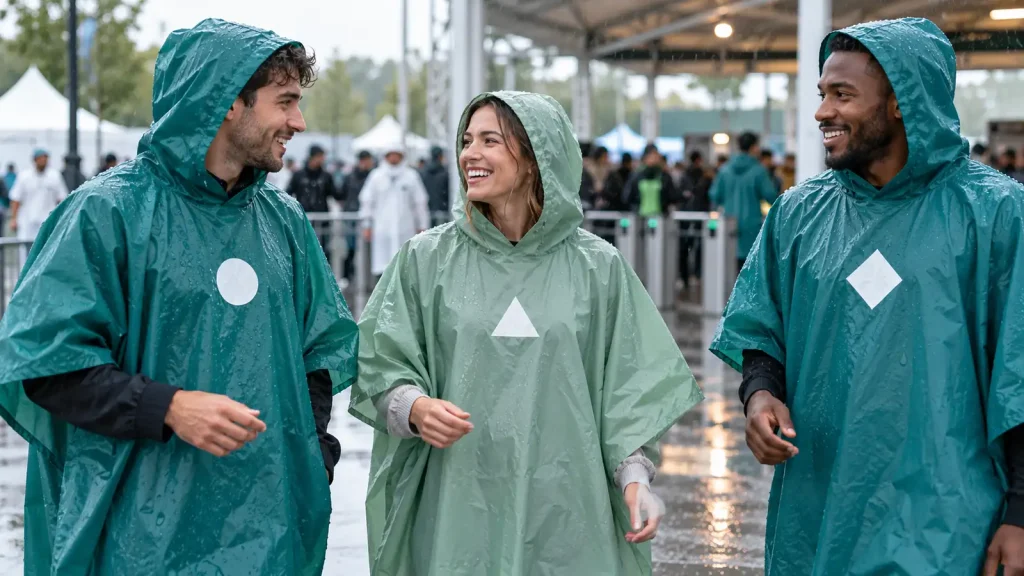
Balance sponsor recognition with a usable festival design
Festival rainwear has two immediate jobs: provide the intended rain protection and carry an identity that makes sense in a crowded outdoor setting. Start by defining which sponsor or event mark should be recognised first. A garment covered with competing small logos may satisfy individual requests while making the overall message harder to understand. Bring the event organiser and relevant brand owners into the layout decision early. Procurement can then ask suppliers to assess a coherent design instead of repeatedly sampling arrangements that change whenever another stakeholder reviews the project.
Discuss the audience and distribution plan alongside the artwork. Attendee ponchos, volunteer rainwear and crew jackets may need different visual treatments even within one event. A staff identity might help visitors find assistance, while an attendee design might focus on the event or sponsor. Keep these purposes distinct in the variant matrix and packaging plan. If colours or marks help identify roles, confirm that the arrangement is practical for the event team. Do not assume that a decorative choice automatically provides a safety function or a reliable operational identification system.
Review the graphic on the proposed garment in a realistic setting. The hood, loose fit and clothing underneath can affect what people see. A large back mark may be partly covered by a backpack, and a chest mark may be interrupted by a strap or event pass. Identify which views matter most to the sponsorship brief and make the trade-off explicit. The goal is a useful, recognisable design within the garment's practical limits. Avoid promising a particular number of impressions or a commercial return that the sample and purchasing brief cannot establish.
Manage sponsor approvals as part of the production timeline. Collect the correct logo files, approved colour versions and any required wording before the decorated sample is released. If a sponsor joins late, ask whether the design and order can be revised without compromising the agreed process. A separate packaging element may be an option to discuss, but it should not be presented as equivalent without the organiser's approval. Keep the commercial sponsorship decision with the responsible people and make sure the supplier receives one clear production instruction for each accepted variant.
Think about the garment after the event where reuse is part of the brief. A design without a large date or a very specific campaign message may be easier for the organisation to use again, but that is a planning choice rather than proof of an environmental benefit. Ask whether the intended users and operations team actually have a reuse plan. If they do, connect the artwork, garment construction and care expectations with that plan. The purchasing decision should support a practical use case instead of relying on an attractive claim about keepsake value that nobody has assessed.
Finish with a festival-specific approval package: role and quantity allocation, final sponsor hierarchy, garment and decoration references, packed presentation and distribution identifiers. Keep the visual design tied to those operational details. If the event team changes a gate allocation or role colour, review the affected labels and carton plan as well as the garment artwork. This gives the supplier a stable brief and helps the organiser receive rainwear that can be distributed efficiently. The best branding decision is one that remains clear from the first sponsor discussion through to the moment someone opens the pack in wet weather.
Coordinate corporate and outdoor workwear identities
Corporate rainwear often needs to fit an existing visual identity rather than stand alone as an event item. Ask the brand team which garment references, colours and logo treatments already guide the organisation's uniform programme. Then assess how those requirements translate to the proposed rainwear construction. A mark that works on a polo shirt may need a different size or placement on a rain jacket. Keep the identity recognisable while allowing the technical review to address the material, garment access and finished appearance of the new product.
Distinguish ordinary corporate branding from requirements connected with occupational use. If a garment is selected for a protective function, the relevant safety or technical reviewer should assess the decorated construction and any implications of the proposed location. Do not allow the brand team to assume that every area is available for a logo. Conversely, do not invent a universal prohibition that prevents sensible discussion. Ask the supplier and responsible specialist to identify the appropriate boundaries for the exact garment and intended claim, then show those boundaries clearly on the placement drawing.
Coordinate the identity across job roles and garment styles. A business may use different rainwear for visitors, delivery teams and staff working outdoors. One shared artwork master can support a coherent appearance, while each construction has its own decoration reference. Record which version belongs to which role and location. This avoids a common purchasing problem in which a familiar logo becomes the only identifier and several technically different garments are treated as interchangeable. Operations should be able to order and receive the correct item without relying on a photograph of the branding alone.
Discuss role names or departmental text carefully. Such information can help an organisation identify staff, but it adds artwork variants and may become outdated when teams change. Ask whether a shared corporate mark plus another identification method would better suit the programme. If text is printed, confirm the wording and final size with the responsible department. Check its readability on a worn garment and keep the spelling approval separate from the technical printing approval. The supplier should not be expected to verify the organisation's internal job titles or determine which abbreviation is appropriate.
Plan care and replacement in the context of the complete uniform programme. If garments are cleaned centrally or issued for repeated use, include those expectations before selecting the decoration method. Ask the technical team to reconcile the rainwear and print requirements into coherent care instructions. For replacement orders, confirm whether matching the retained visual reference or adopting an updated corporate identity has priority. A procurement manager can then manage the transition deliberately instead of receiving a mixture of versions that individual departments interpret as inconsistent production.
Keep a programme register that links approved garments, artwork and purchasing references. Include the current sample identifiers, relevant evidence and the person authorised to approve changes. This makes it easier for regional buyers to follow the same standards without repeating the entire development process. It also allows improvements to be reviewed properly. If a new jacket construction is proposed, the team can retain the brand identity while checking the new material and application. Consistency comes from a controlled relationship between the design and product, not from applying an old printing instruction indiscriminately to every piece of outdoor gear.
Keep repeat orders recognisable without freezing useful improvements
A repeat rainwear order should begin with a comparison against the last accepted product. Retrieve the artwork revision, garment specification, decoration reference, sample and receiving feedback. Ask the supplier whether the proposed repeat uses the same construction and process or includes any changes. The phrase same as before is convenient but incomplete. It may conceal a new material source, a different garment finish or a revised transfer. Establishing the actual proposal gives the buyer a sound basis for deciding which approvals can be retained and which questions need fresh review.
Separate brand continuity from technical continuity. The organisation may want the same visible identity while accepting a better-suited garment or process. That can be a sensible improvement, but it should be managed as a revised product with a new reference. Compare the appearance with the retained sample and assess the relevant technical evidence for the changed construction. Do not assume that an improvement in one aspect automatically preserves every other requirement. A revised raincoat may alter available print space, folding, feel or the way the logo appears when worn.
Use receiving and user feedback to identify worthwhile changes. Perhaps the previous mark was difficult to see under a backpack, two variants were hard to distinguish in their packs or a department found the chosen placement too prominent. Record these observations in concrete terms and ask whether artwork, position, packaging or garment selection offers the best response. Avoid turning a single personal preference into a programme-wide requirement without checking its relevance. The purchasing team should connect improvements to recurring operational needs and the organisation's brand priorities.
Plan identity transitions explicitly. If the company has refreshed its logo, decide whether all new purchases should use the revised version and how existing stock will be managed. The supplier needs a clear effective revision for each order, and receiving teams need to know which version is expected. Do not let old and new files circulate in the same release package without identifying their purpose. A transition can be orderly even when the organisation uses remaining stock, provided the purchasing and brand teams agree the approach and communicate it consistently.
Review the quantity and variant structure again rather than copying it automatically. Demand may have shifted among roles, garment sizes or destinations. Ask how the updated assortment affects MOQ, sampling and Bulk Pricing. A repeat design does not make a new quantity matrix identical to the old one. Keep the commercial offer linked to the current demand and approval work. This allows the business to benefit from retained knowledge while still treating the new order as a specific commitment with its own product, quantity and delivery requirements.
Close each repeat with an updated as-produced record. Preserve the earlier reference so the history remains understandable, but make the current approved version easy to identify. Summarise any improvement and the evidence supporting it. Over time, this creates a practical body of product knowledge for the OEM Program. New colleagues can see why the decoration sits where it does, which material was assessed and how the packing arrangement developed. The programme stays recognisable to its users while remaining open to deliberate, useful improvements rather than becoming trapped by a vague instruction to reproduce an old sample forever.
Planning an outdoor event? Explore our Wholesale Festival Rain Poncho Collection Here. For occupational purchasing, use our industrial rainwear specification guide to keep branding within the complete product review.
12 / 12
B2B FAQ: choosing and approving custom printed rainwear
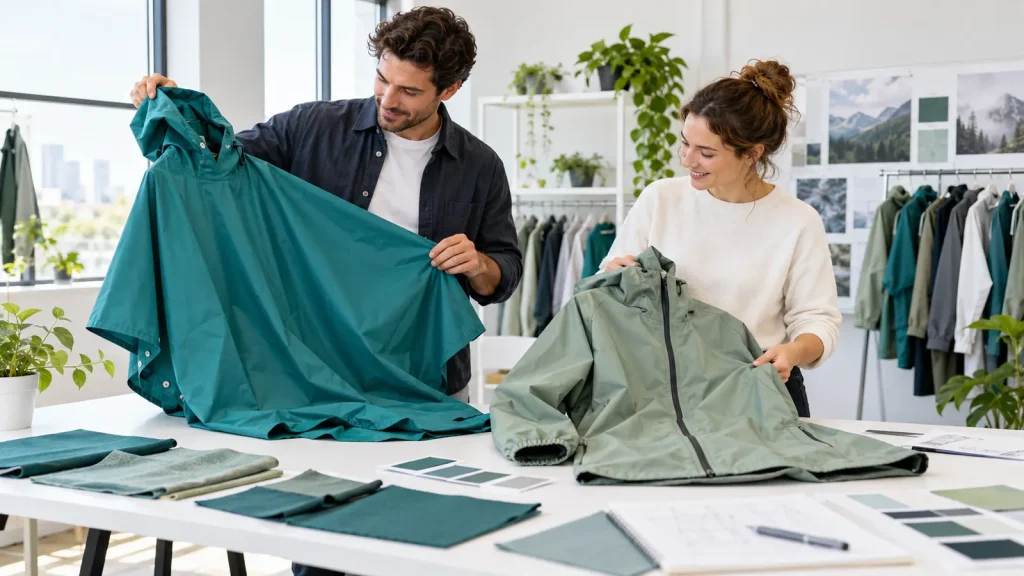
Is screen printing or heat transfer better for raincoats?
Neither method is automatically better for every raincoat. The right starting point is the actual garment surface, artwork and intended use. Ask the supplier to propose a decoration route for that combination and show a representative sample. Screen printing and heat transfer can produce different appearance and handling results, and each proposal has its own preparation and application requirements. A procurement decision should compare those real proposals against a shared specification. Choosing solely from a method name can overlook the material and construction details that determine whether the finished product is suitable.
For a simple repeated emblem, begin by asking how screen printing would be arranged on the chosen garment. For a detailed graphic or another design requirement, ask what transfer construction the supplier proposes and how it will be applied. These are enquiry starting points, not fixed rules. The supplier may recommend another route after reviewing the surface, print location and quantity. Request an explanation of the recommendation and any artwork adaptation. That lets your technical and brand colleagues assess whether the proposal solves the original problem without silently changing the result they expected.
Use the same comparison brief for both options. Include garment style, colour, printable face, graphic dimensions, location, quantity matrix, packaging and use conditions. Ask each proposal to identify its sample work and approval requirements. If one offer assumes a different material or simplified design, list that as a separate alternative. Otherwise the purchasing team risks comparing unlike products and attributing the difference to printing alone. A common brief makes the discussion more transparent and allows Bulk Pricing to be reviewed in the context of the whole finished item.
Judge samples in several ways. Check the artwork and colour against the approved references, examine the surrounding garment, and review the design while worn and packed. Ask for relevant technical evidence where the intended use requires it. Keep informal handling observations distinct from formal test results. A method should not be selected because a dramatic demonstration looks persuasive if it does not address the actual requirement. Equally, a well-chosen sample review can resolve many visual and practical questions without pretending that every purchasing decision requires the same extensive testing programme.
Consider the approval and production sequence. Ask what must be completed before bulk work can begin and what a later artwork change would affect. A route that appears straightforward for one design may need additional work for another garment colour or print position. Include those dependencies in the project plan, especially for a fixed event date. The supplier's proposal should make clear which timing assumptions depend on buyer decisions. This gives procurement a fairer comparison than choosing the shortest isolated production estimate while ignoring unresolved sampling or artwork preparation.
Record the selected option as a product-specific decision. State the accepted garment, artwork revision, process reference and sample, with any conditions. Do not turn that choice into a rule that the same method must be used on all future rainwear. A different material, style or campaign may justify another approach. Retaining the reasoning is more valuable than retaining only the method name: the next buyer can understand what was assessed, recognise which assumptions have changed and request a suitable new proposal without starting from either blind confidence or unnecessary uncertainty.
Can a logo print stay durable without affecting rain protection?
A decorated rainwear product can be assessed for the durability and garment performance required by its intended use, but no generic method name guarantees that result. The supplier needs to evaluate the proposed decoration on the actual construction. Define what durable means for the order: expected handling, folding, contact and care where relevant. Then ask the technical reviewer what evidence is appropriate. Keep rain protection as a separate requirement, because a visually intact logo after a splash is not by itself proof of the finished garment's weather performance.
Start with the surface and location. The same artwork applied to a different finish, garment layer or structural area may raise a different question. Ask whether the decoration route changes the surrounding material or interacts with seams, closures or other features. Review a representative finished sample, not only an isolated printed swatch. A swatch can be useful during development, but the garment shows the actual placement and construction. If the product carries a particular performance claim, involve the person responsible for that claim before approving the decorated version for bulk production.
Separate appearance from evidence of endurance. Colour, edge quality and placement can be assessed against an approved reference. Adhesion, colour transfer and response to relevant care conditions may need other agreed evaluations. Ask for the method, sample identity and acceptance criterion where a formal test is required. Do not accept the word tested without understanding what was tested. At the same time, avoid applying a textile method to a film product or a tiny graphic without technical advice about suitability. The evaluation needs to answer the specific question that matters to the purchasing decision.
Include the product's storage and packing journey. A logo may sit across a fold or contact another surface inside a compact pack. Ask for a packed decorated reference and discuss the intended storage period and conditions. If the supplier provides handling guidance, make sure the warehouse and distribution teams receive it. This is part of delivering the approved product in the intended condition. It also keeps a later problem from being assessed only as a printing issue when the evidence may require review of packing, storage, transport or several interacting factors.
For reusable garments, resolve care instructions at the finished-product level. The garment's requirements and the decoration system's guidance need to form a coherent set of instructions. Ask the responsible suppliers and technical reviewer to address any conflict before release. If repeated cleaning is important, put that in the original brief and request suitable evidence. Do not add a broad washability or lifetime claim because another product using a similar transfer has made one. The accepted statement should remain within the scope of the construction and evidence actually reviewed for the order.
The practical answer is therefore a controlled approval process rather than an unconditional promise. Identify the product, assess a representative decorated sample, review the relevant evidence and retain the approved references. If a supplier proposes a change, ask which part of that approval needs to be reconsidered. This approach gives procurement a useful way to protect both branding and garment function. It also gives marketing a clear basis for describing the finished rainwear accurately, without stretching a favourable sample or narrow test result into a claim that covers every possible condition of use.
What should a buyer send to request an OEM printing proposal?
Send a concise project brief with enough detail to describe the finished item and the decisions still open. Begin with the intended wearer, use setting, destination and required delivery outcome. Add the preferred garment construction or the options you want to compare. If you already have a product reference, identify it clearly and explain whether the supplier must match it or can suggest alternatives. This gives the enquiry a useful direction without forcing the decorator to guess whether the request concerns a lightweight event poncho, reusable corporate rainwear or another construction.
Attach the approved artwork master and a readable proof. State the finished graphic dimensions, proposed locations and the colour reference that should guide sampling. If the design is not yet final, mark its status and explain which elements may change. Ask the supplier what file format it requires and whether the artwork needs adaptation for the proposed process. Keep that technical review separate from brand approval. The supplier can recommend a workable interpretation, but the buyer should confirm any change to identity, wording or visual hierarchy with the people authorised to make that decision.
Provide a quantity matrix rather than only an overall total. Show garment colours, sizes, artwork variants, packaging versions and destination allocations where known. Distinguish confirmed demand from comparison scenarios. Ask how MOQ applies and request Bulk Pricing against clearly identified alternatives if necessary. Include any preferred individual pack or carton arrangement, especially where fast event distribution or multiple locations are involved. A supplier can then explain its assumptions and identify which choices affect the offer, instead of preparing a quotation for a simpler assortment than the business actually needs.
Describe the approval evidence you expect, or ask for a proposed plan if it has not yet been defined. Include decorated sampling, colour and placement review, relevant durability or performance questions, packed presentation and the first production checkpoint. Avoid demanding unexplained certificates or a generic list of tests. State the requirement and let the responsible technical reviewers identify suitable evidence for the product. This makes the enquiry easier to answer and helps distinguish a supplier that understands the project from one that merely returns a broad assurance that custom printing is available.
Use a short request structure your team can repeat: project and intended use; garment and surface; quantity and variants; artwork and placement; sample and evidence requirements; packaging and destination; approval contacts and delivery outcome. Ask the supplier to identify assumptions, exclusions and alternatives separately. For example, a hypothetical agency could request one shared event graphic on two garment colours, with a specific packed identification method and an agreed sample review before release. The exact MOQ, process availability and timing would remain matters for the supplier's current proposal and the buyer's acceptance.
Nominate one contact to consolidate the response. That person can gather the brand, technical and operations decisions, resolve conflicting comments and issue the current approved package. Keep the enquiry and quotation linked to the same revision references throughout the project. Once a proposal has passed the agreed checks, confirm the specification and release conditions in writing. This gives the OEM Program a clear starting point and turns a general request for custom logo printing on raincoats into an actionable purchasing discussion, with fewer assumptions for the supplier and a more useful basis for the buyer's decision.
Return to the wholesale rainwear sourcing, branding and logistics guide to bring the approved decoration, packaging and delivery requirements into one purchasing plan.