
Nylon and ripstop - Construction, evidence and buying decisions
Nylon and Ripstop Rain Ponchos: Fabric, Coating and Durability
Choose a nylon rain poncho by separating the fiber, weave, coating and finished garment. This buying guide connects ripstop construction with evidence, fit, care, branding and a practical wholesale approval process.
Identify the complete construction, review representative samples and approve the garment, instructions and kit together.
From fabric names to an approved nylon poncho order
- 1. Define the useIdentify adult users, clothing, carried bags and destination.
- 2. Identify constructionSeparate fiber, weave, coating and seam details.
- 3. Review evidence and fitMatch reports to samples; inspect the finished garment.
- 4. Approve the complete kitReview branding, care, drying, pouch and distribution.
- 5. Release and controlAlign the specification, sample, quotation and receiving checks.
Unresolved checks return to sample revision. A construction change returns to the affected evidence, fit, care or packing decision before release.
| Question | What to request | Decision to preserve |
|---|---|---|
| What is nylon and what is ripstop? | Confirmed fiber and weave separately | Actual material identity |
| What provides rain resistance? | Coating, seams and applicable evidence | Specific supported performance wording |
| Will the garment suit users? | Adult fit, movement and carrying review | Intended-use scope and dimensions |
| Will the program work? | Care, packing, branding and current quotation | Approved complete kit and release references |
01 / 12
Separate nylon fibers from ripstop construction
Read the material description in three parts
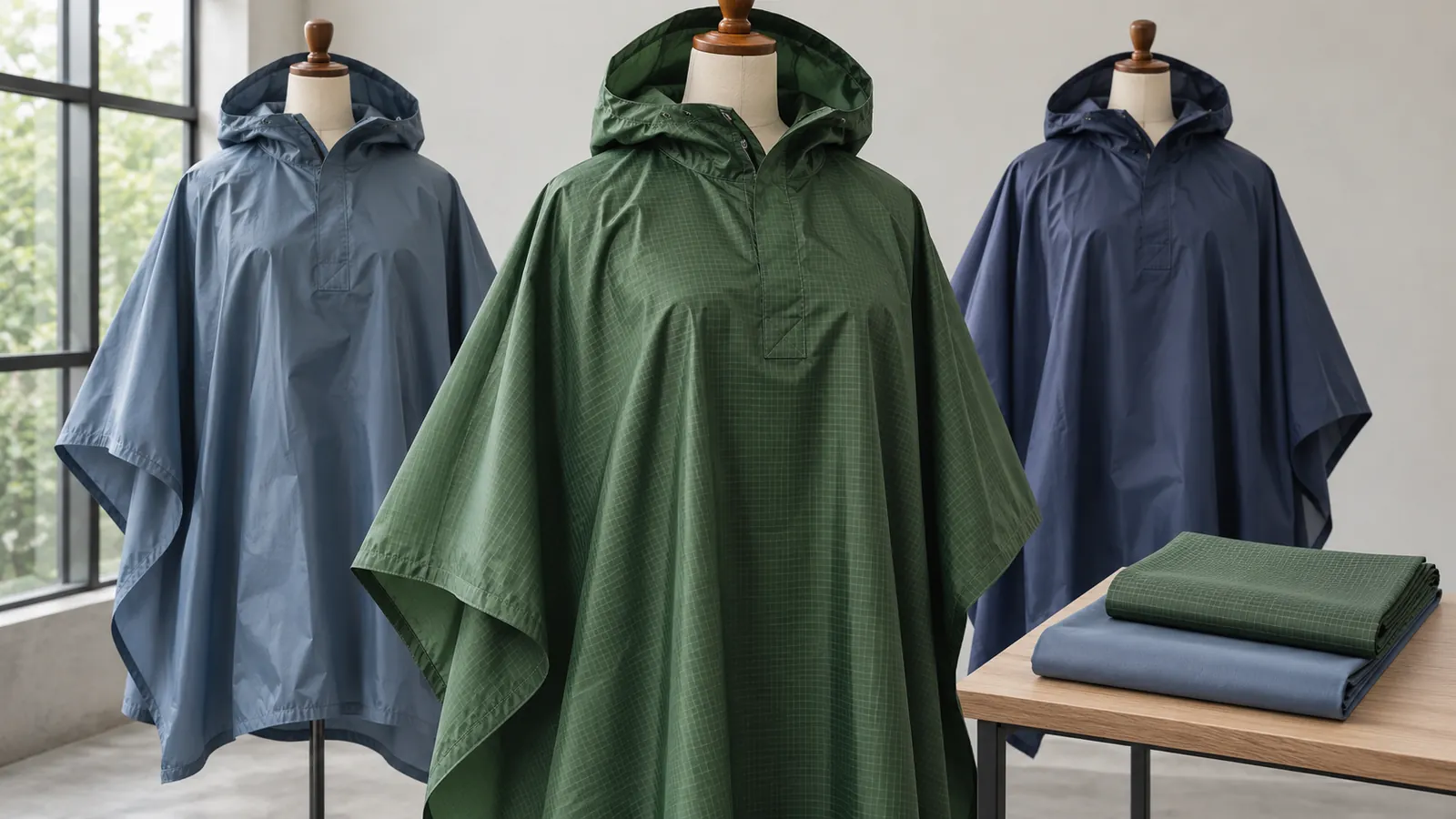
A nylon rain poncho description should answer three separate questions: what the main textile is made from, how that textile is constructed, and what makes the finished assembly suitable for the intended rain exposure. Nylon identifies a fiber family. Ripstop describes a reinforcing arrangement in a fabric. Neither word, on its own, identifies the complete water barrier, seam treatment or garment coverage. A buyer who puts all three questions into the first enquiry will receive a more useful answer than one who asks only for a waterproof nylon poncho at the lowest price.
Start with a component description. Ask the supplier to identify the shell fabric, any coating or laminate, and any different material used for reinforcement, hood details or a storage pouch. Keep the main shell separate from accessories in the specification. A nylon shell supplied with a different pouch fabric is not necessarily a problem; an undisclosed substitution is a problem because the approved reference becomes unclear. Where the offer uses a general term such as coated fabric, request the available construction information and mark any unresolved details before comparing quotations.
Next, describe the weave without turning appearance into a performance result. The visible grid on a ripstop poncho may be useful for identifying the intended construction, but a photograph cannot establish fiber identity, coating chemistry or a tear result. A plain-looking nylon fabric may also be proposed for a practical rainwear design. Compare the actual offered assemblies against the purchasing brief. Avoid making the visual presence of squares a compulsory requirement unless that construction or appearance serves a defined need in the program.
Finally, connect the material to the garment. Identify whether the offer includes stitched joins, treated seams, a hood, side closures and a separate bag. Request a finished sample that represents these details. A loose fabric cutting is helpful for examining color and surface feel, but it cannot demonstrate how a hood turns with the head or how the side opening behaves during walking. Keep the swatch and finished sample under related reference numbers so the material reviewed by procurement remains connected to the item reviewed by users.
Consider a hypothetical visitor program comparing two quotations described as nylon ripstop. One includes a specified coated shell, a seam treatment description and an approved pouch; the other lists only a fabric nickname. The first quotation is easier to assess, but that does not prove it performs better. The next action is to request missing information from the second supplier and review equivalent samples. Price comparison becomes meaningful only after the team understands which construction, accessories and evidence each price actually includes.
The purchasing record can therefore use three short fields: shell identity, fabric construction and rainwear assembly. Assign a named reviewer to each unresolved question, and record the answer against the sample revision. If a supplier cannot disclose a proprietary formulation, ask for the information necessary to specify the finished product and substantiate the proposed claims, rather than demanding a recipe. The release decision should reflect what is known, what has been checked and what remains outside the agreed scope. This approach leaves room for different suitable constructions while preventing an attractive material name from substituting for a complete product definition.
Identify the reinforcement pattern without assuming performance
A ripstop pattern is easiest to discuss when the buyer and supplier examine the same physical sample. Note the grid appearance, its scale and its consistency across the visible panel. Photograph the whole swatch and a closer detail with a reference label beside it. The purpose is to recognize the proposed fabric and avoid accidental substitutions. Do not convert the photograph into a claim that the fabric is tearproof, puncture resistant or suitable for every outdoor activity. Those are different statements requiring their own justification and, where relevant, appropriate testing.
Manufacturer descriptions illustrate why the terms need separating. Ottertex lists ripstop fabrics made with different fiber and finish combinations. That is a useful reminder that ripstop is not another name for nylon, and that a finish must be identified separately. It does not establish equivalence between any two suppliers or verify the construction of the sample on your desk. Ask for the offered material description in writing, then use the reference sample to confirm the appearance and handling characteristics that the purchasing team intends to preserve.
Inspect the fabric in normal viewing conditions before making aesthetic decisions. A grid that looks pronounced in a close photograph may be much less noticeable when the poncho is worn. Conversely, a color or surface sheen may make the grid a prominent part of a branded garment. If appearance matters, approve the garment at normal viewing distance as well as the swatch. Include the approved color reference, viewing conditions and acceptable appearance range in the sample comments. A technical construction requirement and a visual preference should occupy separate lines.
Ask how the fabric is oriented in the garment panels if the layout is part of the approved design. The production team may need a cutting arrangement that respects the pattern, coating side and construction details. Procurement should not prescribe a layout solely to make a photograph look symmetrical. Instead, request the supplier's proposed arrangement and review the resulting garment for appearance and function. If a visible change is accepted during sampling, update the reference rather than leaving two conflicting examples in circulation.
When someone calls a sample stronger, ask what comparison they mean. They may be describing a firmer hand, a heavier finished fabric or a particular test result. Those observations are not interchangeable. Record subjective handling comments as comments, and numerical results with their test method and specimen identity. For example, a reviewer may prefer the way one sample drapes over a daypack, while a laboratory comparison addresses a separate tear property. Both may inform selection, but neither should be rewritten as a universal durability ranking.
A useful approval note might say that the green sample with a visible grid is the chosen shell appearance, subject to confirmation of the specified coating, seam construction and relevant evidence. It should not say that all ripstop fabrics meet the same standard. Keep a labeled swatch with the finished reference garment, and ask for advance notice if the supplier proposes a different base fabric. That small discipline helps the receiving team distinguish a documented alternative from an unexplained change. It also gives marketing a clear boundary: describe the approved construction accurately and avoid extending that description into performance promises the order has not established.
Connect the sample to a controlled material specification
A sample is useful only if the team can identify what it represents. Give each material cutting and finished poncho a reference that includes the model, color, revision and date received. Add a short status such as for comparison, changes requested or approved for the stated order. Do not use an unsigned showroom sample as the production reference merely because several people have handled it. The sample record should make it possible for a colleague who did not attend the meeting to understand which version was selected and why.
Build the material specification around attributes that can be checked. Include the declared shell fiber, weave description, yarn information where supplied, finished fabric mass where required, coating description and side, and the agreed color reference. Use consistent units and identify the source of each value. A supplier declaration, a buyer measurement and a test report serve different purposes. Preserve that distinction in the record. If a value is still being confirmed, write pending with an owner and decision date rather than filling the field with a plausible number.
Connect the shell specification to a drawing or garment measurement sheet. The same nominal fabric can be used in garments with different dimensions, seams and closures. List the finished sample that accompanies the fabric reference and record any approved exceptions. For instance, the team might accept a color development sample for appearance while waiting for the final hood construction. That sample should remain conditionally approved for its stated purpose. It should not silently become full production approval for details that nobody has reviewed.
Use photographs as supporting records, not as the entire specification. Capture the outside, inside, hood, joins, closures and packed format, with enough context to identify each view. Keep the physical references where practical and assign responsibility for retaining them. A supplier and buyer can each hold an agreed reference, while the written record explains how disputes or proposed changes will be reviewed. Avoid relying on the memory of a single purchaser, especially when purchasing, merchandising and warehouse teams work in different locations or time zones.
Change control should be proportionate but explicit. Ask the supplier to identify proposed changes to the shell, coating, seam treatment, dimensions, trims, decoration or packing before proceeding with the affected order. The buyer can then decide which checks need repeating. A change in pouch color may require an appearance decision; a change in coating system may require a broader review of evidence, seam treatment, decoration and care. Do not assume that an approval for one characteristic automatically covers every consequence of a different construction.
Close the sampling stage with a short decision record. State the accepted reference, unresolved items, conditions for release and people responsible for approval. Attach the current quotation and ensure that its model description points to the same revision. This is particularly useful for repeat orders: a familiar product name should not conceal a new material proposal. When the next purchase begins, retrieve the approved reference and ask whether anything has changed. A controlled specification makes continuity a verifiable purchasing question rather than a promise based on a previous photograph, an old email or a generic phrase in a catalog.
Compare the wider categories in the rain poncho types, materials and uses guide.
02 / 12
Understand denier, weave density and finished fabric mass
Keep yarn size, thread count and fabric mass distinct
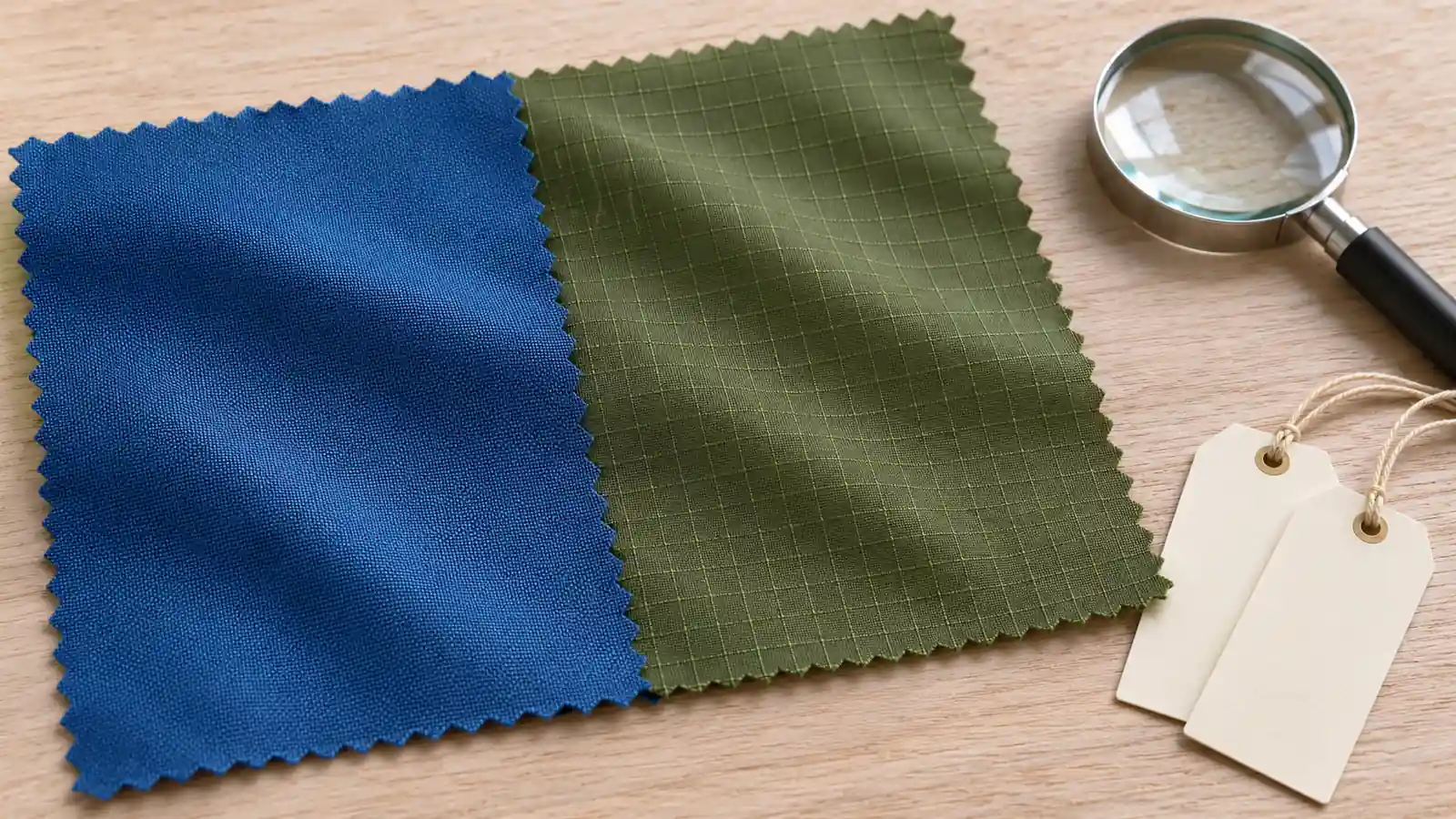
Fabric quotations often contain several numbers that appear comparable but describe different things. Yarn linear density concerns the yarn itself. Thread count concerns the woven arrangement. Fabric mass per unit area concerns a specified fabric specimen, which may include a finish or coating. Finished garment weight concerns the complete poncho. Keep these fields separate in the comparison sheet. A number beside the word nylon is not a complete specification unless the buyer knows what is being measured, which component it describes and what units are used.
When a quotation gives denier, ask whether it identifies the main yarn, reinforcement yarn or another part of the construction. A ripstop fabric may be described using more than one yarn detail. Procurement does not need to infer the entire textile design from a short catalog label. Request the supplier's available technical description and preserve the agreed terminology. If two offers use different naming conventions, ask each supplier to explain its own entry before attempting to normalize the comparison. Do not silently treat a missing value as equivalent to the better documented offer.
For fabric mass, establish whether the stated value applies to the base textile or the finished coated fabric. Record the units and any agreed variation. If the buyer measures a swatch, record its dimensions, condition and weighing method, and distinguish the observation from a supplier specification. Small samples can be difficult to compare reliably with ordinary office equipment. Use such observations to identify questions rather than claiming laboratory precision. Where mass is a contractual requirement, agree the measurement approach and acceptance rules with the supplier before ordering.
A heavier fabric should not automatically receive the highest score. The purchasing brief may prioritize compact packing, comfortable drape, a particular appearance or an evidence-backed performance requirement. Different constructions can balance those factors differently. Create separate columns for confirmed fabric identity, finished mass, handling observations and relevant evidence. This prevents a single familiar number from dominating the decision. It also makes tradeoffs visible to the person who must approve the order rather than hiding them inside an unexplained overall quality rating.
Use a hypothetical comparison to test the sheet. Offer A lists a yarn size but no finished fabric mass. Offer B lists a coated fabric mass but no yarn details. Neither entry answers the other's question. The appropriate next step is to request the missing specification or decide which information is necessary for the actual application. Averaging the two numbers or ranking the offers by whichever number is larger would be meaningless. The same caution applies when a garment weight is accidentally entered in a fabric mass column.
Before sample approval, review the units and definitions with the people who will receive the goods. A warehouse inspector needs an agreed finished garment measurement or weight procedure, while a material reviewer may need a separate swatch record. Keep the specification readable: one attribute per line, one identified component, one unit and one verification route. Where the project does not require a particular numerical attribute, do not invent a target simply to fill the table. A smaller set of well-defined requirements is more useful than a dense technical sheet containing values that nobody can trace to the offered construction.
Compare drape and handling on equivalent samples
Handling comparisons are most useful when the conditions are similar. Lay equivalent size swatches on a clean table, examine the same side first and keep the samples identified. Then handle the finished garments separately. Note how the fabric falls, folds and moves, without presenting these observations as measured tear strength or water resistance. A reviewer can legitimately prefer one sample's feel or appearance. The important step is to record what was observed and which purchasing requirement that preference supports, rather than labeling one fabric universally better.
Use the intended clothing and accessories during a finished sample review. A poncho that drapes neatly on a dress form may sit differently over a jacket or daypack. Ask an adult reviewer to put it on, walk normally and reach for the items relevant to the use brief. Record whether the coverage, openings and hood arrangement are acceptable. Keep these comments separate from comfort claims that would require a broader user study. One person's short review can reveal a design question, but it cannot prove how every wearer will experience the garment.
Include packing and unpacking in the handling session. Fold the sample according to the proposed instructions, place it in its pouch and remove it again. Observe whether the process is clear and whether the pouch opening is practical. If the supplier has provided a demonstration fold that requires unusual precision, ask for a repeatable user method. The buying decision may favor a slightly different packed format if it makes everyday handling easier. Record the actual sample and method used so a later revision can be compared fairly.
Color and lighting can influence subjective judgments. Review the main colors under consistent conditions and avoid treating a bright photograph as evidence of a different surface quality. If the final order includes several colors, request the relevant references rather than assuming that one sample establishes every appearance decision. When a garment is intended for branded distribution, include the decorated sample in the handling review. A print, label or applied trim can introduce local stiffness or change how the item folds, so the undecorated sample may not answer the final question.
A simple review form can have four columns: observation, location, practical consequence and decision. An entry might identify a stiff area near an approved print location and request a revised sample for packing review. Another might record that a wider pouch opening is preferred for an adult visitor program. Use factual language and photographs where helpful. Avoid vague instructions such as improve quality, because they leave the supplier to guess whether the buyer means surface feel, appearance, construction, dimensions or something else entirely.
Conclude the session by separating preferences from mandatory conditions. The team may prefer a softer drape while accepting another construction that better meets the complete brief. Conversely, an awkward opening or unclear packing method may require correction before release. Assign each requested change an owner and link it to the next sample revision. When the revised sample arrives, review the changed area and any connected features, then close the comment explicitly. This creates a practical record of selection without pretending that subjective handling is a substitute for a defined technical test or a complete assessment of long-term service life.
Choose a weight target around the finished garment
Begin a garment weight requirement with the use case. A commuter may want a compact item carried in a bag, while a staffed distribution program may care about the complete kit and carton handling. Neither need is answered by fabric mass alone. Define whether the target applies to the dry garment, garment plus pouch, individual retail pack or a shipping unit. Give each configuration its own name in the specification. This avoids a common comparison error in which one supplier quotes the bare poncho and another includes every accessory.
List the components included in each weighing condition. A hood adjustment, side closure, reinforcement, label, print and pouch all belong to the final product definition, even when their contribution is not individually measured. Procurement should not demand an arbitrary lighter result without asking what construction would change. If a supplier proposes a weight reduction, request an explanation of the affected components and an updated sample. Review the consequences for coverage, handling, evidence and packing before approving the new target for production.
Measure equivalent sizes and conditions when checking samples. Use a suitable scale, record the sample reference and note whether the garment is dry and free of packaging. The procedure should be repeatable by the supplier and buyer. If a reading appears inconsistent, first check the configuration, scale setup and sample identity. Do not immediately infer that the fabric has been substituted. A sensible investigation distinguishes a measurement difference from a construction change and records the explanation before the comparison sheet is updated.
Agree a realistic acceptance approach rather than treating one development sample reading as a universal exact value. The supplier should state the proposed specification and variation for the finished item, and the buyer should decide whether that meets the program's needs. This article does not prescribe a single acceptable tolerance for all ponchos. A contractual target must fit the actual construction and measurement method. If weight is a critical commercial requirement, resolve it explicitly during sampling instead of leaving it as a rounded marketing number.
Consider the complete portability decision alongside dimensions. A low mass does not guarantee that a garment is easy to fold or that its pouch fits a particular storage space. Measure the packed format separately and review it in the intended bag, rack or distribution container. For a bulk program, ask how individual units are arranged in the carton and whether the packing proposal matches the receiving process. A buyer may accept a different individual format when it improves access or reduces confusion during distribution, provided the change is reviewed and documented.
Write the final weight requirement in plain language. Identify the model and size, the included components, the agreed measurement condition, the target and variation, and the responsible verification step. Keep a photograph of the weighed configuration with the sample record. Marketing can then use an accurate, appropriately qualified description derived from the approved specification. Purchasing can compare a repeat order against the same definition. Most importantly, the team can discuss portability without assuming that the lightest offered garment is always the most practical, durable or suitable choice for the people who will use it.
Review the broader material choices in the raincoat materials comparison.
03 / 12
Specify the coating or laminate as a separate layer
Ask which surface carries the barrier
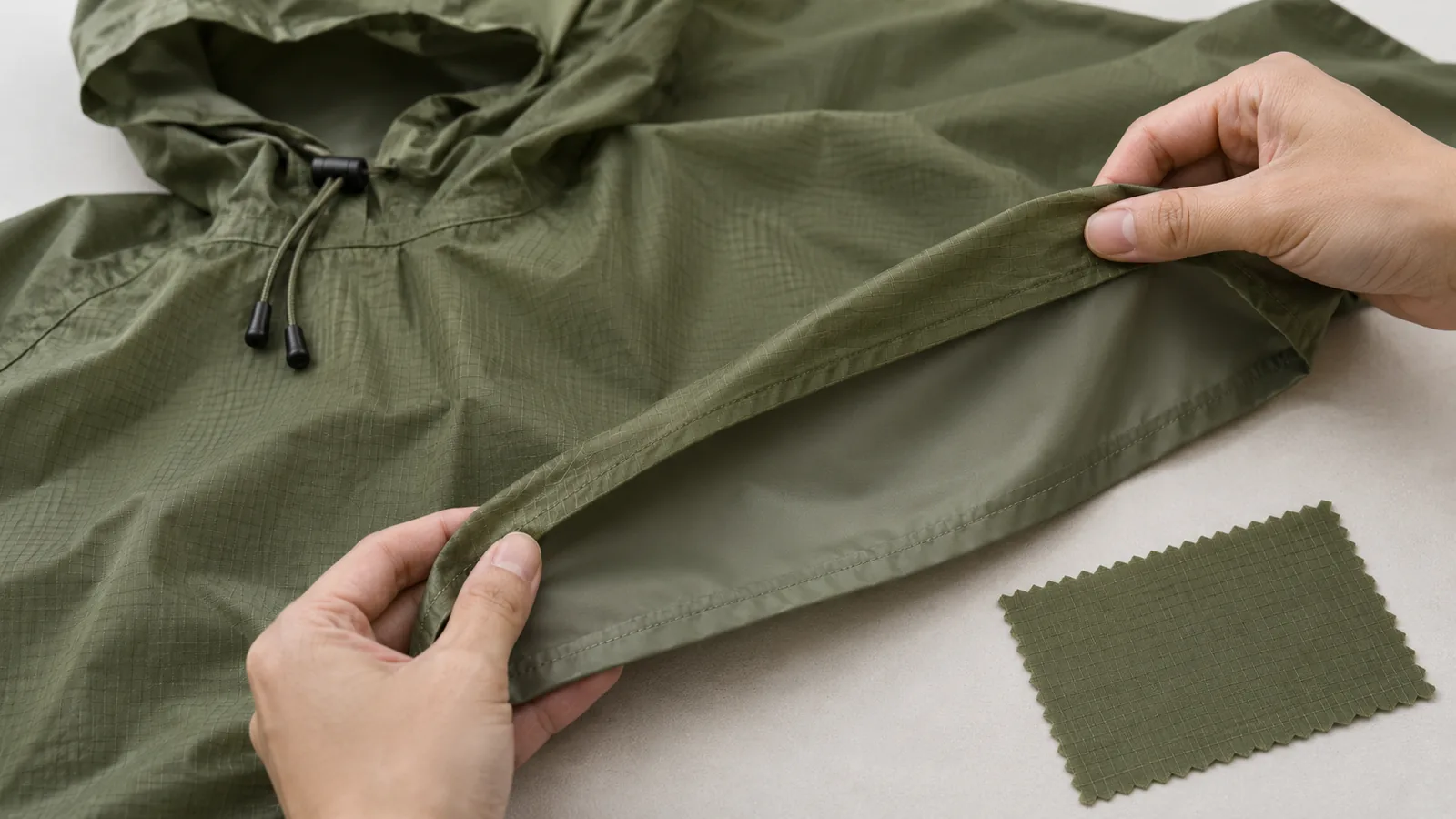
A coating or laminate description should identify the proposed construction clearly enough to support purchasing, decoration, care and repair decisions. Ask which side of the shell carries each treatment and whether the inside and outside differ. Do not infer the answer from shine, color or touch alone. Those observations can help locate a feature for discussion, but they do not establish the chemistry of the layer. Request the supplier's written description for the actual material and connect that description to the current sample reference.
Keep a simple outside-to-inside construction note. It can identify the outer textile surface, the relevant coating or laminate and any separate lining or protective layer where present. Not every poncho has the same arrangement, and a diagram should not add layers that the supplier has not confirmed. If a catalog uses a broad phrase such as waterproof coated nylon, ask what information is available for the offered model. Mark any proprietary or unresolved detail honestly, then decide whether enough evidence exists for the intended specification and claims.
Inspect an edge or accessible seam on the sample to understand the assembly. Ask the supplier to explain what the buyer is seeing rather than cutting apart the only approved reference without agreement. A separate development cutting may be useful for construction discussion. Record the sample identity and the supplier's explanation beside the photographs. This gives other reviewers a practical way to locate the coating side, seam treatment and decoration surface without assuming that every smooth surface represents the same material or manufacturing process.
Ask how the proposed seam treatment relates to the barrier construction. A coating description on its own does not explain the treatment of stitched joins or attachment points. Request the intended method and a finished sample that shows the actual result. The buyer should review visible workmanship and the relevant evidence together. Do not prescribe a particular tape or adhesive merely because it appeared on another poncho. Compatibility and suitability must be confirmed for the offered material and manufacturing arrangement, including any changes made during sampling.
An unclear coating description can also create confusion after delivery. A customer may ask which cleaner, repair product or decoration process can be used. Procurement should obtain the model-specific guidance needed to answer those questions before approving public instructions. If the supplier cannot support a proposed use or treatment, do not invent a generic answer based on the word nylon. Limit the instructions to the supported scope and request further review where necessary. A careful description prevents a material choice from becoming an unsupported maintenance promise.
For a hypothetical comparison, two blue ponchos may look similar while using different coating systems or seam arrangements. The buyer should not assume that a successful print trial or repair approach on one transfers to the other. Keep construction-specific samples and records, and ask the supplier to flag substitutions before manufacture. The approval can then state which shell and barrier assembly was reviewed, which surfaces may be decorated and which guidance accompanies the order. This turns an invisible or difficult-to-see material feature into a controlled purchasing detail that remains useful throughout sampling, production, receiving and customer support.
Separate water repellency from water penetration resistance
A surface that sheds visible droplets and a fabric that resists water passing through it are not the same purchasing question. Treat surface behavior, fabric barrier evidence and garment coverage as separate subjects in the brief. A short demonstration of droplets on a swatch may be useful for discussing appearance or surface behavior, but it does not establish a complete waterproof rating for a poncho. Ask what exact claim the supplier proposes and what evidence supports that claim for the identified construction and condition.
Use precise wording when requesting information. Instead of asking whether the fabric is waterproof in every situation, describe the intended ordinary use and ask for the available water penetration evidence, relevant limitations and care instructions. If the supplier provides a named test result, review its scope and sample identity. If it provides only a visual demonstration, record that accurately as a demonstration. Do not translate an informal observation into a standardized result or a guarantee about how long a wearer will remain dry in unspecified weather.
The finished design adds further variables. A fabric panel may be suitable for the intended barrier function while openings, joins or uncovered areas need separate attention. Review the hood, neck opening, side arrangement and overall coverage on a finished sample. The buyer should decide whether those details suit the stated activity and clothing. Avoid using a laboratory fabric number to answer a fit question, and avoid using a successful short wearing review to replace the material evidence required by the purchasing specification.
Marketing language should follow the evidence rather than lead the sample process. If a product page is planned before sampling is complete, use working notes that clearly mark proposed claims for review. Do not approve an absolute statement merely because a competitor uses similar wording. Decide which descriptions can be supported, what conditions or limitations need stating and which claims should be removed. For a business buying brief, a clear construction description and a practical use explanation are often more informative than an unexplained superlative.
Consider a hypothetical retailer that receives a swatch photograph with rounded water droplets and a separate garment sample. The photograph does not answer whether the sample's seams were treated or whether the same fabric revision was used. The appropriate questions are about material identity, documented evidence and finished construction. A buyer can ask for clarification without rejecting the sample prematurely. Equally, a visually impressive demonstration should not cause the team to waive unresolved requirements that were important enough to include in the original brief.
Record the final decision in three lines: the supported surface description, the available fabric water penetration evidence and the finished garment checks completed. Identify any conditions attached to each line. This keeps the purchasing team from collapsing different observations into one broad promise. It also helps customer-facing staff explain the product accurately when asked about ventilation, rain coverage or care. The goal is not to avoid useful performance information; it is to preserve the meaning of that information so the buyer can compare offers and communicate the approved product without extending a narrow observation beyond its actual scope.
Review coating compatibility before approving decoration
Custom branding should be reviewed on the same coated fabric proposed for production. A print that looks acceptable on an uncoated swatch or a different rainwear material does not automatically establish suitability for a nylon poncho. Ask the supplier to identify the proposed decoration method, location and any construction-specific limitations. The buyer can then evaluate a decorated sample rather than relying only on a digital artwork proof. Keep the artwork revision and the fabric revision together in the approval record so both parties know which combination was reviewed.
Begin with placement. Mark the intended print area on the garment drawing and check how that area behaves when the poncho is worn and folded. Avoid putting essential information where a fold, hood or closure routinely hides it. If the design crosses a seam or moves close to an attachment point, ask whether the proposed process and layout are suitable. Procurement should not invent a technical solution from a mockup. The supplier needs to review the actual construction and explain any changes required before the buyer approves the final visual arrangement.
Discuss the process conditions at a useful level without demanding confidential production recipes. Ask whether the proposed printing, transfer or attachment method has been assessed for the offered shell and coating. Request the relevant sample checks and any restrictions on artwork size or location. Where a process involves heat, pressure, solvents or adhesives, suitability should be established by the responsible supplier for that construction. Do not publish universal temperature settings or assume that a method used successfully on another fabric is safe for every nylon rain poncho.
Review more than the first photograph of the print. Examine the decorated area, surrounding fabric, inside surface and nearby seams on the sample. Fold and unpack the item using the intended method, and inspect it under the agreed review conditions. If durability or care-related performance of the decoration is a requirement, specify the appropriate evidence and acceptance criteria with the supplier. An attractive initial appearance is one part of approval. It does not justify a lifetime colorfastness claim or a guarantee that the decoration will remain unchanged under all handling conditions.
Resolve care instructions for the decorated version. Instructions suitable for an undecorated shell may need review when a print, applied label or other trim is added. The final guidance should address the actual supplied garment. If a proposed cleaning or repair action could affect the decoration, ask for model-specific advice rather than suggesting an unverified home treatment. Keep any limitations clear enough for the end user to follow. A brief, accurate instruction is preferable to a long generic list assembled from unrelated materials and products.
The final approval package should therefore include the decorated garment reference, artwork file, print dimensions and position, confirmed construction, relevant review results and current care instructions. Require review of changes that affect this combination. For repeat orders, ask whether the fabric, coating, ink system or decoration process has changed before accepting the old proof as sufficient. This does not mean every order needs to restart development. It means that a previous approval has a defined scope, allowing the team to reuse sound evidence while identifying the specific changes that need fresh attention.
Browse the existing nylon rain poncho product category and request a current construction-specific proposal.
04 / 12
Read water resistance evidence with the right limits
Define what a hydrostatic result covers
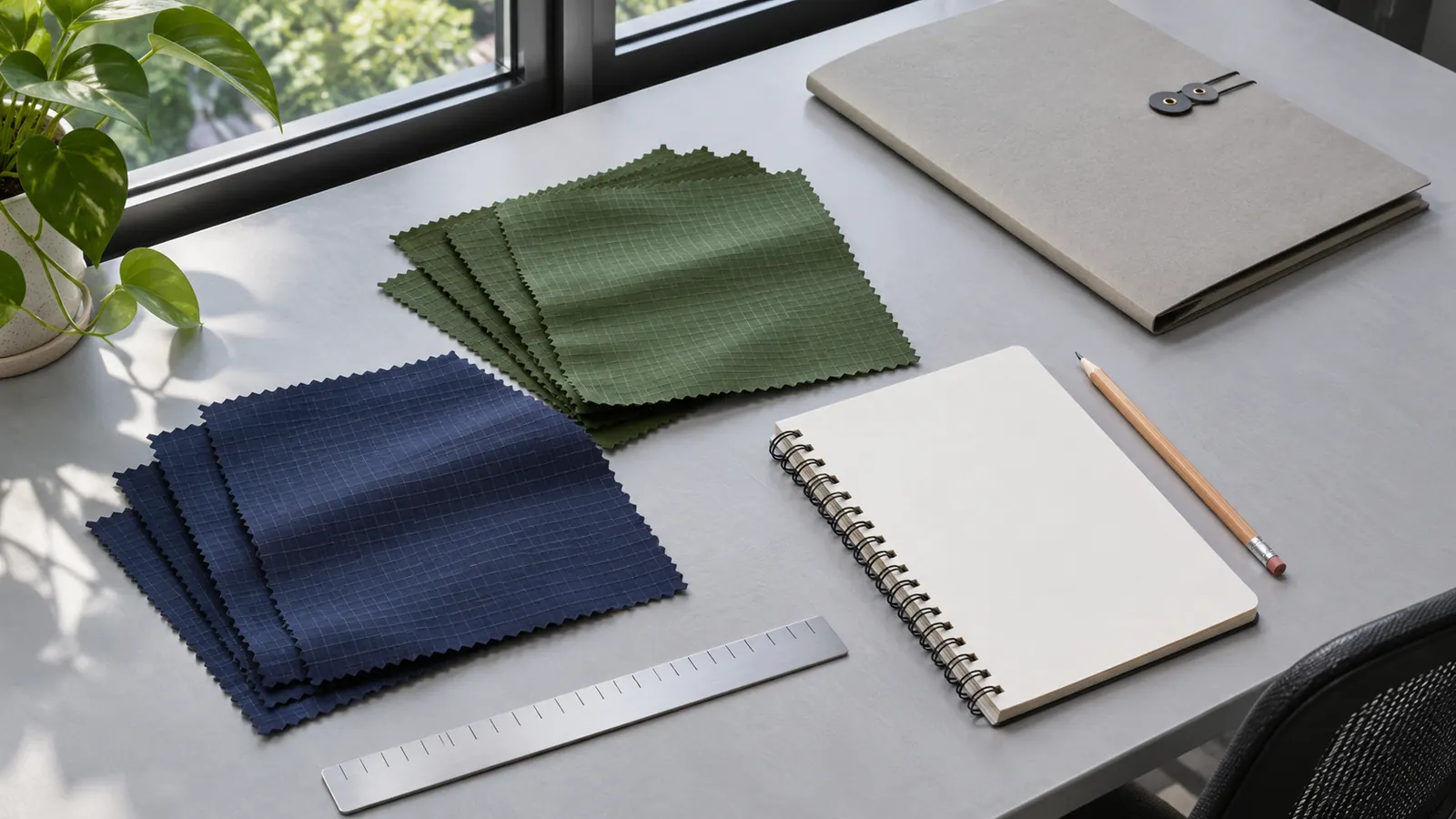
A hydrostatic result belongs to a defined test, specimen and condition. It should not be treated as a free-standing score that describes every part of a rain poncho. ISO 811 identifies a method for determining fabric resistance to water penetration under hydrostatic pressure. That scope is useful when a buyer requests fabric evidence. It does not, by itself, certify a finished garment, establish a universal passing value or describe comfort, breathability and seam performance. Keep the method and the product claim separate when reviewing an offer.
Ask for enough report information to understand what was tested. Identify the material reference, sample description, date, method and edition, test condition and reported result. Where a report contains several specimens or directions, read the applicable entries rather than selecting the most attractive number. If the supplier gives only an extract, request the relevant context needed for the purchasing decision. Do not infer an unreported result or remove qualifications when summarizing the evidence for a comparison sheet or an internal approval meeting.
Match the tested material to the offered sample. A report for another color, finish or construction may be informative, but its applicability must be explained rather than assumed. Ask the supplier to describe the relationship and identify any differences. The buyer can then decide whether additional evidence is necessary for the actual order. A laboratory name or a recognizable standard number does not resolve this matching question. The report needs a traceable connection to the construction being purchased and the statement the seller wants to make.
Define the requirement with the appropriate technical support where performance is critical. This guide does not supply a universal numerical target for every activity or market. A buyer should not select a threshold merely because it appears in another product's marketing. Consider the intended use, applicable requirements and the evidence needed to support the specific claim. If the procurement team lacks the necessary expertise, obtain qualified advice for that decision. Keep the resulting specification explicit enough that the supplier knows which evidence and acceptance conditions are required.
Compare reports only after checking that their methods and conditions are suitable for comparison. Different procedures, specimen conditions or reporting conventions can make a simple ranking misleading. If the offers are not directly comparable, show the difference in the table instead of converting them into an invented common score. A procurement note can say that additional clarification is needed before comparison. That is a more useful conclusion than presenting precision the available information does not support, especially when the ranking will determine a bulk purchase.
Finally, decide how the result will be used. It may support material selection, a contractual acceptance requirement or a carefully worded product statement. Record that purpose and preserve the original report alongside the summary. Keep the fabric result out of unrelated claims about tear resistance, garment lifetime or all-weather protection. A well-managed evidence file makes the result more valuable because its meaning survives handoffs between technical review, purchasing and marketing. The buyer can explain what was established, which sample it concerned and what additional garment checks were required before the order was approved.
Specify conditioning and the state of the tested sample
The state of a tested sample matters to the meaning of a result. Ask whether the reported specimen was new, conditioned in a particular way, or subjected to a defined care or treatment sequence before testing. Record the answer as supplied. A result on a new material should not be described as evidence of unchanged performance after repeated use unless the relevant additional work has actually been done. Equally, an aged or treated specimen result needs its procedure and limitations preserved so the buyer understands the comparison.
Start by identifying the claim the project needs to support. A simple material description may require a different evidence package from a specific statement about performance after a named care sequence. Do not commission an arbitrary series of treatments just to create a large test file. Discuss the intended use and claim with the supplier and, where needed, a competent laboratory or reviewer. The goal is relevant evidence with a clear decision rule, rather than a collection of numbers whose connection to the product brief remains uncertain.
Care instructions and test conditions should not contradict each other. If the garment is supplied with a particular care method, a proposed evaluation needs to identify how that method relates to the tested sequence. Do not recommend laundering, heating or chemical treatments that the supplier has not approved for the construction. If a report uses a condition that differs from the end-user instructions, ask what conclusion the supplier intends to draw. Record that explanation before adopting the result in a sales claim or purchase specification.
Keep sample handling traceable while the review is underway. Label samples, protect them from uncontrolled treatments and note any inspection or wear review that occurred before a later test. A fabric cutting used repeatedly for demonstrations should not accidentally be submitted as an untouched reference. The buyer does not need to reproduce a laboratory's entire quality system, but should preserve the basic identity and history of the submitted material. This makes it easier to investigate discrepancies without relying on assumptions about what happened to the specimen.
For a hypothetical repeat-use program, the buyer may want evidence relevant to the proposed care instructions and a separate practical review of drying and packing. These are connected decisions, but they remain different forms of evaluation. The laboratory work addresses its defined property and conditions. The practical review addresses whether the instructions and routine can be followed in the program. Neither should be stretched into a guaranteed number of years of service. Any numerical durability or retention statement needs its own appropriately scoped evidence and wording.
Summarize the report with a condition field that is as visible as the result field. Include the sample revision, treatment or conditioning description, method and the conclusion authorized by the review. If important details are missing, leave the evidence status open and request clarification. When the supplier changes the coating, fabric or care instructions, assess whether the previous evidence still applies. This preserves a logical chain from the actual product through the relevant test conditions to the final statement, and prevents a genuine report from being used to support a broader claim than it can reasonably establish.
Keep fabric evidence separate from whole-garment checks
A complete poncho review needs both material information and examination of the finished design. The material evidence addresses the specimen and property identified in the report. The garment review addresses the assembly, coverage, openings and practical handling of the supplied item. Keep separate records for these tasks and connect them through the sample reference. This makes it clear that a favorable fabric result does not automatically approve the hood, seams, closures or dimensions, while a comfortable fit review does not establish a laboratory material rating.
Create a finished-garment checklist before the sample arrives. Include the outside and inside surfaces, join locations, seam treatment where specified, hood shape, neck opening, side closures and hem. Add the measurement points and intended adult clothing or bag configuration. The checklist should reflect the actual design rather than every feature found on unrelated rainwear. Where a feature is absent by design, note that fact and assess whether the arrangement meets the brief. Do not mark an item as failed simply because it differs from a different product category.
Use the sample session to identify practical questions. Can the adult reviewer put the garment on using the proposed instructions? Does the hood arrangement allow the intended ordinary movement? Does the coverage remain acceptable when a daypack is added? Are the closures understandable and accessible? Record the specific observation and any requested change. These questions provide useful purchasing information without pretending that an informal review establishes compliance with a specialized protective clothing standard or a universal safety assurance for every activity.
If the project requires a defined whole-garment performance evaluation, agree its method, scope and acceptance criteria with qualified support. Do not improvise a dramatic water demonstration and label it certification. A controlled evaluation should identify the sample, procedure, conditions and reported outcome. The buyer also needs to understand whether the evaluation covers the exact finished construction, including decoration and accessories where relevant. Keep any limitations in the report summary. They help the team decide what the evidence supports rather than weakening an otherwise useful result.
Review the transitions between features. A hood join, an attachment point or the end of a seam treatment may deserve attention because it connects different parts of the assembly. Inspect those locations against the drawing and approved sample, and request clarification where workmanship or construction differs. Do not infer hidden defects solely from a photograph, but do not ignore an unexplained discrepancy either. Ask the supplier to identify the issue and proposed disposition, then document whether the buyer accepts the sample or requires a revised version.
The release record should state that the relevant material evidence was reviewed and that the named finished sample completed the agreed checks. List any exceptions and the conditions for closing them. Avoid a single unexplained pass box that hides which tasks were actually performed. When production or receiving questions arise, the team can return to the appropriate record: material evidence for the defined fabric property, garment inspection for construction and measurements, and user review for practical handling. This separation makes the approval more reliable and gives the buyer a clear basis for requesting targeted corrections without overstating what any one check has proven.
Organize supplier evidence with the rainwear sourcing guide for procurement managers.
05 / 12
Inspect seams, hoods and fastening points
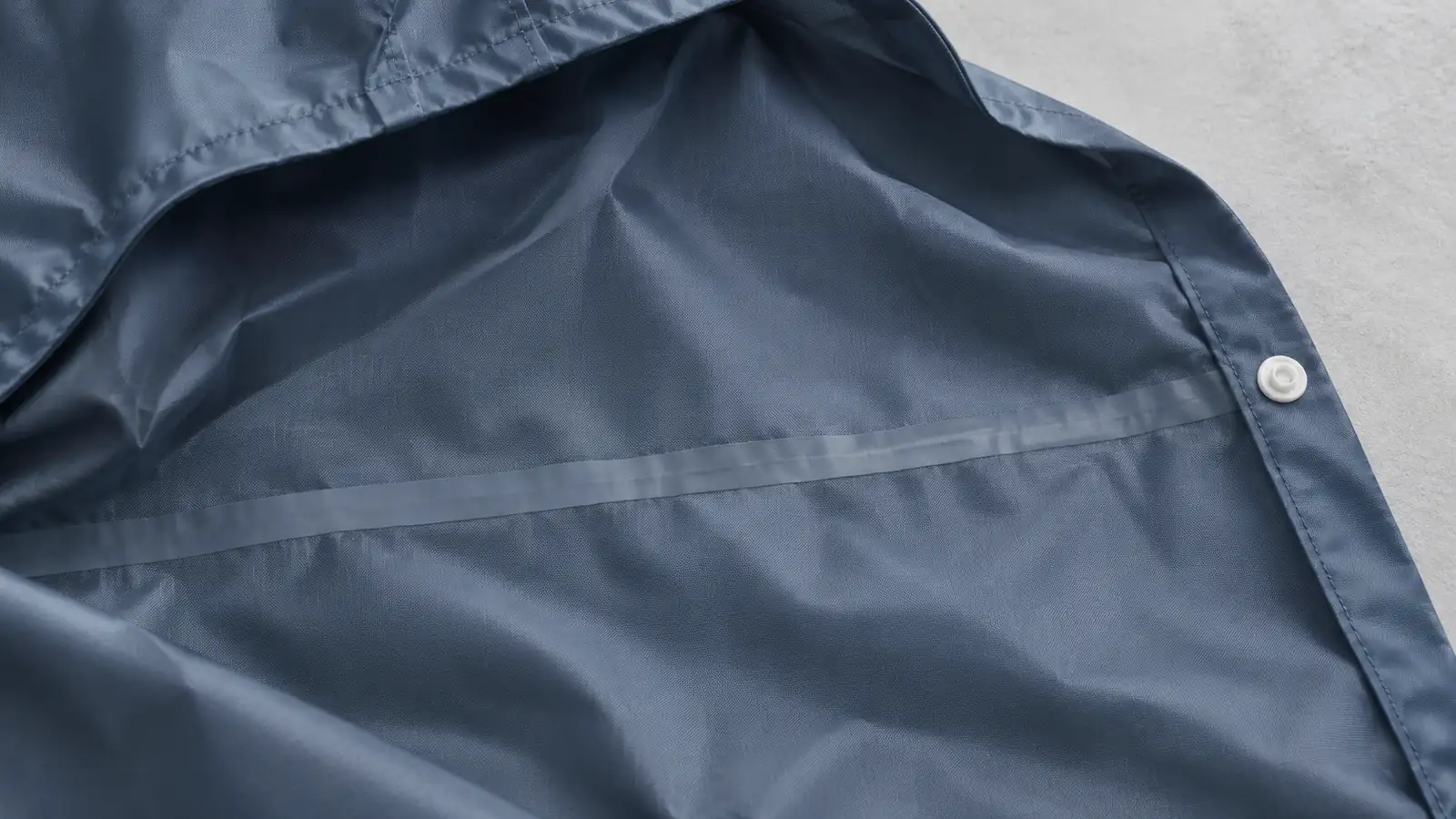
Follow the complete seam path
A seam review should begin with the garment drawing and continue around the actual finished sample. Identify every join in the shell, hood and attached components. Note which joins are stitched and what treatment is specified for each location. Do not assume that the presence of one visible taped seam means every join has the same treatment. The purchasing record should describe the intended construction, while the inspection record shows whether the named sample matches that description at the locations the team reviewed.
Turn the garment inside out where the design permits and examine it under suitable light. Look for visible differences from the approved reference, including interrupted treatment, unusual lifting, folds or unexplained changes in join construction. Record the location and photograph the observation with enough surrounding context to identify it. An inspection comment should ask for assessment or correction of a specific condition. Avoid diagnosing an unseen manufacturing cause from a photograph alone, and avoid accepting a cosmetic explanation without understanding whether the condition affects a requirement.
Pay attention to junctions and endpoints. Where several seams meet, where tape ends, or where a closure is attached, compare the construction with the supplier's intended method. Ask how the detail is meant to function and whether it is represented in the relevant sample or evaluation. The buyer does not need to prescribe machinery settings. The useful procurement question is whether the finished detail matches the agreed construction and whether the supplier can support its suitability for the proposed product statement and use.
Keep stitch appearance and water barrier evidence separate. A neat seam can still require a specific treatment to meet the intended specification, while a material test report may not address that seam at all. If the project includes seam-related performance requirements, identify the appropriate evidence and acceptance criteria before release. Do not invent a universal tape width or a particular seam design for every nylon poncho. The suitable construction depends on the offered materials, design and required performance, which should be reviewed together rather than selected from an isolated photograph.
Use the sampling process to resolve discrepancies. A hypothetical sample may show the agreed treatment along the main body join but a different arrangement near the hood. Record the difference and ask whether it is intentional, acceptable under the specification or a development error. The supplier's answer should identify the relevant drawing or revised sample. Procurement can then make an informed decision. A vague promise that production will be better is not the same as closing the issue with an agreed reference and verification step.
For receiving, turn the approved sample review into a proportionate inspection instruction. Identify the locations to examine, the reference to use and the process for reporting deviations. Agree any sampling and acceptance arrangements with the supplier; this guide does not prescribe a universal inspection percentage. Keep rejected, conditionally accepted and approved samples clearly separated. When a seam construction changes, review the connected material, decoration and care implications as necessary. A complete seam path review gives the buyer a practical basis for evaluating the actual garment without assuming that a fabric label or one attractive close-up establishes the quality of every join.
Examine hood openings and coverage in use
The hood is a fit and usability feature as well as part of the rainwear assembly. Review it on adults representative of the intended size range, using the clothing expected in the program. Record the sample size and the review conditions. A photograph of a hood on a dress form can explain shape, but it cannot answer all questions about ordinary head movement, access to adjustments or how the opening sits on a person. Use a finished sample and a practical review brief before approving the design.
Begin with putting the garment on and locating the front opening. Ask the reviewer to follow the proposed instructions without coaching every movement. Observe whether the orientation and closures are understandable. If an adjustment is present, check that its intended use is clear and ask the supplier for the relevant instructions and limitations. Do not add an improvised cord arrangement or modify an adjustment during the session and then treat the altered sample as the approved product. Any design change should return through the supplier's review process.
Examine ordinary head turns and the relationship between the hood and shoulders. Record whether the opening stays in a position the reviewer can use comfortably for the stated activity. If a reviewer reports restricted visibility or an awkward adjustment, describe the observation and request assessment. Do not convert a short review into a universal safety claim. This guide addresses ordinary adult rainwear purchasing; specialized activities, protective applications and child products need their own appropriate requirements and review rather than assumptions based on an adult walking sample.
Look at coverage together with openings. A larger hood or longer body is not automatically the better choice if it creates a different practical problem for the intended wearer. Ask whether the design works with the expected clothing and whether the supplier's size information is clear. Document the agreed measurement points so a repeat sample can be compared. If several adult sizes or configurations are offered, review the relevant variants. Do not assume that a favorable result on one size establishes fit for every person or every carried bag.
Use comments that the supplier can act on. Instead of saying that the hood feels wrong, identify where the opening sits, which normal movement causes the issue and which sample was used. Photographs can support the description if the reviewer agrees, but keep them focused on the product detail. The supplier can propose a revised pattern or adjustment arrangement for review. Procurement should then assess the new sample as a whole, because a local change may alter the way the hood joins the body or packs into the pouch.
The final approval should identify the hood construction, opening arrangement, instructions and fit review completed. Preserve any use limitations supplied for the product and ensure that customer-facing wording remains consistent with them. A practical instruction to choose the appropriate size and follow the model's guidance is more useful than an unsupported promise of universal fit. When the order includes branding near the hood or neck, review that version too. The aim is a coherent garment whose coverage, adjustments and instructions have been considered together, with unresolved fit questions answered before the buyer commits to a bulk quantity.
Review closures and reinforcement under normal handling
Closures and reinforcement details deserve their own line in the specification because they affect how the poncho is put on, opened, folded and handled. Identify the type, number and position of side closures and any other fastening points in the proposed design. Record the relevant sample and drawing. A quotation that names the shell fabric but leaves these details open is incomplete for comparison. Two garments with similar outlines may have different closure arrangements, so the buyer should understand which version is included in the offered price.
During sampling, operate each closure using the intended method and normal handling. Observe access, orientation and the surrounding fabric. If a closure is difficult to use or the adjacent area looks different from the approved reference, record the specific location and request assessment. Do not carry out improvised overload or destructive demonstrations and report them as standardized strength tests. Where a defined attachment strength or other performance requirement is needed, agree an appropriate evaluation and acceptance criteria with competent technical support and the supplier.
Ask the supplier to explain reinforcement where it is part of the design. A patch, folded area or additional layer may serve a construction purpose, but its presence alone does not establish a universal durability claim. Identify its material, location and relation to the shell as necessary for the specification. Check the finished sample for the intended appearance and handling. If the supplier proposes removing or changing reinforcement to alter weight or cost, review the consequences before accepting the revised quotation and production reference.
Include the packed state in the closure review. Fasteners and attached parts should be considered when the garment is folded according to the supplied method. Record whether a particular folding arrangement is required and whether that instruction is practical for the intended users. Do not assume that the showroom fold is the only possible configuration, but ask the supplier to confirm the recommended approach. A clearer folding instruction or a revised pouch can be a more appropriate solution than an unreviewed change to the garment's fastening system.
For a hypothetical branded visitor program, the buyer might prefer side closures that are easy to identify while wearing ordinary outer clothing. The sample review could reveal that a printed panel hides the closure position or that the instructions do not explain the opening sequence. These are actionable findings. Update the artwork placement or instruction proposal through the agreed process, then inspect the revised decorated sample. The team should not accept the undecorated closure review as complete if the final supplied configuration introduces a different practical issue.
Finish with a clear reference for production and receiving. Preserve the closure layout, approved trim description, reinforcement details and any relevant evidence. State how changes will be reviewed and how deviations should be reported. If a supplied component differs from the reference, hold the decision open until its identity and impact are understood. This approach avoids both extremes: treating every visual difference as a proven defect, or assuming that all fastening systems are interchangeable. The buyer obtains a documented assembly that can be inspected and discussed, while the supplier receives specific requirements instead of a vague request for stronger snaps or better quality.
Compare everyday fit and handling in the reusable rain poncho buying guide.
06 / 12
Evaluate tear, abrasion and practical durability
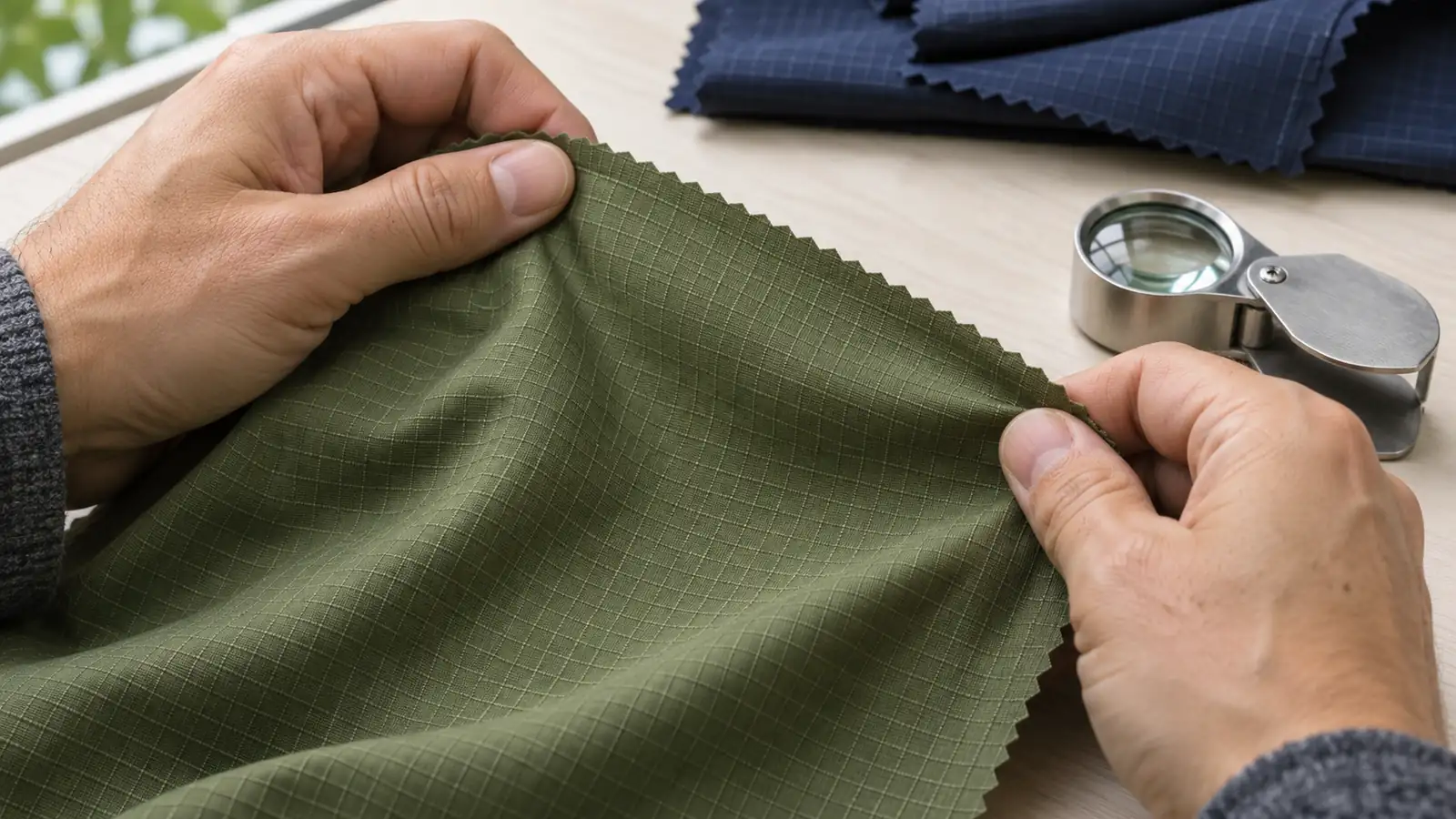
Ask the relevant question for each damage mode
Durability is too broad to serve as a single technical specification. A buyer should identify the concern: tearing, abrasion, puncture, seam damage, coating changes, fastening problems or another observed issue. Each question needs an appropriate evaluation and a clear relationship to the intended use. A ripstop grid does not answer every one of those questions. Begin with the program's handling conditions and the features that matter, then ask the supplier what relevant evidence is available for the proposed construction rather than requesting an undefined strongest fabric.
Tear and abrasion evidence describe different properties. ASTM D2261 addresses a tongue tearing method, while ASTM D3884 concerns abrasion using a rotary platform arrangement. These method scopes illustrate why a tear result cannot simply replace an abrasion result. They do not establish that either test is required for every poncho or that a particular product has passed. The purchasing team should select relevant evaluations with appropriate technical advice and preserve the actual method, specimen details and result when evidence is supplied.
Translate operational concerns into specific questions before choosing a test. If staff report damage near a closure on a development sample, the first task is to identify the location and construction, not automatically to request a fabric abrasion report. If the concern is contact between a carried bag and the garment, review the actual arrangement and ask what evaluation would be relevant. A clear problem statement helps the supplier or laboratory propose useful work. An impressive but unrelated test result may add cost without resolving the purchasing decision.
Keep observations from ordinary handling distinct from controlled evaluations. A sample inspection may reveal a loose component or visible surface change that deserves investigation. Record the observation, sample history and conditions. Do not infer a standardized rating from pulling, rubbing or scratching a swatch by hand. Such demonstrations can vary greatly with the person and setup. If the issue matters enough to become an acceptance requirement, define how it will be evaluated and what outcome is needed before placing the order.
Avoid combining unrelated results into an invented durability index. A procurement table can present separate evidence for the relevant properties and separate comments on fit, packing and care. If management wants an overall selection recommendation, explain the tradeoffs in ordinary language. For example, a team may choose a construction because it meets the agreed evidence requirements and is practical to carry, while acknowledging a different appearance preference. The recommendation should show the decision logic rather than concealing it behind a numerical score with no technical basis.
Before release, make sure the final specification names the actual requirements instead of relying on phrases such as heavy duty or premium strength. If those phrases are proposed for marketing, ask what precise meaning and evidence support them. Remove or narrow wording that cannot be justified. A useful durability review identifies relevant damage concerns, suitable evidence, agreed construction and care limitations. It does not promise that a poncho cannot be damaged or that every wearer will obtain the same service life. That distinction protects the quality of the buying decision and gives customer-facing teams an accurate explanation of the approved product.
Read comparative results without creating a lifetime promise
A comparative test can help a buyer choose between defined samples, but it does not automatically predict years of service. Start by identifying exactly what was compared and under which method and conditions. Check whether the samples represent the offered constructions and whether the comparison is directly applicable to the purchase. A higher result in one property may be relevant to the brief, yet it should not be rewritten as a guarantee that the garment will last longer in every setting or remain unchanged after unlimited use.
Read the report beyond its headline result. Note the sample description, test date, procedure, specimen condition and any stated limitations. If the report includes variability or several observations, preserve the relevant context in the summary. Ask for clarification when a supplier presents only a single number without identifying its source. Procurement should not fill gaps by borrowing information from another model's document. A traceable result with a clear scope is more useful than an impressive figure whose relationship to the offered poncho cannot be established.
Consider the complete selection brief when interpreting a comparison. An offered construction may differ in weight, drape, packed size, decoration compatibility and care as well as the tested property. The buyer should decide how these factors matter for the actual program. Do not use a test result to dismiss practical constraints that remain unresolved. Conversely, a preferred feel or color should not override a mandatory evidence requirement. Keep mandatory conditions, desirable features and commercial considerations visible so the approval reflects an intentional tradeoff rather than an accidental preference.
Treat repeat-use claims with particular care. The ability to use a garment again is not a verified number of uses, and a defined laboratory sequence is not a direct calendar-life prediction. If a supplier proposes a specific retention or lifetime statement, request the evidence and qualified interpretation needed for that exact wording. Where such evidence is unavailable, describe the construction and supported care instructions without inventing a duration. The buyer can still communicate practical features and intended use clearly, provided the language does not promise outcomes the review has not established.
Use a hypothetical comparison to clarify the decision. Two samples may both meet the agreed purchasing requirement while one produces a higher result under the chosen test. The team might select the other because its complete garment fits the program better, provided all mandatory requirements remain satisfied. The decision note should explain that choice. It should not claim the selected option is technically superior in every respect. This is especially useful when later staff revisit the order and wonder why the sample with the largest number was not chosen.
Preserve the original evidence and the approved interpretation together. If marketing needs a short statement, have the responsible reviewer confirm that it stays within the report's scope. If the material or construction changes, reassess applicability rather than carrying the old result forward by habit. A responsible comparison therefore has three outputs: the actual result, the limited conclusion it supports and the purchasing decision it informs. Keeping those outputs separate allows the business to use technical evidence confidently while avoiding a lifetime promise that no defined sample comparison can establish on its own.
Record sample issues and control construction changes
A useful sample issue record describes what happened, where it happened and which sample was involved. Include the model, revision, color and relevant handling history. Add photographs that show both the detail and its location on the garment. Avoid broad labels such as poor durability when the actual observation is a lifted edge, a loose closure or a visible mark. Specific descriptions allow the supplier to investigate and propose a disposition, while vague judgments make it difficult to distinguish a construction problem from a misunderstanding about the sample's purpose.
Give each issue a status and owner. Possible statuses include clarification requested, revised sample required, accepted with a documented condition or closed against an approved correction. Do not mark an issue closed solely because someone has acknowledged the email. Record the evidence or decision that resolved it. If the supplier explains that a sample used a temporary development component, request the representative production detail before relying on that area for final approval. A development exception can be legitimate, but it must remain visible until the relevant requirement is satisfied.
Ask the supplier to identify what will change in response to a finding. A different coating, fabric, reinforcement or fastening arrangement may address the observed issue but affect other characteristics. Review the connected requirements rather than checking only that the original mark is no longer visible. For example, a local reinforcement revision may change packing, appearance or decoration placement. Procurement should not assume that every correction is isolated. The supplier's change description gives the buyer a basis for deciding which sample checks or evidence need to be revisited.
Control the reference set during revisions. Keep superseded samples labeled and separate from the approved version so they are not accidentally used for production or receiving. Update drawings, material descriptions, artwork and care instructions where affected. If a meeting results in a verbal agreement, capture the decision in the shared record. The goal is not excessive paperwork; it is a reliable answer to a simple question: which configuration are both parties agreeing to supply and receive? That answer should not depend on reconstructing a long chain of informal messages.
For a hypothetical order, the buyer may approve the overall fit while requesting a closure change and a larger pouch opening. The revised sample should show both changes, and the review should confirm that the updated parts work together. If only one change is represented, the remaining item stays open. Do not combine photographs from different revisions and call them one approved sample unless the approval explicitly defines that arrangement and the supplier confirms how it will be implemented. A complete representative sample usually makes the decision easier to understand.
Close the development stage with a concise issue summary showing all required dispositions. Identify the final physical reference, document revision and release authority. Retain the record for repeat orders and customer support questions. If a later production deviation is reported, compare it with the approved configuration and investigate the actual difference. This process supports consistent purchasing without promising that defects can never occur. It gives the buyer and supplier a clear method for recognizing, assessing and correcting specific issues while preserving the evidence and decisions that define the accepted rainwear construction.
Distinguish woven constructions from film options in the plastic rain poncho material and thickness guide.
07 / 12
Fit the poncho to clothing, movement and carried bags

Define coverage with and without a backpack
A poncho's coverage depends on the finished dimensions, the wearer's clothing and any carried bag. Begin the fit brief by stating whether the garment is intended to cover a daypack, be worn without one or accommodate both arrangements. Describe the expected adult user group and ordinary activity. Do not assume that a one-size label answers every coverage question. Ask for a measurement drawing and a representative finished sample so the team can review the actual design rather than relying on a flat product photograph.
Agree the measurement points before comparing dimensions. Identify the body length, width, hood dimensions and any other relevant features using a clear drawing. Record whether the measurement is taken flat and how closures or folds are positioned. Different measurement conventions can produce apparently conflicting values for the same design. Ask the supplier to explain its method and use that method consistently in the sample record. A dimension without a defined point or condition is difficult to verify and can create unnecessary disagreement during receiving.
Review the garment over the clothing expected in the program. A light shirt and a bulky outer layer create different practical arrangements. If a backpack is part of the brief, use a representative bag and record its configuration for the review. Observe coverage at the front, sides and rear during ordinary standing and walking. Do not imply that the result applies to every bag size or load. A sample review establishes observations for the stated setup and helps the buyer identify whether additional size or configuration checks are needed.
Ask reviewers to describe the practical result rather than only their preferred appearance. Record whether the garment can be put on easily, whether the bag sits within the intended coverage and whether ordinary access to carried items is practical. If the user must remove the garment to reach a bag compartment, decide whether that is acceptable for the program and explain the intended routine. Procurement should not invent a feature such as guaranteed backpack protection when the design and evidence have not established the proposed claim.
For a hypothetical guided walking program, the buyer may distribute ponchos to adults carrying small daypacks. The review could reveal that the chosen garment works with the specified setup but needs a clearer size guide for larger bags. The response might be a revised garment size, a separate option or a more precise description of the intended use. The correct choice depends on the actual requirement. Avoid solving an undefined coverage problem by simply ordering the largest available garment without reviewing its other handling and fit consequences.
Approve the fit information as part of the product, not as an afterthought. Keep the measurement sheet, sample photographs, reviewed clothing and bag setup, and any size guidance together. If the supplier changes the pattern or dimensions, assess the effect on coverage and packing before accepting the revision. A clear specification allows the buyer to describe the garment's intended adult use accurately while acknowledging the need to choose a suitable size and configuration. It also gives the receiving team concrete dimensions to check instead of an unsupported promise that one poncho fits everyone and every backpack.
Balance ventilation and exposed openings
Ventilation and weather coverage should be considered together, but they should not be described as the same property. A loose poncho design can have openings that allow air movement while the shell fabric itself has a different moisture transport characteristic. Do not infer a breathable fabric rating from the garment's roomy shape. Ask the supplier to identify any specific fabric claim and the evidence supporting it. Separately, review how the hood, neck and side openings behave during the intended ordinary use of the finished garment.
Use clear language in the buying brief. If the team wants a particular opening arrangement or adjustable closure, describe the design feature rather than specifying an unsupported comfort outcome. Ask how the proposed configuration is intended to be worn and what limitations accompany it. A manufacturer such as Sea to Summit distinguishes coated nylon construction, seam treatment and the ventilation of its own poncho design. That example reinforces the need to separate these topics; it does not establish the same performance or construction for a different supplier's garment.
During the sample review, observe how openings change with normal movement and clothing. Record whether the intended arrangement remains understandable and practical. If a reviewer prefers a more open side for handling or a more closed arrangement for coverage, document the preference and the reason. The supplier can then propose a design response for review. Do not promise that a single arrangement will provide identical comfort or protection in all weather, because the actual experience also depends on the user, activity, clothing and conditions.
Avoid creating a false choice between maximum closure and maximum openness. The right question is which arrangement suits the defined program and can be described honestly. A stationary distribution use, a short walk and a different everyday activity may call for different practical priorities. The buyer should specify the actual situation and review the resulting sample. If the use brief changes substantially, revisit the design rather than assuming that an earlier fit approval covers the new activity. Keep specialized protective or hazardous uses outside an ordinary poncho recommendation unless properly assessed.
Customer instructions should explain the available adjustments and the intended wearing configuration without adding unsupported physiological claims. Do not say that a garment prevents overheating, guarantees comfort or manages moisture at a stated rate unless the exact statement is supported. Instead, describe the verified design features and the model-specific guidance. If an adjustment affects coverage, make that relationship clear in a practical way. A user should not have to infer from a marketing photograph how the side closures or hood are intended to be used.
At approval, keep two separate decisions in the record: the accepted garment opening arrangement and the supported fabric-related wording. Review them again if the shell, pattern or closure system changes. This separation helps the buyer compare options without confusing a construction feature with a laboratory property. It also makes marketing more useful: the product description can explain roominess, closures and ordinary use while reserving technical performance terms for claims the evidence actually supports. A practical poncho brief balances these considerations explicitly instead of expecting one material name to answer every question about comfort and rain coverage.
Check ordinary movement and intended-use limits
A fit review should include the ordinary movements relevant to the stated use, conducted in an appropriate setting. For an adult walking program, that may mean putting the garment on, walking on a level surface, turning the head and reaching for a bag or pocket. Define the review before asking people to participate. Do not treat a brief demonstration as a general safety assessment, and do not introduce hazardous activities merely to test the limits of a sample. Specialized applications require their own qualified requirements and evaluation.
Record the clothing, size and carried items used in the session. Ask the reviewer to describe any restriction, awkward access or unexpected movement of the garment. The buyer should note the specific feature and circumstances rather than writing a broad conclusion about all wearers. If the sample creates a concern during the intended ordinary use, stop that part of the review and request assessment or a revised design. A product's appealing appearance or a favorable material report should not cause the team to ignore a practical issue that remains unresolved.
Include simple handling transitions. The user may need to take the poncho from its pouch, identify the front, put it on and later remove and repack it. Observe whether the instructions support that sequence. If staff must explain every step, decide whether the design, labeling or instruction format needs revision. This is particularly relevant for distribution programs where users may encounter the item for the first time. Keep the review focused on usability rather than turning a small sample session into an unsupported claim that every customer will find the product easy.
State the intended-use limits clearly. Ordinary adult rainwear should not be promoted as suitable protective equipment for unrelated hazards without the required product-specific assessment and evidence. Do not extrapolate an adult sample review to children, vehicles, machinery or specialized occupational situations. If a buyer's project includes such conditions, identify them early and seek the appropriate product and expertise. A supplier discussion can then address the actual requirements instead of quietly treating a general-purpose poncho as a universal solution.
For a hypothetical tourist distribution order, the sample may be acceptable for the stated adult walking use but unsuitable for another activity proposed later by marketing. The team should review that new proposal separately. It may require a different product, additional evidence or a narrower description. The existence of an approved sample does not authorize every possible use claim. Keep the approved application visible in the purchasing and marketing records so later colleagues understand the boundary without having to reconstruct the original conversation.
Close the review with a short list of accepted features, requested changes and clear limitations. Confirm that the final instructions and size guidance match the approved configuration. If the pattern, closures, hood or included accessories change, identify which ordinary movement checks need repeating. This provides a practical basis for selecting a garment that suits the defined program while avoiding broad safety promises. The buyer receives useful evidence about the actual sample, the supplier receives actionable design feedback, and the end user receives a description grounded in the product's intended use rather than a collection of unsupported assurances.
Plan ordinary travel coverage with the lightweight commuter rain protection guide.
08 / 12
Compare portability and everyday operating needs

Measure garment and kit weight consistently
A portability comparison needs a consistent definition of the item being carried. List the bare garment, the garment with its pouch and the complete individual kit as separate configurations where relevant. Identify any card, sleeve or additional accessory included in the kit. Record the sample reference for each measurement. Without this distinction, a purchasing table can accidentally compare a dry poncho from one supplier with a fully packed retail unit from another, producing a misleading conclusion even when both reported weights are accurate for their own configurations.
Agree a repeatable weighing procedure. Use suitable equipment, the same configuration and an identified sample condition. Record the units, date and person responsible for the observation. If the buyer's reading differs from the supplier's value, check the included components and measurement setup before concluding that there is a production problem. The difference may still require investigation, but the record should establish what was actually weighed. Where weight is an acceptance requirement, agree the specification and variation rather than treating a single sample reading as an exact universal value.
Measure packed dimensions separately from mass. A light kit may have a different shape or opening arrangement from another light kit. Record the packed format and the method used to achieve it. Avoid compressing one sample unusually tightly while allowing another to sit loosely, then presenting the dimensions as directly comparable. Ask the supplier for the recommended packing method and review whether ordinary users can reproduce it. If the item is intended to fit a particular storage space, use that practical requirement as part of the sample decision.
Keep individual portability and shipment handling distinct. The weight carried by an end user is not the same question as carton weight, carton dimensions or distribution allocation. Request a packing proposal that identifies the number and configuration of units in a carton, together with the relevant dimensions and weights for the current quotation. Do not invent a carton capacity from an individual pouch photograph. The supplier should confirm the proposed arrangement, and the buyer should assess whether it matches the actual receiving and distribution process.
For a hypothetical commuter promotion, the team may prioritize an individual pouch that fits an everyday bag. A separate warehouse team may need cartons arranged for regional allocations. Both requirements belong in the brief, but neither should erase the other. Review the kit in the intended storage context and review the shipping proposal with the receiving team. If the packing changes after sample approval, ask whether the individual configuration, quantities or shipment measurements have changed as well. Update the quotation and receiving instructions where necessary.
The final comparison sheet should make each configuration obvious. Use headings such as garment only, garment and pouch, individual kit and shipping carton, with units and agreed conditions beside each value. Preserve the representative packed sample or photographs of its arrangement. This allows the buyer to discuss portability accurately without confusing a fabric specification with a complete carrying experience. It also gives marketing a reliable basis for any supported weight statement and gives operations a separate, current packing record for the quantity actually being ordered.
Assess packing effort and access
A compact pouch is useful only if its packing routine suits the intended user. Ask the supplier to demonstrate the recommended method, then have an adult reviewer repeat it using the same sample and instructions. Record whether the process is understandable and whether any step needs clarification. Do not assume that a tightly arranged showroom sample proves easy everyday packing. The development team may be familiar with a fold that a first-time user would not recognize without guidance, so the instructions deserve review alongside the pouch dimensions.
Examine access before focusing on the smallest possible volume. Check the pouch opening, closure and the way the garment is removed. Review whether the user can identify the hood and front after unpacking. If the item is distributed at an event or reception desk, consider how staff will hand it over and explain its use. These are practical questions that can be observed on a sample. Avoid claiming an exact unpacking time or universal ease of use unless the project has deliberately established and supported such a statement.
Review the relationship between garment details and the packed format. A hood, closure, print or label may influence the recommended folding arrangement. Ask the supplier to confirm the method for the final decorated version, rather than relying on an earlier plain sample. If a new pouch is proposed, check its material, dimensions and closure as part of the configuration. Do not approve a smaller pouch simply because it improves a catalog measurement if ordinary packing becomes impractical or the supplier cannot support the proposed routine for the finished garment.
Keep post-use handling separate from dry storage approval. The buyer should obtain the model-specific drying and storage instructions and make sure the pouch description does not encourage unsuitable long-term storage. If the program needs a temporary carrying arrangement after rain exposure, discuss that requirement explicitly with the supplier. Do not invent a drying time or promise that packing a damp garment has no consequences. The instructions should tell users how to handle the actual product within the supplier's supported guidance, with any temporary arrangement clearly distinguished from normal storage.
A hypothetical travel retailer might find that a slightly larger pouch opening makes the product easier to demonstrate and repack at the counter. Another program may prefer a different closure for its distribution routine. Neither choice is automatically superior for every order. Document the reason for the selected format and preserve the approved sample. If a later cost revision changes the pouch, revisit the practical review instead of treating packaging as an interchangeable accessory. The pouch is part of the user experience and should match the brief.
Finish the packing review with a short sequence that can become a clear instruction: identify the garment, follow the approved fold, place it in the pouch using the intended orientation and close it as directed. Include only steps the supplier supports for that construction. Keep diagrams or photographs simple and consistent with the actual sample. A practical format balances space, access and repeatability. It should help the user carry the poncho conveniently without turning a small packed dimension into an unsupported claim about durability, drying performance or effortless use in every circumstance.
Choose a practical format for the distribution program
The right packing format depends on how the poncho reaches the end user. A retail shelf, an employee kit, a visitor desk and a mailed promotional package create different requirements. Describe the actual route in the buying brief: where the goods are received, how units are counted, whether staff open the cartons and how the individual item is presented. The supplier can then propose a format that addresses the program rather than offering an attractive pouch without understanding the operational context or the information the buyer needs to preserve.
Separate required functions from optional presentation features. The individual pack may need to identify the model and color, carry instructions or support a particular merchandising arrangement. A decorative sleeve or extra insert should have a clear purpose. Ask for a sample of the complete configuration and review the wording, dimensions and handling together. Do not assume that an accessory described as premium improves every program. The buyer should assess whether it helps the intended distribution task and whether its cost and practical implications fit the approved brief.
Plan variant identification early. If the order includes several colors, sizes or artwork versions, specify how each will be recognized without unnecessarily opening every item. Agree carton markings and allocation information with the supplier. Use the buyer's actual receiving needs rather than inventing labels or codes that nobody will use. A clear variant plan reduces uncertainty at handover, but avoid promising a quantified reduction in errors without evidence. The practical objective is straightforward: the receiving team should be able to match the delivered configuration to the purchase order.
Review the sample with the people who will handle it. A marketing approver may focus on presentation, while warehouse staff need clear quantities and distribution staff need accessible instructions. Bring these perspectives into one decision record so the supplier does not receive contradictory late changes. If the team chooses a different packet or carton arrangement, update the relevant quotation, sample reference and artwork. The final approval should identify the complete supplied format, including any agreed exclusions, rather than leaving several possible packaging versions in circulation.
For a hypothetical multi-location visitor program, the buyer may require cartons allocated by location and individual pouches suitable for direct handover. A supplier's standard mixed-color carton might not match that workflow. The buyer can request an alternative and review the current commercial terms without assuming it is available at the same price or lead time. Treat unconfirmed packing options as quotation questions rather than available services. Keep quantities, destinations and required dates explicit so the supplier can respond to a concrete project.
Approve the distribution format alongside the garment. Retain the individual pack reference, current labeling, carton proposal and receiving instructions. Check that care information remains available to the end user after any outer sleeve is removed. If the program changes from staffed handover to unattended retail display, review the information and presentation requirements again. A practical distribution format connects the physical product, its instructions and the buyer's operations. It gives the poncho a coherent path from supplier to user without relying on a generic packaging promise that may not suit the actual order.
Connect kit and carton decisions with the bulk rain poncho buying guide.
09 / 12
Create care, drying and storage instructions
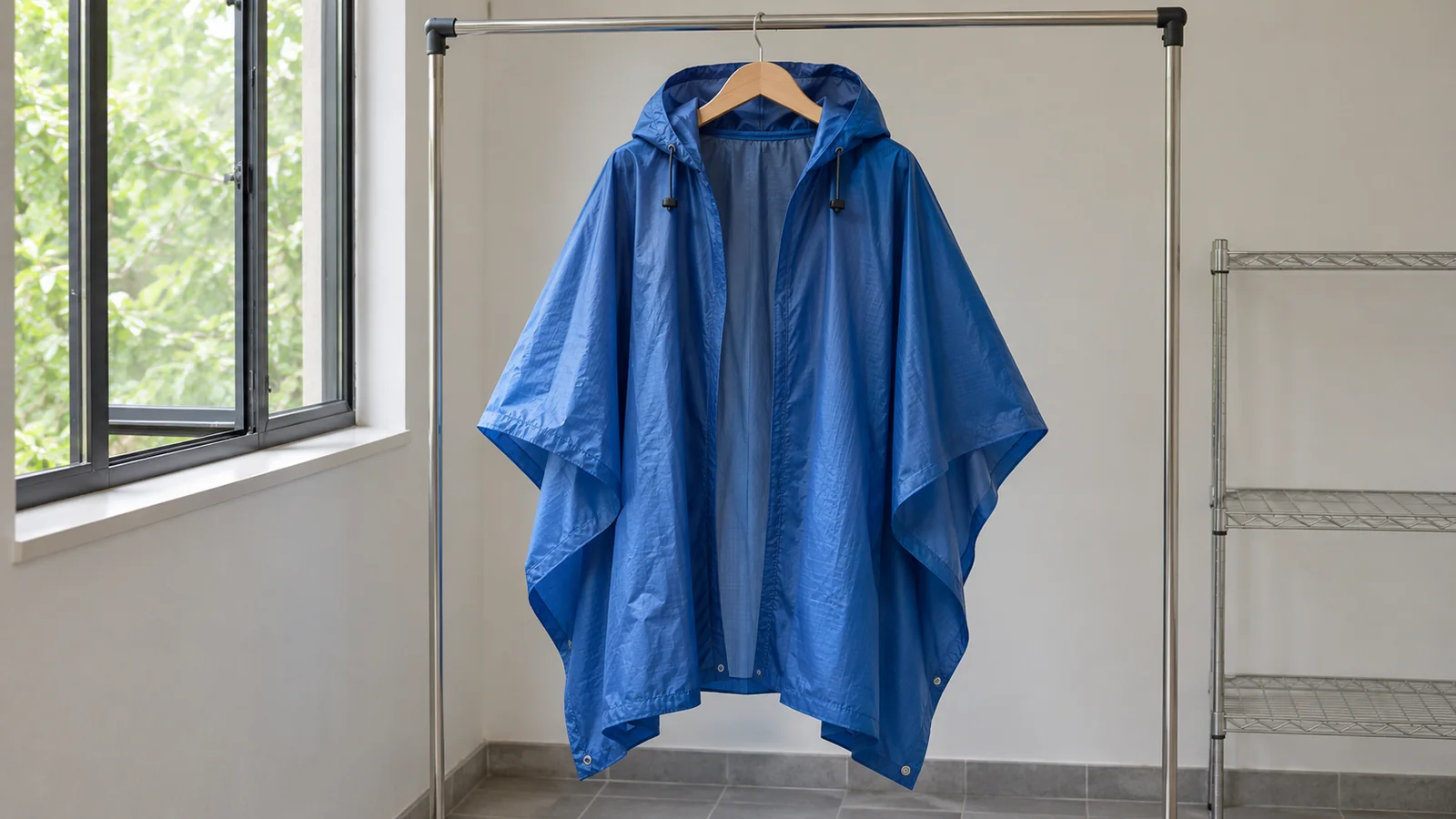
Start from instructions for the exact construction
Care instructions should describe the supplied garment, including its shell, coating, seam treatment, decoration and trims. Nylon alone is not enough information to select a cleaning method. Request the supplier's current instructions for the exact model and revision before approving the order. If the instructions are missing or ambiguous, treat that as an open product information question. Do not assemble a generic care label from several unrelated products and assume that their recommendations transfer to the offered construction.
Ask the supplier to address the practical actions a user will need to take. The guidance should explain the permitted cleaning approach, relevant restrictions, drying arrangement and storage condition. Where symbols are used, confirm that the final label and accompanying wording are appropriate for the destination and product. Procurement should verify the proposed information with the responsible supplier or qualified reviewer as needed. Avoid publishing universal wash temperatures, detergent types, ironing settings or dryer instructions when those details have not been confirmed for the actual garment.
Review the decorated version separately where necessary. A custom print or attached component may require consideration alongside the shell's care needs. Ask whether the proposed instructions apply to the complete supplied configuration, then keep the answer with the artwork and sample approval. If the supplier changes a decoration method or material during development, revisit the instructions before release. This is more useful than adding a vague handle with care warning that leaves the customer to guess which ordinary actions are acceptable.
Test the clarity of the information with an adult reviewer. Give the proposed instructions to someone who has not attended the development meetings and ask them to explain the routine in their own words. The purpose is to identify confusing language, missing steps or a mismatch between the text and the sample. It is not a substitute for technical validation of the care method. If the reviewer cannot identify which side is referenced or which closure should be opened, improve the instruction layout and have the supplier confirm the revised wording.
For a hypothetical rental or shared-use program, the buyer may have an established cleaning process. Describe that process to the supplier before selecting the garment, rather than assuming the poncho can tolerate it. The supplier may confirm compatibility, propose a different product or require further assessment. Do not promise a cleaning capability to the program until the relevant review is complete. A product that suits individual occasional use may not automatically meet a different operational routine, especially when the care requirements are part of the purchasing specification.
Approve the final instructions as a controlled product document. Identify the language versions, location on the product or pack, responsible reviewer and revision date. Ensure that the end user can still access the information after disposable outer packaging is removed. For repeat orders, ask whether the construction or guidance has changed and update the reference if necessary. Clear, model-specific instructions support practical use and help customer service answer questions consistently. They also prevent a buyer from turning a familiar fiber name into an unsupported cleaning recommendation that may not suit the complete coated and decorated poncho.
Make drying and storage practical
Drying and storage need a practical place in the buying brief, particularly when a poncho is intended for repeated use. Ask the supplier for the supported routine for the actual construction and review how users will follow it. A compact pouch is a carrying feature; its presence does not answer every question about handling a wet garment or preparing it for storage. Keep the instructions clear about the transition from use to the approved storage condition, without inventing a universal drying time or a climate-independent performance promise.
Review whether the garment can be opened and arranged as described in the instructions. Identify a suitable support or layout consistent with the supplier's guidance, and make sure the explanation refers to recognizable features of the sample. Do not prescribe direct heat, a machine cycle or a chemical treatment without construction-specific confirmation. If the program has limited space, ask how the proposed routine fits that setting. It may be necessary to adjust the operational plan or select a different product rather than expecting the garment to meet an unsupported shortcut.
Inspect the complete kit after following the approved sample routine. Consider the pouch as well as the poncho and clarify any separate care guidance for accessories. If the supplier's instruction says to store the item dry, make that condition visible in the user information and distribution briefing. Do not replace it with a promise that a damp kit can remain packed indefinitely. Where temporary transport after use is unavoidable, ask the supplier to explain an appropriate arrangement and the actions needed afterward, keeping that temporary state distinct from normal long-term storage.
For a staffed visitor program, allocate responsibility for returned items before distribution begins. Decide who receives the garment, checks its condition, follows the approved care routine and returns it to the available stock. Keep used and ready-to-issue items distinguishable in the operating process. These are suggested management steps, not claims about a particular poncho's hygiene performance. If the program requires specialized cleaning or infection-control procedures, obtain appropriate expertise and product-specific confirmation instead of assuming ordinary rainwear instructions cover those requirements.
Storage planning should also consider identification and access. Keep model, size and color information available when units are stored outside their shipping cartons. Preserve the supplier's stated storage limitations and avoid adding an invented shelf-life figure. If stock has been held for an extended period or its condition is uncertain, inspect representative items and seek guidance before distribution. The review should focus on the actual product and circumstances. An old purchase date alone does not establish either continued suitability or automatic failure.
Complete the buying record with the approved drying and storage guidance, the individual packing method and any operational arrangements the buyer needs. Check that marketing descriptions of compactness or repeat use do not contradict those instructions. When the product construction or pouch changes, confirm whether the routine remains applicable. This makes care practical rather than decorative text on a card. The user receives a manageable sequence, staff know how to prepare stock for the next handover, and the buyer avoids promising that every storage situation is suitable simply because the garment is made from nylon.
Define repair compatibility and retirement decisions
Repair guidance must begin with the actual material and coating, not with the general word nylon. Ask the garment supplier whether repairs are supported for the model, which types of damage can be assessed and what products or methods are appropriate. If the construction is uncertain, do not recommend a generic adhesive by appearance alone. Keep the original material description and care information available so the person assessing a damaged item has a reliable starting point rather than a catalog nickname.
GEAR AID distinguishes sealant choices for different coating systems, including silicone and polyurethane applications. The useful purchasing lesson is that compatibility matters. It is not a reason to prescribe one product or procedure for every rain poncho, and it does not confirm the coating on an unidentified garment. Obtain model-specific advice and follow the relevant product and garment instructions where a repair is supported. Avoid publishing universal cure times, application thicknesses or restored-performance claims without the evidence and instructions for the actual combination.
Define a simple reporting route for damaged items in a managed program. Record the model, location of damage, observed condition and relevant history, then remove the item from ready-to-issue stock while the decision is open. The responsible person can seek supplier advice and decide whether repair, replacement or another disposition is appropriate. Do not encourage staff to conceal damage with an improvised patch and return the garment to circulation without assessment. The process should make the item's status clear to the next person who handles it.
A repair decision should consider more than whether a patch adheres initially. Ask what function the affected area serves and whether the proposed action is supported for that location and use. A damaged seam, hood attachment or closure may raise different questions from a small surface mark. Where a product has a specific protective application or claim, obtain the appropriate qualified advice before deciding that a repair preserves it. This ordinary rainwear guide does not establish acceptance criteria for specialized protective equipment or certify the performance of repaired garments.
For a hypothetical visitor program, a staff member may notice separation at a join after an item is returned. The useful first record identifies the location and sample or batch reference. The supplier can then advise on assessment and any supported next step. The team should not assume the issue proves every unit is defective, nor should it dismiss the finding because the shell looks intact elsewhere. Review the specific condition, investigate related stock where appropriate and document the disposition so the same unresolved item is not issued repeatedly.
Include retirement and disposal questions in the operational plan without making environmental claims that the evidence cannot support. If an item cannot be returned to the required condition, decide how it will be removed from service and check the actual local route for its components. Repairability, recycled content and recyclability are separate subjects. A practical buyer keeps those distinctions clear, retains the relevant instructions and avoids promising indefinite service. The resulting process helps users recognize when advice is needed and gives staff a consistent way to handle damaged rainwear without treating an unverified repair as a guarantee of restored performance.
Review the wider repeat-use decisions in the reusable rain poncho selection guide.
10 / 12
Review custom branding, documentation and claims
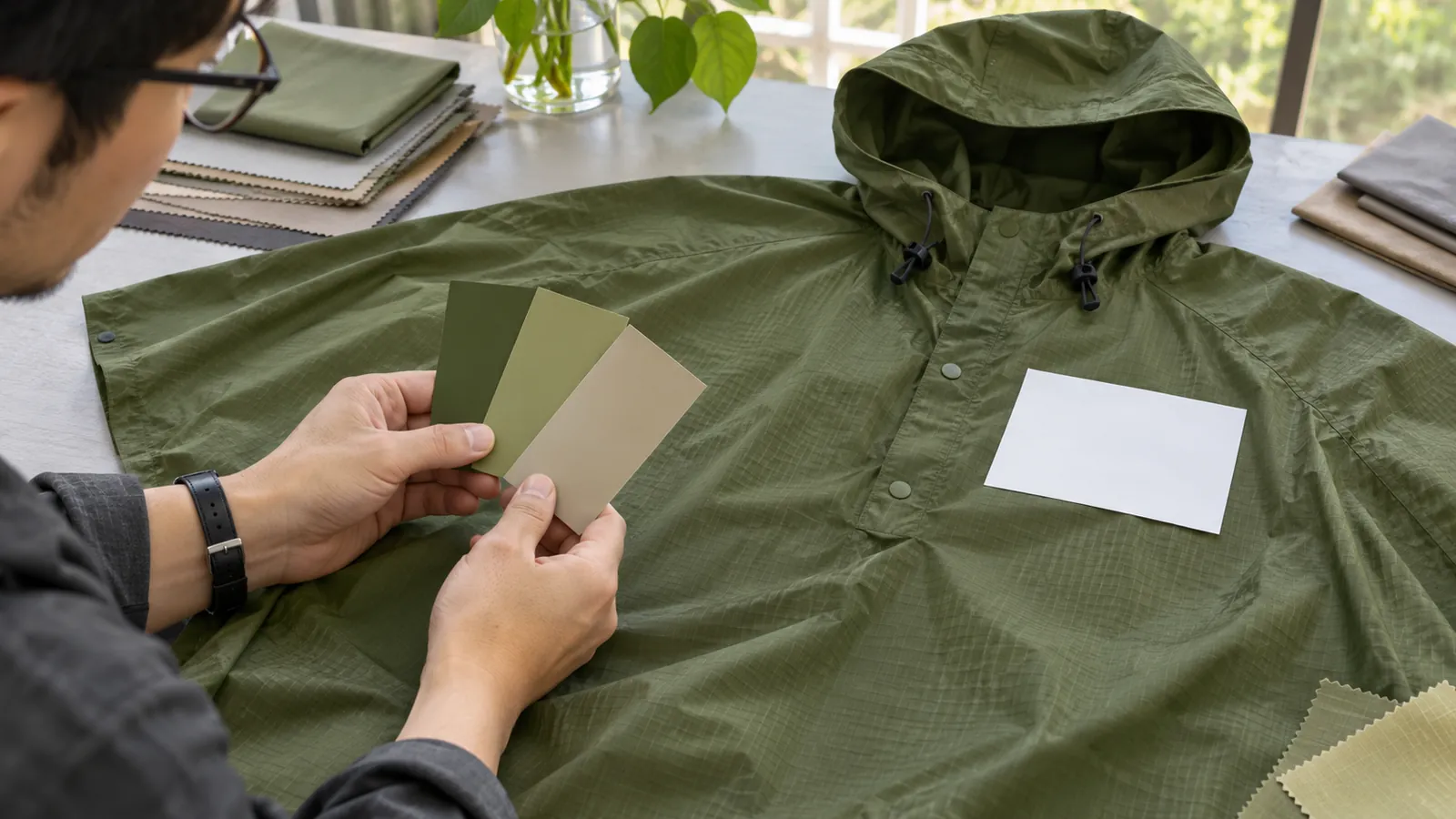
Approve the print on the actual coated fabric
A custom nylon poncho order should connect the artwork to a physical decorated sample. Begin with a placement drawing that identifies the front, back and any other approved location. State the artwork revision, dimensions and color references, and ask the supplier to review the proposed layout on the actual shell and coating. A digital mockup is useful for communicating intent, but it cannot establish the finished appearance, handling or compatibility of the decoration. Keep those approval stages separate so neither party mistakes a layout sign-off for complete product approval.
Review the visual hierarchy at normal viewing distance. A logo can look balanced on a flat drawing but sit differently when the hood, folds or bag coverage change the garment's shape. Ask an adult reviewer to wear the decorated sample in the intended configuration and assess the result. Record the accepted position using defined measurement points rather than a vague instruction such as slightly higher. If the order includes different sizes, ask whether the placement is constant or adjusted and identify the approved arrangement for each relevant variant.
Color approval should use the agreed physical reference and viewing conditions. A screen image can vary with the display and lighting, so do not make it the sole reference for a critical color decision. Compare the shell, print and pouch together where they form a coordinated kit. If the supplier proposes a practical limitation or an alternative, review that proposal before promising an exact result to a downstream customer. The quotation should identify the approved configuration and any conditions that remain subject to sampling.
Inspect the decorated area in relation to construction details. Check nearby seams, closures, folds and the inside surface, using the supplier's proposed review approach. Ask for relevant evidence where print durability or a care-related requirement forms part of the brief. Do not invent a universal adhesion or wash performance claim from one attractive sample. The supplier should explain the supported process and any applicable limitations for the offered construction, while the buyer should preserve the exact statement and reference sample that the approval covers.
For a hypothetical promotional order, two artwork versions may share a logo but use different sizes or positions. Treat them as defined variants in the approval and packing records. Confirm how quantities will be allocated and how staff will distinguish the versions at receiving. A late artwork change should be reviewed for its effect on cost, sample timing, placement and packing. Do not assume that a previous approval transfers automatically because the brand name remains the same. The physical arrangement, process and commercial scope may have changed.
Release the decorated order only when the relevant visual, construction and documentation decisions are aligned. Keep the final artwork, placement drawing, decorated sample, care instructions and current quotation together. Ask for advance review of substitutions that affect this combination. This gives the buyer a practical way to request consistent branding while keeping the supplier's commitments tied to an actual approved product. It also provides customer-facing teams with accurate photographs and descriptions of the selected arrangement, avoiding promises based only on an early concept or a different fabric's print trial.
Keep technical and environmental wording specific
Product wording should identify the actual feature or claim and the evidence supporting it. Nylon, ripstop, coated, reusable and recyclable do not mean the same thing. A construction description may be supported by the specification, while a performance or environmental statement may require different evidence and qualification. Review each proposed statement separately. Do not let a general preference for an environmentally responsible product become an unsupported claim that every nylon poncho has a lower impact or a beneficial end-of-life route.
The FTC Green Guides summary advises specificity and substantiation for environmental marketing claims. For a purchasing brief, this means asking what the claim refers to, which component it covers and what supporting information is available. A statement about recycled content does not automatically establish recyclability, and a broad green label can imply more than the evidence supports. Use the applicable guidance and qualified review for the destination market where necessary. Do not copy a supplier's general slogan into the final product page without examining its meaning.
If recycled content is proposed, identify the relevant component and the exact statement to be supported. Ask for the supplier's evidence and traceability information appropriate to the claim. Keep the shell, coating, trims and pouch distinct where their composition differs. Do not calculate a whole-product percentage from a shell-only statement without a valid basis. If the information is incomplete, leave the claim unapproved while continuing other product development work that does not depend on it. A clear material description is preferable to an invented environmental benefit.
End-of-life wording needs an actual route, not just a theoretical material category. Ask what local collection or recovery option applies to the finished construction and its components in the intended destination. Avoid promising that a coated or decorated garment belongs in a particular collection stream without confirmation. The buyer can provide appropriately scoped disposal information where it is supported, but should not treat a fiber name as proof of acceptance. Keep location-specific instructions separate from universal product descriptions so a change in destination triggers the right review.
Apply the same discipline to technical claims. A fabric report should support only the property, specimen and conditions it addresses. A visible grid is not a tearproof guarantee, and a short sample review is not proof of lifetime performance. If marketing wants a stronger statement than the current evidence supports, identify the additional work needed or narrow the wording. Do not solve the gap with a more emphatic adjective. The business can communicate useful features such as the approved construction, packed format and care guidance without overstating them.
Maintain a claim register with the proposed wording, evidence reference, applicable product revision, destination and approval status. Include statements on the website, packet, hangtag and sales sheet so contradictory versions do not circulate. Review the register when materials, decoration, instructions or destinations change. This is a practical editorial control, not a claim that every order requires the same legal process. It helps the buyer keep public language aligned with the actual product and gives sales staff a reliable answer when asked to explain a feature or substantiate a specific promise.
Build a clear wholesale quotation and change record
A useful wholesale enquiry identifies the product configuration before asking for a price. State the intended adult use, destination, quantities by variant, preferred construction and the samples or evidence needed for approval. Include the proposed artwork and packing requirements where available. If some details are undecided, identify them as options to quote rather than allowing several different assumptions to hide under one product name. The supplier can then respond to a defined request, and the buyer can compare commercial offers without silently comparing different garments.
Ask the quotation to separate the relevant cost elements and conditions. The appropriate breakdown depends on the project, but it may need to distinguish the garment, decoration, individual packing, sample work and delivery basis. Request current minimum quantities, production timing and any other commercial terms directly from the supplier. Do not assume that a number seen on a general product page applies to a custom configuration. Conflicting or outdated catalog information should be clarified in the current quotation rather than repeated as a promise in the purchase brief.
Define dates in a way both parties understand. A desired arrival date is not the same as a production completion date, and sample approval can affect the agreed sequence. Ask the supplier to identify the proposed milestones and what information or approvals are required to meet them. The buyer should avoid treating an estimated schedule as a guarantee unless the actual terms support that commitment. Keep the destination, delivery arrangement and outstanding decisions visible so timing discussions address the complete order rather than an isolated manufacturing estimate.
Maintain a revision record when the specification changes. A different shell, coating, color allocation, print position or pouch may affect the quote and sample requirements. Ask for a written explanation of the change and the updated commercial scope before approving it. Do not rely on a short message saying same as before if several versions exist. The current quotation should point to the accepted specification and artwork revisions, while the purchase order should identify the configuration and terms the buyer is actually accepting.
For a hypothetical order split across two destinations, the buyer may need different carton allocations or instruction languages. Put those requirements into the enquiry early and ask for the proposed arrangement. If the order later consolidates to one destination, review the relevant changes rather than assuming all costs and timing remain identical. A transparent comparison can show which options are included, excluded or pending confirmation. This allows the buyer to make a commercial decision based on current information without inventing a standard price or lead time for every nylon poncho program.
Finish the quotation review with a concise reconciliation: product revision, variants and quantities, decoration, packing, evidence and sample status, delivery basis, timing and change approval. Resolve discrepancies before release and preserve the accepted documents with the reference sample. A well-defined quotation does not eliminate every possible production or delivery issue, but it gives both parties a common basis for decisions. When an unexpected change arises, they can identify which requirement is affected and agree a documented response instead of debating what a generic product name was supposed to include.
Develop artwork and packing requirements with the custom rain poncho logos, colors and packaging guide.
11 / 12
Build an EAV specification and sample approval workflow

| Entity | Attribute | Value to agree | Verification |
|---|---|---|---|
| Shell | Fiber identity | [Confirmed composition; material reference] | Supplier declaration linked to sample |
| Fabric | Weave | [Plain weave or specified ripstop construction] | Labeled swatch and material description |
| Yarn | Linear density | [Relevant yarn; units; value where required] | Supplier specification |
| Finished fabric | Mass per area | [Coated or uncoated state; units; variation] | Agreed measurement and specification |
| Barrier | Coating or laminate | [Confirmed construction; treated side] | Supplier description and sample |
| Fabric evidence | Water penetration | [Method; edition; specimen; condition; result] | Applicable report and qualified review |
| Durability evidence | Relevant property | [Tear or abrasion requirement where needed] | Appropriate method and sample evidence |
| Joins | Seam construction | [Locations; treatment; approved details] | Finished sample and relevant evidence |
| Fit | Dimensions and hood | [Drawing points; values; tolerances; adult use] | Measurement and practical review |
| Garment | Mass | [Dry garment-only configuration; units; variation] | Agreed weighing procedure |
| Kit | Packed format | [Included components; dimensions; packing method] | Complete sample and handling review |
| Branding | Artwork and process | [File revision; placement; colors; supported method] | Decorated sample approval |
| Care | Instructions | [Construction-specific cleaning; drying; storage] | Supplier guidance and review |
| Claims | Exact wording | [Statement; component; destination; conditions] | Relevant substantiation and approval |
| Order | Release reference | [Specification; sample; quote; variant quantities] | Named release owner and change record |
Record entity, attribute, value and evidence
An EAV specification separates the thing being described from its characteristics and agreed values. For rainwear procurement, the entity might be the shell fabric, finished garment, print or pouch. The attribute might be composition, dimensions, placement or packed size. The value is the actual project requirement, with units and conditions where relevant. Add an evidence or verification column so the team knows how each entry will be confirmed. This creates a practical purchasing table rather than a list of attractive but uncheckable adjectives.
Begin with the shell. Record the declared fiber, weave description and any yarn information required for the project. Identify whether a mass value applies to the base fabric or the finished coated material. Add the coating or laminate description and side as confirmed by the supplier. Keep unknown entries visibly open. Do not populate the table with typical industry numbers that have not been established for the offered construction. A blank field with a responsible reviewer is more honest and useful than an invented value that later appears to be an approved specification.
For the finished garment, define dimensions using drawing points and state the relevant tolerances or acceptance arrangement agreed with the supplier. Identify hood construction, joins, seam treatment, closures and reinforcement where applicable. Add garment-only weight and the packed configuration as separate attributes if they matter to the brief. The table should connect each entry to the current sample revision. This makes it possible to distinguish a fabric change from a pattern change and to identify which evidence or practical checks need reconsideration.
Use the same discipline for branding and packing. Record the artwork revision, placement measurements, color reference and accepted decorated sample. Identify the pouch and individual packet separately, including the information supplied to the user. If the project has several variants, show which attributes are shared and which differ. Avoid a single general note that obscures different colors, sizes or artwork versions. The receiving team should be able to find the relevant requirement for a delivered variant without guessing which sample the buyer intended.
The verification column should name the actual route: supplier declaration, measurement, finished-sample inspection, relevant report or a specific approval record. It should not mark every attribute certified merely because one laboratory report exists. The evidence needs to match the property and component being described. If the buyer relies on a supplier statement for an identity field and a separate report for a performance field, preserve that distinction. This gives reviewers a clear view of both the strength and limits of the available information.
Treat the table as a controlled working document. Assign a revision, date and owner, and keep it aligned with the accepted quotation and sample. Changes should identify affected rows rather than replacing the whole specification with an unexplained new version. Before release, review open fields and decide which must be resolved for the order to proceed. The EAV format is useful because it makes those decisions visible. It does not replace technical judgment, supplier communication or physical sampling; it organizes them into a reference that purchasing, production and receiving can use consistently.
Use a sample review checklist with decisions
A sample checklist should lead to decisions, not merely collect ticks. Start with the identified garment and the intended scope of review. A color sample, a fit sample and a final decorated production reference may serve different purposes. State which one is being examined and what it can reasonably establish. Then group the checklist around material identity, construction, fit, evidence, branding, care and packing. Each item should point to a requirement in the specification or a clearly stated practical question from the buying brief.
Give reviewers a place to record observations and dispositions. Useful entries include accepted, clarification required, revised sample required and not applicable to this design. A bare pass box can hide an unresolved assumption, especially when several departments review different aspects. Ask the reviewer to identify the reference used and describe any discrepancy. If a requirement is not applicable, explain why rather than leaving an ambiguous blank. This helps the next person understand whether the item was considered, overlooked or deliberately excluded from the approved scope.
Review construction in a consistent sequence. Examine the outside and inside, follow the joins, inspect hood and closures, and compare dimensions with the drawing. Review the material and relevant evidence records alongside the physical sample. Then assess the ordinary adult fit and handling arrangement defined in the brief. The sequence can be adjusted for the project, but it should remain clear enough to repeat on a revised sample. Do not present an informal inspection as a standardized laboratory evaluation or a certification process.
Include the final user-facing elements. Check artwork position, visible wording, care information, size guidance and the packed format. Compare the decorated sample with the approved files and ask whether the instructions describe the actual configuration. If an outer sleeve contains essential care information, consider how the user will retain access after opening it. If the order includes language or artwork variants, identify the versions that require separate review. A complete garment approval should not leave the supplied information and individual packing as unexamined last-minute additions.
For a hypothetical review meeting, the fit may be accepted while the print placement and pouch opening remain open. The decision record should say exactly that. Assign an owner and next step for each unresolved item, and specify what the revised sample must show. Do not describe the whole product as approved simply because most checklist rows passed. Equally, preserve the accepted decisions so the next round focuses on the changes and their connected effects rather than unnecessarily restarting every discussion from the beginning.
Close each issue against a specific response, revised sample or documented decision. Keep the final checklist with the EAV table, quotation and physical reference. If the supplier proposes a later substitution, use the same structure to decide which checks must be repeated. This creates a manageable approval workflow with visible boundaries. The buyer knows what has been accepted, the supplier knows what remains to be resolved, and the receiving team can understand the final configuration without relying on the memory of people who attended the original sample meeting.
Release the purchase against controlled references
Purchase release should bring the product, evidence and commercial records into agreement. Identify the accepted specification revision, sample reference, artwork and packing configuration before issuing the final order. Check that the supplier's quotation describes the same model and variants. If several development versions exist, state which one supersedes the others. A familiar product name is not enough to establish the intended configuration, particularly when the project has changed its shell, hood, decoration or pouch during sampling.
Review the open-issue list explicitly. Decide which items must be closed before release and whether any remaining condition has a defined owner, deadline and effect on the order. Do not let an unresolved technical requirement disappear inside a commercial approval email. If the buyer accepts a documented exception, describe its scope and ensure the relevant decision-maker agrees. The purpose is to make the release understandable, not to impose one approval format on every business. A small order and a complex program may use different documents while preserving the same clarity.
Reconcile quantities and variants with the distribution plan. Confirm the allocation of colors, sizes, artwork versions and destinations, together with the agreed packing and identification. Check any instruction language requirements and ensure the supplied information matches the intended market. Where destination-specific requirements need qualified review, identify that work rather than assuming a general sample approval covers it. Keep commercial terms current and project-specific, including the delivery basis and agreed milestones. Do not copy an old quotation into a new order without confirming its applicability.
Define how changes will be handled after release. Ask the supplier to notify the buyer of proposed substitutions affecting the approved shell, coating, construction, trim, decoration or packing. The buyer should identify who can approve a change and what supporting information is needed. A revised configuration may require new evidence, a new sample or a narrower review, depending on what changed. Avoid automatic approval based only on a statement that the substitute is equivalent. Ask which attributes are unchanged and which must be reassessed.
Prepare receiving instructions from the approved records. Identify the reference sample, key dimensions and configuration checks, carton information and process for reporting deviations. Agree any sampling and acceptance arrangements rather than inventing a universal inspection plan. Give the receiving team enough information to recognize a mismatch and route it for decision. They should not be expected to recreate the entire development review, but they should know which product was ordered and what evidence or documentation accompanies the shipment.
Preserve the release package for repeat purchasing. When a new order is discussed, ask whether the construction, sources of components, decoration, care guidance or packing have changed, and assess the relevant answers. A repeat order can reuse valid references without treating them as permanently applicable to every future version. The controlled package makes that distinction practical. It connects the original buying brief to the goods the business expects to receive and provides a clear basis for resolving questions, approving changes and communicating the product accurately after delivery.
A named release owner should confirm that the final package is complete and accessible to the teams responsible for the order.
Connect the specification to the wholesale rainwear sourcing, branding and logistics guide.
12 / 12
Answer nylon and ripstop poncho buying questions
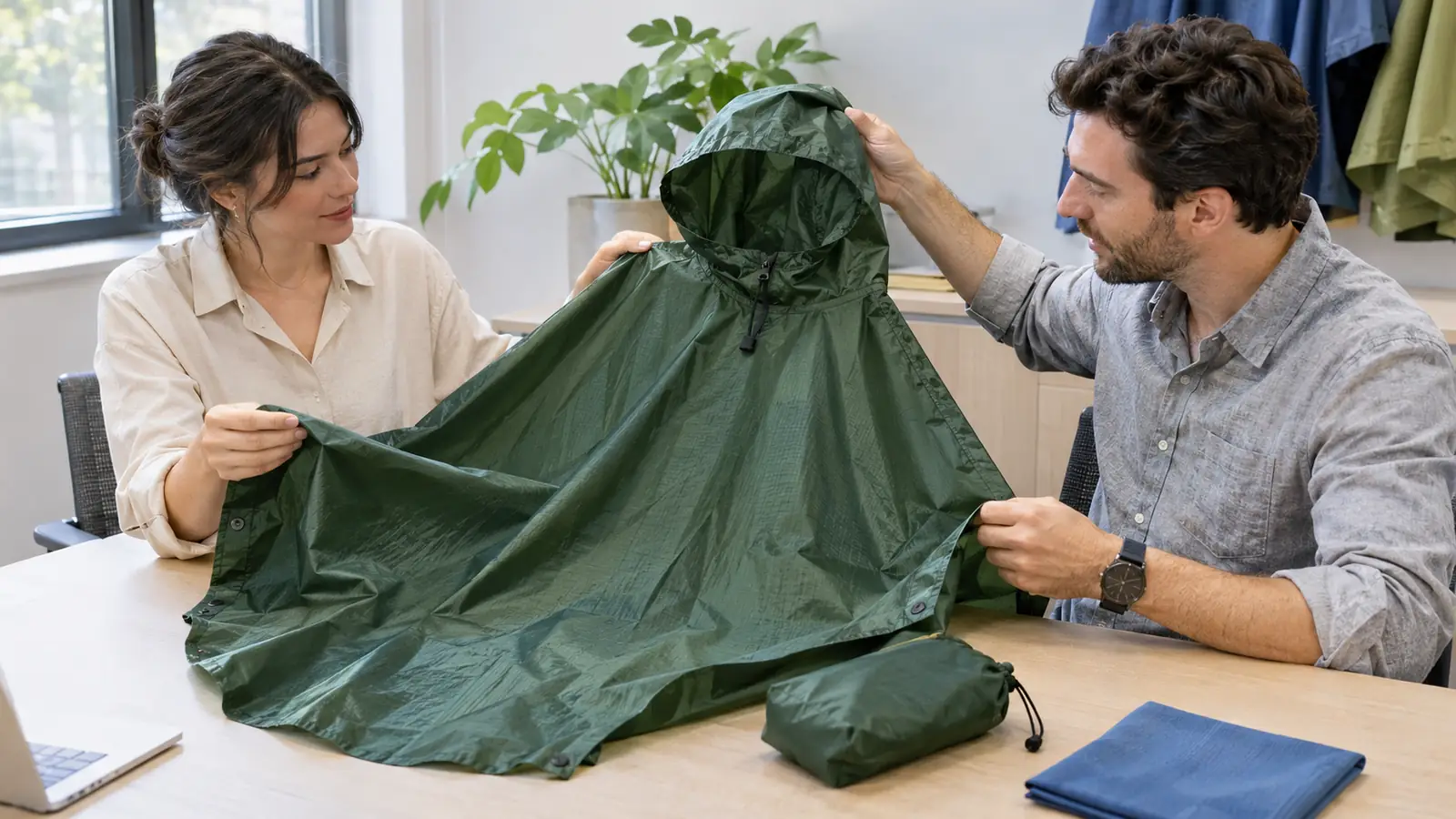
Is a nylon or ripstop poncho automatically waterproof
No. Nylon identifies the fiber, while ripstop describes a fabric construction. Neither term alone establishes the complete water barrier or the performance of the finished garment. A buyer should ask about the coating or laminate, the relevant fabric evidence, the seam construction and the intended coverage. This is the central distinction when comparing a nylon rain poncho with other options. The useful question is how the identified finished construction meets the actual buying brief, not whether an appealing material name can stand in for all of those details.
If a search or quotation uses the phrase nylon poncho waterproof, translate it into specific purchasing questions. What exact product is being offered? Which layer provides the claimed barrier? What report or evaluation supports the proposed wording, and which specimen and conditions does it cover? How are joins, openings and attachment points handled in the finished garment? These questions turn a broad search phrase into a reviewable specification. They also make it easier to compare suppliers whose catalog descriptions use different levels of technical detail.
A hydrostatic fabric result can be relevant, but it should retain its method, sample identity and limitations. Do not treat the number as a complete garment certificate or as proof that every wearer will remain dry for an unlimited time. Review the finished sample separately for the agreed construction, fit and practical use. If the project needs a defined whole-garment evaluation, arrange that through appropriate expertise and specify the decision criteria. An informal demonstration can raise useful questions without becoming evidence for a claim it was never designed to establish.
The same caution applies to breathability. A roomy poncho may provide ventilation through its design, while the shell has a separate moisture transport characteristic. Ask for evidence before using a specific fabric performance claim. Describe the actual openings and adjustments accurately, and preserve the supplier's guidance on intended use. Avoid promises of universal comfort or all-weather protection. A clear explanation of the construction and practical arrangement can help a buyer choose a suitable option without relying on adjectives that mean different things to different sellers.
For an adult everyday-use program, request a finished sample representing the proposed fabric, coating, seams and closures. Review it over the expected clothing and bag configuration, and keep a record of the accepted dimensions. Ask for current care instructions and any relevant limitations. If one part of the specification is still unclear, identify it and obtain the needed answer before approval. A sample that looks good in a photograph can remain a useful candidate while its evidence or construction details are being resolved; it should not receive an unsupported final performance endorsement.
The purchasing conclusion should therefore be specific: the named sample uses the confirmed construction, the relevant evidence has been reviewed for its stated scope, and the agreed garment checks have been completed. Marketing wording should follow that conclusion. If the available information supports only a narrower statement, use the narrower statement or obtain further evidence. This gives the buyer an accurate basis for selection and gives customers a product description tied to the actual offered poncho, rather than a guarantee inferred from the words nylon, coated or ripstop.
Which construction fits repeated use and compact packing
There is no single construction that can be selected as best for every repeated-use and compact-packing requirement. Start with the adult user's activity, clothing, carried items and practical care routine. Then compare complete samples against the relevant requirements. A ripstop rain poncho may be a candidate, but the grid alone does not establish its service life, packed convenience or suitability for a particular program. The shell, coating, seams, closures, dimensions and pouch need to be reviewed together.
Separate the measurable attributes from preferences. Record garment-only weight, kit weight and packed dimensions using equivalent configurations and agreed methods. Review drape, appearance and handling as identified observations. Ask for appropriate evidence where tear, abrasion or water penetration properties matter to the brief. Do not merge these different considerations into a claim that the lightest, heaviest or most visibly textured fabric is automatically the most durable. The final choice should explain the tradeoffs that matter to the actual users and the purchasing program.
Repeated use also requires a realistic care arrangement. Obtain instructions for the supplied construction and consider whether the intended users can follow them. A shared-use program with a defined cleaning process should disclose that requirement during selection and seek product-specific confirmation. An individual travel item may have a different routine. Do not promise a fixed number of uses, years of life or environmental benefit simply because a garment can be used again. Such statements require their own appropriate support and should not be inferred from a reusable description.
Compact packing should be demonstrated with the final garment and pouch. Ask a reviewer to follow the proposed instructions, remove the poncho and repack it. Check whether the packed format suits the intended bag or distribution space. A very small presentation pack may not be the most practical everyday option if the routine is difficult to repeat. If the team prefers a larger opening or a different closure, request a revised proposal and review it. Packaging is part of the complete product configuration, not an unrelated accessory that can be changed without consideration.
For a hypothetical commuter promotion, the buyer might choose a construction that meets the agreed evidence requirements and offers a manageable carrying format, even if another sample has a more pronounced grid or a lower advertised weight. A different program may prioritize a different balance. The decision record should state the actual reasons and preserve the approved reference. This makes repeat ordering more reliable and helps downstream staff explain the selection without inventing a universal ranking that the sample review does not support.
The practical answer is to choose against a defined brief: confirmed materials, relevant evidence, acceptable fit, workable care and an approved packed configuration. Ask the supplier for a current project-specific proposal rather than assuming a standard minimum quantity, price or lead time applies to every variation. Where a requirement cannot be met or confirmed, revise the brief or consider another suitable option. This approach keeps portability and repeated use connected to the actual garment and operating routine, giving the buyer a defensible decision rather than a promise based on a fabric nickname.
What should a buyer approve before a bulk order
Approve a complete product definition, a representative sample and a current commercial agreement before releasing a bulk order. The product definition should identify the shell, weave, coating or laminate, construction, dimensions, closures and any relevant evidence requirements. The representative sample should show the configuration being purchased, including decoration and packing where applicable. The commercial agreement should identify variants, quantities, delivery basis, timing and the conditions attached to the proposal. These records should refer to the same revision rather than several similar development versions.
Use the EAV table to check that each important attribute has an agreed value or a clearly identified open decision. Keep measurement methods and units visible. Do not allow a general phrase such as high quality to replace a defined requirement for dimensions, construction or evidence. Where a supplier declaration is the basis for an identity field, record it as such. Where a test report supports a particular property, preserve the sample and condition details. This makes the approval transparent without pretending every attribute has been independently certified.
Complete the practical sample review with the intended adult clothing, bag setup and ordinary movements. Inspect the garment inside and outside, follow the join arrangement and operate closures according to the instructions. Review the decorated area, appearance references and packed format. Record accepted features and unresolved items separately. If a revised sample is required, identify what it needs to show and close the relevant issues against the new reference. Do not combine partial approvals into a complete release without checking that the final supplied configuration is coherent.
Approve the information that accompanies the product. Check care and storage guidance, size information, intended-use limitations and the exact technical or environmental claims proposed for the packet and sales page. Ask qualified reviewers to address destination-specific requirements where needed. A supplier's general catalog claim should not automatically become the buyer's approved wording. Keep the evidence and scope linked to each statement, and remove or narrow claims that remain unsupported. This helps customer service answer questions consistently after the order has moved beyond the development team.
Reconcile the quotation with the specification and distribution plan. Confirm quantities by variant, artwork versions, individual packing, carton allocation and required documents. Ask for current commercial terms rather than assuming that an older order or a general website listing applies unchanged. Identify which approvals are needed for the proposed schedule and who can authorize changes. If the supplier proposes a substitution after release, review its effect on the agreed attributes before accepting it. The change process should be clear enough to use when timing becomes tight.
Finally, prepare the receiving reference and retain the release package. The receiving team needs to identify the ordered configuration, check the agreed characteristics and report deviations through a defined route. Preserve the approved sample, drawings, artwork, instructions, evidence and accepted quotation for repeat orders. A well-prepared bulk purchase is therefore more than a price and a fabric name. It is a shared, traceable description of what will be supplied, how the relevant requirements were assessed and how changes will be handled. Bring those details to the supplier discussion so the resulting proposal addresses the actual project and supports a clear approval decision.
Nylon and ripstop poncho purchase checklist
- Define adult users, ordinary activity, clothing, bags and destination.
- Confirm shell fiber, weave, coating side and seam construction.
- Review appropriate material evidence within its actual scope.
- Agree dimensions, weight configurations and practical sample checks.
- Approve artwork on the actual coated fabric.
- Confirm construction-specific care, repair and storage guidance.
- Review the complete pouch, packet and distribution proposal.
- Reconcile specification, sample, current quotation and change control.
| RFQ field | Buyer entry |
|---|---|
| Use | [Adult audience; activity; clothing; bag; destination] |
| Construction | [Fiber; weave; coating; seams; drawing; dimensions] |
| Evidence | [Required property; suitable method; condition; report scope] |
| Branding | [Artwork; placement; colors; decorated sample] |
| Care and packing | [Instructions; pouch; packet; carton allocation] |
| Commercial scope | [Variants; quantities; delivery basis; required dates] |
| Approval | [Reference revision; open issues; reviewers; change process] |
Return to the rain poncho selection guide or use the bulk purchasing guide to organize your enquiry.