
Plastic ponchos - Material, measurements and everyday use
Plastic Rain Ponchos: Materials, Thickness and Everyday Uses
A plastic rain poncho can be easy to carry and quick to distribute, but its product name tells a buyer very little about the material, coverage or finished construction. This guide turns those unknowns into practical specification, sample and purchasing decisions for wholesale rainwear programs.
Identify the offered film, compare complete samples and approve the garment and packet together.
From a generic product name to an approved poncho order
- 1. Define the useIdentify adult wearers, clothing, activity and destination.
- 2. Confirm the materialIdentify the main film, components and individual packet.
- 3. Measure and handleReview thickness, weight, coverage, joins and packet opening.
- 4. Check evidence and disposalMatch proposed claims and instructions to the product and destination.
- 5. Approve and controlAlign the specification, quotation, receiving checks and changes.
Return unresolved material, fit or evidence questions for review before release. Recheck affected decisions when the construction, artwork or destination changes.
| Buying question | What to request | Decision to preserve |
|---|---|---|
| What does plastic identify? | Confirmed film and component description | Actual material scope; unresolved details |
| How is the garment specified? | Thickness, weight and dimension methods | Comparable values and approved sample |
| How will it be used? | Adult fit, openings, joins and packet review | Practical use and handling limitations |
| What can be said after use? | Product evidence and actual local collection answer | Exact claims and destination-specific instructions |
01 / 12
Identify what a plastic rain poncho actually contains
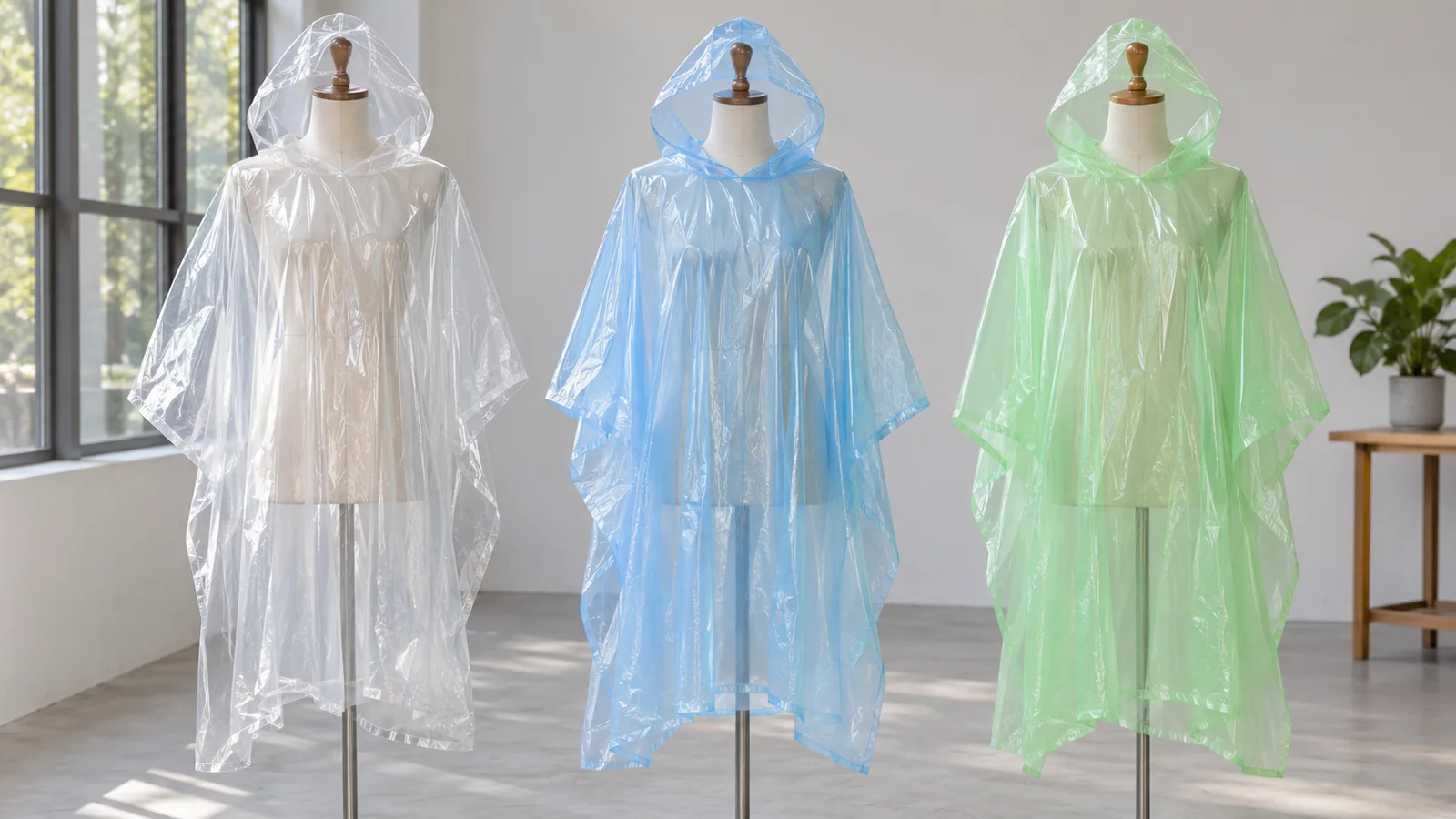
Translate generic product names into a material specification
A plastic rain poncho is a product category, not a complete material specification. The name usually tells a buyer that a flexible plastic surface forms a substantial part of the garment, but it does not identify the polymer, the formulation, the thickness or the joining method. A supplier may use similar photographs for several constructions. Begin an enquiry by asking what the actual offered model is made from and which document connects that answer to the sample. This simple distinction prevents an attractive picture from becoming an accidental technical commitment in a purchase order.
Describe the item in ordinary purchasing language before adding specialist terms. Identify an adult hooded pullover, an open-sided cape with snaps, or another clearly drawn format. Record whether the main body is unsupported film or a construction containing textile reinforcement. State the proposed material exactly as the supplier identifies it, while marking unresolved information as pending. If a listing only says plastic, retain that description until the supplier supplies a defensible answer. Do not convert it to polyethylene merely because the garment is clear, thin, inexpensive or packed in a small pouch.
Create a short identity record that can travel with every discussion. It should include the supplier model number, sample date, photograph, drawing revision, material description and intended use. A buyer can then ask whether a quotation, measurement sheet and decorated sample all refer to that same item. Keep the original wording alongside any normalized purchasing terminology so that a translation does not erase an important distinction. Where a supplier uses an abbreviation, request the full name and its scope. An abbreviation on an outer bag might refer to that bag rather than the poncho inside.
Consider a hypothetical visitor program comparing two clear ponchos. Both samples look similar when folded, and both fit the same reception drawer. One quotation names a particular polyethylene construction; the other provides no material description. Those offers are not yet equivalent. The useful next step is a clarification request, not an assumption that their materials match. Ask the second supplier to identify the film and confirm that the response applies to the finished sample. Meanwhile, compare measurable dimensions and packet size, because those observations remain useful even while material identity is unresolved.
Avoid turning identity into an automatic performance ranking. A confirmed polymer name does not settle how easily the neckline opens, whether the side snaps are usable, or how the garment behaves over a winter jacket. Those questions require finished samples and an agreed evaluation. The material record should therefore sit beside the garment drawing and sample notes, rather than replacing them. If a supplier proposes a blend, a multilayer film or a proprietary formulation, establish what information can be provided and what independent evidence is needed for the particular claim or purchasing requirement.
Finish this stage with a description that another buyer could recognize without seeing your email history. For example, specify the approved adult poncho model, its confirmed main-body construction, the drawing revision and the associated sample reference. Leave no ambiguity over which items remain subject to approval. This record does not require publication of confidential formulation details; it requires enough reliable information to define the product being ordered. Once the identity is clear, thickness, weight, packaging and everyday use can be compared on a common basis instead of on the strength of a generic product name.
Separate the garment film from trims and packaging
A poncho order contains more than one material decision. The main body may be one plastic, the snaps another, and the individual packet a third construction. Printing, labels, cords and any separate carrying pouch introduce further components. Treating the complete delivery as a single undifferentiated plastic item creates avoidable confusion when reviewing specifications, instructions or disposal wording. Start with a simple component map. A drawing or photograph can identify each part without requiring a complex engineering document, provided the supplier confirms that it represents the offered finished product.
For the garment itself, distinguish the body panels, hood, seams and closures. Ask whether the hood uses the same film as the body and whether reinforcement is added at the neck or fastening points. A visually similar patch may have a different construction or joining process. Where there is no reinforcement, record that accurately instead of adding it because another sample had it. If the model has no cords, preserve that simple design in the approved specification. Optional additions should remain proposals until their effect on fit, handling and relevant requirements has been reviewed.
Give the packet its own line in the record. Include its material description, closure type, opening method, printed information and dimensions in the supplied state. If an insert card or paper sleeve is included, identify it separately. A clear packet is not evidence that the poncho is made from the same resin. Likewise, a recycling statement printed on the packet may concern only the packet. Ask the supplier to explain the scope of every material or environmental marking before copying it into a catalogue, customer presentation or event instruction sheet.
This separation helps with everyday operational questions. A hotel may want the poncho to fit inside an amenity kit, while its housekeeping team needs the packet to open without scissors. A tour operator may prefer a simple outer sleeve that staff can count quickly. An outdoor brand may require an existing pouch size to fit a display fixture. These are different decisions from the garment's film thickness. Reviewing them separately makes it easier to change an unsuitable packet without silently changing the rainwear that was already approved.
Use a component-level change log when options evolve. If a supplier offers a new snap, confirm its appearance, attachment and opening behavior on a finished sample. If the packet changes, verify that the folding method and printed instructions still work. Record which evidence applies to the changed part and whether other reviews need updating. Do not assume that approval of the body film automatically approves every accessory. Conversely, do not require irrelevant documents for a component simply because another part of the order needs a specific assessment; match the request to its actual purpose.
The result should be a short, usable bill of materials and packing description. It can be as simple as a table naming the main film, hood construction, fastening details, decoration, individual packet and outer carton arrangement. Assign an owner to unresolved lines and keep the approved version with the reference sample. This gives purchasing, artwork, receiving and customer-facing teams the same understanding of what the order contains. It also creates a reliable starting point for disposal planning, because the garment and each packaging component can be discussed with the relevant collection provider on their own merits.
Resolve unknown materials before making claims
Unknown material information should be visible in the buying process. It is better to record a question clearly than to fill a gap with a familiar resin name or a reassuring phrase. A supplier's answer may arrive in stages, particularly when a trading company is obtaining details from a production partner. Define what is needed before approval and who will provide it. This keeps the project moving without allowing an incomplete description to become a public claim. It also prevents later teams from mistaking an early working assumption for a verified specification.
Separate three kinds of information: what the supplier states, what the buyer observes, and what a relevant assessment establishes. A supplier may state that a film is polyethylene. A buyer can observe the supplied color, dimensions and appearance. A suitable laboratory assessment may answer a particular identification or performance question. These records support different conclusions. A photograph of a sample cannot establish its chemical composition, and a material identification result does not automatically establish the performance of every seam, closure or finished garment in a future shipment.
Frame requests narrowly enough to obtain useful answers. Instead of asking whether a poncho is safe, ask which product requirements apply to the intended users and destination, what evidence is available for the offered construction, and which parts or claims that evidence covers. Instead of asking whether it is environmentally friendly, identify the precise statement under consideration and the evidence needed to support it. Broad questions often produce broad assurances. Specific questions reveal whether the supplier has a document tied to the actual product or only a general statement about a material family.
Do not use improvised burning, solvent or odor checks as a substitute for appropriate identification. A buying team does not need to create an unsafe experiment to resolve a documentation gap. Ask the supplier for traceable information, and use a competent specialist when a remaining uncertainty matters to the order. Keep the sample intact for comparison where possible. If analytical work is commissioned, agree the question, sample identity and reporting scope in advance. The purpose is to resolve an actual decision, not to accumulate technical-looking paperwork that does not address the offered garment.
A practical decision log can record the question, its consequence, the evidence requested, the responsible person and the approval status. For example, an unresolved film identity may prevent a proposed material-specific catalogue description, while a confirmed packet dimension can still support a drawer-fit trial. This distinction allows independent work to continue. It does not authorize release of the whole order before its essential requirements are met. Make the boundary explicit so that a production deadline does not silently turn an unresolved item into an accepted deviation.
When the information arrives, update every affected document rather than only replying to the latest email. Check the specification, sample label, quotation, artwork and intended customer description. Remove any earlier wording that no longer matches the confirmed facts. Retain the clarification and its date with the approval record, especially if a supplier corrected an earlier statement. This disciplined approach is particularly useful for a clear plastic rain poncho, where visual similarity can conceal different constructions. The purchasing decision becomes stronger because it is based on a traceable product description and relevant evidence, not on confidence created by a generic label.
Compare the wider categories in the rain poncho types, materials and uses guide.
02 / 12
Compare confirmed PE and other film options

Use polymer families as a starting point for questions
Polyethylene is one possible material family for a plastic poncho, but the word plastic covers a wider range of constructions. When polyethylene is confirmed, buyers may encounter terms such as low-density polyethylene or linear low-density polyethylene. Dow's polyethylene portfolio distinguishes several PE families, including LDPE, LLDPE and HDPE. That classification is useful background for asking a supplier what it offers. It is not evidence that a particular poncho uses a Dow resin, and it does not justify transferring a resin supplier's performance statements directly to a finished garment.
Ask the supplier to explain its proposed description in relation to the actual model. If the answer names a blend, request enough information to define the agreed construction and the limits of acceptable substitution. The buyer may not need access to every confidential formulation detail, but the order should not leave the main material entirely undefined. Specify which information is part of the commercial description, which is supporting technical information, and which requires specialist review. Keep the same terminology across the quotation, sample label and purchasing specification.
Other plastic rainwear may be identified as EVA, PEVA, PVC or another construction. These names should lead to appropriate follow-up questions rather than a universal ranking from best to worst. A particular program might favor a certain hand feel, fold size or closure design, but those requirements must be checked on offered samples. Compare the real garment rather than a list of generalized material advantages. If a supplier changes both the material and the pattern at once, treat the proposal as a different option because the effects cannot be attributed to the resin alone.
Pay attention to the level at which evidence was produced. A raw-material data sheet describes a specific material under stated conditions. A film report concerns the tested film. A finished-product evaluation may address additional construction features. None should be silently substituted for another. Ask the supplier to identify the specimen, method, result and intended relevance. If the evidence is being used to support a claim about the poncho, determine whether the connection is adequate for that exact claim, destination and construction. This is especially important where printing, closures or reinforcement differ from the tested sample.
A useful comparison sheet can contain one column for confirmed material identity and separate columns for finished dimensions, measured weight, packet size and observed handling. Leave unverified fields blank or explicitly pending. This layout prevents the material name from dominating decisions that depend on several factors. It also makes competing quotations easier to clarify. If one supplier gives a detailed identity and another only says premium plastic, the missing information is visible without prematurely rejecting a sample that may otherwise be suitable.
Use polymer terminology to narrow questions, then return to the purpose of the order. A rainwear program for short walks between sheltered locations has a different brief from repeated outdoor work. The buyer should define the intended use, request suitable constructions and review samples against that brief. Supplier recommendations can be valuable, but the final record should explain why a specific offered model was selected. The strongest decision combines confirmed identity with appropriate garment evidence, practical handling and a clear specification that the next shipment can be checked against.
Compare complete samples without assuming equal performance
Material comparisons become useful when the samples represent the products that could actually be ordered. Loose swatches help explain surface feel and appearance, but they do not show whether a hood is awkward, a snap is difficult to open or a folded packet is easy to distribute. Request finished samples with the proposed construction and identify any differences from production. If the sample is only a preliminary version, mark its limitations clearly. A buyer can learn from it without treating it as final approval for details that have not yet been supplied.
Define a small set of decisions before examining the samples. For a visitor program, these might include adult coverage over clothing, ease of opening, packet fit in a reception drawer and acceptable appearance over a uniform. For a promotional order, decoration placement and packed presentation may also matter. Write the decisions in language that operational staff can use. An instruction to compare quality is too broad; an instruction to record whether the neckline opens comfortably over the intended clothing gives reviewers something specific to observe.
Keep conditions comparable wherever practical. Review the garments over similar clothing, use the same sequence of ordinary movements, and record whether a bag is worn inside or outside the poncho. Compare packet dimensions in the supplied state rather than compressing one sample more tightly than another. When weighing, use the same unpacked or packed basis. These steps do not transform an informal review into a certified test. They make the observations more intelligible and reduce the chance that an apparent difference is simply a difference in how the samples were handled.
Record strengths and limitations separately. One model may be easier to unfold, while another has a preferred hood shape. A compact packet may be useful for a travel kit but less convenient to reopen after use. These are legitimate trade-offs. Do not hide them behind a single numerical score unless the scoring criteria and their importance are understood. A short explanation often serves purchasing better than a total that suggests false precision. Include photographs of the relevant detail, with the sample reference visible in the record rather than permanently marking the garment itself.
Consider a hypothetical comparison between a clear pullover and a colored side-snap cape. If the cape covers a small backpack more comfortably, that does not prove its material is inherently superior. The pattern and opening arrangement may explain the difference. Ask whether the preferred construction is available in the required material and size, then review that version. This avoids requesting an unsupported combination of features assembled from several different samples. The final approved product must exist as one coherent construction, not as a wish list drawn from unrelated photographs.
Close the comparison by identifying the selected model, the reasons for selection and the remaining conditions. Keep rejected options in the record if their differences explain the decision, but do not let them remain active references in production correspondence. Request a final sample when important changes are made. Confirm that the quotation, artwork and packing specification all point to the same version. Complete-sample comparison then becomes a practical bridge between material research and a repeatable purchasing decision, with enough detail for another reviewer to understand what was actually approved.
Document material substitutions and approval boundaries
A material description has limited value if it can change without anyone noticing. Once a sample is approved, state which aspects are controlled and how proposed substitutions will be reviewed. This does not require the buyer to prohibit every future improvement. It requires a clear route for evaluating changes before they affect an order. The route should cover the main film, its construction, color, relevant additives or recycled-content claims, and components whose changes could affect the agreed use or evidence. Match the level of control to the importance of the characteristic.
Ask the supplier to identify a proposed alternative in writing. The request should explain what changes, why the change is proposed, which specifications remain the same and which evidence may need updating. A statement that the replacement is equivalent is a starting claim, not a complete assessment. The buyer needs to know the basis of equivalence. If the alternative changes appearance, fold behavior, print compatibility or the scope of a report, those effects should be visible before approval rather than discovered when cartons arrive.
Separate commercial acceptance from technical approval. Purchasing may agree to consider an option without authorizing production. An artwork team may approve a color appearance without approving a material substitution. An operations team may confirm that the packet fits its storage space without reviewing product evidence. Name the decisions and reviewers so that one department's email cannot be mistaken for approval of the entire change. This is particularly helpful for organizations where sourcing, branding and event operations are handled by different people or external agencies.
Use a focused comparison instead of automatically repeating every earlier activity. Review the characteristics affected by the change and determine whether linked decisions also need attention. A different packet closure may require a new opening check and artwork position review. A change to the main film may require a broader sample and evidence assessment. Document why a particular review is sufficient for the proposed change. Where uncertainty remains, obtain qualified advice rather than declaring the alternative acceptable solely because its nominal thickness matches the earlier sample.
Keep old and new references distinguishable. Update revision numbers, sample labels and the purchasing description. State whether the change applies to the current order, a future replenishment or only a trial. Avoid using phrases such as latest sample without a date or identifier. If several colors or sizes are ordered, specify which variants are affected. An approved change to one model should not silently spread to every item in the program. The receiving team should be able to tell which version belongs in a particular shipment.
Finally, retain a simple decision trail: proposal, supporting information, review outcome and release authorization. If a substitution is declined, communicate the reason and the required original specification. If it is accepted with conditions, include those conditions in the order record. This protects the practical work invested in sample review without pretending that a document alone guarantees consistent production. The buyer still needs agreed receiving checks and a response process for discrepancies. Change control keeps those checks meaningful by ensuring that everyone is comparing the delivery with the same approved product.
Review specific alternatives in the EVA raincoat and poncho guide and the PVC rainwear selection guide.
03 / 12
Specify film thickness with meaningful measurements

State microns, millimeters and the measurement scope
Thickness is useful only when the number and its meaning are clear. A quotation that says heavy, premium or extra thick leaves the buyer without a measurable reference. Ask for a numerical thickness, its unit and the part of the garment being described. For plastic film, microns and millimeters are commonly encountered units. One millimeter equals one thousand microns, so a stated value of 0.03 millimeters is 30 microns. That conversion explains the units; it is not a recommended poncho thickness or evidence that a particular product meets an intended use.
Check whether the quoted value refers to one film layer. A folded poncho contains overlapping panels, seams and creases, and a measurement taken through several layers cannot be treated as the thickness of a single sheet. A reinforced neckline may also differ from the main body. Ask the supplier to show where the stated value applies on a drawing or sample photograph. If the construction includes several distinct layers, request a description that distinguishes total construction thickness from any individual layer value being offered.
Treat ambiguous gauge terminology carefully. Different industries and suppliers may use gauge in ways that are not immediately comparable. Ask for the value in a clearly defined unit and request the conversion basis if a supplier's existing specification uses another convention. Do not perform an assumed conversion and silently place it into an order. The clarification should come from the party responsible for the specification, with the resulting unit agreed by both sides. A short written answer at this stage can prevent a large misunderstanding later.
Distinguish nominal thickness from the readings obtained on particular samples. A nominal value may describe a target, while actual measurements vary across locations or specimens. The purchase specification should explain the permitted variation and the evaluation basis. Avoid inventing a universal tolerance for every film or order. Ask what the supplier can consistently provide, what the application requires and how disagreements will be resolved. Record the resulting agreement alongside the measurement method, because a tolerance without a method can still leave room for conflicting interpretations.
A hypothetical quotation comparison illustrates the problem. Supplier A states a single-layer film target in microns with an agreed range; supplier B gives only a garment weight and calls the product thick. The buyer cannot infer B's film thickness from that weight alone. The poncho may have a different pattern area, hood construction or set of closures. Request the missing measurement information and compare the finished samples. Weight remains a useful independent observation, but it should not be used to manufacture a thickness specification that the supplier has never confirmed.
The final thickness line should identify the relevant film, unit, target or agreed range, measurement locations and method reference. Note any areas that are intentionally different, such as seams or reinforcement. Keep a dated sample record so that future reviewers can understand what the value meant when the product was approved. This level of clarity makes thickness a useful purchasing attribute. It also prevents a large number, an unfamiliar unit or a vague marketing adjective from carrying more weight than the actual construction and finished-product review.
Agree measurement points, method and acceptable variation
Two thickness readings can differ because the film differs, because the locations differ, or because the measurement procedures differ. Before interpreting the numbers, establish how they were obtained. Ask the supplier or laboratory to identify the instrument, specimen preparation, measurement locations and reporting approach appropriate to the task. The buyer does not need to improvise a laboratory procedure. The objective is to understand the basis of comparison and agree a workable method for the purchasing decision, rather than relying on isolated readings with no context.
ASTM's D6988 guide addresses thickness determination for plastic film test specimens used in property calculations. Its scope distinguishes that purpose from commercial sampling and quality-control arrangements. Accordingly, citing the guide does not by itself define a shipment acceptance plan. Ask a qualified laboratory to confirm the relevant edition and method for any formal work, and separately agree the commercial inspection arrangement. This keeps the technical reference in its proper role while leaving the buyer and supplier responsible for defining how an order will actually be evaluated.
For a practical sample review, agree which body areas represent the main film and which features need separate attention. A seam or doubled edge should not be mixed into a set of single-layer body readings without explanation. Record the locations on a simple drawing so that another reviewer can repeat the comparison. If the supplier reports an average, request enough underlying information to understand the variation. An average can be useful, but it may conceal a location that matters to the buyer's specific construction or acceptance requirement.
Discuss specimen handling with the person responsible for the method. Thin flexible film can be awkward to position consistently, and different instruments or contact arrangements may produce different results. Do not flatten, stretch or stack material in an improvised way and then compare that reading directly with a laboratory report. If the buying team uses a portable tool for screening, identify that activity as a screening check. A disagreement should trigger review of the method and specimen rather than an immediate conclusion that one party supplied false information.
Define the acceptance logic before a shipment is inspected. State what is being sampled, how many observations are required under the agreed plan, which values are evaluated, and what happens if the findings do not meet the specification. The appropriate arrangement depends on the order and its risks; there is no universal sample count supplied by this guide. Use competent inspection advice where necessary. A clear plan is more useful than repeatedly measuring one convenient garment and assuming it represents every carton.
Preserve the report with the sample and order references. Include the date, person or laboratory, instrument or method identification, units and any qualifications. If a later measurement conflicts with the original record, compare the procedures before changing the specification. Document the resolution and any recheck. Consistent measurement does not remove the need to inspect fit, seams and handling, but it gives the thickness discussion a defensible foundation. The buyer can then distinguish a real construction difference from a difference created by the way the film was measured.
Read thickness alongside seams, fit and handling
Thickness is one attribute of a rain poncho, not a complete description of its usefulness. A buyer can specify it precisely and still receive a garment that is awkward to put on, too short for the intended clothing or poorly suited to the planned packet. Review thickness alongside the pattern, hood, joins and closures. The purchasing question is whether the offered finished construction suits the defined use. Avoid treating a larger thickness value as automatic proof of better rain protection, longer service life or easier handling.
Consider the points where ordinary use places demands on the garment. Opening the neckline, pulling the poncho over a jacket, fastening a side snap and removing it without dragging the hood are different actions. Observe those actions on the complete sample. If a reviewer struggles, identify whether the issue comes from the opening size, the placement of a join, the closure design or another detail. A material change may help in some cases, but a pattern or construction change may be the more relevant proposal. Ask the supplier to explain the proposed solution.
Packed size adds another trade-off. A buyer may prefer a compact unit for a small travel kit, but the final dimensions depend on the entire garment and folding arrangement. Do not assume that a thickness reduction alone will deliver a specified packet size. Request the actual packed sample and check that it opens normally. If the packet has been compressed unusually tightly for presentation, it may not represent routine production or user handling. The compactness decision should therefore include both the supplied unit and the ordinary process of taking the poncho out.
Appearance and comfort should also be reviewed directly. A clear film may show underlying clothing differently when its surface, folds or construction changes. A garment that looks satisfactory on a dress form may behave differently while an adult turns their head or reaches into a pocket. Record the conditions of the review, including clothing and activity. Do not convert a subjective preference into an unsupported technical claim. It is entirely useful to say that the reviewing team preferred one sample's drape, provided that preference is not presented as a universal material property.
If a supplier proposes a thicker version, ask what else changes. The hood pattern, joining process, snap attachment, folding method or packet may need to be reconsidered. Request a finished sample of the proposed version rather than approving it from a swatch alone. Where the buyer has already approved artwork or instructions, check whether those decisions still apply. A specification should describe one coherent product; it should not combine the thickness of one version with the fit, packing and evidence of another without confirming that the combination can actually be supplied.
Use the final review to identify the minimum information needed for a repeatable decision. Keep the agreed thickness line, the approved drawing, sample reference, practical observations and relevant evidence together. Explain why the selected construction fits the intended program and record any limitations. This makes it easier to compare future proposals without restarting from vague labels such as light or heavy. Thickness becomes a controlled part of a broader product specification, while the actual garment remains the object of approval.
Connect measurement questions with the raincoat materials comparison.
04 / 12
Understand garment weight and packed dimensions
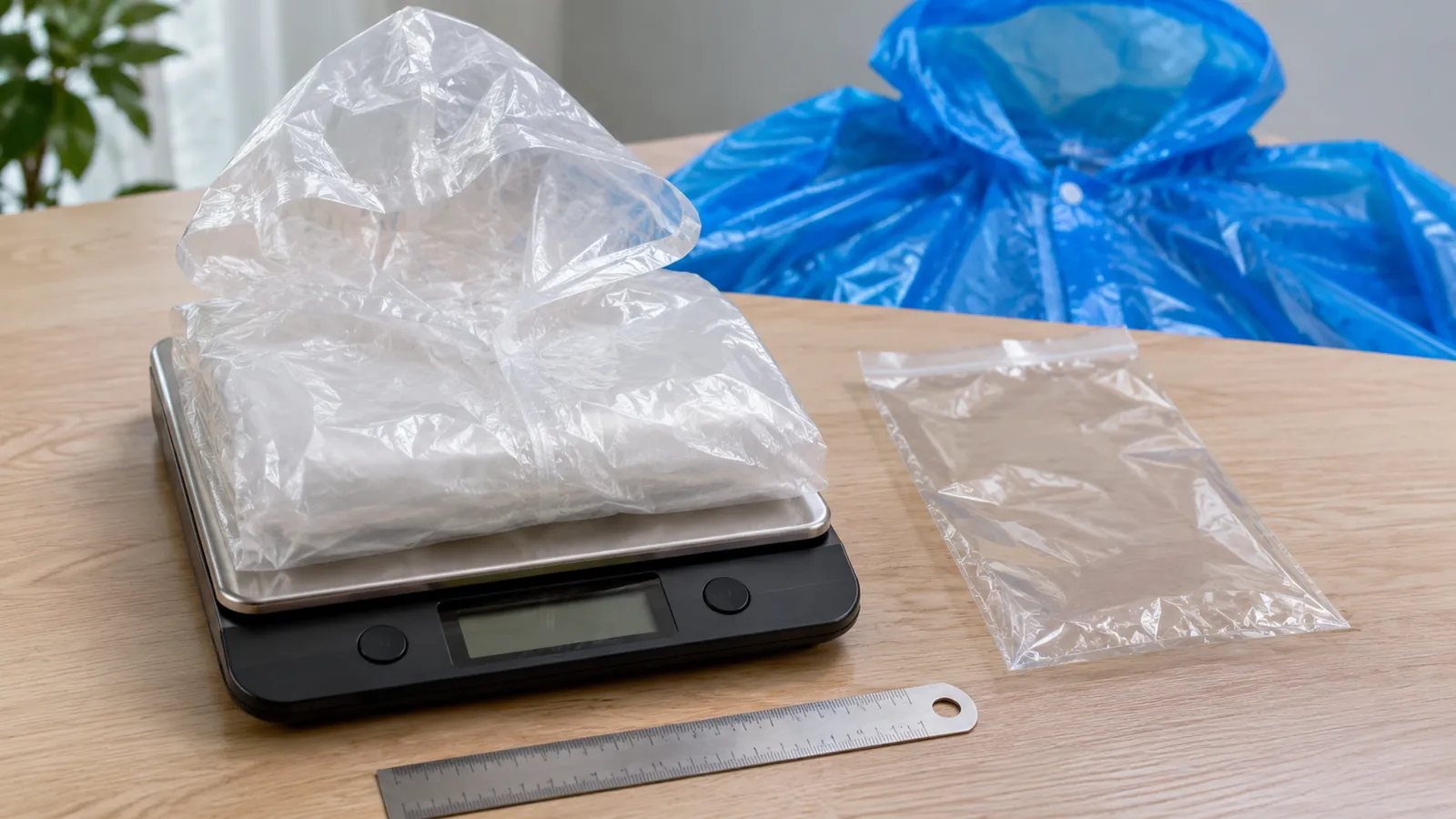
Weigh the poncho separately from its packet
Weight is an accessible purchasing measurement, but the object being weighed must be defined. A garment alone, a garment with its individual packet, and a complete presentation kit are different items. Ask the supplier to state which basis appears in its quotation. For comparison work, record the unpacked poncho and the complete supplied unit separately. This gives the buyer useful information about the rainwear itself and the item that will be carried or distributed, without allowing a heavy pouch or insert to distort the apparent garment weight.
Use an appropriate scale and a consistent procedure for your sample review. Identify the scale, check its readiness according to its instructions, and ensure the item rests fully on the weighing surface. Do not let part of a folded poncho hang off the platform or touch the table. Keep the garment dry and identify whether removable accessories are included. These practical details help reviewers understand the reading. They are not a substitute for a formal method when the order requires one; agree that method with the responsible specialist.
Record the sample size and construction with the weight. A larger adult pattern, a different hood or additional snaps can affect the finished item being compared. The same stated film thickness does not imply the same garment weight when the pattern and components differ. Likewise, the same garment weight does not establish identical film thickness. Keep those attributes on separate lines in the comparison sheet. If a supplier proposes weight as the main control, ask how it relates to the agreed dimensions and construction rather than treating it as a universal shortcut.
Distinguish a nominal or typical value from an acceptance requirement. A catalogue may show an approximate weight for a representative item, while a purchase specification needs a defined basis and any permitted variation. Ask the supplier what can be committed for the selected model and size. Do not copy a typical value into a strict rejection rule without discussion. Conversely, do not accept unlimited variation because a quotation uses the word approximate. The order should make clear whether weight is an informative attribute, a screening check or a controlled acceptance characteristic.
A hypothetical travel-kit program shows why separate records matter. Two suppliers offer packets that fit the same pouch. The complete units have similar weights, but one includes a substantial paper insert while the other contains only a folded poncho. Comparing only the sealed units could lead the buyer to assume that the garments are similar. Opening representative samples and recording both components exposes the difference. The buyer can then review coverage, film information and instructions on their own merits, while still planning the total kit weight accurately.
Keep the weighing result with a photograph or identifier of the sample and the date of the check. If a later delivery differs noticeably, examine the garment size, accessories and packing before attributing the change to the film. The aim is to make weight a useful signal within a controlled specification. It can support comparisons and identify questions worth investigating, but it should not be presented as proof of material identity, waterproof performance or expected service life. Those conclusions require their own relevant information and review.
Compare coverage and weight on the same basis
A lightweight description can be misleading when the compared garments provide different coverage. One poncho may have a wider body, a longer hem or a larger hood, while another achieves a smaller weight partly through a smaller pattern. Start with the dimensions and intended wearers. Compare the actual products against the same use brief before deciding which weight is preferable. The goal is not to minimize one number in isolation; it is to select a garment that meets the defined coverage and carrying requirements together.
Use a consistent drawing to record the main dimensions. Identify the measurement points for body width, front and back length, hood opening and arm access as appropriate to the model. State whether the garment is laid flat, fastened or opened for the measurement. Do not infer wearable circumference from a flat width without considering the pattern and openings. A photograph of the measurement points can help different teams use the same interpretation. Keep the drawing revision with the weight record so that later comparisons remain meaningful.
If the program includes several sizes, compare each relevant size rather than borrowing a weight from one and dimensions from another. A supplier's representative photograph may show only one variant. Ask for the information and samples needed for the actual assortment. Where a single adult size is proposed, review it over the clothing and bags expected in use. The label one size does not demonstrate suitability for every adult. Record the range of reviewers and clothing used in the practical assessment without implying a universal fit guarantee.
Avoid creating an unofficial material performance index from incomplete information. Dividing garment weight by a rough estimated surface area may look analytical, but the estimate can omit hood panels, overlaps, trims or other construction details. Unless the calculation has a defined purpose and reliable inputs, direct sample measurements are often more useful. Ask the supplier or a competent technical reviewer for the appropriate comparison method when a decision depends on material area or mass per unit area. Do not let a neat spreadsheet conceal uncertain assumptions.
Consider a hypothetical outdoor-event brief that requires coverage over a small daypack. A compact sample may be lighter but lift at the back when worn over the pack. A wider version may be more suitable despite a higher weight. The decision should record that practical reason, together with the final packed dimensions. If the backpack will instead be carried outside the poncho, document that different arrangement and assess it accordingly. The same garment can present different coverage outcomes under different wearing conditions.
Close the comparison with a coherent set of requirements: the approved dimensions, intended clothing and bag arrangement, sample reference, garment weight basis and packet size. If one parameter changes, review the linked decisions rather than assuming the rest remain valid. This is particularly useful during cost discussions, when a revised pattern can otherwise be mistaken for an equivalent lighter product. A clear record helps the buyer explain why an option was selected and gives the supplier a consistent target for the complete garment, not merely a number on a scale.
Measure the packed unit for the actual carrying space
Packed dimensions matter because a poncho is often selected for the place it must fit before anyone wears it. That place may be a visitor pouch, an amenity kit, a staff drawer or a compact display. Define the available space and the opening through which the packet must pass. A packet can fit inside a container yet be awkward to insert through a narrow zipper opening. Review the complete supplied unit in the actual receiving space whenever practical, rather than relying only on a supplier's flat illustration.
Measure length, width and thickness in a defined state. Specify whether the packet is sealed, naturally resting or compressed under an agreed arrangement. Flexible packets can change shape when squeezed, so two measurements taken under different conditions may not be comparable. Ask for the normal production fold and packet, not a specially compressed presentation sample. Record any protruding closure, label or hanging feature that affects fit. The dimensions should describe the unit staff and users will actually handle, including its printed insert if one is supplied.
Try the complete handling sequence. Insert the packet into the intended pouch or drawer, remove it, open it and unfold the garment. Check whether the packet catches on the opening, whether its closure is identifiable, and whether the poncho can be removed without unnecessary pulling. If a user is expected to keep the pouch, check whether the opened garment can be returned under the intended conditions. Do not promise that a used poncho will refold to the factory-packed size unless that process has been demonstrated and is appropriate to the product.
Different distribution formats may need different packing priorities. A giveaway packet might be optimized for counting and quick handout. A travel accessory may need an accessible opening and useful carrying pouch. A replenishment carton may need grouped units that fit a stockroom shelf. Clarify which level is being optimized before requesting changes. Making the individual packet smaller can affect opening convenience or folding effort, while changing carton quantities affects a different operational problem. Keep those decisions connected but distinguishable in the order record.
Use a realistic tolerance and verification arrangement agreed with the supplier. Flexible packaging should not be judged against an unexplained dimension taken from a photograph. State the measurement basis and what the receiving team will check. If the available storage space is unforgiving, provide a physical fit reference or a clear drawing and request a packed sample early. This is more useful than discovering after production that an acceptable-looking packet cannot pass through the intended kit opening.
Retain the approved packed unit as well as the opened garment sample. They answer different questions and should not be confused. Photograph the normal fold, identify the packet revision and record any insert orientation needed for display. When future orders change the film, pattern or accessories, recheck the packed unit because the earlier fit may no longer apply. Packed size then becomes a practical part of the product specification, supporting everyday carrying and distribution without relying on vague promises of pocket size or universal compactness.
Plan unit and carton requirements with the bulk rain poncho buying guide.
05 / 12
Check sizing, coverage and ease of movement

Define the adults, clothing and bags the poncho must cover
Sizing starts with the people and clothing involved in the program. A poncho intended for adults walking around a visitor attraction should be reviewed over the clothing those adults are likely to wear. A sample that looks generous over a thin shirt may behave differently over a winter coat. Ask the project team to describe the expected layers, ordinary activities and any bags. This creates a meaningful brief for the supplier and helps reviewers assess coverage without treating a generic adult label as sufficient evidence of fit.
Record the garment dimensions using agreed measurement points, but do not stop at the drawing. A practical wearing review can reveal how the pattern drapes, where the hem sits and whether the hood remains usable when the wearer turns their head. Select reviewers appropriate to the intended audience and record the limitations of that review. A small sample of adults cannot establish universal fit. It can identify obvious mismatches and help the buyer decide whether further sizes, pattern adjustments or a different rainwear format are needed.
Clarify the bag arrangement explicitly. Some programs expect a small daypack underneath the poncho; others expect bags to remain outside or be handled separately. The pattern, rear coverage and arm movement may be affected by that choice. Do not photograph a bag-covered sample and assume that every larger bag will also fit. Use representative bags with ordinary contents during the review and record their approximate dimensions or model reference. The goal is a reproducible observation, not a sweeping promise that the garment covers all luggage.
Include the transition from packet to worn garment. Observe whether an adult can identify the head opening and front orientation without prolonged explanation. Check whether normal clothing details, such as a jacket collar or glasses, complicate putting it on. Reviewers should follow the proposed instructions and avoid forcing the garment. If an opening is awkward, ask the supplier for a revised sample or clearer instructions. Do not solve a design problem by telling users to stretch or cut the garment in a way that the product was not designed to support.
Consider the setting in which the review occurs. An indoor fitting can establish basic dimensions and access, while an appropriate outdoor review may reveal additional movement or handling questions. Neither should be mislabeled as certified performance testing. Record the conditions and observations honestly. For example, note that the rear hem rose while a reviewer reached into a bag, or that an opening was difficult to locate while the film was folded. Such concrete findings help a supplier respond more effectively than a general complaint that the fit was poor.
Approve the model for a defined audience and use, with any limitations preserved in the buying record. If children's use is proposed later, treat it as a separate product and safety review rather than simply reducing adult dimensions. The original adult assessment does not cover that change. Keep the approved drawing, sample and user instructions aligned. This makes the sizing decision useful to the people who will purchase, distribute and wear the poncho, while avoiding unsupported one-size-fits-everyone language that can create unrealistic expectations.
Review hood, arm access and opening details
The hood and openings deserve their own review because they influence how a poncho is put on, adjusted and used. Start by identifying the intended front and back of the garment. Examine the neckline, hood depth, face opening and any fastening arrangement on the actual sample. Look for a design that reviewers can understand without guessing. A compact packet can hide these details until the moment of use, so the opening sequence should be part of sample approval rather than an afterthought left to event staff.
Have adult reviewers turn their heads, look to either side and perform ordinary tasks relevant to the brief. Observe whether the hood moves with them or obstructs their view. Do not assume that a photograph with the hood neatly positioned demonstrates usable movement. If adjustment is provided, assess its operation according to the supplier's instructions. Record any limitation and request an appropriate change where necessary. Avoid inventing a universal adjustment method or adding accessories that were not part of the reviewed construction.
Arm access should be assessed together with the intended clothing and carried items. A wide cape opening may make some movements easy but expose more clothing in certain positions. A different opening or side closure may suit another use. These are construction choices that need direct comparison. Ask reviewers to reach for a ticket, use a pocket or carry the relevant small bag in an ordinary way. Record the position and task when a problem occurs, because that information helps distinguish a pattern issue from an isolated handling mistake.
Inspect closures before and after ordinary opening and fastening during the review. Note whether the user can find the snap, align it and open it without pulling excessively on the surrounding film. If the fastening feels difficult, ask the supplier to review its attachment and operating behavior on a finished sample. Do not substitute a different closure in the specification based only on a catalogue photograph. The attachment method and nearby construction matter as much as the appearance of the fastening itself.
Keep the intended audience central when evaluating cords or small components. The US Consumer Product Safety Commission identifies specific hazards and requirements for drawstrings on children's upper outerwear. An adult poncho review should not be extended to children without a separate assessment of the design and applicable requirements. Where a mixed-age program is planned, obtain appropriate product-specific advice and separately reviewed options. Avoid presenting a cord, toggle or closure as safe for every user simply because it appears on an adult sample.
The approval record should explain the chosen hood and opening configuration in ordinary terms and through an annotated drawing. Include the reviewed clothing, tasks and instructions. If a supplier revises the neckline, hood join or closure, repeat the relevant checks before treating the new version as equivalent. A poncho is a simple-looking garment, but these details determine whether people can use it conveniently. Clear approval prevents a procurement discussion about material and thickness from overlooking the parts that users interact with most directly.
Use a practical fit review to record limitations
A useful fit review is planned around decisions, not around producing a flattering photograph. Before inviting reviewers, write a short sequence of ordinary actions: open the packet, orient the garment, put it on over the intended clothing, fasten any closures, move normally and remove it. Add tasks that genuinely matter to the program, such as reaching a ticket pocket or wearing a small daypack. Keep the sequence appropriate to the product and setting. Do not introduce hazardous activities merely to make the review seem more demanding.
Prepare a simple observation form. Identify the sample, reviewer context, clothing, bag arrangement and conditions. Provide space for what worked, what was awkward and what requires clarification. Reviewers should describe observable behavior rather than diagnose material chemistry or predict service life. For example, the note that a neckline was difficult to pass over a bulky collar is actionable. A statement that the film is low quality is much less useful unless the underlying observation is explained. Photographs can support the record, with appropriate consent from anyone identifiable.
Separate preference from a requirement. A reviewer may prefer a certain color, hood shape or drape, while the program's essential requirements concern coverage and usability. Both kinds of feedback can be recorded, but they should not be treated as equivalent rejection criteria. Agree which characteristics must be met and which are trade-offs. This keeps the evaluation fair to competing suppliers and avoids late changes driven by a personal preference that was never part of the original brief.
Use the review to identify limits as well as strengths. A poncho may suit a short walk between sheltered locations but be unsuitable for the program's more active task. A single size may not provide acceptable coverage across the intended adult audience. An opening may work well without a bag but become awkward with one. Recording these boundaries helps the buyer choose a different model, add a size or revise the use plan. It is more responsible than forcing every observation into a positive approval summary.
When a concern arises, request a specific response from the supplier. Describe the task and observed issue, provide the relevant sample reference, and ask what construction change is proposed. Review the revised finished sample rather than assuming that a written assurance resolves the problem. Keep the earlier record so that the team can see whether the change addressed the original concern and whether it introduced another limitation. A revised hood, for example, may improve one aspect of use while changing how the garment folds into its packet.
End the review with a documented outcome: approved for the defined use, approved after stated changes, or not suitable for the current brief. Identify unresolved questions and the person responsible for closing them. Keep the final sample available to receiving and operational teams, together with its approved instructions. The fit review then provides a practical basis for selection without claiming to establish every aspect of product safety or weather performance. It supports an honest buying decision grounded in the actual garment, the intended adults and the conditions in which they are expected to use it.
Compare coverage and carrying needs in the reusable rain poncho guide.
06 / 12
Inspect joins, openings and water management
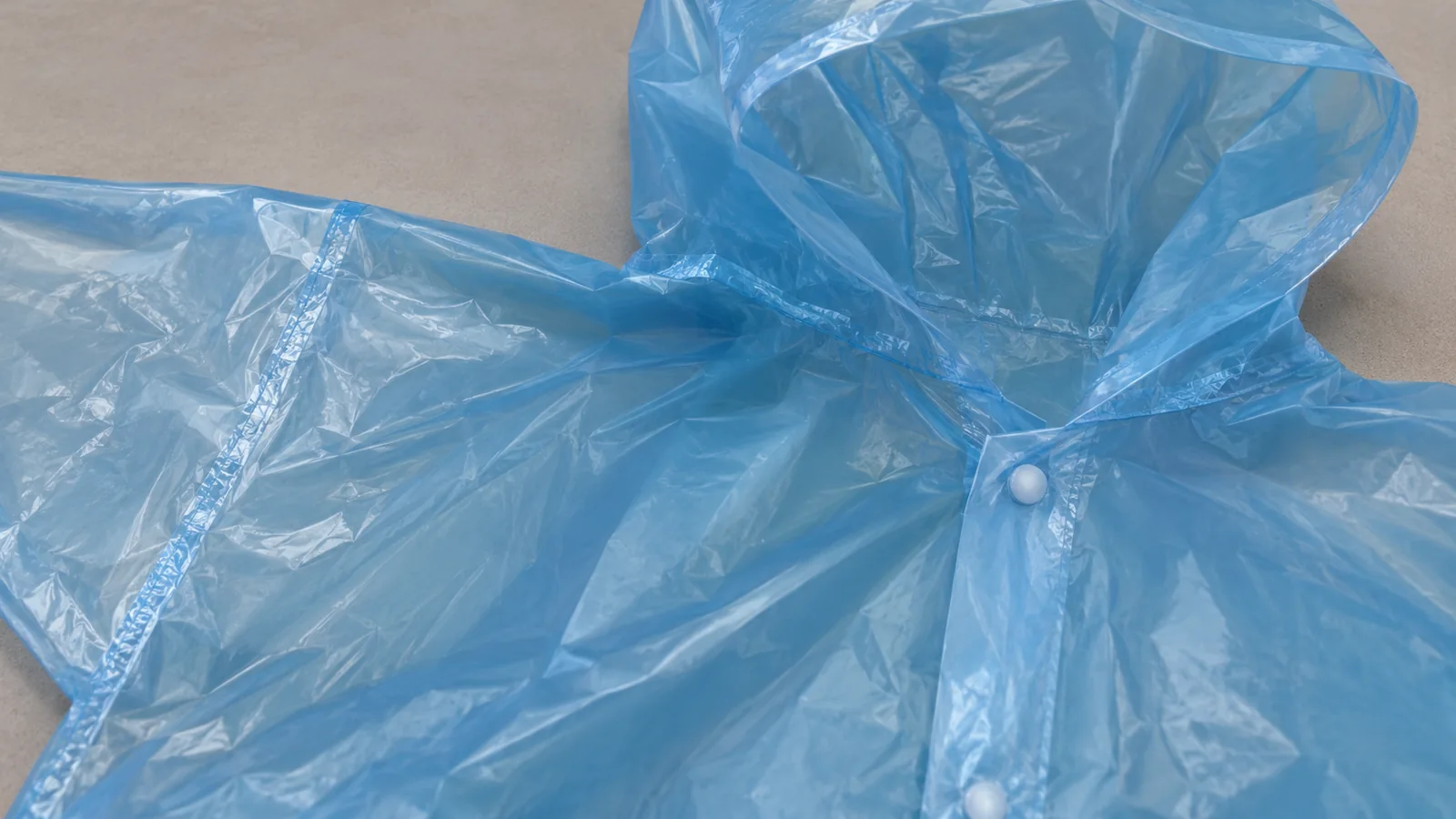
Examine seams and stress points on the finished garment
Seams turn a sheet-like material into a usable poncho. Their position and construction therefore deserve attention alongside the film specification. Lay out the sample and identify the hood join, side joins, neckline details and any reinforced fastening points. Ask the supplier to describe the joining method used for the offered model. Do not assume that all plastic ponchos use the same process or that a seam visible in a photograph matches the sample. Keep the construction description tied to the drawing and the actual finished garment.
Begin with a visual examination under suitable lighting. Look for incomplete joins, irregular edges, unintended holes, trapped folds and obvious damage. These observations can identify questions, but they should be recorded carefully rather than translated immediately into a performance conclusion. A visible irregularity may require further review to determine its significance. Photograph the location and describe what is observed. If the buyer and supplier disagree, a clear image and sample reference provide a better starting point than a broad accusation that the entire batch is defective.
Review areas handled during ordinary use. The neckline is involved when the garment is put on and removed; side closures are manipulated when fastening; the hood may be adjusted repeatedly. Observe these areas during the practical sample sequence. Avoid pulling the film to destruction without an agreed purpose and method, then treating the result as a comparable test. If strength or durability is a formal requirement, arrange appropriate product-specific evaluation with a competent party and define the intended evidence before the work begins.
Ask how reinforcement, if present, is specified. Its dimensions, location, material and attachment should be clear enough to compare future samples. A larger patch is not automatically better if it interferes with folding or changes the way a closure is used. Review the complete arrangement. If the supplier proposes a construction change to address an issue, request a revised finished sample rather than accepting a photograph of a component alone. The relationship between the film, join and fastening matters to the practical result.
Keep sample condition visible throughout the review. A garment that has been repeatedly unfolded, measured and handled may no longer represent an untouched unit. Record which observations were made before use and which appeared afterward. Retain an unhandled reference where the inspection plan calls for one. This helps distinguish an issue present on receipt from damage introduced during evaluation. It also gives the supplier a fair opportunity to understand the concern and propose a relevant response, rather than guessing how the sample was treated.
The final seam record should identify the approved construction, any agreed workmanship criteria, the sample reference and the method for evaluating important concerns. Link it to the receiving plan so that inspection staff know which details require attention. Do not claim that visual inspection alone proves waterproofness or long-term durability. Its value is narrower and practical: it helps the buyer recognize the intended construction, spot obvious discrepancies and decide when additional evidence or specialist testing is needed before an order is released.
Distinguish water shedding from verified performance
Rainwear language can easily outrun the evidence behind it. A plastic surface may visibly shed droplets, but that observation does not establish the performance of the complete poncho under every condition. Openings, joins, fit, movement and the way the garment is worn all matter to what a user experiences. Begin by defining the intended use and the exact statement that the buyer wants to make. A description of ordinary rainwear for a short outdoor visit is different from a quantified performance claim or a claim of protective certification.
Ask what evidence supports the offered garment, and identify the level at which it applies. A film-related result should not be presented as if every seam and opening of the finished item was assessed. A report on another model should not be treated as interchangeable without a justified connection. Review the specimen description, method, conditions, result and any limitations. If the buyer needs a particular performance statement, obtain qualified advice on the appropriate evaluation rather than selecting a convenient test name after the result is known.
Practical sample checks can still be useful when they are honestly described. A controlled comparison may help a buyer observe where water reaches clothing in a defined arrangement. Record the garment, wearing setup, duration and conditions, and distinguish these observations from standardized testing. Do not convert a casual demonstration into a numerical rating or a claim that the product meets a recognized standard. The purpose is to identify relevant questions and compare the offered samples, not to create a certification impression through an informal exercise.
Keep the use plan realistic. A poncho supplied for visitor convenience should not automatically be treated as equipment for hazardous work, severe weather exposure or activities with specific protective requirements. If the intended task changes, revisit the product selection and evidence. Ordinary rainwear is not proof of suitability for chemical protection, flotation, road visibility or another specialized purpose. Those are different decisions with their own requirements. Avoid adding broad protective language merely because the garment covers a large part of the body.
Review customer-facing wording with the same care as the technical record. Words such as waterproof, durable and reusable may be interpreted more broadly than the buyer intends. Use descriptions that match the actual evidence and supported instructions. If an important qualification is needed, place it where the reader can understand it rather than hiding it in an unrelated document. A supplier's marketing phrase should not be copied automatically into the buyer's catalogue, packaging or event announcement simply because it appears beside a product photograph.
At approval, preserve both the evidence and the claim it supports. Record which model and revision are covered, which conditions matter, and who reviewed the proposed wording. When the material, joins or pattern change, determine whether that connection still holds. This approach does not demand unnecessary testing for every ordinary observation. It asks the buyer to keep observation, formal evidence and marketing language distinct. The result is a more credible description of what the poncho is intended to do, with fewer opportunities for users to mistake convenience rainwear for a different class of protection.
Build repeatable sample checks and a defect record
A sample check is most useful when another person can understand and repeat it. Start with the questions that matter to the order: whether the packet opens normally, the garment matches the drawing, the closures work as intended and the agreed appearance is present. Turn those questions into a short sequence. Avoid a checklist that simply asks whether quality is good. Define the observed characteristic, the reference used for comparison and the action required when the result is unclear or outside the agreement.
Separate pre-use inspection from handling observations. First record the supplied state, including packet condition, identification, dimensions and visible workmanship. Then follow the ordinary opening, wearing and removal sequence appropriate to the product. Finally, record any changes or concerns. Keeping these stages separate makes the evidence easier to interpret. A tear discovered after several handling activities cannot automatically be described as present on arrival. Similarly, an obvious incomplete join seen before use should not disappear into a vague note about reviewer preference.
Use consistent defect descriptions. Identify the location, nature and extent of the issue, with a photograph where useful. For example, record an unjoined segment at a named hood seam or a closure that cannot be aligned under the agreed conditions. Avoid assigning a severity category without a defined basis. If the order uses a formal inspection plan, agree the categories, sampling arrangement and disposition process with competent input. The article does not supply a universal acceptance limit; those requirements belong in the actual purchasing agreement.
Keep individual sample identities distinct. Number or otherwise identify the review units in the record, and note which unit was used for each activity. If one sample is retained for reference and another is used for additional assessment, record that separation. This prevents conflicting findings from being attributed to the wrong item. It also helps the supplier reproduce the concern. A short video or sequence of photographs can be useful for an opening problem, provided it shows ordinary handling and does not omit steps that materially affect the observation.
Give every unresolved issue a disposition. The options might include clarification, revised sample, further evaluation, acceptance of a documented variation or rejection of the proposed construction. Name the responsible person and the evidence needed to close the issue. Do not let an approaching delivery date turn an unanswered question into an implicit approval. Where a variation is accepted, update the specification and affected instructions so that receiving staff are not asked to reject a feature the project team has already authorized.
Use the completed record to shape receiving checks, while recognizing that a single preproduction sample does not prove every unit in a shipment is identical. Agree how deliveries will be identified, sampled and reviewed, and how discrepancies will be reported. Retain the approved reference and the final revision. A repeatable sample process creates a practical chain from buying brief to delivery inspection. It gives both buyer and supplier a shared basis for resolving problems without relying on memory, vague quality language or a photograph that was never intended to define the complete product.
Use the rainwear sourcing guide for procurement managers to organize supplier and sample questions.
07 / 12
Choose clear film, colors and decoration
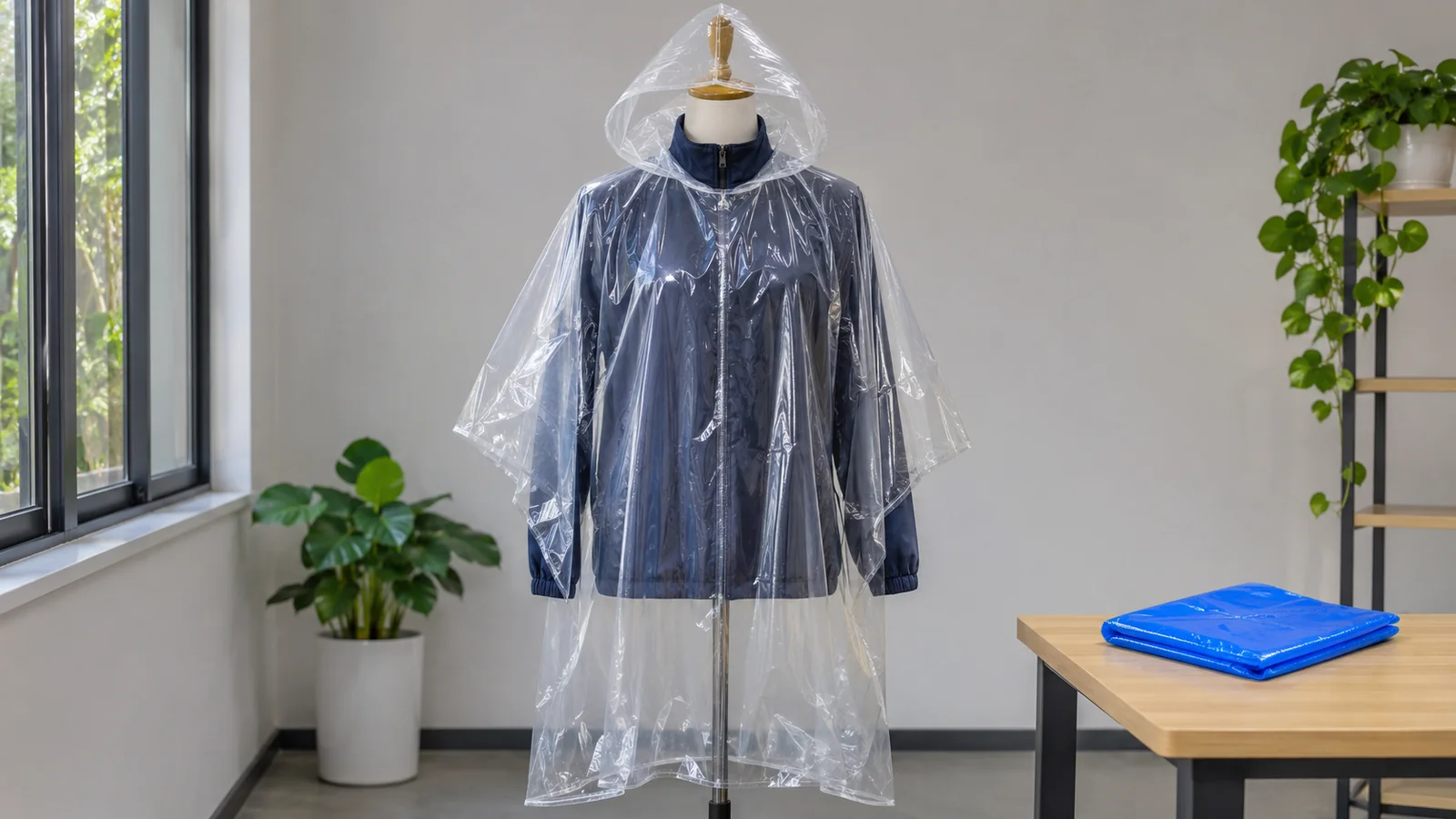
Assess a clear plastic poncho against real clothing
A clear plastic poncho is often chosen because the clothing underneath remains visible, but transparency is not a single fixed appearance. Folds, surface finish, thickness, lighting and the underlying colors all affect what a reviewer sees. Evaluate the actual offered sample over representative clothing. A photograph against a white background may not show how the garment looks over a dark jacket, a patterned uniform or a visitor's daypack. The practical question is whether the appearance suits the program, not whether the product can be described with the word clear.
Use more than one viewing condition when appearance is important. Review the garment indoors under the lighting used for distribution and, where appropriate, outdoors in ordinary daylight. Observe it both laid flat and worn. Record whether the surface is transparent, translucent, tinted or visibly frosted according to the agreed description. Do not use these words interchangeably simply because a catalogue does. Ask for a physical reference if a particular level of clarity or finish matters, and agree how future samples will be compared with that reference.
Consider the effect of folding. The factory-packed unit may develop a visible crease pattern that changes the garment's appearance when first opened. A studio image of an unusually smooth sample may not represent that state. Request a normally packed sample and review it after ordinary unpacking. If the program expects immediate use, that is the appearance users are likely to encounter. Record whether the result is acceptable without assuming that every crease will disappear within a particular time. Any such expectation should be supported by the actual product information.
Keep transparency separate from protective or visibility claims. Being able to see a uniform through a clear film does not establish high-visibility performance, and a clear poncho should not be described as certified visibility equipment without the relevant evidence. Likewise, a tinted color does not by itself demonstrate sun protection or another specialized function. If those functions are part of the brief, select and review appropriate products with qualified input. Appearance decisions can be valuable without being promoted into unsupported technical claims.
A hypothetical hospitality program might compare a clear poncho over a dark staff jacket with a translucent colored version. The clear option may preserve the visual identity of the clothing, while the colored version may be easier to distinguish in storage. Neither outcome establishes a universal winner. Record which objective matters to the program and whether a packet label can solve the storage issue without changing the garment. This keeps the decision focused and avoids changing material or color unnecessarily to address a problem at a different level.
Approve the appearance using the actual construction, normal fold and intended clothing. Keep a dated physical sample where feasible, supported by photographs that explain the conditions rather than pretending to replace the sample. If the supplier later changes the film formulation, finish or thickness, recheck the appearance because the earlier reference may no longer apply. This gives the buyer a practical basis for discussing a clear plastic rain poncho with suppliers and customers, using a description that matches the product people will actually receive.
Approve color and print on the offered material
Color approval should be based on the material and construction being ordered. A color reference can communicate an intention, but it does not show exactly how a particular plastic film will look at the selected thickness and finish. Ask the supplier for a sample of the proposed color on the offered material. If printing is included, review the printed result as well. Do not approve a rainwear color solely from a screen image or from a swatch made with a different construction that will not be supplied.
Establish which reference controls the decision. The buyer may provide a physical sample, a defined color reference or another agreed target. State how differences will be reviewed and who can approve them. Keep lighting and viewing conditions consistent enough for a useful comparison. If the program needs several colors, identify each variant separately. A successful match in one color does not automatically establish that every other color is approved. The supplier should know which samples have been accepted and which remain under review.
Decoration introduces additional practical questions. Confirm the proposed printing method for the actual film, the artwork size, placement and number of colors, and any restrictions identified by the supplier. Request a decorated sample when the result matters to the order. A digital proof can confirm spelling and layout, but it cannot demonstrate the physical appearance or handling of ink on the material. Keep the digital approval and physical approval distinct so that one is not mistaken for the other during production planning.
Review the decorated garment in the condition in which it will be used. Open it from the normal packet, unfold it and observe the artwork on the worn sample. Check whether folds obscure important information or place a mark in an unintended position. If the print is expected to remain legible through specified handling, define the relevant evaluation and obtain appropriate evidence. Avoid promising unlimited wash or wear durability without support. The instructions and claims should match the particular printed construction rather than a generic statement about printing technology.
Consider what information belongs on the garment and what belongs on the packet. A large promotional message may suit the body, while detailed instructions may be clearer on an insert. If the film is transparent, underlying clothing can influence the perceived appearance of the print. Review that interaction using representative clothing rather than assuming the white-background artwork proof is the final visual result. Where a background layer or different print arrangement is proposed, confirm availability and approve the actual sample before including it in the order.
Record the final artwork file, revision, physical reference, placement dimensions and approved color outcome. Include any accepted variation and the conditions of approval. If the material or print system changes, determine which parts of that approval need repeating. This keeps an OEM Program discussion grounded in a manufacturable, reviewed product. The buyer can request current capabilities and a project-specific proposal without implying that every color, process or artwork combination is available from the supplier or suitable for every plastic poncho.
Keep artwork, folding and handling requirements aligned
Artwork is part of the complete packed product, not an isolated graphic on a screen. Its placement interacts with the garment pattern, folds, packet and opening sequence. Start by identifying what the user should see before opening the packet and what should be visible when the poncho is worn. Those may be different information needs. A compact unit used for a visitor handout may need a clear size or model identifier on the outside, while the garment itself carries a simple promotional mark.
Use the actual fold during sample review. A print placed across a fold may be partly hidden in the packet, and an insert may rotate if the packing arrangement does not control its orientation. Ask the supplier to demonstrate the normal production presentation. If a particular face must remain visible, include that requirement in the packing specification and review a packed sample. Do not rely on a carefully arranged photograph that staff cannot reproduce consistently during ordinary packing.
Check that operational information remains easy to find. Staff may need to distinguish sizes, colors or program allocations quickly. A packet identifier can support that task without turning the poncho into a crowded advertising surface. Keep the information concise and agree its location. If several variants share similar clear packets, use a reliable identification system that the supplier and receiving team can follow. Do not depend solely on subtle film shades when the packet is folded or stored under different lighting.
Review the opening experience with the final decorated and packed sample. Instructions should refer to the actual closure and garment orientation. Avoid wording that assumes a tear feature or fastening that the selected packet does not have. If artwork changes the way the unit is folded, repeat the relevant handling check. A revised presentation may look better but make the first opening less obvious. The buyer should evaluate both results and choose a version that serves the real distribution setting.
Keep environmental, safety and product claims under separate control from graphic approval. An artwork designer may place supplied wording accurately without being responsible for substantiating it. Identify who approves the claim itself and which evidence supports it. Do not add a recycling symbol, protective mark or certification impression simply to make the design look more complete. If a statement applies only to the packet, make that scope clear. The final artwork should reflect approved information, not create new claims through decorative elements or ambiguous icons.
Release artwork and packing together as a matched revision. Keep the print file, placement drawing, fold reference, packet artwork and approved sample in the same order record. When a later change affects one of those elements, review the linked items before production. This reduces misunderstandings between sourcing, design and packing teams. It also helps a buyer compare proposals fairly: a quote for a plain folded garment and a quote for a controlled branded presentation are different scopes, even when both use the phrase plastic poncho raincoat.
Keep the approved folding example with the artwork proof so receiving staff can compare both presentation and print placement on the same finished unit.
Develop the decoration brief with the custom rain poncho logos, colors and packaging guide.
08 / 12
Plan everyday uses and distribution

Equip walking visitors and short outdoor trips
Everyday use is a useful starting point for plastic poncho selection because it forces the buyer to describe a real activity. A walking visitor may need a garment that can be carried in a small bag, opened at a sheltered point and worn over ordinary clothing. The program may involve a museum courtyard, garden route or short connection between buildings. Define that activity before selecting a material or packet. A vague outdoor label can conceal very different expectations about movement, exposure, carrying and the availability of shelter.
Map the user's journey from receiving the unit to putting it away or disposing of it appropriately. Identify where the poncho is handed out, whether the person has time to open it calmly, and where the empty packet goes. Consider whether staff can explain the opening or whether the unit must be self-explanatory. These practical details influence packet design and instructions. They may matter more to the experience than a small difference in a nominal material attribute that users never see or understand.
Review the intended clothing and carried items. Visitors may wear coats, hats, glasses or small daypacks, and the selected adult sample should be assessed accordingly. Do not assume that the same garment suits every visitor simply because it is loose. If the program includes users outside the reviewed range, provide an appropriate alternative or obtain further product assessment. A selection guide should help the buyer define the limits of the offer, rather than encouraging staff to make unsupported assurances about universal fit.
Coordinate rainwear with the site's operating plan. A poncho should not become a reason to continue an activity when the site's weather procedures call for shelter or cancellation. Ask the responsible operations team to decide how the garment fits into its existing arrangements. The buyer's role is to supply an appropriate reviewed product and accurate information, not to replace weather judgment or site safety procedures. Keep instructions about those decisions with the people responsible for them.
A hypothetical garden-tour operator might keep individually packed adult ponchos at the reception point and offer them before a short outdoor section. The useful evaluation would include packet access, adult fit over expected clothing, bag handling and a clear end-of-use instruction. It would not need to claim suitability for every outdoor pursuit. If the tour later changes to a longer or more demanding route, the product brief should be reviewed again. The original approval was tied to a defined activity and should not expand automatically.
After the program begins, collect specific feedback. Ask whether people could identify the opening, whether packet litter was controlled and whether staff encountered recurring fit questions. Treat feedback as information for improving the specification and distribution process, not as proof of a technical performance claim. Record the model and circumstances so that any proposed change addresses the actual problem. This creates a practical cycle from use brief to sample review to real operational learning, while keeping the plastic raincoat poncho's role clear and proportionate to the intended everyday task.
Prepare event and hospitality rainwear stations
A rainwear station needs a plan for people, stock and packaging. Simply placing a carton of ponchos near an entrance leaves staff to solve counting, opening and replenishment while guests are waiting. Identify the likely handout points and the space available at each one. Decide who controls stock and how staff request more units. The article does not supply a universal quantity allowance; use the event's attendance assumptions, access arrangements and purchasing constraints to develop the actual allocation.
Keep a representative packed sample at the planning stage. Test whether staff can take one unit from the stack without disturbing the others, identify its size or variant, and explain the opening. If several products are supplied, make their identification clear at the point of use. A packet that looks attractive in a presentation may be awkward to handle in a crowded reception drawer. Review the actual distribution movement and choose packing that supports it, with any required labels approved as part of the order.
Plan for empty packaging as part of the handout process. Guests may open the unit immediately and need an obvious place for the wrapper. Ask the venue's waste team to define the appropriate route and place the collection point where it does not obstruct access. Do not print a recycling claim merely because a container is available. The actual garment and packet must be accepted by the relevant service before a specific recycling instruction is used. A simple accurate instruction is more useful than a reassuring but unsupported symbol.
Brief staff on the product's intended use and limitations. They should know the offered sizes, how the garment opens and what to do when it does not suit a guest. Provide a small practical reference rather than asking staff to repeat technical claims they cannot verify. If a guest needs a different option, define the response in advance. This is especially relevant for mixed-age or accessibility needs, where an adult sample approval should not be treated as a solution for every person arriving at the venue.
Use a stock record that distinguishes unopened units from opened, damaged or returned items. An opened poncho should not silently return to the same pile as new sealed stock. Decide how staff handle those categories according to the product information and venue procedures. Record remaining unopened inventory at the end of the event and retain its identification for future use if appropriate. This provides a more reliable basis for replenishment than counting empty cartons and assuming every item was distributed successfully.
Review the station after an initial use period. Look for concrete operational issues: unclear variant labels, packets that are difficult to grip, insufficient wrapper collection or stock stored too far from the handout point. Adjust the process or request a relevant packing change before the next order. Keep those findings separate from unsupported claims about the garment's material. Event and hospitality programs benefit when product selection and distribution are reviewed together, because the guest's experience begins with receiving and opening the unit, not only with wearing the poncho in rain.
Choose when a different rainwear format is needed
A buying guide should make it easier to recognize when the proposed product is outside the brief. Plastic ponchos can be considered for defined convenience uses, but they are not automatically suitable for every task that involves rain. If the activity requires specialized protection, a particular fit, repeated demanding handling or compatibility with other equipment, review appropriate alternatives. The decision should be driven by the use requirement and relevant evidence, not by a desire to fit every situation into the same low-complexity product category.
Start with the activities that are essential to the user. A person who must perform frequent arm movements, manage equipment or work under a defined protective-clothing program may need a different construction or garment format. Do not assume that a loose cape can substitute for a fitted jacket or a specifically assessed protective garment. Ask the responsible technical or safety personnel to define the requirements. Purchasing can then request options that actually address them, rather than asking a supplier to endorse an unsuitable sample through broad assurances.
Consider the expected handling cycle. If users repeatedly put on, remove, dry and repack the garment, the product and instructions should support that pattern. A unit intended for a brief encounter should not be described as repeatedly reusable solely because it remains intact after one demonstration. Conversely, the word plastic does not by itself establish that every item must be single-use. Obtain model-specific information and review the planned handling. The relevant distinction is the supported construction and use pattern, not an assumption attached to a broad material label.
Storage and carrying can also point toward another format. A program may require a particular pouch, a more structured closure or a garment that staff can identify and manage over repeated use. If the selected poncho does not meet those needs, compare a different offered design. Avoid repeatedly modifying an unsuitable sample until it becomes a hypothetical product that has never been reviewed. Ask for an actual construction with a coherent specification, and evaluate its garment, packing and instructions together.
Do not add specialized claims to solve a mismatch in the brief. Bright color is not a substitute for evidence supporting a visibility requirement. A plastic barrier is not a substitute for an assessed chemical-protection garment. A hooded rainwear product is not flotation equipment. If such functions are needed, they must be addressed through the correct product selection and applicable assessment. This boundary helps prevent ordinary convenience rainwear from being presented as equipment for tasks it was never designed or verified to perform.
Document the reason for selecting an alternative when one is needed. The record might identify fit limitations, handling requirements, packing constraints or a specialized performance need. Keep the relevant sample observations and the revised brief so that future sourcing work does not repeat the same mismatch. A clear boundary is commercially useful: it helps the supplier propose a relevant option and helps the buyer explain the decision internally. Choosing the right category at the start is more effective than trying to repair an unsuitable choice through increasingly broad product descriptions.
Review distribution choices in the disposable rain poncho uses and sizes guide.
09 / 12
Control individual packets, storage and handling
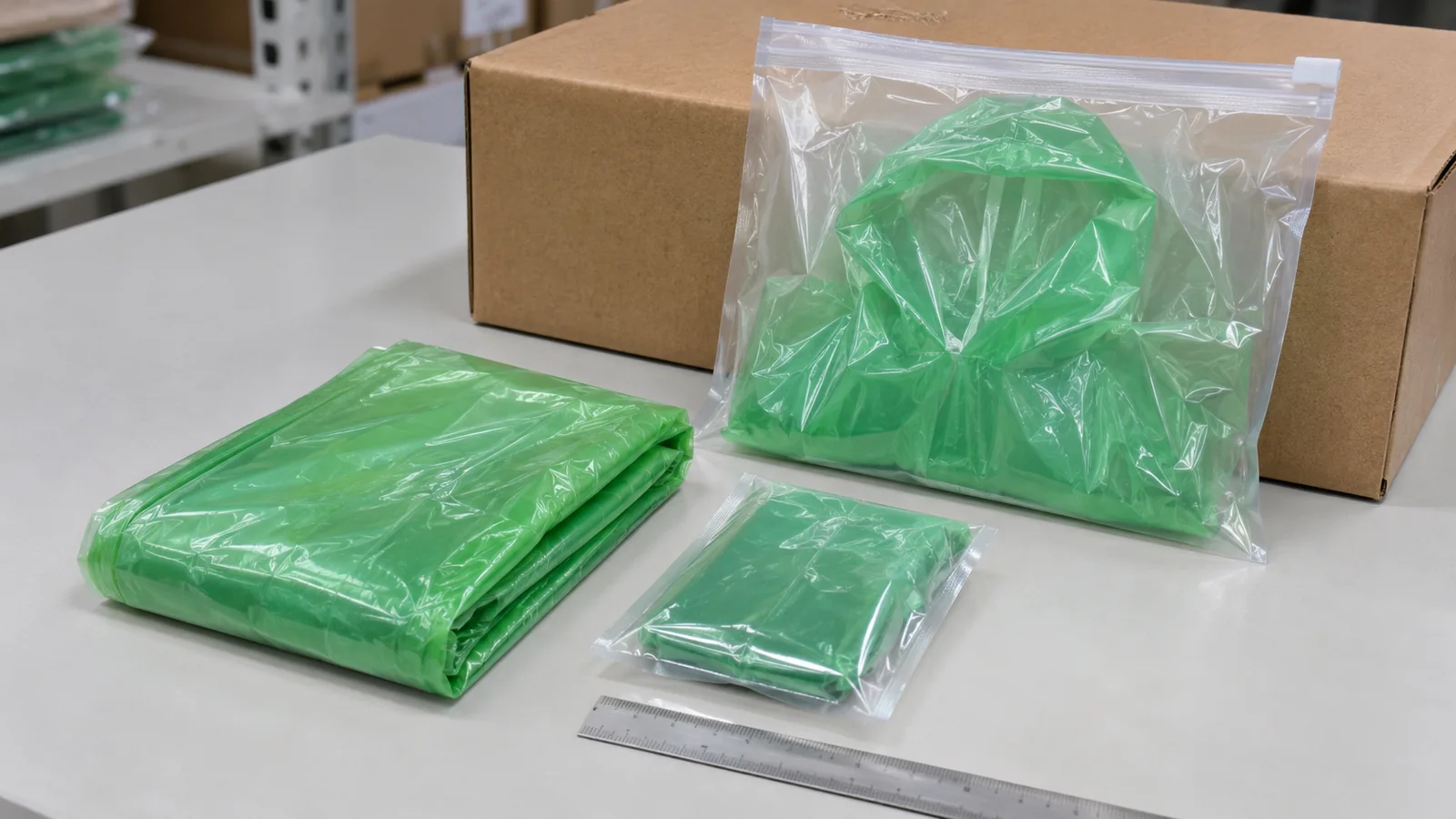
Balance compact packing with practical opening
Compactness is valuable only if people can use the packed product. A small sealed unit may look efficient on a specification sheet but become frustrating when the opening is unclear or the garment catches in the closure. Review the packet as part of the product. Ask the supplier to provide the normal fold, packet material and closure arrangement planned for production. Open representative samples in the same way a user or staff member will, following the proposed instructions rather than relying on prior knowledge of the packaging.
Identify the opening feature precisely. A peelable seal, zipper or other arrangement should be described according to what the actual packet provides. Do not write tear here instructions unless the approved pack has a suitable defined feature and the opening has been reviewed. If a separate tool is required, determine whether that is practical in the distribution setting. The buyer should not discover during an event that guests need assistance to open a unit intended for quick independent use.
Observe how the film comes out of the packet. A tight fit can make it difficult to distinguish the garment from the wrapper or unfold it without unnecessary pulling. Ask reviewers to use ordinary care and record the steps. If a problem appears, determine whether the fold, packet dimensions or opening method is responsible. A revised packet may solve the issue without changing the garment. Request the revised packed sample and repeat the relevant sequence so that a promising drawing does not substitute for a working physical arrangement.
Consider the role of inserts and labels. They can communicate useful instructions and identify the product, but they also affect packet thickness and the user's first impression. Keep necessary information readable and attached to the correct component. If the packet contains a printed card, confirm its orientation and whether it interferes with opening. Avoid adding material only to make the unit look more substantial. Every component should have a defined purpose and be included in the agreed packed dimensions and disposal discussion.
A hypothetical travel-kit buyer might initially request the smallest possible packet. Sample review could show that a slightly different fold fits the same kit opening and is easier to remove. The useful outcome is a controlled pack that satisfies the actual space and handling requirements. It is not a competition to produce the most compressed demonstration unit. Document the approved fold and measurement state so that later production samples are compared fairly and staff do not need to recreate an unusual packing technique.
Approve the packet with the garment inside, then retain both the sealed reference and the opening instructions. If the garment pattern, thickness or accessories change, recheck the packet because the earlier arrangement may no longer work. Include any meaningful packing requirements in the quotation and order, rather than leaving them in informal correspondence. This helps the buyer obtain a compact plastic poncho that is practical to distribute and open, with clear expectations for the supplied unit instead of an undefined promise of portability.
Store stock using product-specific instructions
Storage planning begins with the supplier's instructions for the actual product and packet. Ask for any stated conditions, handling limits and shelf-life information relevant to the offered construction. Do not invent a universal storage temperature or expiry period for all plastic ponchos. Different films, printing, closures and packages may need different consideration. Keep the instructions with the stock record and make them available to the staff who receive and store the goods, rather than leaving them only in the original purchasing email.
Choose storage that preserves identification and packet condition. Keep cartons organized so that model, variant and order references remain visible. Avoid arrangements that encourage staff to mix loose unidentified packets from different deliveries. If units are transferred to smaller bins for distribution, label those bins with the relevant product information. The goal is to keep the link between the stock and its approved specification intact. This becomes particularly useful when several clear poncho models look similar or a later order includes an approved revision.
Handle cartons and packets according to the actual packing arrangement. Do not assume that a tightly packed carton can support unlimited stacking or that a sealed individual wrapper makes the entire shipment suitable for any storage environment. Ask the supplier for relevant handling information and coordinate with the site's normal storage procedures. Where stacking, shelf dimensions or transport between locations matters, review the packed configuration. The buyer should define the real logistical conditions instead of treating the packet as a guarantee against every possible form of damage.
Include periodic condition checks in the stock process when appropriate to the program. Inspect a defined selection for damaged packets, unclear identification or other visible concerns, and record the finding. A visual check cannot establish every property of the garment, but it can identify stock that needs further review before distribution. If the product has been stored outside the supported conditions, ask the supplier or a qualified reviewer what action is appropriate. Do not simply relabel questionable stock as acceptable because an event date is approaching.
Keep incoming and outgoing stock records proportionate to the operation. Record delivery identity, quantities received, where stock is held and what is issued to each location. If the organization uses a rotation method, ensure it is consistent with the product information and any dated requirements. Do not claim an arbitrary shelf life based on the date the buyer happened to open a carton. If no supported shelf-life statement is available, record that fact and seek clarification where it is important to the intended holding period.
When replenishing, compare the new order with the existing reference before mixing stock. A changed packet, color shade or construction may be legitimate, but it should be understood and approved through the change process. Retain the relevant instructions for each version if they differ. Good storage control protects the practical value of sample approval: staff can identify what they are distributing and know whether the units have been handled in line with the product's information. It does not create unsupported durability promises or replace inspection of the delivered goods.
Manage opened, wet and unused ponchos separately
Unopened stock, an opened but unused unit, and a wet worn poncho should not be treated as the same inventory category. Define how each is handled before the product reaches users. The appropriate process depends on the supported product instructions and the organization's use plan. A sealed packet may be ready for distribution, while an opened item may need inspection or a different disposition. Keep the categories clear so that staff do not accidentally present a returned or handled garment as a new sealed unit.
If the product is intended for reuse, obtain instructions specific to that model. Clarify cleaning, drying, inspection and repacking requirements with the supplier. Do not assume that any plastic poncho can be machine washed, heated, chemically cleaned or repaired using a generic method. A proposed procedure should be supported for the actual film, decoration and components. Where the supplier does not support the planned reuse process, revisit the product choice rather than inventing a maintenance routine to make it fit the program.
Plan the transition after a wet use. Users may need a place to remove the garment without wetting other belongings, and the organization may need a defined route for returns or disposal. If a carrying pouch is provided, explain its intended role according to the product information. Do not promise that placing a wet garment back into a small packet constitutes suitable long-term storage. The practical instructions should distinguish temporary carrying from any subsequent drying, inspection or storage process that the selected product requires.
For shared programs, assign responsibility for returned items. Staff need to know who reviews them, where they are held and when they can be released again, if reuse is supported. An unplanned pile of wet garments creates uncertainty about condition and identification. Keep the process simple enough to operate consistently. If the organization cannot support the required handling, select a product and distribution arrangement that better matches its capabilities. Procurement should account for the operational work created by a reuse claim, not only the cost of the initial unit.
Record damage and recurring handling problems in a useful way. Identify whether an issue appeared while opening, wearing, removing or repacking the garment. Keep the model and sample or stock reference with the observation. If users repeatedly struggle with the same fold or closure, that may justify a different packet or clearer instructions. Do not convert isolated feedback into a universal material judgment, but do not ignore a pattern because the original sample looked satisfactory on a desk.
At the end of a program, reconcile unopened remaining stock separately from opened, damaged and used items. Preserve the identification of stock retained for later use and follow the actual disposal route for items no longer suitable. Update the next buying brief with specific operational lessons. This approach helps a buyer avoid unsupported claims about how many times a plastic poncho can be reused. It replaces those assumptions with a defined product, supported instructions and a handling process the organization can actually carry out.
Compare packet decisions in the rain poncho packaging guide.
10 / 12
Plan disposal and substantiate environmental wording
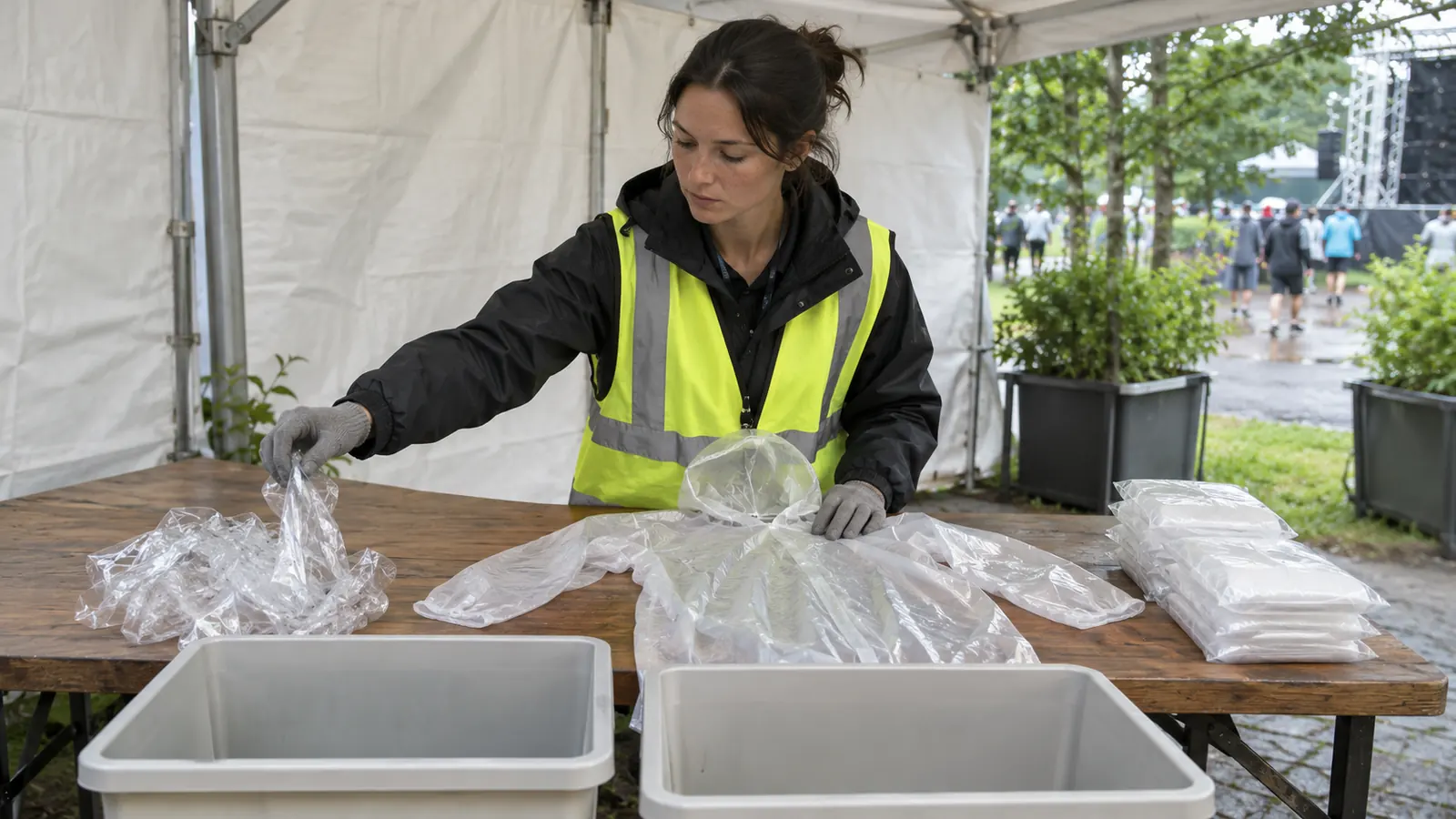
Identify the actual collection route before using recycling claims
A disposal decision starts with the people who will receive the used garment, not with a symbol selected for the packet. Ask the venue or waste contractor whether the exact poncho construction is accepted, in what condition, and through which collection arrangement. Describe the garment, printing, closures and attached parts. Send a product photograph and the confirmed material information when requested. Acceptance of a clean shopping bag does not establish acceptance of a used rain poncho. A useful answer identifies this item and the destination that will handle it, rather than referring generally to plastics.
The US EPA recycling FAQ explains that local acceptance varies and that a plastic resin code does not guarantee local recyclability. Apply that distinction to both the garment and its packaging. A packet may have a different composition and collection route from the item inside it. Keep separate entries for each component in the disposal review, including any paper insert. Where the provider cannot confirm acceptance, do not place the item in a recycling collection on the strength of appearance, a familiar material name or an assumption about another product.
For a hypothetical visitor attraction, the purchasing file could contain a short disposal enquiry alongside the sample approval. The enquiry describes a particular adult poncho, its printed design, its fasteners and the expected condition after use. The facilities team records the contractor's response and the proposed collection point. Procurement then checks whether the selected packet instructions match that response. This sequence gives the people preparing signage something specific to work with. It also exposes a disagreement early, while the order and the artwork can still be reviewed together.
Keep the geographical scope visible. An arrangement at one event site is not necessarily available at another branch or at a visitor's home. If guests take the poncho away, a venue-specific collection statement needs enough context to avoid implying universal acceptance. Conversely, a contracted collection route may depend on returning the garment to a staffed location at the event. The buying team should decide whether that return is realistic before building a communication plan around it. A route that guests cannot find or staff cannot operate is an unresolved operational question.
Review proposed recycling wording separately from the physical waste arrangement. The FTC Green Guides summary calls for appropriate qualification where access to recycling facilities is limited. The exact claim therefore needs a destination-specific marketing review as well as practical collection information. A supplier's material statement alone cannot answer either question. Avoid adding broad environmental labels simply because the buyer has arranged a collection bin. Keep a copy of the approved wording, its supporting evidence and the limits that were considered so later artwork changes do not quietly expand the claim.
Treat the collection answer as part of the order's revision history. A different closure, coating, print system or packet may change the information supplied to the contractor and require a fresh enquiry. A change of venue can do the same even when the garment is unchanged. Assign someone to check that these changes reach the person responsible for disposal instructions. At receipt, compare the supplied construction and package wording with the approved record. If the delivered item differs, hold the affected instructions for review instead of asking front-line staff to improvise a recycling answer.
Separate recycled content, compostability and reuse statements
Several environmental terms can appear in a single purchasing discussion, but they describe different questions. Recycled content concerns the material input. Recyclability concerns a possible collection and processing route after use. Compostability concerns performance under specified composting conditions. Reuse concerns another wearing or handling cycle and the arrangements that support it. Treat each proposed statement as a separate line in the claim review. A positive answer in one line should not automatically populate the others. This makes it easier to see precisely what the supplier has documented and what the buyer is still assuming.
The FTC summary distinguishes recycled-content claims from compostability claims and requires evidence and appropriate qualifications for environmental statements. In practical buying terms, request the claimed proportion and its component scope for a recycled-content proposal, and the relevant product evidence and disposal conditions for a compostability proposal. Do not substitute a statement about a raw material for a conclusion about the assembled garment and its packet. Broad descriptions such as eco-friendly should not replace this work. Their apparent simplicity can conceal several different promises that the procurement file has never examined.
For each proposed statement, write down the exact words that would reach the wearer. Identify whether those words would appear on a product page, an individual packet, a carton or a counter sign. A statement that is carefully qualified in a supplier document may lose its qualification when shortened for a small label. Ask the artwork reviewer to compare the final layout with the approved wording, including the size and position of the explanation. Keep a readable proof in the approval file so the decision is about the message people will actually see.
A reuse statement deserves a product and service discussion rather than a count selected for marketing effect. Ask whether the offered model is intended for repeated wearing, what inspection and care instructions apply, and which damage or contamination conditions require withdrawal. Do not promise a fixed number of uses without an appropriate basis. A poncho retained by one adult for occasional personal use presents different handling questions from stock collected and issued to another guest. The buyer needs to decide which arrangement is proposed before asking the supplier for supporting instructions.
Comparisons between options should use the same boundaries. If one proposal includes a separate pouch, return collection, inspection and storage, include those elements in its practical assessment. If another is distributed for an immediate visit, record what happens to unused inventory and to opened garments. These observations can inform the purchase without turning into an unsupported claim that one option has a lower overall environmental impact. Keep operational preferences, measured project information and wider environmental conclusions in separate fields. That separation lets a team make a sensible purchasing decision while keeping public wording within its evidence.
Where documentation is incomplete, reduce the claim to what is actually established or leave it out while the question is resolved. An accurate material description, clear care guidance and a confirmed local disposal instruction can be more useful than an ambitious badge. Give unresolved statements an owner and a deadline before artwork approval, rather than allowing them to remain as informal notes. Recheck the final product description and packet proof together. The result should be a consistent set of specific statements whose scope is understandable to procurement, venue staff and the person receiving the poncho.
Write an event disposal plan people can follow
A practical disposal plan follows the visitor's route. Identify where people receive the poncho, where they are likely to remove it, and where they leave the site. A collection point positioned only at the issue desk may be of little use when the exit is elsewhere. Walk the route with the facilities team before deciding the locations and signs. Consider queues, sheltered areas and the space needed for staff to maintain the stations. The plan should fit the event's existing movement and cleaning arrangements instead of relying on guests making a special journey.
Describe the intended contents of each container in ordinary language and with examples that match the supplied products. If a route is available only for a particular accepted item, make that limitation clear. Keep unused stock out of used-item collection, and give staff a separate place for unopened packets that can return to inventory after inspection. Where garment and packet destinations differ, explain the separation at a point where people can act on it. Do not assume that visitors will understand internal material abbreviations or distinguish similar transparent films without guidance.
Give staff a short operational sheet covering collection locations, the responsible contact and what to do when an item does not fit the agreed route. Include the contractor's relevant preparation requirements and the arrangements for moving collected material. Staff should not have to interpret a laboratory report at a wet exit gate. A supervisor can hold the supporting documents while the operational sheet states the approved action. If the route is uncertain or unavailable, escalate to the responsible facilities person rather than inventing another destination or mixing the contents with an unrelated collection.
Plan for changes during the event. A station can become full, a collection service can be delayed, or an exit can close. Agree who may relocate a container and how replacement signs will be checked. Provide a way for staff to report recurrent confusion, such as packets repeatedly entering the garment container. These observations are useful evidence for improving the next distribution. They should be recorded as site observations, with the relevant date and product, rather than converted immediately into claims about recycling performance or environmental savings.
Close the event with an inventory and handover record. Separate unopened usable stock, opened stock awaiting an approved decision, damaged items and material handed to the waste provider. Record quantities only when they have actually been counted or measured, and identify the method used. A collection receipt shows a handover under the recorded arrangement; it should not automatically be described as proof of final processing. Ask what downstream information the provider can supply if that information is needed for reporting. Keep any uncertainty visible rather than filling the gap with a favorable assumption.
Use the findings to refine the next order. If people struggled to open packets without discarding inserts on the ground, review the packet and instruction format. If many unopened units remained at scattered counters, review replenishment and consolidation. If the contractor could not accept a changed construction, correct the product and disposal approval process before the next purchase. These are concrete improvements that can be evaluated within the event operation. They also help the buyer brief the next supplier discussion using actual handling needs, without claiming an environmental outcome that the available records cannot establish.
Explore the separate claim and disposal questions in the biodegradable rain poncho buying guide.
11 / 12
Build an EAV specification and buying approval record
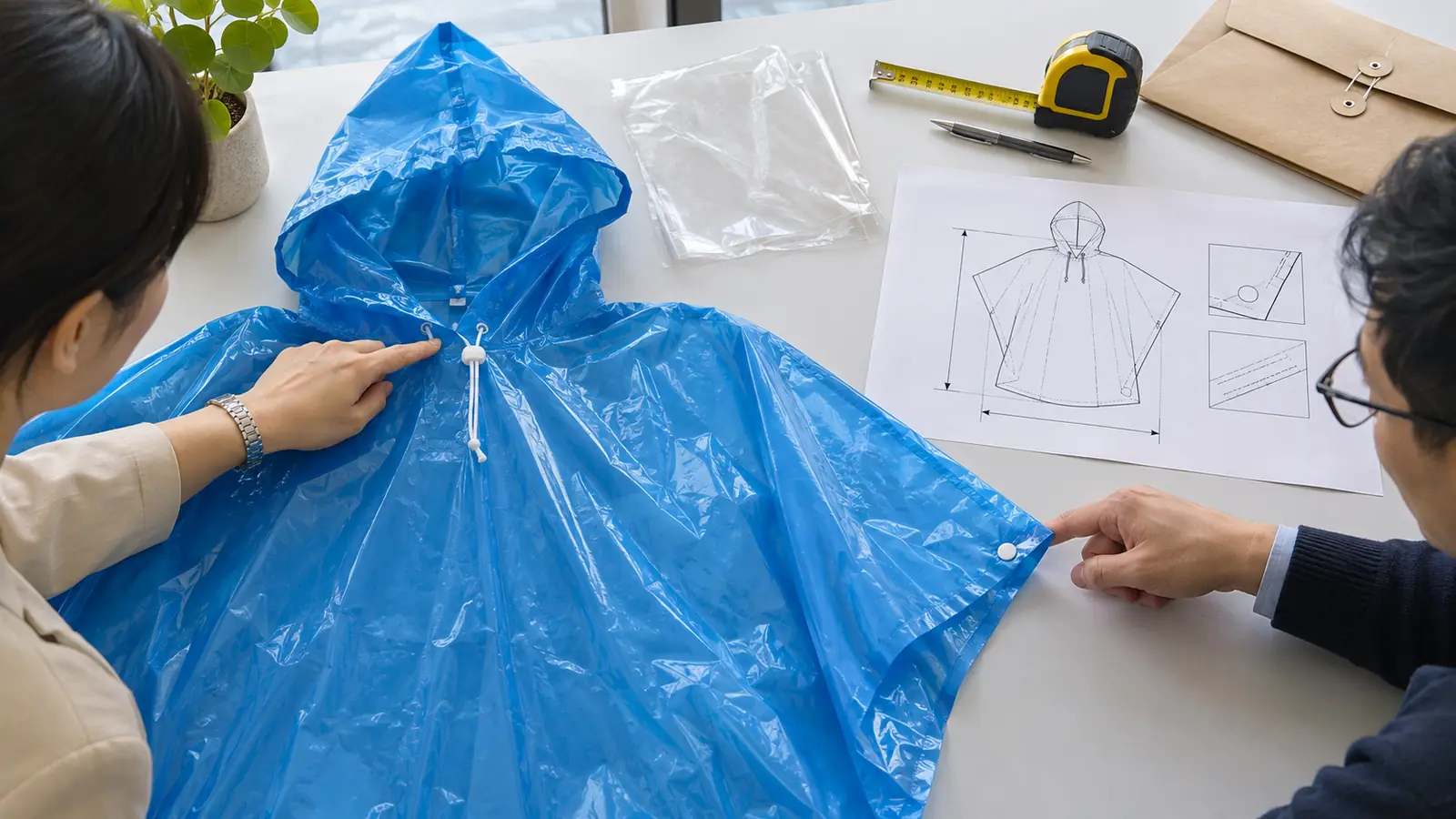
| Entity | Attribute | Value to agree | Verification |
|---|---|---|---|
| Finished poncho | Identity | [Model; revision; sample reference] | Approved finished sample |
| Main film | Composition | [Confirmed material; unresolved details identified] | Supplier statement linked to sample |
| Film | Thickness | [Units; target; method; points; tolerance] | Agreed measurement record |
| Garment | Unpacked weight | [Size-specific value and variation] | Separate garment weighing |
| Fit | Dimensions | [Drawing points; dimensions; tolerances] | Flat measurement and adult fit review |
| Hood and openings | Configuration | [Approved drawing; closure and opening details] | Finished-sample inspection |
| Joins | Construction | [Join locations and accepted workmanship] | Relevant inspection and evidence |
| Appearance | Clear film or color | [Physical reference; viewing conditions] | Approved appearance sample |
| Decoration | Artwork | [Revision; position; size; print system] | Decorated sample and artwork proof |
| Unit packet | Dimensions and opening | [Packed dimensions; format; instructions] | Opening and carrying review |
| Handling | Care and storage | [Model-specific instructions and limitations] | Supported supplier guidance |
| Disposal | Destination | [Actual local acceptance; component routes] | Waste-provider confirmation where relevant |
| Claims | Exact wording | [Statement; destination; conditions] | Product-specific evidence and review |
| Order | Commercial scope | [Variants; quantities; packing; dates; terms] | Current quotation and purchase order |
| Changes | Approval | [Approvers and release conditions] | Controlled revision and disposition record |
Turn the sample into a measurable order specification
An approved sample becomes much more useful when its important features can be described without relying on memory. An EAV table organizes the description into entity, attribute and value: which part is being discussed, what feature matters, and what has been agreed. Add a verification column so each value has a practical checking route. The table above is a working structure, not a list of standard product specifications. Replace its project fields with the details agreed for the offered model. Leaving a field open is preferable to copying an attractive number from an unrelated listing.
Begin with identification. Give the finished model, sample and document revision references that everyone can use consistently. Then distinguish the main film, closures, decoration and individual packet. The material entry should state what the supplier has actually confirmed, with any unresolved composition question clearly marked. A generic plastic raincoat poncho description can remain a purchasing category, but it should not stand in for a confirmed polymer entry. If alternatives are under consideration, create separate variants rather than combining their features into a specification that no single sample represents.
For dimensions and thickness, include the measurement conditions that make the values interpretable. A length measured on a flat, unstretched garment is not necessarily comparable with a length measured while it hangs from a form. Identify the relevant drawing points, the units and the agreed method. Distinguish an agreed target from an acceptable range and from a single sample observation. The buyer and supplier should resolve this language before production approval. Otherwise, a receiving team can end up debating whether a recorded sample value was an example or a mandatory limit.
Use references for qualities that cannot be captured adequately by one number. A physical color sample, an approved clear-film appearance reference and a decoration proof can sit alongside written criteria. Describe which reference controls when a photograph and a physical sample appear different. Include the conditions used for a visual comparison where these affect the decision. The aim is not to make every subjective response disappear. It is to make the approval sufficiently explicit that a later reviewer can understand the basis and recognize a meaningful change.
Separate fixed requirements from requested options. For example, a buyer may require adult coverage and a particular packet size while asking the supplier to propose different confirmed film constructions. Mark the proposed fields as awaiting approval, then update them when a sample is selected. Do not let a supplier's optional suggestion become an accepted substitution merely because it appears in the latest email. A controlled table should show the status of each important choice, the reference supporting it and the person responsible for closing any remaining question.
Finish by checking the table against the physical packed sample. Follow the wearer-facing sequence: identify the packet, open it, unfold the poncho, inspect the relevant dimensions and components, and review the instructions. Then follow the receiving sequence: identify the variant, locate the carton information, compare the approved references and record the result. This exercise can reveal a missing field more effectively than another round of general discussion. Save the final table with the sample photographs and approval record so the order can be understood even when the original buyer is unavailable.
Match product evidence to destination and intended use
Evidence should answer a defined question about the offered product. Before asking for a collection of certificates, list the destinations, users, activities and exact claims involved in the order. An adult visitor poncho, a children's garment and protective clothing for a specified workplace can require different assessments. The word plastic does not decide which requirements apply. Ask the responsible compliance reviewer to define the applicable scope, then request the documents needed for that scope. This approach helps prevent a familiar-looking report from being accepted simply because it contains a recognized laboratory name.
Check identification across the sample, specification and report. Look for the model or material references, color or component scope, relevant dates, test method and reported result. Where a document describes a different sample, ask the supplier to explain the relationship and have that explanation assessed before relying on it. A result for an undecorated film may not answer a question about the finished printed garment. Equally, a report about one component should not be presented as a comprehensive approval of everything in the packet. Preserve the limits of the evidence in the purchasing record.
The European Commission's REACH overview describes a framework for managing chemical risks and places responsibilities on industry. For a rainwear order, use a competent review of the actual materials, components and destination to identify the applicable obligations and evidence. Do not treat the broad phrase REACH compliant as a substitute for that review or assume that one document covers every restriction. Ask which product configuration the statement concerns and what supports it. This article does not establish the chemical composition or compliance status of any offered poncho.
California requires a separate consideration where relevant. OEHHA's Proposition 65 FAQ explains that warnings concern exposure to listed chemicals and that a warning does not itself establish a violation of product safety standards. A buyer should therefore ask the responsible specialist to assess the proposed product and communication, rather than equating either the presence or absence of a warning with universal safety. Keep the conclusion tied to the actual product, destination and current requirements. Do not copy a warning from another article or remove one merely to simplify the appearance of a packet.
Performance claims need the same discipline. A comfortable fitting session and a visual examination of joins can support the observations actually recorded, but they do not create a certified waterproof rating or establish suitability for specialized protective use. If a quantified claim or regulated protective function is part of the brief, obtain appropriate evaluation for the finished configuration. Discuss with the reviewer how changes in seams, openings, sizing or decoration affect the evidence. Avoid expanding the sales description beyond the question that the supporting work was designed to answer.
Record a clear disposition for each evidence item: accepted for the stated purpose, clarification required, or not applicable to the current decision. Include who reviewed it and which specification revision was considered. Keep unresolved issues visible in the release checklist instead of burying them in an attachment folder. If the supplier changes the construction, return the affected evidence to review before approving the substitute. This creates a practical link between paperwork and the goods being purchased, while leaving specialist legal and technical conclusions with the people qualified to make them.
Align quotations, receiving checks and controlled changes
A quotation is easiest to evaluate when its product references match the specification. Ask each proposal to identify the model, variant, material description, decoration, packet and carton arrangement being priced. Record the quantities for each variant and the stated commercial assumptions. A lower unit price can be difficult to interpret when the compared offers contain different garment coverage or packing arrangements. Bring those differences into the comparison table before discussing value. The objective is a clear choice among actual offers, not a ranking of figures whose underlying products remain uncertain.
Distinguish the stage of the offer. A preliminary estimate may precede a final artwork file, sample approval or delivery instruction. Keep its assumptions visible and request an updated quotation when the relevant details are settled. Ask the supplier to confirm the applicable terms and dates for the current enquiry rather than relying on a past project's minimum quantity or lead time. If the buyer needs several delivery locations or phased quantities, include that information in the discussion. Do not turn an indicative response into a promised production or arrival date without confirmation.
Agree receiving checks before the goods arrive. Identify which features can be checked against the approved sample, which need measurement, and which require document review. Arrange an appropriate inspection or sampling plan with the supplier and qualified reviewer where needed; do not invent a universal sample size from the order quantity. Specify how results will be recorded and who will decide the disposition of a discrepancy. The receiving team should have access to the current specification and references, rather than working from a sales photograph that omits the agreed details.
Write the change process in simple terms. Identify which changes require prior approval, who can authorize them and how the affected sample, quotation or evidence will be updated. A substitution may involve more than the main material: the packet, closure, print system or fold can affect a decision already made elsewhere. Require the proposal to describe those consequences, not just label the substitute equivalent. The reviewer can then decide whether new measurements, fitting, artwork review or disposal enquiries are needed before the revised product is released.
For a hypothetical multi-site visitor program, keep the common garment specification separate from site-specific allocations. The same approved model might be packed into different carton quantities for each location, with different receiving contacts and disposal instructions. A master record can identify the shared product while allocation sheets identify the operational differences. This prevents a local change from being mistaken for a new garment specification. It also helps procurement investigate a problem at one site without assuming that every shipment contains the same packing or communication error.
Close the order with documents that agree with one another. Check the purchase order, final quotation, artwork proof, packing instruction and approved specification for conflicting revisions. List any exceptions explicitly, together with the authorized decision, rather than expecting a note in an email chain to override a signed reference silently. Preserve the sample and records needed for later comparison. A disciplined handover cannot eliminate every supply problem, but it gives both parties a shared description of what was approved and a practical route for resolving differences when the delivered goods are examined.
Connect the order specification to the wholesale rainwear sourcing, branding and logistics guide.
12 / 12
Answer procurement questions and release the order
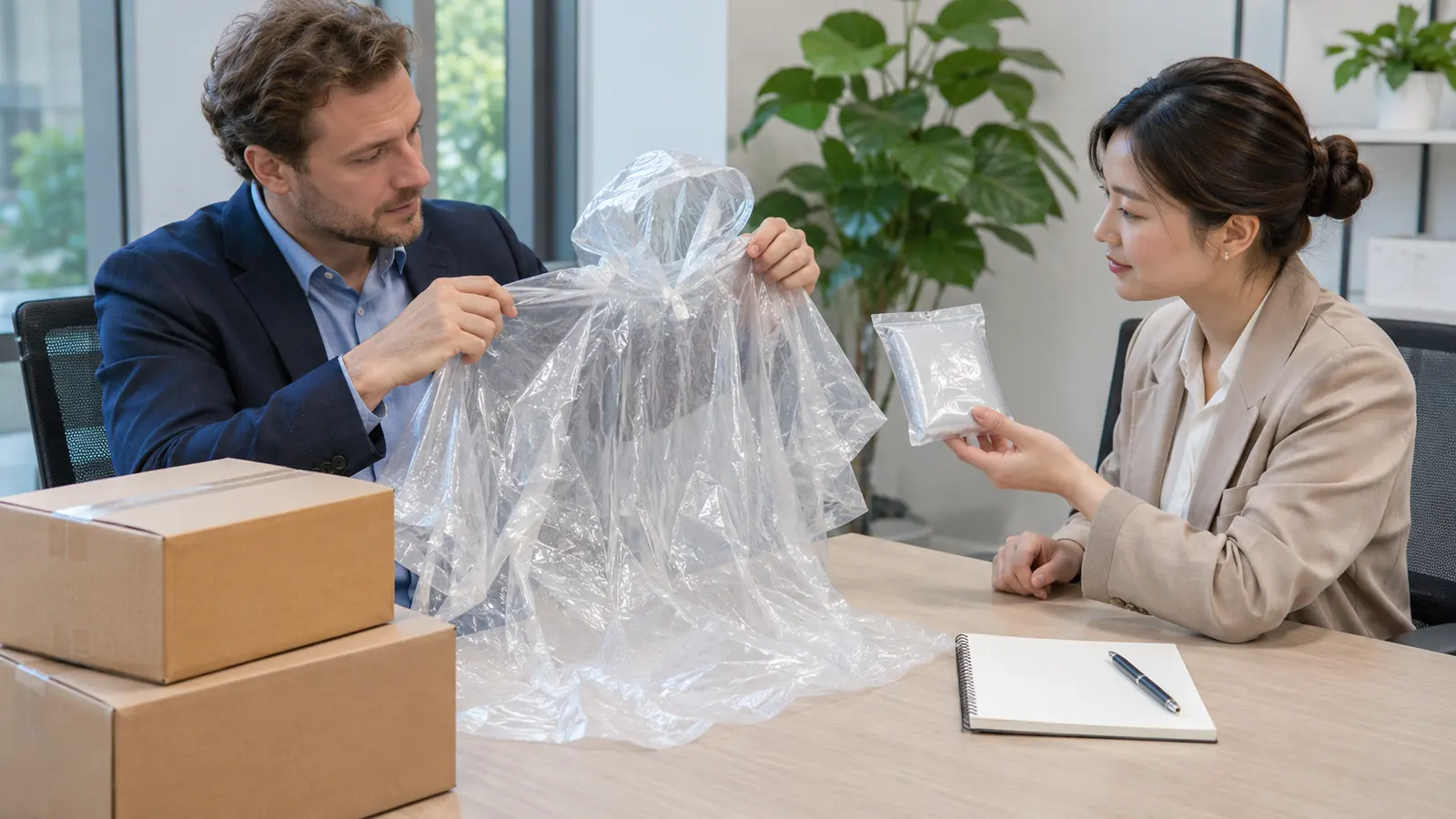
Which material and thickness should a buyer request?
Should a buyer request PE whenever a listing says plastic rain poncho? No. Start by asking the supplier to identify the main film and relevant components of the offered model. Plastic is a broad description, and appearance does not resolve the composition. If the supplier confirms a particular polyethylene construction, record that confirmation with the sample reference. If the identity remains uncertain, keep it unresolved in the specification. A buyer can compare the practical samples while investigating composition, but should not publish material-specific claims or approve a material-dependent requirement on an assumption.
Is there one best thickness for every everyday poncho? A useful request begins with the wearing brief: the adults to be covered, their clothing and bags, the expected handling and the distribution format. Ask the supplier to propose a construction for that brief and explain the available thickness specification. Then review finished samples rather than selecting solely from a list of micron values. A thicker film does not, by itself, establish better fit, stronger joins or greater practical convenience. The relevant decision concerns the complete garment and the job the buyer expects it to perform.
How should two quoted thickness values be compared? Confirm the units, component, measurement locations and method before comparing the numbers. Ask whether the quoted value is a nominal target, a sample reading or an acceptance range. Check whether a folded or joined area has been measured differently from a single film layer. The answer may explain an apparent difference without establishing that either offer is better. Preserve the agreed measurement procedure in the purchase record so a later check uses the same basis instead of creating a dispute through a different measuring approach.
Does a heavier poncho necessarily contain thicker film? Not necessarily. Compare the unfolded dimensions, construction, closures and included components, and confirm whether the stated weight excludes the packet. A larger garment can weigh more even when the film specification is unchanged. A packet or insert can also distort a comparison described loosely as product weight. Ask for separate garment and packed-unit information when both matter. Use weight to understand the offered configuration and carrying requirement, while keeping thickness and coverage as their own specification fields.
What if two acceptable samples use different materials? Keep both alternatives clearly identified and compare them against the same practical brief. Record fit, handling, join construction, appearance, packet size and the evidence needed for any proposed claims. Seek current quotations for the actual variants and review the operational differences with the people who will distribute or use them. There is no need to force every decision into a single material ranking. The buyer's preferred option may depend on the approved wearing task, available packing arrangement and documented limitations.
What should a buyer do when an answer remains vague? Turn the uncertainty into a specific question with an owner. For example, ask whether a weight includes the packet, whether the material description covers the closure, or which drawing points define the width. Request a revised specification or sample where necessary. Do not compensate by adding a wide tolerance that nobody has reviewed. Release the order only after the important requirements can be understood and checked. A short list of resolved questions is more valuable than a long specification assembled from assumptions.
How small should a packet be, and can the poncho be reused?
How small should an individual packet be? Start with its actual destination: a visitor counter drawer, a jacket pocket, a transport kit or another defined space. Measure that space and consider how the user will remove and open the unit. Ask for a packed sample with dimensions taken on an agreed basis. A very compact packet may be convenient to store, but the buyer also needs to examine opening, unfolding and the condition of the garment. The purchase decision should consider the whole interaction rather than rewarding the smallest advertised number.
Can the supplier's folded dimensions be used to plan a carton? Not without checking the complete packing arrangement. Confirm whether the measurement describes the garment alone, an individual packet or a larger pack. Ask for the proposed quantity and arrangement within the carton, together with current dimensions and weight information for that configuration. A packed unit that fits a pocket does not establish how a shipment will occupy a storeroom. Keep the individual carrying requirement and the bulk receiving requirement as separate fields, then verify both against the offered arrangement.
Can a plastic poncho be worn again? That depends on the particular product, its intended use, its condition and the applicable instructions. Ask whether repeated use is supported for the offered model and how the garment should be inspected, cleaned, dried and stored. Do not infer a service life from thickness alone or promise a number of uses because a sample survived one fitting. If a model is intended only for a limited-use distribution, communicate that intended use accurately. A buyer seeking repeated wearing should make that requirement explicit before selecting the sample.
Is issuing an opened poncho to another guest the same as personal reuse? No; it introduces a different handling arrangement that needs its own assessment. A venue must consider who receives the returned item, how its condition is assessed, what supported care is possible and whether reissue is appropriate. Do not place a used garment back among unopened stock merely because it looks intact. Keep the stock categories and responsibilities clear. If the operation cannot support the necessary process, choose a distribution arrangement that does not depend on undocumented collection and reissue.
Can the used poncho simply be returned to its original packet? Check the packet's intended function and the product's care instructions. A presentation sleeve may not be a practical storage pouch, and a wet garment should not be treated as ready for long-term storage merely because it can be folded to fit. Review an actual handling sequence with the proposed model: opening, wearing, removal, any supported care and eventual packing. Record what the user needs to know and which accessories, if any, are included in the quoted product. Avoid promising storage functions that the packet has not been designed or approved to provide.
How should a buyer choose between a small disposable-format unit and a reusable option? Describe the actual service arrangement and compare complete proposals. Consider who keeps the garment, where it is carried, how it will be cared for and what happens to unused or damaged stock. Include practical staffing and storage requirements in the operational discussion. These factors can support a purchasing preference without establishing a universal environmental ranking. Select the configuration that meets the documented brief and keep its instructions, packet description and user-facing claims consistent with the evidence for that particular product.
What should be confirmed before a wholesale order?
What information belongs in the first enquiry? Provide the intended audience, destination, ordinary wearing task, clothing or bag coverage, preferred appearance and required quantities by variant. Add the packet and distribution requirements that could affect the product choice. If material or thickness has not been decided, ask for proposals instead of supplying an unsupported specification. Include the questions that require clarification and any timing constraints that the supplier needs to assess. This gives the conversation a practical starting point without presenting an early preference as a final approved construction.
Which sample should be approved? Review the finished configuration that represents the intended order closely enough for the decisions being made. If the available sample differs in color, print, closure or packet, list the differences and determine what still needs a representative sample or proof. Approval should identify its scope: a fit review alone is not a complete decoration or packing approval. Keep the selected reference accessible to the buyer, supplier and receiving team. When a later sample replaces it, identify the new reference and record which earlier decisions remain applicable.
What documents should accompany the final decision? Keep the agreed specification, current quotation, relevant drawings, artwork, packing details, supported instructions and the evidence required for the product's destination and claims. The useful collection is the one that answers the defined questions, not necessarily the largest folder. Check that reports and statements identify the offered configuration and have been reviewed for their intended purpose. Mark unresolved matters plainly. If a specialist decision is needed, obtain that decision before using the affected claim or approving the corresponding requirement.
How can a buyer avoid an unexpected substitution? State which changes require prior approval and ask the supplier to identify proposed differences before implementation. Include the main film, closures, decoration, packet and other features that affect the agreed result. Require the revised proposal to show which sample or document changes. A change that seems minor commercially may matter to the packing, disposal or appearance decision. The approval route should therefore reach the relevant reviewer rather than relying solely on the person who processes the price amendment.
What should be checked immediately before release? Compare the final purchase order with the latest accepted quotation and specification. Confirm variant quantities, artwork revision, packet wording, delivery instructions and the agreed handling of inspection results. Check that the people receiving the shipment have the necessary references and know whom to contact about a discrepancy. Resolve contradictory entries before release instead of assuming the supplier will choose the intended one. The checklist below can serve as a final meeting agenda, with each point tied to the document or sample that closes it.
What makes the order ready to proceed? The buyer should be able to describe the product accurately, explain why the sample suits the intended everyday use, identify the evidence behind its claims and show how the delivered goods will be checked. The supplier should have the same approved references and a clear route for proposing changes. Commercial details need current confirmation, and unresolved technical or destination-specific issues need appropriate review. Bring those requirements into the enquiry and approval discussion. A plastic poncho becomes a manageable wholesale purchase when the general product name has been translated into a specific garment, packet and documented buying decision.
Plastic rain poncho purchase checklist
- Define adult users, activity, clothing and destination.
- Confirm main-film identity, separate components and packet composition.
- Agree thickness, unpacked weight, dimensions, closures and appearance references.
- Review the decorated finished sample and practical packing.
- Obtain model-specific care and storage instructions.
- Match claims and disposal instructions to evidence and the actual destination.
- Align the specification, quotation, receiving checks and change control.
| RFQ field | Buyer entry |
|---|---|
| Use | [Adult audience; activity; clothing; destination] |
| Construction | [Confirmed film; drawing; thickness; unpacked weight; components] |
| Branding and packing | [Artwork; placement; pouch; sleeve; carton allocation] |
| Care and evidence | [Instructions; exact claims; reports; unresolved questions] |
| Commercial scope | [Variants; quantities; dates; delivery basis; current terms] |
| Approval | [Reference sample; reviewers; acceptance; change process] |
Return to the rain poncho selection guide or continue the enquiry with the bulk rain poncho buying guide.