
Rainwear compliance · A practical evidence guide for bulk buyers
Rainwear Safety Standards: EN343, REACH, and California Prop 65 Compliance
A raincoat can look right and still arrive with the wrong evidence. For bulk buyers, the useful question is which requirements apply to this product, in this market, for this intended use. This guide connects rain protection, chemical information and California warning decisions with the documents, sample approvals and change controls your OEM Program needs. It also covers the move from EN 343 to EN ISO 24232, so an old certificate number does not become your entire purchasing strategy.
Define the use. Match the evidence. Release the approved configuration.
01 / 12
Start rainwear compliance with the intended use and destination

Write a use brief before requesting certificates
Start with the person wearing the garment, the task they will perform and the destination where you intend to supply it. A festival visitor walking between stages, a maintenance team working outside and a school group waiting for transport do not create the same purchasing brief. Even when all three buyers use the phrase waterproof rainwear, their expectations about wear time, movement, supervision, visibility and reuse may differ. Write those expectations down before asking a supplier to send every certificate in its files. A focused brief makes the evidence request much more useful.
Describe the product in ordinary language first. Include whether you need a loose poncho, a fitted jacket, a jacket and trouser set or a compact emergency pack. State the intended user group, approximate wear duration, expected activities and whether another garment or protective item must fit underneath. Explain how the product will be distributed and what the recipient will be told about its use. These details help your technical reviewer decide which questions belong in the specification and which assumptions need clarification before a quotation becomes a production order.
Then identify the markets. A shipping port is not always the final destination, and a distributor may serve more than one territory. Ask the commercial team where the rainwear will be offered, supplied or used, including online channels and onward distribution. Record the intended markets beside the model reference. If the customer later adds another destination, treat that as a review event. It is much easier to reassess a defined market change than to discover at dispatch that different teams have been using different interpretations of the original order.
For an OEM Program, include the planned alterations. A logo print, a different coating, a custom colour, an extra pocket or a substituted fastening can change the configuration your evidence needs to describe. Do not hide these details in a separate artwork email. Link the design brief to the product specification from the beginning. A supplier can then explain which existing documents may be relevant, which features need further assessment and which approvals depend on receiving the final artwork or material selection.
Consider a hypothetical promotional agency buying rain ponchos for a multi-country event. The agency knows the quantity and branding but has not yet confirmed whether the same stock will be offered to visitors and issued to staff performing outdoor duties. The practical next step is to separate those uses in the brief. That does not automatically require two products, but it prevents one vague description from carrying two different expectations. The responsible reviewers can decide whether a common configuration is suitable and what evidence each distribution route needs.
Finish the brief with a decision owner and an approval date. Name the person who can resolve intended-use questions, the person who reviews technical evidence and the person who authorises commercial release. Keep unanswered points visible rather than converting them into optimistic assumptions. A useful enquiry might say that the product category is awaiting review, that a specific market is confirmed and that branding remains provisional. This gives suppliers a realistic basis for discussing MOQ, sample development and Bulk Pricing while your team closes the outstanding decisions.
Separate rain protection, chemical controls and warning duties
A compliance file becomes difficult to use when every document is treated as another version of the same certificate. Organise the review around the question each document answers. Rain protection evidence concerns the relevant performance of a material, seam or finished garment. Chemical information addresses substances and the rules or contractual restrictions applicable to the product. A warning review considers whether information must reach the user in a particular market. These workstreams may share a model number and material register, but they do not replace one another.
Build three columns in your purchasing worksheet: requirement, supporting evidence and decision. Under rain protection, describe the standard edition or test method being relied upon and the construction covered. Under chemical controls, identify the destination, material scope and information requested. Under warnings, identify the assessment and approved communication, if a warning is needed. This simple separation stops a positive result in one column from being carried into another without review. It also makes missing evidence easier to discuss without dismissing useful information already supplied.
For example, a report describing a fabric's resistance to water penetration does not identify every substance in the printed logo. A supplier declaration about a defined chemical restriction does not explain the finished jacket's seam construction. A California warning label does not establish a rain protection classification. Buyers often encounter these documents together, so the file should explain the connection rather than leave a future colleague to infer it. Use a common product reference and keep the conclusion attached to the requirement that was actually examined.
The distinction also helps when a supplier offers a different route to your target. You may receive a stronger material specification but less complete documentation, or a well-documented standard product that cannot accommodate the proposed decoration. Neither tradeoff can be resolved by counting certificates. Compare the proposed configuration with the intended use, identify the remaining work and ask whether that work can be completed before approval. Commercial teams can then evaluate the whole proposal, including development time and evidence gaps, instead of treating paperwork as a final administrative step.
Keep the language of each conclusion narrow. A useful record explains that a named report supports a particular property for an identified sample, or that a declaration covers listed materials against a stated scope. Avoid expanding this into globally certified rainwear or an unrestricted safety promise. Even a detailed evidence package has boundaries. Recording those boundaries is part of a professional buying process because it tells your team when another market, material change or customer claim requires a fresh decision.
This approach is especially helpful when several departments contribute. Product development can review construction and fit, a compliance specialist can assess applicable obligations, procurement can manage supplier responses and marketing can use the approved claims. Everyone works from the same configuration, but each person has a defined question. The resulting file is easier to maintain than a folder of unrelated attachments. More importantly, it supports a clear release decision: what has been established, what remains open and who is responsible for closing each outstanding point before the order proceeds.
Assign responsibility across the wholesale supply chain
The person placing the purchase order is rarely the only person responsible for the finished rainwear programme. A brand may commission the design, a supplier may coordinate production, a decorator may apply the logo and an importer may handle the destination-market review. A distributor may then present the product to another business. Map these roles at the start. The purpose is to make document requests, approvals and changes reach the right people, rather than allowing each participant to assume that someone else has completed the necessary assessment.
Use names and functions, not just company logos. Your working record should identify who controls the specification, who can approve material substitutions, who holds the full test reports and who maintains the final label artwork. It should also identify the person responsible for checking the legal role of each economic operator in the destination market. Commercial contract wording can allocate tasks, but your compliance reviewer should confirm the obligations that apply to the actual arrangement. A delivery term or a promise to handle everything is not a substitute for that review.
Create an evidence request that can travel upstream without losing meaning. Instead of asking for all compliance papers, list the model, revision, component or property and the document needed. Explain whether the request concerns the unprinted garment or the final branded version. Ask the supplier to identify any evidence held by a material producer or another party and explain how the connection to your order will be established. This helps preserve accountability when the person answering your email did not manufacture every component themselves.
Decide how unresolved points will be escalated. A salesperson may be able to confirm available colours and packaging, while a technical colleague is needed to explain a report's scope. Set a route for those questions rather than allowing a commercial answer to become a technical approval by default. Keep the original question, the response and the supporting attachment together. When a conclusion depends on specialist interpretation, record that dependency and the person who accepted it. This is particularly useful when a deadline encourages everyone to shorten their emails.
A hypothetical apparel company might ask its sourcing office to obtain evidence, its product team to approve the sample and its compliance lead to approve the market file. The sourcing office can report that documents have arrived without declaring the product released. The product team can approve fit without approving a chemical claim. The compliance lead can identify a missing component declaration while allowing unrelated artwork work to continue. These separate decisions keep the project moving while making the final release conditions visible.
Finally, plan for staff turnover and repeat orders. Store the approved file where the next buyer can find the exact configuration, source documents and decision history. Add a contact route for supplier updates and a review trigger for new destinations or changed materials. A repeat purchase should reference the last approved revision and require confirmation of any differences. That gives the supplier a concrete continuity question to answer and gives your team a reliable starting point for checking whether the previous approval still fits the new order.
Connect the evidence brief with the complete purchase in our Wholesale Rainwear Buyer’s Guide to Sourcing, Branding and Logistics. Use one product revision across sourcing, samples, artwork and delivery.
02 / 12
Read EN 343 evidence alongside the EN ISO 24232 transition

Check the standard edition and the current regulatory reference
If your enquiry still says EN343 waterproof standards, add an edition check before sending it. NEN's current catalogue lists EN ISO 24232:2025 as replacing EN 343:2019, and the European Commission's Decision (EU) 2026/1971 lists EN ISO 24232:2025 among harmonised PPE standards. The European designation refers to ISO 24232:2024. Those identifiers are similar enough to be mixed up in a quotation, so record the complete designation rather than shortening everything to a familiar standard number. Confirm the applicable route for your product and intended placing-on-market date.
The practical buying question is how the proposed product's evidence relates to the requirement you intend to use. Ask the supplier which edition appears on the report, declaration and product information. If the documents use different references, request an explanation before treating them as equivalent. Your technical reviewer should examine the current official reference and any applicable transition provisions. Do not infer a universal legal expiry date from a standards seller's withdrawn label, or assume that a newer standard number can simply be typed over an older report.
Keep the distinction between a catalogue status, a technical assessment and a regulatory reference visible in your file. Each serves a different purpose. A standards catalogue helps identify the document and its history. A report records work performed on a sample under a stated method. The regulatory framework determines how that evidence supports the product's conformity route. The supplier's explanation should connect those pieces to the specific model, rather than offer a general statement that all old and new references mean the same thing.
For a new procurement programme, ask your technical reviewer to define the required evidence before sampling begins. That can avoid commissioning work against an edition that does not fit the proposed route or delivery plan. For an existing model, ask for a documented review of the current file and any proposed updates. The answer may involve additional assessment, revised documents or a different product configuration. The important point is that the review is explicit and completed by the appropriate people, not silently assumed by a buyer comparing catalogue descriptions.
Use a small revision register to manage the discussion. Record the requested standard, the reference shown on the supplier's evidence, the date of the official reference check and the conclusion reached. Add the next review trigger, such as a revised specification or a later supply programme. If the technical position is unresolved, label it unresolved. This is more useful than a red or green cell with no explanation because it tells the purchasing team exactly what must be clarified before it can make an informed commitment.
The sources linked in this section establish the successor and the current reference context; they are not a replacement for the full standard or a product-specific conformity review. Avoid copying a performance table from an old brochure and applying it to another edition. Obtain the relevant standard through an authorised source and have the applicable requirements interpreted for the proposed garment. Your enquiry can then ask for a precise result and supporting evidence while keeping the commercial discussion about quantities, samples and delivery connected to the correct technical brief.
Match the report to the finished rainwear construction
A performance result becomes useful only when you can connect it to the rainwear you intend to buy. Start with the sample description on the report. Does it identify a fabric, a seam assembly, a finished garment or another test piece? Check the material reference, construction, colour where relevant and model designation. Compare those details with the current specification and the sample in front of you. A familiar supplier name on the first page does not establish that the document covers every raincoat in that supplier's catalogue.
Build the connection in a short evidence map. Give the finished model a revision number and list its shell, coating or membrane, seams, closures and other features relevant to the assessment. Against each report, record the component or assembly it describes. Where the report uses a laboratory sample code instead of your purchasing reference, ask for a traceable explanation of the relationship. Keep that explanation with the report. The objective is to let another reviewer follow the same path without relying on an undocumented phone call.
Pay attention to what happened before the measurement. If a report describes conditioning, cleaning, pretreatment or another preparation step, make sure your reviewer understands it. A result obtained under one stated preparation is not automatically a result for every care routine or wear condition. Ask how the declared care instructions relate to the evidence. This does not require procurement to reinterpret laboratory methods; it requires procurement to keep the conditions attached to the result so the technical team can assess them accurately.
Seams and closures deserve particular attention because a garment is more than a flat sheet of material. Ask how the finished construction was represented in the assessment and whether the proposed design differs from the assessed one. A relocated pocket, a new fastening or a different seam treatment may require review. Record the supplier's explanation and the technical decision rather than assuming that a successful shell material result settles every construction question. The same discipline applies when a standard model is adapted for a promotional or workwear programme.
Imagine a hypothetical buyer receives a report for a coated fabric and a sample jacket with a different seam arrangement from the illustrated model. The constructive response is to ask for the missing link: which report or assessment supports this assembly, and what evidence connects it to the supplied sample? The buyer does not need to reject the entire proposal immediately. It can identify the gap, obtain the relevant explanation and decide whether further work is needed before approving the configuration for bulk manufacture.
Preserve the final answer in the approval record. Attach photographs or a sample reference, the relevant document identifiers and the accepted construction revision. If a proposed substitution changes that relationship, reopen the review. A clear connection between evidence and product makes repeat orders easier because the supplier can confirm whether the approved assembly remains unchanged. It also gives receiving teams something concrete to compare with the delivered goods. The benefit is practical traceability, not an impressive folder that nobody can connect to the cartons arriving at the warehouse.
Translate performance evidence into a practical buying decision
Technical evidence should help your team choose suitable rainwear, not merely fill a tender attachment. Begin with the intended use and ask which properties matter to that use. Rain exposure, activity level, garment layering, wear duration and care arrangements can all shape the specification you ask a qualified reviewer to develop. The current rain protection standard's published scope concerns precipitation, fog and ground humidity; it does not make the garment suitable for every water-related hazard. Keep the intended protection and any limitations aligned with the actual work or event.
Ask for the result in the form the report supports. If the document gives a classification, identify the relevant edition and the property it represents. If it gives a measured value, keep the method, units and conditions with that value. Do not convert an isolated number into a broader performance promise. Your technical team should decide how the evidence relates to the purchase requirement. Procurement's job is to make the proposed requirement, supplied evidence and approval conclusion easy to compare across competing offers.
Separate demonstrated performance from user preferences. A buyer may prefer a softer feel, a lighter pack or a particular hood shape. Those preferences can be evaluated through appropriate sample review, but they should not be presented as proof of a standard classification. Conversely, a performance document does not answer every fit or usability question. Record both kinds of findings. The most useful purchasing file explains why the product meets the defined requirement and why the approved configuration works for the intended distribution and wearing arrangement.
Run a structured sample review with the people who will specify or manage the garment. Check whether users can operate closures, access necessary pockets and move as expected while wearing the planned layers. Record observations without describing the exercise as a certified test. Where an observation raises a technical concern, send it to the appropriate specialist for assessment. This keeps practical feedback connected to the formal evidence while avoiding unsupported claims about what a short office trial or a photograph has established.
For a hypothetical outdoor workforce order, the buyer might compare two documented constructions. One may be easier to pack and distribute, while the other fits the proposed layering arrangement better. The decision should state the required performance evidence, the approved use and the operational reasons for choosing the configuration. It should also record any user instructions or limitations that must accompany the product. That is more defensible than selecting the largest number in a comparison chart without understanding whether the measurements address the same property.
Close the decision with a specification that a supplier can quote and a receiving team can recognise. Include the exact model, material set, approved features and required evidence references. Keep optional improvements separate from mandatory release conditions so a change in budget does not quietly alter a critical requirement. When discussing Bulk Pricing, compare like configurations and identify any remaining assessment work. A lower commercial offer is meaningful only when your team understands the product, documentation and approval effort included in that offer and can judge them against the same purchasing brief.
Primary references: NEN EN ISO 24232:2025 scope and replacement history, European Commission Decision (EU) 2026/1971.
03 / 12
Distinguish ordinary rainwear from a documented PPE programme

Confirm the product category before applying CE claims
Do not decide that a raincoat is PPE simply because it is waterproof, brightly coloured or supplied in bulk. The intended protective function and applicable legislation need to be assessed. The EU PPE Regulation excludes products designed for private use against atmospheric conditions that are not extreme. That scope distinction matters for ordinary consumer rainwear and promotional ponchos. A professional-use product or a product with additional protective claims needs its own assessment. Ask the responsible technical or regulatory reviewer to document the classification for the actual product and use.
Give that reviewer the proposed sales description as well as the physical specification. The words used in a brochure, quotation or online listing can express an intended function that is not obvious from a sample alone. If the commercial team describes the garment as protection for a particular workplace hazard, the technical file must address the relevant claim. If the programme is ordinary weather coverage for visitors, keep the description accurate to that use. Do not add protective claims merely because they sound more persuasive in a tender response.
Avoid treating a logo or mark as the starting point. First establish the applicable requirements and conformity route; then determine the appropriate documentation and markings. A mark printed on a supplier's catalogue page does not show which model, configuration or assessment it relates to. Ask for the supporting documents and compare their product identification with the proposed order. Where CE marking is required for PPE, the manufacturer's declaration and the applicable conformity assessment are part of the relevant framework, not optional decorative additions to the garment label.
Keep additional hazards separate from rain protection. Reflective elements, a long hem or a strong-looking fabric do not by themselves establish suitability for traffic exposure, chemicals, heat or other workplace risks. If the use brief includes such risks, involve the customer's safety team and identify the relevant evidence. A rain protection reference cannot be expanded into an all-purpose workwear approval. This prevents the purchasing process from confusing visible design features with a documented protective function and helps the supplier understand what must be addressed in its proposal.
In a hypothetical procurement meeting, an event organiser may want the same colour for public ponchos and staff jackets. The colour choice can be coordinated, but the products still need use-specific review. Staff responsibilities, wearing conditions and customer claims may differ from those of visitors. The buyer should capture those differences and ask whether one model genuinely fits both briefs. If it does, the supporting explanation should be clear. If it does not, the programme can maintain a coherent visual identity while specifying different products for different roles.
Record the classification decision in plain language, with the evidence and reviewer identified. Make it accessible to the people preparing artwork and sales copy so that an unapproved CE claim does not appear late in the project. Reopen the decision when the intended use or protective claims change. This gives procurement a practical control point: the product category is established before markings and commercial promises are finalised, and every later document can be checked against the same agreed purpose rather than a shifting interpretation of the word rainwear.
Build a model-specific conformity file
A useful conformity file has a clear product at its centre. Begin with the model name, revision, drawings or photographs, material references and the approved size range. Add the intended use, destinations and the classification decision. This creates the framework into which reports, declarations and instructions can be placed. Without that framework, a collection of valid-looking documents may still be difficult to connect to the garment being ordered. The file should let an informed colleague identify the product and follow the reasoning without starting the investigation again.
For a product within the PPE framework, have the responsible reviewer identify the documentation and conformity assessment required for its category. Do not assume every product requires the same third-party involvement, and do not assume a supplier's general certificate answers the model-specific question. Ask who issued each document, what it covers and how it relates to the proposed configuration. Keep the manufacturer's declaration distinct from a laboratory report and from any third-party certificate. Their titles and purposes should remain visible in the document register.
Create a contents page that explains the file rather than merely listing filenames. For each entry, record the document identifier, issue date, product connection and review status. If an attachment is an update or replacement, retain a clear revision history so the current version is obvious. If a document includes conditions, limitations or an annex, keep them with it. A shortened first page can be convenient for an email, but the release review should have access to the complete information needed to understand the scope of the conclusion.
Include the instructions and label artwork in the same controlled set. A technically sound product can still create confusion if its accompanying information describes a different model or an unsupported use. Ask the supplier to identify the final wording and language versions proposed for the confirmed destinations. The compliance reviewer should approve the content relevant to the product and market, while the artwork team checks legibility and placement. Store the approved files with the product revision so they travel together when the order moves from sampling to production.
Use a hypothetical document check to test the file's clarity. Give a colleague the proposed order reference and ask them to locate the supporting report, approved label and current material list. If they have to guess which attachment belongs to the model, improve the register before release. This is a simple usability exercise, not a substitute for technical assessment. It reveals whether the administrative structure will support a real question from a customer, receiving team or supplier after the original project staff have moved on.
Keep the file proportionate and purposeful. Procurement does not need to collect unrelated records just to increase its size. It needs the correct evidence, a traceable product connection and a documented decision by the appropriate people. Where information is held by another responsible party, record how it can be obtained and who maintains it. Agree the retention and access arrangements with your compliance team. A well-organised file supports repeat orders, changes and enquiries because it preserves the basis of the decision instead of only preserving the fact that someone once said approved.
Keep branding changes within the approved configuration
Branding is often treated as the final cosmetic step in a rainwear order. In practice, a proposed decoration should be reviewed against the approved construction and evidence. A logo may introduce another ink, adhesive, transfer film or application process. Its size and placement may also affect how the garment is assembled or used. Give the supplier the actual artwork and intended location early enough for the appropriate technical review. A statement that the base jacket is documented does not automatically answer every question about the finished branded version.
Record the decoration as part of the model revision. Identify the process, artwork reference, colours, placement and relevant material references. Ask the supplier what evidence supports the proposed combination and whether any existing assessment has limits on decoration. Where another company performs the printing, make sure the base-garment supplier, decorator and buyer are working from the same approved instructions. The handover should specify what can be changed, what requires review and who can authorise the final configuration before bulk production starts.
Avoid making your own technical assumptions about application conditions. A heat-transfer process, for example, should be assessed for the actual substrate and construction by the relevant specialists. Procurement can request the process specification and approval evidence, but it should not invent universal temperatures or dwell times from an unrelated garment. The same principle applies to screen printing, embroidery or attached patches. Each proposal needs a defined relationship to the product being ordered, including any effects the supplier or technical reviewer identifies as requiring further work.
Approve a representative branded sample where the project calls for one. Check the artwork, placement and visible construction against the agreed design, and keep a record of the material and process references used. If a performance or chemical review is required, make sure the submitted sample represents the final decoration rather than an earlier plain garment. Separate the buyer's visual approval from technical release so that a positive comment about logo appearance is not accidentally treated as acceptance of every other aspect of the product.
Consider a hypothetical outdoor brand that increases a back print after approving a smaller chest logo. The larger design may still be achievable, but it is a change to the agreed configuration. The buyer should ask the supplier to review the revised artwork and identify any implications for the assessment, process or documentation. This is more efficient than discovering the difference after thousands of units have been decorated. It also gives the commercial team a clear explanation of why a revised sample or evidence review may affect the timeline.
Close the branding approval with a version that everyone can recognise. Include the artwork file, garment revision and any approved process or placement limits in the purchase record. Ask for written notification before changing inks, transfer materials or subcontractors where those changes affect the agreed evidence basis. Then make the receiving check specific: confirm the delivered decoration matches the approved version and investigate discrepancies before release. This keeps brand presentation connected to the documented product and reduces the chance that a seemingly small artwork change bypasses a necessary technical decision.
Primary references: EU PPE Regulation 2016/425, current consolidated text.
For an occupational buying brief, explore our industrial rainwear procurement guide. Confirm the intended risks and evidence for the exact proposed model.
04 / 12
Turn REACH requirements into a component-level rainwear review
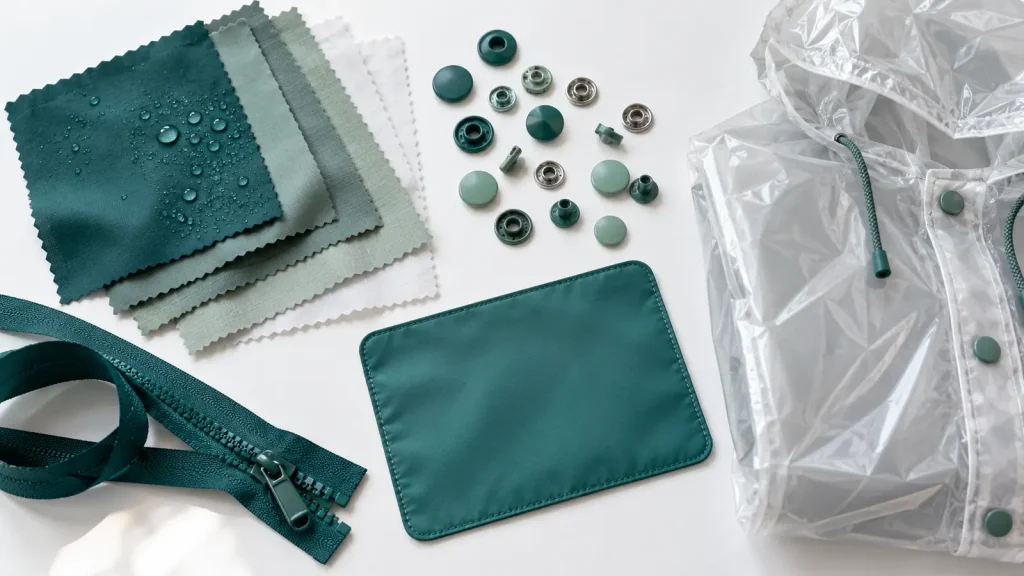
Map materials, coatings, inks and accessories
When asking for REACH compliant raincoats, start by identifying what is actually in the finished product. A rain jacket may combine a shell, coating or membrane, lining, seam treatment, printing, fasteners and labels. A simple film poncho can still include colourants, print, snaps and packaging. A material name such as EVA, PE, PVC or polyester does not describe every ingredient or component. Create a component register that gives your reviewer a practical map of the product instead of relying on a single broad material label.
Use the approved sample and specification together. List each distinct part with a reference that the supplier recognises, and connect it to the finished model revision. Include the colour or decoration version where it changes the proposed material set. Ask the supplier to identify which information comes from its own production and which comes from upstream material or accessory suppliers. This does not require a buyer to publicly disclose confidential formulations. It does require enough traceable information for the relevant chemical review and for future changes to be identified.
Photographs can help explain the register, especially when several small components have similar names. Mark a snap, zipper pull or printed panel with a reference that matches the worksheet. Keep those references consistent across sample submissions and supplier declarations. If a report uses a different code, ask for a mapping rather than renaming the report yourself. The aim is to avoid the common situation in which every document describes something plausible but nobody can show which part of the actual garment was assessed.
Include packaging in the project review while keeping its identity separate from the garment. A reusable pouch, printed insert or rigid container may introduce its own materials and claims. The responsible reviewer can decide which requirements apply to each item. Combining every component into one vague product description makes that work harder. A separate reference for the pack also helps when a buyer changes the presentation format without changing the rainwear, or when one approved garment is supplied in different packs for different customers.
ECHA's guidance on substances in articles includes an outdoor-jacket example that illustrates the value of identifying constituent articles and gathering targeted information. Use that principle to improve your supplier questions rather than copying an example's material list into your own specification. Your garment may be constructed differently. The useful outcome is a product-specific map that enables the reviewer to ask where relevant substances could occur and what information is needed. The register itself is an organising tool; it does not establish that a substance is present or absent.
Keep the map current after approval. A new colour, substituted snap, changed print system or different pouch should be checked against the register and the evidence associated with it. Ask the supplier to flag differences before using them in your order. When the next season's buyer opens the file, they should be able to identify the approved material set and see whether the repeat proposal matches it. That continuity is one of the most useful benefits of a component-level approach: chemical evidence stays connected to the product rather than becoming a generic attachment reused indefinitely.
Keep Candidate List communication separate from restrictions
REACH includes different obligations, so a single checkbox labelled REACH passed can hide important distinctions. ECHA explains that suppliers of articles containing a Candidate List substance above 0.1% by weight must provide recipients with information sufficient for safe use, including at least the substance's name. Consumers can request that information and must receive it within 45 days, free of charge. This Article 33 communication duty is different from the conditions imposed by Annex XVII restrictions. Have your reviewer identify the applicable obligations rather than treating one assessment as a universal answer.
For procurement, the immediate task is to ask what the supplier's statement covers. Does it address Candidate List substances, specified restrictions, a customer restricted-substances list or some combination of these? What date or version is used? Which product and components are included? A declaration that answers these questions can be evaluated. A statement that only says compliant gives the buyer little basis for deciding whether it addresses the intended market and configuration. Ask for clarification in terms the supplier's technical team can respond to directly.
Keep the relevant calculation basis with the requirement. Different provisions may refer to an article, a material or another defined basis. Do not average a component result across the entire packed shipment to make a number appear smaller, and do not assume that the same percentage has the same meaning under every rule. The technical reviewer or laboratory should identify the correct basis for the applicable requirement. Procurement should preserve that explanation in the evidence register so later comparisons do not detach the result from its legal or analytical context.
Build a communication route for updates and customer questions. A material supplier may provide information to the garment producer, which then needs to reach the relevant customer or operator. Decide who maintains the current statement and how a question about a particular model will be answered. Link the information to the product reference, not just to the sales contact who originally handled the order. This is useful operationally because an enquiry may arrive long after the goods have been received or after the purchasing team has changed.
Imagine a hypothetical distributor receives a declaration dated before a relevant review update. The appropriate response is to ask the supplier to confirm the scope and current position for the specific model, then have the responsible reviewer assess the answer. It is not enough to change the date on the old document. Equally, the buyer should not assume that an older document is automatically useless without understanding the product, evidence and update process. A reasoned review is more helpful than either automatic acceptance or automatic rejection.
Document the conclusion separately for each obligation. Your register might show that a communication assessment has been reviewed, that a restriction question remains open and that a customer-specific requirement needs an additional supplier response. This structure lets the project team see the remaining work without confusing the categories. It also prevents marketing from translating a limited statement into a sweeping non-toxic claim. The purchase can then progress against clearly defined release conditions, with the supplier and buyer sharing the same understanding of what the evidence does and does not establish.
Agree the market, substance scope and reporting basis
Before commissioning chemical testing, agree the question the work is intended to answer. Give the laboratory or qualified reviewer the destination markets, intended use, component register and proposed customer claims. Ask them to define the applicable substance scope, methods, units and reporting basis for the product. This avoids buying a familiar test package simply because its name contains REACH. A package can be useful, but your team needs to know whether it addresses the actual material set and requirements of this rainwear programme.
Distinguish legal requirements from additional buyer specifications. A customer may set restrictions that are more detailed or different from the legal baseline, and a laboratory may offer a screening package for a defined list of substances. Put each requirement in its own row with the source and version identified. The supplier should be able to see which conditions are mandatory for the order and which questions are still under review. This also makes commercial comparison fairer because every shortlisted supplier receives the same evidence brief.
The European Commission's restrictions guidance identifies separate Annex XVII entries relevant to areas such as certain phthalates and CMR substances in clothing and textiles. Applicability depends on the wording, material and product scope of the relevant entry. Use those references to frame a qualified review rather than assuming every restriction applies identically to every poncho. Ask the reviewer to explain exclusions or special conditions where relevant. Keep that reasoning with the test plan so the chosen scope can be understood later without reconstructing the entire discussion.
Specify how the sample will be described. The submission should identify the finished product, component, colour and revision, and explain whether the sample is from development or production. Agree who will select and send it and how its identity will be recorded. If the laboratory proposes combining materials for a particular analysis, ask how that approach affects interpretation against the applicable requirement. Procurement does not need to prescribe analytical technique, but it should ensure that the chosen approach answers the release question the business actually needs resolved.
Set a clear format for the output. Ask for a complete report with the sample description, methods, results, units and any limitations required to interpret it. Identify who will review the report and what happens if a result is inconclusive or the sample differs from the approved configuration. A test plan is stronger when it includes these decision steps before the samples are shipped. Otherwise, a project can reach its deadline with a technically detailed report that still does not support a clear approval decision.
Finally, connect the scope to the order revision. If the material, colour, print or destination changes while testing is underway, notify the reviewer before assuming the original plan remains suitable. Record the decision on whether additional information or assessment is needed. This keeps the evidence process proportionate: the team focuses on changes that matter to the defined question instead of repeatedly commissioning unrelated work. It also gives the supplier a concrete basis for planning sample availability, documentation and production while the buyer maintains control over the final release requirements.
Primary references: ECHA Article 33 supply-chain communication, European Commission REACH restrictions guidance, ECHA guidance on substances in articles.
Build the component register with our raincoat material guide to PE, PVC, EVA and polyester. A material comparison helps frame the specification; it does not replace product-specific evidence.
05 / 12
Specify chemical evidence without vague non-toxic claims

Choose targeted testing from the actual construction
The phrase non-toxic rain ponchos is too broad to serve as a purchasing specification. Replace it with defined questions about the proposed materials, intended use and destination requirements. Ask your qualified reviewer which information can be supported by supplier declarations and which questions need analytical evidence. The answer should reflect the actual component register. A transparent film, a coloured coating, a printed panel and a metal fastening may call for different questions. Treating them as interchangeable because they belong to one garment can leave the review poorly focused.
Start with the materials and processes that are genuinely proposed for the order. Ask the supplier to identify the relevant formulation or material references through an appropriate confidential route where necessary. Then agree a test scope that addresses the applicable requirements and any additional buyer restrictions. The scope should explain the substances or properties being examined and the samples needed. Avoid commissioning a large list simply to create the impression of thoroughness. The useful question is whether the work will resolve the specific release decisions your team needs to make.
Discuss sample selection before dispatching anything. A development swatch may be useful for an early decision, while a final printed sample may be necessary for a later one. Identify which stage the sample represents and what changes remain possible. If the order includes different colours, decorations or accessories, ask the reviewer how those variations should be addressed. The sampling rationale should be documented rather than improvised by the person packing the courier envelope. This makes it easier to judge whether the resulting report supports the configuration you eventually approve.
Do not interpret an untested component as cleared because a related component has a favourable result. A supplier may have good evidence supporting a material family, but the relationship still needs to be explained. Ask for the basis on which the proposed variants are represented and have the relevant reviewer accept that approach. This allows sensible use of existing information while keeping the boundaries visible. The objective is neither automatic testing of every conceivable combination nor automatic acceptance of one convenient sample for the entire range.
For a hypothetical promotional poncho order, the buyer may initially select a plain material and later add a large custom print. The original chemical review can remain useful background, but the final decorated configuration should be brought back to the reviewer. Ask what additional information is needed about the print system and whether the earlier sample still represents the release question. The project can then plan the appropriate evidence before bulk decoration, instead of discovering after delivery that the document pack only describes the undecorated version.
Make the final test request readable. Include the product revision, sample identities, destination, applicable requirement references and the person authorised to resolve questions. Ask the laboratory to flag any scope limitation or unsuitable sample before proceeding where possible. Keep the request with the final report so the result can be understood in context. A targeted plan gives procurement a stronger basis for approving the product and discussing development costs, because the evidence work is tied to a defined question rather than a vague promise that everything has been checked.
Read methods, detection limits and sample descriptions
When a report arrives, begin with identity before reading the result column. Confirm the laboratory, report number, date, client and sample description. Check that the document is complete and that the sample reference maps to the approved rainwear configuration. If the report includes photographs, compare them with the submitted sample record. This first review is administrative, but it is important: a technically sound analysis of another material does not answer the question for your order simply because the product looks similar or comes from the same supplier.
Next, have the technical reviewer examine the method, result and reporting limits together. A statement such as not detected has meaning only within the method and its reported capability. It should not be rewritten as an unlimited claim that a substance cannot exist in the product. Likewise, a numerical result needs its units and material basis. Procurement can help by refusing to detach the result from those details when summarising the file for a customer or another department. Keep the complete report available behind every short internal summary.
Ask how the laboratory's conclusion relates to the requirement in your test brief. If the report states pass, identify the limit or criteria used and whether they match the intended market and buyer specification. If it gives results without a compliance conclusion, assign the interpretation to the appropriate reviewer. Do not fill the gap with a sales team's assumption. If the report notes a deviation, sample limitation or other qualification, keep that information visible in the approval record and resolve its significance before using the result to release the order.
Pay particular attention when several materials were combined or when a result is reported for a selected part of the sample. The approach may be appropriate for the defined question, but your reviewer needs to understand its implications. Ask for clarification where the sample description is ambiguous. A garment-level photograph beside a component-level result can easily be misread by someone who only sees the first page. Your internal summary should name the tested part and avoid implying that unrelated components were examined under the same procedure.
A hypothetical buyer might receive a report showing a favourable result for a teal swatch, while the purchase order specifies a printed navy garment. The right response is to investigate the relationship, not to change the sample description in the summary. Ask whether the report is relevant to the proposed material and what additional evidence supports the differences. If the reviewer accepts a connection, record the basis. If further work is needed, give it an owner and completion point before treating the chemical question as closed.
End the review with a concise, accurate conclusion. State the product or component covered, the relevant requirement, the evidence reference and any conditions attached to approval. Keep technical uncertainty explicit when it remains unresolved. This protects the usefulness of the report during later customer enquiries and repeat orders. It also reduces the chance that a careful laboratory conclusion becomes an exaggerated marketing statement after several rounds of copying and pasting. The goal is a decision that another competent reviewer can follow, not a green status that hides how the decision was reached.
Manage colour families and supplier substitutions
A rainwear range can grow quickly from one approved sample into several colours, prints and pack formats. Treat that expansion as a specification exercise. Build a variant matrix showing which components remain common and which change. Identify the shell reference, colour, print system, trims and packaging for each version. This gives the technical reviewer a clear basis for deciding how existing evidence can be used and where additional information is needed. Without a matrix, a buyer may accidentally assume that a shared style number means an identical material set.
Ask the supplier to explain any proposed grouping of variants. The explanation should come from relevant material and process information, not simply from the fact that the products are sold together. Have the qualified reviewer decide whether the available evidence appropriately represents the group. Record the accepted basis and its limitations. This can make a large range more manageable while avoiding two unhelpful extremes: repeating work without a reason or accepting every variant on the strength of one unrelated sample.
Create a change-notification requirement that the supplier can understand. Name the kinds of differences that must be brought to your attention, including material references, formulations where relevant, colourants, printing systems, accessories and subcontracted processes. Explain that notification is needed before the change is used in the order. A request to maintain quality is too vague for this purpose. The supplier needs to know which elements form the approved configuration and which proposed alternatives require your team's review before they can be treated as equivalent.
When a substitution is proposed, ask for a comparison rather than a reassurance. Identify what is changing, why it is changing and which evidence supports the alternative. Review the impact on the specification, appearance, performance, chemical information and customer claims as appropriate. Some changes may be straightforward to assess; others may need new samples or specialist work. Keep the decision tied to the actual difference. This lets procurement make a reasoned choice about timing and cost without pretending that every replacement is either harmless or unacceptable.
Consider a hypothetical order in which a preferred snap becomes unavailable. The proposed replacement looks similar and fits the same hole, but it has a different supplier reference. The buyer can ask for the relevant component information and have the reviewer decide what is needed to approve it. If the replacement is accepted, update the material register and release record. If the evidence is incomplete, the team can consider retaining the original component, changing the schedule or selecting another documented option rather than quietly accepting an unreviewed change.
Carry the approved variant matrix into receiving and repeat purchasing. Carton labels, product references and order records should make it possible to identify which version was supplied. Ask the supplier to confirm the approved revision on repeat orders and disclose any differences since the last supply. This preserves the value of the original evidence review and gives your team a practical way to manage an expanding range. The commercial benefit is clearer comparison and fewer last-minute surprises, because the product being quoted remains connected to the product that was actually assessed and approved.
06 / 12
Evaluate California Proposition 65 as an exposure and warning question

Connect chemical information with the proposed use
California Proposition 65 should be approached as an exposure and warning question, rather than a generic product certificate. OEHHA explains that the law requires warnings about significant exposures to listed chemicals, with relevant exceptions and exposure thresholds. The presence of a listed substance and the need for a warning are not interchangeable conclusions. For a rainwear order intended for California, ask a qualified reviewer to assess the product, use and available information. A simple concentration result may be an input to that work, but procurement should not turn it into an unsupported exposure conclusion.
Begin by explaining how the product will reach and be used by the recipient. Identify the garment, intended wearer, likely handling and the distribution channel. Include the finished decoration and packaging where relevant to the review. If the product is part of a promotional kit, describe the contents rather than supplying only the raincoat's material name. The reviewer needs a clear account of the proposed product and circumstances, and the supplier needs to know which configuration its information is expected to support.
Gather the available material and chemical evidence without changing its meaning. Supplier declarations, analytical reports and formulation information may each contribute different pieces. Keep the sample identity, scope and limitations attached to them. Ask the reviewer what additional information is required to reach a defensible decision. A laboratory report should not be treated as a universal Proposition 65 certificate merely because it includes a familiar list of substances. The relevant question is what the evidence establishes for the product and use being assessed.
Avoid making an informal warning decision based on appearance, odour or a broad material label. A soft transparent poncho, a dark coated jacket and a reusable pouch may need different questions, but visual impressions cannot settle the legal assessment. Likewise, the phrase food grade or a certificate for an unrelated use does not automatically answer the rainwear question. Keep the review anchored to the actual configuration and destination. This prevents the buying team from substituting an attractive sales phrase for the evidence its reviewer needs.
A hypothetical distributor might receive a supplier's statement that a particular raincoat is sold in several markets. That history can help frame questions, but it does not by itself establish the appropriate California warning decision for the distributor's branded version. The buyer should provide the final configuration, ask for the supporting information and assign the assessment to a competent specialist. If the product will change after the review, those changes should be considered before the earlier conclusion is reused for the new version.
Keep the result practical for the purchasing team. The review should identify the configuration assessed, the conclusion, the basis and any conditions that must be maintained. If a warning is needed, the approved communication should move into the artwork process. If a warning is not required on the assessed basis, preserve the supporting reasoning and the review triggers. The objective is not to place an unnecessary warning on every item or to avoid warnings for commercial convenience. It is to make the appropriate decision from relevant evidence and maintain that decision through the supply programme.
Document the warning decision and its limits
A warning decision should be recorded in a way that survives the next email handover. Identify the product revision, destination, assessed use and evidence reviewed. Name the person or specialist responsible for the conclusion and record the date. Add any conditions or assumptions that matter to the decision. This creates a usable record for procurement, artwork and distribution teams. A short message saying no warning needed is difficult to rely on when nobody can tell whether it referred to the plain garment, the printed version or a different pack.
Keep the decision separate from the artwork approval. The first determines what information is required for the assessed circumstances. The second checks how the approved information is presented on the product, packaging or relevant sales channel. Both are important, but they answer different questions. The designer should not be expected to choose legal wording from an old label, and the compliance reviewer should be able to see the final design before it is released. Link the two approvals through the same model and revision reference.
Where a warning is required, use wording and delivery methods approved for the specific circumstances by the responsible reviewer. OEHHA provides official guidance and sample warning resources, but a buyer should not paste a generic example onto every product without checking applicability. The applicable content may depend on the relevant chemical and endpoint, among other requirements. Avoid presenting a ready-made universal warning in the supplier brief. Instead, identify who will supply and approve the exact wording and how it will be incorporated into the finished product information.
Where the assessment supports supplying without a warning, keep the reasoning accessible. The absence of a label does not explain the decision by itself. Record the evidence and the conditions under which the conclusion was reached, including the product configuration. If a customer later asks about the basis, the responsible team can respond accurately rather than improvising. Do not translate that conclusion into a claim that the product contains no chemicals or is risk-free in every possible use. The approved statement should remain within what the assessment actually supports.
Set review triggers that fit the programme. A changed material, print system, accessory, intended use or destination arrangement may require the decision to be revisited. A change in relevant legal requirements or new information should also reach the responsible reviewer. Procurement can support this by requiring suppliers to communicate relevant changes and by keeping the approved configuration visible. The process is more reliable when updates have a named recipient and a clear route into the file, rather than depending on someone remembering a conversation months later.
For a hypothetical repeat order, the buyer might discover that the supplier changed the reusable pouch while leaving the raincoat unchanged. The previous warning assessment should be checked against that difference before the old artwork is reused. The reviewer can decide whether the existing conclusion still applies or whether more information is needed. Documenting this small decision preserves the chain of reasoning. It also helps the commercial team explain any resulting artwork or timing adjustment without making unsupported statements about the product or treating the review as an arbitrary obstacle to delivery.
Coordinate labels, packaging and online information
Once the warning decision is established, turn it into a controlled communication plan. Identify every place where the approved information must appear for the relevant route to market. Depending on the assessment and applicable rules, that may involve the product, packaging, accompanying material or an online purchasing process. Have the responsible reviewer confirm the required approach. Procurement should then make sure the approved wording and presentation reach the people who create, print and maintain those materials, including any distributor or customer responsible for a sales channel.
Use a single approved wording reference and a separate version for each artwork file. This prevents a designer from accidentally taking text from an outdated pack while another team updates the website. Record the product revision, label version, packaging version and any channel-specific instructions together. If the programme includes several destinations, clearly identify which version goes to which route. Keep the physical stock and digital information connected so a change in one does not leave the other describing a different configuration or decision.
Review the actual presentation, not only the text in an email. Check the final proof at the intended size and on the proposed packaging format. Ask the compliance reviewer to confirm the relevant content and presentation requirements, while the production team confirms that the approved design can be reproduced. Small pouches and compact poncho containers can make layout decisions more demanding. Resolve those constraints before bulk printing rather than shrinking or moving approved information at the last moment without review.
OEHHA's business guidance explains that internet warning responsibilities and delivery methods need attention alongside physical product information. Use that guidance to coordinate the applicable process with the seller or distributor. Do not assume that a warning inside a sealed carton automatically answers every online requirement, or that a warning on a website automatically replaces physical information. The responsible reviewer should define the route, and the commercial team should obtain clear confirmation that the relevant partners have received and implemented the approved materials.
Consider a hypothetical agency supplying branded ponchos through both an event distribution programme and a customer's online store. The physical product may be the same, but the communication workflow needs to account for both channels. The agency can maintain a version register, send the approved assets to the named contacts and request confirmation of implementation. This is an operational control, not a conclusion that every channel has identical legal duties. It ensures the qualified assessment is translated into the places where the recipient will actually encounter the product.
Keep evidence of the implemented version. Retain the approved production proof and, where appropriate, a dated record of the relevant digital presentation. Include a contact for future updates and a process for withdrawing obsolete artwork from use without deleting the historical approval record. When a material or warning decision changes, the team can then identify which stock and channels require attention. The value of this coordination is continuity: the information approved by the reviewer remains the information supplied with the actual rainwear programme, rather than being altered or lost between departments.
Primary references: OEHHA overview of Proposition 65, OEHHA business questions and warning guidance.
Coordinate the final presentation with our rain poncho packaging guide and custom printing guide for branded rainwear.
07 / 12
Plan warning revisions and other destination-specific requirements

Control short-form warning changes through the supply chain
Warning artwork needs a revision plan, especially when an order will remain in stock across a regulatory transition. OEHHA's adopted short-form amendments took effect on January 1, 2025. The transition provisions allow the prior short-form content for products manufactured and labelled before January 1, 2028, subject to the applicable conditions. The revised short form identifies a listed chemical for each relevant endpoint. Have your responsible reviewer confirm the exact requirements for the product and timing. Do not treat a purchase-order date alone as proof that a particular label version qualifies.
Build the transition into the product-information register. Record which approved wording applies, the associated artwork version and the product or production records needed to support the decision. Ask the supplier to identify how manufacturing and labelling records will be connected to the delivered stock. Where a distributor holds inventory, include that party in the communication plan. This helps prevent a new artwork file from being applied inconsistently while older stock continues to move through another route with different supporting records.
Think about the order beyond its expected arrival date. Rainwear may be held for an event, distributed through several warehouses or carried into another season. Ask the commercial team how long the stock is likely to remain in the programme and whether repeat orders will use the same packaging. The compliance reviewer can then define an appropriate artwork strategy for that horizon. A simple operational plan established early is usually easier to manage than a rushed relabelling discussion after cartons have already been allocated to several destinations.
Coordinate digital information with any physical revision. OEHHA's business guidance addresses updating online warnings when the applicable short-form information changes. Assign responsibility for those updates and confirm that the relevant seller receives the approved assets and instructions. Keep a record of the notification and implementation process. The buyer should not assume that sending a revised label PDF to the factory automatically updates a distributor's product page, or that a customer will notice a changed warning in a routine packing-specification attachment.
A hypothetical importer might place a long-running branded rainwear programme that includes several production batches. It can define a controlled artwork change, identify which batches use each approved version and give the distributor a clear update package. The reviewer should assess the applicable conditions for each version. The operational team can then manage stock identification and communication without inventing its own legal interpretation. This is a useful way to separate the specialist decision from the practical work of implementing that decision accurately across the programme.
Keep the transition record concise but complete. Include the approved wording reference, relevant dates, product revision, supplier confirmation and the people responsible for physical and online updates. Preserve obsolete versions as historical records while clearly marking them as unavailable for new production unless specifically approved. Recheck the position when the order timing or configuration changes. This gives future buyers a clear explanation of why a particular batch used a particular version, and prevents an old packaging file from becoming the default simply because it is the easiest one to find.
Check PFAS and other product rules separately
A Proposition 65 warning review does not complete every California product-law question, and an EN rain protection reference does not complete every EU chemical question. Create a separate destination checklist for requirements outside the three familiar headings in this article. Let a qualified reviewer determine the applicable rules for the actual product, use and supply date. This is particularly important for finishes, coatings and other material choices that may be affected by substance-specific or product-specific restrictions. The checklist should point to a current requirement, not a generic promise of global compliance.
For EU supply, the PFHxA restriction introduced by Regulation (EU) 2024/2462 is a relevant example. It includes provisions applying from October 10, 2026 to specified clothing and related accessories for the general public, with defined substance limits, material basis and exceptions. Ask the reviewer to assess the actual construction against the current text. Do not collapse a specific PFHxA assessment into a claim that every possible PFAS question has been answered. Equally, do not assume every rainwear product falls under identical conditions without reviewing the scope.
California also has textile PFAS provisions separate from Proposition 65. Official California materials identify AB 1817 as a textile-article measure. Before approving a California programme, have the current statutory requirements, definitions, dates and any applicable exceptions checked for the product. Ask what supplier information, declarations or analytical evidence are needed for that review. A warning should not be treated as a way to bypass a separate restriction. The purchasing file should show that these are distinct decisions even when they concern some of the same material information.
Keep environmental and chemical marketing language aligned with the defined evidence. A supplier may describe a finish as having no intentionally added substances of a particular group, while a laboratory report addresses a specified analytical scope. Those statements should not be silently rewritten as an unlimited free-from claim. Ask the reviewer what wording is supported and what limitations must remain clear. This helps the commercial team communicate useful information without extending a narrow material statement beyond the evidence available for the finished garment.
For a hypothetical reusable jacket order, a change to the water-repellent finish might affect more than appearance. The buyer should obtain the new material reference and ask the technical and compliance reviewers which existing decisions need updating. That review may involve performance evidence, chemical information and customer claims. Treat the change as one coordinated product revision rather than three unrelated email threads. The supplier can then respond with a consistent material description, and the buyer can see which release conditions remain open.
Use the destination checklist as a living control. It should identify the rule reviewed, the product scope, the date checked, the evidence requested and the responsible decision maker. When a new market is added or a relevant rule changes, the team can update the affected rows. The aim is not to publish an endless list of laws on a product page. It is to make sure the procurement decision covers the applicable requirements and that no familiar certificate or warning label is mistaken for a universal permission to supply every version everywhere.
Review each market before reusing an approval
An approval for one destination is a starting point for another market review, not an automatic passport. Keep the underlying product evidence, but ask which requirements, operator roles, markings and information duties apply to the new route. The material and performance data may remain useful, while the legal conclusion or accompanying information may need to change. A clear product register makes this work easier because the reviewer can identify what is unchanged and focus on the destination differences instead of rebuilding the entire file.
Ask the sales team to identify the actual destination before promising a common specification. A multinational customer may place one central order and then distribute stock through several local entities. Record those routes and the intended uses at each destination. If onward distribution is uncertain, keep that uncertainty visible and define what must be confirmed before allocation. Procurement can still discuss options and quantities, but the final release should reflect a destination plan that the responsible reviewers have been able to assess.
Separate translation from regulatory adaptation. Translating an approved sentence into another language does not establish that the sentence is sufficient for another market. Have the relevant reviewer define the required information, then manage the language and artwork process against that brief. Keep the approved translations connected to the product and destination versions. This avoids a common handover problem in which a designer receives a request for several languages but no explanation of which information belongs to which configuration or distribution route.
Review customer requirements alongside legal obligations. A business customer may have its own restricted-substances policy, documentation format or supplier approval process. Identify those requirements before comparing proposals so the supplier can respond realistically. Keep them distinct from the legal baseline in your register. If the customer changes its requirements during the programme, assess the effect on existing approvals and future production. This prevents a new commercial request from being mistaken for an already-completed legal review or being silently ignored because the product passed an earlier assessment.
Consider a hypothetical distributor that moves leftover event ponchos into a different country's promotional campaign. The physical stock may be unchanged, but the use, audience, packaging and customer claims may differ. Before reallocating it, review the destination and presentation against the existing file. The outcome may be straightforward, or it may require additional information or a different distribution plan. The key is that the decision happens before the stock is promised, while the business still has options for using the goods appropriately.
Maintain a market-release matrix with clear status and conditions. Each row should identify the product revision, destination, approved use, relevant document set and any remaining action. Do not use a single worldwide approved field unless the supporting assessment genuinely defines and supports that scope. When a customer asks about another market, your team can see what work is already useful and what needs review. This turns compliance information into a practical sales and procurement tool while keeping the claims and release decisions tied to the places and uses that have actually been assessed.
Primary references: OEHHA adopted short-form warning amendments, EU PFHxA restriction Regulation2024/2462, California DTSC PFAS factsheet.
08 / 12
Create a rainwear EAV specification and evidence register

| Entity | Attribute | Value to define | Evidence and verification |
|---|---|---|---|
| Finished rainwear | Model and revision | Buyer-approved model, size range and intended use | Specification and approved sample |
| Material set | Shell, coating, print and trims | Named material references and colour versions | Component register and supplier declarations |
| Rain protection | Applicable standard and result | Edition, tested assembly, class or measured result as reported | Complete model-linked report |
| Chemical review | Applicable substances and limits | Market-specific scope, units and material basis | Dated review and relevant analytical evidence |
| Candidate List | Article communication assessment | Applicable list date and component information | Supplier information and responsible operator review |
| California supply | Exposure and warning decision | Assessed use, decision basis and approved wording if needed | Qualified review and artwork approval |
| OEM changes | Approved configuration | Controlled revision and unresolved differences | Change log and impact assessment |
| Batch release | Delivered product identity | Lot, quantity, specification and approved destinations | Inspection record and release authorisation |
Define the product and measurable attributes
An EAV specification organises information as entity, attribute and value. For a rainwear order, the entity might be the finished garment, a material, a printed panel or a packaging item. The attribute is the property you need to define, and the value is the agreed requirement or recorded result. Add an evidence column and the table becomes a useful bridge between a commercial specification and the approval file. It gives every participant a consistent way to see what is being discussed and where the supporting information belongs.
Start with identity fields. Record the finished model, revision, size range, colour variants and intended use. Then add the material and construction references needed to distinguish the approved configuration from a similar-looking alternative. Use supplier codes where appropriate, but explain their relationship to your own purchasing references. A value such as standard material is difficult to verify later. A named material reference connected to a sample and supplier record gives the receiving team and future buyer a much clearer point of comparison.
For measured properties, keep the units and method with the value. If a report supports a performance result, record it as reported and link the complete document. If the value is a purchasing target awaiting confirmation, label it as a target. Do not mix requested values and demonstrated results in the same cell without explanation. This distinction is especially useful during quotation, when several suppliers may be proposing different constructions and not every requirement has yet been confirmed through the final approval process.
Use the table below as a structure for the evidence discussion, not as a claim that a particular product has already achieved the listed requirements. The values are fields to define for your programme. Your technical reviewer should determine the applicable performance and chemical criteria, while procurement records the agreed references and evidence. The table can then be expanded for the actual order without inventing universal thresholds, MOQs or lead times. Each row should answer a real purchasing question rather than exist only to make the document look comprehensive.
A hypothetical buyer might create one row for the shell material and another for the finished rain protection evidence. The material row identifies the approved reference and supplier information. The performance row identifies the relevant report and its connection to the finished construction. A third row records the print version. This separation makes it easier to see why changing the print may reopen one part of the review while leaving other information useful. It also prevents an entire model from being marked approved when a critical configuration detail remains unresolved.
Keep the specification readable enough for everyday use. A concise main table can link to detailed annexes rather than reproduce every report. Use clear status words such as proposed, under review and approved, with the responsible person identified. When the order is released, preserve the approved version and use a new revision for later changes. This makes the EAV record useful across sourcing, technical review, production and receiving. It becomes a shared description of the product and its evidence, rather than another spreadsheet that only its original author understands.
Link every requirement to a decision and evidence owner
A requirement without an owner tends to remain open until the deadline makes it inconvenient to discuss. Add responsibility directly to the evidence register. Identify who obtains the information, who reviews it and who can close the requirement. These may be different people. Procurement can confirm that a report has been received, while a technical specialist decides whether it supports the intended use. Keeping those steps separate makes progress reporting more accurate and prevents administrative completion from being mistaken for technical approval.
Define what a completed row looks like. It should identify the requirement, the relevant product revision, the evidence reference and the review conclusion. If the conclusion is conditional, state the condition and the point at which it must be satisfied. A green cell with no explanation is not enough for a future colleague to understand. A short decision note can explain why the evidence is accepted, what it covers and what would trigger another review. That note is often more useful than a lengthy email chain stored elsewhere.
Give open questions a specific next action. Instead of writing waiting for supplier, identify the missing document or clarification and the person expected to provide it. Include a realistic response date tied to the project's next decision. If the question requires a laboratory or another specialist, make that dependency visible. This allows the project manager to see which work can continue and which milestone is at risk. It also helps the supplier prioritise meaningful requests instead of receiving repeated general reminders for paperwork.
Use a consistent approach to evidence links. Store the full document in the approved project location and record a stable identifier in the register. Include the version or issue date so a replacement can be distinguished from the earlier file. Avoid linking only to a temporary email attachment or a supplier portal page that another colleague cannot access. Where a document is confidential, record the access route and responsible holder. The reviewer should be able to obtain the necessary information without requiring the commercial team to circulate sensitive formulation details indiscriminately.
A hypothetical order may have approved artwork, an accepted sample and one unresolved accessory declaration. The register should show that exact position. The team can continue preparations that do not depend on the missing decision, while keeping the relevant release condition open. If an alternative accessory is proposed, it should receive its own review rather than being used to make the outstanding row disappear. This gives management a truthful view of readiness and supports a deliberate choice about timing, configuration and commercial commitments.
Review the register at decision milestones, not only at the end. Sampling, artwork approval, material commitment and shipment release are useful points to check whether assumptions have changed. Ask each owner to confirm the status of their rows and update any conditions. The result is a shared working record that supports the project's pace without hiding uncertainty. When the order is finally released, the team can explain which evidence supported the decision and who accepted it, rather than relying on a general impression that all the documents looked satisfactory.
Use a release record that survives a supplier handover
The final release record should tell the next person exactly what was approved for supply. Identify the finished model and revision, quantity or batch reference, destinations, intended use and approved material set. Link the relevant evidence register, sample record and artwork. State any conditions that must remain in place. A new colleague should be able to distinguish the released configuration from earlier proposals without opening every email in the project. This is particularly valuable when a sourcing office, supplier or distributor changes personnel during a long programme.
Keep the release decision distinct from the purchase order itself. The order establishes commercial instructions, while the release record captures the approved product and evidence position. Connect the two by reference so they cannot drift apart. If the order is amended, check whether the release record also needs review. A quantity increase may have different implications from a material substitution or a new destination. The record should show the actual decision for the actual change, rather than assuming every amendment has the same effect.
Include the approved physical references. A retained sample, photographs and component identifiers can help explain the configuration, provided they are clearly labelled and connected to the document set. Record where any physical reference is held and who can access it. A sample without a date or revision can become confusing after several rounds of development. The purpose of retention is to preserve a reliable comparison point for production and receiving, not simply to keep an unlabelled garment in a cupboard.
Define how the supplier acknowledges the released version. Ask for confirmation that the production team and any relevant decorator or packer have received the correct specification and artwork. Where a subcontracted process is involved, identify who controls the handover and reports changes. This does not require the buyer to manage every factory instruction. It requires the supplier to confirm that the agreed configuration is the one being used and that proposed deviations will be brought back for review before they become part of the order.
For a hypothetical repeat programme, the original buyer may leave the business before the next season. A clear release record allows the replacement buyer to send a specific continuity request: confirm the named revision, identify any changes and provide updates required by the current review. The supplier can answer against a concrete baseline. Without that baseline, both sides may use the phrase same as last time while referring to different samples, packaging files or material references. The release record removes much of that avoidable ambiguity.
Preserve the decision history without making the current position difficult to find. Keep superseded versions for traceability, but clearly identify the version approved for the relevant order. Record later changes with their impact review and authorisation. Agree retention arrangements with the responsible compliance and quality teams. This gives the business a durable account of the programme: what was supplied, why it was accepted and how later differences were handled. The record supports customer questions and future sourcing because it retains the reasoning behind approval as well as the final signature or status.
09 / 12
Make laboratory reports and supplier declarations usable

Verify identity, scope and the complete report
Document review should begin with the basic question: what is this document, and what does it establish? A laboratory report, a supplier declaration, a factory audit and a product certificate are different types of evidence. Identify the type before interpreting the content. Then check the issuer, document number, date and product reference. This prevents a general business credential from being used as if it were a result for the raincoat in your order, and it gives the reviewer a clear starting point for any verification or follow-up.
Request the complete document where it is needed for the decision. A cropped image or first-page summary may omit the sample description, methods, conditions, annexes or limitations. Explain to the supplier why those pages matter rather than simply rejecting a shortened copy. If confidentiality or permission limits what can be shared, agree a suitable route for the responsible reviewer to see the relevant information. The goal is to establish a reliable basis for approval, not to collect material that the business has no reason to possess or circulate.
Compare identifiers carefully. The applicant's name, factory name and brand may differ for legitimate reasons, but the relationship should be explained. The report's sample code may differ from the purchase-order model code, but the mapping should be traceable. Ask for clarification when the connection is unclear. Do not edit the source document to make it match your preferred terminology. Keep the original intact and add a separate explanation accepted by the relevant reviewer. This preserves the distinction between the issuer's findings and the supplier's account of how those findings relate to your order.
Where authenticity needs confirmation, use an appropriate independent route. Ask the issuer about its verification process or use an official verification facility if one is available. Avoid relying solely on contact details pasted into an unfamiliar attachment. Record what was checked and the result, without claiming a broader verification than was actually performed. A document can be authentic and still be irrelevant to the proposed product, so identity verification and scope review should remain separate steps in the purchasing file.
Consider a hypothetical buyer who receives a genuine report for a supplier's earlier rainwear model. The report may be useful background, but the buyer still needs to understand whether the current construction is represented. Ask the supplier to identify the differences and provide the relevant supporting assessment. If the connection is accepted, record why. If it is not, define the additional work required. This approach respects legitimate evidence while avoiding the assumption that any real report from a reputable issuer automatically covers every later product supplied by the same business.
Finish with a review note that is specific enough to be useful. State which document was examined, how it connects to the product and what conclusion the reviewer reached. Include unresolved points and any conditions attached to acceptance. Keep the full source available through the register. This makes future enquiries easier because the team can explain the basis of approval without repeatedly asking the supplier for the same attachments. It also keeps the purchasing discussion focused on the actual evidence gap rather than on the appearance or number of certificates in a sales presentation.
Resolve missing or contradictory evidence before approval
Missing information is easier to resolve when the question is precise. Identify the exact difference between the requirement and the evidence supplied. It might be an unexplained model reference, a missing page, an outdated material list or a report for a different sample. Describe the gap in a short issue record and ask for the information needed to close it. A request to send better certificates is too vague. The supplier needs to understand what connection or conclusion your reviewer cannot currently make.
Separate administrative gaps from technical ones. A missing signature or annex may be resolved by obtaining the complete current document. A difference in materials, methods or product scope may require specialist review or additional evidence. Do not treat both as the same kind of delay. Assign the issue to the appropriate person and record the expected response. This helps the project manager understand what can be completed quickly and what may affect sample development, production timing or the feasibility of the proposed configuration.
When documents disagree, preserve both versions and ask for an explanation. One report may describe a material reference that no longer appears in the current specification, or a declaration may list a different colour range from the proposed order. The explanation should identify which document applies and why. Avoid selecting the more favourable result without resolving the conflict. Your review record should show how the inconsistency was addressed, including any revised evidence or product change that formed the basis of the final decision.
Use an issue log with a closure condition. Record the question, affected product or component, responsible person, response date and evidence required for closure. When a response arrives, have the appropriate reviewer decide whether it answers the question. Do not close the item merely because the supplier replied. This distinction is useful in fast-moving projects, where an active email thread can create the impression of progress even when the underlying approval question remains unanswered. Clear closure criteria make status reporting more honest and more actionable.
A hypothetical order may have a material declaration describing one coating and a sample specification describing another. The buyer can ask the supplier to confirm the actual proposed coating, explain the difference and provide the relevant evidence. The answer may reveal a simple naming mismatch or a real substitution. Either way, the team should resolve it before approving production. If the issue cannot be closed within the required timeline, management can consider a documented alternative, a revised schedule or another configuration rather than accepting ambiguity by default.
Keep commercial pressure visible without allowing it to rewrite technical conclusions. Procurement can explain the delivery consequences of an open issue and help the supplier prioritise a response. The relevant reviewer should still decide whether the evidence supports release. If a proposed alternative changes the product or claim, document that change and obtain the necessary approval. This gives the business a defensible route through uncertainty. The result may be a revised plan, but it will be a plan based on an understood configuration and evidence position rather than a hopeful interpretation made under deadline pressure.
Protect confidential formulation information while preserving accountability
Suppliers may be reluctant to share detailed formulation information broadly, and buyers do not always need every ingredient disclosed to every project participant. Begin by explaining the compliance question and the information needed to resolve it. Ask whether the relevant data can be provided directly to a qualified reviewer or laboratory through an agreed confidential route. This can protect legitimate commercial information while allowing the assessment to proceed. The important point is that confidentiality should shape the handling process, not erase the need for an evidence-based decision.
Separate the information required by different roles. The artwork team needs approved wording and product references, not necessarily a full formulation. Procurement needs to know whether the relevant review is complete and what conditions apply. The technical reviewer may need more detailed information to assess a specific question. Define these access needs and keep the working files organised accordingly. This reduces unnecessary circulation of sensitive supplier information while preserving the ability of the responsible people to examine what is needed for the product and market review.
Ask for a useful confirmation when detailed information is reviewed confidentially. The confirmation should identify the product or material reference, the scope assessed, the evidence basis and the conclusion or remaining limitations. It should not become a vague assurance that everything is fine. A buyer needs enough information to connect the specialist's work to the order and maintain the approved configuration. If the underlying material changes, the confirmation should make clear that the relationship may need to be reviewed again rather than carried forward automatically.
Agree who holds the source information and how future questions will be handled. A customer or responsible operator may need clarification after the initial purchase. Record the contact route and the conditions for accessing or updating the relevant information. Keep this arrangement in the project file so it does not depend on one salesperson's memory. Where legal obligations require particular information to be communicated, have the responsible reviewer ensure that confidentiality arrangements do not obstruct those obligations. Commercial secrecy and required product information need to be managed together.
For a hypothetical custom coating, the supplier might provide detailed data to the appointed laboratory while giving procurement a controlled material reference and the resulting assessment. The buyer can then specify that reference and require notification of changes. If the supplier later proposes an alternative formulation, the confidential review route can be used again. This allows the business to maintain traceability without publishing the formula or asking unrelated departments to interpret technical chemistry. The release decision remains connected to a known configuration and a defined review.
Avoid using confidentiality as a reason to accept an unbounded marketing claim. If the available information cannot support the proposed statement, narrow the statement or obtain the necessary evidence. A documented conclusion with clear limits is more useful than a sweeping claim backed only by a promise that the details are secret. The best arrangement gives each participant the information needed for their role, preserves the source evidence through an appropriate holder and establishes a workable process for updates. That supports both the supplier relationship and the buyer's ability to make accurate, traceable procurement decisions.
Use our guide to sourcing rainwear from China to connect supplier identity, sample approval and document requests within the wider OEM purchase.
10 / 12
Carry compliance controls from the sample into bulk production

Approve a representative sample and traceable material set
The approved sample should represent the configuration intended for bulk production. Identify the garment model, materials, colours, decoration, trims and packaging used in the sample, and connect them to the current specification. If any element is provisional, say so explicitly. A sample can be useful for reviewing fit or artwork while still being unsuitable as the final production reference. Clear status prevents a development sample from becoming approved for all purposes simply because it was the last garment photographed in an email.
Ask the supplier to explain how the sample's material set will be maintained for the order. Record the relevant references and any supplier or process details needed for the evidence review. Where an item is produced by another party, identify how its approved reference is controlled. The buyer does not need to manage every manufacturing operation, but it should know what configuration the supplier has committed to provide. A traceable material set gives both parties a concrete basis for discussing substitutions or differences discovered later.
Separate the approvals performed on the sample. Visual appearance, dimensions, usability, technical performance and chemical information may be reviewed through different processes. Record the decision for each relevant area and identify any remaining action. An attractive logo or comfortable fit should not close an unrelated compliance question. Conversely, a complete report does not confirm that the final artwork matches the customer's brand instructions. This separation gives the project team a clear picture of readiness and avoids misunderstandings about what a sample approval email actually means.
Retain an appropriate reference for production and receiving. This may include a physical sample, labelled photographs, construction details and approved artwork files. Assign a revision and record where the reference is held. If the supplier and buyer retain separate samples, confirm that they represent the same configuration. A small difference can become difficult to explain after several development rounds. The reference should help resolve questions quickly by showing what was agreed, rather than introduce another uncertain version into the discussion.
For a hypothetical branded jacket order, the first sample may use a temporary zipper colour while the final material is being sourced. The buyer can approve the overall fit while leaving the zipper and associated evidence open. Once the final component is confirmed, the relevant review can be completed and the production reference updated. This is more precise than either rejecting all progress or issuing a broad approval that hides the provisional component. It allows the programme to move forward with clearly bounded decisions.
Before bulk production is released, confirm that the final sample record, material register and evidence file describe the same version. Resolve any naming differences or outstanding substitutions. Ask the supplier to acknowledge that version in its production confirmation. This creates a clear starting point for the order and for any later change review. The approved sample then serves its proper purpose: a practical representation of the documented configuration, supported by the relevant evidence and decisions, rather than a stand-alone object expected to prove everything about the product by itself.
Handle changes with a written impact review
Changes are common in manufacturing programmes, so the buying process should provide a workable way to assess them. Define which changes require notification and make that requirement part of the supplier brief. Relevant examples may include materials, formulations, colours, trims, printing systems, construction, subcontracted processes and packaging. The exact list should reflect the approved configuration and evidence basis. Ask for notification before the change is used in the order, while the business still has the opportunity to review alternatives and manage the consequences.
Use a short change request with a before-and-after comparison. Identify the affected model and component, the reason for the proposal and the evidence available for the alternative. Ask the supplier to explain any effect it has identified on appearance, function, documentation or timing. The buyer's reviewers can then decide what further information is needed. This is more useful than a message saying the replacement is the same quality, because it makes the actual difference visible and gives the review a specific subject.
Assess the change across the relevant decisions. A substituted material may affect performance and chemical evidence. A revised print may affect the approved decoration and claims. A new destination may leave the physical product unchanged while requiring a different market review or information set. Do not assume every change has the same consequences, and do not automatically reopen unrelated work. A proportionate impact review identifies which approvals remain useful, which need updating and what must be completed before the revised configuration can be released.
Record the decision and update the controlled documents. If the change is accepted, identify the new revision, the evidence supporting acceptance and the orders or batches to which it applies. If it is rejected or awaiting information, make that status clear to the supplier and relevant internal teams. Keep the earlier version available for historical traceability while preventing it from being confused with the current instruction. The goal is an unambiguous production direction, not a growing collection of files all labelled final.
A hypothetical supplier may propose changing the print subcontractor to protect a delivery date. The buyer should ask whether the materials, process and approved evidence remain the same and what confirmation supports that position. If differences exist, the relevant reviewers should assess them before release. The commercial team can evaluate the timing benefit alongside the review work required. This turns a potentially rushed substitution into a deliberate decision about the finished configuration, with the consequences visible to the people responsible for the programme.
Carry the change into receiving and customer information where necessary. The warehouse needs to know how to recognise the revised product, and the commercial team needs the current approved claims and artwork. If the change affects only future production, identify the distinction from existing stock. A written impact review is useful because it connects these operational steps to the technical decision. It allows the business to adapt when supply conditions change while preserving a traceable explanation of what was authorised, what evidence supported it and which goods were produced under the revised instructions.
Inspect delivered goods against the released configuration
Receiving inspection should check the delivered rainwear against the configuration that was actually released. Provide the inspection team with the current specification, reference sample or photographs, artwork and relevant packing instructions. Identify the model, revision, lot or order references expected on the goods and documents. This gives the team a concrete comparison point. Without it, an inspection can confirm that cartons contain raincoats while missing a difference in material reference, decoration or accompanying information that matters to the approved programme.
Agree the inspection scope with the responsible quality and technical teams. The plan may include identity, quantity, dimensions, construction, appearance, labels and packaging checks, with appropriate sampling and acceptance criteria defined for the order. Keep the plan distinct from laboratory or conformity assessment work. A visual receiving check cannot prove every chemical or performance requirement. Its role is to establish whether the delivered goods match the released configuration and to identify discrepancies that need further assessment before the stock is made available for use or distribution.
Document what was examined. Record the shipment and batch references, the sample selection, observations and any differences from the approved record. Use clear photographs where they help explain a discrepancy. Avoid describing an entire shipment as fully tested when the work was a defined sample inspection. The report should allow another colleague to understand the scope and outcome. If the inspection reveals a difference that may affect earlier evidence, refer it to the relevant reviewer rather than treating it only as a cosmetic supplier complaint.
Create a controlled route for nonconforming or uncertain stock. Identify who can place goods on hold, who investigates and who can authorise the next step. Keep affected goods distinguishable from released stock while the issue is assessed. The appropriate action depends on the actual discrepancy and applicable obligations, so do not assume that relabelling or accepting a commercial allowance resolves every problem. Procurement can coordinate the supplier response, but technical and compliance questions should be closed by the people responsible for those decisions.
A hypothetical shipment might contain a different pouch from the approved sample. The warehouse can record the difference and place the affected stock under the agreed review process. The buyer then asks the supplier to explain the substitution and provides the relevant information to the reviewer. If the alternative is acceptable, the decision and revised reference can be recorded. If it is not, the business can determine an appropriate corrective action. The inspection has done its job by identifying the difference before it became an undocumented part of the programme.
Feed the findings back into future orders. If a recurring ambiguity caused the discrepancy, improve the specification or supplier confirmation process. If the delivery matches the approved configuration, retain the receiving record alongside the release file. This closes the loop from intended use and evidence review to the actual goods supplied. It also makes repeat sourcing more efficient because the next buyer can see both the approval basis and the delivery outcome, rather than relying only on the fact that the previous order arrived and no immediate complaint was raised.
11 / 12
Write an OEM rainwear enquiry that supports defensible claims

Ask for evidence before comparing Bulk Pricing
A useful OEM rainwear enquiry gives suppliers enough information to propose a product and an evidence plan together. Start with the intended use, destinations, wearer group, product format, quantity matrix and branding scope. Attach the relevant specification or explain which elements are still being developed. Then identify the documentation and review questions that must be addressed before approval. This allows the supplier to distinguish an available documented configuration from a custom proposal that may require additional samples, information or assessment.
Use a clear evidence request rather than a blanket demand for certification. Ask the supplier to identify the exact model and revision, the supporting rain protection evidence where applicable, the material and component references, relevant chemical information and the proposed product-information set. Request a list of gaps or conditions as well as the available documents. A supplier that explains limitations gives your team something concrete to assess. A simple yes beside every requirement may look convenient but leaves little basis for understanding what is actually included in the proposal.
Ask commercial questions against the same configuration. MOQ, sample charges, tooling or artwork work, packaging and Bulk Pricing should refer to the agreed product and approval scope. Do not compare a plain stock poncho with a custom branded configuration as if the only difference were the quoted amount. Identify which development and evidence activities are included, which require separate arrangements and which remain dependent on final specifications. This gives procurement a more realistic comparison of the proposals without publishing unit prices or inventing a supplier's capabilities.
A practical enquiry paragraph might ask the supplier to propose a suitable rainwear construction for the confirmed use and markets, identify the exact evidence available for that construction and explain any additional work needed for the final branding. Add a request to disclose proposed material or process changes before production. Ask for a milestone plan tied to sample and evidence approval. The wording should invite a specific technical and commercial response, not encourage the supplier to repeat broad catalogue claims that your team cannot connect to the order.
Create a comparison sheet that separates confirmed information from assumptions. For each proposal, record the product, evidence status, open issues, sample requirements and commercial scope. Give a named reviewer responsibility for the technical conclusions. Procurement can then compare the total programme realistically, including the work needed to reach a released configuration. If one proposal appears faster or less expensive, ask whether it includes the same product information and approval steps. A meaningful comparison needs a common basis rather than a collection of unrelated headline offers.
Close the enquiry stage by agreeing the next decision, not by implying final approval too early. The supplier may be asked to provide a representative sample, clarify a report connection or confirm a material reference. Record who will review the response and what is needed to move forward. This keeps the conversation productive and gives both sides a clear route from enquiry to order. The eventual purchase is stronger because the commercial commitment is built around an understood configuration and evidence plan, rather than relying on a promise to sort out compliance after production has begun.
Set approval milestones around realistic decision time
Compliance work needs a place in the production plan. Build the timeline around decisions rather than only around factory start and shipment dates. Identify when the intended use and markets must be confirmed, when the material set and artwork must be fixed, when samples will be available and when the evidence review can be completed. Ask the supplier and relevant specialists to confirm their own dependencies. Do not invent standard lead times for work that depends on the product, test scope, sample readiness or availability of supporting information.
Work backwards from the date when usable, released stock is required. Include receiving and review time rather than treating arrival at a port or warehouse as the end of the programme. Ask which approvals must be complete before materials are committed and which can proceed in parallel without creating an unacceptable risk of rework. The project team can then see where a late artwork change or missing declaration affects the critical path. This is more useful than a single promised delivery date that hides every assumption underneath it.
Give each milestone a clear completion condition. Sample available is different from sample approved. Reports received is different from evidence accepted. Artwork sent is different from final production proof released. Use those distinctions in status reports so management understands what has actually been achieved. A supplier may have completed its immediate task while the buyer's review remains open. Naming both steps prevents either side from assuming the project is ready for production when an important decision is still waiting with another team.
Plan how to handle an inconclusive result or missing connection. The schedule should identify who will assess the issue, what alternative information may be available and how the commercial team will decide between a revised configuration and a revised timeline. Do not promise that every question can be resolved within a fixed number of days. The useful contingency is a decision process with named owners, not an optimistic buffer that nobody has connected to the actual work. Early visibility gives the business more options when something changes.
For a hypothetical festival order, the event date may be fixed while the logo artwork arrives late. The buyer can ask whether an already-reviewed plain configuration or a simpler approved decoration offers a workable alternative. Any alternative still needs the appropriate review, but the team may be able to reduce the development scope instead of compressing necessary decisions into the final days. This illustrates why the commercial brief should distinguish essential features from preferences. A clear priority list can protect the programme without pretending that approval work disappears under time pressure.
Review the plan whenever a significant assumption changes. Update the milestone dates and explain the consequence for production, freight and receiving. Keep the customer informed through accurate commercial commitments approved by the responsible team. When all release conditions are met, record the approved configuration and move promptly to the next authorised step. A realistic milestone plan supports speed because everyone knows what evidence or decision is needed next. It also prevents a rushed shipment from becoming the default response to an approval delay that should have been visible much earlier in the programme.
Turn technical findings into accurate customer-facing language
The final product description should reflect the evidence your team has actually accepted. Start by listing the claims the business wants to make, then connect each claim to its support. A statement about material, construction, intended use or a particular performance result should be traceable to the approved file. If the evidence supports only a limited statement, keep the wording within that limit. Good B2B copy can be clear and persuasive without suggesting that one document establishes universal safety, certification or suitability for every use.
Avoid unqualified phrases such as globally certified rainwear or non-toxic in every condition. They do not tell a buyer which product, market or evidence is involved. Prefer specific language that identifies the relevant configuration and the review needed for the customer's programme. If a supplier offers documentation for a defined model, say what can be reviewed rather than extending that into a claim about all products. Where certification is genuinely applicable and verified, use the exact scope and approved wording supplied through the responsible technical process.
Keep rain protection claims distinct from workplace hazard claims. A description can explain the garment's intended weather use without implying protection against unrelated risks. If the customer requires additional protective functions, those should be separately specified and supported. The same discipline applies to chemical and environmental language. A result for selected substances should not become chemical-free, and a material statement should not become a broad sustainability promise. Ask the relevant reviewer to approve the wording that will appear in quotations, product pages, packaging and customer presentations.
Use a claim register alongside the artwork register. Record the proposed wording, product revision, supporting evidence and approval status. Include the places where the wording will be used so changes can be implemented consistently. A corrected product page is not enough if an old catalogue paragraph remains in a distributor's sales pack. Give commercial partners the approved wording and a clear update route. This helps preserve accuracy as the information moves beyond the original buyer and technical team into the wider distribution programme.
A hypothetical sales team may want to describe a custom raincoat as EN343 certified because it has seen a report for a related material. The reviewer should assess whether that exact claim is supported for the finished model and current route. If it is not, the team can use a narrower accurate description and explain the documentation available for review. This is not a loss of useful commercial information. It replaces an unsupported shorthand with a statement that a serious procurement customer can evaluate and discuss against its own requirements.
Review the final text in context. Headings, image captions, tables and callout boxes can imply more than the main paragraph intends. Make sure photographs are used to explain the subject and are not presented as proof of actual certified testing or facilities. Keep the language natural, specific and focused on the customer's purchasing decision. The strongest outcome is a product story that connects the buyer's need, the proposed configuration and the available evidence, with a clear invitation to discuss the project rather than a collection of claims the supplier cannot substantiate.
Planning an outdoor event programme? Explore our Wholesale Festival Rain Poncho Collection Here. Build approval milestones into your seasonal rainwear inventory plan before committing the distribution date.
12 / 12
B2B rainwear compliance FAQ and final approval review

Does EN 343 evidence also prove REACH or Proposition 65 compliance?
No. Treat these as separate questions within one product file. Rain protection evidence, chemical obligations and California warning decisions address different matters. They may rely on some shared product information, but a favourable conclusion in one area does not automatically establish the others. The practical way to manage them is to use one model and component register, then maintain a separate requirement and decision record for each applicable review. That gives the buyer a coordinated file without blurring the purpose of the documents inside it.
What should a buyer ask for first? Start with the intended use, destinations and exact configuration. Then ask which evidence supports that configuration and what remains to be assessed. If the supplier sends a rain protection report, identify the sample and scope. If it sends a chemical declaration, identify the substances or requirements covered and the material basis. If it gives a California warning statement, identify the assessment and product version behind it. Each answer should connect to the same proposed order while remaining specific about the question it resolves.
Is a familiar standards number enough? No. The edition and current regulatory context matter, and the transition discussed earlier in this guide should be reviewed for the proposed route. A buyer should not assume that a new designation automatically invalidates every earlier document, or that an old reference remains sufficient indefinitely. Ask the responsible reviewer to assess the actual file. The useful commercial question is what evidence is available for this model and what work is needed to support the requirement that applies to the intended programme.
Does a California warning mean a product is banned? A warning question and a restriction question should be reviewed separately. The responsible specialist should assess the relevant obligations for the product and use. Procurement should not treat a warning as proof of a ban, nor use a warning as permission to ignore a separate restriction. Keep the conclusions in their own rows and connect any approved wording to the final artwork. This makes the file easier to explain to customers without turning a complicated review into an inaccurate yes-or-no marketing slogan.
Can the same supplier document support more than one order? It may be relevant, but the connection needs to be reviewed. Confirm the model, material set, decoration, intended use and destinations, and identify differences from the earlier approval. Ask whether the evidence and review remain appropriate for the current order. A repeat product name alone does not establish continuity. A documented confirmation of the approved configuration and a review of relevant updates provide a much stronger basis for deciding what can be reused and what needs further attention.
The buyer's final question should be simple: can our team explain what each document establishes for the product we are ordering? If the answer is unclear, request the missing connection before release. Use the EAV register, sample record and decision notes to make that explanation accessible. This keeps the process useful for procurement managers, technical staff and business owners alike. They can see the proposed product, the evidence supporting it and the remaining actions without needing to assume that a single certificate or broad compliance phrase covers every part of the programme.
What should buyers do when a report covers a different material or colour?
First, identify the difference precisely. Compare the report's sample description with the current material register and approved sample. Determine whether the mismatch concerns a naming convention, a genuine material change, a colour variation, a different print system or another feature. Ask the supplier to explain the relationship and provide the relevant evidence. Do not alter the report description or assume that visual similarity establishes equivalence. The appropriate technical reviewer should decide whether the document can support the proposed configuration and what additional information is needed.
Does every colour need a separate test? There is no useful universal answer for every rainwear programme. The scope should be determined from the materials, requirements and evidence involved. Ask the qualified reviewer to define a justified approach to the variants rather than accepting an automatic one-sample-for-everything rule. Record the basis on which any grouping is accepted. This allows the business to use relevant existing information efficiently while keeping the boundaries clear and avoiding claims that extend beyond the reviewed product family.
What if the supplier says the formulation is confidential? Agree an appropriate route for the necessary information to reach the qualified reviewer or laboratory. Procurement may not need to circulate every detail, but it still needs a traceable conclusion connected to the product and scope. Record who holds the information, what was assessed and what conditions apply. If the evidence cannot support the proposed claim, narrow the claim or obtain additional support. Confidentiality should not turn an unanswered technical question into an automatic approval.
What if the difference appears after production? Follow the agreed hold and investigation process for the affected goods. Record the delivered configuration, ask the supplier to explain the change and refer the relevant questions to the responsible reviewers. The appropriate response depends on the actual difference and applicable obligations. A commercial allowance may address a business dispute, but it does not by itself resolve a technical or legal issue. Keep the product decision separate from the negotiation so the stock is not released merely because a financial discussion has ended.
How can repeat orders avoid this problem? Specify the approved revision and require confirmation of any differences before production. Maintain a variant matrix and a change-notification process. Keep the supplier's material and component references linked to your purchasing codes so substitutions are easier to identify. Review updates that affect the evidence basis or intended markets. The aim is not to repeat every step without a reason; it is to make continuity demonstrable and ensure that new information reaches the people who can assess its significance.
The best response to a mismatched report is a clear question followed by a documented decision. It may turn out to be an explainable coding difference, or it may reveal work that needs to be completed. Either outcome is more useful than guessing. When the issue is closed, update the evidence register and preserve the explanation with the source document. Future buyers can then understand why the report was accepted for the configuration, what limitations remained and which changes would require the question to be reopened before another order is released.
How can a buyer approve an urgent order without losing control?
Start by defining what is genuinely fixed: the required use, destination, quantity, delivery need and any essential product features. Then identify what can change, such as decoration scope, packaging complexity or the choice between suitable documented configurations. An urgent deadline does not make missing evidence more conclusive. It does make prioritisation important. Ask the supplier and your reviewers which available option can satisfy the required brief with the least unresolved work, and keep the release conditions visible as the commercial plan is adjusted.
Can an existing model help? Potentially, if its configuration and evidence fit the intended programme and the responsible reviewer accepts the connection. Ask for the exact model and document set rather than assuming stock availability means approval readiness. A plain or previously reviewed configuration may reduce development work, but a new destination or claim can still create questions. Compare the options against the actual use and market brief. The goal is to simplify the programme intelligently, not to describe an unsuitable product as equivalent because it can ship sooner.
What can proceed while a question is open? Work that does not depend on the unresolved decision may be able to continue under the project's agreed controls. For example, the team can organise quantity allocation or review unrelated artwork elements while waiting for a specific document clarification. The project manager should identify dependencies and avoid commitments that would make an unapproved configuration difficult to change. Keep progress reports explicit about what is completed and what remains conditional. This helps management make informed choices rather than confusing activity with readiness.
Who should authorise release? The business should use its defined approval responsibilities, with technical and compliance conclusions made by the relevant reviewers and commercial decisions made by authorised personnel. Do not let the person arranging freight become the default decision maker for unresolved product questions. Use the release record to identify the approved configuration, evidence and conditions. If the deadline cannot be met with an acceptable product and completed review, revise the commercial plan instead of silently lowering the requirement or implying that incomplete evidence has become sufficient.
What should the supplier receive before shipment? Provide the final approved specification, artwork and packing references, together with the order and any relevant release instructions. Ask for confirmation that the delivered configuration matches the approved version and that no unreviewed substitutions have been made. Give the receiving team the same references and the agreed inspection plan. This closes the gap between a desk approval and the goods arriving at the warehouse. The process can be concise, but it should still be specific enough for both sides to recognise the released product.
Bring your project brief, proposed destinations, quantity matrix and branding scope to the next supplier discussion. Ask for a product-specific evidence plan, the available documentation and a realistic route through the remaining approvals. Discuss MOQ, an OEM Program and Bulk Pricing against that defined configuration. A well-prepared urgent enquiry gives the supplier a practical problem to solve and gives your team a clear basis for choosing among the options. The strongest result is a timely order whose product, claims and evidence remain connected from the initial brief through receiving and onward distribution.
Return to the wholesale rainwear sourcing, branding and logistics guide to bring the approved product, evidence, packaging and delivery plan together.