
Attraction rainwear · Guest service, branding and bulk procurement
Bulk Rain Ponchos for Theme Parks, Zoos, and Tourist Attractions
A shower can expose every weak point in an attraction’s rainwear plan: stock in the wrong building, packs that are awkward to open and a size range that leaves staff guessing. Build your bulk poncho program around how guests move, how teams replenish stock and what your brand promises. This guide helps procurement and visitor-services teams turn those details into a clear supplier brief.
Plan the guest journey. Approve the complete product. Keep usable stock within reach.
01 / 12
Build a bulk rain poncho brief around your attraction
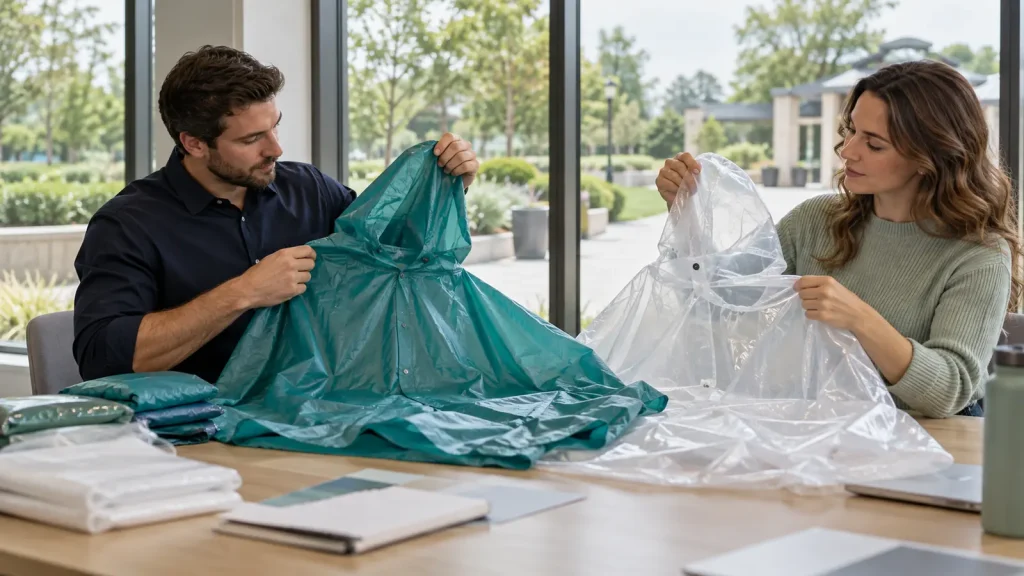
Choose the service model before comparing poncho offers
Start with the moment a guest receives the poncho. Is it a purchase at a gift shop, an item included in a tour package, a courtesy issue from visitor services or a product offered through several channels? These arrangements can use similar garments, but they create different packing, stock and approval requirements. A supplier cannot make a useful recommendation from the phrase “theme park rain ponchos” alone. Describe the service you intend to provide, the people who will use it and the places where the stock will be held. That information gives the quotation a practical foundation.
A gift-shop program needs a clear presentation that works alongside other merchandise. Staff may need to identify sizes quickly, scan an existing stock code and explain whether a pouch is included. A courtesy program may place greater importance on fast identification and straightforward issue records. A tour operator might need packs grouped by departure rather than arranged for display. None of these choices establishes a universal best poncho. They tell the buying team which features deserve attention during sample review. Keep the commercial model visible in the brief so a later packaging change does not quietly undermine the intended service.
Consider whether guests are expected to keep the garment. A souvenir rain poncho can become part of a broader branded assortment, but that possibility should be supported by the product's fit, finish and packing rather than by an optimistic label. If repeat use matters, ask how the garment should be dried, folded and stored, and assess those instructions with the proposed pouch. If the program is intended for a single visit, describe that operating assumption without making unsupported claims about disposal or environmental performance. The distinction affects the questions you ask; it does not excuse a weak specification.
Document the boundaries of the offer as well. An attraction might distribute ponchos for walking between permitted areas while applying separate rules to particular rides, animal encounters or indoor activities. Those restrictions belong to the venue's operating procedures and should be confirmed by its responsible team. Do not let a supplier's generic photograph determine where a garment may be worn. Ask whether the pack needs a short instruction pointing guests to staff guidance. Keep that message concise and consistent with the actual rules, especially when different locations within the same group operate different attractions.
For a hypothetical example, imagine an attraction with a main gift shop, two smaller kiosks and a group-arrivals desk. The shop might hold the full approved size range, while the kiosks carry a deliberately narrower selection and the group desk receives pre-counted packs. Before ordering, the team should decide how guests reach another size, who authorizes transfers and whether the packaging clearly distinguishes each variant. The useful outcome is a service plan that the stock arrangement can support. Copying the main shop assortment into every small kiosk may create storage and replenishment problems that a lower purchase price will not solve.
Finish this part of the brief with a short statement that everyone can use: the distribution model, intended wearer, expected handling, product ownership after issue and operational restrictions. Add the departments responsible for confirming those points. Then ask suppliers to state any assumptions they have made about the program. A proposal that identifies missing information is easier to evaluate than one that promises a perfect product without understanding the setting. Once the service model is agreed, material, branding and Bulk Pricing discussions become more focused because every option can be assessed against the same purpose.
Map departments and decision owners into one buying brief
Attraction rainwear often crosses more departmental boundaries than its modest pack size suggests. Procurement compares proposals, visitor services sees guest difficulties, retail manages displays, operations controls access and movement, and marketing owns the artwork. The warehouse may discover a carton problem that none of those teams considered. Bring these perspectives into one buying brief before asking for final quotations. You do not need a large committee for every decision. You need named people who can answer specific questions, approve their part of the specification and understand when a change affects someone else's work.
Give each department a practical assignment. Ask frontline supervisors to describe where guests hesitate during issue or opening. Ask retail colleagues to measure the available display and storage space. Ask receiving staff which carton information they need to identify a delivery without opening every box. Ask brand owners which artwork files and color references are approved. These requests are more useful than a general invitation to comment on a sample. They turn opinions into information the supplier can act on and make it easier to distinguish a required feature from an individual preference.
Separate consultation from approval. Several employees may provide observations about a hood or pouch, but one designated owner should consolidate the response. Otherwise, the factory can receive conflicting requests through different conversations: make the pack smaller, add another insert, increase garment coverage and keep the original carton count. Those requests may not all be compatible. Use a shared decision record that lists the proposed change, the reason, the affected dimensions or files and the person authorized to accept the resulting compromise. The objective is a clear decision, not the elimination of useful discussion.
Include the people who will maintain the program after launch. A new stock coordinator should be able to understand which sample is current and which artwork revision belongs to each site. A replacement buyer should not have to reconstruct the order from scattered messages. Store the approved specification, sample photographs, packing details and supplier confirmation in a location accessible to the relevant team. Keep superseded documents identifiable without mixing them into the current release pack. A brief that survives staff changes is especially valuable for seasonal attractions that bring additional employees into service during busy periods.
An approval map can be simple. Record a decision area, its owner, the information required and the point at which approval is needed. For example, the operations owner may confirm distribution locations before packaging dimensions are fixed, while the brand owner signs off the decorated sample before production release. Add a substitute contact for absences. Do not make every person approve every minor detail; that can slow progress without improving the outcome. Instead, define which changes require renewed review. A different garment size, material, print method or pack format deserves more attention than a corrected internal file name.
When you send the RFQ, give the supplier one commercial contact and a clear route for technical questions. Ask for unresolved questions to be returned in a consolidated list. Keep a dated record of answers and circulate decisions to the affected departments. This prevents a verbal clarification from becoming an unofficial specification change. The final brief should read as one coherent instruction, even when several teams contributed to it. That coherence helps suppliers price the same scope, gives your reviewers a common reference and makes the eventual approval easier to defend when the program moves from samples to bulk delivery.
Turn guest frustrations into measurable approval questions
Guest complaints can be valuable buying information, but they need interpretation before they become product requirements. “Too small” might refer to the body width, the head opening, the sleeve arrangement or the space available over a day bag. “Difficult to use” might describe the wrapper rather than the garment. Ask the frontline team to record what happened, which variant was involved and what the guest was trying to do. Avoid collecting unnecessary personal information. A concise description of the interaction is usually more useful for procurement than a detailed account of the individual visitor.
Convert each recurring observation into a question that can be answered during review. If staff report that guests struggle to identify the front, ask whether the opening and instructions make orientation clear. If packs look identical across sizes, check whether the approved size identifier remains visible in the chosen display. If the garment is hard to return to its pouch, review the pouch with the actual folded sample rather than an empty shell. The question should lead to an observable outcome. Broad requests such as “make it premium” or “improve quality” leave too much room for different interpretations.
Decide how the observation will be checked and who should participate. A packing concern may be assessed at a real counter with the staff who work there. A fit concern needs suitable wearers and the clothing or bags that represent the intended use. A print-placement concern requires the decorated garment to be viewed in its normal drape, not only spread flat on a table. Record the limits of each review. A short handling exercise can identify awkward steps, but it does not establish a laboratory performance rating or prove how every guest will experience the product.
Use neutral acceptance language. Instead of writing that a pack must open “instantly,” describe the opening method and the conditions under which it will be assessed. Instead of promising that all visitors will remain completely dry, define the garment dimensions, closure configuration and any performance evidence required for the intended use. Agree tolerances and methods with the supplier where measurements matter. The aim is a specification that can be checked consistently. Claims that cannot be tied to a method tend to produce arguments after delivery because neither party knows what evidence would settle the question.
Keep a distinction between product faults and service problems. If the correct size exists but staff cannot find it, the answer may be a stock-location change rather than another garment redesign. If a suitable pouch is supplied but omitted during issue, the handover routine needs attention. Review these possibilities before increasing complexity in the product. Every additional size, insert or closure can affect packing, identification and ordering. A simple improvement to the operating routine may solve the problem more reliably than adding a feature that employees and guests must learn to use.
Bring the results together in an approval checklist that fits the actual program. Include the concern, the proposed solution, the review method, the outcome and any remaining action. Photograph relevant details with the sample revision visible in the record, and retain a physical reference where practical. Use the checklist to compare suppliers on the same questions rather than scoring their presentations. It becomes a useful bridge between guest experience and procurement: frontline observations lead to specific decisions, those decisions become approved requirements, and the delivered stock can later be checked against a record that explains why each requirement exists.
Compare tourism with other purchasing contexts in our Bulk Rainwear by Industry guide. Use the attraction brief here to turn that market overview into specific product and distribution decisions.
02 / 12
Plan rain poncho distribution around the guest journey
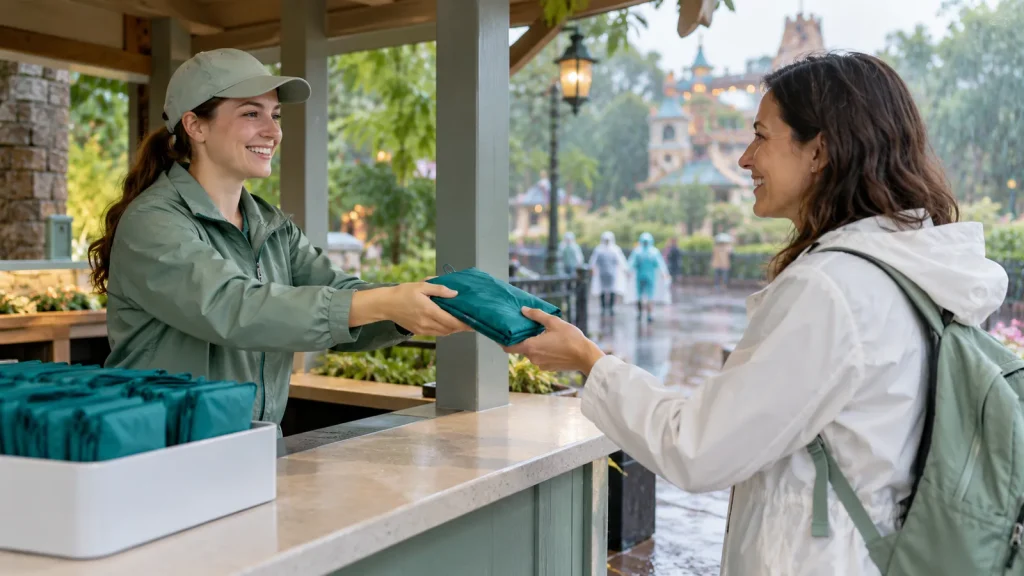
Position stock where guests can reach it without blocking circulation
A rain poncho program begins with a map of the attraction, not a carton quantity. Mark the places where visitors arrive, pause, ask for help and leave. Then identify the locations that can accommodate a rainwear transaction or handover within the venue's approved circulation plan. The nearest available counter is not automatically the right point. Guests may already be queuing there for another service, and employees may have little room to keep packs dry or separate sizes. Review proposed locations with the operations team before ordering a display format that assumes more space than the site provides.
Walk the route from a guest's perspective. A visitor leaving a show may need a different point of access from someone arriving at the entrance or returning from a distant exhibit. Consider what information is visible before the guest joins a queue. If the full size range is available only at the main shop, staff at smaller points need a clear way to explain that. Avoid sending visitors repeatedly between locations because nobody knows which stock is available. An accurate location guide and a simple staff communication routine can be as important as the physical placement of the ponchos.
Distinguish storage from distribution. A central room may have enough space for the full order but be unsuitable for serving guests. A kiosk may be convenient for issue yet hold very little reserve stock. Define the link between them: who requests replenishment, who brings it, which route is authorized and how the transfer is recorded. Do not rely on an employee improvising a trip through a busy public area with an open carton. Check the transport container and handling arrangement with the relevant venue team, particularly when stock must move across outdoor paths or between buildings.
Think about the condition of the pack at the point of handover. A sheltered kiosk can still expose stock to damp hands, wind-blown rain or wet counters. The approved storage method should protect unused stock within the packaging supplier's stated conditions. Keep opened demonstration garments separate from sealed stock so employees do not confuse them. If the counter uses trays or dividers, test the final packed dimensions in those fixtures. A pack that fits an empty drawer may be difficult to remove once the drawer is full, especially when several sizes must remain identifiable.
Use a small location worksheet to make the plan concrete. For each point, list its operating hours, available storage, approved variants, replenishment contact and alternative location when it is closed. Add any constraints that affect the supplier's packing proposal, such as a maximum practical inner-pack size or a need to separate size groups. These are planning requirements rather than universal venue standards. Confirm them with the staff who manage the location. Where the attraction changes its layout seasonally, record which configuration the worksheet describes and when it should be reviewed again.
Finally, trial the arrangement before committing the entire order to one pack format. Place representative packs in the proposed fixtures, rehearse the transfer from reserve storage and ask staff to identify a requested variant. Observe where they search, reach or need another person's help. Record specific changes and repeat the relevant step after revision. You are checking whether the stock arrangement supports the service you have designed, not attempting to predict every rainy-day queue. This practical exercise helps prevent a technically acceptable garment from arriving in packaging that is awkward to distribute at the very location where it is needed.
Give frontline teams a practical handover routine
The best supplier specification still needs a workable handover at the counter. Decide what staff should establish before giving a guest a poncho: the requested size, the relevant product option and any information the venue requires them to communicate. Keep the routine short enough to use during a busy period. Employees should not have to deliver a product lecture or search through procurement documents. A concise reference card can explain the approved variants, where to find them and which questions should be referred to a supervisor rather than answered from memory.
Make size identification visible in the stock arrangement. If the individual pack carries a size label, check its location after folding and placement in the display. If stock is grouped in an inner pack, confirm that the group identifier remains available after the outer carton is removed. Do not depend on color alone when several variants could look similar under the counter lighting. Use the venue's agreed identification system and test it with unfamiliar staff. A good routine should remain understandable when a new seasonal employee joins the team and has not seen the supplier's original sample presentation.
Provide one approved demonstration method. A staff member may need to show where the head opening is, how a side fastening works or how the garment returns to its pouch. Use a designated demonstration sample and the supplier's approved instructions. Avoid opening saleable or sealed issue stock repeatedly to answer the same question. Review the demonstration with actual employees so the steps match the space and equipment available. If the sample is stored separately, label it clearly in the internal system and ensure it is replaced when the product revision changes.
Plan for exceptions rather than leaving them to individual judgment. A guest may find the selected size unsuitable, discover a damaged pack or ask for an option that the kiosk does not carry. Define the approved response and escalation route. Record the basic information needed to investigate a suspected product issue, such as the variant and batch reference, without collecting unnecessary visitor details. Separate the operational decision about assisting the guest from the later supplier investigation. Staff should know how to help within the venue's policy while preserving enough evidence for the buying team to understand what happened.
The handover routine should also cover what staff may say about the product. Use the approved description for material, intended use and care. Do not turn a vague supplier phrase into a promise of universal waterproof performance, certified protection or environmental superiority. If a guest asks a question that the available evidence does not answer, provide the agreed contact or information source. This protects the consistency of the program and avoids placing frontline employees in the position of making technical claims. Procurement can help by supplying clear, usable wording with the final stock release.
Rehearse the routine with the packed product and the actual counter layout. Ask someone unfamiliar with the order to locate a size, explain the opening method and follow the exception procedure. The exercise may reveal that a label faces the wrong way or that a pouch is easily separated from its garment. Fix those details before they become a repeated service problem. After launch, invite staff to suggest improvements using the same specific observations. Treat the routine as a maintained part of the rainwear program, with a version owner and a review point whenever the product or distribution arrangement changes.
Keep rainwear distribution separate from severe-weather decisions
Rainwear helps with an ordinary rain-protection brief; it does not establish whether an attraction should remain open or whether a particular activity is safe. Keep those decisions with the venue's responsible operations and safety personnel. The purchasing team should understand the approved use boundaries and ensure the product description does not contradict them. A poncho offered at an information kiosk should never be presented as a reason to ignore a closure, a staff instruction or a weather alert. This distinction belongs in the internal brief before marketing copy and handover instructions are approved.
The National Weather Service advises people outdoors during thunderstorms to reach a safe building or vehicle and emphasizes planning for groups. Its guidance also explains that open-sided picnic shelters are not safe lightning shelters. For an attraction buyer, the practical implication is that providing rain ponchos cannot replace the venue's weather response plan. Have the responsible venue team determine shelter arrangements and operating decisions. Keep product distribution messaging aligned with that plan rather than adding your own thresholds, shelter claims or reopening rules to a garment specification.
Ask what happens to the rainwear service when operations change. A kiosk might close, employees might be reassigned or a guest route might be redirected. The distribution plan should recognize those possibilities without interfering with the venue's established procedures. Name the person who communicates changes to stock locations and service availability. Staff should not continue a normal sales or issue routine simply because ponchos remain on the shelf. The aim is coordination: the rainwear program supports the visitor-service function within the current operating decision, and the operating decision retains its proper authority.
Review the wording on displays, inserts and staff reference cards. Phrases that encourage guests to continue every activity regardless of weather can create the wrong expectation. Describe the product and direct visitors to follow venue guidance. If an attraction has specific restrictions concerning loose garments, hoods or accessories, obtain the approved wording from its responsible team and consider how guests will encounter it. Do not infer a rule from another venue or from a supplier's marketing example. Requirements can differ across activities, and the brief should make clear which organization is responsible for confirming them.
A tabletop discussion can expose gaps without turning procurement into an emergency-planning exercise. Use a hypothetical change in operations and ask where the rainwear stock, staff instructions and guest information would be affected. For example, if one distribution point becomes unavailable, is there an approved alternative, and who updates the other counters? Record the questions for the appropriate owner rather than inventing answers. The value of the exercise is to identify dependencies in the buying and distribution plan. It is not evidence that the venue's broader emergency arrangements have been tested or certified.
Keep the final approval record clear about scope. Product samples may have passed the agreed fit, packing and handling review while the venue separately controls permitted activities and weather procedures. Retain both references where relevant, but do not combine them into a misleading claim that the poncho itself makes an outdoor activity safe. When the program is refreshed for another season, check whether any operating instructions have changed before reprinting packaging. This modest coordination step helps the procurement team supply a useful product while preserving accurate guest expectations and the decision-making responsibilities that belong elsewhere in the attraction.
Primary references: National Weather Service outdoor lightning guidance.
03 / 12
Specify materials and construction for bulk attraction ponchos
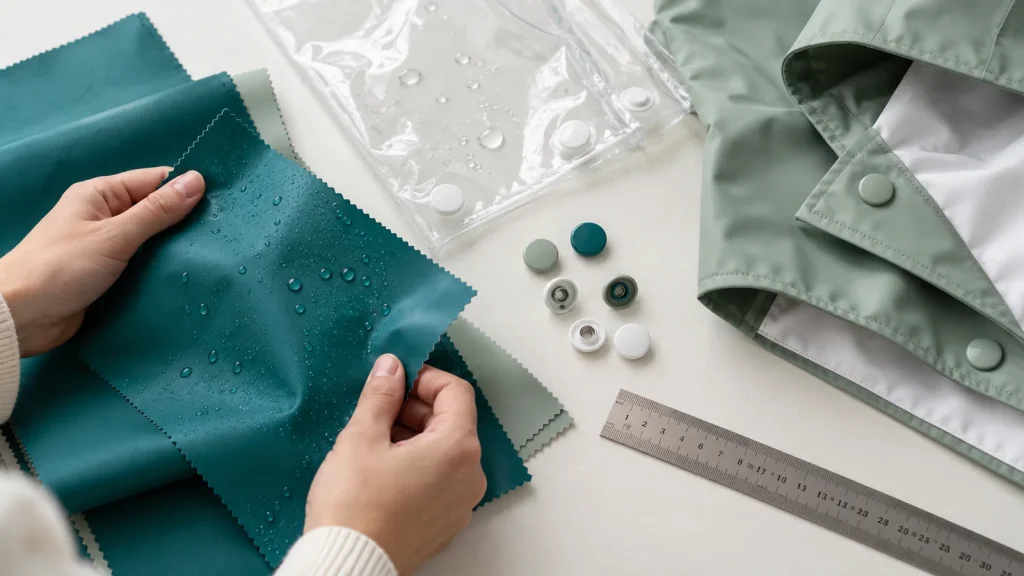
| Entity | Attribute | Value to define | Evidence and verification |
|---|---|---|---|
| Garment | Intended use | Guest rain protection during permitted activities | Confirm venue restrictions and approved use instructions |
| Material | Composition and construction | Exact film or coated textile specification | Supplier declaration tied to sample and order revision |
| Film | Thickness | Nominal value in micrometres, with agreed tolerance | Measurement method and representative sample points |
| Textile | Mass per area | Value in g/m² for the specified construction | Document whether coating is included in the value |
| Fit | Garment dimensions | Length and width in cm for each size | Agreed measurement diagram and wearer review |
| Closure | Opening and fastening | Approved snap or other closure configuration | Opening, fastening and component review |
| Branding | Artwork placement | Dimensions and position in mm | Approved decorated sample and artwork revision |
| Individual pack | Packed dimensions | Length × width × depth in mm | Check with the final folded garment and insert |
| Master carton | Count and gross mass | Units/carton and kg/carton | Packing list and receiving sample |
| Order | Traceability | Model, size, artwork revision and batch reference | Consistent labels and retained approval record |
Compare complete constructions rather than material names alone
A quotation that says only PE, EVA, PVC or polyester leaves too much room for interpretation. Those labels identify a material family; they do not describe the finished poncho you will receive. For a useful comparison, ask each supplier to identify the material construction, dimensions, fastening arrangement, seam method and packaging. Then tie the answer to a physical sample. Two products with the same material description can feel different, cover different areas and fit into very different packs. Your attraction buys a complete garment and an operating solution, so the comparison needs to reach that level.
Start with the intended guest experience. A compact pack handed out during an unexpected shower has different priorities from a branded garment positioned as a souvenir. The first brief may emphasize quick opening, simple sizing and efficient storage. The second may give more attention to repeated handling, decoration and a usable carrying pouch. Neither description automatically selects a polymer. It gives the supplier a reason to propose a construction and explain its compromises. Ask for those explanations in writing so the team can distinguish a necessary feature from an attractive but irrelevant addition.
Request measurable information in the right units. Film thickness belongs in a defined thickness measurement, usually micrometres, while textile mass per area is normally expressed in grams per square metre. These are different attributes and should not share a comparison column without explanation. For a coated textile, establish what the quoted mass includes. For any nominal dimension or material value, agree the tolerance and measurement method. A precise number is useful only when both parties understand how it will be checked and which part of the garment it represents.
Look beyond the main material to the points guests handle. Opening the neck, finding the sleeves or side openings, closing snaps and removing the garment all place demands on the construction. Review the edges, junctions and fastenings on a finished sample rather than a loose swatch. Ask whether the sample uses the proposed production components. If it does not, write down the differences and the next approval needed. This avoids accepting a sample for its appearance while assuming that unseen details will remain identical when the bulk order arrives.
Keep performance language proportionate to the evidence. A supplier’s general description of a waterproof material does not by itself establish the performance of every seam, opening or decorated area. If your brief needs a particular test result, identify the method, specimen, conditions and acceptance requirement with a qualified technical adviser. Request evidence that applies to the proposed construction. Do not turn an informal splash demonstration into a certification claim. For ordinary attraction rainwear, clear use instructions and realistic coverage expectations are more helpful than an impressive phrase nobody can substantiate.
Finish the comparison with a short decision record. State which construction you prefer, which guest need it answers and which questions remain open. Keep alternatives visible if their different packing or fit may suit another location. For example, an attraction might evaluate a compact emergency pack for information desks and a separate reusable option for its main gift shop. That is a hypothetical range decision, not a reason to order both automatically. The objective is a deliberate match between product and service, supported by a sample everyone recognizes.
Use an EAV specification to make proposals comparable
An entity, attribute and value specification sounds formal, but the idea is straightforward: name the thing, name the property and state what is required. Add a verification column so the buyer knows how the requirement will be confirmed. For theme park rain ponchos, the entities include the garment, material, decoration, individual pack and master carton. This structure stops a discussion about the garment from overlooking the pouch or replenishment carton. It also gives suppliers a consistent place to explain an exception instead of hiding it in a general quotation note.
Begin with a small set of attributes that affect your decision. Garment length and width, size identification, material construction, opening style, artwork position and packed dimensions usually deserve early attention. Do not fill the table with invented values just to make it look complete. Mark an unresolved value as buyer approval required and assign the person who will resolve it. A working specification can contain open questions, provided they are visible. An apparently finished document with assumptions disguised as confirmed requirements is much harder to manage when production is approaching.
For each value, identify its reference. Dimensions should point to an agreed drawing with measurement positions. Color should point to a physical approval or another clearly defined reference, rather than a photograph viewed on different screens. Artwork needs a revision identifier and a placement drawing. Packaging needs the actual folded garment, insert and closure included in its measurement. These links make the specification usable during inspection. Without them, a supplier and receiving team may both report that a product matches the brief while measuring different things or referring to different versions.
Use the verification column to separate document checks from physical checks. A declaration can identify the proposed composition, while a sample review checks whether the hood opening and fastening arrangement suit the intended use. A packing list supports carton counts, but it does not replace the receiving check your team has agreed. If laboratory work is necessary, reference the appropriate report and its scope. The table should make these forms of evidence complementary. It should never imply that a supplier statement, a photograph and a finished-product test answer the same question.
Ask suppliers to return the table with three clear response types: meets the requirement, proposed alternative, or confirmation pending. That is easier to compare than several brochures with different levels of detail. Review alternatives before ranking offers. A changed pouch depth may be acceptable if the shelf can accommodate it; a changed garment size may require another fit review. Record the accepted alternative in the next specification revision. Do not leave the purchase order dependent on a chain of emails in which nobody can tell which exception was finally approved.
Keep the table connected to change control after selection. A revised snap, print method or pack count can affect more than its own row. Ask the supplier to identify related changes and submit them for approval before implementation. Retain the previous revision alongside the new one so receiving staff can understand a legitimate difference between batches. The EAV table below is a planning framework rather than a claim about a particular stocked product. Replace its buyer-defined fields with confirmed project values before treating it as an order specification.
Assess comfort and practical coverage on the finished garment
A sample that looks tidy on a table may behave differently once someone wears it over a jacket or a day bag. Review the finished garment in the ordinary situations your attraction permits: walking between exhibits, waiting at a covered entrance and taking the poncho off indoors. Invite staff with different heights and builds to describe what happens. Their comments can reveal awkward openings or confusing fastenings that a flat measurement misses. Keep this review separate from formal testing; it is a structured check of usability, not a substitute for evidence of a claimed technical performance.
Pay attention to the hood and the wearer’s view. Ask reviewers to turn their heads naturally and describe whether the garment moves with them or needs adjustment. Note how easily the hood is located when the product first comes out of its pack. Avoid solving every fit complaint by adding an adjustment component. A changed hood shape, a different size or clearer instructions may be the more appropriate response. Any proposed component needs its own safety and usability review, particularly where the range includes children or guests who may need assistance.
Check coverage in relation to movement rather than length alone. A longer garment can offer different coverage while also creating handling questions for a shorter wearer. Observe hems, arm openings and fastening positions during a controlled review. If the poncho is intended to cover a small day bag, state that in the brief and review that configuration. Do not assume that capacity follows from a loose silhouette. Equally, do not suggest that a garment can be worn on every ride or piece of equipment. The attraction’s operating restrictions remain the authority for those activities.
Ask about comfort without promising a universal answer. People experience temperature, humidity and garment feel differently, and the clothing underneath changes the result. Record the conditions of a sample review and the comments that matter for your service model. A compact film poncho and a coated textile garment may invite different expectations, but the actual construction should drive the evaluation. If breathability is a purchasing requirement, define the evidence you need rather than relying on a material name. An open side or loose fit should not be translated into an unsupported laboratory rating.
Removal and repacking deserve their own review. A guest may need to remove the poncho before entering an indoor area, while holding a bag and other belongings. Check whether the fastenings are understandable and whether the intended reusable pack can accommodate a carefully folded garment. Discuss wet handling with the venue team and use instructions supported by the chosen product. Do not encourage sealing a damp garment indefinitely. If drying or cleaning instructions are part of the proposition, obtain them for the exact construction and make sure the packaging has room for useful guidance.
Summarize the review in practical terms: which size worked for which use, where assistance was needed and which design changes require another sample. Photographs can support these notes with reviewers’ permission, but the approved physical reference remains valuable. Give the supplier specific observations such as an opening being difficult to identify, rather than a general verdict that the sample feels wrong. The result should be a clear approval decision or a short list of changes. That makes the next sample purposeful and keeps the bulk order tied to a guest experience your team has actually considered.
Build your construction shortlist with the PE, PVC, EVA and polyester raincoat material guide, then compare service models in our disposable versus reusable poncho guide.
04 / 12
Choose guest sizes and fit for families and tour groups
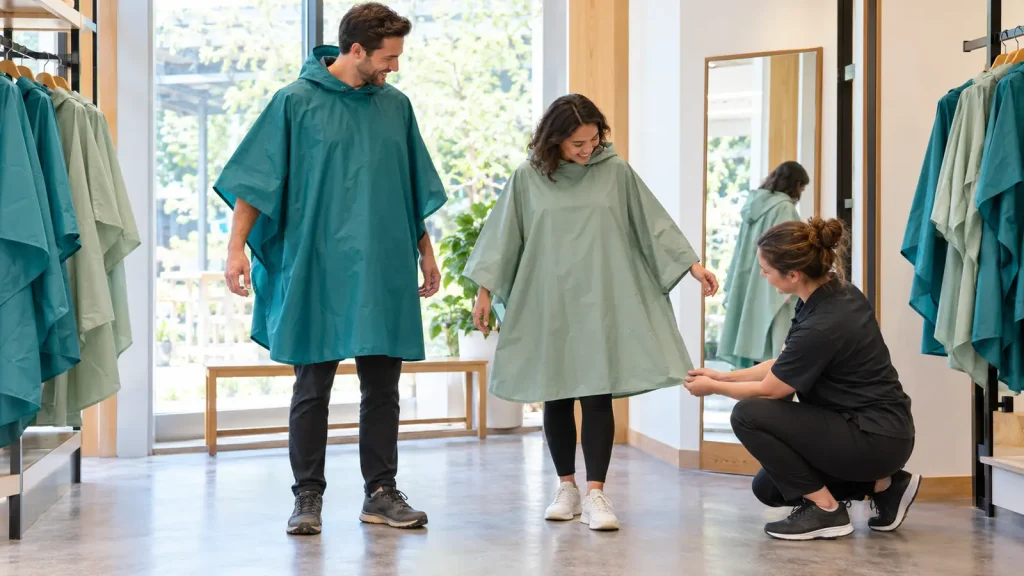
Replace the one-size assumption with a usable size matrix
One size may simplify a catalogue, but it does not answer a guest’s question about fit. An attraction can welcome school groups, adults carrying bags and families wearing several layers on the same day. Start the size discussion with those use cases. Ask the supplier for actual garment dimensions and a measurement drawing, then decide which range needs a wearer review. A label such as adult, junior or universal is a starting description rather than a reliable comparison between suppliers. The procurement team needs a size matrix it can connect to a specific product.
Keep the matrix understandable for the people distributing stock. Include the approved size name, garment dimensions, pack identifier and any verified wearer guidance. Separate body measurements from finished-garment measurements; they are not interchangeable. If the supplier provides a suggested height range, ask how it was established and review it against the sample. Do not turn an unverified recommendation into a definitive fit guarantee. The purpose is to reduce avoidable confusion, while allowing staff to explain that comfort and coverage depend on clothing, body shape and the way the poncho is worn.
Use a controlled sample session to refine the range. Invite a varied group of adult staff or other appropriate reviewers and give them the same simple tasks. Ask them to put the garment on, find the fastenings, turn naturally and remove it. Record the size tried and the clothing worn underneath. Make participation voluntary and avoid collecting unnecessary personal measurements or photographs. The useful output is a set of observations about the garment. You do not need a detailed personal profile to learn that an opening is confusing or a hem is awkward for a particular reviewer.
Translate fit findings into stock decisions carefully. If several reviewers need a second option, investigate whether a different size solves the issue before expanding every color into every size. An extensive matrix can become difficult to replenish and explain. A smaller, well-supported range may be easier for the venue to operate, provided it addresses the actual audience. Ask the supplier how size variants affect MOQ, packing and identification. Obtain project-specific answers rather than assuming that all sizes can be mixed freely within the same minimum order or production batch.
Make size recognition possible without opening every pack. A consistent printed label, approved color marker or clearly separated shelf location can help, but check the system with frontline staff. Do not rely on garment color alone if the range also changes by artwork or campaign. A visitor-services team should be able to distinguish an adult clear poncho from a smaller clear poncho while the products remain sealed. Confirm that the same naming appears on the pack, inner bundle, carton and stock record. Conflicting abbreviations create unnecessary interpretation during a busy distribution period.
Treat the matrix as an operational document that can improve after use. Collect specific fit feedback alongside the model and size involved, then review it before the next order. Avoid replacing a whole size range because of an isolated vague complaint, but do not dismiss a recurring issue merely because the dimensions match the original drawing. Both facts can be true: the product meets the order and the order needs improvement. A disciplined review turns guest feedback into a clearer specification, with approved changes carried into the next sample and replenishment plan.
Review children’s ponchos as a distinct product brief
A child’s poncho should not be treated as a shortened adult garment with a different label. The audience, component choices, information requirements and applicable rules need their own review. Identify the intended age or size range and the markets where the product will be supplied. Ask the supplier to propose an appropriate construction and explain the documentation available for that exact product. Involve a qualified compliance adviser where needed. A general statement that a factory also makes children’s products is not evidence that your proposed design meets the requirements of its destination market.
CPSC guidance identifies hood and neck drawstrings in children’s upper outerwear in US sizes 2T through 12 as a substantial product hazard. Its guidance also addresses waist and bottom drawstrings in larger children’s sizes. These are specific US requirements, not a universal checklist for every country or design. For a children’s attraction range, have the applicable product rules assessed before approving components or artwork. A drawstring-free concept can simplify one design question, but it does not establish overall compliance or remove the need to review other relevant requirements for the finished item.
Look at components in the context of ordinary handling. Ask how fastenings are attached, whether the opening is intuitive and what information should accompany the product. Do not add decorative toggles, charms or detachable pieces merely to make the child range look playful. Every addition creates another specification and review question. The packaging is part of that discussion as well. Have any required warnings and instructions checked for the intended market and age group. Use approved wording and placement, rather than copying a warning from an unrelated product that happens to use similar packaging.
Keep fit guidance clear for accompanying adults. A guest-service employee should not have to estimate a child’s age from appearance and promise a fit. Give the team the approved sizing information and a sensible way to show garment dimensions or an appropriate display sample. Ask how the family can make a choice within the venue’s service policy. A school-group order may allow size requirements to be collected in advance, while a general admission setting needs a simpler counter process. The product range and the distribution method should be designed together rather than settled by different teams independently.
Any wearer review involving children needs the venue’s appropriate consent, supervision and safeguarding procedures. It should be a planned review by responsible adults, not an improvised trial at a busy entrance. Record garment observations and avoid unnecessary personal data. If a design appears unsuitable, stop that part of the review and return to the supplier with the concern. Do not use a children’s sample session to test risky situations or to demonstrate a performance claim. The goal is to understand ordinary fit and handling within an already appropriate product-development process.
Before the order is released, assemble the child-range approval record separately enough to be identifiable. It should connect the model, size range, components, packaging and relevant evidence to the final revision. Confirm whether a proposed substitution needs renewed review. Keep the approved instructions accessible to receiving and visitor-services teams, not only in procurement’s files. This makes it easier to spot an unexpected component or missing label when cartons arrive. It also prevents a later repeat order from quietly inheriting adult-product assumptions that were deliberately excluded from the original children’s brief.
Include different bodies and ways of wearing the poncho
Inclusive buying starts by asking how people will use the garment, rather than assuming that a loose cut will work for everyone. Guests may wear different layers, carry a day bag, use a mobility aid or need help with fastenings. These are reasons to broaden the review, not reasons to promise a universal fit. Invite the attraction’s accessibility team into the brief early. They can help identify relevant situations and the right way to obtain user feedback. The supplier can then address those needs with specific design options and samples instead of a general claim that the poncho suits all visitors.
Separate the fit of the garment from the compatibility of the activity. A poncho that is comfortable while walking may still be unsuitable for a particular ride, escalator arrangement or equipment use. The venue’s rules and the equipment operator’s instructions should govern those situations. Do not use a procurement guide or supplier photograph as permission to override them. Ask operations to identify any restrictions that need to appear in staff guidance or approved guest instructions. This keeps the rainwear program aligned with the attraction’s established practices rather than creating a parallel set of informal rules.
Review reach and fastening effort as practical questions. Can a wearer identify the front, find the opening and manage the intended closure without an unnecessarily complicated sequence? Where help may be needed, can a companion assist in a way the venue considers appropriate? Avoid deciding for users what is easy. Structured feedback from people with relevant experience is more useful than an assumption based on a quick staff demonstration. Record the task and the difficulty observed, then ask whether a change in closure, opening, instruction or size could address it without introducing another problem.
Coverage for seated guests needs thoughtful assessment. Do not assume that extra length automatically improves the result; the way material falls can change when someone is seated. Where a product is proposed for use alongside a mobility aid, obtain appropriate user and technical input for that configuration. Keep loose material clear of moving parts in accordance with applicable instructions and venue procedures. A general poncho photograph cannot establish compatibility with every device. If a specific use has not been assessed, communicate that uncertainty and explore a suitable alternative rather than making an unsupported promise.
Consider how information reaches the guest. Small lettering, color-only size coding or a complicated folding diagram can make a simple product harder to use. Ask the venue team to review the clarity of approved labels and instructions in the context of its audience. Where multiple languages or accessible formats are needed, plan them before the packaging is finalized. Translation should preserve the intended meaning and any required warning language. The supplier should receive the approved files, while the attraction retains responsibility for confirming that its communication approach matches the service it intends to offer.
Use findings to make the range more understandable, not merely larger. A clearly differentiated second size or an alternative closure may solve a real problem; adding numerous barely different variants may make selection harder. Document what each option is intended to address and how staff should present it. Keep feedback open after launch so repeated issues reach the buying team. Inclusive procurement is an ongoing process of listening, specifying and reviewing. The strongest outcome is a set of products and instructions that serve identified needs honestly, with clear limits wherever a particular fit or use has not been established.
Primary references: CPSC guidance on drawstrings in children’s upper outerwear.
For organized youth visits, use our school and educational-tour rainwear guide to develop the size, supervision and distribution brief.
05 / 12
Create branded souvenir rain ponchos that guests want to keep
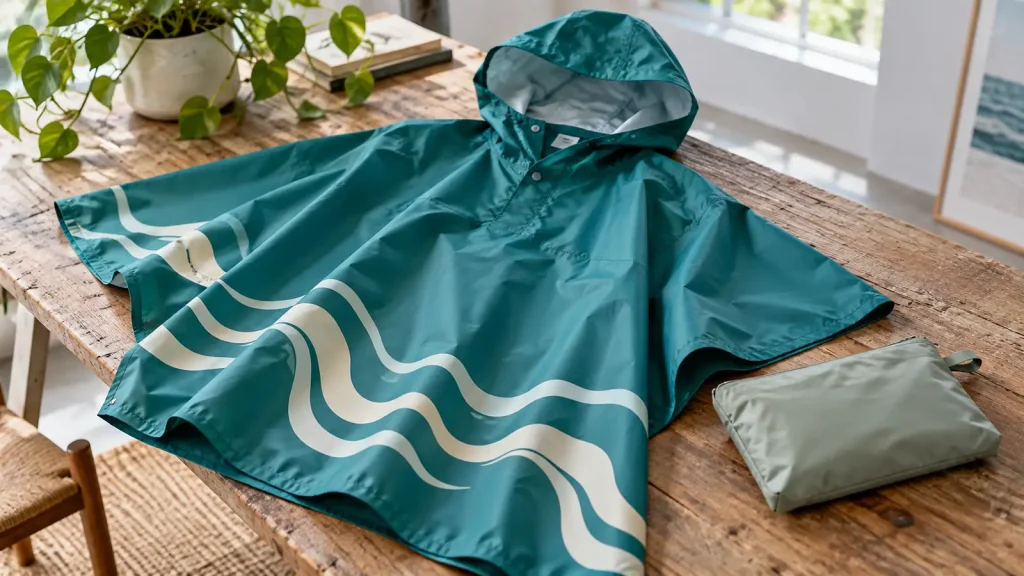
Build the artwork around the poncho’s actual print area
A souvenir poncho has to work while it is being worn, folded and displayed. Begin the artwork brief with the garment drawing, including seams, openings, fastenings and the proposed print area. A large graphic placed on a flat rectangle may disappear into folds once the poncho is on a person. Ask the supplier for a placement template for the exact model, then have the design team build within it. This is more reliable than approving a dramatic mock-up first and discovering later that the chosen position conflicts with a seam or an area the supplier cannot decorate consistently.
Decide what the design should accomplish. A quiet attraction identity, a recognizable color combination and an event-specific graphic create different impressions. A theme park may want a design that belongs with its wider souvenir range, while a zoo may prefer a restrained pattern that sits comfortably alongside educational merchandise. Those are creative directions, not reasons to copy another venue’s artwork. Use assets the organization owns or is authorized to use. Ask the brand team which elements must remain unchanged and which can be adapted to the shape and movement of rainwear.
Think about the view from several angles. Front decoration can be interrupted by an opening or covered by the wearer’s arms; a back graphic may be more visible in a queue but less visible when the product is packed. A pattern can make folds less conspicuous, yet it may complicate alignment or color approval. Request a realistic layout showing the intended placement rather than a generic logo pasted onto a stock silhouette. If a proposed visual depends on matching across separate pieces, ask the supplier to explain what can be controlled and what variation should be expected.
Scale the artwork to the actual garment and audience. Fine lines or tiny lettering may not read well on a moving, folded surface. A design that works on an adult size may need a separate placement review on a smaller size. Confirm whether the same graphic dimensions will be used across the range and whether that choice changes the visual balance. Do not assume that reducing the entire file proportionally solves every issue. The brand team and supplier should review the smallest important elements on a sample made with the intended decoration process.
Give the pack a complementary role. The individual pouch or sleeve can carry the product identity, size information and approved instructions without forcing every message onto the garment. Keep essential use information available in the format required for the product and market. A memorable design should not make the pack difficult to understand at a busy kiosk. Consider how the poncho looks when folded into its final package, because that is often the guest’s first view. The artwork plan should include that presentation rather than stopping at a full-length garment illustration.
End the concept stage with a small, deliberate selection. Compare options against the brief: recognizability, readability, suitability for the print area and consistency with the attraction’s identity. Record why the preferred option was chosen and what still needs physical approval. Avoid treating enthusiastic reactions to a screen image as permission for bulk production. The next step is a production-relevant decorated sample. That sample allows procurement, brand and operations to assess the same object and decide whether the creative idea remains useful when it becomes a real garment and pack.
Approve colors and decoration on production-relevant samples
Color approval needs a shared reference. A teal seen on one screen may look different on another, and a translucent material can appear different depending on what sits behind it. Ask how the supplier proposes to match and approve both garment color and decoration. Use the agreed physical reference under suitable viewing conditions, with the material construction identified. Keep the approved sample rather than relying solely on photographs. A photograph is helpful for communication, but lighting, exposure and display settings can change the impression enough to create an avoidable disagreement later.
Have the supplier explain which decoration method is suitable for the exact substrate and design. Screen printing, transfers and other methods have different process requirements; the best choice depends on the material, artwork and intended handling. Do not select a method simply because another attraction uses it on a different garment. Ask what information is needed to assess compatibility and what sample work will demonstrate the result. Where heat or other processing conditions matter, the supplier should address them for the proposed construction. A broad method name is not a guarantee of adhesion or appearance.
Review the decorated sample as a complete product. Look at placement, edges, color, legibility and the relationship between the print and seams. Handle it in the ways included in your approved review plan, such as opening, folding and fastening. If the product is intended for repeated use, agree relevant evaluation and care expectations with the supplier. Use defined criteria for any formal durability claim. An informal review can reveal concerns, but it should not be described as a standardized test or converted into a claim about a fixed number of uses without supporting evidence.
Consider both the garment and its packaging when approving the color story. A pouch made from a different material may not appear identical even when the requested color reference is the same. Decide whether a close coordination or an exact match is the actual requirement, then ask what is achievable and how it will be approved. A deliberate contrast can be easier to manage than an ambiguous near-match, but it must fit the brand brief. Record the accepted relationship so a later reviewer does not reject a planned difference as an unexpected production error.
Ask for a clear record of sample limitations. A sample may use the intended print process on the correct material while still differing in size, closure or packaging. Another may be a useful fit sample with temporary decoration. Neither is necessarily unsuitable for its purpose, provided the distinction is explicit. Do not let one approval silently cover attributes that were not represented. Before bulk release, identify the reference that confirms the final combination, or document the approved sequence of evidence that covers it. Everyone should know which questions have been answered and which remain open.
Keep the approved decoration record accessible for repeat orders. It should identify the artwork revision, colors, placement dimensions, process and relevant sample. Note any accepted variation in terms the supplier and receiving team can use. If a future material substitution is proposed, review whether the decoration approval still applies. A repeat order is easier when the team can reproduce the original decision, rather than asking a new employee to infer it from an old photograph. This discipline protects the creative work while reducing uncertainty in the next purchasing cycle.
Manage artwork ownership and revisions before bulk release
Attractions often have several people contributing to a single design: a brand team, an outside agency, a licensing contact and a purchasing coordinator. Establish who owns the final approval before sending files to the supplier. One named coordinator can collect comments and issue the authorized revision without making every contributor a production contact. This does not remove specialist review; it gives that review a clear route into the order. The supplier should not have to decide whether a late email from one department overrides the file approved by another.
Confirm that the organization has the rights it needs for the proposed use. A licensed character, a photographer’s image or a partner’s logo may carry conditions that differ from the attraction’s own identity. Ask the appropriate rights holder or internal adviser to resolve those conditions before sampling or production. Do not assume that permission for a poster automatically includes merchandise. Keep the approval evidence with the artwork record, and give the supplier only the files and instructions needed for the project. This is a rights-management step, not a claim that every design requires the same legal arrangement.
Use a revision system that survives an email thread. Put the project name, artwork identifier and revision in the file name and approval record. Mark superseded files clearly in your own records and tell the supplier which revision is released. Avoid descriptions such as final, final-new and final-approved-again. Those labels become ambiguous when multiple teams save local copies. A simple sequential revision with a date and a named approver is easier to follow. Include the associated placement drawing and color references, because the graphic file alone may not contain the complete production instruction.
Review text separately from appearance. Attraction names, campaign dates, size labels and instructions can be visually attractive while still being wrong. Have the responsible team proofread the actual production file at a readable scale, including the pack and carton identification where relevant. If several language versions are used, identify who approves each one. Do not let a supplier infer the preferred translation from an older campaign. Copy corrections after production release can affect timing and cost, so resolve them before approval and record the exact file that was checked.
Agree how changes will be handled once the order is underway. A revised event date or sponsor graphic may appear minor to the marketing team but affect printing, packing or previously approved samples. Ask for the consequences before authorizing the change. Keep the original instruction visible until the replacement is explicitly accepted, then confirm which quantities or batches use which version. If some stock will legitimately carry the earlier design, plan how the venue will identify and distribute it. Do not allow a mixed delivery to become a surprise for staff opening cartons.
For repeat campaigns, retain a short artwork handover pack. Include the released files, approval record, sample reference, rights information and any expiry or review dates that apply. Identify whether the design can be reused unchanged or requires a fresh brand decision. This keeps an OEM Program from depending on one person’s memory. It also helps procurement distinguish a straightforward reorder from a new creative project. When the files, authority and physical reference agree, the supplier can quote and plan with fewer assumptions, and the attraction can maintain a consistent souvenir range.
Take the artwork into sampling with our custom printing guide for branded rainwear. Confirm the proposed process on the actual material.
06 / 12
Choose rain poncho packaging for kiosks and gift shops
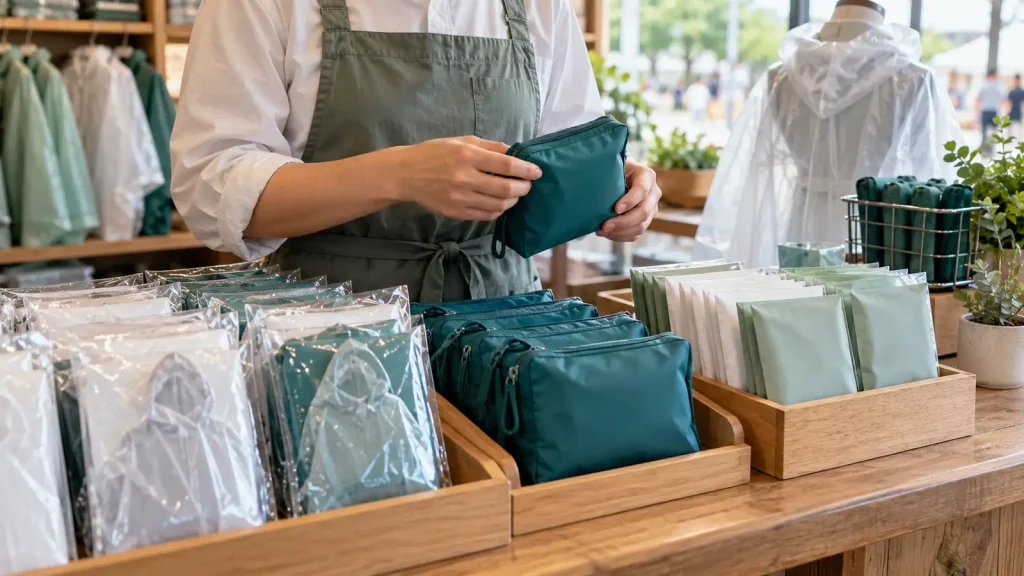
Design the individual pack around storage and opening
The individual pack is the connection between the storeroom and the guest. It has to protect the folded product, fit the intended display and be understandable when someone needs it. Start by measuring the space where packs will sit: a counter tray, shelf, hanging display or information-desk drawer. Then ask the supplier to propose a packed size using the actual garment and any required insert. An empty pouch dimension is not enough. The final thickness, closure and fold determine whether the pack can be stored and handled as planned.
Choose a packaging format for a reason. A simple sealed pack may suit a compact distribution program, while a pouch may support a reusable souvenir proposition. A hanging feature may be useful in a gift shop but unnecessary in a drawer behind reception. Each feature adds a design question, and potentially another approval or handling step. Ask what the feature contributes to the venue’s service. Do not assume that a decorative container improves the program if it makes the product harder to identify, increases storage demands or leaves the guest with an awkward item to carry.
Review opening with ordinary users under controlled conditions. Can they find where to begin, remove the poncho and understand which way it goes on? Observe whether the packaging creates several loose pieces or requires tools that the distribution point will not have. Any required warnings or tamper features still need to be preserved; usability is not a reason to remove them. Instead, ask the supplier to propose a format that meets the relevant requirements while remaining clear. A brief opening demonstration can expose a problem that a polished packaging photograph conceals.
Plan the information hierarchy before artwork is finalized. The guest needs to identify the product and, where relevant, its size and approved use or care guidance. The staff member may also need a stock code or other identifier. Decide which details belong on the individual pack and which belong on the carton or internal record. Avoid covering the pack with purchasing information the guest cannot use. Equally, do not sacrifice necessary product information to a large decorative graphic. A clear pack makes the attraction’s brand easier to recognize because the useful information is organized around it.
For reusable packaging, check the return journey as well as the first opening. A factory fold can be tighter than the fold a guest will make later. Ask someone to place the garment back into the proposed pouch without reproducing a complicated production method. If it only fits when compressed precisely, the pouch may not support the intended experience. Review approved drying and storage guidance for the chosen material, and make room for that guidance where needed. A reusable pouch should be a practical accessory, not merely a container that works once in the packing room.
Record the approved pack as a complete configuration. Include the garment fold, insert, closure, labeling and packed dimensions. Ask whether a material or size change would require a different fold or pack. Keep an unopened reference and, where useful, an opened example that shows the intended contents. The packing specification should be clear enough for receiving staff to identify a missing insert or incorrect size label. This makes packaging part of quality control and guest service, rather than an attractive final detail that receives attention only after the garment has been approved.
Separate guest-facing packaging from replenishment packs
The pack a guest sees and the unit a stock team moves serve different purposes. A well-designed individual pouch does not automatically make a convenient replenishment unit. Ask how many guest packs will be grouped together, how that group is identified and how it fits inside the master carton. The right arrangement depends on your storage and distribution process. A small kiosk may need modest replenishment bundles, while a central store can handle larger cartons. Establish these needs with the people moving stock before asking the supplier to finalize packing quantities.
Define the stock unit used at each stage. Procurement may order by garment, the warehouse may receive by carton and a kiosk may request an inner bundle. If the relationship between those units is unclear, a request for ten can mean very different quantities to different teams. Put the unit and conversion in the stock record, packing list and replenishment instruction. Do not assume that staff will remember a supplier’s standard carton count, especially if different sizes or constructions use different counts. Clear unit definitions make both physical checks and inventory records more reliable.
Decide whether cartons will contain one variant or an approved mix. Single-variant cartons can simplify identification, while mixed cartons may suit a specific distribution plan. Either choice needs an explicit packing specification. For mixed packs, state the contents and the way they will be arranged or identified. Ask the receiving team whether that arrangement can be checked without unpacking every garment. Avoid creating a mix that looks efficient in a quotation but causes repeated sorting at the venue. The objective is to move stock into use with a manageable amount of local handling.
Keep guest-facing and internal labels consistent without making them identical. The individual pack might use an approved size name and product identifier, while the inner bundle and carton add quantities, revision references and destination details. Make sure each layer points to the same underlying variant. If the attraction uses its own stock code, agree how it relates to the supplier’s model code. Retain that mapping in the order record. A label that is perfectly legible but refers to an unfamiliar naming system can still slow receiving and lead to incorrect replenishment.
Discuss partial cartons and opened bundles. Once stock has been divided between kiosks, the original outer label may no longer describe what remains. Give staff a simple way to record the remaining quantity and preserve the variant identification. Keep returned or questionable packs separate from confirmed usable stock according to the venue’s process. Do not let an opened carton become a miscellaneous container for several designs unless the inventory system can represent it accurately. The supplier’s original packing can support a clean start, but the venue’s handling determines whether that clarity continues throughout the season.
Approve replenishment packing with a small physical rehearsal. Move a representative carton into the storeroom, open it, identify the contents and prepare the amount a kiosk would request. Note awkward counts, unclear labels or unnecessary unpacking. Ask the supplier whether a different inner quantity or label position would help. Document any change before production, including its effect on carton dimensions and freight planning. This practical review connects packaging to labor and stock accuracy, giving procurement a fuller basis for comparing offers than the appearance of the individual pack alone.
Test the pack in the actual display and handover space
A display test should use the real space whenever practical. Place the proposed pack in the intended tray, hook, shelf or drawer and ask the team to work with it. Check how many packs can be presented without forcing them into place or hiding the size information. A packaging dimension can be technically correct while the product still sits poorly because of its closure or uneven thickness. That is why a physical sample is valuable. The test turns an abstract storage assumption into a visible decision about presentation and replenishment.
Review the display from the guest’s position. Can someone identify the product without picking up several packs? Are different sizes distinguishable? Does the layout leave the counter usable for its other tasks? Avoid relying on a perfect arrangement that requires constant staff attention to maintain. A simple grouping that remains understandable as stock is removed can be more useful than a visually elaborate display. Ask the gift-shop or visitor-services team to explain what would happen during an ordinary busy period, then adjust the plan around their actual working conditions.
Include the handover sequence in the test. An employee may need to answer a question, identify a size, retrieve a pack and give approved instructions while managing other duties. Observe where the sequence becomes confusing or repetitive. If every guest asks the same question, a clearer pack or display message may help. Keep that message accurate and consistent with the product’s approved use. Do not create improvised performance promises to speed the interaction. The goal is to make reliable information easier to deliver, with a product that supports the service rather than requiring an explanation of every feature.
Check the boundary between public display and reserve stock. A display that holds the full day’s supply may crowd the space, while one that holds too little may need constant replenishment. Use the venue’s own demand information and staffing pattern to choose a working balance. The pack dimensions and inner quantities should support that choice. If the reserve stock sits in a different building, include the time and route needed to bring it over. A display decision can therefore affect the broader inventory plan, even though it begins with a small tray on a counter.
Ask how the pack will be handled after it is opened. Where do discarded sleeves, removed seals or other packaging pieces go? Can staff keep the area orderly using the venue’s existing waste arrangements? If a guest opens the poncho beside the counter, is there an appropriate place to do so without obstructing others? These are local operating questions, not universal design rules. Discuss them with the team responsible for that space. A packaging format that works well in a large gift shop may need adjustment for a small information booth with limited room.
Document the approved display and handover setup with dimensions, photographs where appropriate and a short operating note. Keep the record focused on the product and layout rather than unnecessary personal details. Share relevant findings with the supplier so future packaging changes can be assessed against the same space. After launch, ask staff whether the setup still works when stock is low or the weather changes. The best packaging review does not end with a neat sample photograph; it leaves the attraction with a practical arrangement that can be maintained and improved.
Compare pouches, compact packs and other formats in our rain poncho packaging guide, then test the preferred format in your counter or display space.
07 / 12
Plan rainwear inventory for weather-driven attraction demand

Use operating history without treating weather as a sales forecast
Rainwear demand is connected to weather, but a forecast alone does not tell you how many ponchos an attraction will distribute. Attendance, advance preparation, available shelter, guest mix and the service model all affect the result. Start with the records your venue actually holds: stock issued, stock sold or handed out, transfers, returns and closing balances. Separate those categories before drawing conclusions. A large warehouse issue may reflect a transfer to several kiosks rather than immediate guest demand. If the data cannot distinguish the two, improve the record before using it to justify a larger order.
Compare periods that share relevant operating conditions. A school-group weekday, a special evening event and a holiday weekend may have different attendance patterns and distribution needs. Note where a weather interruption changed opening hours or activities, because that can affect the meaning of the rainwear figures. You do not need a complex forecasting model to begin. A consistent record with useful context can be more informative than a detailed spreadsheet built from incompatible numbers. Make the assumptions visible so another team member can understand why a period was selected as a comparison.
Look for evidence of unmet demand as well as recorded distribution. If a kiosk ran out, its sales or issue count may understate what guests would otherwise have requested. Staff feedback can help identify those occasions, but keep it separate from confirmed quantities. Record a stockout observation as an observation rather than inventing the missing demand. Similarly, a high closing balance may reflect poor placement or an unpopular size, not simply excessive overall supply. Investigate the operational reason before changing the purchase quantity. The same total can arise from very different problems.
Build a small set of planning scenarios using your own assumptions. For example, distinguish ordinary operations, a busier period and a disrupted replenishment route. State which attendance, issue-rate and lead-time assumptions each scenario uses. The figures are internal planning inputs, not promises about future demand. Review them with finance and operations so the chosen buffer reflects the venue’s tolerance for shortages, storage commitments and unused stock. Avoid presenting a percentage borrowed from another attraction as a universal rule. Your guest behavior and distribution network may be materially different.
Use short-term weather information to support local preparation within the approved operating plan. It may help staff check kiosk stock, confirm contact arrangements or move already-owned inventory to an appropriate location. It should not automatically trigger a new custom production order. Manufacturing and delivery decisions operate on a different timescale and need a broader view of demand and supply. Keep the responsibilities distinct: the operating team manages immediate conditions, while procurement manages the order pipeline. Both should share information, but neither benefits from treating every forecast change as a new purchasing instruction.
After each significant operating period, compare the plan with what happened. Ask which assumptions were useful, which records were incomplete and whether a stock problem came from quantity, location or product mix. Update the next forecast with those findings rather than merely increasing the total because the season felt busy. Retain a brief explanation of the change. Over time, this creates a practical planning history that new staff can use. The goal is not perfect prediction; it is a more informed order decision and a clearer response when conditions differ from the plan.
Set replenishment triggers for each distribution point
Central stock availability does not guarantee that a guest can obtain a poncho where it is needed. Give each distribution point a replenishment rule based on its own space, demand and delivery route. Start by defining usable stock at that location. Exclude damaged packs, reserved group allocations and anything awaiting review. A shelf count that includes unavailable goods can create false confidence. The trigger should refer to a clear stock unit and an identified variant, so the employee reporting it and the team preparing the replenishment understand the same request.
Measure the replenishment interval in operational terms. How long does it take from recognizing a low balance to putting usable packs back at the counter? That interval may include a staff request, approval, picking, transport and receiving. It can vary by location or opening period. Use the venue’s own observations rather than a supplier’s manufacturing lead time, which answers a different question. If the route crosses guest areas or depends on particular staff, include those constraints. A replenishment trigger is only useful when the process behind it can actually operate as assumed.
Choose the trigger and target together. The trigger tells staff when to request stock; the target tells the supplying team how much to send. Setting one without the other can result in repeated small trips or an overfilled kiosk. Review the proposed quantities against shelf capacity and the approved inner-pack arrangement. If the target cannot fit in the available space, change the plan rather than relying on temporary piles of cartons. Keep the rule easy to use during ordinary operations, with a named person responsible for adjusting it when the location’s role changes.
Agree an escalation route for unusual demand or a failed delivery. Staff need to know whom to contact and what information to provide: location, variant, remaining usable quantity and the time the request was made. The response might involve another stock point, a revised distribution arrangement or an operational decision by the venue. Do not encourage informal promises to guests before replacement stock is confirmed. A clear escalation process makes the shortage visible early and keeps the conversation grounded in available inventory rather than assumptions about what the central store probably has.
Keep a basic transfer record even when the physical move is small. Record the issuing location, receiving location, product variant, quantity and time. Have the receiving team confirm what arrived. If a bundle is opened or divided, update the remaining count in the same unit used by the stock system. This is particularly important when several locations share the same clear poncho in different sizes. Without a record, one kiosk’s apparent consumption may be another kiosk’s replenishment. The resulting figures can distort both the next order and the evaluation of the distribution layout.
Review triggers after real use. A location that repeatedly reaches its low-stock point before the next delivery may need a different target, a faster route or a revised role. A location with persistent surplus may need fewer variants or a smaller allocation. Investigate the cause before changing the numbers. Keep adjustments documented and communicate them to both the receiving and supplying teams. Replenishment is a continuing operating process, not a quantity printed once in a launch plan. The supplier’s pack configuration can support it, but the venue must keep the rule aligned with its actual workflow.
Control the size and artwork mix before adding more variants
Every additional variant creates another stock decision. A second size, a special-event graphic or a new garment color may be useful, but the combination can grow quickly. Map the proposed range before requesting Bulk Pricing. Show which sizes belong to which construction, artwork and pack, and identify the distribution points that need each combination. This makes it easier to see whether a new option serves a distinct need or simply duplicates an existing choice. Ask the supplier how the proposed mix affects MOQ and packing rather than assuming all combinations share one production minimum.
Separate permanent range decisions from temporary campaigns. A standard attraction design may be suitable for repeat orders, while a dated event graphic has a narrower use period. Decide what will happen to unused event stock before ordering it. The answer might be an approved future use, a deliberate limited allocation or a different artwork approach without the date. Do not assume that a later discount or giveaway will solve the problem automatically. Procurement, brand and operations should agree whether the stock will still be appropriate once the event has passed.
Use variant-level records where practical. An overall poncho total can hide a shortage of one size and surplus of another. Track the dimensions that drive replenishment decisions, while avoiding unnecessary complexity in the stock system. A venue with a small range may manage this through a simple consistent code; a multi-site operation may need a more detailed structure. The important point is that staff can identify the same variant on the pack, carton and record. If the code cannot be interpreted at the counter, it is unlikely to support reliable local stock checks.
Consider whether customization can be concentrated in one part of the product. A shared garment with an approved campaign-specific sleeve may have different operational implications from several separately printed garments. Ask the supplier to explain feasible options and their limitations, then review them against the guest experience and rights requirements. This is not a promise that a modular approach will reduce cost or minimum quantities. It is a question worth exploring when a broad range is creating complexity. Any alternative still needs its own packing, artwork and quality approval before it enters the order.
Plan how variants will be retired or replaced. A new design should have a clear start point and a decision about existing stock. If both versions remain in use, tell staff how to distinguish them and whether they are interchangeable for the service. If they are not, identify the intended distribution route for each. Keep the purchasing record connected to those decisions so a repeat order does not accidentally revive an obsolete campaign. A well-managed transition preserves useful inventory while preventing the venue from presenting inconsistent or expired branding without realizing it.
Review the range after the season with both quantitative and qualitative evidence. Which variants were requested, which caused confusion and which were difficult to replenish? Did a size problem reflect the garment or the way it was labeled? Did a special design attract interest but leave an awkward residual balance? Use the answers to simplify or improve the next brief. Adding more options is not always the best response to a gap. Sometimes a clearer label, better allocation or revised standard design addresses the need with a range the venue can operate more confidently.
Connect local replenishment with the wider purchase in our seasonal rainwear inventory planning guide.
08 / 12
Coordinate bulk rain poncho delivery across attraction sites

Work backward from the date stock must be usable
The most useful delivery date is the date the attraction needs approved stock ready for distribution. That is not always the date a shipment reaches a port, warehouse or loading bay. Define the operational deadline first, then allow for receiving, checks, internal transfers and staff preparation. Ask the supplier to distinguish production completion, dispatch and the delivery milestone included in its proposal. A phrase such as ready in several weeks is too ambiguous for a fixed event. Both parties need to know what is ready, where it is and which steps still remain.
Build the timeline around approvals as well as transport. Artwork release, material confirmation, sample review and packaging approval can affect when production can proceed. Assign an owner and decision date to each open item. Do not ask the supplier to commit to a final schedule while the design team is still considering several constructions. Instead, identify the assumptions behind the provisional timeline and the point at which it will be confirmed. This makes a delay easier to understand: the team can see whether it arose from a late decision, a production change or another part of the route.
Separate confirmed information from planning allowances. A booked delivery appointment is different from an estimated transit duration, and both differ from an internal buffer chosen by the venue. Label them accordingly. Where the movement crosses borders, have the relevant logistics adviser confirm documentation, responsibilities and the expected clearance process for the actual shipment. Avoid copying a generic importing timetable into the plan. The route, shipment terms and current operating conditions matter. The article cannot establish a universal lead time for a custom product, and a supplier’s earlier order may not be a reliable template for yours.
Include the venue’s receiving constraints early. Some attractions limit delivery hours, vehicle access or the areas where unloading is permitted. There may be separate arrangements for central stores and individual sites. Send the relevant requirements to the supplier or logistics coordinator before dispatch planning. Ask who books the appointment and who receives updates if it changes. A shipment can be physically close to the venue and still unavailable for use if nobody can receive it. These details belong in the purchasing brief because they can affect the chosen packing and delivery arrangement.
Create a contingency discussion before there is a delay. Identify which options the team would consider if the schedule moves: an approved unbranded alternative, a partial delivery or a revised allocation of existing stock, for example. Each option needs confirmation of availability, cost, suitability and authorization when it is considered. Do not describe a contingency as guaranteed supply. The value of the discussion is knowing who can make the decision and what evidence they need. It also prevents a rushed substitution from bypassing the fit, safety or artwork approvals that defined the original order.
Keep the timeline current through a short milestone record. Record actual approvals, confirmed completion and dispatch information, and update the remaining plan when something changes. Share the consequences with the people who operate the attraction, not only the purchasing contact. If stock will arrive in separate batches, identify what each batch contains and when it can be released for use. A clear delivery plan connects the supplier’s work to the venue’s opening needs. It replaces a single optimistic date with a sequence the team can follow and adjust responsibly.
Confirm cartons and receiving needs before shipment
Carton details determine how the shipment can be received, stored and divided. Ask for the proposed outer dimensions, gross mass, unit count and variant contents, with units clearly stated. Confirm whether these are estimates from a sample pack or final values for the order. A change in garment fold or pouch can affect the carton, so revisit the information after packaging approval. The warehouse team should review it before shipment, especially when the venue has limited storage or handling equipment. A carton that fits the supplier’s process may still be awkward for the destination.
Agree a carton label that answers receiving questions quickly. It should identify the relevant order, product variant, quantity and any approved destination or revision information. Use the venue’s required stock references where applicable, while retaining a clear relationship to the supplier’s code. Discuss where the label will be placed and whether it remains visible in the intended storage arrangement. Avoid adding confidential commercial details that receiving staff do not need. The label’s job is to connect a physical carton to the correct record and allocation, not to reproduce the entire purchase agreement.
Check the relationship between the packing list and the carton labels. If a shipment contains mixed sizes or designs, the documents should let staff determine where each variant is located. A total garment count alone may be insufficient. Ask for a packing structure that supports the agreed receiving check, and confirm how any partial cartons will be identified. If the shipment will be split between locations, distinguish those allocations before dispatch. This reduces the chance that the central store has to open and sort every carton simply to discover which site should receive it.
Plan the receiving check according to the venue’s agreed quality process. It may include confirming quantities, visible carton condition, variant identification and selected product attributes. Specify how discrepancies will be recorded and who decides whether stock can be released. Do not treat a signed delivery receipt as proof that every garment meets the specification. Equally, do not invent a sampling percentage without considering the order and the appropriate quality method. Where a formal inspection plan is needed, agree it with qualified support and make its scope clear to both the supplier and receiving team.
Keep questionable goods identifiable while a decision is pending. Follow the venue’s process for separating damaged, incorrectly labeled or otherwise disputed stock from usable inventory. Record the carton reference and the observed issue, supported by clear photographs where appropriate. Describe what is visible rather than guessing at a cause. A torn outer carton, a missing inner bundle and an incorrect print are different issues that may involve different evidence and follow-up. Clear records help the supplier and logistics parties investigate without turning the first report into an unsupported conclusion about responsibility.
Close the receiving stage with a usable stock record. Confirm the quantities released, the quantities held for review and the locations assigned. Retain the relevant packing information so future questions can be traced to the batch. Communicate any change to the opening or replenishment plan. Receiving is successful when the attraction knows what it has and can put approved stock into service, not merely when cartons have been unloaded. By designing the carton and document requirements before shipment, procurement gives the venue a better chance of reaching that point without unnecessary sorting or uncertainty.
Keep transfers between locations visible and accountable
Multi-site attractions often share stock, but shared ownership does not remove the need for a clear handover. Define the central store, local stores and guest-facing distribution points in the rainwear plan. Identify who can request a transfer and who confirms receipt. The process can be simple, provided it records the product variant, quantity, source and destination. Without that record, stock may appear to have been consumed when it has only moved. The resulting figures can lead one site to over-order while another assumes the remaining inventory is still available centrally.
Give each transfer a practical reference. A stock-system transaction, numbered request or other consistent identifier can connect the request to the physical goods and receiving confirmation. Use the system the organization can maintain rather than creating a separate elaborate process solely for ponchos. The reference should be available to staff investigating a discrepancy. If the receiving location reports a different count, both teams need to know which bundle or carton is involved. A conversation about some clear ponchos moved yesterday is much harder to resolve than a record tied to a specific variant and handover.
Keep reserved stock visible but separate from general availability. A tour-group allocation, event commitment or stock held for quality review should not silently enter the quantity available for ordinary kiosk replenishment. Record the reason for the reservation and who can release it. Review reservations after the relevant date so forgotten holds do not distort the stock picture. The aim is not to prevent sensible reallocation; it is to ensure that the person reallocating goods understands the commitment attached to them. An apparently surplus carton may already have a purpose another team is relying on.
Plan transfers around the venue’s movement rules and staffing. A route that is convenient before opening may be unsuitable during peak guest circulation. Ask operations when and how replenishment can take place, and choose pack quantities that support that arrangement. Do not prescribe improvised movement through restricted areas or assume that staff can leave their normal posts whenever stock runs low. The rainwear plan should fit existing operating procedures. If the approved route cannot support the proposed distribution model, address that conflict while the layout and quantities can still be changed.
Use a consistent approach for returns from local sites. Confirm whether the packs are unopened, correctly identified and suitable for return to usable stock under the venue’s policy. Separate items needing review from those accepted back into inventory. Record the receiving location and any change in quantity or condition. A returned carton may no longer contain its original assortment, so check the label against the contents. This is particularly relevant after an event, when several teams may return leftovers at the same time. Clear handling avoids turning a central shelf into an unverified collection of mixed products.
Reconcile the network periodically using a common cut-off time. Compare central and local records, investigate differences and record the correction with its reason. Avoid solving a mismatch by simply changing the total without understanding whether it came from a transfer, counting error or unrecorded issue. The pattern may reveal a process that needs improvement. Share useful findings with purchasing before the next order, including which locations need different inner quantities or clearer labels. A visible transfer system supports both immediate guest service and a more accurate view of the attraction’s future bulk rainwear needs.
Coordinate supplier selection and shipment responsibilities with our Wholesale Rainwear Buyer’s Guide to Sourcing, Branding and Logistics.
09 / 12
Approve samples and quality checks before the busy season
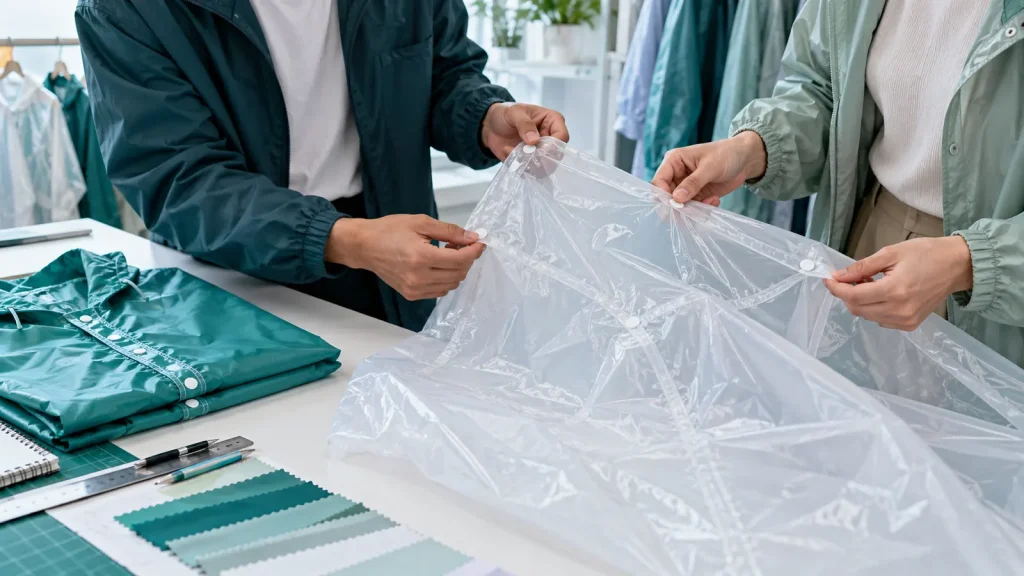
Use a sample sequence that answers the remaining questions
Sampling works best when every sample has a purpose. Early in the project, the team may need to compare constructions or understand the packed size. Later, it may need to approve fit, decoration or the final combination. Ask the supplier what each proposed sample represents and which attributes differ from the intended order. This prevents a useful early sample from becoming an accidental production reference. A sample can answer one question well while leaving another unresolved. The approval record should make that distinction visible before anybody treats the product as ready for bulk release.
Start with the largest uncertainties. If the attraction has not chosen between a compact emergency product and a reusable souvenir option, elaborate artwork sampling may be premature. Compare the relevant construction and service implications first. If the garment is already established and only the design is changing, focus the next sample on decoration and any affected packaging. This sequence can reduce unnecessary iterations without skipping important review. It also gives the supplier clearer feedback: instead of asking for another better sample, the buyer can identify the exact question the next sample must answer.
Prepare reviewers before the sample arrives. Give procurement, brand, operations and any technical adviser the relevant brief and a short list of decisions. Ask each team to comment within its responsibility. A brand reviewer may approve artwork placement while a receiving manager identifies an impractical carton arrangement; neither observation should be lost because the discussion focused on the garment color. Consolidate comments through the named coordinator. The supplier needs one coherent response with agreed priorities, not several conflicting messages that leave it to decide which department’s concern matters most.
Record observations in a repeatable form. Identify the sample, revision, date and review conditions, then separate accepted attributes from changes requested and questions pending. Use measurements and specific descriptions where possible. A note that the pack does not fit the approved counter tray is more actionable than packaging unsuitable. Photographs can show placement or a visible issue, but include enough context to identify the part involved. Avoid implying that a photo proves an invisible material property or a formal performance result. The record should support the decision actually made, without extending beyond its evidence.
Ask for confirmation of the response to each requested change. A revised sample should not require the team to guess which comments were implemented. Have the supplier identify the changes and any consequences for other attributes, timing or packing. Recheck affected areas rather than assuming a corrected detail leaves everything else untouched. For example, changing a garment dimension may alter the fold and packed thickness. This is why the final approval needs to consider the complete configuration, even when earlier samples have already resolved individual questions about color, fit or fastenings.
Before release, establish the approved reference set. It may include a finished sample, specification, artwork file, pack example and relevant supporting evidence. State which document governs each attribute if there is any possible conflict. Keep a copy or agreed equivalent accessible to the supplier and buyer, with the approval recorded by the authorized person. Sampling should end with a clear decision, not a vague sense that the latest version looks acceptable. That clarity gives production and receiving a common reference and makes any later variation easier to assess fairly.
Write practical acceptance criteria for packing and garment checks
An acceptance criterion explains what will be checked and what result is required. Begin with the approved specification rather than a generic inspection list copied from another product. Identify the attributes that matter to your attraction: correct size, understandable openings, specified fastenings, artwork revision, pack contents and carton identification, for example. Some checks can be made visually; others need measurement or specialist evidence. Keep those methods distinct. A good list helps reviewers recognize a deviation without asking them to infer the buyer’s preferences from a product photograph or an old sales description.
Use agreed tolerances for measurable attributes. A garment dimension without a measurement position can produce inconsistent results, and a tolerance without a method may be difficult to apply. Reference the drawing and the conditions used for checking. For decoration, define the approved position and appearance criteria in a form the supplier can understand. Do not demand impossible uniformity through an undefined phrase such as exactly perfect. Equally, do not accept a broad variation statement that could undermine the intended fit or brand presentation. Resolve those expectations before the order reaches production.
Include packaging and identification in the quality discussion. A correctly made poncho in a pack carrying the wrong size can still create a guest-service problem. A missing instruction or incorrect carton count may affect the venue’s ability to use the stock as planned. Check that the packing criteria cover the final garment, inserts, closures, labels and grouping. Where required information is involved, have the appropriate reviewer confirm the approved wording and placement. Procurement should not invent legal labeling requirements, but it should ensure that the agreed requirements are represented in the acceptance record.
Decide how different issues will be handled. The venue and supplier may need to distinguish an isolated cosmetic concern from a wrong model, missing required information or another more significant problem. Agree the decision process and the people authorized to act. If a formal sampling standard or inspection service is used, have its application and acceptance rules defined for the order. Do not select a sample size merely because it is convenient and then claim it proves the entire shipment defect-free. An inspection provides evidence within its scope, and the decision should reflect that scope honestly.
Make the inspection sequence feasible. A receiving team may be able to verify carton identification and selected garment attributes, while laboratory work belongs elsewhere in the approval process. Avoid assigning technical checks to staff who lack the equipment or training to perform them. Instead, identify the evidence they should confirm is present and applicable. If an on-site check requires a specific tool or reference, make it available before delivery. The criteria are useful only when the responsible person can apply them consistently within the time and conditions available.
Use a pre-dispatch review where appropriate to surface issues before stock begins its journey. Agree who performs it, what is reviewed and how the results will be shared. A satisfactory review does not remove the need to check the shipment received, because packing or transit issues may still require attention. Keep the evidence connected through model, revision and batch references. This creates a practical chain from the approved sample to the delivered stock. The result is a more defensible release decision, with fewer disputes based solely on one person’s memory of how the original sample looked.
Close issues with evidence and retain the approved reference
When an issue appears, begin with a factual description. Identify the order, product variant, batch or carton and the attribute involved. Record what was expected and what was observed, using the approved reference to make the comparison clear. Include measurements or photographs where they help. Avoid assigning a cause before it has been investigated. A fastening problem may have several explanations, and a damaged pack may involve manufacturing, packing or later handling. A precise first report gives the supplier and venue a useful starting point without turning uncertainty into an accusation.
Keep the affected quantity distinct from the quantity inspected. If a reviewer finds an issue in selected samples, record that evidence accurately rather than assuming every unit is affected or unaffected. Agree the next step under the quality process: further checking, supplier review, specialist assessment or another defined action. Keep stock awaiting a decision separate from stock released for use according to the venue’s procedures. This protects the clarity of the inventory record while the investigation proceeds. It also prevents a purchasing discussion from becoming disconnected from what the guest-facing teams can actually distribute.
Ask the supplier for a response that addresses both the immediate stock and the underlying issue. The proposed action may involve correction, replacement, an agreed acceptance or another resolution, depending on the facts and the purchase terms. Review the consequences for timing, quantity and product requirements before agreeing. Do not authorize an improvised fix that changes a relevant safety or performance attribute without appropriate assessment. The aim is to restore an approved usable product, not merely to make the visible complaint disappear quickly. Record who approves the resolution and what evidence is needed to close it.
Verify the agreed action. If corrected or replacement goods arrive, connect them to the original issue record and perform the relevant checks. If the parties accept a documented deviation, identify the affected quantity and any conditions attached to that decision. Communicate the outcome to the receiving and operating teams. A closed supplier email is not enough if the warehouse still holds stock with an unresolved status. The physical goods, inventory record and quality decision should tell the same story before the venue treats the issue as complete.
Retain the approved reference and the resolution history for repeat orders. A future buyer should be able to see which problem occurred, what changed and whether the specification was revised. If a component or process was adjusted, confirm that the next order refers to the updated version. Do not rely on the supplier remembering an informal instruction from a previous season. Equally, preserve the original evidence so an improvement can be evaluated against the issue it was meant to solve. This gives the team a useful learning record rather than a folder of disconnected complaint messages.
Use recurring issues to improve the brief and workflow. Repeated wrong-size picks may point to labeling or packing clarity; repeated late approvals may point to unclear decision ownership. Not every problem is solved by changing supplier, and not every problem belongs to the venue. Review the evidence with the responsible parties and make a specific adjustment. Then check whether the next order performs better against the same practical criteria. Quality management becomes more valuable when it improves the next guest experience, rather than ending as an administrative exercise once the immediate shipment has been accepted.
Organize product-specific evidence with our rainwear safety standards and compliance guide. Confirm the requirements for the actual design and destination with the responsible reviewer.
10 / 12
Make sustainable rainwear choices specific and verifiable

Choose a realistic reuse route for your guest program
Calling a poncho reusable does not explain how it will be reused. Start with the route you expect the product to take after the visit. Will guests keep it for another outing, will it remain with a tour organizer, or is the attraction considering a managed return program? These are different service models with different responsibilities. A take-home souvenir needs understandable care and storage guidance; a managed return program needs an operational process the venue can support. Choose the model before making a sustainability statement, because the intended behavior needs a practical route to happen.
For a take-home product, review whether the design encourages continued use. Fit, appearance, a usable pouch and clear product information can all matter to the guest. They do not guarantee that the garment will be used again. Ask reviewers to handle the product after opening and consider whether it can be stored conveniently. If the only way it fits into the pouch is through a complex factory fold, revisit the pack. A reuse proposition is stronger when the product’s ordinary handling supports it, without requiring the guest to follow an unrealistic sequence every time.
For a venue-managed program, involve operations before selecting the garment. Discuss collection, condition assessment, cleaning where applicable, drying, storage and reissue with qualified advisers and the product supplier. Confirm what the exact construction can tolerate and which procedures are appropriate. Do not assume that a product described as washable can enter any cleaning process. The venue also needs to consider staff time, space and the handling of items that cannot be returned to service. Without those arrangements, a return scheme may remain a marketing idea rather than an operating system.
Keep environmental comparisons specific to the evidence available. A heavier garment intended for repeated use is not automatically the lower-impact choice in every situation. Actual use, materials, care, transport and disposal can affect a comparison. If the organization wants to publish a quantified environmental claim, obtain an assessment suited to that claim and its boundaries. For ordinary purchasing discussions, it is often more useful to state the intended reuse model and the evidence still needed. Avoid turning a plausible operational benefit into a universal environmental conclusion that the project has not established.
Track outcomes in a way the venue can realistically maintain. A managed program may be able to record items issued, returned, withdrawn and reissued. A take-home program may have much less visibility into later use. Be honest about that difference. Do not present an assumed number of future uses as measured behavior. If the team collects guest feedback, describe it as feedback and explain its limits in internal analysis. The data can still help improve the product or service, even when it does not support a broad public claim about environmental superiority.
Make the reuse decision part of the buying brief. State the intended user, handling route, product attributes and documentation needed, then ask the supplier to respond to that model. Include any care information that must be approved before artwork is released. Review the program after launch to see whether the intended process is actually happening. A sustainable rainwear discussion becomes more useful when it leads to a specific operational choice, with responsibilities and evidence attached. It should help the attraction make a better-informed decision rather than simply add a reassuring adjective to a product name.
Check environmental statements before printing them
Environmental wording can travel widely once it appears on a garment or pack. A guest may keep the product long after the original campaign, and photographs can circulate without the surrounding explanation. Review the exact statement before printing, including icons and implied meanings. Ask what a reasonable reader would understand from it and what evidence supports that understanding. A supplier’s general sustainability brochure is not enough if the proposed statement concerns a particular material, percentage or disposal route. The claim needs to match the product and the conditions in which it will be presented.
The FTC summary of the Green Guides cautions against broad, unqualified environmental-benefit claims such as green or eco-friendly. It also explains the need to qualify claims where the evidence or available facilities do not support the broad impression. For an attraction’s US-facing packaging, this is a useful starting point for reviewing specific wording with an appropriate adviser. It does not certify a product or replace a legal assessment. Keep the final statement narrow, understandable and supported by evidence that applies to the actual garment or packaging component being described.
Separate recycled content from recyclability. A statement about material used to make an item answers a different question from whether the item can enter a collection and processing route after use. Identify the component and scope of any recycled-content statement, and obtain suitable documentation for the proposed claim. Do not let a claim about a pouch imply that the whole garment has the same composition. Likewise, do not infer local recyclability from a material family alone. Ask the relevant collection or processing organization about the specific item and local arrangements before giving guests disposal instructions.
Treat compostability and biodegradability as different claims with different evidence needs. Do not use either as shorthand for harmless litter or rapid disappearance outdoors. If a compostability statement is proposed, establish the applicable conditions, evidence and available facilities, then have the wording reviewed for the markets involved. Keep any necessary qualification close enough to be understood with the claim. A small symbol on the front and an obscure explanation elsewhere may leave an impression broader than the evidence. If the project cannot support the intended wording, revise or remove it before approving the pack.
Review supplier evidence for scope and traceability. Identify the model, material or component covered, the document date and any limitations. Ask whether the production proposal matches that evidence and what happens if the material changes. A report associated with another product should not be treated as automatic support for yours. Keep copies in the project record and note who assessed them. The marketing team needs a clear approved statement, while procurement needs the underlying reference that explains why it was approved. Both should be updated if the specification or claim changes.
Keep the approval process practical. Create a short claim record with the proposed wording, where it will appear, supporting evidence, required qualifications and named approver. Include the website description if it repeats the packaging statement. Do not allow a carefully reviewed pack to be undermined by a broader claim in a purchasing brochure or online product introduction. Revisit the record for repeat orders and new markets. This makes environmental communication a controlled part of the OEM Program, helping the attraction say something useful and defensible about the product without promising more than it knows.
Agree the end-of-use handling plan with the venue team
End-of-use planning begins with the people responsible for the attraction’s waste and housekeeping arrangements. Ask what happens to unwanted ponchos and packaging at the venue today. Identify the actual collection routes, contracts and local acceptance criteria. A material description on a supplier quotation cannot answer those operational questions. The venue may have different arrangements from the guest’s home area, so keep on-site guidance specific to the location. If a suitable collection route is not confirmed, do not place a recycling or composting instruction on the product merely because it sounds preferable.
Separate the garment from its packaging in the discussion. A poncho, pouch, sleeve, insert and closure may involve different materials and handling routes. Ask whether the components can be identified and separated in a way guests or staff can reasonably manage. Avoid designing instructions that require detailed material knowledge at a busy exit. Where the venue provides collection points, the signs and product information should use the same approved terminology. Conflicting messages can leave guests guessing and make the intended collection process harder for the staff who have to manage it.
Review collection placement as an operational choice. A bin or return point should fit the venue’s circulation, housekeeping and service procedures. The rainwear team should coordinate with those responsible for the area rather than adding a stand-alone station without a maintenance plan. Identify who empties it, how often it is checked and what happens if unexpected items are deposited. A collection point is a continuing responsibility, not just a sign. If the attraction cannot support the proposed arrangement, revise the program before presenting it to guests as an established service.
For any take-back arrangement, define the purpose and acceptance rules clearly. Is the aim to assess products for reuse, collect a specific material stream or support another confirmed process? Those purposes should not be blurred. Tell staff which items are accepted, what information to provide and when an item needs separate handling. Obtain the appropriate advice for cleaning, hygiene and other relevant requirements if reuse is involved. Do not promise that every returned poncho will be reused or recycled unless the process and evidence support that statement. The guest-facing message should reflect what the program actually does.
Collect useful operating feedback without overstating the results. Staff may observe frequent contamination, confusing instructions or packaging that creates unnecessary loose pieces. Record those findings and discuss changes with procurement and the supplier. If quantities are measured, define what is being counted and how. A collection total is not automatically a measure of material successfully processed, and a return count is not the same as a reuse count. Keep those distinctions in the internal report so the organization can improve the system without turning an intermediate step into an unsupported environmental outcome.
Bring the findings into the next product review. A simpler pack, clearer material identification or different service model may address an observed problem. Ask the supplier for options and assess them against guest usability, operational feasibility and substantiated environmental information. Keep the decision connected to the attraction’s actual arrangements rather than a generic image of sustainable tourism. A credible end-of-use plan is specific about responsibilities and honest about limits. It gives guests clear guidance, gives staff a process they can maintain and gives procurement concrete evidence to use when the next bulk order is considered.
Primary references: FTC summary of the Green Guides.
Frame environmental evidence questions with our sustainable rainwear procurement guide. Keep claims tied to the specific product and handling route.
11 / 12
Compare suppliers, MOQ and Bulk Pricing on the same basis

Send a complete RFQ that makes differences visible
A useful request for quotation tells suppliers what decision you are trying to make. Open with the attraction type, intended guest use and service model, then describe the proposed product and distribution arrangement. Include the expected order range, size mix, branding needs, packaging and destination. Identify which details are fixed and which are open to a supplier recommendation. This gives the supplier enough context to explain an alternative intelligently. A message asking for the cheapest custom poncho leaves too many assumptions unresolved and produces offers that may be impossible to compare fairly.
Attach a structured specification and artwork information appropriate to the stage of the project. If the final design is not ready, say so and provide a clear concept brief rather than presenting a provisional file as approved. Ask suppliers to identify exclusions and assumptions in their response. Important differences may involve the material construction, print area, inner-pack quantity or delivery scope. Those differences should be visible beside the commercial proposal, not discovered after selection. The buyer’s objective is a comparable set of offers, with enough detail to understand why they differ.
Request MOQ information at the level that matters. A total order minimum may differ from the minimum for a particular color, size, artwork or packaging format. Ask whether mixed variants are possible and under what conditions. Do not assume that a supplier’s catalogue minimum applies unchanged to a custom attraction program. If the proposed mix is not feasible, invite a clearly described alternative. The supplier may suggest fewer variants or a different decoration approach, but the venue must review whether that alternative still meets the guest-service and brand requirements established in the brief.
Ask for timing information with defined milestones. Request the anticipated sample process, approval dependencies, production milestone and delivery scope, with the assumptions behind each estimate. State the date stock needs to be usable at the venue and explain any fixed event or receiving constraint. A supplier can then identify the gap between your need and its proposal. Avoid treating a fast initial response as evidence of a reliable delivery schedule. The relevant question is whether the proposal explains the work and dependencies well enough for the team to plan around them.
Include the evidence you need to evaluate the supplier and product. This may involve a production-relevant sample, material information, appropriate compliance documentation or a proposed quality process. Specify the purpose of each request so the supplier does not respond with a generic collection of unrelated certificates. Review whether documents apply to the proposed construction and market. A logo on a brochure is not a substitute for an applicable record. Where specialist interpretation is needed, involve the appropriate adviser before using the evidence as a selection criterion or making a public claim.
Compare responses through a short clarification round. List unresolved points and ask each supplier to confirm its position in the same format. Keep revisions dated so the team knows which offer it is evaluating. Do not silently fill gaps with optimistic assumptions. If a supplier cannot confirm a critical requirement, record that limitation and consider its effect on the decision. A strong RFQ process ends with a proposal the venue can explain: what is included, what remains conditional and why the selected configuration fits the intended attraction rainwear program.
Compare the total operating commitment behind each proposal
Bulk Pricing is useful only when the underlying products and responsibilities are clear. Compare the complete proposed configuration, including decoration, packaging, sampling and the agreed delivery scope. Keep project pricing within the quotation process so the supplier can respond to the actual quantity and specification. A public unit-price headline cannot capture those variables. For internal evaluation, use a consistent comparison basis and identify items that are excluded or estimated. This allows procurement and finance to understand the commitment without mistaking a lower headline figure for a complete like-for-like offer.
Look at the operational work each proposal creates. A smaller individual pack may suit the kiosk but require a different replenishment bundle; a more complex size range may improve coverage while increasing sorting and stock control. Ask the relevant teams to assess those consequences using their own processes. Do not assign invented labor savings to a design feature. Where the organization can estimate handling effort from a controlled trial, record the assumptions and method. The purpose is to make the tradeoff visible, not to produce a precise-looking total from numbers nobody has verified.
Consider storage and inventory exposure alongside the order minimum. A proposal requiring a larger quantity may have implications for space, cash commitment and the possibility of unused campaign stock. A smaller order may have different commercial or replenishment conditions. Discuss those choices with finance and operations using the venue’s own demand scenarios. Avoid assuming that buying more always creates better value or that buying less always reduces risk. The answer depends on the product’s intended life, the stability of the artwork and the venue’s ability to use and manage the stock.
Keep optional services separate in the comparison. A sample round, inspection arrangement, special packing or delivery to multiple sites may be included in one proposal and offered separately in another. Ask for the scope and responsibility of each item. If a service is optional, decide whether the venue actually needs it rather than comparing offers with different assumptions. Do not remove a necessary quality or compliance step simply to make the total more attractive. A lower commitment that leaves a critical requirement unresolved is not a complete alternative to an offer that addresses it.
Review the consequences of changes and repeat orders. Ask how a new artwork revision, revised size mix or additional destination would be handled. Clarify which previous approvals can be reused and which may need another sample or review. These are project-specific commercial questions, so obtain the answer in the proposal rather than relying on a general expectation. A repeat order can be simpler when the specification remains stable, but it should not be assumed to carry identical timing or conditions indefinitely. Current availability and the agreed scope still need confirmation.
Write the recommendation in terms the decision team can evaluate. Explain which proposal best meets the brief, what tradeoffs it carries and which conditions must be resolved before release. Include the operating team’s relevant findings and the evidence supporting the selection. Keep uncertain figures labeled as estimates and avoid presenting a supplier’s assertion as a measured result. This creates a decision record that remains useful after staff change or the next season begins. It also gives the supplier a clear understanding of the program it has been selected to deliver.
Agree change control and responsibilities before the order
Before releasing an order, identify who can authorize changes and how those changes will be recorded. A custom rainwear program can involve material, fit, artwork, packaging and delivery decisions, each with different consequences. The supplier should know which buyer contact issues the final instruction, while the buyer should know who confirms feasibility and timing on the supplier’s side. Keep specialist reviewers involved through that agreed route. Clear authority helps prevent an informal comment from becoming a production change that another department did not expect or approve.
Define the approved order set. It should connect the purchase reference to the current specification, artwork revision, packing arrangement and relevant sample or evidence. If documents conflict, resolve the conflict before release and state which reference governs the attribute involved. Do not leave production dependent on an old email attachment that differs from the latest drawing. Ask both parties to acknowledge the same set of files. This is ordinary project discipline, but it becomes especially valuable when an attraction is managing several campaigns or suppliers with similar-looking products.
Ask suppliers to disclose proposed substitutions before using them. A different material, fastening, decoration process or pouch may affect attributes that the original approval covered. The buyer needs enough information to assess those effects and obtain appropriate review. A substitution should not be accepted simply because it appears similar in a photograph. Equally, an alternative may be workable if its implications are understood and approved. The change process should allow a reasoned decision, with the revised specification and any needed evidence recorded before the new configuration enters the order.
Clarify responsibilities at handover points. Who approves artwork, confirms pack information, arranges any agreed inspection, prepares shipping documents and books receiving? Which party communicates a delay or discrepancy, and to whom? These questions belong in the project record and, where appropriate, the commercial agreement reviewed by the organization’s advisers. This guide is not a substitute for legal advice or contract drafting. Its practical purpose is to help the buying team identify gaps that should be resolved with the responsible people before the project relies on an assumption.
Agree the information needed when a change is proposed. A useful request states the reason, affected attribute, revised proposal and consequences for timing, quantity, approvals and commercial terms. The response should explicitly accept, reject or request clarification. Avoid treating silence as approval. Keep the original instruction in force until the parties have confirmed the replacement through their agreed process. If only part of the order changes, identify the affected batch or quantity so receiving staff can distinguish a legitimate variation from an unexplained discrepancy when the shipment arrives.
Close the order with records that support the next one. Retain the approved configuration, actual delivery information, relevant quality findings and any accepted changes. Review which parts of the process worked and where the brief could be clearer. Share appropriate lessons with the supplier before discussing a repeat OEM Program. A good working relationship benefits from predictable decisions and specific feedback. The attraction gains a more reproducible product and the supplier gains a clearer target, while both avoid rebuilding the project from scattered messages whenever a new purchasing cycle begins.
If your attraction also hosts outdoor events, Explore our Wholesale Festival Rain Poncho Collection Here and prepare a separate distribution brief for each event.
12 / 12
B2B FAQ: buying rain ponchos for theme parks, zoos and tourism
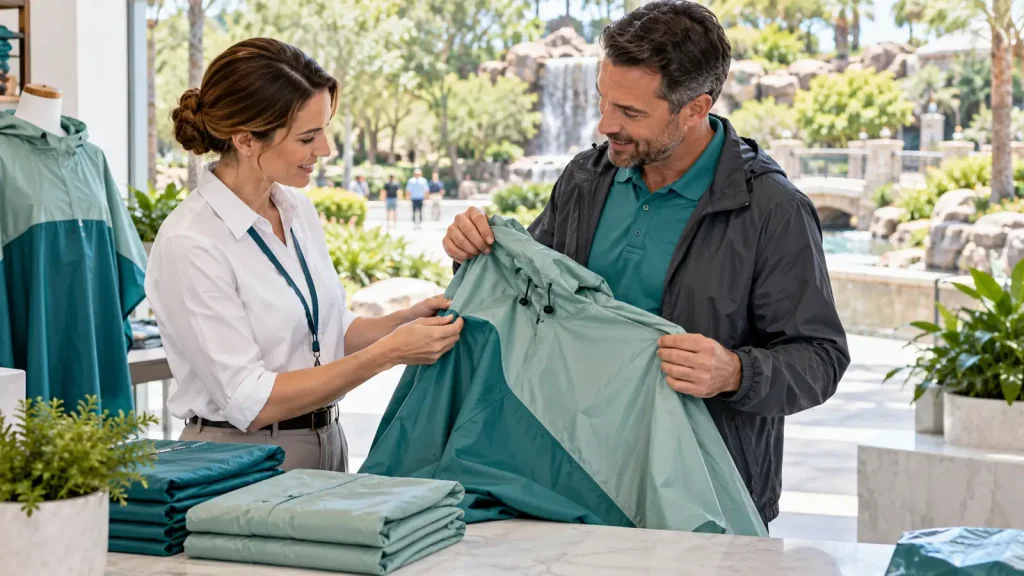
How do we choose an MOQ and order quantity for an attraction?
Start by separating the supplier’s minimum order quantity from your attraction’s planned requirement. MOQ describes a commercial or production condition for the proposed configuration; it is not a recommendation about how much your venue should hold. Your requirement comes from the service model, expected demand, existing usable stock and replenishment plan. Ask for minimums by the relevant variant, including size, color, artwork and packaging. A single total MOQ may not explain whether your preferred mix is feasible. The first useful answer is therefore a clear definition of the minimum and what can be combined within it.
Build a provisional quantity from the venue’s own information. Use comparable operating periods, confirmed group allocations and the current stock position, with assumptions stated clearly. Account for stock already ordered or reserved elsewhere in the network so it is not counted twice. If historical information is weak, say so and use scenarios rather than a false point estimate. Discuss the tradeoffs with finance and operations. The objective is to select an order the venue can justify and manage, not to force uncertain demand into a precise number simply because the quotation form requires one.
If the proposed MOQ is above the quantity you can responsibly use, ask about alternatives before changing the brief. A reduced variant range, shared packaging or different customization approach may be worth evaluating. The supplier must confirm whether those options are available and what conditions apply. Do not assume that an alternative is cheaper or faster. Review it against the same guest fit, branding, packaging and quality requirements. A workable minimum is valuable only if the product still serves the intended attraction program rather than creating a new problem at the counter or storeroom.
For a new program, consider what a controlled introduction could teach you. The venue might evaluate an approved product in a limited distribution arrangement, with a defined review of opening, fit questions and replenishment behavior. Whether that is commercially feasible depends on the supplier’s proposal and the organization’s needs. A small introduction should not be presented as statistically representative of every future season. Its value is practical learning. Record what it can and cannot answer, then use the findings to refine the next specification and demand assumptions rather than treating the first result as a universal forecast.
Ask how replenishment will work after the initial order. Confirm whether repeat quantities, artwork and lead-time assumptions differ from the first production. Establish what happens if a size sells or is issued faster than expected while other variants remain. The attraction may need a different allocation or range structure rather than another full mixed order. Keep the supplier informed of the intended replenishment model so its proposal can address it. A quantity decision should account for the next step, not only the immediate ability to meet the minimum and place an order.
The final order quantity should be an approved business decision with a short explanation. Record the demand assumptions, usable stock, variant mix, storage constraints and relevant supplier conditions. Identify the person responsible for reviewing the plan after launch. Do not publish or rely on a universal MOQ for all theme park rain ponchos, because customization and order structure can change it. Request a project-specific proposal with the intended mix and timing. That gives the supplier a concrete basis for its answer and gives the attraction a clearer route from initial inquiry to a manageable bulk order.
What affects lead time and repeat orders for branded ponchos?
Lead time depends on what must happen before stock is ready to use. For a custom project, that can include specification decisions, sample work, artwork approval, material preparation, production, packing, transport and receiving. Ask the supplier to identify the milestone its estimate refers to. Production completion and arrival at your attraction are different events. Then add the venue’s own time for checks and internal distribution. A useful answer connects the proposed schedule to the actual project rather than offering a single general duration that leaves the buyer to guess which stages are included.
Approvals are often an important dependency because the supplier cannot reproduce a decision that has not been made. Identify who approves the garment, decoration and pack, and set realistic review dates. Consolidate feedback so a revised sample answers an agreed set of questions. If the project changes materially, ask for an updated timeline before assuming the original date remains possible. The change may affect only one stage or several. Keeping those dependencies visible helps the attraction understand the consequence of a late brand revision without attributing every schedule movement to production itself.
Repeat orders may reuse established references, but they still need confirmation. Ask whether the material, components, artwork process and packing remain unchanged. Confirm current availability, production planning and delivery scope. If the original sample or documentation is no longer representative, obtain the appropriate update before release. A previously successful order is valuable evidence of the relationship and specification, but it is not a permanent guarantee of identical conditions. Treat the repeat as a controlled continuation, with the stable elements carried forward and the current variables checked explicitly.
Seasonal or event-driven requirements need early coordination. Give the supplier the date stock must be usable and identify any non-negotiable receiving or campaign constraints. Ask which approval dates support that target and what remains provisional. Keep logistics advice specific to the route and shipment terms. Avoid assuming that an earlier shipment’s transit experience will repeat exactly. Where a schedule carries uncertainty, decide how the venue will manage it through existing stock, approved alternatives or another considered contingency. Those options require their own confirmation and should not be advertised internally as guaranteed backup supply.
For split deliveries or multi-site orders, define the sequence and contents. A first shipment is useful only if it contains the variants and quantities needed for the initial operating period. Confirm the remaining balance and its expected milestones, and ensure the stock record reflects the split. Ask how each batch will be identified and whether any approved production change affects it. This prevents a receiving team from interpreting a planned partial delivery as a shortage or assuming that the first carton represents the full assortment. Clear batch information matters as much as the headline arrival date.
The best lead-time conversation ends with a milestone plan and named contacts. Record what is confirmed, what is estimated and what action is due next. Update the plan when an approval or shipment event occurs, then share the implications with operations. For repeat orders, retain the actual history so the next planning discussion has a useful reference. Request current timing for your specific branded poncho configuration rather than relying on a universal promise. That approach supports realistic preparation while leaving room to respond when the project or operating conditions change.
What should we include in a request for a bulk rainwear proposal?
Include enough context for the supplier to understand the attraction’s service. State whether you operate a theme park, zoo, museum campus, sightseeing service or another visitor venue, and explain where the ponchos will be distributed. Describe the intended users and whether the product is an emergency convenience, a souvenir range or part of a group package. Mention relevant restrictions or operating requirements already identified by your team. This context helps the supplier propose a useful configuration. It is more informative than a logo file and a quantity without any explanation of how the product will be used.
Provide the known product requirements and label open decisions clearly. Include the proposed construction, dimensions or size range, fastening preference, branding area and individual pack. If you have an approved reference, identify what should be retained and what may change. If you do not, ask for suitable options with the reasons behind them. Avoid presenting an unrelated photograph as a complete specification. A visual reference can communicate style, but the supplier still needs measurable requirements and a clear statement of which features the buyer intends to approve through samples.
Describe the commercial and logistical scope. Give an estimated order range, proposed variant mix, destination and the date stock needs to be usable. Ask for MOQ by relevant variant, sample requirements, approval dependencies and the delivery milestone included in the proposal. Mention carton or receiving constraints that could affect packing. Keep sensitive internal budgets or unrelated business records out of the inquiry unless there is a clear reason to share them. The supplier needs enough information to quote the project accurately, not unrestricted access to the attraction’s wider operations.
Explain the artwork status and approval route. State whether the design is ready, in development or subject to a rights-holder review. Provide authorized files when appropriate and identify the coordinator who will consolidate comments. Ask for a production-relevant decoration sample and placement confirmation suited to the chosen material. Include the pack artwork if it carries size, care or other approved information. Keeping garment and packaging decisions together helps prevent a quotation from covering only the visible logo while overlooking the information and presentation needed to make the product usable at the venue.
List the evidence and quality checks required for the intended market and product. Ask for applicable information about the exact proposal rather than a collection of general certificates. Have technical or legal questions reviewed by the appropriate adviser, especially for children’s products or environmental claims. State how samples will be assessed and who can approve changes. If the attraction has a receiving or inspection process, share the relevant requirements. A supplier can then identify what it can provide, what needs clarification and which steps must be agreed before the order is released.
Finish with a concise request for a comparable response. Ask the supplier to separate confirmed compliance with the brief, proposed alternatives, assumptions and exclusions. Request a clear next step for unresolved choices, whether that is a sample, drawing or clarification call. Keep the inquiry focused enough that the response can support a decision. When the attraction’s use case, product requirements and approval process are visible, an OEM proposal becomes much easier to evaluate. You can then select a bulk rainwear program that fits the guest experience and the operating team’s actual needs, with the remaining commitments confirmed before production.
Return to the industry rainwear buying guide to compare your attraction program with other use cases, or develop supplier questions with our rainwear sourcing guide for procurement managers.