
Relief rainwear · Procurement, packing and receiving
Emergency Rain Gear for Disaster Relief & Humanitarian Aid
A rainwear order supports a relief program only when the right garments reach the intended people in a usable form. Start with the wearer, the expected use and the receiving arrangements. This guide helps procurement teams compare rain ponchos and raincoats, document the proposed product, and connect sample approval with packing, stock and delivery decisions.
Define the need. Approve the garment. Coordinate the complete delivery.
01 / 12
Start disaster relief rainwear procurement with the people and the purpose

Separate household rain protection from specialist response equipment
The phrase emergency rain gear can describe very different purchases. A compact poncho issued to a household for ordinary movement in wet weather is one product. Clothing selected for a trained response team working around identified hazards is another. Start the purchase by naming the wearer and the task in plain language. This short statement gives the supplier a practical design target and helps the buying team avoid comparing garments that only share a similar appearance.
For household distribution, the first questions often concern coverage, fit, opening, carrying and storage. Will the wearer put the garment over existing clothing? Is a front opening preferable to a pull-over design? Does the pack need to fit inside a larger assistance kit? These decisions belong in the request for quotation because they affect the pattern, material quantity, fastening and individual packaging. A sample photograph cannot answer all of them, especially when dimensions and the intended size range are missing.
For staff or specialist teams, route the specification through the person responsible for the task and its risks. A general rain poncho should not be selected as chemical protective clothing, flotation equipment or a substitute for task-specific protective equipment. Keep those requirements in separate procurement lines with their own evidence and approval. This separation also helps receiving teams: a carton described as household rainwear should not be issued to a specialist team simply because both orders arrived together.
CDC's floodwater guidance advises people to stay out of floodwater and explains that it can contain harmful contaminants and physical hazards. Buying rainwear does not change that advice. Assess the proposed garment against its supported rain-protection function and the organization's defined use. A lightweight poncho is not a basis for treating floodwater entry as safe or expecting protection against illness. Ask the responsible technical reviewer to address any specialist requirement separately before accepting the item for that purpose.
Write down the intended limits alongside the intended use. For example, a hypothetical buying brief could describe adult household rainwear for ordinary outdoor movement, with no claim of protection against immersion or chemical exposure. That is a procurement boundary, not a universal product specification. The organization still needs to decide whether the proposed item is appropriate for its circumstances. Clear boundaries allow the supplier to identify an unsuitable request early instead of offering a visually similar garment with an ambiguous description.
Keep thermal protection separate too. A thin rain shell, a textile blanket and a reflective emergency blanket have different constructions and intended functions. Combining them in one carton does not make their performance interchangeable. If the program requires more than rainwear, list each component separately, request the relevant product information, and let the responsible program or technical team approve the combination. The packed kit should reflect that decision rather than quietly redefining it.
Finally, give the brief an owner and a revision date. The owner resolves questions about the task, while procurement manages the commercial comparison. This avoids a familiar problem: one department asks for a simple household poncho, another adds specialist language, and the final purchase order mixes both descriptions. A single approved use statement makes every later decision easier to assess, from material selection to sample review and the wording on the receiving record.
Turn a needs assessment into a usable rainwear brief
A useful rainwear brief translates program knowledge into decisions a manufacturer can act on. It does not need to reproduce a complete humanitarian assessment or collect unnecessary personal information. Procurement usually needs an approved summary: intended wearer groups, expected clothing layers, likely use pattern, size requirements, distribution format and destination. Ask the program team to distinguish confirmed information from assumptions so that the supplier knows which points are fixed and which require sample comparison.
Begin with the activity rather than the catalogue. A garment intended for short trips between covered locations may be evaluated differently from rainwear expected to be carried and used repeatedly over a longer period. Describe the expected handling, whether the wearer is likely to carry a bag, and whether the garment must accommodate bulky clothing. Do not convert these observations into unsupported performance ratings. They are inputs to product selection and testing, not evidence that any particular product has already passed.
Then describe the people who will use it without reducing them to a single average body size. A broad population may require several sizes, different opening arrangements or an alternative for people who cannot comfortably lift a garment over their head. The buying team can request dimensioned options and representative samples before deciding the final mix. Record where the size information came from and how uncertain it is; a supplier's generic size chart should not silently replace the organization's assessment.
Ask how the item will be handed over. Individual issue, household kits and central stock for later distribution create different packing needs. A poncho that is easy to count in a supplier's carton may become difficult to identify once transferred into a mixed kit. If the receiving team needs a visible size code, a separate item label or a particular folding orientation, include that requirement early. Late packaging changes can affect carton counts and shipping dimensions even when the garment itself is unchanged.
Language and explanation also deserve a place in the brief. Identify the languages needed for essential product information and who will approve the translation. If pictograms are proposed, review them with people who understand the local context. Keep instructions short enough to use, but do not omit information merely to achieve a smaller label. The objective is a pack that the intended user and distribution team can interpret, not a label that looks complete only to the purchasing office.
Use a simple decision record for unresolved points. Each open question should identify the choice, the person who will decide, the evidence needed and the date by which the answer affects the order. For instance, the team may compare two opening styles while keeping the color neutral. This allows useful sample work to continue without treating every detail as settled. It also prevents an unanswered question from becoming an accidental supplier assumption during production.
Once the brief is approved, send the same version to every bidder. Invite suppliers to identify exceptions explicitly, including unavailable sizes, alternative materials or changes to the packing format. A clear exception is easier to evaluate than a vague statement that the product is equivalent. The final specification should show which option was chosen and why it fits the assessed need. Keep the original assessment summary available to the organization, while sharing only the procurement information the supplier actually needs.
Coordinate quantities with the wider assistance package
Rainwear quantities should connect to the assistance plan rather than begin with an attractive carton price. Decide whether the allocation is per person, per household, per staff member or held as unallocated reserve stock. Each basis produces a different order calculation. A household count cannot automatically be treated as a wearer count, and a total garment quantity does not show whether the available sizes match the people expected to receive them.
Create a quantity matrix with separate lines for product, size, destination and intended allocation. Keep the calculation visible enough that another team member can follow it. If some information is provisional, label it as such and state when it will be reviewed. The matrix should also distinguish garments already available and usable from those ordered, reserved elsewhere or awaiting inspection. Counting all of these categories as free stock can create an apparent surplus that does not exist at the point of distribution.
Coordinate with the people assembling other items in the package. A rain poncho may be purchased separately but placed in a common carry bag, carton or household kit. Confirm how many rainwear units belong in each kit and whether sizes will be mixed or supplied independently. Avoid forcing every household into an identical size assortment merely because it simplifies the packing line. Where allocation needs flexibility, separate size cartons or clearly identified inner packs may be more useful than a fixed bundle.
The complete package also determines handling. Ask whether the receiving team will open master cartons at a warehouse, transport sealed kits to a distribution point, or repack items locally. These choices influence carton quantity, label placement and the usefulness of individual barcodes or item codes. The supplier needs the agreed packing arrangement; it does not need personal recipient lists. Keep distribution eligibility and sensitive records within the organization's own processes while providing the product identifiers needed for accurate packing.
Reserve quantities deserve an explicit purpose. A reserve might support approved size exchanges, replacements for damaged units or a later phase of the program. Do not hide it inside a general percentage that nobody owns. State who can release it and how it will be tracked. This makes the purchase easier to reconcile and helps the organization distinguish legitimate reserve stock from unexplained leftovers after the initial distribution has finished.
Consider a hypothetical two-location program. One location may need garments already packed into household kits, while another needs separate size cartons because allocations will be finalized later. Combining both locations into one undifferentiated purchase line creates unnecessary repacking. A better quotation request shows the same approved garment on two packing lines with their respective quantities and receiving points. The unit price comparison can then include the actual work required instead of assuming every destination receives the same format.
Before order release, reconcile the quantity matrix with the purchase order, packing instructions and delivery plan. Confirm that garment units, inner-pack units and carton units are not being confused. If the supplier proposes a carton multiple that changes the order total, record the difference and obtain the buyer's decision. A carefully agreed quantity structure gives the warehouse and distribution teams something they can count, explain and reconcile, which is more useful than a large headline number with uncertain allocation.
Primary references: CDC: Floodwater Safety Guidelines.
Place the relief procurement brief within the wider Bulk Rainwear by Industry guide. Keep each program’s intended use, receiving arrangements and approval responsibilities clear.
02 / 12
Choose a practical format for emergency rain ponchos and raincoats

Compare pull-over ponchos with front-opening raincoats
A pull-over poncho and a front-opening raincoat solve the task of putting on rainwear in different ways. A poncho may provide a broad, simple shape with fewer fitted dimensions. A raincoat may offer more defined sleeves and a closure that opens along the front. Neither format is automatically the right answer for every relief program. Compare the complete garment against the intended users, their clothing and the way the item will be carried and put on.
For a poncho, inspect the head opening, hood attachment and side arrangement. Some designs have open sides, while others use snaps or other fasteners to control the shape. Check how the wearer finds the front, puts the garment over the head and reaches the side closures. A generous width may appear convenient on a flat measurement drawing but behave differently when worn by a shorter person or someone carrying belongings. The sample review should include those ordinary movements.
For a raincoat, examine the front closure as a complete assembly. Fastener spacing, overlap, flap shape and the material around the attachment points all influence how the garment operates. Ask the supplier to identify the proposed fastener and show it on the actual construction. A photograph of a zipper or snap from another product does not establish how the offered garment will feel or hold together. The receiving specification should name the approved arrangement rather than simply saying front opening.
Consider assistance with dressing. A front opening may be useful for a wearer who has difficulty raising both arms, but the closure itself can introduce another challenge if it requires fine finger movement. A pull-over design may avoid a long closure yet be awkward for someone who cannot comfortably place it over the head. Ask varied reviewers to try the offered samples and describe the difficulty in practical terms. Do not assume that one format is universally accessible.
Review coverage with the intended layers and carrying items. If a backpack is expected to sit under a poncho, confirm that arrangement on a sample instead of assuming extra width will be sufficient. If the garment will be worn over a coat, check shoulder and arm movement in that combination. Avoid extending these observations into claims about all users or all conditions. The purpose of the review is to identify the dimensions and design details needed for this purchase.
Packing differences also matter. A compact fold can be valuable, but an unusually tight fold may make the garment difficult to unpack and identify. Compare the actual packed versions, including the pouch or sleeve, rather than a loose sample beside an estimated package size. Ask reviewers to open the pack, unfold the garment, find its orientation and put it on. Record any confusion so that the folding method or instructions can be improved before the bulk packing stage.
Keep a short comparison sheet with the same headings for each format: opening, closure, coverage, movement, size range, packed dimensions and proposed evidence. Add photographs of the reviewed samples and record the selected revision. This gives the buying team a concrete basis for choosing the format. It also helps the supplier understand why a change to an opening or fastening cannot be treated as a harmless cosmetic substitution after approval.
Decide whether single-use or reusable supply fits the operation
Single-use and reusable are purchasing choices that need a clear operating context. A lighter garment intended for a limited use pattern may suit one program, while another may require a garment that can be retained and used repeatedly. The decision should consider the expected use, the wearer's ability to keep and care for the item, the supported product instructions and the organization's waste arrangements. A label alone does not establish how many times a particular garment will remain usable.
Ask the supplier what it means by reusable for the offered model. Request the construction, care instructions and evidence supporting any durability or repeated-use claim. Do not accept a generic statement covering every product in a catalogue. A garment with a stronger shell may still have a closure or seam that needs separate review. The complete combination matters, particularly when the item is expected to be folded, carried and opened repeatedly rather than worn once and discarded.
For a proposed single-use product, define the intended limitation clearly in the specification and public description. Avoid promising a service life that has not been established. Check whether the garment can be unfolded without tearing at the neck or attachment points, whether the dimensions are usable, and whether the instructions explain its intended handling. A low purchase price is not useful if the item cannot be put on successfully or the receiving team must discard damaged packs before issue.
For a reusable option, discuss what the recipient will realistically be able to do with it between uses. The buying organization should consider drying space, carrying arrangements and the practicality of following the supplied care instructions. These are program questions, not assumptions the manufacturer should make on behalf of the user. If the preferred construction requires care that is unrealistic in the intended setting, compare another option rather than adding optimistic wording to the instruction leaflet.
Do not equate reusability with a guaranteed environmental benefit. A meaningful comparison depends on the product, its actual use, transport, care and end-of-use route. Likewise, a biodegradable or recyclable description requires specific support and a relevant disposal context. In an urgent buying brief, it is better to state a measurable requirement, such as a particular packaging construction or a documented material attribute, than to rely on a broad green claim that cannot be checked for the offered order.
Model the commercial implications using transparent assumptions. A hypothetical comparison might place a lighter option beside a more substantial garment and show unit price, packed volume, expected handling and the evidence available. Keep any assumed use frequency clearly marked as a planning assumption. Do not present it as a verified performance result. This helps the team see what would need to be true for one option to offer better value in its own operation.
Record the final choice in the purchase documents, including the agreed product description and care information. If later requirements change from a short distribution to a longer program, review the selected garment again. The correct response may be a revised order, an additional product line or a different allocation approach. The original selection remains understandable when its assumptions are visible, and the supplier can quote the change without guessing what the word reusable was intended to mean.
Approve coverage and movement on the finished garment
Finished-garment review is where a flat specification becomes a usable product. Begin with the approved dimensions, then put the sample on representative adult reviewers over the clothing combination described in the brief. Check the garment from the front, side and back. A satisfactory chest width does not necessarily mean the hood, arm openings or overall length are appropriate. Review the complete shape before treating a sample as ready for bulk production.
Ask reviewers to carry out ordinary movements relevant to the intended use. They might sit on a chair, reach for a bag, turn their head, raise an arm or open the front closure. Keep the activity safe and routine; there is no need to recreate a disaster or expose anyone to hazardous conditions. The purpose is to notice restricted movement, awkward openings or coverage changes that may not be obvious when the garment is displayed on a hanger.
Look closely at the hood in relation to the rest of the garment. Does it sit in a usable position when the wearer turns their head? Can the person identify and operate the adjustment, if one is provided? Does the garment pull noticeably at the neck when the arms move? These observations help refine pattern and fit. They do not replace any technical assessment required for the product, and they should not be used to invent a claim about visibility, protection or comfort in every condition.
Check length across the proposed size range. Extra length can change how a garment behaves when a wearer sits or walks, while a shorter style may leave more of the underlying clothing exposed. The buyer needs to decide the appropriate balance for the intended task. Record dimensions and observations separately: a reviewer saying that a hem feels too low is useful feedback, but the supplier still needs the agreed measurement and tolerance for the revised sample.
Inspect openings and fastening points after the review. Look for visible damage or distortion and compare the sample with its starting condition. Agree any more formal durability or attachment checks with the responsible technical reviewer before production. Avoid turning an informal fitting session into a certificate. A useful sample report says what was examined, under what conditions and what was observed. It should also identify questions that still need a different form of evidence.
Review the garment together with its packed presentation. Confirm that the size label remains visible after folding, that the pack contains the approved item, and that opening instructions match the actual product. If the garment has an unusual orientation, make that clear in the approved information. A well-fitting product can still create frustration if the wearer cannot find the opening or if staff issue the wrong size because the pack identifier is hidden.
Finish with a controlled approval record. Identify the sample, its revision, the dimensions checked, the reviewers' observations and any remaining actions. If changes are required, approve the revised combination rather than assuming a written correction has already solved the problem. Keep the accepted sample available for comparison during inspection and receiving. This turns the review into a practical reference for the order and reduces the risk that an attractive but unreviewed variation replaces the garment the team actually evaluated.
Primary references: FTC: Environmental Claims, Green Guides.
Compare product-life questions in our disposable and reusable rain poncho guide. Assess the proposed garment and the program’s actual use conditions.
03 / 12
Specify materials and evidence for bulk rain gear for NGOs
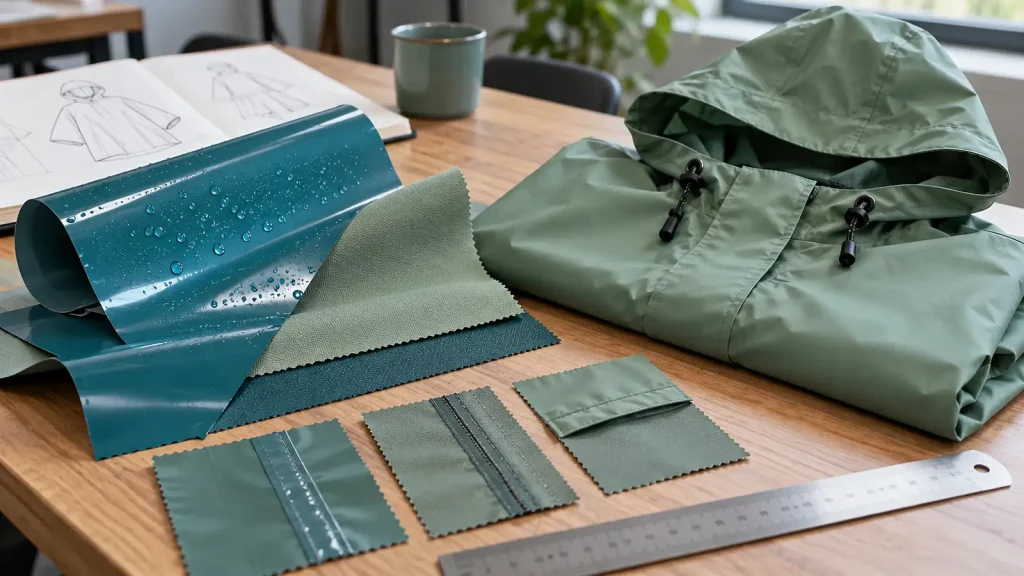
| Entity | Attribute | Value to define | Evidence and verification |
|---|---|---|---|
| Wearer group | Use and fit | Defined users, layering and size mix | Needs brief and representative fit review |
| Shell | Material construction | Composition, film or textile structure and coating | Specification linked to the offered sample |
| Material | Thickness or mass | Thickness in mm or material mass in g/m², method and tolerance | Agreed measurement record |
| Garment | Coverage and dimensions | Length, width and hood dimensions in cm; defined measurement points | Drawing and finished sample measurements |
| Seam | Joining method | Welded, sewn or sealed details for each location | Construction sample and agreed checks |
| Performance | Rain-protection claim | Defined claim, method and conditions | Relevant product-specific evidence |
| Closure | Usability and construction | Fastener type, placement and operation | Wearer review and inspection criteria |
| Individual pack | Identification and access | Size, item code, instructions and opening method | Approved packed sample |
| Carton | Shipment data | Unit count, dimensions in cm, gross mass in kg and lot identifier | Packing list and receiving comparison |
| Stock | Condition and availability | Usable quantity, location and inspection status | Dated stock confirmation and condition check |
| Blanket | Separate component specification | Construction, dimensions, use and supported claims | Independent sample and evidence review |
| Order | Approved revision | Product, artwork and packing references | Controlled approval record and change process |
Describe the complete material and construction combination
Material names are useful starting points, but they are not a complete rainwear specification. A request for PE, EVA, PVC or polyester leaves many questions unanswered. The supplier still needs to define the exact construction, dimensions, joining method, fasteners and packed form. Two garments described with the same broad material name can differ in important ways. Ask for a product-specific description that can be connected to the physical sample and used consistently throughout the quotation and order.
For a film garment, specify the proposed material description and how thickness will be expressed and checked. For a textile garment, ask for the fiber composition, fabric construction and any coating or laminate included in the offer. If mass per unit area is quoted, establish what the figure includes. A comparison becomes misleading when one bidder reports a base fabric and another reports the completed coated material. Keep units and measurement conditions visible rather than treating every number as directly comparable.
Seams deserve their own line in the specification. Identify where the garment is welded, sewn, sealed or joined by another proposed method. Ask for photographs and samples showing representative junctions, including places where several components meet. The method suitable for one material or design should not be assumed to apply to all alternatives. A substitution that changes the shell construction may also require changes to the seam process and the evidence used to support the product's claims.
Fasteners and trims are part of the product, not incidental extras. Record the type and placement of snaps, zippers, elastic, tabs and other components included in the approved version. If a component is optional, distinguish the quoted option from the selected one. This is especially useful when a supplier offers a standard garment with several custom choices. The final purchase order should point to a single configuration instead of leaving the factory to select whichever trim is most readily available.
Color and opacity can also influence the user's experience and the organization's requirements. Review the actual proposed material in the selected shade and thickness rather than relying on a digital color reference alone. If the program requires a particular appearance, document the accepted reference and how variation will be assessed. Do not treat color as evidence of performance. A bright garment, for example, does not establish a certified high-visibility function without the appropriate product-specific basis.
Build the specification in a format that separates requirements from supplier declarations. One column can state what the buyer needs, another what the supplier offers, and a third how the point will be verified. This makes differences easy to identify before an order is placed. It also prevents a catalogue description from being copied into a contract as if every statement had already been reviewed and accepted by the buying organization.
When the material is approved, keep its reference connected to the garment sample and packing sample. Changes should identify the affected component, the reason for the proposal and any effect on appearance, performance, evidence, price or delivery. Some changes may be acceptable after review; others may not. The important point is that equivalence is evaluated by the buyer's responsible reviewers rather than assumed because the new material has a familiar name or looks similar in a photograph.
Match water-resistance evidence to the intended claim
A rainwear performance claim needs a clear object and a clear basis. Is the statement about the shell material, a seam construction or the finished garment? Which method and conditions were used to assess it? What product revision was examined? These questions are more useful than asking for a generic waterproof certificate. They help the buyer understand what the evidence actually supports and where further review may be needed before a claim appears on packaging or in a purchase specification.
AATCC's TM127 scope describes a method for measuring a fabric's resistance to water penetration under hydrostatic pressure. It also notes that results can differ from those obtained through rain or spray methods. That distinction matters when comparing reports. A number from one method should not be treated as interchangeable with a result from another merely because both concern water. Ask a suitable technical reviewer to assess the method, specimen and conditions for the intended buying decision.
Keep the specimen identity visible. A report concerning an unspecified fabric does not automatically establish the performance of the offered garment. Request the material or product reference, relevant construction details and the connection to the proposed order. If the sample has changed since testing, ask which changes were made and whether the evidence remains applicable. The supplier should be able to explain the relationship rather than relying on a report with a similar color photograph.
Finished construction introduces additional questions. Openings, closures, seam junctions and the hood arrangement are not described by a shell material result alone. Decide what finished-garment review is needed for the claim and use. This may include practical sample assessment and additional testing selected by the responsible reviewer. Keep the scope precise: an informal inspection can identify workmanship issues, while a technical test addresses the defined conditions of its method. Neither should be described as proving more than it examined.
When a quotation uses a performance number, ask for its units, method, conditions and acceptance basis. The same applies to claims about breathability, tear resistance or durability. Avoid filling gaps with assumptions drawn from the material family. If comparable evidence is unavailable, record that fact in the evaluation and decide whether to request further work, narrow the claim or choose another option. Uncertainty should remain visible until the buyer has a reasoned basis for the decision.
Align commercial language with the reviewed evidence. The quotation, sample label, individual pack and final product description should not make progressively stronger claims as the order moves forward. A supplier may describe the garment accurately in a technical file while a marketing label uses a much broader phrase. Ask for the final wording during sample approval. This gives the team time to remove unsupported language before it is printed across an entire shipment.
Maintain a small evidence register containing the relevant document references, dates, product revision and the decision each document supports. Do not collect reports simply to create a large folder. A concise, traceable set of evidence is easier to use when an inspector, receiving team or later buyer asks why the garment was selected. If a claim remains unresolved, keep the order decision conditional until the responsible person has reviewed it and the approved wording reflects that outcome.
Use an EAV register to prevent silent substitutions
An entity-attribute-value register organizes a specification around concrete product facts. The entity is the part or item being described, the attribute is the characteristic that matters, and the value is the agreed requirement or offered result. Add an evidence column so the register shows how the point will be checked. This format is useful for relief rainwear because it connects small details, such as a closure arrangement or carton count, to the complete approved order.
Use a separate row for each decision that could otherwise become ambiguous. Shell material, garment dimensions, joining method, size identification and packing quantity should not be compressed into a single sentence saying standard poncho. If a value is still undecided, mark it as pending and identify the decision owner. A blank cell can be mistaken for permission to choose freely, whereas a visible pending decision tells the supplier that confirmation is still required before production.
The table in this section is a starting structure, not a universal specification. Fill it with values appropriate to the actual program and selected garment. Do not copy hypothetical measurements or performance targets simply because they appear in another tender. The buyer's responsible team should determine which attributes are necessary, which methods are relevant and what evidence will be accepted. The register then records those decisions in a form that sourcing, inspection and receiving can all understand.
Give each approved version a clear identifier. The identifier should appear on the sample record, the specification and the purchase order, with cross-references to artwork and packing instructions where needed. A supplier should not have to infer whether the latest email replaces an earlier drawing. When an update is approved, explain which version it supersedes and which parts remain unchanged. Retain the earlier version privately so the reason for a change can be reconstructed later.
Create a simple change-request process. The supplier describes the proposed substitution, why it is needed and which rows of the register would change. The buyer then reviews the effect on fit, function, appearance, evidence, packing, price and timing. A change that seems minor in isolation may affect another part of the order. For example, a different garment fold can alter individual pack dimensions and carton quantity even though the shell material remains the same.
Use the register during inspection rather than leaving it in the purchasing folder. Inspectors need to know which reference to compare, how to record a result and whom to contact when something differs. The receiving team may use a shorter version covering identity, size, quantity, lot and visible condition. Both versions should point back to the same approved product. This creates continuity without expecting every person in the supply chain to interpret a long technical document.
Close the register when the order is received and reviewed. Record accepted differences, unresolved issues and changes recommended for a later purchase. Keep these observations separate from the original agreed values so that history is not rewritten. The result is a practical record of what was requested, what was supplied and what the organization learned. For a repeat order, that record is far more dependable than asking for the same poncho as last time without identifying which version was actually delivered.
Primary references: AATCC TM127: Hydrostatic Pressure scope.
Develop the construction brief with our PE, PVC, EVA and polyester raincoat material guide.
04 / 12
Plan sizes, accessibility and dignified everyday use

Build a size mix from the intended wearer population
Size planning begins with the people expected to use the garment, not with the sizes easiest to purchase. Ask the program team what information is available about adult and child users, typical clothing layers and any groups likely to need a different fit. Keep the information proportionate to the buying decision. Procurement normally needs an approved size profile or allocation approach, not names or detailed personal records that have no purpose in the supplier's work.
Compare garment measurements rather than relying only on labels such as small, large or universal. Those labels can describe different dimensions across suppliers. Ask for a measurement drawing showing how length, width, sleeves, openings and hood dimensions are taken. Agree tolerances and identify which measurements matter most for the selected format. A simple poncho still needs a defined size; a broad shape does not remove the need to check coverage and movement on the intended wearer groups.
Avoid treating an adult garment as a child product merely by folding the hem or shortening a sleeve informally. If children are included, create a separate specification and obtain an appropriate review of the design, components, labeling and applicable requirements. The buyer should identify the intended age or size range and the responsible technical reviewer. Keep children's products clearly distinguishable in the order and packing documents so that an adult size is not issued as an undocumented substitute.
Where the population profile is uncertain, consider how the distribution approach can retain flexibility. The organization might decide to hold clearly identified size cartons and finalize allocation closer to handover. Another program may have sufficiently reliable information to pack specific assortments in advance. The supplier should quote the chosen method accurately. Do not conceal uncertainty by ordering equal quantities of every size unless that distribution is a deliberate, reviewed planning assumption.
Review a size set rather than approving only one middle size. Changes in garment length, hood position or opening dimensions may not behave consistently across the range. Ask reviewers to wear the samples with the intended layers and record where the fit differs from expectations. If the supplier uses a grading rule, request the resulting measurements for each size. The buyer can then approve the actual size set instead of assuming that a satisfactory medium sample proves the entire range.
Size identification needs to survive the packing process. A garment label may be hidden inside a folded pack, so confirm what the distribution team will see without opening every unit. Use the approved item and size codes consistently on inner packs, cartons and the packing list. If colors are used to assist sorting, retain a readable code as well. An identification system should remain understandable when lighting, printing or the reader's color perception differs from the designer's assumptions.
Record a process for size-related feedback and any approved exchanges. This can inform a reserve quantity and improve the next order, but it should not promise an exchange service that the program has not arranged. After distribution, compare the issued size mix with remaining usable stock and reported fit concerns. Those observations can refine later procurement. The goal is a size plan that is explainable, adaptable and connected to actual use, rather than a static list copied from a previous shipment.
Review opening, fastening and hood use with varied users
Usability review should include people with different ways of moving, dressing and handling small objects. A feature that seems straightforward to a designer may be difficult for another wearer. Invite appropriate reviewers to examine the garment in a calm setting and explain what they find awkward. Participation should be voluntary, respectful and limited to the product questions being assessed. There is no need to expose anyone to rain, floodwater or other hazards to learn whether a closure is difficult to operate.
Start with the unopened pack. Can the reviewer identify the garment, locate the opening and remove it without damaging the product? Does the folding arrangement make front and back clear? If the pack relies on a tear point, check how it works on the actual packaging material. A demonstration by the supplier can be useful, but the more revealing observation is often what happens when a new user opens the pack without being coached through every step.
Then examine dressing and removal. Compare the effort of lifting a pull-over garment with operating a front closure. Notice whether the wearer must twist, reach behind the body or use both hands in a way that conflicts with their normal movement. Record the specific feature and task rather than assigning a vague accessible label. A practical observation such as difficult to locate the first snap is easier to address than a broad statement that the garment is unsuitable.
Review the hood with the garment on. Ask the wearer to turn their head and look around in ordinary directions. Check whether the adjustment, if included, is understandable and reachable. Do not assume that adding more cords or fasteners makes the design easier to use. Each component creates another interaction and may require separate design review, especially for products intended for children. The simplest usable arrangement for the particular group is more valuable than a long list of optional features.
Include seated use where relevant. A garment can sit differently over the body when a person is in a chair, and a long loose edge may interact with the surrounding equipment. Ask the appropriate user and product reviewer to assess the actual combination. Avoid claiming compatibility with every mobility aid on the strength of one demonstration. Document the configuration reviewed and identify where an alternative design or further assessment is needed before the purchase is finalized.
Keep the review focused on improvements that the supplier can implement. These may include opening size, closure placement, tab shape, garment length, folding orientation or clearer information. Request a revised sample when a change affects how the product is used. A written promise to adjust the pattern is not a substitute for checking the resulting garment. Confirm that the revised feature has not created a new difficulty elsewhere, such as reducing coverage or hiding the size identifier.
Summarize the findings without collecting unnecessary personal detail. The report can describe reviewer groups, relevant clothing combinations, observed difficulties and approved changes. Store any personal information under the organization's own rules rather than forwarding it with the supplier's specification. The final approval should explain which users and uses were considered, while avoiding universal claims. That gives procurement a useful basis for selection and helps later teams understand the limits of the review.
Include practical information in languages people understand
Product information is part of the supplied item. Decide what the wearer and the distribution team need to know, then choose an appropriate way to communicate it. Essential information may concern product identity, size, putting the garment on, care, storage or intended-use limits. The exact content depends on the approved product and destination requirements. Treat the information as an item to review during development, with a named owner and an approved final version.
Identify languages through the receiving organization rather than guessing from the destination country alone. A program may serve people who use several languages or who are more comfortable with spoken explanations than a printed leaflet. Procurement can ask for translated artwork, while the program team decides how the information will be explained at handover. The supplier should use the approved text exactly and flag any printing or layout issue before production rather than silently shortening the wording.
Keep sentences concrete and connected to the actual garment. If a diagram shows a front-opening coat while the shipment contains a pull-over poncho, the information can create confusion even when the translation is accurate. Review illustrations alongside the selected sample. Show the correct orientation, opening and fastening arrangement where an explanation is useful. Avoid adding decorative icons that could be mistaken for a certification, protective rating or approval that the product does not possess.
Pictograms can support communication, but their meaning should be checked. A symbol that appears obvious to the design team may be interpreted differently by another audience. Ask suitable local reviewers to explain what they understand before approving the artwork. If the interpretation differs from the intended message, revise it. Do not assume that removing all words automatically makes a label more accessible; sometimes a short approved phrase and a clear illustration work better together.
Consider how the information will remain available after the pack is opened. A removable outer sleeve may be discarded immediately, while a garment label or separate card may remain with the item. The right choice depends on the information, the product construction and applicable requirements. Avoid putting critical instructions only in a location that the user is unlikely to retain. Equally, do not add a bulky insert without considering how it affects the packed kit and the handover process.
Create an artwork proof with the final dimensions and printing method. Check legibility on the actual material, including contrast, folds and any transparent areas. A large screen preview can conceal a label that becomes difficult to read when printed at its true size. Approve a physical or otherwise representative proof and record the revision. If the supplier changes the packaging material, review whether the approved appearance and readability still hold for the new version.
Finally, connect product information with the organization's handover and feedback arrangements. The pack should not invent an assistance telephone number, promise medical support or direct recipients to an unapproved contact. Use only the channels the receiving organization has authorized. If information needs to change after printing, agree a controlled correction before shipment. A clear, accurate message that matches the garment is more useful than a crowded label filled with broad claims and instructions that nobody has verified.
05 / 12
Build useful kits without confusing rainwear and thermal equipment

Keep each kit component tied to a defined function
A kit is a group of products, and each product still needs its own reason for inclusion. Start with the program's approved list of functions, then identify the item proposed for each one. Rainwear may support ordinary movement in wet weather; a carry pouch may keep the garment together between uses; a blanket may serve a separately defined purpose. Do not let the convenient phrase emergency kit blur these distinctions or imply that the collection covers every need in a response.
Create a bill of materials with a separate line for every component. Include the item name, specification reference, quantity per kit, approved supplier or source where relevant, and packing position. If a component is optional, show which kit version includes it. This prevents a quotation for one combination from being compared with another that contains different goods. It also helps the receiving team identify a missing item without having to reconstruct the original discussion from several emails.
Review compatibility in practical terms. Will the rainwear pack fit the intended carry bag without being forced into an excessively tight fold? Can a rigid component damage a garment sleeve during transport? Does the kit remain easy to carry in the format selected by the organization? These are questions for a complete packed sample. Looking at separate catalogue photographs does not establish how the components behave when assembled and moved together.
Keep product claims separate on the label and packing list. A supported statement about one component should not migrate to the entire kit. For example, a material attribute of the carry pouch says nothing about the composition of the poncho or blanket. If the supplier proposes a combined claim, ask what evidence supports that claim for the complete combination. Otherwise use precise component descriptions and retain the relevant information with each item.
The organization should decide whether recipients need every component in the same quantity. A standard bundle may simplify assembly, but the assistance plan may require different allocations. If so, consider whether items should be packed separately or supplied in clearly identified kit variants. The purchasing team should not redesign the program around a supplier's preferred bundle without review. Operational convenience matters, but it should be evaluated alongside the intended usefulness of the contents.
Avoid adding products merely to make the kit look more comprehensive. Every additional item introduces cost, volume, sourcing, inspection and information requirements. Ask who requested it, what function it serves and how its suitability will be checked. If these questions cannot be answered, leave the decision open rather than treating an extra component as automatically beneficial. A focused kit with approved contents is easier to understand and control than a collection of loosely related emergency accessories.
Record the complete approved kit as its own packing reference while retaining the specifications of its parts. This allows the supplier to assemble consistently and the buyer to inspect both component identity and overall presentation. If one item changes, review the effect on the complete pack. The change may alter weight, dimensions, instructions or the order of access. Maintaining both levels of information gives the team a clear view of the product and the package that will actually be handed over.
Specify blankets separately from the rainwear line
Blankets should have a distinct specification and approval process even when they are ordered alongside rain ponchos. A textile blanket, a reflective sheet and an insulated garment are different products. Their names, dimensions, materials, intended uses and supporting evidence should be recorded separately. The rainwear supplier's ability to offer a blanket does not establish that the proposed blanket is appropriate for the program, and a familiar appearance does not replace review by the responsible technical or program team.
Begin by identifying the function the organization has approved. Is the purchase for a particular household item, an additional kit component or a product selected under a separate technical protocol? Procurement should carry that defined requirement into the quotation. Avoid choosing the function after seeing what is available. When an enquiry uses the phrase survival blanket, ask for the exact product description and supporting information so that a marketing name does not become the sole basis for selection.
For a textile product, request the relevant composition, construction, finished dimensions and other attributes required by the buyer's specification. For a reflective product, request its material construction, dimensions, packaging and supported use information. The responsible reviewer should decide what performance evidence is needed. Do not substitute a photograph, a supplier's general brochure or an unrelated report for the evidence requested for that particular component and order.
Keep numerical thermal claims out of the pack unless the buyer has reviewed their basis and applicability. A percentage printed on a sample packet may depend on a defined test or interpretation that does not establish the outcome in use. Procurement should ask what was measured, under which conditions and for which product. If the explanation is incomplete, narrow or remove the claim while the issue is resolved. The article should likewise avoid promising prevention or treatment of a medical condition.
Check whether the blanket has its own storage, handling or service-life information. Do not assign it the same conditions as the rainwear simply because the two items share a carton. If a component carries a date or a lot identifier, decide how that information will be retained in the kit and on the receiving record. The organization may need to inspect or rotate components differently, and the packing method should allow those decisions to be carried out.
Ask for the actual blanket sample in the proposed packaging. Compare it with the specification and with the complete kit assembly. Verify that the quantity and identity are clear without relying on color alone. If the blanket is sourced from a different manufacturer, record that supply arrangement and the relevant approval references. A combined commercial invoice can still contain distinct product lines and evidence requirements; convenience in purchasing does not require ambiguity in technical records.
When rainwear and blankets are presented together in an enquiry, keep the call to action specific: discuss the required components, their specifications and the evidence needed for a proposal. Do not imply that every component is held in stock, immediately available or already approved for the buyer's program. Those facts must be confirmed for the actual order. Clear separation lets procurement compare the offer honestly and gives the receiving team a reliable account of what is inside the kit.
Check packing order and access with a complete kit sample
The order in which items are packed affects how people find and use them. Ask the receiving organization which components need to be identified first and which may remain packed until later. Then assemble a sample using the actual proposed products and packaging. A packing diagram is useful, but it should be checked against the physical combination. Thickness, flexibility and fold size can change how a kit closes and how easily the contents can be removed.
Start the review with a person who has not watched the pack being assembled. Ask them to identify the kit, locate the rainwear and remove the intended item. Observe whether they must empty the entire bag or whether labels are hidden by other components. This is a practical packaging exercise, not a test of the reviewer. If the sequence is confusing, improve the presentation rather than expecting every recipient or distribution worker to remember a detailed explanation.
Check that the individual product remains protected during assembly. Sharp carton edges, hard accessories or tightly stretched straps can affect flexible packaging. Inspect the complete pack after normal handling appropriate to the proposed logistics plan. Any formal transport or packaging test should be defined with suitable technical input. Do not describe an informal drop or carrying demonstration as certification. Record what was done and what was observed so the buyer can decide whether further assessment is needed.
Confirm quantities in several units: items per individual pack, individual packs per kit, kits per inner pack if used, and inner packs or kits per master carton. A single missing conversion can multiply into a large receiving discrepancy. Use the same units in the quotation, purchase order and packing list. Where a kit contains several sizes, show the assortment explicitly and explain how the receiving team will recognize the version without opening every package.
Review the packed dimensions and weight using the completed sample. Estimates based on loose garments may understate the actual shipment once bags, inserts and cartons are included. Ask the supplier to distinguish net product weight from gross packed weight and to identify the measurement basis. The logistics team can then assess the shipment using meaningful data. If the kit changes, update these figures rather than leaving earlier numbers attached to a different packing configuration.
Think about repacking and partial issue where the program expects them. A master carton may be opened at a central warehouse and its contents divided among several locations. Individual packs should remain identifiable after separation, and any necessary product information should travel with the item. If a seal is intended to show that a kit has not been opened, define what staff should do when the seal is damaged. Do not leave that decision to an improvised assumption at the receiving desk.
Approve the final pack with photographs, a bill of materials and an assembly sequence. Keep one reference available to the supplier and one to the buyer where practical. The approval should identify the selected packaging materials and artwork revision as well as the contents. During production, any change to a pouch, insert, fold or carton quantity should be reviewed against this reference. The result is a kit that can be assembled, counted and opened consistently, with fewer hidden decisions left for the people receiving it.
06 / 12
Approve branding, instructions and packaging before production

Use identification that the receiving organization has authorized
Branding in a relief purchase should begin with authorization and a defined purpose. The receiving organization may want an item code, a program identifier, a donor acknowledgement or no visible branding at all. Ask for the approved requirement and artwork before quoting decoration. Do not infer permission from a logo found online or from a previous project. The supplier's task is to reproduce the authorized design on the agreed product, not to decide how the organization presents itself.
Separate operational identification from promotional design. A readable size or lot code may be essential for sorting, while a large decorative print may have no useful role in the program. Keep each element connected to its purpose. If the organization requires several identifiers, establish their priority and placement so they do not obscure product information. A crowded pack can make the most useful details difficult to find even when every individual logo is printed correctly.
Request artwork in a controlled file with dimensions, colors and placement references. Confirm whether the design belongs on the garment, individual packaging, carry pouch or master carton. These are different surfaces and may require different production methods. A print approved on a flat film swatch is not automatically approved on a coated textile garment. Review decoration on the actual proposed material, color and construction before accepting it as part of the bulk specification.
Keep organizational names, emblems and approval statements out of the supplier's own marketing unless the organization has specifically authorized that use. Supplying a product for a proposed program does not create a general endorsement. The buying documents should distinguish product identification from any separate publicity permission. This is especially useful when a supplier wants to photograph samples or retain a decorated reference: the buyer can state what may be used for production control and what may not be published.
Ask the responsible program team whether visible branding is appropriate in the intended context. Procurement should follow the approved decision rather than assuming that a more prominent mark is always preferable. The team may choose discreet identification, neutral colors or different packaging for separate destinations. Record the selected arrangement in the purchase specification. If the receiving context changes, revisit the artwork before production instead of assuming the original design remains suitable everywhere.
Approve the final proof at its actual size. Check spelling, language, proportions, contrast and location relative to seams, folds and closures. If the decoration affects the garment construction or care requirements, have the relevant reviewer assess that combination. Keep a record of the approved proof and the decorated sample. An email saying the logo looks fine is less useful than a clear reference showing which artwork revision, size and placement were accepted.
For repeat orders, confirm that the permission and artwork remain current. Programs, donor requirements and contact details can change while a supplier retains an old print file. Ask the supplier to identify the reference it intends to use and compare it with the current order. If a neutral stock garment is decorated later, record that stage separately. The final shipment should carry the approved identification for this purchase, with no unreviewed names, claims or imagery added along the way.
Make the individual pack easy to identify and open
The individual pack is often the first part of the product that a distribution worker or recipient handles. It should protect the garment, identify it and allow straightforward access. Start by defining what the pack must do during storage, transport and handover. Then compare packaging options against those functions. An attractive sleeve that hides the size or tears the garment during opening can create more work than a simpler pack designed around the actual handling process.
Place item and size information where it remains visible after the garment is folded. If the pack is transparent, check whether the garment label can reliably be seen or whether an external identifier is needed. Do not rely on a perfect fold that is difficult to reproduce at scale. Review several packed samples and confirm that the information remains readable. A consistent item code also helps staff distinguish similar garments supplied for different groups or kit versions.
Opening should be assessed on the proposed material and seal. Ask reviewers to locate the opening and remove the garment without tools where that is the intended method. Check whether the opening feature remains clear when the pack is stacked or placed inside another bag. If the packaging is intended to be reusable, verify how it closes again and whether the garment can be returned without an impractical folding process. Keep claims about reuse tied to the actual design.
The pack should contain the approved product information in the agreed languages. Decide which information needs to stay with the garment and which is only for warehouse handling. Avoid adding unsupported terms such as sterile, certified or medical grade to make the package appear more suitable for relief use. Those words carry specific implications and need an appropriate basis. A straightforward description of the item, size and intended use is easier to understand and verify.
Consider the relationship between individual packaging and the wider kit. A pack that works well on its own may become difficult to identify when placed beneath a blanket or inside an opaque carry bag. Review the complete arrangement and decide whether an outer kit label should show the contents. If several size versions exist, the outside of the kit should make that distinction clear using the approved identification system, without exposing personal recipient information.
Specify the packaging material and dimensions, not merely the phrase individually packed. Ask the supplier to explain any proposed alternative and its effect on protection, opening, labeling and carton volume. If environmental attributes are requested, make them specific and evidence-based. Do not assume that a package described as recyclable will be collected or processed in the intended location. The organization should consider the actual end-of-use arrangements when choosing the presentation.
Finish by approving a packed sample and recording the folding orientation, label position, seal and opening method. Use it during production checks and receiving. If damage or confusion is reported later, compare the delivered pack with this reference before deciding whether the problem concerns design, assembly or handling. This turns packaging into a controlled part of the product and gives the supplier a concrete improvement request rather than a general complaint that the packs were difficult to use.
Define cartons that receiving teams can count and handle
A master carton should help the next team identify, count and move the goods it contains. Begin with the receiving arrangement: where the shipment will be unloaded, whether cartons will remain intact, and how the contents will be divided among destinations. Ask the logistics team to confirm the practical handling constraints. The supplier can then propose a carton count and construction that fit the approved process rather than choosing packaging solely to maximize units per box.
State the quantity per carton and any inner-pack structure clearly. If a carton contains mixed sizes, show the assortment in a consistent order and identify it on the packing list. Avoid descriptions such as assorted ponchos without the exact composition. Mixed cartons can be useful for some programs, but they complicate receiving when the assortment is unclear. Separate size cartons may be easier to allocate where the final mix will be decided closer to distribution.
Confirm actual carton dimensions and gross weight from the proposed packed sample. The logistics team needs these figures to assess transport and storage, and the warehouse needs them to plan handling. Do not confuse garment net weight with the weight of the complete carton. If the supplier changes the packaging, folding method or unit count, update the shipment data. A quotation based on an earlier packing arrangement may no longer describe the goods being dispatched.
Agree the label content and placement. Common procurement information includes item code, size or assortment, quantity, lot reference and the buyer's approved order identifier. Destination or handling information should match the logistics plan. Keep labels readable when cartons are stacked in the intended orientation. If the receiving team needs labels on more than one face, include that requirement in the packing instructions rather than expecting it to be inferred from a sample photograph.
Review carton integrity as part of the packing approval. The proposed carton, closure and internal arrangement should suit the agreed transport and handling plan. Ask the responsible packaging or logistics reviewer what assessment is appropriate. Avoid claiming that a particular carton can withstand every route or storage condition. A useful specification identifies the arrangement selected for this shipment and the checks that will be used to evaluate it before release.
Plan for partial cartons and short quantities. If the order total does not divide evenly into the standard carton count, require the final carton to be clearly identified with its actual contents. The packing list should show the exception. Otherwise a receiving team may multiply carton count by standard quantity and record stock that was never shipped. The same principle applies to samples or replacement units added to the shipment: identify them separately instead of hiding them in a routine carton.
At dispatch, reconcile the carton labels with the packing list and the approved quantity matrix. At receiving, use the same identifiers to record condition, count and any discrepancy. This shared structure makes it easier to locate an affected lot or understand a short delivery. Good carton information does not eliminate every logistics problem, but it gives each team a common description of the goods and reduces the amount of interpretation required when time and space are limited.
Coordinate the packed sample using our rain poncho packaging guide and custom printing guide for branded rainwear.
07 / 12
Validate samples, inspection and product-specific requirements

Choose samples that represent the proposed bulk order
A sample is useful only when the buyer understands what it represents. A stock example may demonstrate a general shape, while a development sample may show a proposed modification. A production reference should match the selected material, dimensions, components and decoration closely enough to support the agreed approval. Label these stages clearly. Without that distinction, a convenient catalogue sample can gradually become treated as proof of a different product that has never been reviewed.
Ask the supplier to identify the sample's material, size, construction and revision. Record any differences from the quotation, including temporary components or placeholder packaging. Differences are not automatically unacceptable, but they must remain visible. If the sample uses a different fastening because the selected one is not yet available, the buyer should know which decisions can be made from it and which must wait for a more representative version.
Plan the sample sequence around decisions. The team might first compare formats, then review fit, then approve the completed garment and packing. Some purchases may combine these stages, while a more customized program may need separate reviews. Avoid requesting many samples without explaining what each should resolve. A clear purpose helps the supplier prepare useful versions and allows the buyer to stop revisiting settled questions while unresolved details receive proper attention.
Include the proposed size range where fit matters. One sample can reveal construction details but cannot establish that every size is suitable. Request a size set or the specific additional sizes needed for review, and compare them with the measurement chart. If a product is intended for children or another group requiring particular attention, involve the appropriate reviewer. Keep the approval connected to the actual intended group rather than extending an adult fitting observation to everyone.
Review decoration and packaging on the selected construction. A logo printed on a separate sample sheet does not show its placement on the garment, and a plain pouch does not show the final label or opening arrangement. Ask for a complete reference when those details affect the buying decision. This also helps identify interactions, such as a label hidden by the fold or a print placed across a seam, before they become repeated across the entire order.
Keep accepted samples identifiable and protected from accidental replacement. Record photographs, measurements and the approval reference, and arrange access for the people who will inspect production. Where the supplier and buyer retain separate samples, confirm that they represent the same revision. If a later correction is approved, mark the earlier reference as superseded. A pile of similar samples without clear status can be as confusing as having no sample at all.
Finally, distinguish sample approval from shipment release. A good sample establishes a reference, but the bulk goods still need the agreed checks. The supplier should not treat approval as permission to alter the material or packing without review. The buyer should not treat it as proof that every unit will be identical. Connect the sample to the inspection plan and change process so it remains a useful control throughout production, dispatch and receiving.
Agree acceptance checks before goods are packed
Acceptance checks work best when the buyer and supplier agree them before production. Define what will be inspected, which reference applies, how results will be recorded and who decides the response to a discrepancy. Keep the plan proportionate to the product and order. It should be detailed enough that an inspector can distinguish a conforming item from an issue without inventing criteria at the packing table.
Separate identity, workmanship, dimensions, function, packaging and documentation. Identity checks confirm that the product and material references match the order. Workmanship checks examine the agreed construction features. Dimension checks compare measurements using the defined method and tolerances. Functional checks address the selected closures or other features. Packaging and document checks confirm the quantity, identifiers and approved presentation. These categories make a report easier to interpret than a single statement that quality looks acceptable.
The responsible quality reviewer should determine the inspection method and any sampling approach. Do not copy a sampling level or acceptance number from an unrelated purchase without considering the product and risk. A buyer may use an established organizational procedure or agree a suitable plan with a qualified inspection provider. The article does not prescribe a universal pass threshold. The useful procurement step is to ensure the chosen approach is documented and understood before the inspection takes place.
Define how problems will be described. Photographs should identify the affected feature and be connected to a product, carton or lot reference. Measurements should include units and the relevant location. If a closure does not operate as agreed, record the observation rather than replacing it with a broad claim that the whole shipment is defective. Clear descriptions help the buyer distinguish an isolated issue, a repeated construction problem and a mismatch between the specification and the supplied product.
Agree what happens when a check fails or remains unresolved. The response may involve sorting, rework, replacement, further review or a decision to hold the affected goods. The responsible buyer should make the acceptance decision under the organization's process. Do not allow a supplier to redefine an issue as acceptable simply because dispatch is approaching. Equally, avoid demanding an unplanned remedy without identifying the requirement that the delivered product failed to meet.
Recheck corrected goods against the same approved basis. A repair or replacement may solve one problem while changing another feature, particularly where seams, fasteners or packaging are involved. Record the correction and its verification so the final release decision can be understood later. If a departure is accepted, document who authorized it and for which quantity or lot. An approved exception should not silently become the specification for every future order.
Keep the inspection report connected to the dispatch documents. The released quantity, lot references and packing list should describe the goods that were actually reviewed. If additional units are packed after inspection, identify them and apply the agreed process. This continuity gives the receiving team a meaningful reference and helps procurement respond to discrepancies. It also prevents a report for one batch from being used as a general approval for goods that were never included in its scope.
Keep reports and changes connected to the exact product
Evidence loses value when it becomes detached from the product it is meant to describe. A report, declaration or sample record should identify the relevant material or garment and the revision reviewed. Procurement should ask how that reference connects to the proposed order. A recognizable supplier name on a document is not enough if the construction, size, component or intended claim differs from the product being purchased.
Build a document list around the actual requirements. The responsible technical or compliance reviewer should identify what applies to the destination, wearer and intended use. Avoid collecting certificates simply because a catalogue includes them. A document may concern a factory management system, a particular material or a different product category; those are not interchangeable forms of evidence. Record the question each document answers and leave unrelated documents out of the decision summary.
Read the scope before relying on a result. Check the product description, method, date, conditions and any limitations relevant to the decision. If information is missing or unclear, ask the supplier or issuing body for clarification through appropriate channels. Do not fill the gap by assuming that a similar model is covered. The purpose is to understand the evidence, not to produce a folder that appears complete while key connections remain uncertain.
When the product changes, review the evidence affected by that change. A different shell, coating, print, seam or fastening may require a fresh assessment of the claims or requirements. Not every modification has the same effect, so the responsible reviewer should decide what is necessary. The supplier should provide a clear description of the proposed change rather than sending a new sample without explaining why it differs from the approved version.
Keep a controlled correspondence record for decisions. It should show the issue, the information reviewed, the person responsible and the accepted outcome. Avoid relying on informal messages that say proceed without identifying the relevant version. The final purchase file should let another team member reconstruct why the product was approved. This is particularly helpful when staff change between sourcing, production and receiving or when a repeat order is placed months later.
Share the right level of information with each team. Inspectors need the approved product reference and checks; logistics staff need accurate shipment data; receiving staff need identity, quantity and condition information. They may not need every technical attachment. Provide concise summaries that link back to the controlled file rather than creating inconsistent copies. If a document is updated, identify who needs the new version and make the superseded status clear.
After delivery, retain the evidence with the order record and note any issue that could affect future purchases. Do not rewrite the original approval to match what arrived. If the supplied item differs, record the discrepancy and the buyer's response. A transparent history helps the organization learn from the order and keeps later claims tied to what was actually reviewed. The result is a more dependable procurement file, with fewer assumptions hidden behind familiar product names or impressive-looking documents.
Organize product-specific evidence questions with our rainwear safety standards and compliance guide. Confirm requirements for the actual garment, use and destination.
08 / 12
Plan stock readiness and replenishment without unsupported promises

Distinguish available stock from production capacity
An urgent enquiry should ask what is available now and what still has to be made. These are different supply positions. A supplier may have raw material, an unfinished production batch, undecorated garments or fully packed units. Each position requires different work before dispatch. Ask for a dated statement identifying the product, quantity, sizes, condition, location and remaining steps. A general statement that the factory has capacity does not establish that the requested rainwear is ready to ship.
Define available in relation to the buyer's approved specification. Stock of a similar garment may be useful as an alternative, but it should not be described as the requested item until its differences have been reviewed. Ask for dimensions, construction, packing and relevant evidence for the actual stock offered. If the size mix is incomplete, show the available quantities by size. A large total can conceal a shortage in the sizes the program needs most.
Check whether the stock is unallocated or already committed. The buyer needs a clear commercial understanding of what can be reserved, for how long and under which agreed terms. Do not assume that a photograph of a warehouse creates a reservation. The supplier should confirm the specific quantity and any decision deadline that affects availability. Procurement can then follow its own approval process using current information rather than relying on an earlier conversation that may no longer describe the stock position.
For goods still in production, request a milestone plan. Separate material readiness, manufacturing, decoration, inspection, packing and dispatch preparation. Ask which milestones depend on the buyer's approval and which remain within the supplier's responsibility. A single lead-time number can be difficult to interpret when the starting point is unclear. State whether the timing begins after specification confirmation, artwork approval, payment or another agreed event, and keep those conditions visible in the evaluation.
Distinguish dispatch from delivery. Goods leaving a factory is one milestone; arrival at a destination and acceptance by a receiving team involve additional steps. The logistics plan should identify the relevant transport and receiving assumptions. Avoid promising a response deadline on the strength of a production estimate alone. If a supplier offers an expedited option, ask what changes in the process and what remains dependent on transport, documentation or destination arrangements.
Compare an available-stock option with a custom option only after listing their differences. A neutral garment might be ready earlier but have a different size range or packing format. A customized garment might fit the program better but require additional approvals and production time. The buyer's responsible team can decide the tradeoff. Do not label the options equivalent simply because both are rain ponchos, and do not imply that the fastest quoted option is automatically the most useful.
Keep availability updates in the order record. When the buyer is ready to proceed, reconfirm the position that matters to the decision rather than assuming an old quotation still represents current stock. The supplier's final confirmation should identify the agreed product and quantity, the remaining actions and the next milestone. This makes urgency manageable without inventing immediate supply, guaranteed transport or a reserve of finished goods that has never been verified for the actual purchase.
Set reorder decisions around usable stock and confirmed demand
Reorder planning should begin with stock that can actually be issued. Separate usable, unallocated goods from damaged items, samples, reserved quantities and units waiting for a decision. Then compare the available position with approved demand and expected replenishment. A warehouse total on its own is not enough. The program may have substantial stock overall while lacking a particular size, pack version or quantity at the location where it is needed.
Use item, size and location as the basic planning dimensions. Keep the units consistent so that cartons, kits and individual garments are not combined without conversion. If one carton contains several inner packs, record how many garments those packs represent. A reorder discussion becomes much clearer when every figure refers to the same unit. This also helps the supplier quote a precise requirement instead of interpreting a request for several boxes as an undefined quantity.
Separate confirmed demand from possible future demand. The organization may have an approved distribution, a provisional expansion or a contingency scenario. These can all inform planning, but they should not be added together without explanation. Label the basis of each figure and identify who can authorize a change. Procurement can then compare options for replenishment while preserving the difference between a committed order and a scenario being considered.
Use actual replenishment information where available. Review previous milestones and current supplier confirmations, while recognizing that conditions may change. Do not treat a past delivery time as a guarantee for the next order. Ask what has changed in material availability, production, packing or transport. A reorder trigger should reflect the organization's chosen assumptions and tolerance for uncertainty, and those assumptions should be reviewed by the people responsible for the program and logistics.
Consider the size mix when deciding how much to replenish. A blanket reorder of the original assortment may increase an existing surplus while leaving another size short. Compare issued quantities, remaining stock and reported fit needs. If the program's population or use has changed, revisit the mix rather than automatically repeating the last order. The supplier can quote revised quantities more accurately when the request explains the selected assortment and packing arrangement.
Keep the stock plan simple enough to maintain. A small program may use a controlled spreadsheet, while a larger organization may use an established inventory system. The important point is that receipts, issues, reservations and adjustments are recorded consistently. Assign responsibility for updates and review unexplained differences. A sophisticated calculation based on stale or inconsistent stock data is less useful than a modest register that the team actually keeps current.
When a reorder is approved, connect it to the current product revision. Confirm whether the organization wants an exact repeat or an improved version based on feedback. If the product changes, plan how the two versions will be identified and used. The receiving team should not have to discover the difference after opening mixed cartons. Reorder planning is therefore both a quantity decision and a product-control decision, bringing current demand, usable stock and the selected specification into one clear purchase.
Keep a reserve plan that can survive a change in access
A reserve plan should explain what the stock is for and how it can be used if the operating situation changes. It is not enough to buy extra cartons and call them contingency stock. Identify the approved purpose, the people responsible for release and the conditions that would trigger a review. The reserve may support replacement, later allocation or an additional destination, but those uses should be agreed by the organization rather than left to interpretation.
Think about location as well as quantity. Stock at a distant central warehouse may not serve the same purpose as stock already positioned near an intended receiving point. The organization should assess access, storage and transport through its own logistics process. Procurement can support that decision with accurate carton dimensions, weights, packing formats and confirmed supplier milestones. Do not promise that a particular stock location guarantees access during a disruption.
Use scenarios to expose dependencies. A hypothetical plan might consider a delay in final allocation, a change in receiving location or a transport interruption. For each scenario, identify which decisions can be changed and which costs or approvals would follow. Keep the scenarios clearly hypothetical. Their value is in showing the team what information it would need, not in predicting how an emergency will develop or prescribing an operational response.
Review packaging for flexibility where the program requires it. Separate, clearly identified size cartons may be easier to redistribute than a highly customized mixed kit. On the other hand, a completed kit may reduce local assembly work where the intended allocation is already known. Compare those choices against the organization's plan. The supplier should not decide the balance simply because one packing method is easier on the production line.
Agree the commercial treatment of changes before they become urgent. Ask how a revised quantity, packing instruction or destination would affect the quotation and schedule. Any binding commitment should follow the buyer's normal approval process. A reserve plan can include options and decision points without treating every possibility as an order. Keeping these distinctions clear helps both parties respond to a change without assuming that an informal discussion created a new obligation.
Maintain condition checks for reserve stock. Garments held for later use still need suitable storage and periodic review under the organization's procedures and the product's supported instructions. A reserve that has become damaged or difficult to identify may not serve its intended purpose. Record any inspection findings and update the usable quantity. If a component has specific date information, keep that visible rather than assuming every item in a mixed kit can be managed in the same way.
After a reserve is used, review what happened and what should be replenished. If it remains unused, reassess whether the original purpose and size mix still make sense. The decision may be to retain, reallocate or otherwise manage the stock under organizational and donor rules. Do not let reserve inventory become an unexamined permanent balance. A useful reserve remains connected to a current purpose, an accurate stock record and a practical plan for the people who may eventually receive it.
Build a documented replenishment brief with our rainwear inventory planning guide, adapting its commercial planning questions to the organization’s assistance program.
09 / 12
Protect rainwear during storage and transport

Record stock by item, size and lot
A stock record should make it possible to identify what is present and what has happened to it. For rainwear, the useful identifiers commonly include item, size, product revision, lot or batch, packing format and location. Use the identifiers agreed in the purchase documents. A generic line called ponchos may be too broad when several sizes or constructions are stored together. The record should help staff pick the intended item without relying on memory or appearance alone.
The Logistics Cluster's physical storage guidance recommends an inventory ledger together with visible stock, stack or bin cards, and explains that the records should agree. It also distinguishes routine stock rotation from expiry-based rotation where relevant. For a rainwear purchase, apply the organization's stock procedure and the actual product information. Do not invent an expiry date for a garment, and do not ignore date information supplied for a separate component in a mixed kit.
At receiving, record the actual quantity and condition rather than copying the supplier's packing list without checking. Note any partial carton, damaged packaging or unclear identifier. The level of checking should follow the agreed receiving process. If goods are awaiting a decision, keep that status visible so they are not counted as freely available stock. Procurement can then resolve the discrepancy using the purchase order, inspection report and shipment references.
Record movements using consistent units. If a carton is opened and some inner packs are issued, the remaining balance should still be understandable. Where systems use cartons as a storage unit, maintain the conversion to individual garments. This is particularly important for mixed-size cartons or kits containing more than one rainwear unit. A total of ten cartons means little unless the team knows what each carton contains and whether any are incomplete.
Keep lot information through transfers where practical. If goods move from a central warehouse to a local site, the receiving record should retain enough detail to identify the relevant batch. This can help investigate a recurring issue or locate a particular product revision. Avoid placing personal recipient details on supplier-facing stock records unless there is a justified and authorized need. Product traceability and personal data collection are separate questions and should not be casually combined.
Use physical counts to check the record under the organization's inventory procedure. Differences should be investigated and adjusted through the approved process rather than silently overwritten. A discrepancy may result from unit conversion, an unrecorded movement, damage or another cause. Record the explanation where it is known and identify unresolved points. The objective is a reliable balance, not a record that always appears perfect because exceptions have been hidden.
Share a useful stock summary with the people planning the next order. It should show usable available quantities, reservations, pending issues and expected receipts by relevant item and size. Keep the underlying detailed record available to the warehouse team. This allows procurement to plan replenishment on a meaningful basis and gives the program a clearer view of what can actually be issued. Accurate stock identity is the link between a well-written specification and the correct garment reaching the intended user.
Check packaging condition and storage instructions regularly
Storage planning should use the supported instructions for the actual product and packaging. Ask the supplier what conditions and handling practices apply to the offered garment, then have the warehouse team assess whether its arrangements can meet them. Avoid assigning a universal shelf life or storage limit to every rainwear material. The construction, packaging and any additional kit components may differ, so the information should be product-specific and retained with the stock record.
The Logistics Cluster's storage guidance advises keeping cargo separated from the ground, monitoring its condition and identifying damaged goods. These are useful general principles for the receiving team to incorporate through its own procedures. For the rainwear order, record the actual storage arrangement and the condition checks selected. Ask the responsible stock team to identify the inspection date, the lots examined and any open findings. Review those records alongside the product's storage instructions when deciding whether stock remains suitable for issue.
Inspect packaging for signs that warrant further review, such as crushing, punctures, water damage or loss of identification. Record the location and affected quantity. A damaged outer carton does not automatically mean every garment is unusable, but it should prompt the appropriate assessment. Equally, an intact carton does not remove the need for the agreed stock checks. The responsible team should decide whether goods can be repacked, held, inspected further or managed through another approved action.
Keep goods awaiting a decision distinguishable from released stock. Use the organization's established status and labeling process so that staff do not issue them by mistake. Update the usable balance when items are removed from general availability. If outer packaging is replaced, preserve the product, size and lot information that receiving and distribution teams need. Repacking should improve protection and clarity, not sever the connection between the item and its original order record.
Review mixed kits at component level where needed. A rainwear garment and a separate blanket or accessory may have different instructions or date information. The kit record should make those differences visible. If one component needs attention, decide whether the entire kit must be held or whether an approved replacement process is appropriate. Do not assume that the condition of one visible item establishes the condition of everything packed beneath it.
Use periodic checks to inform procurement. If packs repeatedly become difficult to identify or cartons suffer damage in normal handling, document the pattern and discuss a design improvement for the next order. The change may concern carton construction, label placement, inner packing or the chosen unit count. Avoid blaming the material or supplier before comparing the delivered goods with the approved packing reference and the actual handling conditions. A precise observation leads to a more useful correction.
Keep disposal, donation, reallocation or return decisions within the organization's approved procedures and applicable rules. The supplier can provide product information and discuss a commercial remedy, but should not decide how a relief organization manages its stock. Retain the record of the chosen action and its quantity effect. A regular condition review supports a realistic view of usable inventory and helps ensure that reserve goods remain suitable for the purpose for which they were purchased.
Prepare transport data for the actual shipment
Transport planning depends on the goods that will actually be dispatched. Ask for a final packing list showing the product references, quantities, carton count, dimensions and gross weights. Confirm whether pallets or other handling units are included and how they change the shipment data. Figures from an early quotation may be useful for planning, but they should not be treated as final after the garment, packing or quantity has changed.
Identify the receiving point precisely through the organization's logistics process. A country or city name is not always enough to define the commercial delivery scope. The relevant team should confirm the location, receiving arrangements and responsibilities with the supplier and transport providers. Keep sensitive operational information limited to those who need it. The product article can explain the need for accurate coordination without publishing route details or pretending to direct a live relief movement.
Distinguish the commercial delivery term from the practical milestone plan. The quotation should state its agreed basis clearly, while the logistics plan identifies the steps needed for the shipment. Have the responsible commercial and logistics reviewers confirm their meaning. Do not assume that a short abbreviation answers every question about documentation, local handling or receipt. If a point affects cost, risk or timing, resolve it explicitly in the appropriate purchase documents.
Ask the relevant specialists to determine customs and import requirements for the actual products and destination. Material, construction, origin and product function can affect classification and documentation. A humanitarian purpose should not be treated as automatic permission to bypass requirements or assume exemptions. Procurement should obtain the necessary guidance through the organization's process and share accurate product data with the people preparing the documents. Avoid inventing a universal tariff code or clearance promise for all rainwear shipments.
Align item descriptions across the invoice, packing list and any other required documents. The names should accurately identify the goods and match the approved order. If a kit includes several different products, ask the responsible logistics team how those components should be described. Do not simplify the description so far that it becomes misleading. Consistent, accurate information helps the receiving and documentation teams understand the shipment without reconstructing it from marketing terms.
Set a process for changes after the first shipment plan is issued. A revised carton count, partial shipment or substituted packing format may affect bookings and receiving arrangements. Require the supplier to communicate the change before dispatch and identify which documents need revision. Keep the approved final version available to the parties handling the goods. Sending several packing lists without marking the current one can create confusion even when each was accurate at the time it was prepared.
At handover, retain the relevant dispatch evidence and connect it to the order and released lot. At arrival, record the actual receipt and any discrepancy. This provides a clear account of the shipment's commercial and physical progress without promising that every step is under the manufacturer's control. For an urgent program, a realistic milestone record is more valuable than a vague fast-delivery claim because it shows what has happened, what remains and who is responsible for the next decision.
Primary references: Logistics Cluster: Physical Storage Guidelines.
Connect the packing and shipment decisions through the Wholesale Rainwear Buyer’s Guide to Sourcing, Branding and Logistics.
10 / 12
Make distribution and feedback part of the buying decision
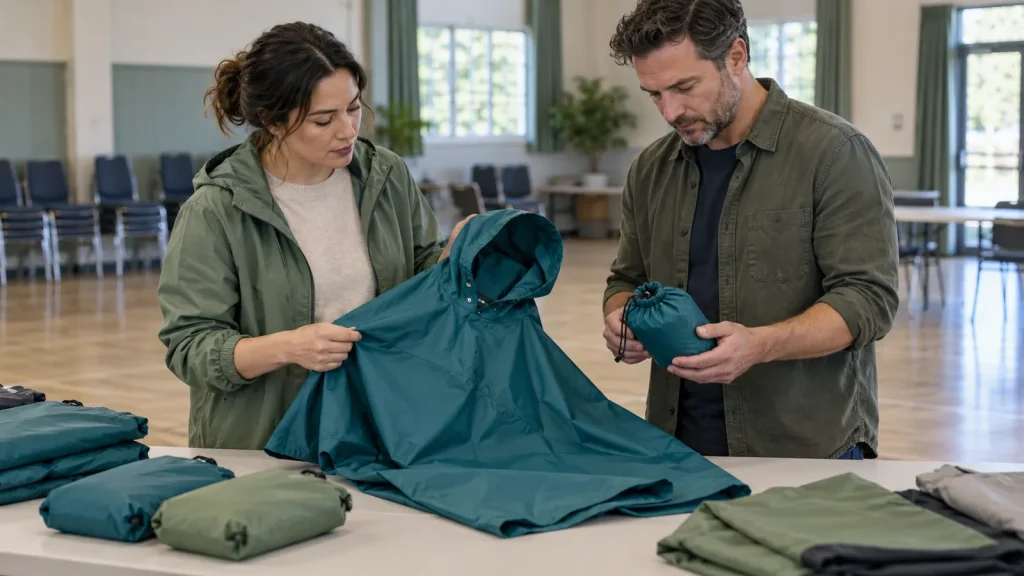
Translate handover needs into the packed product
The product handed to a household is the packed garment, not the approved drawing. Procurement therefore needs a short handover brief before it freezes packaging. Identify who will issue the rainwear, how the size will be chosen, what information accompanies it and how people are expected to carry it away. These decisions affect pack identification, bundle size and carton sorting. A supplier cannot reliably solve those details from a request for a large number of emergency ponchos alone.
The Logistics Cluster's guidance on distribution emphasizes understanding recipients and local conditions, communicating practical information and assigning responsibilities. For a rainwear buyer, the immediate implication is to involve the receiving team while the packed sample can still change. Ask whether the proposed identification and instructions can be used in that setting. Keep the supplier's role focused on the agreed product and pack; the responsible organization retains control of eligibility, distribution arrangements, protection measures and communication with the people receiving assistance.
Test a simple handover sequence using the proposed pack. A coordinator should be able to identify its item and size without opening several neighboring packs. The recipient should receive the intended garment and the relevant instructions together. If a bundle must be divided, check that each remaining unit still carries sufficient identification. A carton label can help warehouse staff, but it does not necessarily help someone who receives a single unmarked pouch after the outer carton has been discarded.
Consider the language and format of information separately from brand presentation. A large logo does not tell a person which opening is the neck or how to close the front. Have the receiving organization review plain instructions, any diagrams and the proposed size description. Request a physical proof at the actual print size. Text that looks clear on a large screen may be too small on a folded packet, especially when the printing sits over an uneven garment or a dark background.
For a hypothetical program with several issue locations, separate cartons by the allocation that the receiving team actually needs. One mixed carton might suit a small location with a broad size range, while another team may prefer cartons containing one size. Neither format is automatically better. Compare the work needed to count, sort and replenish each option. Record the approved arrangement in the packing specification so that the production team does not replace it with a more convenient mixed assortment without notice.
The handover review should also consider what remains after the product is opened. Ask the organization how empty wrappers and cartons will be managed within its established arrangements. Do not add unsupported recyclability or disposal claims to the pack. When a pouch is intended to store the garment again, test the repacking task with the actual garment and instructions. Its usefulness depends on the combination of size, opening and everyday handling, rather than on a label calling it reusable packaging.
Close this review with a signed packed-sample reference and a short list of acceptance points. Include the visible item code, size indication, instruction version, contents and carton arrangement. Give the receiving coordinator a copy of those references before dispatch. This allows the first delivery to be compared with the same agreed product that procurement approved. It also makes a later discrepancy easier to describe without requiring the coordinator to reconstruct the supplier's original quotation or interpret a photograph from an earlier sample stage.
Prepare a clear process for incorrect or damaged items
An order can arrive with the right total quantity and still contain units that should not be issued. A carton may have the wrong size, a pouch may contain an incomplete garment, or handling damage may make the contents unsuitable. Agree how such findings will be recorded and escalated before dispatch. The receiving team needs a practical route to a decision, while procurement needs enough detail to distinguish a packing error, a product issue and damage arising during transport or storage.
Define a small set of useful discrepancy categories in the receiving instructions. Examples include quantity short, wrong item, wrong size, missing instructions, visible garment damage and damaged outer packaging requiring further examination. Keep the descriptions concrete. A report that says only poor quality leaves everyone guessing about the actual condition. A record identifying the item code, carton number, affected quantity and observed problem gives the buyer a clearer basis for deciding what evidence or response is needed next.
Make the reporting method workable for the people who will use it. A simple receiving sheet or an established organizational system may be sufficient. Do not demand an elaborate new platform solely for this purchase. Identify the person responsible for consolidating findings, the procurement contact who will review them and the supplier contact authorized to respond. If photographs are appropriate, focus them on the garment, packaging and identifying marks. Avoid gathering recipient names or other personal information when a product record can establish the issue.
Keep questionable goods distinguishable from the stock approved for issue under the organization's own procedures. The practical purpose is to avoid treating an unresolved quantity as usable availability. Record what has been set aside and why, together with the person who can approve the next step. This is particularly important when an urgent replenishment request arrives: a stock total that includes unreviewed damaged units can create a false impression that the required sizes are ready to distribute immediately.
Agree commercial remedies with the supplier as part of the order terms, not as an assumption made after a problem appears. The response might involve further inspection, replacement, a documented correction or another agreed resolution, depending on the finding and contract. Do not promise recipients a replacement date based on an unconfirmed supplier message. Procurement should distinguish the supplier's proposed action from a confirmed dispatch and from the receiving team's ability to provide an appropriate garment to the affected person.
Use a clear closure record for each discrepancy. It should state the finding, quantities involved, evidence reviewed, decision, responsible party and actual completion. Where a correction changes labels or packing, retain the approved revised reference. Where the issue cannot be resolved immediately, keep the remaining action visible rather than marking the entire delivery complete. A short open-items list is more useful than a lengthy email chain in which the latest decision is unclear to the person receiving the next shipment.
Review the pattern across the order without exaggerating what a small sample proves. Several wrong-size packs may justify checking the packing process, but they do not automatically establish that every carton has the same problem. Ask what additional examination is proportionate to the finding. The objective is a defensible decision about the affected goods and a practical correction for future deliveries. This process protects the accuracy of the stock record and makes supplier discussions more specific, even when the immediate delivery timetable is under pressure.
Use recipient feedback to improve the next order
Recipient feedback can reveal problems that a table inspection misses. A garment may meet the listed dimensions yet be awkward to put on over everyday clothing. A pouch may be difficult to open, or a size label may mean little to the people receiving it. Build a modest feedback route into the purchasing cycle through the responsible organization. Its purpose is to learn whether the supplied configuration works in the intended context and to translate useful findings into a better next specification.
Ask focused questions about the product rather than inviting only a broad satisfaction score. Was the garment identifiable by size? Could the person put it on and close it as intended? Which part of the coverage or opening caused difficulty? Did the supplied instructions help? The receiving organization should decide how to gather views respectfully within its established procedures. Procurement generally needs an anonymized account of product issues and circumstances, not a database of personal stories or sensitive details about individual recipients.
Separate a preference from a functional difficulty when reviewing the responses. A preferred color may influence a later order if it is practical, while a closure that many intended users cannot operate calls for a different review. Neither should be dismissed, but their implications are different. Record the actual observation before proposing a solution. If someone describes a hood problem, establish whether it concerns fit, visibility, adjustment or instructions rather than immediately ordering a larger hood across every size in the next purchase.
Connect feedback to the product version that was actually supplied. Note the garment code, size range, pack version and relevant lot where available. Otherwise, a comment on an earlier pull-over poncho can be mistakenly applied to a later front-opening raincoat. Keep the timing and use context clear as well. A sample tried indoors and a garment used repeatedly in everyday rain provide different observations. These records support a targeted discussion without claiming that informal feedback is a controlled performance test or a certification result.
Bring the most useful findings into the next sample review. If recipients struggled with the pouch opening, compare alternative openings using the complete packed garment. If the size mix produced an imbalance, examine the allocation assumptions with the receiving team before changing the factory order. The supplier may propose practical options, but each option still needs approval for the intended program. A change made to address one difficulty can introduce another, such as a larger pack that no longer fits the agreed kit arrangement.
Avoid treating every comment as a requirement to redesign the whole product. Group findings by frequency, consequence and the confidence of the available information. Identify which changes are essential before another order, which need further review and which can be considered at a planned refresh. Keep those decisions visible to procurement and program colleagues. This helps prevent a rushed purchase from reverting to an old specification simply because the approved improvement was discussed informally and never transferred into the actual enquiry documents.
Close the loop by telling the responsible receiving team what changed and what still needs investigation. Provide the revised product and packing references, explain the practical difference, and identify any new checks for the next delivery. Do not use feedback as an unsupported public endorsement or claim that a humanitarian organization has certified the product. Its value lies in improving the buying decision. A well-maintained feedback record turns experience from one order into specific questions and better-defined acceptance points for the next one.
Primary references: Logistics Cluster: Before Distribution.
11 / 12
Compare quotations and manage the complete relief rainwear order

Compare Bulk Pricing on the same product and delivery basis
Bulk Pricing is useful only when the quotations describe comparable goods and responsibilities. One offer may cover an undecorated poncho in a simple individual pack, while another includes printed instructions, size sorting and a different carton arrangement. A lower total does not explain those differences. Start the comparison with a shared specification revision, quantity matrix and receiving brief. Ask each supplier to identify departures explicitly so that procurement can compare the proposed alternatives without assuming that every line has been included.
Build a comparison sheet around the decisions that affect the order. Record the garment construction, size quantities, colors, branding, individual pack, carton contents and any agreed evidence or inspection service. Then separate product charges from development, packing, transport and other quoted services. Use the supplier's actual terms rather than inventing a universal cost structure. Where a cost is not included or remains provisional, label it clearly. An empty cell should never silently mean that a service will be provided free of charge.
Confirm the delivery basis with the people responsible for logistics and the commercial agreement. Identify the named place, the parties handling each transport stage and the documents needed by the recipient. If a quotation uses a trade term, have the responsible reviewer confirm its version and implications for the proposed shipment. Do not rely on a casual phrase such as delivered price when it leaves the destination, unloading arrangements or additional charges unclear. The comparison should describe the same practical handover point across offers.
Pay attention to quantity changes within the size mix. A quotation based on one adult size may not remain comparable when the program requires several sizes packed separately. Likewise, a single-color order can differ from a matrix of colors and identification marks. Ask for the cost and timing consequences of the actual proposed mix. Keep optional alternatives on separate lines so that a decision to compare them does not inadvertently replace the approved base product or make the supplier unsure which version to prepare.
Compare the approval and inspection scope as carefully as the garment description. Does the offer include the requested sample stage, the complete packed sample and the agreed checks? Which evidence is already available for the offered configuration, and which would require additional work? Do not treat a generic certificate as a substitute for a defined service or relevant product evidence. Record the review outcome beside the quotation so that the commercial ranking is informed by what the buyer would actually receive and still need to arrange.
For a hypothetical buyer choosing between two otherwise suitable offers, write down the reason for the preferred option in plain language. One may have a confirmed stock allocation matching the required sizes; another may need production after artwork approval. Those are different planning positions even if the quoted goods appear similar. Document the evidence behind the distinction and the remaining conditions. Avoid turning an estimated dispatch into a guaranteed arrival date or assigning a precise monetary saving to a risk that has not been measured.
Finish the comparison with a list of clarifications that must be resolved before commitment. Each should have an owner and a decision date suited to the purchasing process. The final approval should identify the selected quotation, its accepted deviations and the exact product reference. This creates a clear handover to order administration. It also helps the team resist a later change that looks commercially minor but alters the pack, size mix or delivery responsibility on which the original decision depended.
Clarify MOQ and OEM Program choices before committing
MOQ is a supplier-specific condition for a particular configuration, not a fixed property of all humanitarian rainwear. The relevant minimum may depend on the garment, material, color, printing or packing arrangement. Ask how the proposed order is grouped and which choices create separate minimums. A total quantity that appears sufficient can still leave a requested color or size below the supplier's offered basis. Resolve that distinction before the organization approves artwork or allocates quantities to receiving locations.
Separate the essential program requirements from optional customization. The intended size range, usable garment construction and correct instructions should be identified clearly in the brief. An extra color or decorative feature may be desirable but negotiable. This allows the supplier to present meaningful alternatives without treating every detail as equally flexible. If an alternative reduces a minimum or changes timing, assess the actual sample and packing consequences. A simpler configuration is useful only if it still meets the approved purpose of the order.
An OEM Program should describe the work being commissioned. State whether the project involves a new garment pattern, changes to an existing design, authorized branding, a special pack or a combination of these. Identify who supplies the artwork and who approves each stage. Ask for a development sequence and the decisions required to proceed. The term OEM alone does not establish ownership, exclusivity, production capability or compliance. Those matters need specific agreement and evidence where relevant to the proposed relationship.
Protect version control during customization. A material choice may change how an imprint looks, while a new fold can change the position of an instruction panel on the unopened pack. Have the supplier show the connected configuration at the appropriate sample stage. Approving artwork separately is useful, but it does not confirm that the complete packed product will present it correctly. Record the final garment, artwork and packaging references together so that a later revision to one component triggers review of the affected combination.
Discuss order flexibility using concrete scenarios. Ask what happens if the approved size quantities change before production, if a receiving location needs separately marked cartons or if the organization requests a second delivery. The response should identify what is feasible, what must be confirmed and when the decision becomes binding under the agreed terms. Do not assume that a supplier's willingness to discuss an option means that capacity, materials or transport have already been reserved for that revised plan.
Keep commercial and technical approval responsibilities distinct but coordinated. The person authorizing expenditure may not be the person reviewing a garment's fit or a claim on its label. Give each reviewer a clear decision and the information needed to make it. When a requested change affects price or delivery, return those consequences to procurement rather than allowing a sample discussion to become an undocumented order instruction. This is especially valuable when several staff members communicate with the supplier during a time-sensitive project.
The agreed order should state the selected customization, quantities, approved references, remaining conditions and the method for authorizing changes. Retain the supplier's confirmation with the buyer's approval record. A clear MOQ and OEM discussion does not require elaborate language; it requires shared understanding of what will be made and on what basis. That understanding makes it easier to request a repeat order later, evaluate a justified revision and avoid paying for a version that differs from the one the receiving team expects.
Close the order with receiving records and useful follow-up
Dispatch is an important milestone, but it is not the same as a completed procurement cycle. The receiving team still needs to reconcile what arrived, identify discrepancies and confirm which quantities are available for the intended program. Plan this close-out before shipment so that the necessary references accompany the goods. A concise receiving pack should identify the order, product revision, size quantities, carton arrangement and relevant contact details. It should be usable by the actual recipient without requiring access to the buyer's entire correspondence archive.
Compare the delivery with the agreed packing list and the physical records created at receipt. Record the quantities accepted, quantities still under review and any shortage or discrepancy. Keep the unit of measure consistent: a carton count is not a garment count unless the carton contents have been established. If the order arrives in several consignments, maintain the balance across them. Otherwise, a later partial delivery can be mistaken for the full order or an already recorded shortage can be counted twice.
Link any unresolved issue to the discrepancy process rather than hiding it within a general completion statement. Identify the responsible party, the action agreed and the evidence needed for closure. When the supplier has promised replacement goods, record the confirmed details as they become available and reconcile them on arrival. A credit discussion and a physical replacement are different outcomes. The organization's commercial reviewer should confirm the agreed resolution while the receiving team maintains an accurate account of the usable stock.
Archive the documents that would make a repeat purchase dependable. These normally include the accepted quotation, final specification, approved sample reference, artwork and packing revisions, relevant evidence and receiving summary. Use a clear folder or established record system with one current version identified. Do not retain every draft as if it were equally authoritative. The objective is to let another colleague understand what was purchased, what arrived and which changes were approved without having to infer the decision from file names or incomplete email attachments.
Hold a focused review with the people who handled procurement and receipt. Ask whether the size mix matched the allocation, whether cartons were easy to identify, whether the packing protected the contents and whether the supplier's information supported the receiving process. Discuss differences between the planned and actual milestones using the records available. Avoid attributing a delay to one party without evidence. The review should produce useful changes to the next enquiry, not an unsupported performance score or a public claim about the supplier.
Treat a repeat order as a new confirmation of the approved configuration. Refer to the previous order and ask the supplier to identify changes in material, construction, packing, evidence or commercial conditions. A familiar item name does not guarantee that the offered product is unchanged. If the organization has revised its needs, update the brief before asking for the next quantity. This prevents the convenience of reordering from overriding feedback that showed a different size range or pack arrangement would be more appropriate.
Close the procurement record when the defined obligations and follow-up actions have been addressed, while keeping any longer-term product review visible in the appropriate system. State what has been confirmed and what remains outside the evidence available. Receiving records can establish quantities and observed condition; they do not by themselves prove every performance claim. A disciplined close-out preserves that distinction and gives the next buyer a trustworthy starting point for planning emergency rain gear, comparing suppliers and coordinating the complete order.
Prepare supplier questions with our guide to sourcing rainwear from China. For a separate event procurement program, Explore our Wholesale Festival Rain Poncho Collection Here and define that program’s own use and distribution brief.
12 / 12
B2B FAQ: emergency rain gear for disaster relief and humanitarian aid

Are emergency survival ponchos suitable for every response task?
No. Emergency survival poncho is a purchasing or marketing description that can cover very different products. It does not establish protection against every hazard, a thermal performance level or suitability for specialist response work. Begin with the actual task and the people expected to wear the garment. Everyday rain protection for households, rainwear for staff moving between ordinary locations and equipment for specialist responders may require different specifications and evidence. A shared word in a product name is not a sufficient reason to combine those requirements.
Ask the proposing supplier to describe the garment itself. Is it a pull-over poncho, a front-opening coat or another format? What are its dimensions, material construction, closures and seams? What instructions accompany it, and what claims are supported for that configuration? These questions create a product definition that can be reviewed. They also expose situations where an attractive title is doing more work than the specification. Procurement should evaluate the defined garment rather than assuming that the word survival supplies missing technical information.
Where a task involves occupational or other specialist hazards, involve the organization's qualified safety and technical reviewers in defining the equipment requirements. Do not infer that a plain poncho provides chemical protection, flotation, electrical protection, high-visibility performance or other specialist functions. Such claims need the appropriate product-specific basis. If a supplier offers a separate specialist model, treat it as a separate proposal with its own review. An ordinary rainwear sample cannot establish the suitability of another product simply because both are supplied by the same company.
Keep thermal equipment separate in the buying brief. A rain garment and a blanket have different functions, and a kit containing both still requires each component to be specified. A shiny surface or a compact packet does not by itself establish a thermal benefit. Ask for the construction, dimensions, intended use, instructions and relevant evidence for the actual blanket or other proposed component. Any medical or specialist use should be reviewed by the responsible professionals rather than inferred from the appearance of the kit or a broad emergency label.
Fit and accessibility also affect suitability for ordinary use. Consider the intended population, everyday layers, opening method and the ability to manage the closure or hood. A garment that looks generous on a hanger may be awkward for a person who needs a front opening or wears a different combination of clothing. Review the finished sample with appropriate representatives through the organization's process. The result should inform the size mix and design choice without turning a limited fit review into a claim that one size serves every person.
For a hypothetical mixed program, maintain separate item codes for household ponchos and any separately approved staff equipment. Keep their instructions, allocation and stock records distinct so that urgency does not cause one to be issued as a substitute for the other. The receiving team should know the intended purpose of each line. If the required product is unavailable, escalate that gap to the responsible decision maker rather than allowing a similar-looking garment to inherit claims or uses it was never reviewed to support.
The practical answer is to buy against a defined use and an approved configuration. Retain the evidence behind the specific claims, review changes and make the product's intended role clear in the enquiry and receiving documents. Emergency rainwear can be a useful part of an assistance package when those details are addressed. Its usefulness does not require exaggerated language. A precise product description gives procurement and the receiving organization a more reliable basis for choosing, checking and issuing the garment they actually intend to provide.
What should an NGO include in its first rainwear enquiry?
Start with a concise description of the people, use and destination for the proposed rainwear. Explain whether the order supports household distribution, a defined staff use or another program function. State the known quantity and size assumptions, while labeling any estimates that still need confirmation. The first enquiry does not have to solve every detail, but it should make the main buying decision understandable. A supplier can then identify suitable options and questions instead of responding to a broad request for the cheapest emergency poncho.
Describe the essential garment requirements in measurable terms where the team has established them. Include the preferred format, required size range, coverage, material or construction constraints and closure expectations. If the buyer is still comparing film and textile constructions, say so and ask for clearly differentiated proposals. Avoid listing a material name as a complete specification. Ask each proposal to identify the offered sample, its dimensions and construction, and the evidence available for any performance claims the supplier wishes the buyer to consider.
Add the practical packing brief. State whether garments will be issued individually, placed inside a larger kit or delivered in another agreed arrangement. Identify required size labels, instructions, language versions, authorized branding and carton sorting. If these details are undecided, explain which receiving colleague will review them. Request a complete packed sample at the relevant approval stage. That makes it possible to examine the interaction between garment, fold, pouch and information before the team commits to a presentation that is difficult to use.
Give delivery information that is useful without promising an outcome the logistics team has not confirmed. Name the proposed receiving location, desired milestones and any known restrictions or requirements for the shipment. Ask the supplier to distinguish current stock from production and to explain the conditions attached to its timing. Procurement should coordinate the transport basis and responsibilities with the appropriate logistics reviewer. A target date belongs in the discussion, but it should not be treated as proof that goods can arrive by that date.
State the approval route and the evidence questions that matter to the organization. Identify who will review samples, artwork, packing and relevant technical documentation. Ask the supplier to disclose deviations from the enquiry and proposed substitutions. Where a specific destination or product classification creates requirements, have the responsible reviewer define them for the actual order. Avoid requesting a generic compliance certificate as though one document could establish every issue. A focused evidence list is easier to assess and less likely to hide gaps behind familiar terminology.
Ask for the commercial proposal on a consistent basis: quantity by variant, MOQ conditions, available customization, quoted services and clearly identified exclusions. If an OEM Program is being considered, describe the intended development work. Request alternatives separately from the base proposal and ask how they affect samples, approval stages and delivery planning. Do not assume that a supplier offers a particular facility, certification, reserved stock or response time unless that claim has been established for the current project and the responsible team has reviewed it.
Finish with an organized contact and revision process. Give the enquiry a reference, identify the person consolidating supplier questions and state how updated requirements will be communicated. Share only the information needed to define the purchase; recipient personal records are generally unnecessary for a garment quotation. The goal is a clear first exchange that can develop into a controlled specification. When the supplier responds, compare its proposal with the brief, resolve the important gaps and preserve the final decisions in the order record.
How can a buyer balance urgent delivery with dependable quality?
Urgency calls for a shorter decision path, not an undefined product. Begin by identifying which requirements are essential to the intended use and which customization choices are optional. Confirm the people who can make the necessary decisions and give them a common version of the brief. This reduces time lost to conflicting requests and repeated approvals. It also makes it easier to consider a simpler available configuration without accidentally removing a feature, size or instruction that the receiving organization regards as essential.
Establish the supply position with dated, specific information. Ask what quantity is available in the required sizes, where it is held, what condition checks have been completed and whether it can be allocated to the order. For goods requiring production, identify the remaining approvals and other conditions behind the proposed dispatch. A statement that a supplier has capacity is different from a confirmed allocation of finished stock. Keep that distinction visible in the decision record and update it when the offered position changes.
Use the existing approval evidence efficiently. If the exact configuration has already been reviewed, confirm that the current offer matches its material, construction, size, branding and packing references. If it differs, identify the change and its implications before relying on the earlier approval. A repeat item name alone is not enough. The supplier should state whether relevant samples and documents still apply. This focused comparison can save time while preserving a defensible basis for the purchase and avoiding unnecessary redevelopment of unchanged details.
Agree the checks that are needed for the actual order and who will carry them out. The plan should address the proposed product, packing and critical receiving needs rather than copying a long generic checklist. It may include identity, dimensions, closure operation, packing count and other criteria established by the reviewers. Required performance or compliance evidence should not be replaced by a visual inspection. Likewise, photographs of cartons cannot establish the condition of every garment inside them or prove that all required sizes have been packed correctly.
Coordinate product decisions with the transport plan. A ready garment still needs suitable packing, accurate shipment information and a feasible receiving arrangement. Have logistics colleagues confirm the proposed route and responsibilities through their normal process. If a staged delivery is considered, assess the sizes and quantities in each stage and the extra receiving work involved. Describe dates according to their status: requested, estimated or confirmed. Do not turn an aspiration into a public rapid-delivery promise simply because the need is urgent.
Keep an explicit route for unresolved gaps. If the available configuration does not meet an essential requirement, the responsible organization should decide how to address the shortfall within its own procedures. Procurement can present documented alternatives and their consequences, but should not quietly substitute a different garment. Record the selected option, remaining conditions and authorized decision. This approach is especially useful when multiple colleagues are seeking stock at the same time and a supplier receives overlapping requests for apparently similar products.
Finally, preserve a small, usable evidence pack for receipt: the accepted specification, packing list, approved references and discrepancy contacts. Send it to the receiving team before the shipment where practical. Follow the delivery through to the actual quantities and condition recorded at receipt, then carry lessons into the next order. Dependable quality under time pressure comes from clear decisions about the specific goods and honest communication about uncertainties. It cannot be guaranteed by a product label, a generic certificate or a supplier's unqualified assurance that everything is ready.
Return to the industry rainwear buying guide. If your organization also buys for visitor venues, compare that separate brief with our theme park, zoo and tourism rainwear guide.