
Fashion rainwear · Design, fit and wholesale development
Stylish Rainwear Trends: Fashion-Forward Designs for High-End Brands
A raincoat can look convincing on a rail and still disappoint when the wearer raises an arm, pulls up the hood or layers it over a jacket. For premium brands, those details belong in the buying brief from the start. Explore fashion directions worth developing, then turn the preferred silhouette, material and finish into a clear wholesale specification.
Develop the silhouette. Refine the fit. Approve the complete garment.
01 / 12
Turn stylish rainwear trends into a clear wholesale buying brief

Define the wardrobe role before choosing a fashion direction
A premium rainwear brief starts with an ordinary question: where will the customer wear the garment? The answer changes more than the styling. A coat worn over office tailoring needs room through the shoulder and upper arm. A travel layer needs a manageable packed shape. A statement piece for a fashion collection may depend on a strong silhouette, but the wearer still needs to sit down, reach a pocket and use the hood. Write those situations down before collecting references. They give the design team a practical way to decide which attractive ideas belong in the range.
Describe the customer through clothing and routines rather than a vague lifestyle label. Note the layers normally worn underneath, the bags carried, the expected length of outdoor exposure and the places where the coat will be removed. A customer who moves between a train platform, a café and an office may value easy opening and a comfortable collar. Someone choosing a longer coat for walking may care more about hem movement and coverage. These are development hypotheses to investigate with your own customer knowledge. They are not universal facts about a demographic or promises that a particular design will sell.
Use the word premium carefully inside the brief. It can mean a restrained surface, a distinctive cut, a pleasing fastening action, considered lining or consistent presentation. It should not function as a substitute for specifications. Ask the team to name the details that will make the proposed raincoat feel appropriate beside the rest of the collection. If the existing range uses quiet colors and minimal hardware, adding conspicuous technical trims may create an unwanted visual break. If the brand is expressive, a completely anonymous shell may miss the opportunity. Both directions can be valid when their role is clear.
Separate the intended appearance from the intended weather claim. A raincoat can have a technical look without evidence for demanding weather use, while a simple garment may have a carefully developed construction. Give the technical reviewer a written description of the exposure and activities the product is meant to support. Ask which properties need evidence and which observations belong in fit or wearer reviews. Do not let a mood-board word such as storm, expedition or protective drift into public copy before its implications have been considered. Creative language can create expectations just as easily as a numerical performance statement.
For a hypothetical boutique capsule, the buying team might propose one longer coat for daily layering and one shorter jacket for travel. The useful next step is not to multiply colors immediately. It is to compare the two roles, identify shared components and decide whether the customer can explain why both exist. A range with several clear uses is easier to brief than a rail of near-identical alternatives. The final choice should reflect the brand’s own evidence, financial plan and distribution model. This example illustrates a decision process, not a recommended order quantity or a forecast of demand.
End the first brief with a short list of priorities in order. For example, the team may put silhouette consistency first, followed by comfortable layering, manageable weight and discreet branding. Record the trade-offs that remain open. If a more structured fabric improves the line but makes packing less convenient, the buyer should know which priority governs the decision. This creates a shared starting point for fashionable raincoats wholesale proposals. Suppliers can then respond to an intelligible product role, and the brand can judge alternatives against its own purpose rather than whichever sample happens to arrive first.
Build a focused range around your brand and customer
A fashion direction becomes commercially useful when it fits into a range. Consider how many distinct shapes the collection needs, which customer problem each one addresses and where the products will be presented. A high-end brand selling through a small group of boutiques may need a different assortment structure from a label distributing through several regional partners. Keep the initial range map simple enough to discuss in one meeting. Show the silhouette, intended layer, color family and development status for each proposed style. Leave room for evidence to change the map before quantities become commitments.
Think in terms of relationships between garments. A longer rain trench and a compact jacket can share a color language while serving different routines. Two long coats may also deserve separate places if one is deliberately shaped and the other allows generous layering. The distinction should be visible and understandable without a lengthy sales explanation. When styles differ only in a small detail, ask whether that variation warrants a separate pattern, sample sequence, stock record and replenishment decision. Reducing unnecessary variation can give the team more attention for the details that customers will actually notice and use.
Treat trend references as inputs to a design discussion, not instructions to copy. A proportion, a surface contrast or a fresh use of color can suggest a direction without reproducing another brand’s product. Build your own combination of shape, construction and finishing. Keep a clear record of original artwork and the permissions associated with any licensed material. A supplier should not be asked to infer ownership from a screenshot. If a reference is included only to explain length or volume, annotate that purpose and state which features must be developed independently for the proposed collection.
The phrase trendy rainwear for women can describe a search intent, but it is too broad to guide production. Replace it in the working brief with concrete choices about length, ease, shoulder shape, hood volume and styling flexibility. Consider the actual customers your brand serves rather than treating women as one fit category. Size coverage, body proportions and preferred layering vary. Invite the fit team to challenge an attractive sketch that depends on a narrow pose or one wearer. The range becomes stronger when its visual idea remains coherent across the sizes you intend to offer.
Use your existing range data with care. Sales and returns can reveal questions worth investigating, but a previous coat does not perfectly predict demand for a new rainwear construction. Separate confirmed observations from assumptions. If customers have asked for a lighter outer layer, clarify whether they mean lower garment weight, less warmth, easier packing or a less formal appearance. Those needs can point to different solutions. Record what is known, what the next sample should test and what will remain uncertain until the product reaches its intended audience. This keeps the buying conversation specific without pretending uncertainty disappears.
Before expanding the range, agree what makes an additional option necessary. A new color may support an established wardrobe palette; another silhouette may fill a genuine fit or use gap. Ask whether the expected benefit justifies the extra sampling, material allocation, quality review and stock management. This is especially relevant when discussing MOQ with an OEM Program supplier, because minimums may apply differently to styles, colors, materials and trims. Request a clear breakdown rather than assuming a total order quantity can be divided freely. A focused assortment gives both parties a better basis for discussing feasible choices and Bulk Pricing.
Translate a mood board into supplier decisions
A mood board is useful for setting direction, but it leaves many production questions unanswered. A supplier looking at a photograph cannot know whether you care most about the coat’s length, its matte surface, the shape of the collar or the way the fabric falls. Turn each reference into a short written observation. Then create an original sketch or technical drawing that identifies the proposed garment’s own features. This translation prevents an aesthetic conversation from becoming a series of assumptions. It also makes it easier to compare supplier proposals that use different materials or construction approaches.
Start with the outline of the garment. Specify the intended front and back view, approximate length relationship to the wearer, sleeve style and the desired amount of volume. These early dimensions are development targets, not necessarily the final production measurements. Mark the hood, openings, pockets and adjustable elements clearly. If a detail is optional, say so. A factory can then identify which choices affect pattern work, component sourcing or assembly. Without that distinction, an exploratory idea may be treated as fixed, while a feature central to the design may be simplified without anyone realizing its importance.
Describe the material experience in practical terms. Words such as fluid, crisp, soft and substantial can start a discussion, but samples must make them concrete. Ask for a small set of candidates with composition and construction information. Review them in consistent lighting and handle them in a similar way. Record which candidate best supports the intended silhouette and why. If the preferred fabric is still unconfirmed, identify the sample as a provisional material reference. That label helps avoid a common problem: a development garment being approved for appearance while everyone assumes its material has already been accepted for bulk production.
Give the supplier a decision list rather than an unfiltered folder of inspiration. Identify the features that are essential, the alternatives you would consider and the points on which you want technical advice. For example, a concealed fastening may be essential to the front view, while the exact fastening type remains open for review. A supplier can suggest options with different implications for operation, bulk, appearance and assembly. Ask for those implications in writing. The most useful response explains how an option serves the brief and which compromises it introduces, rather than simply describing it as better or premium.
Include the proposed destination markets and distribution channels early. The relevant product information, care instructions and claim review should be planned alongside design, not added after packaging is printed. This does not mean the creative team needs to interpret every rule itself. It means the responsible technical or compliance reviewer has enough information to identify what must be checked. Keep those decisions connected to the actual garment configuration. A change in lining, decoration or closure can affect more than appearance, so the working brief should make changes visible to the people who need to review them.
Finish with a response format that makes the next conversation productive. Ask the supplier to confirm its understanding of the design, list unresolved details, identify proposed materials and describe the sample sequence. Request separate confirmation of MOQ, development charges where applicable, lead-time assumptions and what is included in the proposal. Do not publish unit prices in the guide or treat an early indication as a final commercial commitment. A concise, well-structured brief gives your brand a stronger starting point for original stylish rainwear. It also creates a record that can be refined into the approved specification as decisions become firmer.
Place your fashion program in the wider buying context with our Bulk Rainwear by Industry guide. Use the brief here to develop the silhouette, fit and presentation that suit your brand.
02 / 12
Choose raincoat silhouettes that work beyond the showroom
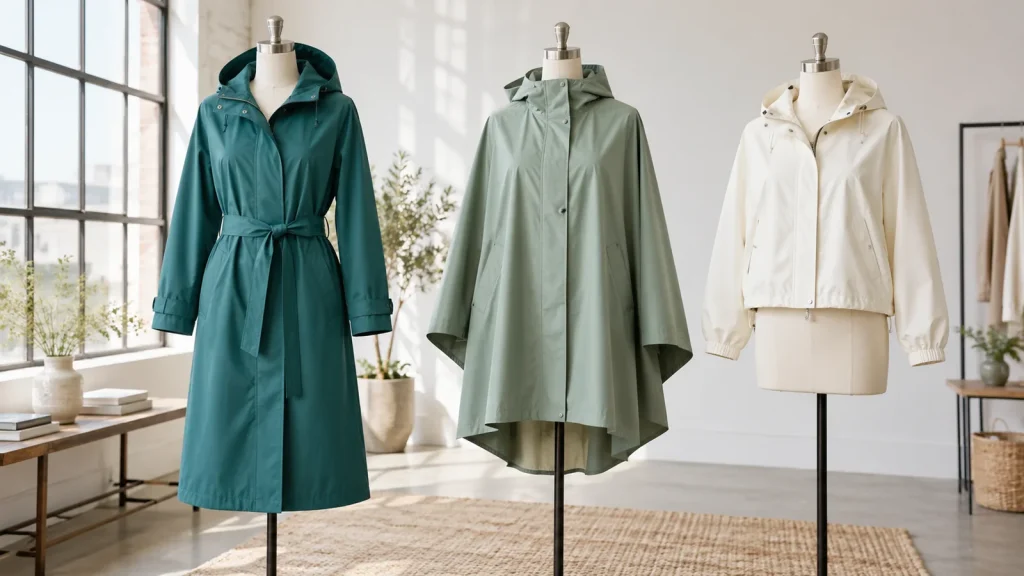
Develop a trench-style raincoat with purposeful proportions
A trench-style raincoat offers many design choices before the team reaches decorative details. Length, shoulder shape, front overlap, belt position and hem volume all change how the garment reads. Begin with the intended wearing situation and the clothes underneath. A long line may support a refined outerwear story, but it must still allow the wearer to walk and sit comfortably. A shaped waist may define the silhouette while reducing flexibility over thicker layers. Treat these relationships as development questions. The best proportion for the collection is the one that works on the intended wearer as well as on the sketch.
Use the front closure to establish the coat’s visual balance. The spacing of fasteners, width of the overlap and position of any placket affect both the appearance and the experience of opening the garment. Review the coat fully fastened, partly open and worn without the belt if that is an intended option. A design that only looks resolved in one arrangement may feel restrictive in everyday use. Ask the sample maker to show how the front edges behave when the wearer moves. The goal is a coherent shape through ordinary changes of posture, not a perfect moment held for a photograph.
Give the belt a defined job. It may shape the waist, adjust volume or simply support the design language, but each purpose needs a slightly different review. Consider the belt’s width, stiffness, length and tendency to twist. Check the position of loops across the proposed size range rather than assuming the same relationship works everywhere. If the coat is intended to be worn loose, make sure the belt can be managed without trailing or creating an awkward bulk. The buyer should also decide how spare or replacement components will be handled if the belt is a separate part of the product.
The back view deserves the same attention as the front. A yoke, vent, pleat or seam can create useful visual structure, but it also adds construction decisions. Ask how the chosen detail behaves when the wearer reaches forward or carries a bag. Check whether the hem stays balanced and whether the fabric catches around the seat when sitting. If the design includes an opening, review the intended coverage and supporting construction rather than assuming an overlapping appearance is enough. These observations belong in the sample record, with photographs and clear references to the garment revision being reviewed by the team.
Do not use familiar trench details automatically. A decorative flap, strap or buckle may add character, yet it can also introduce weight, movement, noise or another component to inspect. Each detail should earn its place in the brand’s version of the garment. A restrained rain trench may rely on proportion and fabric instead. A more expressive coat might use one carefully developed feature as its signature. Compare the options on a full-size sample. Small sketches tend to understate the cumulative effect of hardware and overlapping layers, especially around the collar, cuffs and upper front of the finished coat.
For wholesale development, turn the preferred silhouette into measurable references. Record the approved length, key widths, waist position, fastening layout and relevant tolerances with a measurement diagram. Keep visual approval separate from any unresolved performance checks. A buyer may like the line of the coat while still needing a different seam solution or hood adjustment. Documenting that distinction avoids accidental approval of the entire product. The trench direction can then move from a styling idea to a repeatable design, with the commercial discussion based on a specific construction rather than a general request for a luxury raincoat.
Balance cape and poncho volume with everyday movement
Capes and ponchos offer a different way to explore fashion rainwear because the outline can remain simple while the volume becomes expressive. The development challenge is to make that volume useful. Start by identifying where the wearer’s arms will move, how a bag will be carried and how the garment will be put on or removed. A generous shape may accommodate layers, but it does not automatically provide a good fit. The placement of openings, the front length and the way the sides behave all influence whether the piece feels deliberate or merely oversized during ordinary use.
Review arm access early. A cape with defined openings creates a different experience from a poncho with open sides, and neither should be chosen from appearance alone. Ask wearers to reach for a bag, hold a phone, sit at a table and put their hands in the intended pockets. Observe where the fabric lifts or gathers. If the garment is meant for walking and everyday travel, keep the review within those uses. Do not imply suitability for cycling, machinery or other situations where loose fabric may create separate risks without a specific design and safety assessment for that activity.
Balance the neckline and hood against the wider body. A voluminous shell can pull differently from a conventional sleeved coat, especially if much of its weight hangs from the neck area. Check whether the garment shifts backward or forward as the wearer moves. Review the hood with the front fastened and open, and assess whether the wearer can turn their head comfortably. These are practical observations, not substitutes for a formal performance claim. They help the designer identify where pattern changes may be more effective than adding another adjustment or fastening to compensate for an unresolved shape.
Consider how the side treatment affects the visual idea. Snaps, tabs or a partial seam may help manage volume, but their positions need to suit the intended range of bodies and layers. A fastening that creates a pleasing line on one sample wearer may pull at another point on a different wearer. Test the intended configurations and record which are actually useful. If several arrangements are possible, decide how the product will explain them. A design should not depend on the customer discovering an obscure fastening sequence before it becomes comfortable or looks like the approved sample.
The material choice has a particularly visible effect on a cape. A crisp construction may hold a sculptural outline, while a more fluid one may fall closer to the body. Both need review at full scale. A small swatch cannot show how the hem moves or how folds collect around the arms. Request a prototype in a relevant construction before approving the silhouette. If the first sample uses a substitute material, record that limitation and identify which decisions remain open. Otherwise, the team may approve a line that changes substantially when the final shell is introduced later.
For the buying team, define the cape as a distinct style with its own measurement and fitting logic. Avoid describing it only as one size or relaxed fit. Record the actual dimensions, intended wearer range and observations from the sample review. Explain any adjustable settings consistently in the product information. A well-developed cape or fashion poncho can offer a recognizable alternative within a rainwear capsule, but its value comes from the relationship between shape, access and material. The wholesale specification should preserve that relationship so a repeat order has the same usable character as the sample that won approval.
Use shorter rain jackets to build a complementary capsule
A shorter rain jacket can broaden a collection without repeating the role of a long coat. Begin by deciding what it adds. It may suit customers who prefer less fabric around the legs, a different proportion with their wardrobe or a layer that is easier to handle indoors. These are possible design purposes to test, not reasons to assume a shorter product will be more popular. Place the proposed jacket beside the longer styles in the range map. Its silhouette, material and details should explain why it belongs, while still sharing enough visual language to feel part of the brand.
Hem position is the first major decision. A cropped shape, hip-length jacket and slightly longer shell create different relationships with trousers, skirts and underlying layers. Review those relationships on wearers rather than relying on a flat measurement alone. Ask what happens when the wearer reaches upward or sits down. A jacket can look balanced while standing and then expose an unintended gap during movement. If that is part of the design, describe its intended use honestly. If it conflicts with the rainwear brief, adjust the shape before treating the styling sample as a finished solution.
Decide whether the jacket should look compact through the body or retain room for layering. These choices affect the armhole, sleeve shape and shoulder balance. Simply shortening a longer coat pattern may produce a garment that feels unfinished or distributes volume poorly. Ask the technical designer to review the short style as its own pattern. A shared fabric and color palette can connect it to the trench without forcing identical construction. The buying team should understand which components are genuinely shared and which need separate approval, because that distinction influences sampling and the eventual order structure.
Pay attention to where practical features land on the shorter body. Pocket openings can become crowded by the hem, while an adjustable lower edge may compete with a clean front line. Check the wearer’s hand position and the space available for the items the pockets are intended to hold. Do not call a pocket waterproof merely because its opening is covered. Its claim needs an appropriate construction and evidence review. In the design stage, a simple question is useful: can the customer use the feature comfortably without distorting the garment or exposing another weakness in the overall shape?
If packability is part of the short jacket’s appeal, define it. A garment that can be folded is not necessarily convenient to carry in the proposed pouch. Review the packed dimensions, the folding process and the appearance after unpacking under agreed conditions. Include the actual trims, lining and labels in that review because they contribute to bulk. Avoid promising a particular pocket or bag fit without a measured reference. The product team can instead specify a realistic pack format and show the buyer exactly what has been approved. That is more useful than an unsupported claim of effortless portability.
Use the shorter style to test the discipline of the capsule. It should have a clear purpose, a coherent fit and a manageable number of variants. Compare its development and stock requirements with the role it is expected to play. If the brand wants to launch it later, preserve the specification and pending decisions rather than treating it as an immediate production commitment. Stylish waterproof jackets deserve the same careful sample and claim review as longer raincoats. Their smaller outline does not make the buying decision simpler, but it can provide a strong complementary option when the details are resolved deliberately.
Explore the Rainwear Product and Material Guide for Wholesale Buyers to connect your chosen silhouette with a considered product specification.
03 / 12
Specify materials for stylish waterproof jackets

| Entity | Attribute | Value to define | Evidence and verification |
|---|---|---|---|
| Shell | Composition and construction | Exact fiber, coating or laminate specification | Supplier declaration tied to the approved sample |
| Fabric | Mass and thickness | g/m² and thickness with stated method | Include or exclude coating consistently |
| Garment | Fit dimensions | Chest, hip, length, sleeve and hood measurements | Measurement diagram, tolerances and size-set review |
| Surface | Color and appearance | Approved shade, gloss and texture references | Review shell, trim and decoration together |
| Closure | Configuration | Fastener type, spacing, coverage and operation | Finished-garment review and agreed checks |
| Seams | Construction | Sewn, sealed or welded details as applicable | Confirm method for each seam type |
| Performance | Water resistance | Product-specific claim and test conditions | Report identifies construction, method and conditioning |
| Branding | Artwork and placement | Approved dimensions and revision | Decorated sample on the intended substrate |
| Care | Complete-garment procedure | Supported instructions for the finished combination | Evidence review and appropriate care assessment |
| Packaging | Garment presentation | Fold, sleeve, carton count and identification | Approve packed sample and receiving information |
Assess drape, surface and sound on full-size samples
Material selection is where a fashion rainwear idea becomes tangible. A drawing can suggest a flowing coat, but the chosen construction determines whether the hem falls softly, holds a firm outline or gathers into bulky folds. Begin with enough material to see it at a useful scale. Hang a candidate fabric, place it over a form and handle several layers together. A small swatch is helpful for color and surface comparisons, yet it cannot answer every question about a finished garment. Keep those early observations separate from approval of the actual coat or jacket.
Look at the surface in more than one ordinary viewing situation. A matte finish can appear different near a window and under showroom lighting. A pale color may reveal construction details that are less visible in a darker version. Examine both the face and reverse, then consider how the reverse will be handled in the proposed design. If the garment is unlined, that surface becomes part of the customer’s experience. If it is lined, the extra layer changes the complete product. Ask for samples that represent the intended combination instead of judging the shell in isolation.
Listen as well as look. Move the material through the actions the wearer is likely to make and compare the sound with the intended character of the garment. Some brands may accept a noticeable rustle as part of a crisp shell; others may prefer a quieter result. There is no need to turn that preference into an unsupported technical claim. Establish a reference sample and a consistent review method for the team. The useful question is whether the actual experience fits the brand’s brief, not whether one material can be called universally more luxurious than another.
Review the material after the handling that production and delivery will require. Fold it using the proposed packing method, then examine how it looks after unpacking. Ask whether the garment needs a preparation step before presentation and whether that step is practical for the retailer. Do not recommend heat or steaming without confirming compatibility with the complete construction and supported care instructions. A sample that looks excellent straight from a development room may arrive with a different appearance after packing. The buyer needs to understand that difference before approving the presentation plan or promising effortless recovery to customers.
Consider a hypothetical choice between two teal constructions. The first holds the desired collar shape but creates a fuller fold at the waist. The second falls more softly but needs a revised collar design to achieve the same visual confidence. Neither is automatically wrong. Put both on a relevant prototype and discuss the trade-off with the pattern and production teams. The decision may be to change the fabric, alter the silhouette or accept a deliberate difference in character. That conversation is more productive than asking the supplier to make the coat feel expensive without a shared physical reference.
Keep the selected material identifiable. The approved reference should connect to a composition description, construction details, color reference and supplier designation. If a substitute is proposed later, compare it against both the visual reference and the technical requirements. A similar color alone does not establish equivalence. Fashionable raincoats wholesale programs depend on consistency across a production run and through repeat orders, so the material choice needs enough detail to be repeatable. Retain the reasons for the decision as well as the swatch: they help future reviewers understand which qualities are essential and which variations may be acceptable.
Separate the fabric name from the performance specification
A material name is a starting point, not a complete rainwear specification. Polyester identifies a fiber family; it does not tell the buyer how a particular fabric, coating, laminate or garment performs. Likewise, a general description of a film does not explain its thickness, finish, fastening compatibility or the construction of the finished coat. Ask the supplier to describe the proposed material in sufficient detail for your technical reviewer to assess it. Keep the description tied to the actual sample. A familiar name can make a proposal sound clear while leaving the most important differences unresolved.
Separate the layers and components in the specification. Identify the shell, any coating or laminate, the lining, trims and relevant seam materials. State what a reported mass or thickness includes, because values are difficult to compare when one proposal refers to the whole construction and another refers only to a base layer. Use consistent units and an agreed measurement method. The purpose is not to make the buying document unnecessarily scientific. It is to prevent two different products from appearing equivalent because their descriptions share a word or a number that was measured on a different basis.
Define the intended performance language before requesting evidence. If the brand wants to describe a garment as waterproof, ask the responsible reviewer what evidence and limitations are appropriate for that exact claim and use. If the intended statement is more limited, preserve that distinction throughout development. Do not allow the presence of visible water droplets on a sample to become the entire justification. Appearance, surface behavior, fabric resistance and finished-garment construction answer different questions. The buyer should know which question each sample observation or report addresses, and which parts of the proposed claim remain to be reviewed.
The same discipline applies to comfort language. Soft, breathable, lightweight and warm can mean different things to different customers. Some are sensory descriptions that need careful wording; others may imply measurable performance. Specify what the team actually wants to evaluate and how. A garment’s comfort also depends on fit, openings, layers, activity and conditions. Avoid presenting one material characteristic as a guarantee of the wearer’s entire experience. Where a numerical value is proposed, request the method, units and conditioning information so the technical reviewer can judge whether comparisons are meaningful for the intended product and market.
Bring construction into the discussion before the fabric decision is final. A selected material must work with the intended seam, decoration, closure and care approach. Ask the supplier to explain any limitations and propose a sample route that checks the relevant combinations. If the preferred visual finish creates a problem at a seam or print area, that issue should be visible while design choices are still open. A late change can alter the garment’s appearance, measurements or approval status. The buying brief should therefore treat material and construction as connected decisions, even when they are handled by different people.
For supplier comparisons, request a common description format. Include the proposed composition, construction, nominal physical values, color reference, intended finishing method and evidence still required. Mark unanswered fields openly. An incomplete proposal is easier to improve when the missing information is visible than when vague adjectives conceal the gap. The result is a more useful discussion with a designer rain gear manufacturer: the brand can explain the look and use it wants, and the supplier can show how a specific material and construction might deliver them. Approval then follows the evidence for that proposal rather than the reputation of a material category.
Use an EAV table to compare proposed constructions
An entity–attribute–value table gives a rainwear specification a practical structure. The entity is the part being discussed, such as the shell, closure or package. The attribute is the property that matters, and the value is the agreed requirement or the information still to be confirmed. Add an evidence column so the team knows how each decision will be checked. This format is useful because a premium raincoat is a combination of choices. It prevents a conversation about fabric from overshadowing fit, branding, care or delivery details that are equally important to the finished product.
Begin with fields the team can define responsibly. Use actual measurement points for garment dimensions and a clear description of how those measurements are taken. Identify the approved color and surface references. For performance, enter the proposed claim and the evidence requirements agreed with the technical reviewer rather than copying a number from an unrelated product. Where the value is not yet decided, use an explicit pending status and assign the next action. A table filled with invented precision is less useful than one that honestly distinguishes confirmed decisions from questions the sample program still needs to answer.
Keep values and methods together. A length without a measurement diagram can be interpreted differently, and a material mass without a description of the included layers can mislead. If the supplier uses a different method, resolve the difference before comparing results. The same principle applies to appearance. A shade name alone is not a reliable color approval record, while a photograph may change across screens and lighting. Reference the agreed physical sample and the conditions used for review. The table should point readers toward the evidence they need instead of trying to compress every detail into one ambiguous cell.
Use the table during sample reviews, not only at the end. When a sleeve length changes, update the relevant row and the drawing revision. If a closure is replaced, identify the new component and any checks that must be repeated. This makes the effect of a change visible across departments. The design team may care about the front line, while the quality team needs to know whether the fastening action and surrounding construction remain acceptable. A shared table lets both concerns be tracked without pretending that approval by one person automatically covers every aspect of the updated garment.
For a hypothetical comparison, Supplier A may propose a lined construction and Supplier B an unlined one. Their offers should not be treated as directly comparable merely because both describe a teal rain trench. The EAV rows reveal differences in internal finish, weight, care, packing and potentially the sample sequence. Ask each supplier to explain its proposal against the same intended use. You may decide that either construction could work, but the decision should be deliberate. The comparison is strongest when the team understands what changes with each option and which benefits are supported by actual samples or documents.
Make the final table manageable enough to maintain. Link detailed drawings, reports and artwork rather than pasting all their contents into a single spreadsheet. Assign a revision and identify who can approve changes. Keep the approved version connected to the purchase documentation, retained sample and receiving checks. This is where an EAV model earns its place in a fashion rainwear program: it makes creative and technical decisions easier to communicate and repeat. It does not replace professional judgment, but it gives that judgment a consistent record that remains useful after the people in the first sample meeting have moved to other work.
Compare construction questions in our PE, PVC, EVA and polyester raincoat material guide. Confirm the actual sample and evidence for your proposed garment.
04 / 12
Build fit and size consistency into fashionable raincoats wholesale
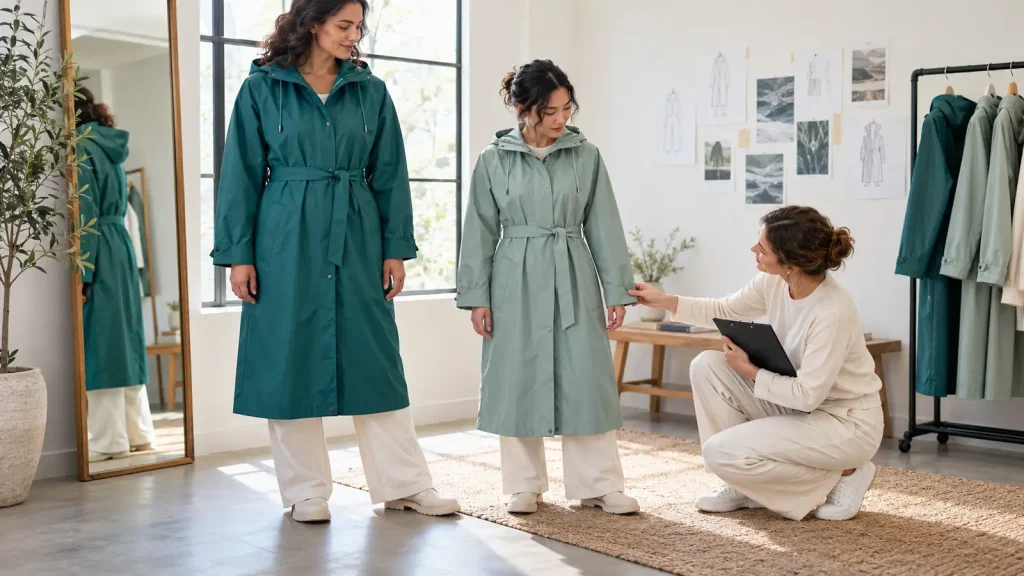
Fit the garment over the clothing customers actually wear
A raincoat is usually worn over something else, so its fit should be reviewed with those layers in place. Start by identifying representative outfits for the intended customer and season. A light shirt, a knit layer and a tailored jacket create different demands on the shoulder, sleeve and body. The sample does not need to accommodate every possible combination, but the intended combinations should be explicit. Otherwise, a coat can be approved over a thin fitting top and later described as suitable for broader layering that nobody has actually assessed during development or wear review.
Decide what the fit language means within your brand. Relaxed, regular and oversized are not universal measurements. Connect each term to the actual garment dimensions, intended ease and visual references. If the design uses a dropped shoulder, explain how that affects the sleeve measurement and the appearance across sizes. If the coat is shaped through the waist, check whether its fit remains comfortable when the belt is used as intended. A supplier can work more effectively with a measurable reference than with a size label whose meaning changes between markets, brands and product categories.
Assess the relationship between layers rather than checking only the outer garment. Look for areas where an underlying sleeve gathers or a jacket collar pushes the raincoat’s neckline out of position. Ask the wearer to put the coat on and remove it without assistance. Observe whether the lining or internal surface makes that process awkward with the chosen clothing. These details are easy to miss during a brief standing fit, yet they shape everyday use. A premium rainwear brief should treat the whole wearing experience as a development question, with enough time to revise the sample if necessary.
Use more than one wearer where the range warrants it. A sample that fits one person well may still reveal problems when tested on people with different proportions within the intended size category. The goal is not to claim that one coat will fit everyone. It is to understand the limits of the proposed fit and make the size information useful. Keep wearer feedback respectful and focused on the garment. Describe where the pattern needs more room, a different balance or a revised length, rather than treating a person’s body as the problem to be corrected.
For a hypothetical long coat, the first review might show enough chest room but restricted upper-arm movement over a blazer. Increasing the entire body width may not be the most effective solution. The technical designer should examine the sleeve and armhole relationship, then test the revision in the same layering context. This example illustrates why precise observations matter. A note that simply says too tight gives the sample maker little direction. A note that identifies the position, movement, underlying layer and garment revision makes the next sample more likely to answer the original question for the buying team.
Capture the approved layering intent in the final product information. The size chart, fit description and imagery should tell a consistent story. Avoid styling the garment with unusually thin layers if the public description emphasizes generous layering, unless the broader claim has been assessed separately. Keep the internal evidence and the customer-facing language aligned. Fashionable raincoats wholesale development becomes more reliable when fit is treated as a defined product attribute. The buyer can then approve the actual range of use and communicate it clearly to retail partners without relying on broad adjectives or a single flattering sample photograph.
Review movement, hood position and access across the size range
Standing still is only one small part of wearing a raincoat. Build a movement review around the intended daily tasks: walking, sitting, reaching forward, raising an arm and accessing the planned pockets. Keep the actions appropriate to the garment’s stated use. The review should reveal where fabric pulls, openings shift or the hood interferes with comfort and visibility. It does not establish a formal safety or weather-performance certification. It gives the development team concrete observations that can be addressed through pattern, construction or component changes before the style moves into a wholesale order.
Start with the hood in relation to the collar and front closure. Ask wearers to put it up, fasten the garment and turn their heads naturally. Check whether the hood stays in a useful position or whether the whole upper body of the coat moves with it. Note any pressure at the neckline and any part of the opening that obscures the wearer’s view in the intended use. An attractive hood shape on a form can behave differently on a moving person. Review the complete arrangement rather than approving the hood separately from the garment that supports it.
Check arm movement with the coat both open and closed where those configurations are intended. A sleeve may feel comfortable at rest but pull the body upward when the wearer reaches. A cape may allow generous arm space while lifting the front more than expected. These observations call for a design review rather than an automatic instruction to add more volume everywhere. Ask the pattern team to identify the cause and propose a targeted revision. Repeat the same actions on the next sample so the team can tell whether the change solved the issue or merely moved it elsewhere.
Review pockets with realistic objects and ordinary hand positions. A pocket that looks elegant may be awkward to enter when the coat is fastened, or its contents may distort the front line. Decide what the pocket is intended to hold and what claims will be made about it. A phone-sized opening does not prove protection for a phone in wet conditions. Keep access, capacity and any protective claim as separate questions. Test the first two directly in the sample review and route the last through the appropriate construction and evidence assessment before using it in public descriptions.
Include different sizes at the right stage. The base-size sample can establish the main design direction, but it cannot confirm every detail of the size range. Hood relationships, pocket positions, sleeve lengths and hem balance may need attention as the garment is graded. Ask for a size-set review appropriate to the program and record which sizes have actually been assessed. If a problem appears at one end of the range, investigate the underlying relationship instead of assuming the wearer should simply choose a different size. The product information should reflect the fit the brand has developed and reviewed.
Turn feedback into an actionable list. Identify the sample revision, wearer size, task, observed issue and requested next step. Use photographs or short internal videos with the participants’ permission where useful, and keep those records private to the development process. Prioritize issues that affect the core use before minor styling refinements. A coherent movement review helps the buyer protect the design’s practical value without losing its fashion character. When the finished coat feels easy to wear, that result should come from deliberate decisions in the sample program rather than from a hope that customers will work around unresolved details.
Define a useful size chart and grading approval process
A size chart should help the intended customer make a choice, while the internal measurement specification should help the supplier produce the garment consistently. These are related documents, but they do different jobs. Decide whether the public chart shows body measurements, garment measurements or both, and label it clearly. Do not mix the two without explanation. A chest measurement taken around a person cannot be compared directly with an unexplained flat garment width. The buyer should agree the measurement language early so the chart, fit notes and sample records develop from the same understanding.
Create a measurement diagram for the internal specification. Show the starting and ending points for each measurement and explain any relevant garment position, such as whether a closure is fastened or an adjustable feature is relaxed. Use consistent units and agreed tolerances. Include the measurements that control the design and intended fit rather than collecting numbers without a purpose. A long rain trench may need particular attention to waist position and hem balance, while a cape requires a different set of references. The diagram helps prevent a repeat order from being judged through a different measurement interpretation.
Review grading as a design process rather than a simple arithmetic exercise. The relationship between sizes should preserve the intended silhouette and usable fit, but not every feature necessarily changes in the same way. Ask the technical team to explain the proposed rules and identify areas that need sample confirmation. This is especially useful for hood dimensions, pocket placement and adjustable components. The buying team does not need to prescribe the technical solution without expertise. It needs a clear approval process and enough evidence to know that the complete size range has been considered before production is released.
Make the size-set review practical. Identify which samples are required, who will review them and which issues must be resolved before sign-off. Keep observations tied to the exact size and revision. A change made after the review should trigger a decision about whether affected sizes need another check. Do not assume that correcting the base size automatically corrects every graded version. Equally, avoid demanding repetitive reviews when a qualified technical assessment shows they add no useful information. The goal is a proportionate process that addresses real fit risks and leaves a clear record of the approved range.
Think about how retail partners will use the chart. A boutique team may need concise fit notes that explain intended layering and the difference between two silhouettes. An online listing may need a clearer distinction between body guidance and actual garment dimensions. Supply the information in a consistent form and keep revision control over it. If the product changes, update the relevant descriptions and partner materials instead of allowing an old chart to circulate beside new stock. Size information is part of the product experience, and inconsistencies can create avoidable confusion even when the garment itself matches the approved specification.
Before bulk release, check that size labels, carton identification, packing lists and the customer-facing chart refer to the same range. Confirm how mixed-size cartons will be identified and how receiving teams can distinguish sizes without repeatedly opening individual packs. These operational details connect fit development to stock management. For a premium rainwear program, a well-resolved size system supports the design from sampling through delivery and reorder. It gives the supplier measurable requirements, gives the brand a defensible approval record and gives the eventual wearer information that is specific enough to help them choose the intended fit.
05 / 12
Create a distinctive palette and surface design for premium rainwear
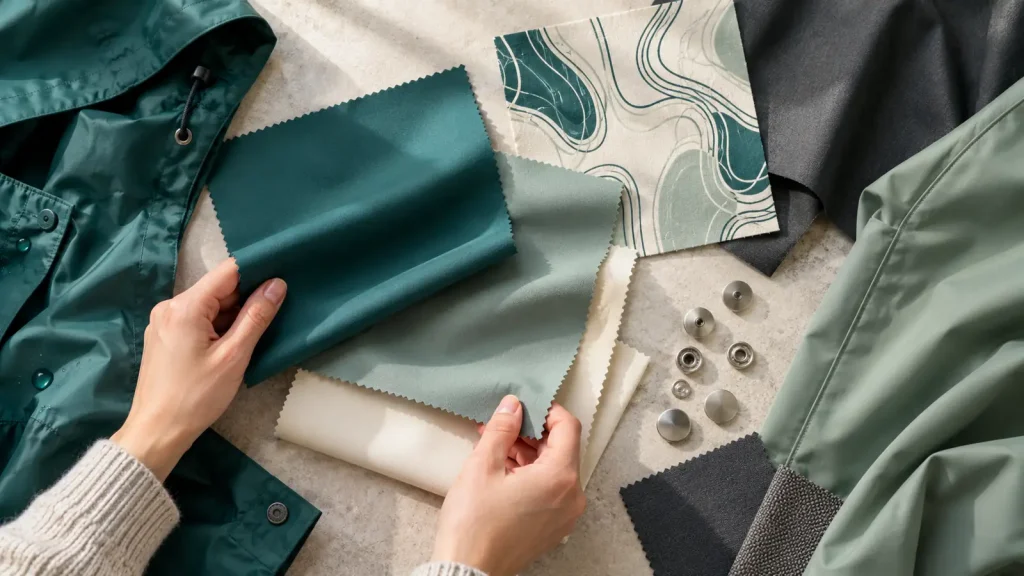
Build color stories that remain coherent across components
Color is often the first detail a buyer notices, but a finished raincoat contains several surfaces that may not read alike. The shell, lining, zipper tape, snaps, thread and labels can each respond differently to light. Start with the intended relationship between those components. Some designs need a close tonal match; others use a deliberate contrast. Write that choice into the brief instead of leaving every supplier to interpret coordinated in its own way. A controlled difference can be attractive, while an accidental near-match may make an otherwise resolved garment feel inconsistent when viewed up close.
Develop the palette in the context of the brand’s wider collection. Place candidate rainwear colors beside the apparel and accessories they are expected to accompany. A shade that looks compelling alone may compete with the existing range, while a quieter option may make the silhouette more versatile. Do not assume that every fashion direction needs a new seasonal color. The buyer can choose a core shade, a considered accent or a small palette based on the program’s purpose. The important point is to explain what each color contributes before adding the sampling and stock requirements it creates.
Use physical references for approval where color accuracy matters. Digital images and screen values are useful for communication, but they do not replace an agreed sample review. Ask how the supplier will identify the approved shade and manage related components. Review the intended production material rather than accepting a color on an unrelated substrate as final. A smooth coating and a textured lining can appear different even when their color descriptions are similar. The brand should decide whether that difference supports the design or needs adjustment, with the decision recorded against the actual combination being developed.
Look at the complete coat under relevant lighting conditions. The goal is not to promise that it will appear identical everywhere; it is to identify combinations that become distracting or unexpected in normal use. A dark fastener may disappear on one shell and stand out sharply on another. A light lining may show at the neckline or hem in ways that change the silhouette. Review these moments on the sample and consider them across the proposed colors. A detail approved on the first shade should not be assumed to work equally well when the shell becomes much lighter or darker.
For a hypothetical capsule, a brand might use a deep teal trench, a sage jacket and a neutral cape. The colors can connect the range without requiring every style in every shade. That structure may support a clearer assortment, but its suitability depends on the brand’s own customer knowledge and buying plan. Ask the supplier how the proposed mix affects material minimums, trim availability and repeat orders. A color decision is both creative and operational. Understanding those implications early helps the team avoid approving a palette that cannot be supplied in the intended quantities or replenished on the required basis.
Maintain a color approval register with the style, component, reference and revision. If a substitute is offered, review the whole combination before accepting it. Keep the retained sample accessible to quality and receiving teams, not only to the designer who chose it. This matters when different people review development, production and delivery. A coherent color story is easier to preserve when everyone knows what was approved. For fashionable raincoats wholesale, that consistency can be more valuable than an expansive palette whose details vary between samples, cartons and later orders without a clear explanation.
Use patterns and panels with a clear production plan
Patterns can give rainwear a distinctive identity without relying on a large logo. The first decision is how the pattern relates to the garment. An all-over design, a contrast panel and a small placement print each create different visual and production questions. Sketch the idea on front, back and side views, then consider where seams and openings interrupt it. A pattern should be developed for the actual silhouette rather than simply placed over a flat rectangle. Its scale and position can change how the customer reads the shape, especially on a long coat or a voluminous cape.
Decide whether continuity matters at each seam. Some abstract patterns work well with a loose relationship between panels; stripes, checks or directional motifs may need a more controlled approach. Do not leave that expectation implicit. Identify the areas where alignment is important and ask the supplier to explain feasibility, tolerances and material implications. The buyer should understand the trade-off before approving the artwork. A design can be simplified or deliberately interrupted if that better suits the program. What matters is that the finished result follows an agreed intention rather than an assumption made during cutting or assembly.
Review the pattern at garment scale and across the size range. A motif that looks balanced on a small artwork sheet can become too dominant when repeated over a full coat. A placement that works on the base size may crowd a seam or pocket in another size. Request a suitable mock-up and then a decorated sample on the intended material. Treat the mock-up as a communication aid, not final evidence of print appearance or performance. The physical sample is where the team can judge color, edge definition, surface feel and the relationship between artwork and construction.
Contrast panels need the same care even when no printing is involved. Confirm the materials, colors and joining methods for each part. If the panels use different constructions, ask the technical team to review their compatibility with the intended assembly and care procedure. Consider how the seam line affects drape and the wearer’s movement. A striking color block can become the product’s main visual feature, so small inconsistencies in position may be especially noticeable. Include the panel layout in the measurement and appearance criteria rather than relying only on a general photograph of the approved sample.
Keep artwork ownership and production rights explicit. Use original designs or material for which the brand has the necessary permission. Identify the files approved for the program and the allowed uses, especially when a pattern is connected to a collaboration or a limited collection. Do not assume a supplier can reproduce any image found online. Clear artwork instructions protect the development process from avoidable confusion and give the production team a reliable source. If the design is revised, withdraw the old production version through the agreed change process while retaining it privately for traceability and comparison.
Ask how the selected pattern affects the broader order. Printing, panel cutting, color approvals and sample timing can influence the development sequence and the feasible assortment. Request a proposal that identifies those dependencies instead of treating decoration as an isolated last step. The brand can then decide whether the pattern belongs across the full range or on one focused style. Original surface design is most useful when it supports a coherent rainwear product. Its value comes from the connection between artwork, material, shape and execution, with each part reviewed before the wholesale program is released.
Choose hardware finishes that support the garment’s character
Hardware is a small part of the raincoat by area and a large part of the wearer’s interaction with it. A snap, zipper pull, buckle or adjuster can make the design feel resolved, but it also has a job to do. Begin by listing the required functions and the places where hardware will be touched or seen. Decide which components should blend into the garment and which may act as a deliberate accent. This prevents the buying team from selecting attractive trims independently and discovering that their combined weight, shine or scale overwhelms the intended silhouette.
Review the fastening action on the actual garment. A component that operates neatly when held alone may behave differently once installed through several layers. Check whether the surrounding material distorts, whether the wearer can grip the part comfortably and whether opening it requires an awkward pull. Ask the technical team to define appropriate functional and durability checks for the intended use. Do not substitute a brief handling impression for evidence where a performance claim is involved. The design review and the quality plan should complement each other, with each clearly identified in the approval record.
Consider the finish alongside the shell under relevant lighting. Brushed, polished, matte and color-matched parts can create different visual relationships. Review all visible hardware together rather than accepting each item separately. A coat with several nominally silver components may still look inconsistent if their surfaces differ noticeably. The brand can choose that contrast deliberately, but it should not arrive as a surprise. Retain approved component samples and identify the supplier references. These details are particularly useful if a repeat order is placed after the original development team has moved on to another collection.
Ask about the component’s composition, finish and relevant evidence for the destination market. A pleasing appearance does not establish chemical suitability, corrosion performance or compatibility with the care procedure. Route those questions to the appropriate technical and compliance reviewers, using the exact proposed component rather than a generic trim category. If a part is changed, identify whether its supporting evidence and installed performance need another review. This is not a reason to make broad claims about one type of hardware being universally safer or more durable. It is a reason to evaluate the actual part in its intended application.
Think about service and replacement before choosing a highly distinctive component. A custom pull or buckle may strengthen the design, but it may also create a dependency if the brand wants to support repairs or repeat orders. Ask whether replacements can be supplied, how they will be identified and what installation would require. Keep any repair promise consistent with the service the brand can actually provide. A spare part in a drawer does not by itself create a workable customer process. The buying team should understand who will handle the request and which components can realistically be replaced.
Finally, review hardware as part of the packed garment. Confirm that prominent or rigid parts do not create unacceptable marks, pressure points or presentation issues under the approved packing method. Include the final trim set in the pre-production sample rather than leaving substitutions unresolved. A premium rainwear program benefits from this attention because the wearer encounters hardware repeatedly. The right choice is not necessarily the most elaborate or expensive-looking one. It is the component that supports the intended appearance, works appropriately in the assembled garment and can be supplied consistently within the agreed OEM Program.
06 / 12
Make raincoat details feel considered in daily use

Resolve the hood, collar and front closure as one system
The upper part of a raincoat concentrates many decisions in a small area. The hood must sit in a useful position, the collar must feel comfortable and the front closure must support the intended coverage and appearance. Develop them together. A hood approved on its own may pull differently once attached to the coat, while a high collar may change how the fastening feels near the face. Begin with the intended wearing configurations and review each one on a complete sample. The design should remain understandable when the wearer changes from an open indoor arrangement to the intended closed arrangement.
Check the neckline before adding adjustments. If the garment sits poorly at the shoulder or neck, extra cords or tabs may conceal the issue without resolving it. Ask the technical designer to review the underlying balance. Then decide which adjustments genuinely improve the wearer’s experience and which merely add complexity. A clean fashion raincoat may need only a small number of well-positioned controls. If an adjustment is included, check that it is reachable, understandable and compatible with the design. Do not assume a feature is useful because it appears on another raincoat or gives the garment a technical appearance.
Review how the hood behaves when it is down. It may rest against the upper back, interact with a collar or create bulk beneath a bag strap. That arrangement is part of the coat’s appearance for much of its use. If the hood is removable or stowable, assess the attachment and storage process as a separate development question. Confirm what happens to the exposed fastening and how the garment looks without the hood. A removable feature should not leave the remaining product feeling unfinished. The sample program needs to cover the configurations the brand intends to show or describe.
The front closure should be assessed for operation and construction as well as its line. Look at the overlap, fastening spacing, lower opening and any protective flap. Ask how the proposed arrangement supports the product’s intended weather claim, then obtain the appropriate evidence for the final design. A flap can contribute to a considered construction, but its presence alone does not prove that the garment is waterproof in every use. Keep the language precise and review the complete configuration. Fashion styling and technical substantiation can coexist when the team is clear about what has actually been evaluated.
Consider different users’ ordinary interactions with the closure. Can the intended wearer start the fastening easily, reach the relevant parts and open the coat without excessive effort? Check the arrangement with the planned layers and at the sizes being reviewed. A long coat may introduce handling questions that a short jacket does not. Record where the wearer hesitates and whether the issue comes from visibility, grip, position or the component itself. This kind of observation gives the supplier a specific problem to solve. It is more useful than a broad instruction to improve usability without showing what happens.
Before approval, inspect the upper front from inside and outside. Confirm that labels, seam finishes and attachment points do not undermine the intended comfort or presentation. Keep the final hood, collar and closure details in the technical drawing and retained sample. If any component changes during production planning, review its effect on the complete arrangement. The result should be a raincoat whose most frequently used features feel coherent. For a high-end brand, that coherence can express quality more convincingly than a long list of details that have been selected individually but never resolved as a finished garment.
Design pockets and openings around real tasks
Pockets should begin with a use case. Decide whether the wearer needs a hand pocket, a small-item pocket, an internal compartment or a feature intended primarily to support the garment’s appearance. Those purposes may overlap, but they should not be confused. A visually discreet opening can be awkward if placed too high or too far back. A generously sized pocket can distort a clean front when filled. Test the proposed design with the objects and hand positions relevant to the brief. The aim is to understand the actual experience before the brand describes the feature as practical or convenient.
Review access while the coat is worn and fastened. The wearer’s arm approaches the opening from a different angle than a designer’s hand at a worktable. Check the interaction with a belt, front overlap and any adjacent panel. Ask whether the pocket can be used without lifting the garment in an unintended way. For a cape, arm openings may affect which pocket positions are accessible at all. Treat these relationships as part of the pattern review. Moving an opening slightly can change its usefulness, but it can also change the visual balance or the construction around it.
Separate capacity from protection. A pocket may hold a phone comfortably without being suitable for a claim that it keeps electronics dry. Covered openings, zippers and linings require evaluation in the complete design if a protective statement is proposed. Do not let the sales team infer that claim from the appearance of the closure. The buying brief should identify what the brand wants to say and route it through the technical review. In the meantime, describe only the established features, such as the pocket’s position or intended storage role, without expanding them into an unsupported guarantee for valuable contents.
Consider how contents change the coat’s line. Place representative items in the approved sample and observe the garment from the front, side and back. Check whether the pocket bag becomes visible, whether the hem pulls unevenly or whether the wearer feels an uncomfortable edge. A premium design may choose a smaller capacity to preserve a particular silhouette, but that trade-off should be deliberate. The team can also revise the pocket structure or placement. The useful discussion is about the desired balance between appearance and function, supported by the actual sample rather than a general preference for larger pockets.
Openings elsewhere on the garment deserve similar attention. Cuffs, side vents and lower closures affect movement, coverage and styling. Decide which configurations are intended and whether they need instructions. An adjustable cuff may help accommodate layers, but the fastening should not create an awkward projection or an uncomfortable overlap in the positions customers are likely to use. A side opening may improve ease while changing coverage during movement. Review those effects together. No single detail should be approved in isolation if its operation changes the way the rest of the raincoat sits or performs in use.
Document the finished arrangement with dimensions, component references and clear photographs. Include pocket and opening checks in the agreed quality review so that production is judged against the same expectations as development. If the design uses a hidden detail, make sure the supplier and inspector can still identify it reliably. Buyers sourcing stylish waterproof jackets should not have to choose between an elegant appearance and understandable function. A focused sample process can clarify both, leaving the brand with features that are easy to explain because their purpose, limits and execution have been considered from the beginning.
Review seams, linings and finishing from both sides
The inside of a raincoat is part of the product, even when most campaign imagery shows the outside. Customers handle the garment, put it on, remove it and may leave it open. Review the interior with the same attention given to the front silhouette. Identify whether the design is lined, partly lined or unlined, and decide what finish is appropriate for the intended construction. Ask the supplier to show the proposed seam treatment on a relevant sample. A description such as clean finish needs a physical reference if it is to become a repeatable production expectation.
Seam choices should follow both the material and the intended product claim. Different constructions may call for different joining or sealing approaches, and the suitability of an approach should be assessed for the actual combination. Do not assume that every seam on the garment can use the same method or that a visually neat seam establishes weather performance. Identify the relevant seam types in the drawing and ask for technical input where needed. The buyer’s job is to ensure the proposal is specific and reviewed, not to prescribe a universal solution without considering the selected shell and design.
Look for changes in the way the fabric falls near seams and layered areas. A front that drapes smoothly in an unassembled panel may become stiffer around a pocket or overlap. A collar may look different once its internal structure is included. These effects are not necessarily defects; they are part of the construction’s character. The design team should decide whether they support the intended look. Ask for a sample that includes the real layers and trims before approving the final shape. Otherwise, the production version may differ from the development sample for reasons that were entirely predictable but never reviewed.
If a lining is proposed, assess its relationship with the shell. Check the ease of putting on the garment over the intended clothing, the way the layers move together and the finish at openings. Include the lining in care and claim reviews. A shell and lining may each have acceptable individual properties while their assembled combination still needs assessment. Avoid selecting the lining solely by color or touch at the swatch stage. The complete garment is the useful reference because it shows the interaction of layers, seam positions and movement that a separate fabric sample cannot demonstrate on its own.
Inspect finishing details under consistent conditions. Look at edge treatment, thread ends, visible markings, component alignment and the overall presentation of the inside. Define the acceptance criteria with the supplier and quality reviewer rather than leaving them as a subjective instruction to make everything perfect. Some variation may be inherent in an agreed construction, while other issues clearly conflict with the approved reference. Use photographs and sample examples to make the distinction understandable. The goal is a practical inspection language that can be applied consistently by people who were not present during the original design discussions.
Retain a complete approved sample with its internal details accessible. If the brand supports repairs, ask how the construction affects access to relevant components and what work should be performed by qualified people. Do not promise easy repair simply because a seam is visible. The final specification should connect appearance, assembly, performance review and service expectations. This attention to both sides of the garment helps a premium rainwear program remain coherent from showroom handling to everyday wear. It also gives the buying team a stronger basis for evaluating alternatives when a supplier proposes a change to materials or construction.
07 / 12
Plan discreet branding for a designer rain gear manufacturer brief

Choose branding placements that suit the silhouette
Discreet branding starts with a clear view of the garment. Before choosing a print or label, identify the lines the designer wants the wearer to notice: a long front, a shaped collar, a clean cuff or an expressive panel. Branding can reinforce those lines or interrupt them. Place proposed marks on front, back and side drawings, then review their scale on a physical sample. A logo that looks restrained on a screen may feel dominant on a moving coat. The right size depends on the silhouette and the brand’s own visual language, not a universal rule about premium products.
Consider when and where the mark is visible. A small cuff detail appears during hand movement, while an internal label is encountered when the garment is put on or removed. A back placement may be prominent in some wearing situations and hidden by a bag in others. Decide whether that matters to the program. The buying brief should explain the desired role rather than demanding maximum exposure by default. A fashion brand may value recognition through shape, color and finishing as much as through a visible name. The supplier needs to understand that balance to propose appropriate decoration options.
Review branding with the garment in its intended configurations. A belt can cover a placement, a folded hood can conceal a mark and an open front can change the relationship between two elements. Check whether the design remains coherent without forcing the wearer into one arrangement. If the mark is meant to align with a seam or pocket, define the reference point and tolerance. Avoid vague instructions such as place it neatly near the edge. Clear dimensions and a decorated reference sample make it easier for production and inspection teams to preserve the approved appearance consistently across the order.
Think about scale across sizes. A fixed-size mark may look different on a small jacket and a much larger coat. That difference may be acceptable, but the brand should decide deliberately. If artwork dimensions change by size, identify the additional files and controls required. The same question applies when one brand element is used across a trench, cape and short shell. A shared visual idea does not require identical placement on every product. Adapt it to the silhouette while keeping the underlying identity coherent, and make those distinctions explicit in the artwork and technical documentation.
Use the package as part of the branding conversation without assuming it must repeat every garment detail. A simple pouch, sleeve or hangtag can carry information that would crowd the coat itself. Decide which messages belong on the permanent product, which belong on packaging and which belong in retail materials. Keep required information and optional brand storytelling distinguishable in the development process. The responsible reviewer should confirm the applicable labeling requirements for the product and destinations. A restrained appearance is easier to achieve when the team plans information placement early instead of trying to fit everything onto the final sample.
For a designer rain gear manufacturer brief, provide a complete branding map. Include artwork files, approved colors, dimensions, reference points and the intended process or processes still under consideration. Ask the supplier to flag any placement that conflicts with assembly or the material’s behavior. Do not treat a digital approval as the final word on the physical result. A decorated sample lets the brand assess the relationship between identity and garment in context. That is the point at which discreet branding becomes an intentional part of the rainwear design, rather than an attractive graphic added after the important decisions have already been made.
Approve decoration on the actual material and color
Decoration should be developed with the selected rainwear construction, not assumed to transfer unchanged from another garment. The shell’s surface, coating, color and assembly can affect the appearance and suitability of a proposed process. Start by asking the supplier which methods it proposes for the exact material and placement. Request an explanation of any limitations and the sample checks needed before approval. A method name alone does not establish the result. Screen printing, transfers, patches and labels all need evaluation in the context of the product rather than being ranked as universally best for premium rainwear.
Use the intended production substrate for the decorated sample wherever possible. If an early trial uses a substitute, identify it clearly and limit the decisions it supports. A successful appearance on one color or finish does not automatically approve every variation in the range. Ask which combinations need their own review, especially where contrast, opacity or surface character changes. The purpose is to avoid overgeneralizing from one attractive sample. Buyers can keep the development efficient by agreeing a sensible representative approach with the technical team while remaining clear about the limits of the evidence collected.
Assess the decoration as part of the garment’s feel. Look at its surface, edge definition, flexibility and relationship with folds. A graphic that appears crisp while flat may become distracting around a curved or frequently flexed area. A label can feel different once attached at a neckline or cuff. Ask wearers to handle the decorated sample in the intended way and record specific observations. These practical checks help the design team choose between alternatives, while appropriate durability and compatibility assessments address the performance questions. Neither type of review should be represented as covering the other without supporting evidence.
Include the planned care procedure in decoration approval. The final combination of shell, print or attachment, lining and trims needs to be considered together. Ask the responsible reviewer which assessments are appropriate and how the results will be documented. Do not instruct customers to iron, wash or treat a decorated area based only on a generic material description. Equally, do not invent restrictive care language simply to avoid evaluating the product. The brand needs supported instructions and a decoration process consistent with them. This connection is easier to manage while samples are still being developed than after labels have been produced.
Approve color and position on the physical sample, then preserve the artwork revision used to produce it. If the supplier makes an adjustment to improve feasibility, request an updated proof and note whether another physical sample is required. Keep the distinction between design approval and production release clear. A buyer may accept the revised graphic while still awaiting a compatibility check. A single message saying approved can be misunderstood if it does not identify the scope. Specify what is accepted, what remains open and which reference will control the next stage of the OEM Program.
For repeat orders, retain enough information to reproduce the result. Keep the artwork, dimensions, substrate identification, process details supplied by the manufacturer and approved decorated sample together. If the material or process changes, assess whether the previous approval still applies. A recognizable logo is not the only measure of consistency; placement, finish and feel contribute to the brand’s presentation too. Careful decoration approval gives fashionable raincoats wholesale programs a more dependable identity. It also helps the brand explain its requirements to a new reviewer or supplier without relying on the memory of one person from the original development meeting.
Control labels, artwork files and ownership before production
Branding administration becomes easier when every file has a defined purpose. Separate the master artwork from proofs, placement drawings and production-ready versions. Give each approved file a clear name and revision, and identify who can authorize changes. This is ordinary production discipline, but it matters particularly when several people contribute to a fashion collection. A designer may adjust a logo size while a packaging colleague uses an older version. Without a shared approval record, both files can look legitimate. The supplier should receive one current instruction set rather than having to decide which attachment represents the brand’s final intention.
Prepare a label schedule for the proposed garment. Identify the brand label, size identification, care information and other product information required for the intended markets. State where each item will be placed and who is responsible for approving its content. Keep legal or technical review separate from visual approval. A label can look correct while containing an inaccurate description, and accurate information can still be placed in a way that is difficult to find or use. The development process should address both. Avoid assuming that one existing label format is suitable for every material, destination and type of rainwear.
Confirm ownership and permission for artwork supplied to the manufacturer. If a collaborator, artist or licensing partner is involved, make sure the brand’s internal team understands the allowed use and any relevant approval conditions. Do not ask the supplier to infer permission from a public image or an earlier product. The procurement record should identify the approved assets and the party responsible for authorizing them. This is a practical way to reduce confusion; it does not replace legal review where contractual questions arise. Keep the actual rights documentation with the people responsible for managing it within the business.
Check the physical label sample as carefully as the digital proof. Review readability, dimensions, attachment and feel in the final location. Confirm that the size label corresponds to the approved range and that the care information matches the finished construction. If a removable hangtag carries additional guidance, verify that its wording does not contradict the permanent information. A premium raincoat should present a coherent set of instructions and identity details. The buyer can achieve that by reviewing the complete label set on one sample instead of approving each component in isolation at different points in the production calendar.
Build a simple change process. When an artwork or label revision is approved, identify the affected styles, colors, sizes and packaging. Ask the supplier to confirm which version will be used and whether any material has already been produced. Decide how obsolete versions will be handled within the authorized production arrangement. Do not leave the change as an informal note in a long conversation. A revision that seems minor to the creative team can affect printing, stock identification or the consistency of a repeat order. Clear records give the buying team a way to resolve those questions before shipment.
At final approval, assemble a compact production pack containing the current drawings, artwork references, label schedule and approval notes. The pack should make it easy to find the controlling information without duplicating conflicting copies. Keep the retained sample connected to that revision. When a future order is discussed, begin by confirming whether the same identity and information remain appropriate. This approach supports a repeatable private-label rainwear program while leaving room for intentional design updates. It also gives the brand a clearer basis for discussing new ideas, because everyone can distinguish the established product from changes that still need review.
Develop the decorated sample with our custom printing guide for branded rainwear, and coordinate the presentation through our rainwear packaging guide.
08 / 12
Use a sample program that answers fashion and performance questions

Separate concept, fit and production approval decisions
Not every sample answers the same question. A concept sample may help the team understand volume and appearance, while a fit sample may focus on measurements and movement. A production-relevant sample should show the proposed materials, components, decoration and finishing together. Agree the purpose of each stage with the supplier before requesting it. This avoids a familiar misunderstanding: one person approves the silhouette and another interprets that message as approval of the complete product. The buying team needs a sample sequence that closes specific questions, with a clear record of what each review can and cannot establish.
Begin with the largest uncertainties. If the silhouette is unproven, a full decoration exercise may be premature. If the shape is established but the material is new, the priority may be compatibility and drape. Ask the supplier to suggest an efficient route and explain the dependencies. The brand should still decide which approvals are required before production release. A shorter sample sequence is useful only if it answers the necessary questions. Skipping a stage without considering the unresolved risks can create more work later, especially when changes affect several components or the intended weather-performance language.
Label development samples clearly in the private approval system. Include the style, size, material reference, revision and purpose. Note any substitute parts or unfinished details. A beautiful sample with temporary hardware can still be useful, but it should not become the final reference by accident. Photographs should carry the same identification in the internal record. This makes it easier for colleagues in different locations to discuss the same object. It also helps the team understand why two samples differ without relying on memory or on the order in which parcels happened to arrive at the office.
During the review, separate observations from decisions. An observation might be that the collar sits high when the hood is down. The decision might be to revise the collar height, retain it as intentional or request another wearer assessment. Keep the reason for the decision where it affects later interpretation. A note saying fixed does not explain what changed or which version was checked. Use the approval list to show the issue, owner and next evidence needed. That structure helps the supplier respond precisely and prevents unresolved comments from disappearing beneath a general message that the sample looks good.
For a hypothetical trench program, the team may approve the outline on the first sample, revise the sleeve on the second and then review the final shell, lining and decoration together. The exact sequence will vary by project. The important point is that each stage has a purpose and that approvals are not silently carried into areas they did not cover. If a late material change alters the drape, the earlier appearance approval may need another look. A controlled process allows that judgment to be made deliberately instead of treating all previous sign-offs as permanently valid regardless of changes.
Before release, hold a final review against the current specification. Confirm the open issues are resolved or explicitly addressed in an agreed plan. Identify the approved reference sample and the production documentation it matches. Ask the supplier to confirm that the proposed bulk construction follows that reference. A sample program is most valuable when it leads to a clear decision, not simply a collection of parcels. For a high-end rainwear brand, this discipline protects both the visual idea and the practical details that make the garment wearable, explainable and repeatable through the wholesale order.
Run a practical wear review with recorded observations
A practical wear review helps a brand understand the garment in ordinary use. Define the purpose before handing samples to participants. You may want feedback on layering, hood operation, pocket access, movement or handling when the coat is removed. Use a consistent set of tasks appropriate to the product’s intended use, and explain that observations should be specific. A broad comment such as comfortable or awkward is a starting point, but it is more useful when the reviewer identifies the situation, the affected feature and what happened. That detail gives the development team something it can investigate and improve.
Choose participants whose clothing and proportions are relevant to the planned range. Keep the process respectful and obtain permission for any internal photographs or recordings. Do not use the review as a basis for claiming universal fit or performance. A small group can reveal practical issues, but it does not represent every possible wearer or condition. Record the sample size and revision, the underlying layers and the relevant tasks. This context helps distinguish a pattern issue from an unsuitable sample size or a use that falls outside the brief. The result should be useful development evidence with clearly understood limits.
Ask participants to put on and remove the garment without coaching at first, where it is reasonable to do so. Observe which features are intuitive and which require explanation. Then review the intended method and see whether the difficulty remains. A confusing closure may need a design change, clearer instructions or a simpler configuration. Do not assume that adding a hangtag solves every usability problem. If the product depends on a complicated sequence for ordinary wear, the brand should decide whether that experience fits its intended customer and whether a more direct design could achieve the same visual effect.
Include the moments between outdoor use. The wearer may carry the coat, place it over an arm, hang it or pack it in a bag. Review those actions if they are part of the product story. Check whether loose components become awkward and whether the approved packing approach is understandable. Keep care and drying instructions tied to the actual garment evidence rather than improvising advice during the review. A practical session should surface questions for the responsible team, not create unsupported guidance that later appears in customer materials because someone casually suggested it while handling the sample.
Distinguish wear observations from formal testing. A participant remaining comfortable during one short outing does not prove a broad weather or breathability claim. If a performance statement is proposed, use an appropriate evidence plan for that statement and construction. The wear review can still identify where further assessment would be useful, such as a closure that shifts or an area that feels restrictive. Route those findings to the technical team. Combining everyday observations with suitable technical evaluation is more informative than asking either one to answer every question about a fashion raincoat’s suitability and claimed performance.
Summarize the review in a concise issue list. Include positive findings where they explain why a feature should be preserved, not only problems. Prioritize changes that affect the intended use and track them through the next sample. When the team decides not to change something, record the reasoning and any limitation that belongs in the product information. This closes the loop between feedback and approval. The buying team can then say exactly what it learned from the wear review and how that knowledge shaped the finished garment, without exaggerating the scope of the exercise or turning informal comments into universal claims.
Keep approved references and changes easy to trace
A retained sample is useful only when people know what it represents. Identify the style, size, color, material, artwork and revision associated with the approved reference. Keep the matching specification and approval notes close to it in the production record. If the sample contains an exception, state that exception clearly and explain which document controls the affected detail. The aim is to make the reference understandable to someone who did not attend the original review. A future buyer, inspector or supplier contact should be able to see why the sample is relevant without reconstructing a long conversation.
Use one current approval register for the program. It can be simple, but it should show the status of materials, fit, decoration, labels, packaging and relevant evidence. Assign responsibility for keeping it current. When several people approve different parts of a product, the register helps prevent a partial sign-off from being mistaken for complete release. It also makes outstanding work visible before the planned production date. A premium rainwear program does not need elaborate administration for its own sake. It needs enough structure to ensure that the coat being ordered is the coat the team actually reviewed and accepted.
Treat changes according to their effect, not their apparent size. A different snap may look nearly identical but need a review of installation, operation or supporting information. A lining substitution may affect the feel, fit or care assessment. Ask the relevant reviewers to decide what must be checked again. Do not assume that every change requires a full restart, but do not allow a small visual difference to bypass a necessary technical question. The change record should identify the reason, affected components, approvals required and the point at which the new version becomes the controlling reference for production.
Keep old references available privately without leaving them active in the production instructions. Archive superseded artwork and specifications with clear status labels. Provide the supplier with the current pack and ask for confirmation of receipt when a meaningful revision occurs. If physical samples are held in different locations, make sure their status is understood. A showroom sample may remain useful for styling even after a component changes, but it should not quietly become the quality standard for a later order. Clear roles for samples reduce the chance that people make reasonable decisions using different versions of the product.
Connect the approval record to receiving and repeat orders. The team checking delivered stock needs the relevant reference, measurement method and agreed criteria. If an issue is found, identify the affected batch or shipment and compare it with the controlling documentation. Keep the discussion factual: what was expected, what was observed and what evidence supports the difference. The same records help when a repeat order is proposed. They make it possible to confirm whether the material, trims and artwork remain unchanged or whether the next order should be treated as a revised product needing further approval.
Review the record after the first delivery and early use feedback. Useful improvements may concern the product itself, the clarity of the specification or the way samples were approved. Preserve those lessons for the next program instead of relying on individual memory. A repeatable fashion rainwear collection depends on this continuity. Good design can lose its intended character when details drift between orders, even if each change appears minor in isolation. A clear reference and change process gives the brand a practical way to protect the approved garment while allowing intentional updates that are properly considered and communicated.
Connect approvals with the wider supply plan in our Wholesale Rainwear Buyer’s Guide to Sourcing, Branding and Logistics.
09 / 12
Match rainwear performance claims to the available evidence
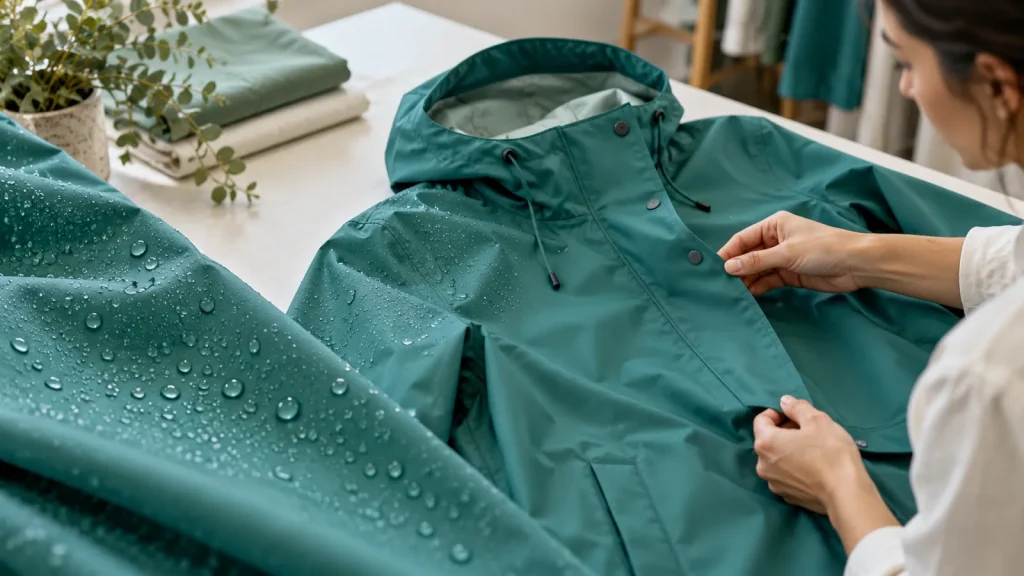
Distinguish surface repellency from resistance to penetration
Water beading is visually persuasive, which makes it especially important to describe it accurately. AATCC’s explanation of water repellency testing describes TM22 as an assessment of resistance to surface wetting. AATCC’s TM127 scope addresses resistance to water penetration under hydrostatic pressure and notes that results may differ from rain or spray methods. These are different questions. A photograph of droplets or a favorable spray result should not be presented as complete proof of a finished raincoat’s waterproof performance. The buying team needs to understand the scope of the evidence before translating it into a product claim.
Start the evidence discussion with the wording the brand intends to use. Write the proposed claim in a separate column beside the product and intended use. Ask the technical reviewer which observations, tests or other information are appropriate to support it. This reverses an unhelpful habit of collecting whatever reports happen to be available and then inventing a claim that sounds related. The evidence should be selected for the actual question. If the proposed wording is broader than the available support, revise the claim or obtain the missing evidence before it reaches a hangtag, listing or sales presentation.
Read the identity details of a report before concentrating on the result. Confirm what was tested, how it relates to the proposed construction and which preparation or conditioning is described. A report on an unidentified fabric cannot simply be assigned to any coat with a similar appearance. Ask the supplier to explain the connection and provide the relevant references. This is an evidence-management task rather than a judgment based on how official the document looks. The buyer should be able to trace the reported result to the material or garment version under consideration without filling gaps through assumptions.
Keep test methods and units visible when comparing proposals. Two values may not be meaningfully comparable if they come from different procedures or conditions. Ask a qualified reviewer to interpret the differences instead of ranking products by the largest number. The same restraint applies to results collected before and after specified care or use-related conditioning. Identify which state of the product the statement describes. A carefully worded claim can communicate useful information without implying that a single laboratory result predicts every combination of weather, activity, wear, maintenance and construction encountered by the customer over the product’s life.
Use appearance demonstrations for the limited purpose they serve. A sample presentation can help a buyer discuss a surface or construction, but it should not be described as a certified test unless that is actually what it is and the documentation supports the statement. Keep development photographs and informal observations separate from formal reports. This distinction is particularly important in fashion rainwear, where strong imagery can make a product feel technically proven before the underlying questions have been answered. The brand can still present the design confidently while ensuring that its performance wording remains proportionate to the available evidence.
At approval, create a short claim record that identifies the exact wording, supporting evidence, relevant product revision and responsible reviewer. Make the approved language available to the people writing product pages and retail materials. If a component or construction changes, decide whether the claim record needs updating. This gives stylish waterproof jackets a more reliable technical story. The objective is not to burden the customer with every testing detail. It is to ensure that the concise language they see has a clear basis and does not collapse several different material or garment properties into one unsupported promise.
Review the finished garment rather than relying on a fabric report
A raincoat includes openings, joins and components that a fabric swatch does not contain. The buying team should therefore ask how the evidence plan addresses the finished design, not only the shell material. Identify the hood, front closure, seams, pockets and any decorative attachments that matter to the intended use and claim. Ask the responsible technical reviewer which parts need assessment and how that assessment should be carried out. The correct approach depends on the actual construction and market. Do not assume that a strong fabric result automatically settles every question about the garment assembled from it.
Map the proposed claim to the whole product. If the brand describes the coat broadly, consider whether the wording could imply protection through areas that have not been evaluated. A pocket or closure may need more precise language than the shell. Keep product features and protective promises distinct in the specification. For example, a covered pocket opening is an observable construction detail; a claim about keeping contents dry requires appropriate support. The buyer should make that distinction before the creative team begins writing, because polished copy can otherwise turn a modest design feature into a much broader customer expectation.
Use the final configuration for relevant checks. Temporary closures, missing labels or substitute linings can limit what a development sample demonstrates. Identify those differences in the sample record and decide which assessments remain necessary once the final parts are installed. The same applies to decoration: an added patch, label or printed area may require consideration in the complete construction. The purpose is not to suggest that every small feature causes a problem. It is to make sure the review concerns the garment the customer will receive, with changes assessed by the people qualified to judge their significance.
Ask the supplier and technical reviewer to distinguish design validation from routine production checks. A development assessment may establish that a proposed construction is suitable for the intended claim, while production inspection addresses whether the delivered goods follow the approved specification and agreed criteria. These activities are connected but not interchangeable. A well-made item can still lack support for an exaggerated claim, and a previously assessed design can still be produced inconsistently. The buying plan should address both questions in a proportionate way, with responsibilities and records clear enough to support the actual order rather than a generic quality statement.
Plan how issues will be investigated. If an assessment reveals a concern, identify the location, sample revision, method and conditions before deciding on a change. Ask whether the cause is design, material, assembly or an interpretation of the intended use. A targeted response is more useful than a general instruction to make the garment more waterproof. Any revised construction should be reviewed for its effect on appearance, fit and care as well as the original issue. Fashion rainwear development works best when technical corrections remain connected to the design rather than being applied as isolated fixes that alter the product unexpectedly.
Retain the resulting evidence alongside the approved sample and claim wording. Explain the product’s intended use and relevant limitations consistently to retail partners. Avoid universal phrases that erase those boundaries, such as protection in any weather, unless there is a defensible basis for such a broad statement. A premium brand does not need absolute language to communicate a considered product. It needs a clear relationship between design, intended use and evidence. Reviewing the finished garment gives that relationship substance and helps the buying team make decisions that remain understandable after the sample stage has ended.
Align technical claims across labels, listings and sales materials
A claim can become broader as it moves through a business. A technical note about a fabric may become a shortened line in a product description, then an enthusiastic phrase in a wholesale presentation. Establish one approved claim record before those materials are produced. Include the product revision, exact wording, supporting evidence and any conditions that need to accompany it. The goal is to keep the meaning stable across channels. A high-end rainwear range can have different tones of voice in different settings while still making the same factual statements about what the garment is designed and supported to do.
Review the complete message, not only isolated words. A headline, image and short caption can create an impression that exceeds the careful wording elsewhere on the page. Consider whether the presentation suggests extreme use, universal protection or a certification that the product does not have. Ask the responsible reviewer to assess the actual customer-facing material. Do not rely on a qualification hidden in another document to correct an overstatement in the main message. Clear, proportionate language is easier for both customers and retail partners to understand, and it gives sales teams a more useful foundation for answering questions.
Keep technical terminology consistent. If the approved description distinguishes water repellency from a broader water-resistance claim, preserve that distinction in translations and shortened copy. Do not allow synonyms to be substituted automatically where they may change the meaning. The same care applies to breathability, durability, recycled content and other attributes. Give copywriters a list of approved statements and a route for questions. That approach supports natural writing without asking every writer to interpret technical reports independently. It also helps prevent old wording from returning when a product page is copied as a starting point for a new style.
Make retail partner materials specific to the product. A general brand brochure may describe several capabilities or ranges, but those statements should not be assigned to every item by default. Provide the relevant fit notes, care information, composition details and approved claims for the exact style being supplied. If a partner needs a shorter description, review the shortened version for meaning. The buying team should also identify which images correspond to the actual product configuration. A photograph of a different closure or material can create confusion even when the written specification is technically accurate and the correct goods are delivered.
Manage updates when the product changes. If a new material, trim or construction affects an approved statement, identify all the places where the old wording appears. Update the current product information and tell the relevant partners which stock or revision is affected. Keep historical records privately so the business can understand what was supplied at different times. Do not quietly merge different versions under one technical description if their supported attributes differ. Traceability in marketing information is an extension of traceability in production: both help the team connect a statement to the product it actually describes.
Before launch, review the label set, packaging, product page and wholesale materials together. Look for contradictions, missing conditions and claims that have no owner or supporting reference. Resolve those points before approving publication or print production. This review should be focused enough to be practical and thorough enough to catch meaningful differences. Buyers of fashionable raincoats wholesale need a product story that their teams can repeat accurately. A controlled claim record lets the brand communicate with confidence because the attractive language, technical basis and delivered garment all refer to the same considered design.
Primary references: AATCC explanation of water repellency testing, AATCC TM127 hydrostatic-pressure scope.
Organize destination and evidence questions with the rainwear safety standards and compliance guide. Confirm the requirements for the specific product and intended market.
10 / 12
Support care, repair and specific sustainability choices
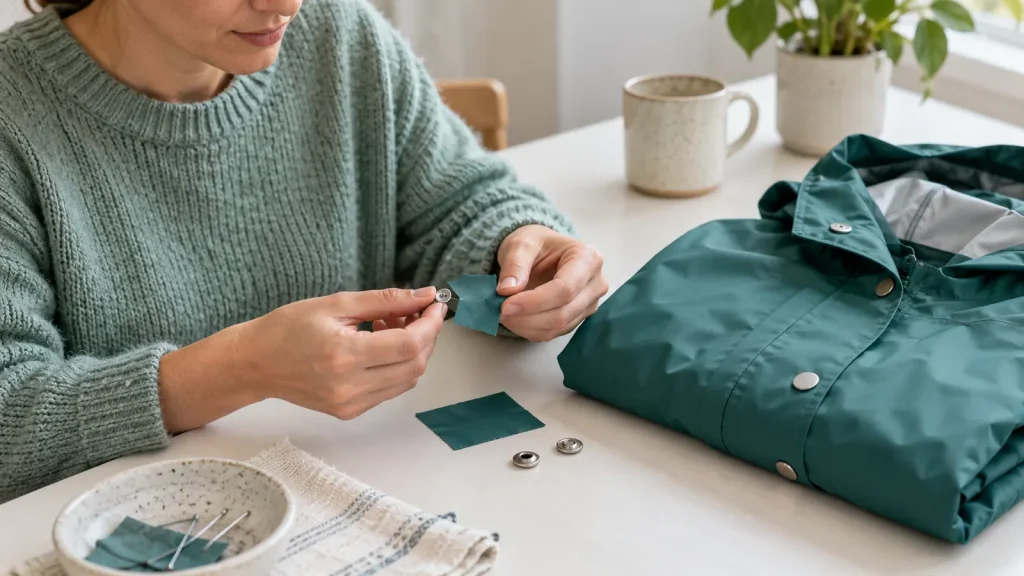
Write care guidance for the complete garment
Care instructions should be developed for the finished raincoat, including its shell, lining, decoration and trims. For covered products in the United States, the FTC’s care-labeling guidance explains the need for a reasonable basis for the instructions and describes requirements for care information. Scope and exceptions matter, so confirm the applicable requirements for the actual product and destinations with the responsible reviewer. Do not copy a care label from a visually similar coat and assume it applies. The approved procedure should have a defensible connection to the construction that the brand is placing on the market.
Bring care into development before the final label artwork is prepared. Ask the supplier what procedure is proposed, what evidence supports it and whether any part of the garment needs special consideration. The buying team should understand the implications for the customer’s routine. A care approach that is technically supportable may still be inconvenient for the intended use, prompting a design or material discussion. Treat that as a product decision rather than a problem for customer service to solve later. The brand has more room to improve the experience while construction choices remain open and samples can be revised.
Review the complete combination, not just individual components. A shell, lining and decoration may each come with information from their respective suppliers, but the assembled garment needs appropriate consideration. Ask the technical reviewer what additional assessment is necessary and how the evidence will be recorded. If the proposed care process changes the appearance or function in an unacceptable way, identify the cause and revise the design or guidance responsibly. Do not hide an unresolved issue behind vague language such as treat with care. The customer needs usable instructions that reflect the product, and the brand needs a clear basis for them.
Keep practical preparation advice consistent with the approved procedure. Retailers may ask how to address packing creases, display the garment or handle samples after use. Do not improvise heat, steam, washing or chemical-treatment suggestions based on general assumptions about the material. Route those questions through the same product knowledge used for the care label. If a preparation step is needed before presentation, confirm that it is supported and feasible for the receiving team. This prevents a gap between the carefully developed garment and the way it is handled by partners before reaching the customer or being shown in a showroom.
Check the clarity of the instructions with the intended audience in mind. The brand may sell in several markets or through partners who need translated information. Confirm the applicable language and presentation requirements, and use qualified review where necessary. Keep translations connected to the approved meaning rather than allowing a literal shortcut to change the procedure. The label’s placement, legibility and relationship to other product information also deserve attention. Good care guidance is both accurate and usable. It should not require the customer to search through contradictory messages on a hangtag, package and website to decide what to do.
When materials or decoration change, revisit the care record. A repeat order with a revised lining or branding process may need further assessment even if the silhouette remains the same. Identify the affected stock and update the relevant information consistently. This gives a premium rainwear program a more dependable after-purchase experience. The aim is to support ordinary ownership with specific guidance, not to imply that any garment will last indefinitely if the wearer follows a few generic tips. A clear care process respects the product’s actual construction and helps the brand answer questions without inventing advice after the order has already shipped.
Plan repair and replacement details before the first order
Repair support begins with a concrete service model. Decide what the brand intends to offer, who will perform the work and which parts of the raincoat can reasonably be addressed. A spare belt, a replacement fastening and a structural repair are different situations. Do not group them under an effortless repair promise without understanding the process. Ask the supplier and relevant technical people which components can be replaced, what information is needed and whether the work could affect the garment’s supported properties. The buying decision should reflect a service the brand can actually deliver to the intended customer.
Identify components that may need to remain available. A distinctive buckle or custom-colored snap can support the design but may be difficult to match later if its reference is lost or its supply changes. Keep component specifications and approved samples with the product record. Discuss availability and ordering conditions without assuming indefinite supply. The brand may choose a more accessible part where that better supports its service plan. Alternatively, it may retain a limited supply of specific components under an agreed arrangement. The choice should be based on the actual program, not on a broad claim that every repairable-looking design is inherently sustainable.
Consider access as well as parts. A component may be replaceable in principle but require specialist work to reach it without damaging surrounding layers. Ask the technical team to assess the intended method and any checks needed afterward. Do not publish do-it-yourself repair instructions without an appropriate basis for the exact construction. A rainwear product can have properties affected by how a seam or attachment is altered. The brand should know when to refer a customer to qualified service and how to explain the limits of what can be restored through the proposed work.
Create a straightforward intake process for customer questions. The team may need a style reference, size, color, purchase information and photographs of the issue. Collect only what is necessary for the service and handle personal information appropriately. Internally, connect the request to the product revision and relevant component records. This helps the brand distinguish an isolated issue from a recurring pattern that deserves a development review. It also prevents staff from offering inconsistent answers based on whichever sample or specification they happen to find first when the customer asks about a replacement or repair option.
Be precise about the language used in product information. If the brand offers replacement belts, say that within the actual terms of the service. Do not expand it into a claim that the entire coat is fully repairable. If a pilot repair arrangement is still being developed, keep it out of broad public promises until it is operational. A credible service statement should identify what is available and how the customer can access it. This approach can be communicated naturally without excessive technical detail, provided the internal process is clear and the public wording remains aligned with it.
Use repair feedback to improve future orders. If the same component repeatedly raises questions, investigate the design, installation, instructions and use context with the responsible team. A change may involve the component itself or simply clearer information. Keep the findings connected to the next development brief and sample review. Repair planning can therefore contribute to a better product program, but its environmental or lifetime benefits should not be quantified without suitable evidence. The practical value for a premium rainwear buyer is that ownership has been considered beyond the first delivery, with responsibilities and limits understood before the collection is launched.
Make environmental claims precise and supportable
Environmental language needs the same care as weather-performance language. The FTC’s summary of the Green Guides advises against broad, unqualified claims such as green or eco-friendly and calls for clear, specific qualifications. It also distinguishes recycled content from other environmental attributes. For a fashion rainwear brief, the practical starting point is to name the exact attribute being proposed, the part of the product it concerns and the evidence available. Confirm the applicable requirements in each intended market. A material choice should not automatically become a broad statement about the entire garment’s environmental impact.
If a supplier proposes recycled content, ask which component contains it and how the stated amount is documented. Keep the shell, lining, trims and packaging separate in the evidence record. A claim about one part should not imply that every component has the same attribute. Ask how the information relates to the proposed production order and whether changes in sourcing require another review. The buying team does not need to turn a product page into a technical dossier. It needs enough reliable information behind the scenes to write a concise statement that accurately describes the actual product being supplied.
Avoid treating a certification logo as a substitute for understanding scope. If a certification is proposed, verify what it covers, which product or supply-chain stage it relates to and whether the intended use of the mark is authorized. Route those questions to the appropriate reviewer. Do not invent a certification or imply that a supplier’s general credentials certify every garment. The same restraint applies to claims about chemical absence, biodegradability or recyclability. Each needs its own basis and context. A fashion brand can choose a specific material attribute without claiming that it resolves every environmental question associated with the finished raincoat.
Consider the operational choices the brand controls. A focused assortment, a realistic order plan, suitable packaging and a workable care or service process can all be meaningful topics for internal improvement. Evaluate them on their actual merits without automatically attaching an environmental saving. If the team wants to make a comparative claim, define the baseline, boundaries and evidence before publishing it. Do not infer a percentage benefit from a simple change in packaging appearance or material name. The procurement discussion can still be useful when it identifies a practical improvement whose wider environmental effect has not been quantified.
Make end-of-use statements specific to the actual route. A garment may combine materials and components that complicate handling, and local facilities or programs may differ. Ask what collection or processing option is genuinely available to the intended customers before promising an outcome. If the brand operates a take-back program, describe its real scope and process rather than suggesting that collection alone proves recycling. Keep the public message connected to what happens after the item is returned. This discipline helps avoid a gap between an appealing story and the service or infrastructure that would be needed to support it.
Before approving environmental copy, place the proposed statement beside its supporting record and the final product configuration. Check whether the wording remains accurate when read without the internal explanation. Remove broad implications that the evidence does not support, and retain clear qualifications where they matter. A premium rainwear brand can communicate specific progress in plain English without using sweeping labels. For wholesale buyers, that precision also improves supplier comparisons: the team can evaluate documented attributes, identify unresolved questions and make an informed decision instead of choosing between competing descriptions whose environmental meaning is unclear.
Primary references: FTC care-labeling guidance, FTC summary of the Green Guides.
Explore specific environmental evidence questions in our sustainable rainwear procurement guide.
11 / 12
Manage MOQ, Bulk Pricing and seasonal fashion rainwear delivery

Compare complete OEM Program proposals on the same basis
A useful supplier proposal describes a complete product and the work needed to deliver it. Send the same current brief to the suppliers you are evaluating, including the silhouette, material assumptions, size range, colors, branding, packaging and destinations. Identify which details are fixed and which remain open to recommendations. Ask suppliers to state deviations rather than quietly substituting their standard options. This gives the buying team a fairer comparison. Two offers for a rain trench may represent quite different garments, so the commercial discussion should begin with an understanding of what each proposal actually includes.
Clarify MOQ at the relevant levels. A minimum may apply to a total program, a style, a color, a material or a custom component. Do not assume that a quoted total can be divided into any combination the brand prefers. Ask how the proposed assortment affects feasibility and what alternatives might be available. The answer may lead to a more focused launch range or a different trim choice. Keep those decisions connected to the product brief. A lower minimum is not automatically a better fit if the available construction does not meet the brand’s intended design and use.
Discuss Bulk Pricing privately against a defined configuration. Ask what is included in the commercial basis, which development or tooling items are separate and what assumptions apply to packing and delivery. Do not publish unit-price comparisons in the article or treat an early estimate as a final commitment. The useful buying question is whether the proposals cover the same responsibilities and product requirements. A seemingly attractive offer can become difficult to evaluate if sample work, packaging or required information is omitted. Request clarification so the team understands the complete commitment before deciding which proposal to develop further.
Evaluate the supplier’s response to uncertainty. A capable proposal should identify questions, explain options and describe what needs to be confirmed through samples or technical review. Be cautious about treating immediate agreement with every request as proof of suitability. The buying team needs a partner who can communicate limitations clearly and follow an agreed change process. Ask how the supplier will maintain the approved material, components and artwork through production. Where claims about capabilities or credentials matter, request relevant evidence and verify its scope. Do not assume that a polished presentation establishes the ability to deliver the exact program.
Use a comparison sheet that separates product, process and commercial considerations. Product fields can cover fit, construction and presentation. Process fields can cover sample stages, communication, quality checks and change control. Commercial fields can cover the confirmed basis of the proposal and responsibilities. Weight these areas according to the brand’s actual priorities rather than creating a universal score. A supplier may be strong for one type of rainwear and less suitable for another. The goal is a reasoned choice for this program, with important uncertainties visible rather than averaged away in a single number.
Before moving forward, summarize the agreed next step. Confirm the sample brief, expected deliverables, approval responsibilities and any commercial terms that must be settled through the appropriate business process. Keep the communication specific enough that both sides can recognize completion. An OEM Program works best when creative intent and procurement discipline support each other. For a high-end brand, the right proposal is one that can turn the intended rainwear design into an approved, repeatable product under understood conditions. That decision requires more than comparing a material name or the first price indication in an email.
Control the color and size mix before committing inventory
An assortment becomes an inventory commitment when quantities are assigned to every style, color and size. Build that matrix deliberately. Start with the role of each product in the range and the information available from your own customers, channels and previous programs. Separate confirmed demand from estimates. A new rainwear category may have less direct history than an established apparel line, so avoid presenting an inherited size ratio as a certainty. Use the matrix to expose the decisions that need attention, especially where a small total is spread across many combinations with different supply constraints.
Consider whether every color belongs in every silhouette. A core shade may support several styles, while a more expressive option may be better developed for one focused product. The right structure depends on the brand, but the buying team should understand the effect on sampling, component matching and replenishment. Ask the supplier how the proposed mix interacts with material and trim minimums. Do not add variants simply because a digital range board makes them easy to display. Each live stock item needs identification, receiving, storage, product information and a decision about how it will be supplied again.
Keep size planning connected to the actual fit. A new silhouette may not behave like a previous coat even if it uses the same size labels. Review the intended wearer range, layering notes and size-set findings before finalizing quantities. If retail partners contribute forecasts, make sure they are using the current chart and product description. An estimate based on an earlier sample can become misleading after a fit change. The buying team should identify those changes and refresh the relevant assumptions rather than treating the first quantity sheet as fixed regardless of what development reveals about the finished garment.
Plan for uncertainty without inventing a universal buffer. The appropriate stock decision depends on demand evidence, replenishment options, storage, financial limits and the brand’s tolerance for missed availability or carryover. Compare plausible scenarios using your own information. Ask what happens if one color performs differently from expectations or if a size needs replenishment before the rest of the range. Discuss whether the supplier can support the required repeat structure and what conditions would apply. A realistic plan acknowledges constraints instead of promising that a future reorder will solve any imbalance regardless of lead time or component availability.
Make identification clear from the garment to the carton. Assign consistent references for style, color, size and revision, then carry them into packing lists and receiving instructions. Decide whether cartons contain single combinations or agreed assortments. If mixed cartons are used, specify the contents and labeling so the receiving team can allocate stock without unnecessary handling. These details may seem removed from fashion design, but they affect how quickly the approved product becomes available to partners. A well-designed coat can still create operational friction if its size and color information is unclear at the point of delivery.
Review the first delivery and subsequent feedback before expanding the assortment. Look at availability, fit questions, returns, presentation and partner comments alongside sales information. Avoid assuming that a slow-moving option failed because of design alone; timing, distribution and stock mix may also matter. Use the findings to refine the next order rather than simply adding more choices. For fashionable raincoats wholesale, a controlled matrix helps the brand preserve attention for the product and the customer. It connects the creative range plan to quantities that the business can manage, explain and replenish under the agreed supply conditions.
Protect the launch with clear packing and delivery milestones
Work backward from the date the rainwear must be usable by the receiving team or retail partner. That date is more specific than a general launch month. Identify the time needed for receipt, checks, allocation, presentation and any supported preparation of the garments. Then connect those activities to sampling, material approval, production, packing and transport. Ask the supplier to confirm its assumptions rather than assigning a universal lead time. A fashion rainwear program may contain custom components or artwork decisions that affect the sequence, and those dependencies should be visible before the brand commits its public launch plans.
Define the approval gates that control production. Identify which decisions must be complete before materials are ordered, decoration is released or bulk assembly begins. Assign an owner and a target response date for each gate. The brand should understand how late feedback can affect the plan, while the supplier should communicate emerging constraints promptly. This is more useful than a single final deadline with no explanation of what must happen first. A clear sequence gives both parties a way to discuss changes and prioritize unresolved questions without pretending that every delay can be recovered at the last moment.
Approve the individual packing method with the final garment. Check the fold, sleeve or pouch, labels and any inserts. Review how the product looks after unpacking and whether rigid components need particular positioning. Confirm that the packing approach supports the intended presentation without making unsupported claims about environmental benefit or protection. If the brand requires a specific handling procedure, put it in the approved instructions. Do not rely on a photograph of an early sample pack if the garment’s size, lining or hardware has changed. The packed production reference should represent the actual configuration being ordered.
Connect individual packs to carton and shipment requirements. Confirm the count, identification, dimensions and mass information needed for receiving and transport planning. Discuss any partner-specific requirements through the appropriate logistics process, and make responsibilities explicit. If several destinations are involved, identify which party controls allocation and how the documents will distinguish shipments. Avoid assuming that a supplier’s standard packing arrangement automatically suits every retailer or warehouse. The buying team should review the actual requirements early enough for them to be incorporated without a last-minute repacking exercise that disrupts the approved presentation or delivery plan.
Prepare a receiving check that is proportionate to the order. Identify who will confirm quantities, style and size mix, visible condition and relevant quality criteria. Make the approved references available before the shipment arrives. If an issue is found, record it clearly and follow the agreed communication route. Do not treat receipt as complete merely because cartons have reached the building. The launch depends on stock being identified, checked and available for its intended use. Planning that transition helps the brand distinguish transport arrival from operational readiness and reduces the chance of discovering an avoidable problem immediately before distribution.
After the first shipment, review the milestones against what actually happened. Note where information arrived late, where approvals were unclear and where packing or receiving instructions helped. Use those findings to improve the next order. Keep the conversation specific to the program rather than making broad claims about guaranteed delivery speed. A reliable fashion rainwear launch depends on several coordinated decisions, many of which sit outside the sewing operation itself. When the buying team makes those decisions visible, the supplier can respond more precisely and the brand can plan its presentation around a product that is truly ready to reach customers.
Build the order calendar with our seasonal rainwear inventory guide. For a separate event collection, Explore our Wholesale Festival Rain Poncho Collection Here and define its own distribution brief.
12 / 12
B2B FAQ: sourcing stylish rainwear for high-end brands

Can a fashion raincoat be both refined and practical in wet weather?
Yes, a refined appearance and practical use can be developed together, but neither follows automatically from the other. Start with a clear intended use, then choose the silhouette, material and construction to support it. A clean front can still include a considered closure; a distinctive shape can still be reviewed for movement and coverage. The important step is to evaluate the complete garment rather than assuming that a technical-looking detail proves performance or that a restrained design must sacrifice function. The brand should know what has been approved through samples and what claims are supported by appropriate evidence.
For a trench-style design, concentrate on the relationship between proportion and movement. The coat should be assessed with the intended layers, fastened and open where relevant, and across the sizes being offered. Review the hood, collar, pockets and hem as parts of one product. A cape or short jacket needs its own equivalent review rather than borrowing conclusions from the trench. These checks help the team preserve the fashion idea while identifying practical issues. They also make it easier to write useful fit and use descriptions because the brand has a specific reference for the experience it intends to offer.
Material selection should address both appearance and the technical brief. Ask how the proposed shell and any lining or coating behave in the intended construction. Compare full-size samples for drape, surface and handling, then obtain the appropriate information for the proposed performance language. Do not use a generic material name as a guarantee. The relevant question is how this construction, assembled in this design, supports the intended use. If an option creates a trade-off, decide which priority matters most to the brand and record the choice. That is a stronger development process than trying to maximize every attribute without acknowledging conflicts.
Be precise with customer-facing claims. Surface repellency, fabric resistance and finished-garment behavior should not be collapsed into one broad statement without suitable support. The brand’s technical reviewer should help define the evidence required for the actual wording and destinations. Once approved, keep that wording consistent on labels, product pages and partner materials. A premium presentation does not need absolute promises. It can explain the design’s intended role clearly, show the relevant features and provide practical care and fit information. Confidence comes from the connection between the product and its evidence, rather than from exaggerating what any one report establishes.
Consider a hypothetical brand developing a minimal hooded coat for everyday urban wear. It may choose a restrained shell, a covered front and discreet pockets, then refine the sleeve and hood through sample reviews. The result could meet the brand’s visual goals while becoming easier to wear than the first prototype. That example describes a development route, not a guarantee of a specific outcome or a claim about an existing company product. The exact solution depends on the materials, construction, intended use and evidence available. The buyer should use the process to ask better questions of the supplier and technical team.
The practical answer is therefore to develop both sides of the brief from the beginning. Do not finish the styling first and ask production to add performance afterward, or select a technical shell and assume the fashion details will resolve themselves. A coordinated sample program gives each decision room to improve the others. Buyers sourcing stylish waterproof jackets can request a proposal that explains the silhouette, fit, construction, branding and evidence plan together. That provides a clear basis for discussing MOQ, an OEM Program and Bulk Pricing once the intended product has been defined in a way both parties understand.
What should a brand prepare before requesting custom rainwear samples?
Prepare a concise product brief that explains the customer, intended use and place of the rainwear in the collection. Include original sketches or clearly annotated references that identify the design features you want to develop. State the desired silhouette, approximate proportions, layering intent and proposed size range. If materials are not yet selected, describe the qualities you want to assess and ask for suitable options. A supplier can work with an exploratory brief, but it needs to know which decisions are open. The more clearly uncertainty is described, the more useful the first sample proposal is likely to be.
Add a feature map covering the hood, collar, closure, pockets, cuffs and any adjustable or removable elements. Identify which features are essential to the design and which alternatives the brand would consider. Provide relevant color references and explain the desired relationship between shell, lining and hardware. Do not expect a mood board alone to communicate those details. If the brand has a fit block or measurement reference it is authorized to share, explain how it should be used. Keep body measurements, garment measurements and size labels distinguishable so the supplier does not have to infer the intended fit system.
Prepare the branding information at an appropriate level of maturity. Supply authorized artwork, proposed placements and dimensions where known. If the decoration method remains open, ask the supplier to recommend options for the actual substrate and explain the sample checks required. Identify the label and packaging information that will need separate technical or compliance review. Avoid sending multiple unmarked versions of the same artwork. Even at an early stage, a simple revision system helps the supplier understand which files are current and prevents a sample from being made with a design the brand has already replaced internally.
State the destination markets, planned distribution channels and proposed performance language. These details help the responsible reviewers identify the evidence and information needed for the actual product. Do not invent target values simply to make the brief appear complete. If the team needs technical advice, name the question and request a recommendation with its basis. The same applies to care and environmental attributes. A useful sample brief distinguishes established requirements from claims or features still under consideration, so the first prototype is not interpreted as approval of statements that have not yet been assessed for the proposed construction.
Give the supplier enough commercial context to propose a feasible sample route. Describe the intended assortment, approximate program scale where available and the date by which the product needs to be ready for use. Ask how MOQ applies to the proposed combinations and what assumptions affect the development sequence. Clarify the purpose of the first sample and the expected output: for example, silhouette review, fit assessment or a production-relevant decorated sample. This does not require publishing unit prices or making a premature order commitment. It creates a shared basis for discussing the work, responsibilities and next decisions.
Finally, identify who will review the sample and how feedback will be consolidated. A supplier should receive one clear response rather than conflicting comments from several departments. Use a structured list of observations, decisions and open questions tied to the sample revision. Keep approval scope explicit. The first sample may advance the design without being ready for bulk production, and that is a normal part of development. A well-prepared brand gets more value from sampling because each parcel has a purpose, each review closes defined questions and the resulting specification becomes more precise as the program progresses toward a fully approved rainwear product.
How do we choose a supplier for a repeatable premium rainwear program?
Choose a supplier against the requirements of the actual program, not a general impression of size or prestige. Begin with the proposed garment, material, construction, branding and delivery model. Ask the supplier to explain how it would develop and produce that combination, what information it needs and where it sees unresolved questions. A useful response is specific enough to test through samples and documents. Do not assume that experience in one rainwear category proves suitability for every fashion silhouette or finish. The buying team should evaluate the match between the supplier’s supported capabilities and the product it intends to place on the market.
Use the sample process as evidence of communication and execution. Notice whether the supplier follows the current brief, identifies substitutions and responds clearly to feedback. Ask for explanations when a proposed change affects appearance, fit or technical review. A sample that differs from the request is not automatically a reason to reject the supplier; an openly explained alternative may be valuable. The important distinction is whether changes are visible and controlled. A repeatable program depends on both parties understanding what was approved and how deviations will be addressed before they reach bulk production or a later reorder.
Review the quality and evidence process for the exact product. Ask how approved materials and components are identified, how production checks relate to the reference sample and what records will accompany the order. Where credentials or certifications are relevant, verify their scope rather than treating a logo as a blanket product guarantee. The responsible technical and compliance reviewers should assess the information needed for the intended claims and destinations. The buying team can then compare suppliers on a concrete basis: not simply whether they say quality matters, but whether their proposed process addresses the requirements that matter to this particular garment.
Clarify the commercial and operational structure. Understand MOQ by style, color and component, the basis of Bulk Pricing, sample responsibilities, packing requirements and delivery assumptions. Ask what a repeat order would require and which materials or trims may have availability constraints. Avoid assuming that a successful first order guarantees identical conditions indefinitely. A supplier that explains those limits gives the brand a better planning basis than one whose proposal leaves them hidden. Keep the final agreement and approval process clear through the appropriate business channels, with responsibilities specific enough to guide the work if circumstances change during development or supply.
Consider how the relationship will handle information over time. The brand should retain its approved drawings, artwork, specifications and sample records. The supplier should know which revision controls the order and how changes will be authorized. If staff change on either side, the program should remain understandable from those records. This is especially important for a premium product whose character depends on several subtle details. A different lining feel, hardware finish or pocket position may be noticeable even when the overall silhouette looks similar. Repeatability comes from preserving the important decisions, not merely reusing the same style name on a purchase document.
Start the conversation with a complete brief and a clear next step. Share the intended silhouettes, size and color matrix, branding scope, destinations and unresolved technical questions. Request a proposal that explains the sample route and the information needed to confirm feasibility. Then evaluate the response through the agreed process rather than expecting certainty before the product has been developed. A strong fashion rainwear program grows from this combination of original design, practical review and controlled supply decisions. The supplier choice should support that work, giving the brand a credible route from an attractive concept to an approved garment it can present and reorder with consistency.
Return to the industry rainwear buying guide or prepare supplier questions with our guide to sourcing rainwear from China. If your brand also supplies visitor venues, compare the operating needs in our theme park and tourism rainwear guide.